BLANTYRE-(MaraviPost)-The Ministry of Homeland Security announced on January 1, 2026, that President Professor Arthur Peter Mutharika has granted pardon to 222 prisoners as part of the 2025 Christmas and New Year festive season amnesty.
The release was authorized under Section 89(2) of the Constitution of the Republic of Malawi, which empowers the President to exercise clemency.
In the official statement issued from Capital Hill, Lilongwe, the Ministry said the amnesty targets qualified prisoners who have served half of their sentences.
The beneficiaries include convicted prisoners, the elderly, female inmates, and those who are chronically ill.
The move is intended to provide relief during the festive season and reflects the government’s humanitarian approach to justice.
President Mutharika’s decision aligns with traditional holiday practices in Malawi, where seasonal pardons are used to decongest prisons and offer second chances to eligible inmates.
The general amnesty is also seen as a gesture of compassion toward vulnerable groups within the correctional system, such as the elderly and sick, who may face heightened health risks in prison environments.
The Ministry emphasized that the presidential pardon is part of ongoing efforts to balance justice with mercy, encouraging rehabilitation and social reintegration of former offenders. While the release reduces prison populations temporarily, authorities have assured that public safety will be maintained by focusing on prisoners who have demonstrated good behavior and met legal criteria for early release.
This year’s amnesty follows similar festive pardons in previous years, which have been praised for promoting national unity and humanitarian values during holiday celebrations.
The government hopes the gesture will inspire community support for reintegrating released individuals into society, reducing recidivism through rehabilitation programs.
The announcement has been welcomed by human rights groups and civil society organizations in Malawi, who view the amnesty as a positive step toward prison reform and humane treatment of inmates.
However, some legal experts have called for broader systemic reforms to address overcrowding and conditions in Malawi’s correctional facilities beyond seasonal measures.
The presidential amnesty will be implemented immediately, with the Ministry of Homeland Security coordinating the release process to ensure smooth transitions for the affected prisoners.
Share this:
Like this:
LikeLoading…
Discover more from The Maravi Post
Subscribe to get the latest posts sent to your email.
The birth of Jesus Christ stands as the cornerstone of Christian faith, a symbol of hope, renewal, and divine love.
Yet, despite centuries of tradition, the exact date of His birth remains shrouded in mystery. While December 25 has been globally embraced as Christmas Day, historical and biblical scrutiny reveals that this date was likely chosen for reasons beyond historical accuracy.
The early Christian church, in an effort to harmonize with prevailing pagan festivals such as the Roman Sol Invictus, selected December 25 in the 4th century as the official date to honor Christ’s birth.
However, mounting scholarly evidence suggests that Jesus was more plausibly born in the spring months of March or April, when shepherds were tending to their flocks in the fields—an unlikely scenario in the cold of December.
This revelation invites a profound reconsideration—not only of historical tradition but of the socioeconomic impact the December celebration has on millions worldwide, especially in developing countries like Malawi.
It is time to advocate for a shift of Christmas celebrations from December 25 to a date in March or April, aligning both with probable historical accuracy and, crucially, with the economic welfare of people burdened by the current festive calendar.
December and January represent a relentless financial strain on households. Within a span of just a week, families engage in two major celebrations: Christmas on December 25 and New Year’s Day on January 1. While these events bring joy and hope, they also entail significant expenditures on gifts, food, travel, decorations, and community engagements.
For many, especially those in economically vulnerable contexts, this season results in near depletion of personal savings and credit, forcing them into debt or financial hardship that lasts well into the new year.
In Malawi, for instance, January is notoriously challenging. After the December festivities, many families enter the new year with “empty pockets,” having exhausted their resources. Yet, this is precisely the time when critical expenses arise.
School fees for the new academic term become due, pressing the finances of parents and guardians who have little to no buffer. Simultaneously, the agricultural calendar demands investment in inputs such as fertilizers to ensure a productive planting season.
Fertilizer is not a luxury but a necessity for food security and economic stability in largely agrarian societies. The timing of these costs compounds the hardship caused by the festive spending spree.
The consequences are stark: January frequently becomes a month of hunger and hardship, a period when many struggle to meet basic needs because resources have been misallocated or stretched too thin in the preceding weeks.
This cyclical pattern of financial distress undermines household stability, community resilience, and national economic progress.
Shifting the Christmas celebration to March or April, therefore, offers a compelling solution. Biblically, this period is more consistent with the narrative of Jesus’ birth. Luke 2:8 describes shepherds watching their flocks by night—a practice more aligned with springtime pastoral activity than with the chill of winter.
Additionally, aligning Christmas with these months would distribute the year’s major celebrations more evenly, relieving the intense financial pressure concentrated at the year’s end.
An international transition to a springtime Christmas would allow families to allocate their resources more sustainably.
December could then be devoted solely to New Year’s festivities, a widely secular celebration that marks renewal and fresh beginnings.
This cultural shift would provide a breathing space between major spending events, enabling households to recover financially and plan better for the year ahead.
Moreover, celebrating Christmas in March or April would coincide more naturally with the agricultural cycle in many parts of the world, including Malawi.
This period often marks the end of the rainy season and an important phase before the main planting season.
Festivities during this time could foster communal solidarity and optimism as farmers prepare for the new agricultural year, creating a spiritual and social boost that aligns with practical economic rhythms.
The historical flexibility of Christmas’s date offers a unique opportunity for global communities to reimagine their celebrations in ways that enhance both spiritual meaning and economic well-being.
The original intent of Christmas—to commemorate the arrival of Christ, the “light of the world” (John 8:12)—holds true regardless of the calendar date. What matters most is the spirit of hope, generosity, and renewal that the occasion embodies.
Internationally, the move to shift Christmas would require careful dialogue and consensus-building among religious leaders, governments, and communities.
Yet, the benefits—reducing the financial stress on millions, improving educational outcomes by easing school fee payments, and bolstering agricultural productivity through timely investment—are profound and far-reaching. The biblical principle of stewardship reminds us to wisely manage resources and care for one another (1 Peter 4:10).
Adjusting the timing of Christmas celebrations to promote economic sustainability aligns with this principle and reflects a compassionate, practical response to contemporary challenges.
While tradition holds deep emotional and cultural significance, it should not become a barrier to necessary progress.
Recognizing that December 25 was historically selected for convenience rather than accuracy opens the door to a transformative change.
By shifting Christmas to March or April, communities—especially those in economically vulnerable settings—can alleviate the heavy financial burden that currently shadows the holiday season.
This change promises a more balanced festive calendar, fostering economic resilience, social cohesion, and a renewed celebration of Christ’s birth that is both historically informed and compassionately grounded in the realities of everyday life.
LILONGWE-(MaraviPost)-As part of her Christmas celebrations, Vice President Jane Ansah visited patients at Nkhoma Hospital in Lilongwe, showing her commitment to uplifting patients during the festive season.
Ansah praised the hospital for helping diverse individuals seeking treatment, highlighting its vital role in healthcare.
She named the first Christmas baby born at the hospital “Jane” – Levinesi Sikonda, adding a personal touch.
However, Ansah expressed concern over maternal deaths at the hospital, where eight mothers died this year compared to one last year, pointing to issues.
Meanwhile, Hospital Director Victor Moyo said despite the hospital’s progress, lack of resources and staff shortages are challenges, highlighting obstacles faced.
Moyo’s comments underscore the hospital’s struggles amid VP Ansah’s visit.
The Vice President’s actions reflect compassion and leadership, touching lives at Nkhoma.
Dr. Ansah’s visit aimed to uplift patients and staff, blending care with governance.
The hospital’s story includes both progress and challenges, as shared by its leader.
Her “Jane” gesture to the newborn symbolizes hope amid healthcare discussions.
Share this:
Like this:
LikeLoading…
Discover more from The Maravi Post
Subscribe to get the latest posts sent to your email.
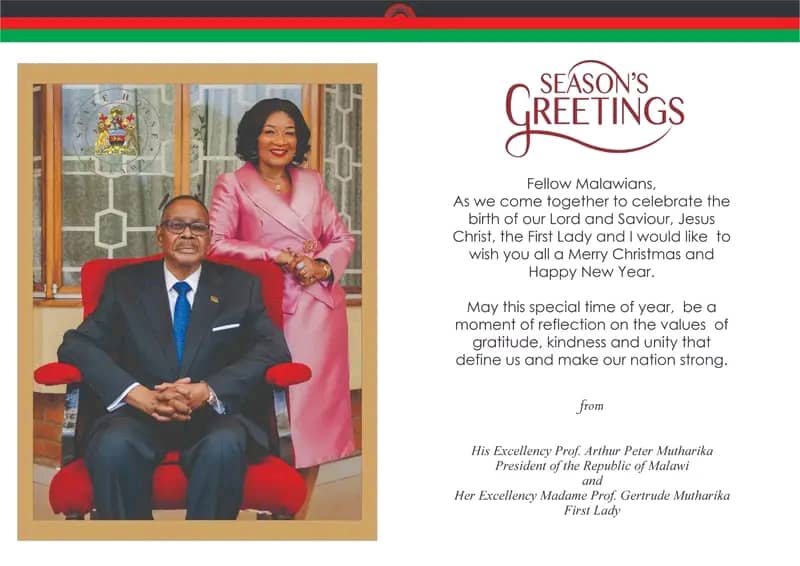
LILONGWE-(MaraviPost)-President Peter Mutharika has offered message of hope to Malawians as they celebrate Christmas and New Year.
In a festive season message to the nation, we have seen the Malawi leader called for citizens to celebrate responsibly.
The President therefore disclosed that will spend the festive season with his family within the country.
Mutharika also extends a heartfelt message of hope, unity, and resilience to all Malawians.
He calls upon citizens to celebrate responsibly, while remembering those who continue to face hardships within our communities.
He therefore urges the nation to uphold peace throughout the festivities and “To welcome the new year with renewed dedication to hard work and patriotism as we, together, continue the journey of rebuilding our nation”.
President Mutharika has described 2025 as the “Year of Rescuing the Nation.”
He acknowledges that it has been a year of profound transition, marked by the challenges of the 4Fs: shortages of Food, Fuel, Forex, and Fertilizers.
Since assuming office in October after September elections victory, Mutharika has devoted his focus and energy to addressing the systemic challenges facing our country.
The President therefore looks to 2026 with great expectation and determined to restore economic stability and uplift the living standards of every Malawian.
Share this:
Like this:
LikeLoading…
Discover more from The Maravi Post
Subscribe to get the latest posts sent to your email.