


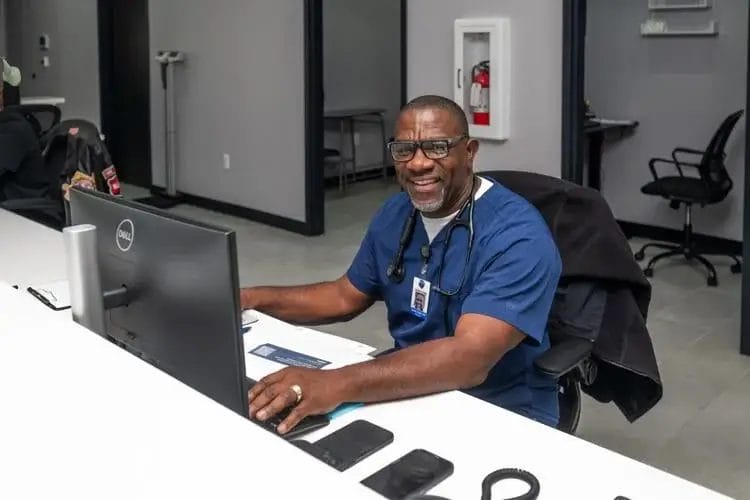

By John Clark Herald correspondent
Dr. Lincoln Coffie remembers the day back in his native Jamaica when his life changed forever.

It was 1989 and he was a senior in high school, living with a foster family since his father died when he was 13 years old. There was a school trip to Miami, Florida, coming up and his foster parents sat him down and told him that when the trip was over, they were going to arrange for him to stay in the U.S. instead of coming back to Jamaica.
“In Jamaica, the students would go to Miami every year to compete in different sporting activities. I came up to do the shot put and discus. The family I was living with had three children and they pretty much said, ‘We’re going to send you on this trip, but we don’t have plans for your future, so just don’t come back. There’s really nothing here for you after you graduate school in a few months.’
“One of their sons was the same age as myself, and they would have had to try and send two boys to college. They said they would try and coordinate with some family (members) I had in America to come pick me up from the school trip. I had an aunt and uncle living in New York, and there was an aunt in Florida.
“The way I saw it then was they were trying to help my future. The way they put it to me, I didn’t feel like they were doing me a disservice. I didn’t think it was vindictive or anything like that. I knew they were doing something to try and help me, instead of putting me out of their family. I was looking forward to what was ahead of me … my future. I would have been on the streets in a couple months after I left school because there was no plan for me. So this was my way to have some kind of future.”
Coffie wound up going to live with an aunt and uncle he had never met who lived in New York City. They drove down and picked him up from Miami, took him home and put him to work.
“I didn’t know what was happening,” Coffie said. “I had never been in America before. I just knew I couldn’t go back to Jamaica.”
It was a difficult situation for the youngster. He worked in construction for a while and finished high school but found himself facing homelessness after going to work at a cousin’s mechanic shop.
“I remember my first paycheck as a construction worker … my aunt held the money for me, even though I didn’t know it would be indefinitely,” he said. “I never got that money back, and several other paychecks.
“I didn’t have any I.D. — my teacher had held onto my passport — so I couldn’t start school. I was finally able to get some school paperwork from Jamaica and got my passport back from the teachers. It was a big deal to get that back. Then I started back to school in 10th grade at James Monroe High School in the Bronx.”
Still without a green card or Social Security number, he started working at a cousin’s mechanic shop in the south Bronx and also tried his hand at selling toys for a while on the city streets.
“Walking Queens Boulevard selling Sesame Street toys,” Coffie said. “One day, I came home and the feds had raided the house. They (his cousins) were selling heavy drugs out of the house (and) I didn’t even know. I was so naïve. Two weeks before
this happened, I had met this lady in Astoria, Queens, when I was selling toys on the street, and I ended up going to live with her and her two kids in the projects. I didn’t have anywhere else to go.
“I was able to save some money, and one of my aunts knew a lawyer in the Bronx and he got me a Social Security card for $1,500, and an American birth certificate. That was the first official (documentation) that I had. The Social Security number actually came from the Social Security office. I don’t know how he did it, but it came in the mail, and I still have that same number today. When I got my citizenship, they told me to keep it because it was legal and already in the system.
“Next, I got a driver’s license, so that’s when I started to work parking cars in Manhattan. That was my first job on the books.
“It was a big turning point for me. I still couldn’t travel to Jamaica, but at least I could get a job. I met a young lady when I was in high school, and she became my first wife and the mother of my first two sons. One is 31 now and one is 27. When I got married, she was the one who started the paperwork for my green card.”
The young couple got married in 1993. Two years later, Coffie had acquired his coveted green card, but his problems were not over just yet.
“We were not in a good place. Our marriage wasn’t going well,” he said. “I think the big challenge was that I couldn’t convince her that I was with her because I loved her. Her family was telling her I was only with her because of the green card.
“Now, the first phase of the green card is a two-year temporary, before you get the 10-year green card. If my marriage didn’t prove (to be) sound, I would have risked my green card (and having) the whole process reversed.”
Although he was now working legally as a parking garage manager in Manhattan, concerns over his marriage failing and possibly losing the temporary green card caused Coffie to circle the wagons and look for other options.
“I could stay in New York and risk everything falling apart, but if I went into the military, I felt like I would be taken care of, as far as my green card,” he said. “The military was like a safe haven for me to keep things together.
“My wife was OK with it because I was the breadwinner and with me being gone, she was going through financial stuff, too. At the end of the day, we got health insurance (and) she came down to Kentucky with me for basic training.”
In Monday’s Killeen Daily Herald, Dr. Coffie talks about joining the U.S. Army, using the G.I. Bill to go to college when he got out, graduating med school, and settling in Killeen, where he owns an urgent care clinic and other businesses.
Source: Killeen Daily Herald
Discover more from The Maravi Post
Subscribe to get the latest posts sent to your email.






