COP30: Broken Promises, New Hope — A Call to Turn Words into Action

Biodiversity, Climate Action, Climate Change, Climate Change Finance, Conferences, COP30, Economy & Trade, Energy, Environment, Featured, Global, Headlines, Indigenous Rights, TerraViva United Nations

Opinion

VICTORIA, Seychelles, Nov 25 2025 (IPS) – When the world gathered in Glasgow for COP26, the mantra was “building back better.” Two years later, in Sharm El Sheikh, COP27 promised “implementation.”

This year, in Belém, Brazil, COP30 arrived with a heavier burden: to finally bridge the chasm between lofty rhetoric and the urgent, measurable steps needed to keep 1.5 °C alive.


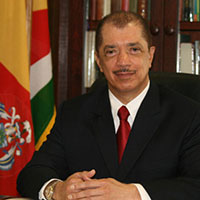
James Alix Michel

What Was Expected of COP30 were modest yet critical. After the disappointments of Copenhagen (2009) and the optimism sparked by Paris (2015), developing nations, small island states, Indigenous groups and a swelling youth movement demanded three things:

    1. Binding phase out timelines for coal, oil and gas.
    2. A fully funded Loss and Damage Facility to compensate vulnerable countries already suffering climate impacts.
    3. Scaled up adaptation finance—tripling the $120 billion a year pledge and ensuring it reaches the frontline communities that need it most.

However the negotiations evolved into a tug of war between ambition and inertia. Wealthier nations, still reeling from economic shocks, offered incremental increases in adaptation funding and a new Tropical Forests Forever Facility (TFFF) worth $125 billion, with 20 percent earmarked for Indigenous stewardship. The Global Implementation Accelerator—a two year bridge to align Nationally Determined Contributions (NDCs) with 1.5 °C—was launched, alongside a Just Transition Mechanism to share technology and financing.

However, the text on fossil fuel phase out remained voluntary; the Loss and Damage Fund was referenced but not capitalised; and the $120 billion adaptation pledge fell short of the $310 billion annual need.

But there were Voices That Could Not Be Ignored.

Developing Nations (the G77+China) reminded the plenary that climate justice is not a charity—it is a legal obligation under the UNFCCC. They demanded that historic emitters honor their “common but differentiated responsibilities.”

Island States(AOSIS) warned that sea level rise is no longer a future scenario; it is eroding coastlines and displacing entire cultures. Their plea: “1.5 °C is our survival, not a bargaining chip.”

Indigenous Peoples highlighted the destruction of Amazon and Boreal forests, urging that 30 percent of all climate finance flow directly to communities that protect 80 percent of biodiversity.

Youth — The Gen Z generation, marched outside the venue, chanting “We will not be diluted” demanding binding commitments and accountability mechanisms.

The Legacy of Copenhagen, Paris, and the Empty COPs –

I attended COP15 in Copenhagen (2009), where the “Danish draft” was rejected, and the summit collapsed amid accusations of exclusion. The disappointment lingered until Paris (2015), where the 1.5 °C aspiration was enshrined, sparking hope that multilateralism could still work. Since then, COPs have been a carousel of promises: the Green Climate Fund fell $20 billion short; the 2022 Glasgow Climate Pact promised “phasing out coal” but left loopholes. Each iteration has chipped away at trust.

COP30 was billed as the moment to reverse that trend.

And the result? Partial progress, but far from the transformational shift required.

Did We Achieve What We Hoped For?

In blunt terms: No. The pledges secured are insufficient to limit warming to 1.5 °C, and critical gaps—binding fossil fuel timelines, robust loss and damage funding, and true equity in finance—remain unfilled.

Yet, there are glimmers. The tripling of adaptation finance, the first concrete allocation for Indigenous led forest protection, and the creation of an Implementation Accelerator signal that the architecture for change exists. The challenge now is to fill it with real money and accountability.

Let us look at ‘What Must Happen Next’

    1. Full Capitalisation of Loss and Damage Fund
    – G20 nations must commit 0.1 % of GDP and disburse within 12 months.
    2. Binding Fossil Fuel Phase out – Coal, oil and gas with just transition financing for workers.
    3. Scale Adaptation Finance to $310 billion/yr
    – Re channel subsidies from fossil fuels to resilience projects.
    4. Direct Funding for Indigenous and Youth Initiatives
    – Allocate 30 % of climate finance to community led stewardship.
    5. Strengthen Accountability
    – Mandate annual NDC updates with independent verification and penalties for non compliance.

But for all this to become reality there must be a determined effort to achieve Future Actions.
We have watched promises fade after every COP, yet the physics of climate change remains unforgiving. The urgency is not new; the window to act is shrinking. But hope endures – in the solar panels lighting remote villages, in mangroves being restored to buffer storms, in the relentless energy of young activists demanding a livable planet.

Humanity has the knowledge, technology, and resources. What we need now is the collective political will to use them. Let COP30 be remembered not as another empty summit, but as the turning point where the world chose survival over complacency.

The future is not written; we write it with every decision we make today.

James Alix Michel, Former President Republic of Seychelles, Member Club de Madrid.

IPS UN Bureau


Social Media Influencer Christopher Blake Griffith Countersues Stefon Diggs

Not long after NFL star Stefon Diggs submitted a libel lawsuit against a social media influencer, the influencer is clapping back.

Christopher Blake Griffith, the content creator who accused Diggs of sexual assault over the summer, is filing a countersuit against the New England Patriots wide receiver, denying Diggs’ claims of libel, according to a report from TMZ on Friday, November 21.

Griffith claims Diggs “drugged and sexually assaulted” him in 2023 after a charity basketball game. Griffith alleged that Diggs and others went to a D.C. club that night before going to Diggs’ home afterwards, where he was assaulted by Diggs and others. In Griffith’s police report from 2023, he also claimed Diggs offered him candy that was “laced with drugs” without knowledge.

According to the TMZ report, when Griffith got to Diggs’ house after leaving the club, Diggs “exposed his penis to Mr. Griffith” and began masturbating. Griffith then allegedly told Diggs to “put his penis away” and when he walked to the door of Diggs’ house, the NFL star tried to kiss him.

NFL’s Stefon Diggs Sues Influencer Christopher Blake Griffin, Alleging Libel

The influencer then reportedly hid in Diggs’ bathroom for 45 minutes and was threatened by Diggs’ family when he left the bathroom. One week later, Griffith was allegedly assaulted outside of his Los Angeles apartment and suffered serious injuries.

On October 1, 2025, Diggs filed a libel lawsuit against Griffith, disputing his claims about what happened that night. According to Diggs, he went to his bedroom to wrap up the evening after the basketball game while his assistant asked Griffith to leave the house.

It was at this time that the alleged assault took place.

Over the summer, nearly two years after the alleged incident, Griffith took to social media to put Diggs under fire about what he claims happened that evening.

GettyImages-2243464372 stefon diggs sues influencer for libel
Stefon Diggs FOXBOROUGH, MASSACHUSETTS – OCTOBER 26: Stefon Diggs #8 of the New England Patriots leaves the field after the game against the Cleveland Browns at Gillette Stadium on October 26, 2025 in Foxborough, Massachusetts. (Photo by Maddie Meyer/Getty Images)

Griffith posted an Instagram story at the time, claiming the assault and tagging the footwear company Ugg and actress Sarah Jessica Parker in the post. (Both had participated in a campaign for Ugg).

The influencer said he was “disgusted” that the company hired Diggs for the campaign after he filed a police report from the May 2023 incident.

He also shared what he claimed was a copy of his police report in the August 2025 post, tagging the NFL and the Patriots in the post.

“Y’all gon let Aaron Hernandez 2.0 just run wild without penalty?” Griffith posted on his Instagram story, referring to the late tight end who was found guilty of first-degree murder in 2015 before dying by suicide while incarcerated in 2017.

“I’m aware that you’re aware & since we’re BOTH aware, let’s act accordingly.”

Stefon Diggs’ Ex Accuses Him of Trying to Silence Her Over Alleged Assault

In a statement obtained by multiple outlets, Griffith’s lawyer, Jake Lebowitz, denied Diggs’ claims that the events ever happened.

“Mr. Griffith is looking forward to showing the world in Court that regardless of the fairy tale fabricated by Mr. Diggs’ high-priced New York Lawyers, he is the victim of Mr. Diggs’ unwanted sexual advances and his brother’s violent attacks.”

Diggs recently welcomed a baby with his girlfriend, rapper Cardi B, the couple announced on Thursday November 13 via Instagram.


Discover more from The Maravi Post

Subscribe to get the latest posts sent to your email.

The Maravi Post

Evaluation Finds Food Systems Programs Deliver Results but Warns of Missed Transformation Chances

Asia-Pacific, Climate Change, Conferences, Development & Aid, Economy & Trade, Environment, Featured, Food and Agriculture, Food Systems, Global, Headlines, Sustainable Development Goals, TerraViva United Nations

Food Systems

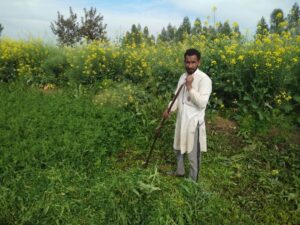
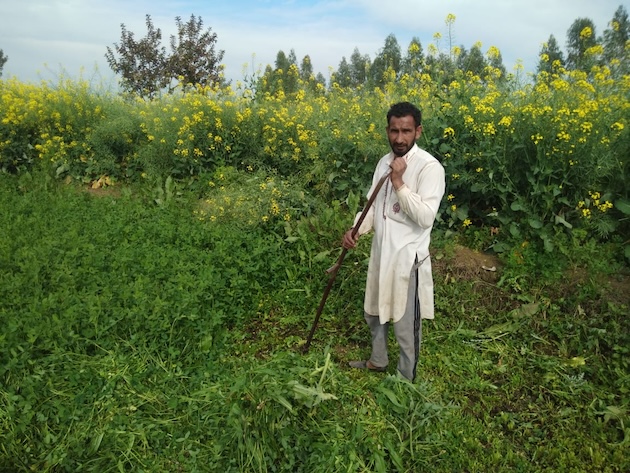
The Global Environment Facility’s food systems program found that its programs are highly relevant to global efforts to curb deforestation, land degradation, biodiversity loss and greenhouse gas emissions from agriculture, fisheries, and commodity supply chains. Pictured here is a farmer in Kashmir's frontier hamlet of RS Pura bordering Pakistan, farmers in this region have been affected by both climate change and conflict. Credit: Umar Manzoor Shah/IPS

The Global Environment Facility’s food systems program found that its programs are highly relevant to global efforts to curb deforestation, land degradation, biodiversity loss and greenhouse gas emissions from agriculture, fisheries, and commodity supply chains. Pictured here is a farmer in Kashmir’s frontier hamlet of RS Pura bordering Pakistan, farmers in this region have been affected by both climate change and conflict. Credit: Umar Manzoor Shah/IPS

WASHINGTON, D.C & SRINAGAR, Nov 21 2025 (IPS) – A new independent evaluation of the Global Environment Facility’s food systems programs says they are delivering strong environmental and livelihood gains in many countries but warns that a narrow focus on farm production, weak political analysis, and shrinking coordination budgets are holding back deeper transformation.


The Evaluation of GEF Food Systems Programs, prepared by the GEF Independent Evaluation Office for the 70th GEF Council in December 2025, reviews five major programs from GEF 6 to GEF 8. Together they cover 84 projects in 32 countries, backed by about USD 822 million in GEF finance and more than USD 6 billion in co-financing.

The report finds that the programs are highly relevant to global efforts to curb deforestation, land degradation, biodiversity loss and greenhouse gas emissions from agriculture, fisheries and commodity supply chains. They also respond to growing pressure on food systems as the world’s population rises and millions still lack access to healthy diets.

“Food systems are major drivers of global forest and biodiversity loss, land degradation, water pollution and greenhouse gas emissions,” the report notes. It says GEF funding has helped countries design more integrated approaches that connect environmental goals with farming, fisheries and rural development.

Results Most Visible at Community Level

During a webinar to launch the report, Fabrizio Mario Dante Felloni, Deputy Director of the Independent Evaluation Office, said the team had used a systemic lens, looking at the whole food system rather than isolated projects. The evaluation drew on document reviews, geospatial analyses, surveys, interviews, and case studies in Ghana, Indonesia, Peru, and Tanzania.

Felloni said the programs mark a clear shift from earlier, more fragmented efforts. They try to connect ministries and sectors that often work in isolation. “Because it was a food system, looking at the different sectors involved” was central to the design, he explained during the presentation.

The evaluation confirms that GEF food systems projects address several environmental pressures at once. Most initiatives target land and soil degradation, deforestation and biodiversity loss, often through better land use planning, sustainable farming practices, and stronger governance of coastal fisheries. Many projects also seek to link environmental gains with better incomes, skills for women and youth, and improved food security.

Results are most visible at the community level. The report highlights gains in biodiversity, improved land management and reduced emissions when farmers have adopted climate-smart or ecosystem-friendly practices. Socioeconomic benefits include higher yields and incomes, new skills for women, and greater youth engagement in agriculture.

At a meso level, some projects are improving value chains through better market access, traceability and basic processing support. At the macro level, the evaluation records progress on policies and governance, including multi-stakeholder platforms, land use and marine planning, and early steps toward aligning national and local policies.

Yet the evaluation also finds clear gaps. While more than 90 percent of projects focus on the production stage, only about 40 percent look seriously at postharvest issues such as storage, processing, transport and markets. Very few tackle food loss, waste or dietary change, even though these are critical for shifting entire food systems.

“Despite having an ambition to look at the food system and value chains, there was still a production-focused type of approach,” Felloni said. Environmental drivers and biophysical issues receive strong attention in design, but only 40 percent of projects examine the political context, and around 30 percent look closely at socioeconomic drivers.

That limited attention to political economy and social dynamics restricts transformational potential, the report argues. It notes that many designs assume that coordination and platforms will naturally lead to policy alignment, without fully analyzing power relations, trade offs or vested interests.

‘Coordination Budgets Are Shrinking’

Jessica Kyle of ICF, who led parts of the evaluation, told the webinar that private sector engagement has been a “key feature” of the food systems programs. Around two-thirds of country projects include some engagement with businesses, from public private partnerships and capacity building to support for national commodity platforms. At the global level, partners such as the International Finance Corporation have mobilized significant private finance for sustainable commodities.

However, she said scaling these efforts remains difficult. Fragmented supply chains, often weak regulatory incentives for sustainability, and unclear business cases are some of the challenges. Programs have also struggled to link global work on standards and finance with activities in country projects.

On the program approach itself, Kyle said the evaluation found real added value. Stronger program governance, shared design frameworks and knowledge pathways have improved the coherence of activities and allowed influence to extend beyond individual project boundaries. The programs have generated many knowledge products, trainings and learning events and have increasingly shifted from broad global exchanges to more targeted regional and commodity-focused dialogues.

Even so, the report finds “relatively limited evidence” that countries are applying this knowledge in a systematic way. Timing is one reason. In some cases, guidance arrived before projects were ready to use it. In others, knowledge products were not tailored to local needs, or project teams were reluctant to adjust activities mid-course.

To address this, the evaluation calls for stronger “country docking” so that global coordination projects can provide support when countries actually need it and in forms they can absorb. It also urges more participatory processes to identify country demands for technical assistance and learning.

A recurring concern is that coordination budgets are shrinking, even as the scope of programs widens. Coordination funding fell from about 10 percent of total program cost in GEF 6 food systems programs to around 7 percent in GEF 8, even though the number of countries and commodities grew. The report warns that this gap risks undermining the entire programmatic promise, since meaningful integration and tailored support require time, travel and staff.

The Catalytic Capital

Speaking for the GEF Secretariat, Peter Mbanda Umunay, thematic lead for food systems and land use, welcomed the evaluation and said many of its findings were already shaping the design of GEF 8 and early thinking on GEF 9. He described it as “one of the less contentious evaluations,” noting that the Secretariat agreed with most points.

Umunay traced the evolution from the first Integrated Approach Pilots in 2015, focused on resilient food systems in sub-Saharan Africa and commodity supply chains, to the FOLUR Impact Program in GEF 7 and the Food Systems Integrated Program in GEF 8. Over time, he said, the Secretariat has tried to tighten links between global coordination platforms and country projects and to use limited GEF funds more strategically as catalytic capital.

He highlighted efforts to promote “country docking” so that information and technical support flow more clearly between global hubs and national projects. The aim is to empower coordination platforms with enough resources and authority to structure strong connections with governments.

On private finance, Umunay said the evaluation had reinforced the case for using GEF resources to unlock much larger flows. By using GEF grants to de-risk investments or support blended finance, he argued, programs can shift perceptions that agriculture and land use are too risky for private investors and bring in both large companies and small and medium enterprises.

He also accepted the criticism that programs focus too much on production and not enough on postharvest value chains. This, he said, is now being addressed in GEF 8 and in plans for GEF 9, including through work on processing, storage, school meal schemes and nutrition outcomes, which can also bring in more ministries and strengthen policy coherence.

The evaluation ends with four main recommendations. It calls on the GEF to sharpen the focus of food systems programs and consider phasing them across replenishment periods so that countries can move from readiness and pilots to larger-scale investments over longer time frames. It urges a broader focus beyond production, especially on value chain integration and demand-side measures, where this can secure environmental and social gains.

The report also recommends deeper analysis of political economy and behavior change at design and during implementation and stronger country docking to turn knowledge and global services into real changes on the ground.

Umunay said the Secretariat had already prepared a management response and would use the findings to strengthen current and future programs. He stressed that the GEF remains country-driven. Governments must see these programs as supporting their priorities, from climate plans and food security strategies to rural development.

“We have been very successful in some countries that have continuously applied this program all across,” he told participants. “We will continue to do that, and this evaluation is eye-opening for the next steps.”

IPS UN Bureau Report


‘Future Shaped by Ocean-Based Innovations Within Reach’

Climate Action, Climate Change, Conferences, COP30, Global, Headlines, Latin America & the Caribbean, Ocean Health, TerraViva United Nations

Ocean Health


Oceans contribute to climate regulation by absorbing over a quarter of human-caused CO₂ emissions and around 90 percent of excess heat but attract only 1.7 percent of everything that’s invested in science.

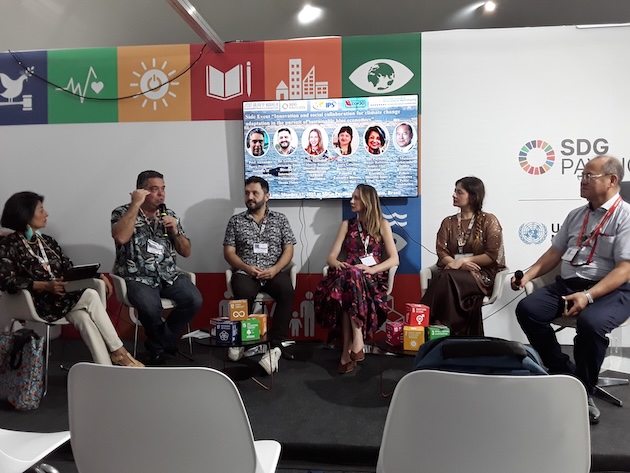
Moderators Masanori Kobayashi (far right) and Farhana Haque Rahman, Senior Vice President and Executive Director, Inter Press Service (far left), at a COP30 side event titled ‘Innovation and social collaboration for climate change adaptation in the pursuit of sustainable blue economies.’ Credit: Joyce Chimbi/IPS

Moderators Masanori Kobayashi (far right) and Farhana Haque Rahman, Senior Vice President and Executive Director, Inter Press Service (far left), at a COP30 side event titled ‘Innovation and social collaboration for climate change adaptation in the pursuit of sustainable blue economies.’ Credit: Joyce Chimbi/IPS

BELÉM, Brazil, Nov 20 2025 (IPS) – The oceans are a fundamental part of Earth’s climate system, regulating it by absorbing and storing vast amounts of solar heat, redistributing that heat around the globe through currents, and absorbing a significant portion of human-caused carbon dioxide (CO₂) emissions—yet scientific research into them remains underfunded.


Oceans contribute to climate regulation by absorbing over a quarter of human-caused CO₂ emissions and around 90 percent of excess heat. But COP30 participants heard during a side event titled ‘Innovation and social collaboration for climate change adaptation in the pursuit of sustainable blue economies’ that the amount of money invested in ocean science is only about 1.7 percent of everything that’s invested in science.

During the side event, Meredith Morris, Senior Director of Strategic Philanthropy (Planet) at XPRIZE spoke of opportunities to tackle humanity’s toughest challenges with bold, scalable breakthroughs. XPRIZE, she said, does its part by inviting the world’s brightest minds to turn audacious ideas into lasting impact for people and the planet.

Owned by the XPRIZE Foundation,  the nonprofit organization designs and operates large-scale incentive competitions.

It has supported numerous projects across various fields, including space exploration, carbon removal, global health, and education, by using large-scale incentive competitions to drive breakthrough innovations.

“I lead the portfolio around energy, climate, and nature. We are a 30-year-old incentivized prize model that sets a bar for the change we want to see in the world and incentivizes innovators to reach that bar or exceed it. We do not honor and celebrate work that’s already being done.

“At XPRIZE, what we’re trying to do is really catalyze systemic change.” Morris continues, “We believe in philanthropy, but we also believe it has to create value. And at the end of investing in doing something like protecting nature or addressing climate change, there should be viable businesses and industries on the other side of that.”

Moderated by Masanori Kobayashi, Senior Research Fellow of the Sasakawa Peace Foundation and Farhana Haque Rahman, Senior Vice President and Executive Director of Inter Press Service, the side event was an insight into life-transformative scientific projects that can only be born at the intersection between science and funding.

Haque Rahman spoke extensively of the urgent need to communicate science in a manner that helps connect with the places on the frontlines of the climate crisis. Masanori Kobayashi confirmed the need to amplify blue economy solutions, as raising awareness can and does lead to more action.

The XPRIZE Carbon Removal, a USD 100 million competition, incentivized the development of scalable solutions for removing carbon dioxide directly from the atmosphere or oceans. Winning projects included using enhanced rock weathering on farms to lock away CO₂ and technologies that permanently store CO₂ in concrete.

The Shell Ocean Discovery XPRIZE challenged teams to develop autonomous underwater technologies for rapid, high-resolution ocean floor mapping. The winning technology helped dramatically reduce the time estimated to map the entire ocean from centuries to just a decade.

Alexander Turra, Professor at the Oceanographic Institute of the University of São Paulo and head of the UNESCO Chair on Ocean Sustainability, based at the Oceanographic Institute and the Institute of Advanced Studies of the University of São Paulo, spoke about Brazil’s Oceans Without Plastics initiative.

Formally known as the National Strategy for a Plastic-Free Ocean, the initiative is a comprehensive, six-year plan (2025–2030) launched by the federal government to address marine pollution by targeting the entire lifecycle of plastics, from production to disposal.

The primary goal is to prevent, reduce, and ultimately eliminate plastic waste from entering Brazil’s marine and coastal environments. Brazil, with a vast Atlantic coastline, is a top-ten global contributor to marine plastic pollution, an issue that impacts biodiversity, human health, fishing, and tourism.

Also on the panel was Leonardo Valenzuela Perez, who serves as the Director of International Partnerships at Ocean Visions, where he leads the Global Ecosystem for Ocean Solutions. He spoke to participants about carbon removal at scale and the place of science in these efforts. What is needed is an unparalleled level of investment, mobilization of resources, and scale of action.

“We Colombians are the only country in South America with both the Pacific and Caribbean coasts, and we have various ecosystems as well as culturally diverse traditional peoples and communities,” said Laura Catalina Reyes Vargas, Founder and Executive Director of Ocean Hub.

“And, mostly, Afro-descendants and Indigenous communities on both coasts happen to be the poorest people in the country. It’s all about racism sometimes, economic inequality, infrastructure, poverty and lack of sanitation—it’s about almost all of the challenges that are being addressed throughout the 17 SDGs.”

“When it comes to the blue economy,” she continues, “We prioritize not only talking about scientific research. As a scientist myself, of course, I truly believe we will be able to address and understand the major steps needed to achieve not only the SDGs but also national plans with very high standards, as we have in Colombia.”

It was also crucial to address the regional organizational challenges.

COP30 has demonstrated a commitment to placing oceans at the center of global climate initiatives and announced the Task Force on Oceans earlier this week during a high-level ministerial meeting. Led by Brazil and France, the initiative integrates oceans into a global mechanism that accelerates the adoption of marine solutions in national climate plans —encouraging countries to set protection targets for the ocean when updating their NDCs.

IPS UN Bureau Report


Beyond Buzzwords: COP30’s Opportunity to Deliver on Sustainable Food Systems

Climate Action, Climate Change, Conferences, COP30, Economy & Trade, Environment, Food and Agriculture, Food Security and Nutrition, Food Sustainability, Food Systems, Global, Green Economy, Headlines, Natural Resources, Sustainability, Sustainable Development Goals, TerraViva United Nations

Opinion


In the midst of the COP30 climate talks, consensus will depend on recognizing that climate action and protecting livelihoods must advance together.

Delegates met at the Global Climate-Smart Agriculture Conference in Brasília before the COP30 climate talks. Credit: 2025Clim-Eat/Flickr

BELÉM, Brazil, Nov 20 2025 (IPS) – The language of agricultural sustainability changes like the seasons—from “climate-smart” to “regenerative,” “agroecological,” and “nature-positive.” Each term reflects good intentions, but the growing list risks duplication, confusion and delays.


The recent CSA Conference in Brasília gathered leaders from policy, science and finance ahead of COP30 to focus not on buzzwords but on the shared foundations of sustainable food systems, which is all the more important in the Grave New World. For all the various theories of change, many share the same principles of soil health, crop innovation, inclusive finance and resilient livestock production.

In the midst of the COP30 climate talks, consensus will depend on recognizing that climate action and protecting livelihoods must advance together. Leaders must challenge themselves to measure success not only in emissions reduced, but also in the quality of life sustained by a thriving and resilient rural economy. With Brazil’s COP presidency determined to accelerate agreements into action, the challenge now is to accept and advance context-specific approaches in pursuit of a shared goal.

At present, fragmentation continues to divide institutions, donors, NGOs and producers, with competing ideologies slowing progress toward sustainability at the speed and scale required. For example, while a vast number of organizations are currently backing the concept of regenerative agriculture, others tread the paths of sustainable intensification or climate-smart agriculture. But some of the practices, such as agroforestry, could fall under each of these concepts.

And the Koronivia Joint Work on Agriculture (KJWA), established prior to COP26, has been succeeded by Sharm el-Sheikh Joint Work on the Implementation of Climate Action on Agriculture and Food Security and yet farmers are still waiting for clear national strategies to emerge from years of workshops and working papers. While the principles underpinning these joint work programs are sound, they have not generated action at the speed needed.

On the other hand, the six CSA Conference themes—from soil health and crop innovation to finance and policy—offer a fundamental framework around which there is already much agreement and can deliver results under whichever buzzword it is categorized. The themes also reflect the priorities of Brazil’s Action Agenda and ABC+ Plan, highlighting practical areas of consensus.

Brazil’s experience offers tangible examples of how shared priorities can move from discussion to delivery. The ABC+ Plan (2020–2030) forms the backbone of the country’s low-carbon agriculture strategy, integrating sustainable practices like no-till farming, pasture recovery and biological nitrogen fixation into a coherent national framework. It represents a direct contribution to the COP30’s Action Agenda’s agricultural pillar, transforming abstract goals on soil health and productivity into measurable outcomes.

Building on this, Brazil’s RENOVAGRO is the financing arm that enables the implementation of the ABC+ Plan, demonstrating how public policy can activate private investment to move all Action Agenda ambitions forward together. By tying credit eligibility to verified adoption of low-carbon practices, the program allows farmers to commit to transitions that would otherwise be out of reach. This realizes the ABC+ Plan’s policy objectives and shows that progress depends not necessarily on new ideas, but on acting decisively on the systems that already work.

At COP30, the challenge is not to settle on the right language but to sustain the right actions—whatever this might look like according to local circumstances and resources. Progress depends on scaling what we already agree on: sound policies, accessible finance that doesn’t exclude vulnerable populations and resilient food systems that keep production within environmental limits. The next phase must prioritize implementation over invention.

Leaders have an opportunity to move from promises to performance. The task ahead is to scale what already works—not to define new concepts, but to deliver proven solutions faster.

Brazil’s example shows that integration works better than focusing on the continued search for a universal solution. There is no single path forward, only a combination of context-specific approaches bound by diplomatic agreement and sustainable financing.

By focusing on fundamentals, we can avoid the paralysis of competing definitions and begin to act collectively by applying the policies and practices we know work in ways that fit local realities.

Ana Maria Loboguerrero, Director, Adaptive and Equitable Food Systems at Gates Foundation
Dhanush Dinesh, Chief Climate Catalyst at Clim-Eat

IPS UN Bureau


Cold or Heat, A Disputed Roadmap to Leave Fossil Fuels Behind in COP30

Biodiversity, Civil Society, Climate Action, Climate Change, Conferences, COP30, Editors’ Choice, Environment, Headlines, Integration and Development Brazilian-style, Latin America & the Caribbean, Natural Resources, Sustainability, Sustainable Development Goals, TerraViva United Nations

Climate Change

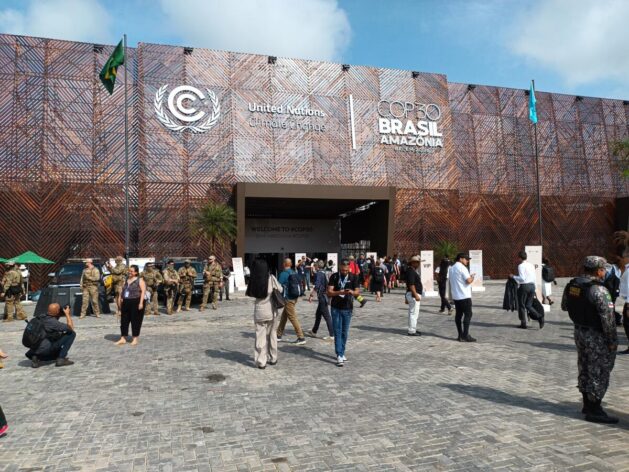
Entrance to the Hangar Convention Center of the Amazonia in the northeastern Brazilian city of Belém. The climate summit, which began on November 10 and is due to conclude on Friday the 21st, is debating issues such as the phase-out of fossil fuels and adaptation goals. Credit: Emilio Godoy / IPS

Entrance to the Hangar Convention Center of the Amazonia in the northeastern Brazilian city of Belém. The climate summit, which began on November 10 and is due to conclude on Friday the 21st, is debating issues such as the phase-out of fossil fuels and adaptation goals. Credit: Emilio Godoy / IPS

BELÉM, Brazil, Nov 20 2025 (IPS) – The heat in the Hangar Convention Center of the Amazonia, in the northeastern Brazilian city of Belém, has reached the negotiation rooms of the climate summit. Over the past 72 hours, one of the most delicate and significant discussions of this climate meeting has been taking place: the path to progressively abandon the production and use of coal, gas, and oil.


In recent hours, a global coalition of rich and developing countries, led by Colombia, has doubled down on pushing for a fossil fuel phase-out roadmap, while major producer countries resist it.

“The plan must have differentiated commitments, the elimination of fossil fuel subsidies, and the reform of the international financial system, because foreign debt payments are punishing us,” Colombian Environment Minister Irene Vélez explained to IPS.

For the official, the 30th United Nations Conference of the Parties (COP30) on climate change must result in a roadmap. “People are mobilizing, demanding climate action; we have to start now,” she urged.

In Belém, the gateway to the planet’s largest rainforest, it is no longer just about reducing emissions but about transforming the foundation of the energy system, thus acquiring a moral, political, and scientific urgency. What was initially meant to be the “Amazon COP” has mutated into the “end-of-the-fossil-era-COP,” but the roadmap to achieve it is a toss-up.

“The plan must have differentiated commitments, the elimination of fossil fuel subsidies, and the reform of the international financial system, because external debt payments are punishing us” –Irene Vélez.

Two years after the world agreed at COP28, held in 2023 in Dubai, to move away from fossil fuels, Belém is the moment of truth, upon which the effort to keep global warming below the 1.5° Celsius limit largely depends—a goal considered vital to avoid devastating and inevitable effects on ecosystems and human life.

Thus, the discussion among the 197 parties to the United Nations climate convention has shifted from the “what” to the “how,” and especially to the “when,” questions that have turned potential coordinates into a geopolitical labyrinth.

In that vein, a coalition of over 80 countries emerged on Tuesday the 18th to push the roadmap, including Colombia, Chile, Guatemala, and Panama among the Latin American countries.

One challenge for the roadmap advocates is that the issue is not explicitly part of the main agenda, a resource that the Brazilian presidency of COP30 could use to shirk responsibility on the matter.

The issue appears on the thematic menu of COP30, which started on the 10th and is scheduled to conclude on the 21st, and whose official objectives include approving the Global Goal on Adaptation to climate change and securing sufficient funds for that adaptation.

Approximately 40,000 people are attending this climate summit, including government representatives, multilateral agencies, academia, and civil society organizations.

An unprecedented indigenous presence is also in attendance, with about 900 delegates from native peoples, drawn by the ancestral call of the Amazon, a symbol of the menu of solutions to the climate catastrophe and simultaneously a victim of its causes.

Also present and very active in Belém are about 1,600 lobbyists from the hydrocarbon industry, 12% more than at the 2024 COP, according to the international coalition Kick Big Polluters Out.

The clamor from civil society demands an institutional structure with governance, clear criteria, measurable objectives, and justice mechanisms.

“The roadmap has become a difficult issue to ignore; it is already at the center of these negotiations, and no country can ignore it. The breadth of support is surprising, with rich and poor countries, producers and non-producers, indicating that an agreement is about to fall,” Antonio Hill, Just Transitions advisor for the non-governmental and international Natural Resource Governance Institute, told IPS.

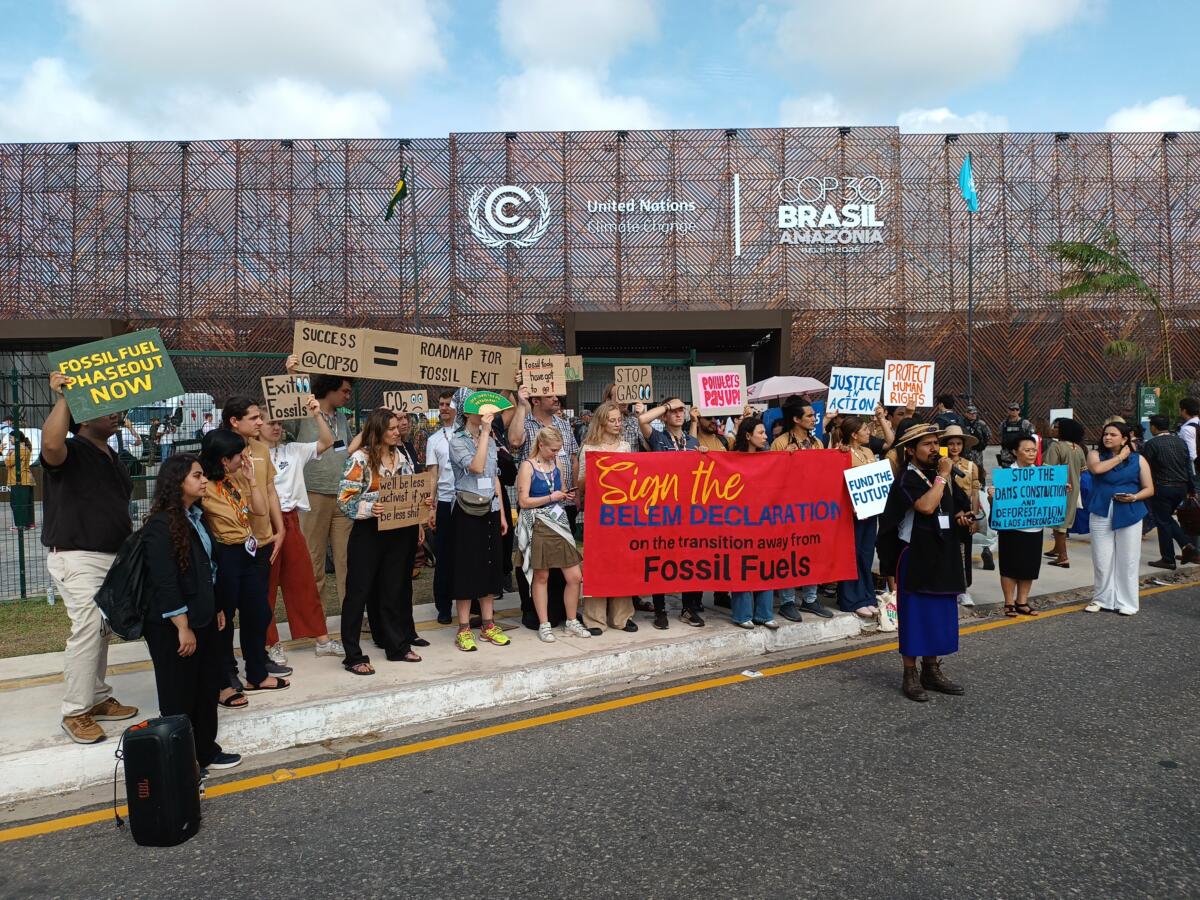
Activists protest on Wednesday the 19th against fossil fuel exploitation at the entrance to the venue of the Belém climate summit, in the Amazonian northeast of Brazil. Credit: Emilio Godoy / IPS

Activists protest on Wednesday the 19th against fossil fuel exploitation at the entrance to the venue of the Belém climate summit, in the Amazonian northeast of Brazil. Credit: Emilio Godoy / IPS

Poisoned

The push for the roadmap comes from the Fossil Fuel Non-Proliferation Treaty, promoted by civil society organizations, strongly adopted by Colombia, and which so far has the support of 18 nations, but no hydrocarbon-producing Latin American country, such as Argentina, Brazil, Ecuador, Mexico, or Venezuela.

Colombia, despite also being a producer and exporter of fossil fuels, has presented its Roadmap for a Just Energy Transition, with which it seeks to replace income from coal and oil with investments in tourism and renewable energy.

Colombia’s 2022-2052 National Energy Plan projects long-term reductions in fossil fuel production. The country announced US$14.5 billion for the energy transition to less polluting forms of energy production.

But for the rest of the region, the duality between maintaining fossil fuels and promoting renewable energies persists.

A prime example of this duality is the COP30 host country itself, Brazil. While the host President, Luiz Inácio Lula da Silva, and his Minister of Environment and Climate Change, Marina Silva, have insisted on the need to abandon fossil fuels, the government is promoting expansive oil and gas extraction plans.

In fact, just weeks before the opening of COP30, the state-owned oil group Petrobras received a permit for oil exploration in the Atlantic, just kilometers from the mouth of the Amazon River.

But Lula and his team committed that this summit in the heart of the Amazon would be “the COP of truth” and “the COP of implementation,” and the issue of fossil fuels has become central to the negotiations, which Lula joined on Wednesday the 19th to give a push to the talks and the outcomes.

In their Nationally Determined Contributions (NDCs)—the set of mitigation and adaptation policies countries must present to comply with the Paris Agreement on climate change signed in 2015 at COP21—Argentina, Brazil, Mexico, or Chile avoid mentioning a managed phase-out of fossil fuels.

Simply put, they argue they cannot let go of the old vine before grasping the new one. This stance also involves a delicate aspect, as nations like Ecuador depend on revenues from hydrocarbon exploitation.

Therefore, the Global South has insisted on its demand for funding from rich nations, due to their contribution to the climate disaster through fossil fuel exploitation since the 17th century.

The result of the presented policies is alarming: although many countries have increased their emission reduction targets on paper, they lack details on phasing out production. The only existing roadmap is the growing extractive one.

In fact, the Global Stocktake of the Paris Agreement process, originating from COP28, demanded that countries take measures to move towards a fossil-free era.

The argument is unequivocal: various estimates indicate that fossil fuels contribute 86% of greenhouse gas emissions, the cause of global warming.

But a key point is where to start. For Uitoto indigenous leader Fanny Kuiru Castro, the new general coordinator of the Coordinator of Indigenous Organizations of the Amazon Basin –which  brings together the more than 350 native peoples of the eight countries sharing the biome–, the starting point must precisely be at-risk regions like the Amazon.

“It is a priority. If there isn’t a clear signal that we must proceed gradually, it means the summit has failed and does not want to adopt that commitment. We will have another 30 years of speeches,” she told IPS, alluding to that number of summits without substantial results.

In the Amazon, oil blocks threaten 31 million hectares or 12% of the total area, mining threatens 9.8 million, and timber concessions threaten 2.4 million.

And in that direction, a major obstacle arises: how to finance the phase-out. The roadmap has a direct link to the financial goals aimed at the Global South, with a demand for US$1.2 trillion in funding for climate action starting in 2035.

“Can the COP deliver the financial backing that countries need to reinvent their economies in time to guarantee just and inclusive development?” Hill questioned.

The atmosphere in Belém is of a different urgency compared to Dubai or Baku, where COP29 was held a year ago. The roadmap to a world free of fossil fuel smoke remains a blurry map, drawn freehand on ground that is heating up far too quickly.

In Belém, humanity is deciding whether to brake gradually or to accelerate, with the air conditioning on and a full tank.