Trashing Jewish Values Risks Israel’s Survival as We Know It

Armed Conflicts, Civil Society, Editors’ Choice, Global Governance, Headlines, Human Rights, IPS UN: Inside the Glasshouse, Middle East & North Africa, TerraViva United Nations

Opinion

A family gathers in a damaged building in Rafah in the southern Gaza Strip. 10 March 2025. Credit: World Food Program (WFP)

NEW YORK, Mar 13 2025 (IPS) – 77 torturous years of the Israeli-Palestinian conflict, punctuated by intense violence and wars, successive Netanyahu-led governments have shattered Jewish values to the core—values that have sustained and preserved Jewish lives for centuries and provided the moral foundation on which Israel was built.


Throughout millennia of dispersion, the Jews had no army, no weapons, and no advanced technology to fight back against persecution, segregation, expulsion, and death, but they survived.

They persevered because they upheld these moral values at all times: in times of joy, in times of suffering, in times of loss, in times of gain, and in times of anxiety when they did not know what tomorrow would bring.

The historian Paul Johnson noted in his book A History of the Jews: “To [the Jews] we owe the idea of equality before the law, both divine and human; of the sanctity of life and the dignity of the human person; of the individual conscience and so of personal redemption; of the collective conscience and so of social responsibility; of peace as an abstract ideal and love as the foundation of justice, and many other items which constitute the basic moral furniture of the human mind.”

Tragically, these moral values have not resonated with Prime Minister Netanyahu and his ardent followers. From the first day he rose to power in 1996, he vowed to undermine the Oslo Accords, and swore to never allow the establishment of a Palestinian state under his watch. Since he returned to power in 2008, the Israeli-Palestinian relationship has hit a new nadir, and the prospect for peace is dimmer today than ever before.

Dehumanizing and brutalizing the Palestinians under occupation in the West Bank, tightening the blockade around Gaza, and categorically objecting to making any meaningful concessions to reach a peace agreement became his life-long mission, rendering the conflict increasingly intractable.

He facilitated the transfer of billions of dollars from Qatar to Hamas, which allowed Hamas to build a powerful militia that is still standing against Israel’s formidable military machine. Netanyahu convinced himself that Hamas was under control, but then came Hamas’ savage attack under his watch.

Though Hamas’ barbarism is unforgivable, and Israel has every right to defend itself, Netanyahu unleashed a retaliatory war against Hamas unparalleled in its scope and disproportionality. The war has laid two-thirds of Gaza in ruin; 47,600 Palestinians were killed, with half of those identified as women, children, or elderly, and over 100,000 have been injured.

Forcible and repeated displacement of 1.9 million people, restriction on deliveries of food, medicine, drinking water, and fuel, and the destruction of schools and hospitals, precipitated a humanitarian disaster unseen since Israel was created in 1948.

Revenge and torture, shooting to kill with no questions asked, and treating all Palestinians in Gaza—men, women, and the elderly—as legitimate targets as if they were all combatants, demonstrate the moral rot that has taken root in Israel.

Asa Kasher, one of Israel’s best-known philosophers, recently stated, “We heard a eulogy from the family of a soldier who was killed, who related how he burned homes and undertook acts of revenge. Where did this disturbed idea of revenge come from?”

These moral crimes have not only violated the laws of war but the very core of Jewish values. They have not brought back to life a single Israeli who was massacred by Hamas, they have only satisfied a corrupt Netanyahu-led government that functions like a criminal gang whose thirst for Palestinian blood is insatiable and would stop short of nothing to achieve its ends.

Furthermore, Netanyahu is using the cover of the Gaza war, where the whole world’s attention is focused, to ransack the West Bank.

During the past 17 months, 886 Palestinians were killed in the West Bank and 7,368 were injured. In 2024 alone, 841 homes in the West Bank and 219 homes in East Jerusalem were demolished. Additionally, as of the end of June 2024, 9,440 Palestinians have been detained on “security grounds,” including 226 minors.

There were 1,860 instances of Israeli settler violence against Palestinians from October 7, 2023, to December 31, 2024; under the watchful eyes of the police and the military, settlers regularly attacked Palestinian villages, setting fire to homes and cars, forcing thousands to abandon their homes and villages where they lived for hundreds of years.

As recently as January 2025, Israel launched a large-scale military operation in the West Bank, displacing 40,000 Palestinians, which is in line with Finance Minister Smotrich’s call for the annexation of the West Bank.

Given what the Jews have endured for centuries in foreign lands, it was once hard to imagine that any Israeli government would be capable of treating another human being the way that the Jews have been treated.

The Netanyahu-led government has steadily been trashing the values that provided the moral foundation of Israel, built on the ashes of the 6 million Jews who perished in the Holocaust; this tragic moral collapse of Israel has infected the Israeli public.

There has been hardly any pushback from Israelis, 80 percent of whom were born after 1967. For them, the occupation has become a way of life—the suppression and incarceration of Palestinians is normal, dispossession of their land is a given, demolishing their houses is unvarying, and night raids are another good measure to instill constant anxiety and fear in their hearts.

The Israelis, many of whom have grown numb to the Palestinians’ daily suffering, should wake up for a brief moment and watch what is being done in their name, internalize the daily tragedies that are being inflicted on so many innocent civilians whose only guilt is being Palestinians. Isn’t that evocative of the Jews’ persecution, whose guilt was just being Jewish?

This total betrayal of Jewish values should send shivers through their spines as it has for every decent human being.

Netanyahu does not want peace. Maintaining perpetual conflict with the Palestinians would allow him to usurp more Palestinian land through coercion, intimidation, and violence than what he can gain through a peaceful negotiating process.

He persistently paints the Palestinians as an existential threat while using night raids, home demolitions, and more to provoke them into committing acts of violence to justify the occupation on national security grounds, while gobbling up their land bite by bite.

Netanyahu opposes a Palestinian state but offers no alternative to a two-state solution. He must show the world another option where both sides can live in peace and security short of that. Is the annexation of the West Bank the answer?

It will do nothing but erase Israel’s Jewish character and deprive it of living in security and peace, defying its founders’ vision and its reason for being. Ninety percent of all living Palestinians were born under occupation. They are left hopeless and despairing and have nothing left to lose.

A fourth generation of youth will now live to avenge the calamity that has befallen their people. What fate will await them? They would rather die as martyrs than live hopelessly in servitude. It will not be if but when a new inferno erupts at a magnitude never seen before.

Netanyahu is champing at the bit to exile the Palestinians from Gaza, courtesy of Trump, who is clueless about the horror that will unfold should he act on his brazen idea. However, Netanyahu’s dream of a greater Israel will be nothing but a lasting nightmare.

Israel will never be able to sustain itself on the ashes of the Palestinians. By forsaking Jewish values, Netanyahu is destroying the moral foundation on which the country stands. The Israelis must remember that the values that guarded the Jews’ survival throughout the millennia must be restored to ensure the survival of the country and, indeed, its very soul.

Dr. Alon Ben-Meir is a retired professor of international relations, most recently at the Center for Global Affairs at NYU. He taught courses on international negotiation and Middle Eastern studies.

IPS UN Bureau

  Source

The G20: How it Works, Why it Matters and What Would be Lost if it Failed

Armed Conflicts, Civil Society, Economy & Trade, Global, Global Governance, Headlines, Human Rights, IPS UN: Inside the Glasshouse, TerraViva United Nations

Opinion

Prof Daniel D. Bradlow is Professor/Senior Research Fellow, Centre for the Advancement of Scholarship, University of Pretoria.

The G20 Johannesburg Summit will be the twentieth meeting of the Group of Twenty (G20), a meeting of heads of state and government scheduled to take place from 22 to 23 November 2025. It will be the first G20 summit held in Johannesburg, South Africa and on the African continent.

PRETORIA, South Africa, Mar 11 2025 (IPS) – South Africa took over the presidency of the G20 at the end of 2024. Since then the world has become a more complex, unpredictable and dangerous place.


The most powerful state in the world, the US, seems intent on undermining the existing order that it created and on demonstrating its power over weaker nations. Other influential countries are turning inward.

These developments raise concerns about how well mechanisms for global cooperation, such as the G20, can continue to operate, particularly those that work on the basis of consensual decision making.

What’s the G20’s purpose?

The G20 is a forum in which the largest economies in the world meet regularly to discuss, and attempt to address, the most urgent international economic and political challenges. The group, which includes both rich and developing countries, accounts for about 67% of the world’s population, 85% of global GDP, and 75% of global trade.

The G20, in fact, is a misnomer. The actual number of G20 participants in any given year far exceeds the 19 states and 2 international entities (the European Union and the African Union) that are its permanent members.

Each year they are joined by a number of invited “guests”. While there are some countries, for example Spain and the Netherlands, that are considered “permanent” G20 guests, the full list of guests is determined by the chair of the G20 for that year.

This year, South Africa has invited 13 countries, including Denmark, Egypt, Finland, Singapore and the United Arab Emirates. They are joined by 24 invited international organisations such as the International Monetary Fund, the World Bank and the United Nations and eight African regional organisations, among others.

The G20 should be understood as a process rather than a set of discrete events. Its apex is the annual leaders’ summit at which the participating heads of state and government seek to agree on a communiqué setting out their agreements on key issues. These agreements are non-binding and each of the participating states usually will implement most but not all the agreed points.

The communiqué is the outcome of a two track process: a finance track, consisting of representatives of the finance ministries and central banks in the participating counties, and a “sherpa” track that deals with more political issues. In total these two tracks will involve over 100 meetings of technical level.

Most of the work in each track is done by working groups. The finance track has seven working groups dealing with issues ranging from the global economy and international financial governance to financial inclusion and the financing of infrastructure. The sherpa track has 15 working groups dealing with issues ranging from development and agriculture to health, the digital economy, and education.

The agenda for the working group meetings is based on issues notes prepared by the G20 presidency. The issues notes will discuss both unfinished business from prior years and any new issues that the president adds to the G20 agenda.

The working group chairs report on the outcomes of these meetings to the ministerial meetings in their track. These reports will first be discussed in meetings of the deputies to the ministers. The deputies will seek to narrow areas of disagreement and sharpen the issues for discussion so that when they are presented at the ministerial meeting the chances of reaching agreement are maximised.

The agreements reached at each of these ministerial meetings, assuming all participants agree, will be expressed in a carefully negotiated and drafted communiqué. If the participants cannot agree, the minister chairing the meeting will provide a chair’s summary of the meeting.

These documents will then inform the communiqué that will be released at the end of the G20 summit. This final communiqué represents the formal joint decision of the participating heads of state and government.

The G20 process is supplemented by the work of 13 engagement groups representing, for example, business, labour, youth, think tanks, women and civil society in the G20 countries. These groups look for ways to influence the outcomes of the G20 process.

What is the G20 troika and how does it operate?

The G20 does not have a permanent secretariat. Instead, the G20 president is responsible for organising and chairing the more than 100 meetings that take place during the year. The G20 has decided that this burden should be supported by a “troika”, consisting of the past, present and future presidents of the G20. This year the troika consists of Brazil, the past chair; South Africa, the current chair; and the US, the future chair.

The role of the troika varies depending on the identity of the current chair and how assertive it wishes to be in driving the G20 process. It will also be influenced by how active the other two members of the troika wish to be.

The troika helps ensure some continuity from one G20 year to another. This is important because there is a significant carryover of issues on the G20 agenda from one year to the next. The troika therefore creates the potential for the G20 president to focus on the issues of most interest to it over a three-year period rather than just for one year.

How successful has the G20 process been?

The G20 is essentially a self-appointed group which has designated itself as the “premier forum for international economic cooperation”.

The G20 was first brought together during the Asian financial crisis in the 1990s. At that time, it was limited to a forum in which ministers of finance and central bank governors could meet to discuss the most important international economic and financial issues, such as the Asian financial crisis.

The G20 was elevated to the level of heads of state and government at the time of the 2008 global financial crisis.

The G20 tends to work well as a cooperative forum when the world is confronting an economic crisis. Thus, the G20 was a critical forum in which countries could discuss and agree on coordinating actions to deal with the global financial crisis in 2008-9.

It has performed less well when confronted with other types of crises. For example, it was found wanting in dealing with the COVID pandemic.

It has also proven to be less effective, although not necessarily totally ineffective, when there is no crisis. So, for example, the G20 has been useful in helping address relatively technical issues such as developing international standards on particular financial regulatory issues or improving the functioning of multilateral development banks.

On other more political issues, for example climate, food security, and funding the UN’s sustainable development goals, it has been less effective.

There’s one less obvious, but nevertheless important, benefit. The G20 offers officials from participating countries the chance to interact with their counterparts from other G20 countries. As a result, they come to know and understand each other better, which helps foster cooperation between states on issues of common interest.

It also ensures that when appropriate, these officials know whom to contact in other countries and this may help mitigate the risk of misunderstanding and conflict.

These crisis management and other benefits would be lost if the G20 were to stop functioning. And there is currently no alternative to the G20 in the sense of a forum where the leading states in the world, which may differ on many important issues, can meet on a relatively informal basis to discuss issues of mutual interest.

Importantly, the withdrawal of one G20 state, even the most powerful, should not prevent the remaining participants from using the G20 to promote international cooperation on key global challenges.

In this way it can help manage the risk of conflict in a complex global environment.

Source: The Conversation AFRICA

IPS UN Bureau

  Source

Trump’s Proposed Gaza Takeover Denounced as “Mad Ethnic Cleansing Plan”

Armed Conflicts, Civil Society, Featured, Global Governance, Headlines, Human Rights, IPS UN: Inside the Glasshouse, Middle East & North Africa, TerraViva United Nations

Children in Gaza stand on debris from a destroyed building. February 2025. Credit: UN News

UNITED NATIONS, Feb 19 2025 (IPS) – President Trump—whose rash and ill-conceived proposals continue unabated—has threatened to “seize Gaza,” turn it into a “Riviera of the Middle East,” and move Palestinians to Egypt and Jordan, two longstanding American allies who depend heavily on US support for their survival.

The US President has also hinted that both countries would suffer either cutbacks or elimination of billions of dollars in economic and military aid —if they refuse to cooperate with him.


Is this for real or just an empty threat?

The proposed seizure of Gaza has been condemned by virtually all Arab leaders who have long advocated a full-fledged Palestinian homeland in the Gaza Strip

In an interview with Christiane Amanpour, Chief International Anchor for Cable News Network (CNN), Prince Turki Al-Faisal, a former Saudi ambassador to the US and UK, was quoted as saying Trump’s Gaza strategy is a “mad ethnic cleansing plan.”

Dr Ramzy Baroud, a journalist and Editor of The Palestine Chronicle, told IPS Arabs cannot accept Trump’s ethnic cleansing plan simply because doing so will destabilize the entire region and all of their regimes.

The repercussions of the original ethnic cleansing of Palestinians in 1948 are still felt throughout the Middle East to this day, he said.

At that time, the majority of the native population of the Palestinian homeland was displaced, around 800,000, most of whom remained displaced within historic Palestine.

Displacing a population of 2.2 million, following a genocide that has ignited rage across the Middle East and around the world, he argued, is a suicidal move for Arab regimes that are already struggling in a desperate search for legitimacy.

“I believe Trump already knows this, but is using the threats to put pressure on Arab regimes to come up with an ‘alternative’ plan aimed at disarming the Palestinian resistance, thus meeting Israel halfway. But in essence, the Arabs have no control over the outcome of the war in Gaza”.

If Israel has failed to disarm Gaza after 15 months of a war of extermination, the Arabs won’t be able to do so, said Dr Baroud, author of six books and a Non-resident Senior Research Fellow at the Center for Islam and Global Affairs (CIGA).

In an interview with FRANCE 24, UN Secretary-General Antonio Guterres said Trump’s plan at “ethnic cleansing is not acceptable in our world”.

“In the search for solutions, we must not make the problem worse. It is vital to stay true to the bedrock of international law. It is essential to avoid any form of ethnic cleansing,” Guterres told the U.N. Committee on the Exercise of the Inalienable Rights of the Palestinian People.

Addressing members of the Committee last week, Guterres said: “At its essence, the exercise of the inalienable rights of the Palestinian people is about the right of Palestinians to simply live as human beings in their own land.”

However, he said, “we have seen the realization of those rights steadily slip farther out of reach” as well as “a chilling, systematic dehumanization and demonization of an entire people.”

Dr Baroud said Prince Turki Al-Faisal is correct to call it “a mad ethnic cleansing plan”. It is.

But it will fail if the Arabs understand American intentions and focus their energies on supporting Palestinian steadfastness in Gaza

Israel is in its weakest position in decades, and aside from empty threats and rhetoric, it has very few cards left. Arab unity is now key, and I believe that a collective response could positively influence inner Arab relations and re-center Palestine as the driving cause for all Arab nations.

In fact, this could be the chance for the Arab League to matter once more, after decades of marginalization and irrelevance, declared Dr Baroud.

Meanwhile, when US Secretary of State Marco Rubio was in the Middle East last week, he was able to gauge the widespread Arab opposition to Trump’s plan, but apparently downplayed the proposal.

The New York Times quoted Rubio as saying Trump was merely trying to “get a reaction” and “stir” other nations into providing more assistance to post-war Gaza.

King Abdullah II of Jordan, leading a country which is already home to about 700,00 Palestinian, Syrian and Iraqi refugees, told Trump during a White House meeting last week that he is ready to offer a home to about 2,000 Palestinian children in need of medical care.

And perhaps nothing more.

Incidentally, the wife of the Jordanian King is Queen Rania, who is of Palestinian descent.

The proposed takeover of Gaza –and the forcible transfer of Palestinians—are considered both a war crime and a crime against humanity, according to the International Criminal Court (ICC).

Janina Dill, co-director of the Oxford Institute for Ethics, Law and Armed Conflict, was quoted in the New York Times, as saying: “Trump is just casually making major international crimes into policy proposals. He just normalizes violating, or proposing to violate, the absolute bedrock principles of international law”.

Meanwhile, Reuter’s reported that Egypt’s President Abdel Fattah al-Sisi will not travel to Washington for talks at the White House, if the agenda includes Trump’s plan to expel Palestinians from Gaza, according to two Egyptian security sources.

In a call with al-Sisi on 1 February, the US president extended an open invitation to the Egyptian President to visit the White House. No date has been set for any such visit, a US official said.

The Gaza takeover will also be the primary topic on the agenda of an emergency Arab Summit meeting scheduled to take place in Cairo March 4.

IPS UN Bureau Report

  Source

Not an Option. A Call for Action

Armed Conflicts, Civil Society, Climate Change, Education, Education Cannot Wait. Future of Education is here, Human Rights, Humanitarian Emergencies

NEW YORK, Feb 11 2025 – A global alert is not an option. It requires global action. Over the past three years, the number of crisis-impacted school-aged children in need of urgent quality education support has grown by an alarming 35 million, according to Education Cannot Wait’s new Global Estimates Report.


The recently published report offers a stark and brutal alert for the future of 234 million girls and boys enduring the frontlines of the world’s most dire humanitarian crises. Their access to a quality education is non-existent. We cannot stand by and let the consequences avalanche into a total collapse. They desperately need our urgent collective global action, now.

The complex and horrific disruption of education in Gaza, the Eastern Democratic Republic of the Congo, Sudan, Ukraine and beyond are utterly dangerous and harmful to them and all of us. Without action, we are pushing even more children into harm’s way. Without a quality education, we risk repeating cycles of displacement, instability, insecurity, uncertainty, chaos and mayhem. We risk leaving an entire generation behind. This will have severe impact on their lives, as well as all our lives.

Education Cannot Wait (ECW) and all our partners – be it strategic donors, the private sector, ministries of education, UN agencies, civil society and local communities – have proven again and again that it is indeed possible to make a difference and a bold impact. It is indeed possible to extinguish the fire, reduce the speed of the avalanche and turn challenges into opportunities. In just a few years, we jointly and collectively delivered a continued quality education to over 11 million children and adolescents in the harshest circumstances on earth.

With more funding, we could double that number in just over a year. With even more funding, we can and will eventually become a collective force of nature that makes sure that every child and young person in crises reaches their potential. When they reach their potential through a quality education, they will be the force of nature for their societies and the world at large, be it in science, in business, as highly-qualified teachers, or any other profession that every society needs to thrive and make an impact.

The needs have never been greater. At the same time, the evidenced-based model for success has never been stronger. This is not the time to fear to fail, nor for closing our eyes to the reality, or the power of education to resolve it.

This is an investment in the human potential at its best. It is an investment in stronger economies and greater stability across the globe. No one loses. All are winners.

According to the United Nations, there is a US$100 billion annual financing gap to achieve the education targets in low- and lower-middle income countries. ECW is calling for a tiny part of that figure to make a major impact. That is US$600 million to deliver on the goals outlined in our four-year strategic plan: to reach 20 million crisis-impacted children and adolescents.

The need for collaboration has never been more important. In January, ECW and our close strategic partner the Global Partnership for Education (GPE) issued a Complementarity Note that underscores the value-addition of our individual organizations and charts a path toward increased results, impact, coordination and collaboration. We ensure that there is no duplication, nor double funding. Rather, we provide a holistic approach based on each other’s comparative advantage. The same applies for the third funding mechanism of IFFEd, the International Finance Facility for Education. With the resources required, these three funds work with all our partners to deliver comprehensively and completely. It is possible.

In Sudan, for example, recent analysis from OCHA indicates that of the 4.2 million targeted through the humanitarian response toward education, only 777,000 have been reached thus far, and of the US$131 million humanitarian funding ask for education, only US$22.8 million has been funded thus far. That is an 83% funding gap.

It is astonishing considering that education is both lifesaving and has the power to reduce aid-dependency in the long run. Now, more than ever, we need to step up funding for education in emergencies and protracted crises. Humanitarian, development, public and private sector funding can make a huge contribution to address the vicious cycle of humanitarian crises.

We should make no mistake: the children and adolescents in crises are extremely resilient due to their soul-shattering experiences. Once they get an education, they will certainly tap into extraordinary innovation, unbreakable courage and a limitless source of creativity. Then, they will show us how to make the impossible possible.

In conclusion, we need to connect the dots and see the whole picture. Climate change is no less of a major factor in disrupting education than conflict. Indeed, conflicts, climate change and forced displacement are all interconnected humanitarian crises. In this month’s high-level interview, we discuss the connection between education and climate change with ECW’s Climate Champion Adenike Oladosu. Funding climate change demands funding education, too. We cannot afford to separate the two.

Or, as the multi-faceted Leonardo da Vinci once said: “Learn how to see. Realize that everything connects to everything else.”

The 234 million children and adolescents deprived of a quality education are connected to 8 billion people, our future as a human species and the progress of our world. Making an investment requires us to see the whole picture. It is not an option. It is a call for action.

Yasmine Sherif is Executive Director of Education Cannot Wait

IPS UN Bureau

  Source

U.S. White House Executive Order Raises Concerns for Its Support to the UN

Aid, Armed Conflicts, Civil Society, Development & Aid, Editors’ Choice, Featured, Headlines, Human Rights, Humanitarian Emergencies, IPS UN: Inside the Glasshouse, Sustainable Development Goals, TerraViva United Nations

Humanitarian Emergencies

Coly Seck (at microphone), Chair of the Committee on the Exercise of the Inalienable Rights of the Palestinian People and Permanent Representative of the Republic of Senegal to the United Nations, briefs reporters with Members of the newly-elected Committee on the Exercise of the Inalienable Rights of the Palestinian People (CEIRPP Bureau). At fourth from right is Riyad Mansour, Permanent Observer of the State of Palestine to the United Nations. Credit: UN Photo: Manuel Elías

Coly Seck (at microphone), Chair of the Committee on the Exercise of the Inalienable Rights of the Palestinian People and Permanent Representative of the Republic of Senegal to the United Nations, briefs reporters with Members of the newly-elected Committee on the Exercise of the Inalienable Rights of the Palestinian People (CEIRPP Bureau). At fourth from right is Riyad Mansour, Permanent Observer of the State of Palestine to the United Nations. Credit: UN Photo: Manuel Elías

UNITED NATIONS, Feb 6 2025 (IPS) – A new executive order from the United States White House calls for withdrawing support from major UN entities and a review of all international intergovernmental organizations which the United States is a member of. The U.S.’s orders against the UN Palestine Refugee Agency also do not bode well for ongoing ceasefire negotiations in Gaza.


President Donald Trumps comments that the “US will take over the Gaza Strip and we will do a job with it, too. We’ll own it,” have also been widely criticized.

On Tuesday, the White House issued an executive order, where they announced that they will pull out from the UN Human Rights Council (UNHRC) effective immediately and called for a review of its membership in UN and other intergovernmental organizations. The executive order singles out other UN entities that needed “further scrutiny”—the UN Relief and Works Agency for Palestine Refugees in the Near East (UNRWA); and the UN Educational, Scientific, and Cultural Organization (UNESCO). The executive order suspended all funding to these organizations.

The executive order also cites that UNESCO has failed to address “mounting arrears” and reform, also noting that it has demonstrated anti-Israeli sentiments over the last decade. A review of the U.S.’s membership in UNESCO would assess whether it supports the country’s interests, and would include an analysis of anti-Semitic and anti-Israeli sentiment within the organization.

The United States announced that no funds or grants would go towards the UN Relief and Works Agency for Palestine Refugees in the Near East (UNRWA), citing corruption within the organization and the infiltration of terrorist groups such as Hamas.

UN Secretary-General Spokesperson Stéphane Dujarric told reporters on Tuesday that in light of the United States’ decision, this would not change the UN’s “commitment to supporting UNRWA in its work”, or the HRC’s importance as a part of the “overall human rights architecture within the United Nations”.

“It has been clear for us that U.S. support for the United Nations has saved countless lives and global security,” said Dujarric. “The Secretary-General is looking forward to speaking with President (Donald) Trump, he looks forward to continuing what was a very, I think, frank and productive relationship during the first term. He looks to strengthening the relationship in the turbulent times that we live in.”

On Wednesday the newly-elected chair of the Committee on the Exercise of the Inalienable Rights of the Palestinian People, Ambassador Coly Seck, Permanent Representative of Senegal, told a told a press conference that it condemned the ban by Israel on UNWRA .

“We strongly condemn Israel’s ban UNWRA which obstructs vital humanitarian cooperation in direct violation of the UN mandate and General Assembly resolutions in stabilizing the ceasefire and supporting Gaza’s recovery. This ban imposed immediately after the ceasefire, deal will deepen Gaza suffering.”

The suspension of aid funding from the United States is already impacting humanitarian operations across different agencies. Dujarric said that the U.S. had committed 15 million USD to the trust fund, of which 1.7 million has already been spent. This leaves 13.3 million frozen and unusable at this time.

Pio Smith, Regional Director for Asia and the Pacific, United Nations Population Fund (UNFPA) told reporters in Geneva that they had to suspend the programs funded by US grants, which included funds that were already committed to the agency. Smith warned that the lack of funding would impact programs in places such as Afghanistan, Pakistan and Bangladesh. Worldwide, more than half of UNFPA’s facilities, 596 out of 982, would be impacted by this funding pause.

Vivian van de Perre, the Deputy Head of its UN Mission to the Democratic Republic of the Congo, told reporters in New York on Wednesday that the recent pause in funding from the U.S. Agency for International Development (USAID) has forced humanitarian partners on the ground to suspend their work. “…Many of the partners, including IOM (the International Organization for Migration), which is a key partner for us, need to stop their work due to the USAID stop-work order,” she said.

The executive order, along with Trump’s announcement that the U.S. would move into and claim Gaza cast a shadow of doubt over ongoing ceasefire negotiations.

UN Human Rights Commissioner Volker Türk said that the priority now must be to move to the next phase of the ceasefire, which calls for the release of all hostages and arbitrarily detained prisoners, an end to the war, and the reconstruction of Gaza.

“The suffering of people in the [occupied Palestinian territories] and Israel has been unbearable. Palestinians and Israelis need peace and security, on the basis of full dignity and equality,” Türk said in a statement. “International law is very clear. The right to self-determination is a fundamental principle of international law and must be protected by all States, as the International Court of Justice recently underlined afresh. Any forcible transfer in or deportation of people from occupied territory is strictly prohibited.”

The forcible removal of 2.2 million Palestinians from Gaza that Trump is calling for has been decried and been called a violation of international humanitarian law.

“Any forced displacement of people is tantamount to ethnic cleansing,” said Dujarric when asked about Trump’s remarks. “…In our search for solutions, we must not make the problem worse. Whatever solutions we find need to be rooted in the bedrock of international law.”

Riyad Mansour, Permanent Observer of the State of Palestine to the United Nations, briefing reporters after the opening session of the Committee on the Exercise of the Inalienable Rights of the Palestinian People, added his condemnation of Trump’s plan.

Mansour said with regard to the idea of “kicking the Palestinian people out from the Gaza Strip, I just want to tell you that during the last 24 hours, statements from heads of states, of Egypt, of Jordan, of the State of Palestine, of Saudi Arabia and many countries, including countries who spoke in the debate in the room behind us during the meeting of the committee, condemn these efforts.”

He said Trump’s plan has been met with a “global consensus on not allowing forced transfer to take place, ethnic cleansing to take place. We Palestinians love every part of the State of Palestine. We love the Gaza Strip. It is part of our DNA.”

The march of Palestinians from the south to the north of the Gaza Strip following the ceasefire was proof of the people’s committment to rebuild their own homes, Mansour said.

“More than 400,000 of them to go to the rubbles in the northern Gaza in order to start cleaning around their destroyed homes.”

At the White House, Trump’s aids attempted a row back on his comments. Secretary of State Marco Rubio reportedly told journalists that it Trump was proposing to rebuil Gaza, and his press secretary Karoline Leavitt, said “the president has not committed to putting boots on the ground in Gaza.”

IPS UN Bureau Report

  Source

Hidden Danger: How War Remnants Threaten Syrian Lives

Armed Conflicts, Civil Society, Development & Aid, Editors’ Choice, Featured, Headlines, Human Rights, Humanitarian Emergencies, Middle East & North Africa, Sustainable Development Goals, TerraViva United Nations

Armed Conflicts

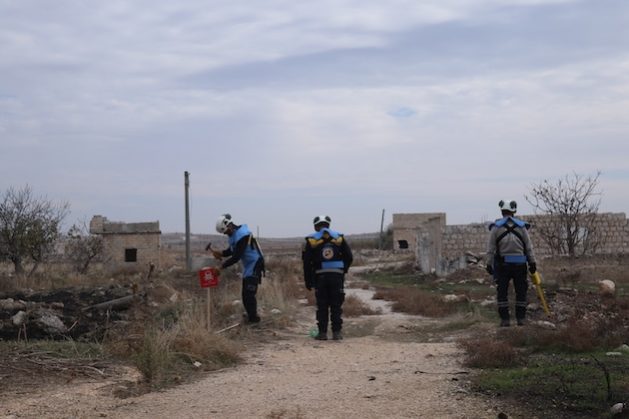
Syrian Civil Defense prepares to remove unexploded munitions of all shapes and types, including landmines. Credit: Sonya Alali/IPS

Syrian Civil Defense prepares to remove unexploded munitions of all shapes and types, including landmines. Credit: Sonia Alali/IPS

IDLIB, Syria, Feb 3 2025 (IPS) – When 42-year-old Amina al-Hassan’s family returned home after the fall of the Bashar al-Assad regime, her son stood on a landmine.

Hassan, from Kafranbel in southern Idlib countryside, sits beside her son’s bed in the hospital after his leg was amputated following the explosion on agricultural land near their home.


“After the fall of the Bashar al-Assad regime and the expulsion of its elements from our city, we went to check on our house, while my son went to inspect the agricultural land near the house. He did not notice a landmine planted among the weeds and plants, and it exploded, amputating his leg,” she told IPS.

Explosive remnants of war and landmines are scattered haphazardly across Syria, endangering the lives of civilians, hindering the return of displaced persons to their cities and villages, and obstructing their agricultural work. The frequency of explosions caused by unexploded ordnance and abandoned explosive ordnance has significantly increased following the collapse of the Bashar al-Assad regime and the fading of the frontlines between the regime and the opposition, where mines and unexploded ordnance are widely dispersed.

“When I heard the explosion, I ran as fast as lightning towards the source of the sound. When I reached the explosion site, I tried to take out my son myself, but the people present at the scene prevented me from doing so. One of the engineering team specialists took charge of removing the mines around him and took him out, then we rushed him to the nearest hospital in the city,” she said, her voice tinged with sorrow.

The United Nations Children’s Fund (UNICEF) confirmed on January 14 that the deadly legacy of landmines and other explosives left behind by years of conflict in Syria had killed more than 100 children in December alone, urging the international community to urgently support mine clearance projects across the country.

According to the Syria Response Coordinators team, the war remnants left by the former Syrian regime continue to claim the lives of Syrians. Since December 8, 2024, explosions of mines and cluster munitions in more than 108 locations in Syria have killed 109 people, including 9 children and 6 women. More than 121 others were injured, including 48 children and one woman.

Rowan al-Kamal (46), from the western Aleppo countryside, visited her home after Syria was liberated from the Assad regime. Unlike many others, she was fortunate, not because her house was intact, but because she noticed an unexploded shell near the house. She recounts, “I moved my children away and called the Syrian Civil Defense, who worked to dismantle it. We were saved from death or injury.”

Kamal adds, “I don’t know how I spotted it amidst the rubble. When I saw it, I was rushing to check what remained of the house. I think my eyes have become accustomed to recognizing shells, as we lived with them throughout the long years of war.”

She reveals that she won’t be able to return to her home due to the presence of landmines and unexploded ordnance, despite living in a makeshift camp with her family of seven and facing extremely harsh conditions, especially with the significant drop in temperatures and the inability of humanitarian organizations to provide the displaced with necessary supplies such as food and heating.

While Kamal and her family survived injury or death, Wael al-Ahmad (22), from Has town in southern Idlib, lost his life after his city was liberated. His mother, Fatima al-Ahmad, recounts, “My son was tending to the sheep on the outskirts of the town and stepped on a landmine without noticing it, causing him severe injuries. He passed away hours later due to his injuries.”

Ahmad calls for intensified efforts to remove these remnants to prevent further casualties and ensure the safe return of the displaced. “The war remnants planted by the Syrian regime and its allies represent a delayed death for Syrians, as they threaten lives and prevent civilians from returning to their homes and farms,” she says tearfully.

Mohammed al-Saeed (32), who works on a war remnants removal team at the Syrian Civil Defense, explains, “War remnants are unexploded munitions of all shapes and types that remain in an area after the end of a war.”

He adds, “War remnants pose a real threat to Syrians in various parts of the country. They are divided into unexploded ordnance such as bombs, rockets, and shells, in addition to landmines.”

Al-Saeed clarifies that the first type is easier to remove and avoid because it can be seen and is usually found above ground. However, the biggest challenge lies in landmines that people cannot see.

Saeed further explained that Syrian government forces planted hundreds of thousands of mines in various regions of Syria, particularly in agricultural lands, military barracks, and frontline areas between the regime and the opposition. He warned that anyone returning to their town, home, or land should be aware that there may be unexploded ordnance present.

According to Saeed, Syrian Civil Defense teams conducted 822 operations to dispose of unexploded ordnance in northwestern Syria between November 27, 2024, and January 3, 2025.

He urged residents to be cautious of strange objects, to avoid touching or moving them, and to report them immediately. Meanwhile, Civil Defense engineering teams continue to conduct daily technical surveys of land contaminated with war remnants and work to dispose of munitions.

Saeed emphasized the need for the international community to work with the new Syrian government and coordinate with it to remove mines by providing funding to expand the Civil Defense’s capacity, hire more personnel, purchase more equipment, and operate in wider areas.

‘The former Syrian regime and its allied militias deliberately planted mines in vital areas, aiming to inflict the maximum number of civilian casualties. This long-term crime represents another facet of their brutal practices,” says Saeed.

IPS UN Bureau Report

  Source