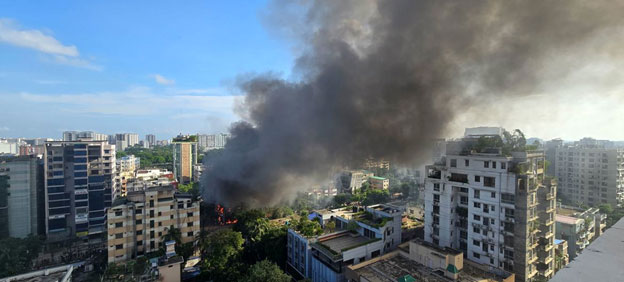
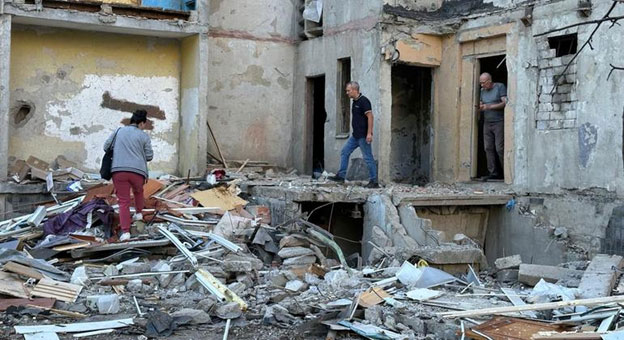
Smoke rises in downtown Dhaka, the capital of Capital, during the July-August 2024 youth-led anti-government protests. Credit: UN Bangladesh/Mithu
BRIGHTON, UK, Apr 6 2026 (IPS) – Urgent steps need to be taken to rebuild the relationship between citizens and state to stem the decline of democracy globally. Experts point to inequality and political exclusion as two of the biggest drivers for democratic backsliding, with the exclusion of citizens from a role in policy and decision-making spaces leading to ‘hollow citizenship’.
A report, published by the Institute of Development Studies, comes as Europe, Africa, Latin America, Asia and the US, have seen a rise in support for populist leaders on the left and right stoking division and weakening democratic safeguards, such as free and fair elections and free media.
This has led to key aspects of democracy declining during the last decade and now 74% of the world’s population (6 billion) live in autocracies.
In response, the report authors call for an urgent rethink of democracy – which evidence shows delivers better social and economic outcomes than other regimes – to focus on people, power and inequality and less on institutions.
The experts say that past efforts to strengthen democracy globally focused too much on strengthening institutions, like legislature, judicial systems and electoral commissions and neglected the needs of people.
To sustain and strengthen democracies for the future, the reports call for urgent action to ensure people are included and engaged in democracy at local and national levels.
Shandana Khan Mohmand, Research Fellow, Institute of Development Studies, said: “After decades of unsuccessful efforts, and millions of dollars spent by Western powers to try and strengthen democracy globally, we need to learn the lessons about what does and doesn’t work.
“While supporting democratic institutions like electoral commissions, judicial systems and independent media are all critically important, evidence shows that the missing ingredient is people – and the extent that they can engage in democracy in meaningful ways. Whether in local council decisions about community parks or on a nation’s policy on green energy, or going to war, citizens need to be included and feel that they are heard in decision making.”
While there was optimism that digital technology, and particularly social media, would act as a force for democratisation and improving transparency and accountability, the research finds that has only led to limited gains.
Instead, the evidence shows that digital technology has been harnessed by regimes to support a descent into authoritarianism, using tactics like mass surveillance and internet shutdowns to suppress dissent and human rights.
The report also finds that the notable youth-led uprisings, such as in Bangladesh, Nepal and Madagascar attracted the headlines but that it is the more everyday acts of young people demonstrating inclusion and collective decision-making, rather than the mass protests, that are more significant for strengthening democracy and peace.
Marjoke Oosterom, Research Fellow, Institute of Development Studies, said: “The scale of democratic backsliding globally serves as a warning to leaders of high, middle and low-income democracies alike. They ignore inequality and political exclusion at their peril as both are being exploited by anti-democratic politicians to stoke division, and lead people to question whether democracy works for them.
“The evidence shows that democracy is still the best model for an inclusive and fair society and urgent action is needed to halt the current democratic decline we are seeing in continents around the world.”
Despite the budget cuts by governments across Europe and the USA which significantly reduced initiatives designed to strengthen democracy globally, the report includes several recommendations for ways that states, policymakers and philanthropist funders can help strengthen democracy.
Those include fixing the relationship between states and citizens via greater inclusion of people in governance and politics, making space for diverse opinions and ideological positions, and public policy to address the needs of marginalised groups and reduce inequality, which in turn builds trust in democracy.
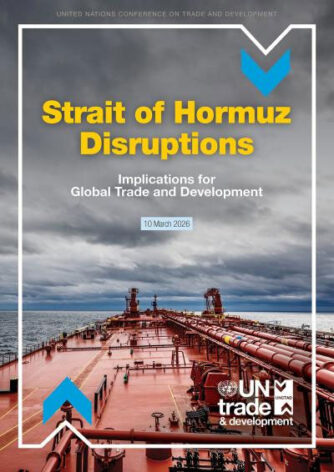
The Strait of Hormuz is one of the world’s most critical maritime chokepoints, carrying around a quarter of global seaborne oil trade and significant volumes of liquefied natural gas and fertilizers.
NEW YORK, Mar 31 2026 (IPS) – Trump’s Iran war has left the Gulf shattered: US bases turned into targets, economies battered, and the “oasis” myth destroyed. Gulf rulers now confront a harsh reckoning over their reliance on Washington and the uncertain search for a new, fragile security order.
As Trump assembled major US naval and air assets in the eastern Mediterranean and the Gulf, Saudi Arabia, the UAE, Qatar, and others quietly urged Washington to avoid a full-scale assault on Iran, fearing a direct blowback on their territory and energy infrastructure.
Nevertheless, the US–Israeli air campaign began on February 28, 2026, without a clearly defined and publicly articulated political endgame beyond “crippling” Iran’s capabilities. This disconnect between military escalation and strategic purpose now lies at the core of Gulf leaders’ anger and sense of betrayal toward Washington.
Trump’s Strategic Miscalculation
Trump’s decision to launch joint US–Israeli strikes on Iran has produced far higher strategic costs than his administration appears to have anticipated, from energy shock and disrupted shipping to heightened regional fragmentation and anti-American sentiment.
Even if Iranian capabilities are significantly degraded, the war has exposed vulnerabilities in US power projection, unsettled allies, and invited greater Russian and Chinese diplomatic activism in the Gulf. The long-term “price” for Washington will be measured less in battlefield metrics than in diminished trust and leverage among its traditional Arab partners.
US Bases Turned to Liabilities
From a Gulf perspective, US bases in Qatar, Bahrain, Kuwait, and the UAE were meant to deter Iran and guarantee regime security; instead, they became priority targets once the war began. Iran explicitly framed its strikes on these facilities as retaliation against Washington, but their location in densely populated and economically vital areas meant that nearby civilian infrastructure also suffered severe damage.
This experience is reinforcing a view in Gulf capitals that foreign basing arrangements draw fire without delivering the reliable protection they assumed for decades.
A Nightmare Realized
Gulf leaders long warned that a war with Iran would shatter their security and economies, a nightmare that has now materialized as Iranian missiles and drones hit oil facilities, ports, power plants, and cities across the region. They blame Washington for launching the campaign and Israel for pressing to “neutralize” Iran regardless of collateral damage in neighboring Arab states.
The sense in Gulf capitals is that their caution was dismissed, while they have paid a disproportionate price in physical destruction, economic setback, disrupted exports, and heightened domestic anxiety.
Shattered Oasis Narrative
The image of Gulf hubs like Dubai, Doha, and Riyadh as insulated “oases” open to business, tourism, and investment has been badly damaged by missile alerts, strikes on ports and airports, and the closure of key sea lanes.
Restoring confidence will require visible reconstruction, enhanced civil defense, improved air and missile defenses, and credible diplomacy that lowers the perceived risk of another sudden war. Investors and tourists will demand proof that the region can manage Iran-related tensions, not just high-end events and mega-projects.
Trump’s Misreading of Iranian Escalation
Trump publicly argued that overwhelming force would quickly coerce Iran and usher in regime change while keeping fighting “over there,” yet he appears not to have anticipated the breadth of Iranian retaliation against neighboring Gulf states or a prolonged closure of the Strait of Hormuz.
The IRGC’s effective shutdown of the strait, including attacks and threats against commercial shipping, has produced global energy shocks and exposed the fragility of US planning assumptions. For Gulf leaders, this underscores how inadequate Washington’s war planning was in accounting for second- and third-order consequences.
Calculated Decision Not to Retaliate
Despite heavy damage, Gulf rulers have so far avoided direct retaliation against Iran, calculating that further escalation would expose their cities and infrastructure to even more punishing strikes. Publicly, they stress restraint and international law, but privately, officials acknowledge their enduring geographic reality: they must coexist with a powerful and proximate Iran long after this US-led campaign ends.
By holding their fire, they hope to preserve space for postwar de-escalation and avoid being locked into a permanent state of open conflict.
Recasting Security Arrangements with Washington
Given their limited strategic alternatives, Gulf monarchies are unlikely to sever ties with Washington but will seek more conditional, transactional security arrangements. They are pressing for clearer US commitments on defense of their territory, better integration of regional missile defenses, and greater say over decisions that could trigger Iranian retaliation.
At the same time, they will hedge by deepening ties with China, Russia, Europe, and Asian energy importers, thereby reducing exclusive reliance on the US while keeping the American security umbrella in place.
Gulf Options to Prevent Future Conflagration
To prevent a repeat, Gulf states are also exploring limited de-escalation channels with Tehran, tighter regional crisis hotlines, and revived maritime security arrangements that include non-Western actors such as China and India. They may push for new rules of engagement around energy infrastructure and shipping lanes, seeking informal understandings that keep these off-limits even in crises.
Internally, they are reassessing missile defense, hardening critical facilities, and considering more diversified export routes that reduce dependence on Hormuz. None of these options are fully reassuring, but together they offer partial risk reduction.
Prospects for Normalization with Iran
Speculation about full normalization, including a non-belligerency pact between Iran and Gulf states, builds on prewar trends of cautious dialogue and economic engagement. Whether this is truly “in the cards” depends on war outcomes, Iran’s internal politics, and Gulf threat perceptions: if Tehran’s regime survives but remains hostile, Gulf states will likely revert to hedging—combining deterrence, limited engagement, and outreach to outside powers.
A more pragmatic Iranian leadership could make structured security arrangements and phased confidence-building measures more plausible over time.
No Return to Status Quo Ante
The Gulf States will not return to the prewar status quo; instead, they are likely to pursue a more diversified security architecture, combining a thinner US shield with expanded ties to China, Russia, and Asian importers. This shift will gradually dilute Washington’s centrality in Gulf security, complicating US force posture and Israel’s assumption of automatic Arab backing against Iran.
For Israel, a more cautious, risk-averse Gulf may limit overt strategic alignment, while for the US, enduring mistrust will make coalition-building for future crises far more difficult.
Trump’s Iran adventure is not an isolated blunder but the latest, and perhaps most explosive, expression of his assault on an already fragile global order. By discarding restraint, sidelining allies, and weaponizing American power for short-term political gain, he has accelerated the erosion of US credibility, fractured Western alliances, and opened new strategic space for Russia and China. The Gulf States are simply the newest casualties of this disorder: their cities struck, economies shaken, and security assumptions shattered.
Whatever emerges from this war, it will not be a restored status quo, but a more fragmented, volatile Middle East in which Israel and the United States confront a diminished margin for error and a far narrower circle of willing, trusting partners.
Dr. Alon Ben-Meir is a retired professor of international relations, most recently at the Center for Global Affairs at New York University (NYU). He taught courses on international negotiation and Middle Eastern studies.
The Russo-Ukrainian war, which began in February 2014, shows no signs of ending. Credit: UNOCHA/Dmytro Filipskyy
KYIV, Ukraine, Mar 19 2026 (IPS) – It is becoming increasingly difficult to ignore the tension, violence and uncertainty in the world in recent years. The number of wars is growing, more and more money is being spent on weapons, and the rhetoric of major powers is becoming increasingly decisive.
The latest escalation in the Middle East has reignited the debate about the start of World War III. The consequences of the Israeli and US strikes on Iran are being felt to varying degrees far beyond the region, at least by those who follow oil prices.
The interests of numerous great powers are at stake, and third parties are considering their next moves and making political statements. Opinions range widely, from the belief that there can be no Third World War because of the existence of nuclear weapons, to the conviction that it has already begun. So, what is really going on?
A journalistic and academic concept
When historians talk about world wars, they mean two unique events in the past. Their scale, the involvement of a wide range of states, the level of violence and the nature of the consequences put them in a league of their own.
To understand how these wars differed from any others, one need only glance at the diagram of human casualties, defence spending, or destruction in various armed conflicts of the 20th century.
However, historians also have different opinions. One of them, better known in his political capacity, Winston Churchill, once described the Seven Years’ War as a world war. This protracted 18th-century conflict drew most of the major powers of the time into direct combat; it spanned numerous battlefields in Europe, North America, the Atlantic and the Indian Ocean; and it had serious geopolitical consequences. How was this not a world war?
By the fact that it was not a total war between industrialised states, the scale of the clashes was rather limited, as were the number of armies; and the consequences, although serious, were not systemic — this may be the response of more conservative historians than the British Prime Minister.
The number of armed conflicts in the world has been growing over the past few years: 2024 has been a record year since World War II.
‘World War’ is both a journalistic and academic concept. To enhance the effect, attract attention or draw conditional analogies, it can be used to describe more events than just the First and Second World Wars. For example, the Thirty Years’ War of the 17th century, the Napoleonic Wars of the 19th century or even the Cold War are sometimes referred to as world wars.
Within this logic, individual elements of a world war can be seen even today. The number of armed conflicts in the world has been growing over the past few years: 2024 has been a record year since World War II. According to some estimates, 61 armed conflicts in 36 countries were recorded this year, which is significantly higher than the average for the previous three decades.
Global military spending is also on the rise: today it has reached 2.5 per cent of the global economy, the highest figure since 2011 and an upward trend since 2021. This is still significantly less than during the Cold War, when a range of 3 to 6 per cent was the norm. Analysing these figures, it is clear that global security has deteriorated in recent years, but how critically?
A more academic approach would be to define a world war as one in which most of the major powers are involved; which has global reach and is total in nature; leads to enormous loss and destruction; and significantly changes the world upon its conclusion. Direct and large-scale armed conflict between major powers is a mandatory criterion.
And this is the main argument against the idea that World War III has already begun. No matter how high the level of destabilisation in the modern world, no matter how far large-scale regional conflicts have escalated, and no matter how much money states spend on armaments, this is not enough for a world war. Large-scale military operations involving major powers are needed.
All just fears?
This has not happened in the world for a long time. The interval between the Second and Third World Wars turned out to be much longer than between the First and Second. Nuclear weapons played a central role in this, raising the price of war so high that major powers began to avoid it by any means possible. This safeguard has been in place for over 80 years and looks set to continue.
Peace, or rather the absence of war between major powers, remains one of the central elements of the current international order. International institutions and regimes may collapse or weaken, regional wars may break out, but the likelihood of war between major powers remains extremely low.
Proponents of the Third World War theory sometimes point out that even in the absence of full-scale war between major powers, other manifestations occur: hybrid wars, cyberattacks, or proxy wars. This is true, but all these outbreaks of conflict are several levels below a world war in terms of their destructive potential and are not total in nature.
Throughout history, states have fought through proxies or resorted to information, trade or religious wars, but we do not consider these wars to be world wars — except in a symbolic sense.
A systemic war does not necessarily have to be a world war
Unlike the 2003 war in Iraq, the strikes on Iran are taking place in a world where, instead of US hegemony, there is complex competition between at least two centres of power. This adds nuances and forces other states to respond, directly or indirectly, for example, by supplying weapons or intelligence data, supporting one side or the other.
But this does not make the war global. Arms supplies, for example, are a common practice found in most regional conflicts, as is diplomatic or financial support from allies or partners. Even if American troops use the technology or expertise of partners – such as Ukrainian drones – this does not mean that Ukraine is being drawn into the war. Just as American arms supplies to Ukraine during the Russian-Ukrainian war did not mean US involvement in the war.
For a world war, the key ingredient is still missing: direct confrontation between major powers. In addition to world wars, there are also systemic wars. In these conflicts, it is not so much the scale that is important as the change in the international order to which they lead.
The Thirty Years’ War, the Napoleonic Wars, and the First and Second World Wars mentioned above were systemic wars: after their completion, the rules of international politics were rewritten and new ones were adopted at peace conferences and congresses. A systemic war does not necessarily have to be a world war.
Moments of hegemonic crisis and the beginning of the struggle for hegemony always carry with them the danger of new wars, arms races and escalations.
The current destabilisation and growth of various risks are largely linked to the struggle for the future of the international order. The United States and China have almost fallen into the ‘Thucydides trap’ — a strategic logic similar to that which led to the Peloponnesian War in the 5th century BC. At that time, the narrowing of the power gap between the hegemon and the challenger forced the Spartans to start a preventive war.
Today, there are well-founded fears that the decline of American hegemony, the rise of China and the approach of a bipolar world will sharply increase the likelihood of direct armed conflict between the superpowers.
The decisive, to put it mildly, steps taken by the US administration can also be considered preventive actions aimed at strategically weakening China’s position while Washington still has the upper hand. Such moments of hegemonic crisis and the beginning of the struggle for hegemony always carry with them the danger of new wars, arms races and escalations.
We are in the midst of such a crisis. It is systemic in the sense that it is not just a collection of regional conflicts in different parts of the world, which have become more numerous, but a manifestation of a large-scale redistribution of influence and power on a global scale. This redistribution will entail changes in the international order, because the rules of the game are linked to the balance of power.
If, at some point, the leaders of major states decide that it is worth taking the risk of war and paying the price, the systemic crisis will turn into a world war. But this, as the Spartans themselves said, is ‘if’.
Nickolay Kapitonenko is an associate professor at the Institute of International Relations at Taras Shevchenko National University of Kyiv and director of the Centre for International Relations Studies.
Source: International Politics and Society, Brussels
A sign outside the UN Secretariat building last year.
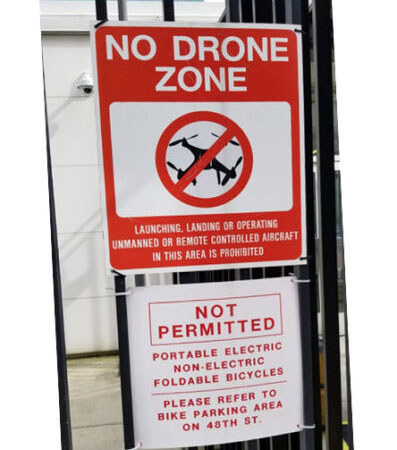
UNITED NATIONS, Mar 18 2026 (IPS) – As the world continues to be weighed down in political and military turmoil, drones are being increasingly used as weapons of war in a rash of ongoing conflicts—including Ukraine vs Russia, Israel vs Palestine, US vs Iran and Israel vs Lebanon, plus in civil wars in the Democratic Republic of the Congo (DRC), Sudan and Haiti.
Described as Unmanned Aerial Vehicles (UAV), drones have fundamentally transformed modern warfare, “offering a low-cost, high-impact form of air power, challenging traditional military doctrines and giving rise to new tactics and ethical debates”.
Once limited to major military powers like the U.S. and Israel, drones are now being used by numerous state and non-state actors, including militant groups and even organized crime cartels.
The use of drones, particularly in targeted killings and with increasing autonomy, has raised significant international debate regarding accountability, civilian casualties, and compliance with international humanitarian law
UN High Commissioner for Human Rights Volker Türk said last week he was “appalled by the devastating impact on civilians of increasing drone attacks”, amid reports that more than 200 civilians have been killed by drones since 4 March alone in the Kordofan region, and in White Nile state.
“It is deeply troubling that despite multiple reminders, warnings and appeals, parties to the conflict in Sudan continue to use increasingly powerful drones to deploy explosive weapons with wide-area impacts in populated areas,” said Türk.
“I renew my call on them to abide fully with international humanitarian law in their use of these weapons, particularly the clear prohibition on directing attacks against civilians and civilian objects and infrastructure, and against any form of indiscriminate attacks.”
Many homes, schools, markets and health facilities were damaged or destroyed in the attacks, compounding the impacts on civilians and local communities, he said.
Meanwhile drones are also being used in the politically-troubled Haiti and also in the conflict between the Democratic Republic of Congo (DRC) and Rwanda despite a peace agreement brokered by the US last year.
According to a report in Cable News Network (CNN) March 17, the war in Iran is continuing to disrupt travel across the Gulf after Iranian drone strikes triggered two major air incidents in recent days. Flights at Dubai International Airport were briefly suspended on Monday after a drone struck a nearby fuel tank, igniting a large fire.
The shutdown forced cancellations and diversions as aviation authorities closed the airport. Part of the UAE’s airspace was also closed for a few hours overnight after the country said it was responding to incoming missiles and drone strikes from Iran.
Meanwhile, the prices of many global airfares that bypass the Middle East are rising, as the conflict drives up oil prices and airlines warn of higher fuel costs ahead, said CNN.
Focusing on a military perspective, Siemon Wezeman, Senior Researcher, Arms Transfers Programme, Stockholm International Peace Research Institute (SIPRI), told IPS more and more states, (and also non-state armed- rebel – groups) acquire drones of all sizes.
“Some of the numbers are quite amazing – Ukraine getting not a few 1,000, but far over 10,000 drones from various suppliers, and Russia, Ukraine and Iran each use drones by the 100s almost every day in the current conflicts.”
And different from some 10 years ago, when most of the drones where for reconnaissance roles, he pointed out, today many drones are armed and many more are ‘one-way attack drones’ (also called suicide or kamikaze drones). The latter are becoming a cheap alternative for long-range missiles against ground targets.
In the SIPRI arms transfers database (https://armstransfers.sipri.org), he said, “we record transfers of all armed drones, and reconnaissance drones with a weight of at least 150kg (we had to put a weight limit to be able to keep monitoring drone transfers with the resources and sources we have)”.
“And we clearly see in recent years that a) the total numbers of drones transferred between states has grown, b) several non-state actors (e.g. Houthis and Hezbollah) have also been supplied with drones, c) the number of states and non-state actors that have acquired drone has grown – most states in the world have now acquired drones, many of them from foreign suppliers, d) the number of producers and suppliers has grown – the simpler drones are offered by dozens if not 100s of large and very small companies and that number is growing, and e) drones, and especially armed drones.”
That is the picture for flying drones, Wezeman said.
But also, sea drones (surface or submarine) are starting to become popular – even if not yet transferred in any significant number. And land drones are also starting to become popular, he declared.
At a press conference March 10, UN Under-Secretary-General for Humanitarian Affairs Tom Fletcher said: “I’m really worried about drones in particular. I think the world has decided that it’s far more interested in spending enormous amounts of money developing these increasingly deadly weapons than it is on saving lives, and it seems to have decided that it hasn’t got time to work on ensuring that the rules that govern these weapons, these lethal autonomous weapons, keep up with the pace of technology.”
So you’ve got this dangerous alliance between very innovative technology and huge amounts of money and people’s desire to kill more people – and that’s a toxic combination, he said.
“And last year, 90 per cent of all deaths caused by drones were civilians, many of them humanitarians. And we’re seeing that across the crises on which we work – whether it’s Gaza, Sudan or in Ukraine, we’re seeing these bad practices move between crises”.
In the DRC last week, a senior official of the UN children’s agency UNICEF and two civilians were killed in drone strikes.
Amplifying further Wezeman said all these drones and one-way attack drones have become more capable, especially in range (the simple Shahed, one-way attack drones used by Iran and sold to Russia have a range of up to 1500 to 2000km), changing them from tactical battlefield weapons to more strategic weapons.
Development is very rapidly continuing for all type of drones, including making them more autonomous and intelligent to be capable of independent targeting and other decision-making. AI plays a growing role in this process. This process leads to questions about control, but right now it seems the process is moving faster than the discussion on controlling the autonomous aspects (see also our programme on emerging technologies.
Will they replace systems with a human on board or in the loop? The development goes certainly that way and for missiles and one-way attack drones that has already started. For the larger, more capable and more complex systems such as combat aircraft, warships and larger combat vehicles that is still a future – but not a distant dream as development of for example drone combat aircraft is already moving into prototypes in the USA, China, Australia and Europe.
There still is an element of doubt however – drones need navigation that now is largely based on GPS-type systems, something that is not free from the risks of being jammed or stopped.
The simpler drones, with their simple technology, cheap and easy to produce are also not as effective as hoped. Most of them are rather easy prey for air-defence systems (or jamming) – while Russia, Iran and Ukraine send every day dozens or 100s to attack their opponents, most do no reach their target but are shot down or lost due to jamming or other causes, declared Wezeman.
Meanwhile Human Rights Watch said last week its latest research on “how Haitian security forces and private contractors working with them have conducted extensive and apparently unlawful lethal drone strikes in densely populated areas killing and injuring residents who were not members of criminal groups, including children”.
“We call on Haitian authorities to urgently rein in the security forces and private contractors working for them before more children die”, said HRW.
According to data from multiple sources reviewed by Human Rights Watch, at least 1,243 people were killed by drone strikes in 141 operations between March 1, 2025, and January 21, 2026, including at least 43 adults who were reportedly not members of criminal groups, and 17 children. The data also shows that the drone strikes injured 738 people, at least 49 of whom were reportedly not members of criminal groups.
“Dozens of ordinary people, including many children, have been killed and injured in these lethal drone operations,” said Juanita Goebertus, Americas director at Human Rights Watch. “Haitian authorities should urgently rein in the security forces and private contractors working for them before more children die.”
The United Nations Integrated Office in Haiti has attributed the drone attacks in Haiti to a specialized “Task Force” established by Prime Minister Alix Didier Fils-Aimé that is operated with support from the private military company Vectus Global.
The US ambassador to Haiti has confirmed that the US State Department issued a license to Vectus Global to export defense services to Haiti.
Thalif Deen, Senior Editor, Inter Press Service (IPS) news agency, was a former Director, Foreign Military Markets at Defense Marketing Services; Senior Defense Analyst at Forecast International; military editor Middle East/Africa at Jane’s Information Group and UN correspondent for Jane’s Defence Weekly, London.
LONDON, Mar 16 2026 (IPS) – Once again, global oil prices are spiking, driven by the Israeli-US war against Iran. With Iran retaliating by attacking infrastructure and transport hubs and blocking the Strait of Hormuz, through which one-fifth of the world’s oil passes, oil supplies from the region are being choked, pushing up prices. The cost of a barrel of Brent crude – the international benchmark for oil prices – stood at US$73 before the conflict but has surged beyond US$100 since. It could go higher still as war continues.
The impacts are already being felt when drivers fill up their petrol- and diesel-powered vehicles. But they go much wider. Bigger household energy bills will likely result, while businesses will pass on their increased costs in the form of higher prices. Russia’s 2022 full-scale invasion of Ukraine sent oil prices soaring and sparked a global cost-of-living crisis, and now, as many economies seemed to be recovering, the war in the Gulf has brought another shock. Impacts could be political as well as financial: in numerous countries, the cost-of-living crisis helped drive voters towards right-wing populist and nationalist politicians. Recent years have seen Gen Z-led protests erupt in countries around the world, fuelled in part by young people’s anger at failing economies.
In a world increasingly characterised by conflict and with powerful states tearing up the international rulebook in pursuit of material interests, more oil shocks and big economic and political impacts seem inevitable. Governments typically react with economic policies that fail to protect those with the least, and by meeting political unrest with repression. They should consider another way.
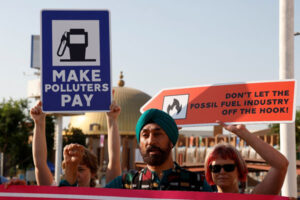
The world will remain vulnerable to oil price shocks only for as long as it stays dependent on oil. The climate crisis compels a rapid move away from fossil fuel dependency to abate the worst impacts of global heating. Increasingly, this should also be seen as a matter of economic and political security.
Some steps have been taken in the right direction. Renewables now provide over 30 per cent of global electricity. Investments in renewables more than double those in fossil fuels. But fossil fuel companies have immense power and are determined not to give it up. That was reflected in the fact that 1,600 fossil fuel lobbyists attended the latest global climate summit, COP30 in Brazil, and succeeded in preventing any new commitment to end fossil fuel extraction. Their power is shown in the lawsuit an oil company brought against Greenpeace, leading to a widely criticised trial in North Dakota, USA, with the campaigning organisation facing a punitive US$345 million damages bill. Their influence was reaffirmed by Donald Trump’s election win, after a campaign in which fossil fuel companies gave US$450 million in donations to Trump and his allies – and they were rewarded by US intervention in Venezuela.
Fossil fuel companies are determined to hold back the tide of renewables for as long as possible, because every day of delay is another day of profit, even though every fraction of a degree of temperature rise means avoidable suffering for millions of people. Delay is the new climate denial.
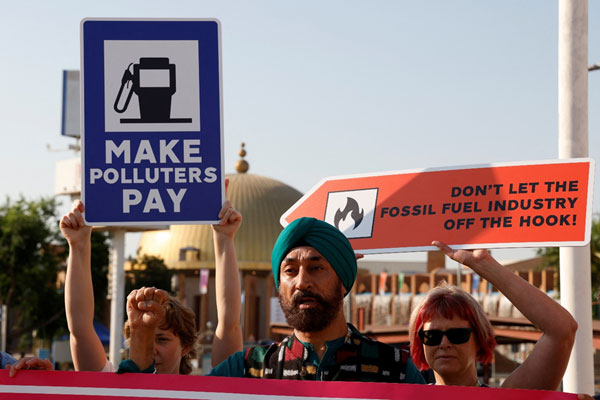
As the latest State of Civil Society Report points out, civil society’s working to make the difference, urging governments to hasten the transition and calling on global north states to make funding available for global south states to decarbonise and adapt to climate impacts. Civil society is exposing the environmental devastation caused by extraction and the complicity of fossil fuel companies in human rights abuses. Its strategies include advocacy, public campaigning, protests, direct action and, increasingly, litigation.
In 2025, climate litigation scored some big successes. The International Court of Justice (ICJ) issued an unprecedented advisory opinion, ruling that states have a legal duty to prevent environmental harm, which requires them to mitigate emissions and adapt to climate change. This victory originated in civil society: in 2019, student groups from eight countries formed the Pacific Islands Students Fighting Climate Change network to persuade their governments to seek an ICJ ruling.
Following extensive civil society engagement, the Inter-American Court of Human Rights issued a similar ruling. The African Court for Human and Peoples’ Rights is set to issue its advisory opinion following a petition brought by the African Climate Platform, a civil society coalition.
These rulings can seem symbolic, but they strengthen national-level efforts to hold states and corporations accountable. These have paid off recently too. In 2025, two South African groups stopped an offshore oil project after a court found its environmental assessments were deeply flawed. More litigation is coming, including in New Zealand, where civil society has filed a lawsuit after the government weakened its emissions reduction plan.
But civil society faces a backlash. Around the world, climate and environmental activists and their allies, Indigenous and land rights defenders, experience severe state and corporate repression.
Last year in Uganda, authorities arrested 11 activists for protesting against the construction of the East African Crude Oil Pipeline. In Peru, police used teargas and non-lethal weapons against people blocking a road to protest against a mine. In Cambodia, five young activists from the Mother Nature environmental group have been in jail since July 2024.
The French government has repeatedly vilified environmental campaigners and deployed police violence against protests, while last year the German government launched an inquiry into public funding of environmental groups and the Dutch parliament adopted a motion condemning Extinction Rebellion and urging the removal of its tax-exempt status.
As the latest oil price shocks reverberate around the global economy, governments should learn the lessons. As economies deteriorate, the temptation will be to say that transition is a luxury, something that can be put off even further. This is the wrong lesson: recent research in the UK suggests that the cost of achieving net zero will be about the same as the cost of another oil price crisis. Economic and political security lies in ending fossil fuel dependency as quickly as possible. To learn the right lessons, governments should stop repressing climate activism and instead listen to and work with civil society.
MONTEVIDEO, Uruguay, Mar 9 2026 (IPS) – Consider what International Women’s Day looked like a few years ago, and what it looks like now: the same date, the same global moment of reflection, but a vastly changed global landscape. Gender rights are facing the most coordinated and wide-ranging attack in decades. Anti-rights forces are dismantling protections secured after generations of struggle, destroying infrastructure built to address gender-based violence and realise reproductive rights and rewriting legal frameworks to roll back rights, with a specific focus on excluding transgender people. This is the result of a deliberate, carefully crafted, handsomely funded and globally coordinated strategy.
Fortunately, resistance is proving harder to extinguish than those driving the backlash had expected. Another International Women’s Day of mobilisation is here to prove it.
A regressive template
While attacks have been building for years, the global landscape shifted quickly in January 2025, when a newly inaugurated Donald Trump signed executive orders imposing a rigid binary classification of sex across federal law, stripping non-discrimination protections for LGBTQI+ people in healthcare and housing, and banning diversity, equity and inclusion policies across the federal government. Because the USA had been the world’s largest bilateral donor, the simultaneous dismantling of USAID and expansion of the global gag rule — blocking US funding to organisations that provide abortions or advocate for abortion rights — had immediate effects on women and girls all over the world, with particularly deadly consequences in conflict zones, rural areas and the world’s poorest countries.
Elsewhere, regressive forces were already mobilising – and Trump’s example only emboldened them. Hungary banned Pride marches and authorised surveillance to enforce compliance. Slovakia and the UK redefined sex as exclusively biological, stripping legal recognition from non-binary and transgender people. Burkina Faso criminalised same-sex relations and their ‘promotion’. Trinidad and Tobago’s Court of Appeal reinstated colonial-era penalties for homosexuality of up to 25 years in prison. Kazakhstan introduced a Russian-style ban on positive LGBTQI+ representation in education, media and online platforms.
It’s striking how consistent the underlying logic is across different political and regional contexts: gender equality is framed as a dangerous ‘ideology’, feminism is demonised as a foreign imposition, LGBTQI+ visibility is portrayed as a threat to children. The similarities reflect a coordinated effort to manufacture cultural conflict to consolidate hierarchies, strengthen elite authority and deflect attention from economic and political failures.
The backlash has reached the international institutions that have long served feminist movements as key arenas for developing a common language, setting a shared agenda and coordinating action across borders. A milestone in anti-rights advances was observed at the United Nations Commission on the Status of Women’s 69th session last year, where a well-organised anti-rights bloc succeeded in stripping longstanding references to sexual and reproductive health and rights from the meeting’s Political Declaration.
What resistance looks like
Yet regression is not going uncontested: not in the streets, not in the courts and not even in the world’s most repressive settings.
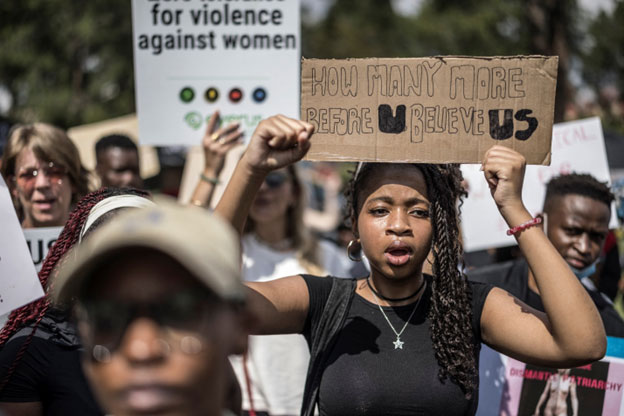
In Hungary, tens of thousands defied the Pride ban in Budapest, risking prosecution to assert their right to be visible in public space. In South Africa, sustained civil society pressure, including over a million signatures demanding action, compelled the government to declare gender-based violence and femicide a national disaster. In St Lucia, the Eastern Caribbean Supreme Court struck down colonial-era laws criminalising same-sex relations. Courts in Malawi and Nigeria recognised the right to safe abortion for sexual violence survivors. The UK finally repealed a Victorian-era law that had continued to criminalise abortion in England and Wales. Denmark and Norway improved access to abortion services. Marriage equality came into force in both Liechtenstein and Thailand. At least three European Union member states — the Czech Republic, France and Poland — adopted consent-based definitions of rape.
Even in the most difficult of circumstances, under Afghanistan’s system of gender apartheid, women are maintaining underground schools, keeping solidarity networks alive and documenting abuses, setting their sights on future justice processes.
While the list of advances is impressive, some of the most important contemporary victories are invisible: stalled bills, softened provisions, laws not passed because civil society refused to stand aside. An attempt to repeal The Gambia’s ban on female genital mutilation was blocked. Kenya’s anti-LGBTQI+ Family Protection Bill remains stalled. In Latvia, when conservative forces moved in October 2025 to withdraw from the Istanbul Convention on violence against women, large-scale protests and a civil society petition won what could be a crucial delay. These defensive successes rarely make headlines, but they result from sustained, unglamorous advocacy and coalition work. Without them, the most extreme proposals would advance much further and faster.
Rising to the challenge
Recognition of rights is never permanent. It’s won through sustained struggle and can be reversed through organised opposition from those who perceive other people’s rights as a threat to their privilege. Backlash isn’t a historical anomaly but a predictable counter-mobilisation, and civil society has met it as such, by organising, mobilising, litigating and refusing to concede ground.
This is precisely what CIVICUS’s 2026 State of Civil Society Report, set for release on 12 March, sets out to document. The report examines the state of the world and civil society action throughout 2025 and early 2026 – including a dedicated chapter on women’s and LGBTQI+ people’s rights – and reveals strong patterns of resistance. Across regions and political contexts, it shows how civil society understands the scale of the attack and is responding in every possible way.
As this International Women’s Day will once again make clear, the backlash is organised and strong. But so is the resistance.