Heralding an Era of Religious Wars

Armed Conflicts, Civil Society, Democracy, Global, Headlines, International Justice, IPS UN: Inside the Glasshouse, TerraViva United Nations
Opinion

Heralding an Era of Religious Wars

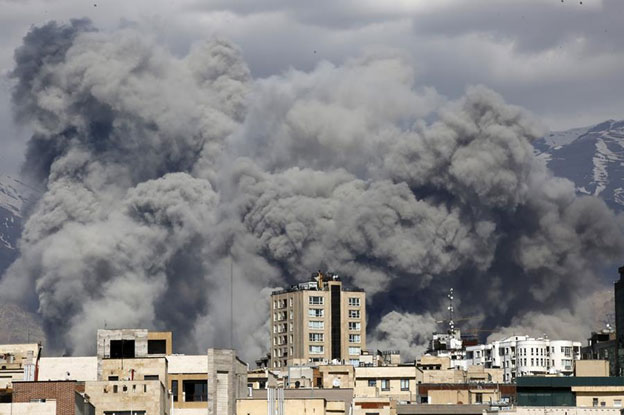
Credit: Office of the High Commissioner for Human Rights (OHCHR)

NEW YORK, Mar 6 2026 (IPS) – In recent months, the language surrounding the escalating confrontation between the United States, Israel, and Iran has taken on a tone that should trouble anyone concerned with global peace.


Across television studios, online sermons, and political commentary, some American preachers and commentators have begun describing the conflict not merely as geopolitics or national security, but as a “holy war.”

Reporting in outlets such as The Guardian, along with coverage in other international media, has noted the growing number of Christian nationalist and Evangelical voices framing the Middle Eastern conflict in explicitly theological terms.

Certain Evangelical preachers in the United States have long interpreted tensions involving Israel through apocalyptic or biblical narratives. In these interpretations, the confrontation with Iran is sometimes presented as part of a divinely ordained struggle between good and evil.

In sermons broadcast online and amplified through social media, the war is described as a moment in which believers must stand with Israel in a battle perceived as spiritually consequential – even leading to ‘the rapture’.

The rhetoric is not limited to pulpits. Some former military figures and commentators have echoed similar themes, invoking civilizational language that portrays the confrontation with Iran as part of a broader clash between Judeo-Christian civilization and an Islamic adversary.

When such language enters strategic discourse, it transforms political conflict into something far more dangerous: a war imbued with sacred meaning.

History shows that once wars are framed as sacred struggles, compromise becomes nearly impossible. Political conflicts can, at least in theory, be negotiated. Holy wars, by contrast, are perceived as battles for divine truth. In that framing, negotiation is betrayal.

This phenomenon is not unique to the current Middle Eastern crisis. Religious legitimization of war has surfaced repeatedly in contemporary conflicts. At the outbreak of Russia’s full-scale invasion of Ukraine in 2022, for example, the head of the Russian Orthodox Church, Patriarch Kirill, framed the war in spiritual terms.

In sermons and public statements, he suggested the conflict represented a metaphysical struggle over the moral future of the Russian world. The language of spiritual warfare, cultural purification, and civilizational defence became intertwined with political justification for military action.

Such rhetoric matters. When religious authority sanctifies violence, it grants moral legitimacy to warfare and discourages dissent among believers. Faith communities that might otherwise advocate peace can become mobilized behind nationalistic or militaristic agendas.

We are therefore witnessing something deeply unsettling: the return of explicitly religious language to modern warfare. For decades after the Second World War, global diplomacy attempted—imperfectly but deliberately—to frame conflicts primarily in political and legal terms.

International institutions, treaties, and multilateral frameworks were designed to prevent precisely the kind of civilizational framing that once fueled centuries of bloodshed.

Yet the present moment suggests that these restraints are weakening. Wars are again being narrated as existential struggles between belief systems. Political leaders, clergy, and media personalities increasingly draw upon religious symbolism to rally support.

The danger is not simply rhetorical. When wars are sacralized, they risk becoming limitless conflicts, unconstrained by borders or diplomacy.

The Collapse of Multilateralism and the Silence of Faith Institutions

For years, I have written and spoken about the uneasy relationship between religion, global governance, and peacebuilding. In articles as well as in interviews and public lectures, I have repeatedly warned that governments and intergovernmental entities have failed to develop a coherent framework for engaging religions constructively in international affairs.

Faith-based organizations today are everywhere. They participate in humanitarian work, development programs, diplomacy initiatives, and interfaith dialogues. International institutions increasingly acknowledge the importance of religious actors in peacebuilding and development. Conferences, seminars, department programmes, global initiatives on “religion and …” or “faith and …” are not only commonplace, but proliferating.

Yet despite this apparent proliferation of engagement, the deeper structural problem remains unresolved: religious actors themselves remain profoundly fragmented, as are the political protagonists dealing with them.

Rather than forming robust alliances capable of confronting violence carried out in the name of religion, many faith organizations continue to operate within narrow institutional or theological boundaries. Interfaith initiatives exist, but they often remain symbolic—highly visible yet limited in their capacity to challenge political power or mobilize believers at scale.

I have argued that religious organizations too often underestimate their responsibility in shaping public narratives around conflict, and doing so together. When religion is invoked to legitimize violence, silence from religious leaders becomes complicity.

At the same time, the broader international system that might once have moderated such dynamics is itself under strain. The erosion of multilateralism has been one of the defining features of the past decade. International institutions that once served as mediators of global crises increasingly appear weakened or sidelined.

The United Nations Security Council remains gridlocked. International law is invoked selectively – if at all. Great-power competition has returned with renewed intensity. In such an environment, appeals to universal norms carry less weight.

Alongside this institutional weakening has come a worrying rise in authoritarianism worldwide. Governments across regions have adopted increasingly illiberal practices—restricting civil liberties, marginalizing minorities, and suppressing dissent. In many cases, religion is instrumentalized to reinforce nationalist narratives or legitimize political authority.

This combination—the decline of multilateral governance and the rise of politicized religion—creates a volatile global environment. Without strong international frameworks to mediate disputes, imperialist narratives and actions gain traction – as in Trump’s and Netanyahu’s war against Iran. Religion, ethnicity, and culture become tools through which political conflicts are interpreted and mobilized.

Faith-based organizations, despite their potential influence, have struggled to counter this trend effectively. Some remain focused on humanitarian services rather than confronting the ideological narratives that legitimize violence. Most hesitate to challenge political authorities with whom they maintain close relationships, and seek financial and/or political backing.

As a result, the global religious landscape today is marked by a paradox: religion is increasingly present in global discourse, yet its potential as a force for peace remains under-realized.

Islamophobia and the Seeds of a Wider Religious Conflict

Perhaps the most troubling dimension of the present moment is the resurgence of Islamophobia as a powerful political force in international discourse.

For more than two decades following the attacks of September 11, 2001, narratives portraying Islam as inherently linked to extremism became deeply embedded in political rhetoric and media representation across many Western societies.

Despite sustained efforts by scholars, religious leaders, and civil society actors to challenge these narratives, they continue to shape public perceptions.

In the context of the current confrontation with Iran, such narratives risk reinforcing the perception that the conflict is not merely geopolitical but civilizational. When Iran is framed not simply as a state actor but as a representative of a threatening Islamic force, the conflict becomes symbolically larger than any single nation.

The danger is clear: political wars are becoming interpreted as religious wars.

If such framing takes hold, the implications extend far beyond the Middle East. Conflicts that are perceived as religious struggles can mobilize believers across borders. They can radicalize communities, fuel sectarian polarization, and undermine the fragile coexistence of diverse religious populations.

History provides sobering examples. The European wars of religion in the sixteenth and seventeenth centuries devastated entire regions, entangling political power struggles with theological disputes. Once religious identity became intertwined with warfare, violence spread across kingdoms and empires.

Today’s globalized world is even more interconnected. Diaspora communities, digital media, and transnational networks allow narratives of conflict to circulate instantly across continents. A war perceived as targeting Islam could ignite tensions in communities thousands of miles away from the battlefield.

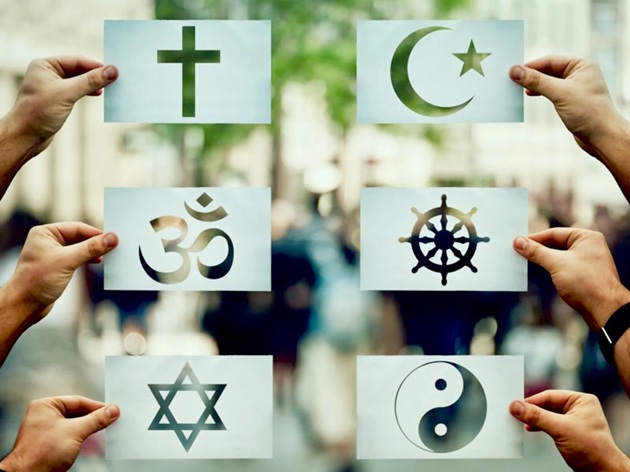
Similarly, religious nationalism in multiple regions—whether Christian, Jewish, Hindu, Buddhist, or Muslim—has been gaining strength in recent years. When one religiously framed conflict emerges, it can reinforce others. Narratives of civilizational struggle feed upon each other.

As the confrontation between the United States, Israel, and Iran becomes widely interpreted through a religious lens, the consequences may be profound. Christian–Muslim tensions, already strained in many contexts, could escalate dramatically. Such conflicts would not respect national borders. They would unfold within societies, across communities, and through global networks of believers.

Ironically, this escalation occurs at a time when religious leaders frequently emphasize the peace-promoting teachings of their traditions. Interfaith initiatives celebrate dialogue, coexistence, and shared values. Religious texts across traditions contain powerful injunctions toward compassion, justice, and reconciliation.

Yet these ideals remain fragile when confronted with political realities.

If religious institutions fail to challenge narratives that sanctify violence, they risk becoming spectators to a new era of religious conflict. Worse still, they may be drawn into it.

Are “Religions” Truly for Peace?

We may therefore be standing at the threshold of a profoundly dangerous historical moment.

Religious language is once again being used to justify war. Political conflicts are increasingly framed as civilizational struggles. Multilateral institutions that once mediated global disputes appear weakened. And faith communities—despite their moral authority—have yet to mount a unified challenge to the narratives that sacralize violence.

None of this means that religion inevitably leads to war. On the contrary, religious traditions contain some of humanity’s most powerful ethical teachings about peace, justice, and compassion. Faith communities have played vital roles in reconciliation processes, humanitarian action, and social movements for justice.

But these possibilities are not automatic. They depend on conscious choices by religious leaders, institutions, and believers.

If religious actors allow their traditions to be mobilized in support of political violence, then religion will become part of the problem rather than the solution.

The question confronting us today is therefore both urgent and uncomfortable.

At a moment when wars are increasingly described as sacred struggles, when geopolitical conflicts are interpreted through religious narratives, and when Islamophobia and other forms of religious prejudice continue to spread, we must ask ourselves: How are religions truly forces for peace?

Prof. Azza Karam, PhD. is President, Lead Integrity

IPS UN Bureau
  Source

A New World Order Where Might is Right

Armed Conflicts, Civil Society, Crime & Justice, Democracy, Featured, Global, Headlines, Human Rights, International Justice, IPS UN: Inside the Glasshouse, TerraViva United Nations

A New World Order Where Might is Right

Credit: Global Centre for the Responsibility to Protect

UNITED NATIONS, Mar 3 2026 (IPS) – As the build-up for a proposed “new world order” continues, a lingering question remains: will the country with the most powerful military reign supreme?

The United Nations remains politically impotent. The UN charter is in tatters. The sovereignty of nation states and their territorial integrity have been reduced to political mockery. And the law of the jungle prevails—be it Palestine, Ukraine, Venezuela or Iran.


What’s next: Colombia? Cuba? Greenland? North Korea?

The widespread condemnation of the ongoing conflicts – including charges of war crimes and genocide— has continue to fall on deaf ears.

UN Secretary-General Antonio Guterres told the Security Council that under Article 2 of the UN Charter, all member states shall “refrain in their international relations from the threat or use of force against the territorial integrity or political independence of any state.”

But is anybody out there listening?

Norman Solomon, executive director, Institute for Public Accuracy and national director, RootsAction.org, told IPS killing from the sky has long offered the sort of detachment that warfare on the ground can’t match. Far from its victims, air power remains the height of modernity

Reliance on overwhelming air power is key to what the U.S. is doing in tandem with Israel. Bombing from the skies while not attacking with ground forces is the ultimate way of killing without suffering many casualties.

This reduces political blowback at home in a political and media culture that values American lives but sees the lives of “others” as readily expendable, he pointed out.

“This flagrant war of shameless aggression, launched by the United States and Israel, cannot be contained — much less rolled back — by the typical diplomatic euphemisms and caution.”

The U.S. and Israeli governments, said Solomon, are too completely run by psychopathic leaders who adhere only to the “principle” that might makes right. If ever there were a time that the vaunted “international community” should step up and confront an alliance of reckless outlaw governments, this is it.

The European allies of the United States, he said, should stop their cowardly vagueness and finally step up to demand a halt to this aggression that is setting the Middle East tinderbox on fire. The EU should be threatening huge countermeasures against the United States and Israel unless that pair of sociopathic governments immediately halts their assault on Iran.

“Playing evasive games with Washington makes the leaders in London, Paris, Berlin and elsewhere accomplices to methodical ongoing war crimes”, declared Solomon, author of “War Made Invisible: How America Hides the Human Toll of Its Military Machine”

According to the Global Centre for the Responsibility to Protect, the US-Israeli act of aggression against Iran was undertaken in violation of international law and the UN Charter, as they exercised use of force without authorization from the UN Security Council (UNSC) or without a demonstrated threat to their security that would trigger the right to self-defense under Article 51 of the UN Charter.

“The attack came amid ongoing nuclear talks between the US and Iran and just hours after Oman’s Foreign Minister – a key mediator in the negotiations – shared details on progress achieved and announced that a breakthrough was near. The attack also mirrors the recent unlawful actions undertaken by the US in Venezuela on 3 January, culminating in the kidnapping of the head of state and setting in motion profound uncertainty for the region and the global order.”

Meanwhile, the Geneva-based UN refugee agency, the UNHCR, said it is deeply concerned about the escalation of conflict in the Middle East and its impact on civilians and further displacement in the region.

“Many affected countries already host millions of refugees and internally displaced people. Further violence risks overwhelming humanitarian capacities and placing additional pressure on host communities”.

“We echo the UN Secretary-General’s urgent call for dialogue and de-escalation, respect for human rights, the protection of civilians and full adherence to international law”.

James Jennings, President of Conscience International, told IPS the joint US-Israeli attack on Iran was misguided, illegal, and based on lies. It will retard, not advance, any future nuclear agreement, perhaps for decades.

It was illegal, he pointed out, because it violates both the US constitution and international law as enshrined in the UN Charter. It was based on lies because the nuclear watchdog groups have clearly indicated in essence that “There’s nothing to see here.”

“Trump regularly claims that June’s joint “Operation Midnight Hammer” obliterated Iran’s nuclear capability, yet his weak case for the current “Operation Epic Fury” war rests on the idea that perhaps someday in the future Iran might get a bomb. Several US administrations have worked diplomatically to prevent that, yet Trump tore the agreement up”.

Trump claims to be limited by no law, constitution, or the UN Charter. Guided only by his own morality, as he said recently, he followed Israel obediently in launching a massive war against a sleeping country of 92 million people, said Jennings.

“All the while, his amateur diplomats were negotiating deceptively for a compromise like Imperial Japan did in the run-up to the WW II Pearl Harbor attack. Ask the parents of the more than l00 schoolgirls killed on the first horrifying day of joint US-Israel bomb attacks at Minaj, Iran, and they will probably not see Mr. Trump as particularly moral”.

George W. Bush called himself “The Decider, so he foolishly decided to take the US into two unwinnable wars that most politicians in Washington, and even Trump himself, now consider monumental mistakes. Trump campaigned vigorously on keeping the US out of mistaken Middle East wars that became “Forever Wars,” said Jennings.

“Yet here he is being pulled around by the nose by Mr. Netanyahu. According to a classic rule when launching a war, one must recognize that two things cannot be changed: one is history and the other is geography. It is stunning that the leader of the United States is cavalier about going to war without understanding that or clearly stating the mission’s purpose or end game.”

Pundits and TV reporters are calling the attack on Iran “a war of choice,” said Jennings.

“Why not call it what it really is–a war of naked aggression? Nobody knows when will it end. Trump’s claim that the war will be over in a few days is a cruel joke. The other side gets a vote. Iran celebrated its 2,500th anniversary in 1971. Maybe people who have been around so long know a few things about survival,” declared Jennings.

IPS UN Bureau Report

  Source

Over 25,500 Palestinians Killed: Absence of Accountability is Nothing Short of Shameful

Armed Conflicts, Civil Society, Crime & Justice, Democracy, Headlines, Human Rights, IPS UN: Inside the Glasshouse, Middle East & North Africa, TerraViva United Nations

Opinion

Over 25,500 Palestinians Killed: Absence of Accountability is Nothing Short of Shameful

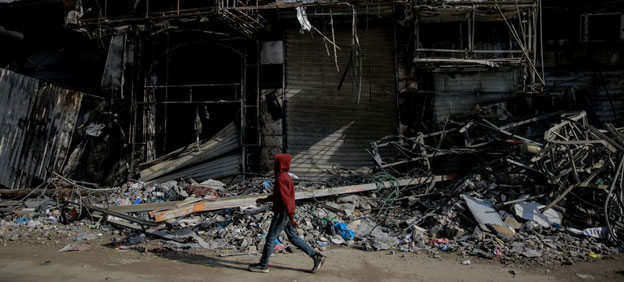
A boy walks through a destroyed neighbourhood in Gaza City. Credit: UNICEF/Omar Al-Qattaa

 
UN High Commissioner for Human Rights, Volker Türk’s remarks to the Interactive Dialogue on the human rights situation in the Occupied Palestinian Territory, at the 61st session of the Human Rights Council in Geneva on February 26 2026.

GENEVA, Feb 27 2026 (IPS) – The situation in the Occupied Palestinian Territory is a human-made disaster.

The report before you sets out events between 1 November 2024 and 31 October 2025 that show Israel’s utter disregard for human rights in Gaza and the West Bank, and the serious violations also committed by Hamas and other Palestinian armed groups.


The evidence gathered by my Office reveals a consistent pattern of gross violations and abuses of human rights, serious violations of international humanitarian law and atrocity crimes – that remain unpunished.

Israel’s continued attacks on residential buildings and makeshift tents, destroying entire neighbourhoods, caused mass civilian deaths. More than 25,500 Palestinians were killed, including entire families, and more than 68,800 were injured during the reporting period.

Among those killed were many Palestinian journalists. My Office has verified that 292 were killed in Israeli operations since 7 October 2023.

Israel’s militarization of humanitarian aid, through the Gaza Humanitarian Foundation, also led to large-scale killings. Between late May and 8 October 2025, my Office recorded 2,435 Palestinians killed by the Israeli military near food collection points — mostly young men and boys.

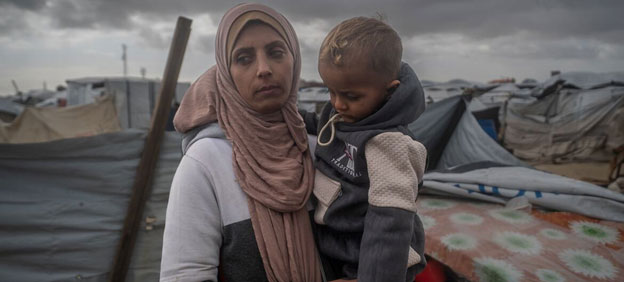
In August 2025, famine was declared in Gaza, affecting more than half a million people. According to the Palestinian Ministry of Health, at least 463 Palestinians, including 157 children, died from starvation. This was the direct result of Israel’s blocking of humanitarian aid and other deliberate actions.

A woman holds a child as a storm approaches Khan Younis in Gaza. Credit: WFP/Maxime Le Lijour

Israeli forces continued to kill humanitarian and medical personnel during this period, and to make mass arrests of Palestinians across Gaza and the West Bank. These arrests often amounted to arbitrary detention, and included enforced disappearances.

Since 7 October 2023, my Office has verified that at least 89 Palestinians have died in Israeli custody. Torture and other ill-treatment of Palestinians in Israeli detention remain widespread.

Israeli operations destroyed some 80 percent of civilian infrastructure in Gaza – including homes, schools, hospitals, cultural sites, and water treatment plants.

During the reporting period, Israel continued to forcibly displace Palestinians, into ever-shrinking areas of the Gaza strip. Over the course of 2025, Hamas and other Palestinian armed groups continued to hold hostages in blatant violation of international law.

Fifty-one hostages who were seized on 7 October 2023 were returned to their loved ones. On their release, the hostages recounted their traumatic ordeals, including sexual and gender-based violence, torture, beating, and prolonged confinement underground.

In June, there were reports that armed men, allegedly affiliated with Hamas, summarily executed 12 Palestinians associated with the Gaza Humanitarian Foundation. In the West Bank, including East Jerusalem, Israeli security forces continued to launch airstrikes and use unlawful force, killing hundreds of Palestinians.

In January 2025, Israeli forces launched Operation Iron Wall in the northern West Bank, which is still ongoing. So far, they have forced 32,000 Palestinians from their homes.

Meanwhile, Palestinian security forces increased the use of unnecessary or disproportionate force, resulting in the unlawful killing of at least 8 Palestinians. They also arbitrarily detained and ill-treated more than 300 Palestinians.

The ceasefire of 11 October 2025 brought some measure of relief. But we must not mistake this for peace or safety. People are still dying in Gaza from Israeli fire, cold, hunger, and treatable diseases and injuries.

Since the ceasefire, Israeli attacks in Gaza have killed more than 600 Palestinians and injured more than 1,600, according to the Palestinian Ministry of Health. Anywhere else, this would be considered a major crisis.

My Office has also recorded at least 80 reported killings of Palestinians by Hamas since the ceasefire, mostly by summary executions and in clashes with rival factions. Gaza now has the highest number of amputee children per capita in the world.

Israel continues to destroy civilian infrastructure and forcibly transfer Palestinians within the Occupied Palestinian Territory. The humanitarian situation is still extremely precarious, as Israel continues to impede the humanitarian community’s ability to bring in food, shelter, fuel, medical supplies, and other essential items.

Since the ceasefire, at least 11 children have died from hypothermia. I deplore Israel’s decision at the end of last year to suspend some 37 aid groups from Gaza. I also deplore the ban on UNRWA operations and the demolition of its premises in East Jerusalem in blatant violation of international law.

Today, the situation in the West Bank is particularly disturbing. Recent Israeli measures expanding land expropriation consolidate the annexation of Palestinian territory. This is in flagrant breach of the Palestinian right to self-determination.

Israeli security forces continue to use unnecessary and disproportionate force, and have killed 1,020 Palestinians since 7 October 2023, according to figures verified by my Office.

Taken together, Israel’s actions appear aimed at making a permanent demographic change in Gaza and the West Bank, raising concerns about ethnic cleansing.

The absence of accountability for the egregious violations committed is nothing short of shameful. Instead, there are efforts to obstruct accountability. The unilateral sanctions imposed on 11 judges and prosecutors of the International Criminal Court are completely unacceptable.

As are those imposed on the Special Rapporteur on the Occupied Palestinian Territory, appointed by this Council. Time and again, I stand before this Council and brief on the litany of violations. I make recommendations, plead for accountability, and for respect for international law.

I do so again today, because it is crucial. The ongoing violations of international law in Gaza must stop. I need to issue a stark warning about the rapidly deteriorating situation in the West Bank. Israel must end its unlawful occupation, in line with the conclusion of the International Court of Justice. And Israel must lift undue restrictions on the flow of humanitarian aid.

We have thought a lot about the contribution my Office can make to shift the trajectory of this awful situation. It may seem incongruous or inappropriate to talk about reconstruction as the suffering continues unabated.

But we have a responsibility to think about what is needed to break this senseless cycle. To talk about lasting peace. Human rights have been crushed in the Occupied Palestinian Territory.

Any realistic effort to rebuild and move toward lasting stability will have to be anchored in human rights. And this is urgent. The reconstruction of Gaza is not a logistics exercise.

Rebuilding Gaza and restoring human rights throughout the Occupied Palestinian Territory requires focusing on what people have lived through over many generations and cutting through the contested narratives.

I see five elements that can help us get there.

First, there need to be meaningful steps towards accountability for all human rights violations and abuses. My Office’s reports form part of this record. Continued monitoring and reporting of the human rights situation is critical.

Second, there must be the long-overdue realization of Palestinians’ right to self-determination, including full responsibility for their own governance and control over their land and resources. Palestinians must be able to shape their own futures and lead reconstruction efforts in Gaza.

Third, security is more than weapons and walls. Unequal treatment is feeding grievances. People can only feel safe when they have faith in equal justice and the rule of law. All segregationist laws and policies that resemble the kind of apartheid system we have seen before must be dismantled.

Fourth, Palestinian and Israeli civil society organizations and human rights defenders that are trusted by their communities need to be central partners in safeguarding human rights going forward. They need the support and protection of the international community.

And finally, we need understanding and healing among Palestinian communities, and between Palestinians and Israelis. This means working to undo the dehumanization which has fuelled this decades-long conflict.

The voices of peace movements – Palestinian, Israeli, and those that bring together Palestinians and Israelis – must be heard and heeded. This can strengthen the constituency for dialogue and increase the space for shared narratives.

The international community needs to step into the moral vacuum and seize the moment – not to return to the pre-October 2023 status quo, but to finally address the underlying causes of this conflict.

Member States need to pursue a path to sustainable peace — one in which Palestine and Israel live side by side in equal dignity and rights, in line with UN resolutions and international law.

IPS UN Bureau

  Source

After a Brutal Winter, Millions of Ukrainians Face Deepening Displacement and Uncertainty

Armed Conflicts, Civil Society, Crime & Justice, Democracy, Europe, Headlines, Human Rights, IPS UN: Inside the Glasshouse, TerraViva United Nations

Opinion

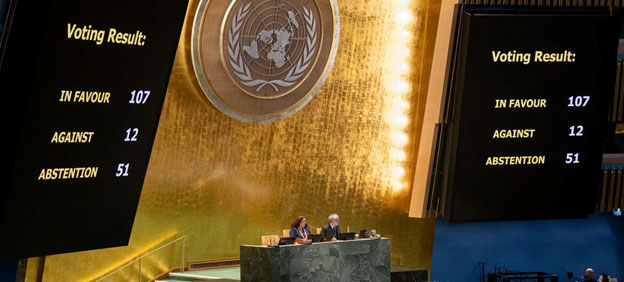
Result of the General Assembly vote on the draft resolution “Support for lasting peace in Ukraine” adopted during the emergency special session. 24 February 2026
Four years after Russia launched its full-scale invasion of Ukraine, the UN is marked the day with high-level debate and renewed calls to end the war – including in the General Assembly which passed a resolution reaffirming its strong commitment to the sovereignty, independence and territorial integrity of Ukraine. Credit: UN Photo/Manuel Elías

GENEVA, Feb 25 2026 (IPS) – After surviving the harshest winter in a decade, millions of displaced Ukrainians are confronting a growing crisis marked by hardship and ongoing attacks as peace prospects remain distant.


Inside Ukraine, repeated attacks on housing, energy systems and essential services throughout the winter left millions without heating or electricity for prolonged periods. While temperatures are slowly rising, the damage remains. An estimated 10.8 million people inside the country need humanitarian assistance in 2026, and 3.7 million are internally displaced.

At the same time, 5.9 million Ukrainians remain refugees abroad. Across Europe, host countries have provided protection and opportunities at an unprecedented scale, giving refugees access to education, healthcare and employment. This has helped millions regain stability and contribute to host communities.

As the war continues, however, more is needed to support refugees from a displacement crisis with no clear end. Alongside Temporary Protection, States should explore options for alternative arrangements for longer stay. These can bring stability for the most vulnerable in particular, for whom return may not be immediately possible even after the war.

Evidence shows that meaningful inclusion delivers results and refugees significantly boost host country economies. In Poland, analysis by UNHCR and Deloitte showed that Ukrainian refugees’ net impact amounted to 2.7 per cent of the Polish GDP, in 2024. With increased language training and wider recognition of credentials, access to decent work and self-reliance can improve for refugees across the region.

Inside Ukraine, communities continue to repair homes, restore services and rebuild livelihoods, with the support of UNHCR and NGO partners. But after four years of war, resilience has limits. Sustained humanitarian assistance remains essential, alongside scaled-up recovery and reconstruction support to prevent further displacement and enable safe conditions for return.

When conditions allow, gradual and voluntary returns will be critical for Ukraine’s recovery. UNHCR is working with the Government and partners to restore people’s documents, support rehabilitation of social infrastructure and repair war-damaged homes. UNHCR also works with partners to analyse refugees’ intentions, forecast return movements and support Ukraine’s recovery planning.

Since the start of the full-scale war, UNHCR and partners have supported 10 million people with emergency aid, protection services and psychosocial support. In 2026, UNHCR plans to assist a further 2 million people inside the country, subject to sufficient funding. Across the region, UNHCR and partners are supporting 1.7 million refugees and the States hosting them, with a focus on inclusion and self-reliance.

As winter fades, the humanitarian crisis does not. We must support the people of Ukraine with humanitarian relief and recovery inside the country, and with safety and self-reliance abroad.

Philippe Leclerc is UNHCR’s Regional Director for Europe and Regional Refugee Coordinator for the Ukraine Situation

IPS UN Bureau

  Source

‘Nothing Compares to Human Lives Lost’ – Reflections on Ukraine War

Armed Conflicts, Civil Society, Editors’ Choice, Europe, Featured, Headlines, Human Rights, Humanitarian Emergencies, International Justice, Peace, TerraViva United Nations

Armed Conflicts

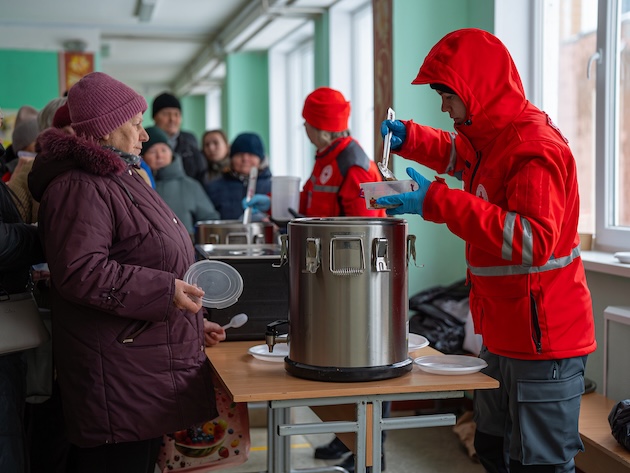
Ukrainian Red Cross teams have delivered over 3,300 hot meals to Kyiv residents at support points around the city. Credit: Red Cross

Ukrainian Red Cross teams have delivered over 3,300 hot meals to Kyiv residents at support points around the city. Credit: Red Cross

BRATISLAVA, Feb 24 2026 (IPS) – “We have a saying here in Ukraine now – ‘young people meet at their friends’ funerals rather than at weddings.’ It’s sad, but very true.”


As Russia’s full-scale invasion of her country moves into its fifth year, Iryna Yakova, 29, is looking back at how her life has changed over the past four years.

Speaking from Lviv, the western Ukrainian city where she lives, she tells IPS that her “values and attitude towards life” have changed. “Material things become unimportant when your loved ones or friends are in danger,” she says. She has also developed a keen sense of her national identity and an empathy for the suffering of her fellow Ukrainians.

“During the full-scale invasion, I realised that all of Ukraine is my home. I cry for people who were killed by a missile in Kyiv while they were sleeping at night. Even though I didn’t know them, it hurts me because they are Ukrainians. It also pains me to see children growing up without their parents because their parents are at the front. The war has intensified my sense of empathy and belonging.”

Her mental health has suffered. She says anxiety is ever-present in her life.

But what she returns to often as she answers questions about how her life is today compared to before the war is the loss she, and others, have experienced.

“What I miss most [from my life before the full-scale invasion] are the people who have been killed in the war. I have lost friends, acquaintances, and relatives. Nothing compares to human loss. The hardest thing I have had to deal with during this war is going to the funerals of friends — people you used to go to parties with, travel with, study with,” she says.

The human cost of Russia’s full-scale invasion of Ukraine has been enormous – Ukraine’s government does not officially give figures for military casualties, but it has been estimated they could be up to 600,000 (Russian military casualties are thought to be more than twice that amount).

But the scale of civilian casualties has been huge, too. According to UN bodies, more than 15,000 civilians have been killed and over 41,000 injured in Ukraine since the start of the invasion on February 24, 2022.

Worryingly, as Ukraine marks the fourth anniversary of the start of the war, research suggests there has been a sharp increase in civilian casualties over the last year.

Data from Action on Armed Violence (AOAV), released earlier this month, showed civilian casualties in Ukraine increased by 26 percent in 2025 compared with 2024, despite there being a 6 percent drop in the number of injurious explosive weapon incidents recorded nationwide.

In Kyiv, response efforts continue amid attacks on energy infrastructure and severe cold. The Ukrainian Red Cross is supporting warming centres around the clock, providing people with a safe place to warm up, receive assistance, and feel cared for during difficult conditions. Credit: Red Cross

In Kyiv, response efforts continue amid attacks on energy infrastructure and severe cold. The Ukrainian Red Cross is supporting warming centres around the clock, providing people with a safe place to warm up, receive assistance, and feel cared for during difficult conditions. Credit: Red Cross

The group said its data showed a worrying shift in the character of the conflict – the average number of civilians killed or injured per incident in Ukraine rose 33 percent over the year, with a total of 2,248 civilians reported killed (an 11 percent rise) and 12,493 injured (a 28 percent rise) by explosive violence.

This suggests that explosive weapons are being used by Russia in Ukraine in ways that generate greater civilian impact, whether through more drone strikes, heavier munitions, specific targeting choices of populated areas, or repeated strikes on urban infrastructure, the group said.

Nearly seven in ten civilian casualties recorded in AOAV data occurred in residential neighbourhoods, up from just over four in ten in 2024.

Niamh Gillen, a researcher at AOAV, told IPS it was impossible to definitively say that Russian forces were deliberately targeting Ukrainian civilians, but that “the data speaks for itself.”

“It shows that civilian areas are being attacked, that the attacks are occurring within civilian areas like hospitals, schools, cities, towns. In general, in areas where civilians are heavily concentrated, like cities and towns, villages, anywhere like that, if you’re using an explosive weapon with wide area impacts, then you’re likely to harm more civilians,” she said.

On top of the deaths and destruction Russian attacks have caused, they have also led to massive displacement. It is thought that at least 3.4 million people are internally displaced in the country. This has put massive pressure not just on the displaced themselves, but also on host communities and services.

People’s physical health has deteriorated in such conditions – the World Health Organisation (WHO) has said that more than two-thirds of the population have reported a worsening of their health since the start of the invasion.

But the harm caused by these attacks is far from just physical. Mental health professionals in the country, as well as international bodies including the WHO, have warned of a mental health crisis in Ukraine, with possibly up to 10 million people suffering with mental health problems.

IPS spoke to scores of people in cities and towns across Ukraine about how the war had affected their mental health. Many spoke of experiencing anxiety, sometimes permanently to some level, which could be intensified at any moment by the frequent sound of air raid sirens warning of an attack, or for those closer to frontlines, the sounds of explosions and bombings.

“What affects my mental health on a daily basis are the constant nighttime drone and missile attacks. Because of them, it is impossible to relax or get proper rest, as reaching a shelter for safety is essential, even at night,” Mihail*, a teenager who lives in the Kyiv region, told IPS.

The situation for many Ukrainians has acutely worsened this winter. In what has been one of the coldest winters the country has seen for many years, Russian forces have repeatedly attacked Ukraine’s energy infrastructure, resulting in massive, widespread power outages. Thermal heating facilities have also been destroyed in targeted attacks.

As temperatures have plunged to as low as minus 30 degrees Celsius on some occasions, millions of people have been left freezing in their homes.

Jaime Wah, Deputy Head of Delegation with the International Federation of Red Cross and Red Crescent Societies (IFRC) in Ukraine, said people were suffering desperately in the cold.

“Some nights have been very unbearable. There is no escape from the cold. When you leave your apartment, it’s cold. Sometimes people have been joking that it’s warmer inside a fridge than inside their apartment. I’ve been here for over four years now, and it’s been the worst winter,” she told IPS.

Humanitarian organisations, including the Ukrainian Red Cross, and state emergency services have set up emergency heating points in cities and towns where people can keep warm, recharge devices and get food.

But Wah said while this has become a humanitarian crisis, it is one of just many crises Ukrainians are battling.

“In frontline regions, there are communities that are under evacuation orders, and some communities have essentially had most of their resources cut off. Family ties are quite strained – mental health needs are also immense, not only in the frontline regions but across Ukraine,” she said.

“There are lots of repairs to homes that are needed, not to mention the energy crisis, which is a humanitarian crisis… with no heating and no electricity, just the day-to-day things – just even heating your food becomes a problem. A lot of families are having to spend more time outside their homes, having to spend more money. On top of that, the cost of living has increased. These are some of the real, tangible situations that people in Ukraine are facing now,” she added.

Amid these problems, many Ukrainians admit that they are exhausted after four years of war.

But among the many people IPS spoke to on the eve of the fourth anniversary of the war, there was a widespread, although certainly not universal, determination to not give up.

“I feel a sense of responsibility. I do not have the right to give up, because many people have died so that I could have the chance to live. Of course, there is exhaustion, but, unlike those in the military, a civilian like me has time to rest and reset,” said Iryna.

For many, such resilience is born out of a desire not just for them and their country to survive what they see as Russia’s attempt to destroy them as an independent state and nation, but also a hope that, ultimately, there will be some justice served for what has been done to them.

The Russian military and authorities have repeatedly been accused of war crimes, crimes against humanity, breaches of international humanitarian law, as well as genocide, during the invasion of Ukraine.

The sheer volume of alleged crimes – at least 180,000 war crimes have been registered by Ukraine’s Prosecutor General – and the constraints of documenting, investigating and prosecuting during an ongoing conflict mean that bringing those behind them to justice was never expected to be easy. Only over 100 people have been prosecuted in Ukraine so far for crimes during the invasion.

But there are fears that international bodies such as the International Criminal Court (ICC), which has issued an arrest warrant for, among others, Russian President Vladimir Putin over alleged war crimes, could be rendered increasingly toothless in their ability to ever prosecute major figures who ordered such crimes because world leaders, such as US President Donald Trump, are no longer interested in upholding international justice for war crimes.

“I truly hope that the war will end very soon and that all war criminals will be brought to justice. However, what I see happening right now is the opposite: while institutions like the UN are unable to punish Russia, people are starting to forget about its war crimes. Countries are gradually lifting sanctions,” said Mihail.

“For example, Russian athletes are going to be able to take part in the Paralympics this year. As a result, people who committed war crimes just months or years ago can now take part in one of the world’s biggest sporting events. So we need to act – by refusing to normalise aggression, keeping sanctions firm and, most importantly, remembering about war.”

Others, though, are more hopeful.

“There is no doubt among Ukrainians that war criminals can be brought to justice,” Oleh Martynenko, an expert at the Ukrainian NGO Center for Civil Liberties, which documents war crimes, told IPS.

“This is evidenced by the participation of Ukrainians in international missions and courts where war criminals have been convicted. Also, thanks to the European Union, Ukrainians are building their own criminal prosecution systems, which provide for the arrest and imprisonment of Russian war criminals in accordance with UN international standards,” he said.

Regardless of these concerns and the other problems Ukrainians are facing as the full-scale invasion goes into its fifth year, some are looking to the future with a degree of hope.

“I feel a mix of determination, resilience, anger, and hope of victory,” Tetiana, a nurse in the Dnipropetrovsk region, who asked not to be identified for security reasons, told IPS. “Glory to Ukraine!” she added.

*Name changed to protect identity.

IPS UN Bureau Report

  Source

International Humanitarian Law is at Breaking Point – but not Beyond Repair

Armed Conflicts, Civil Society, Crime & Justice, Democracy, Global, Headlines, Human Rights, IPS UN: Inside the Glasshouse, TerraViva United Nations

Opinion

Credit: UNICEF/Eyad El Baba

 
What is international humanitarian law? Families flee their shattered homes in Tal al-Hawa neighbourhood in Gaza city. While aid workers serving conflict-affected civilian populations depend on a set of laws to protect them, some warring parties violate these global agreements, from targeting hospitals and schools to blocking aid workers from reaching civilians with lifesaving goods and services. Source: UN News

GENEVA, Feb 17 2026 (IPS) – International humanitarian law is at a breaking point, as rampant impunity for serious violations is enabling even greater abuses against civilians and detainees.


Across today’s wars, violations are no longer concealed or exceptional. They are increasingly open, systematic, and unpunished, with catastrophic consequences for those whom the law is supposed to protect.

New analysis of 23 situations of armed conflict between July 2024 and the end of 2025 reveals a consistent pattern: civilians are being killed, abused and starved at scale, while accountability mechanisms either falter or are actively undermined. Genocidal violence in Gaza, a renewed risk of genocide in Sudan, and mass atrocities elsewhere are not isolated horrors. Taken together, they point to a deeper failure – the collapse of meaningful restraint in the conduct of hostilities.

Conflict-related sexual violence has reached epidemic levels. Rape, sexual slavery, and sexual violence used as punishment or as a tool of territorial control have been documented across multiple conflicts, including in Colombia, the Democratic Republic of Congo, Myanmar, and Sudan. Particularly alarming is the growing number of cases involving attacks children, including victims as young as one.

These are not by-products of war, but violations long prohibited under international humanitarian law, now committed with near-total impunity. This occurs with the complicity of many other States, which have a duty to respect and ensure respect international humanitarian law.

This erosion of civilian protection is not primarily the result of gaps in legal knowledge. The rules exist. The problem is political choice – and a persistent failure to enforce, clarify and update the law where it no longer offers meaningful restraint.

Nowhere is this clearer than in the global arms trade. The United Nations Arms Trade Treaty has been widely ratified, including by major exporters such as China, France, and the United Kingdom. In theory, it requires its member States to deny arms transfers where there is a clear risk that weapons will be used to commit serious violations of international law. In practice, legal risk assessments are all too often overridden by strategic and political considerations.

Continued arms exports to Israel, Russia, and others, despite overwhelming evidence of civilian harm, have had devastating consequences on the ground.

Closing this gap does not require a raft of new rules in the short term. It requires the consistent application of existing ones: enforceable, evidence-based export controls; independent scrutiny of licensing decisions; and real accountability where transfers are authorised despite a clear risk that the law will be breached by the recipient.

Certain categories of weapons are though incompatible with the protection of civilians, but do not necessarily violate the already permissive standards. Repeated firing into populated areas of gravity ordnance from the air and inaccurate long-range artillery from the ground has been a major driver of civilian casualties across multiple conflicts.

There is a fundamental lack of clarity on two key rules: first, how close an attack may be launched to a military target while still complying with the law; and second, how much incidental civilian harm is permissible when targeting a military objective.

On both issues, the law urgently requires clarification. Restricting air-delivered weapons to precision-guided munitions alone would already make a measurable difference to civilian survival. Achieving this, however, requires States to clarify and update the rules of international humanitarian law that were drafted in the 1970s.

In State-on-State conflicts such as in Kherson province in Ukraine, drones have been used by Russian forces – and others – to target civilians, sometimes with real-time video footage disseminated online by the perpetrators.

At the same time, armed drones are no longer the preserve of States. Their use by non-State armed groups is increasing rapidly, including by JNIM in the Sahel, Islamic State in Somalia, and the Arakan Army in Myanmar. There is an urgent need for stronger mechanisms to attribute, investigate, and prosecute unlawful drone and autonomous weapon attacks.

Impunity on this scale is not inevitable. It is the product of sustained political and financial neglect. Institutions designed to promote compliance with international humanitarian law – including domestic courts and international tribunals – are under severe strain, with some facing paralysis or closure due to lack of resources.

Judges at bodies such as the International Criminal Court have even been sanctioned simply for carrying out their mandates. If States are serious about protecting civilians, political and financial support for these institutions must be treated as a core obligation and a policy priority, not an optional gesture.

The current moment represents a critical test for international humanitarian law itself. The international lawyer Hersch Lauterpacht once warned that the law existed at the “vanishing point” of international law. That warning is no longer theoretical.

Whether humanitarian law continues to function as a real constraint on warfare, or recedes into symbolic rhetoric, will depend on the political choices states make now – and on whether civilian protection is treated as a legal duty rather than a discretionary one.

Stuart Casey-Maslen is an international lawyer and lead author of War Watch: International Humanitarian Law in Focus at the Geneva Academy of International Humanitarian Law and Human Rights

IPS UN Bureau

  Source