‘After Decades of Denial and Silence, the Suffering of Rohingya People Is Being Heard at the World’s Highest Court’

Active Citizens, Armed Conflicts, Asia-Pacific, Civil Society, Crime & Justice, Featured, Gender Violence, Headlines, Human Rights, Migration & Refugees, TerraViva United Nations

Feb 9 2026 (IPS) –  
CIVICUS discusses the genocide case against Myanmar at the International Court of Justice (ICJ) with Mohammed Nowkhim of the Arakan Rohingya Society for Peace & Human Rights (ARSPHR), a civil society organisation led by Rohingya people born out of refugee camps in Bangladesh to document atrocities, preserve survivor testimony and advocate for accountability and justice.


‘After Decades of Denial and Silence, the Suffering of Rohingya People Is Being Heard at the World’s Highest Court’

Mohammed Nowkhim

On 12 January, the ICJ began hearings in the genocide case brought by The Gambia against Myanmar over the military’s treatment of the Rohingya Muslim minority. The Gambia, representing the Organisation of Islamic Cooperation’s 57 members, accuses Myanmar of breaching the Genocide Convention. The Gambia’s justice minister presented evidence of mass killings, sexual violence and village destruction during a government crackdown in 2017 that forced over 700,000 Rohingya people to flee to Bangladesh. Rohingya survivors testified in closed sessions. Myanmar denies genocidal intent, characterising its actions as counterterrorism. A final judgment is expected before the end of the year.

What atrocities were committed against Rohingya people and what is being examined in court?

During what were called ‘clearance operations’ in 2017, Myanmar security forces burned entire villages, raped women, killed children and threw them into fires and wells. According to documented reports, over 10,000 people were killed and around 700,000, including me, were forced to flee Myanmar. These were not random acts of violence; they were systematic and targeted attacks aimed at erasing our community.

In 2019, The Gambia, supported by 11 other states, filed a case against Myanmar at the ICJ, accusing it of genocide. Judges are now examining evidence of mass killings, sexual violence, village destruction and forced displacement. They are also reviewing official policies and actions that show intent to destroy Rohingya people as a group, including patterns of violence, coordination by state forces and the systematic denial of basic rights.

This case shows that genocide claims can be examined through law rather than dismissed for political convenience. But for the Rohingya, this is not just a legal process. It represents acknowledgment and a source of hope for present and future generations. After decades of denial and silence, our suffering is being heard at the world’s highest court and recognised in a legal space where truth matters. The hearings can’t erase our wounds, but they can offer some solace and a path towards justice.

What evidence supports the case against Myanmar?

The case was built on years of evidence-gathering. The Gambia relied on extensive material from the Independent Investigative Mechanism for Myanmar and United Nations (UN) fact-finding missions, as well as documentation collected over many years by human rights organisations, including Fortify Rights, Human Rights Watch and Rohingya-led groups.

Civil society played a key role when states failed to act. Even when the world looked away, organisations continued to document the truth and refused to let these crimes be erased or rewritten. Long before any court agreed to listen, groups including the ARSPHR were collecting survivor testimonies, documenting violations and carefully preserving evidence, knowing it might one day be used in court. Without that work, much of what happened would have been lost and perpetrators couldn’t have been challenged.

In a way, civil society became the memory of the Rohingya people. Today, this evidence forms part of the case before the ICJ.

Why is accountability so difficult?

Politics often protects perpetrators. Those with power choose stability over justice and shield those responsible for crimes. Myanmar’s authorities continue to deny wrongdoing and refuse to cooperate, which delays justice.

International law also has its limits. Justice moves slowly because ICJ rulings do not automatically lead to consequences. International courts can establish the truth, but they can’t force states to act. Enforcement depends on political will, often through the UN Security Council, where countries such as China and Russia can block action, even when crimes are clear and well documented.

What must happen to ensure justice?

There must be real action. Perpetrators must be held accountable, Rohingya citizenship must be restored and discriminatory laws that enabled genocide must be removed. Any return of refugees must be voluntary, safe and dignified. It can’t happen without international monitoring and guarantees of protection. People can’t be sent back to the same conditions that forced them to flee.

Ultimately, justice is not only about the past, but also about ensuring that future generations of Rohingya can live with rights, safety and dignity. This case is only the beginning. What happens after the judgment will decide whether justice is real or only symbolic.

CIVICUS interviews a wide range of civil society activists, experts and leaders to gather diverse perspectives on civil society action and current issues for publication on its CIVICUS Lens platform. The views expressed in interviews are the interviewees’ and do not necessarily reflect those of CIVICUS. Publication does not imply endorsement of interviewees or the organisations they represent.

GET IN TOUCH
Website
Facebook
Instagram
LinkedIn
Threads
Twitter
Mohammed Nowkhim/Facebook
Mohammed Nowkhim/LinkedIn

SEE ALSO
Myanmar’s junta tightens its grip CIVICUS Lens 12.Dec.2025
International Court of Justice offers hope of rules-based order CIVICUS Lens 19.May.2025
Myanmar at a crossroads CIVICUS Lens 28.Oct.2024
  Source

‘When Rains Come, Our Hearts Beat Faster’

Aid, Asia-Pacific, Civil Society, Climate Change, Climate Change Justice, Development & Aid, Disaster Management, Economy & Trade, Editors’ Choice, Environment, Featured, Headlines, Human Rights, Humanitarian Emergencies, Sustainable Development Goals, TerraViva United Nations

Disaster Management

A recent report reveals that Asia faces about 100 natural disasters every year, affecting 80 million people. Beyond the statistics are the disrupted lives, damaged homes, and a cycle of repair that drains communities.

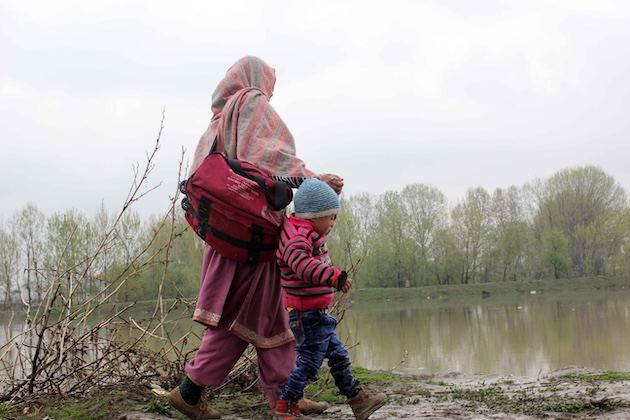
A woman in a remote hamlet in Kashmir, India, migrates to a safer location with her child as floodwater inundates her hometown. Credit: Umar Manzoor Shah/IPS

A woman in a remote hamlet in Kashmir, India, migrates to a safer location with her child as floodwater inundates her hometown. Credit: Umar Manzoor Shah/IPS

SRINAGAR & NEW DELHI, Feb 9 2026 (IPS) – When the rain begins in Kashmir’s capital Srinagar, Ghulam Nabi Bhat does not watch the clouds with relief anymore. He watches them with calculation. How much can the gutters take? How fast will the river rise? Which corner of the house will leak first? Where should the children sleep if the floor turns damp?


“Earlier, rain meant comfort,” said Bhat, a resident of a low-lying neighbourhood close to the city’s waterways. “Now it feels like a warning.”

On many days, the rain does not need to become a flood to change life. Streets fill up within hours. Shops shut early. The school van turns back. A phone call spreads across families, asking the same question, “How is your area?”

For millions across India and the wider region of emerging Asia (a group of rapidly developing countries in the region, including China, India, Indonesia, Malaysia, the Philippines, Thailand, and Vietnam), this is the new normal. Disasters no longer arrive as rare, once-in-a-generation ruptures. They come as repeated shocks, each one leaving behind repair bills, lost wages, and a deeper sense that recovery has become a permanent routine.

A recent analysis from the OECD Development Centre shows that emerging Asia has been facing an average of around 100 disasters a year over the past decade, affecting roughly 80 million people annually. The rising trend is powered by floods, storms, and droughts. The report estimates that natural disasters have cost India an average of 0.4 percent of GDP every year between 1990 and 2024.

Behind the national figure lies a quieter, more poignant story. It is the story of how repeated climate and weather shocks get absorbed by households and not just spreadsheets. By the savings a family built for a daughter’s education. By a shopkeeper’s stock bought on credit. By a farmer’s seed money saved from the last season.

In the north Indian state of Bihar’s flood-prone belt, Sunita Devi, a mother of three, says she has stopped storing anything valuable on the floor. Clothes sit on higher shelves. The grain container has moved to a safer corner. The family’s documents stay wrapped in plastic.

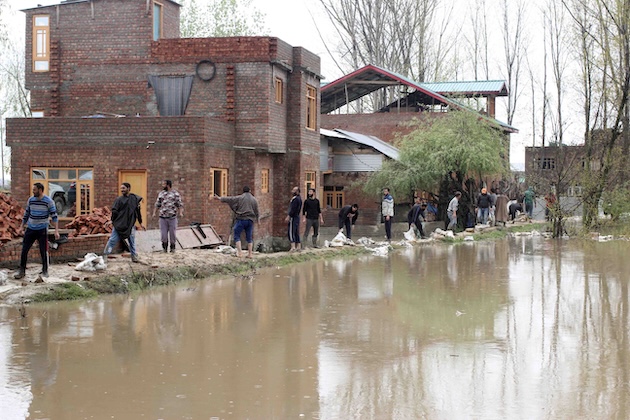
Local residents in Kashmir's capital, Srinagar, stack sandbags to safeguard their homes from floods in 2025. Credit: Umar Manzoor Shah/IPS

Local residents in Kashmir’s capital, Srinagar, stack sandbags to safeguard their homes from floods in 2025. Credit: Umar Manzoor Shah/IPS

“When water comes, you run with children,” she said. “The rest is left to fate. You can rebuild a wall. You cannot bring back the days you lost.”

Her village has lived with floods for decades, but she says what has changed is frequency, uncertainty, and cost. It is not only about big river floods that make headlines. It is also about sudden waterlogging, damaged roads, broken embankments, and illnesses that rise after the water recedes.

“Earlier we could predict. Now we cannot. Sometimes the water comes fast. Sometimes it stays. Sometimes it leaves and then comes again,” Devi told IPS.

Professor Kaveh Madani, director of the United Nations University’s Institute for Water, Environment, and Health, told IPS that water bankruptcy in Asia should be treated as a national security issue, not a sector issue.

“The priority is shifting from crisis response to bankruptcy management: honest accounting, enforceable limits, protection of natural capital, and a just transition that protects farmers and vulnerable communities,” said Madani.

Across emerging Asia, floods have emerged as one of the strongest rising trends since the early 2000s, the OECD Development Centre report notes. The reasons vary from place to place, but the result looks familiar: disrupted lives, damaged homes, and a cycle of repair that drains communities.

In Kashmir’s capital Srinagar, small shop owner Bashir Ahmad keeps an old wooden rack near the entrance. It is not for display. It is for emergencies. When rain intensifies, he quickly moves cartons of goods off the floor.

“My shop is small; my margin is smaller. One day of water is enough to destroy many things. Customers do not come. Deliveries stop. You just wait and watch,” Ahmad said.

He says the biggest loss is not always the damaged stock. It is the days without work. For families that live week to week, even a short shutdown becomes a long crisis. Rent does not pause. School fees do not pause. Loans do not pause.

The OECD analysis, while regional in scope, points to a hard truth that communities already know. It claims that disasters have economic aftershocks that last long after television cameras leave. When repeated losses occur every year, they reduce growth and reshape choices. Families postpone building stronger houses. They avoid investing in small businesses. They spend more time recovering than progressing.

“Disasters are no longer exceptional events. They have become recurring economic shocks. The problem is not only the immediate damage. It is the repetition. Repetition breaks household resilience,” Dr Ritu Sharma, a climate risk researcher based in Delhi, said.

Sharma says India’s disaster losses should not be viewed as a headline percentage alone.

They should be viewed as accumulated pressure on ordinary life.

“A flood does not only damage a bridge. It delays healthcare visits. It interrupts immunisation drives. It breaks supply chains for food and medicines. It can push vulnerable families into debt traps. What looks like a climate event becomes a social event. It becomes a health event. It becomes an education event.”

In the report’s regional comparisons, the burden is uneven. Some countries face higher average annual losses as a share of GDP, especially those exposed to cyclones and floods. India’s size allows it to absorb shocks on paper, but that size also means more people remain exposed. From Himalayan slopes vulnerable to landslides to coastal districts bracing for cyclones to plains dealing with floods and heat, risk is spread across geography and across livelihoods.

Prof. Nasar Ali, an economist who studies climate impacts, says the real damage is often hidden in the informal economy.

“A formal sector company can claim insurance, borrow on better terms, and restart faster. A vegetable vendor cannot. A small grocery shop cannot. A family with a single daily wage earner cannot. Their loss is immediate and personal. They also take the longest to recover,” Ali said.

He believes disaster impacts also deepen inequality because the poorest households lose what they cannot replace.

“A damaged roof for a rich family is a renovation problem. A damaged roof for a poor family can mean sleeping in damp rooms for weeks, infections, missed work and children dropping out temporarily.”

The report also turns attention toward a policy question that has become urgent across Asia: how should governments pay for disasters in a way that does not repeatedly divert development funds?

The analysis highlights disaster risk finance, tools that help governments prepare money in advance rather than relying mainly on post-disaster relief. This includes dedicated disaster funds, insurance mechanisms, and rapid financing that can be triggered quickly after a shock.

For communities, the debate may sound distant. But the outcomes are visible in the speed of recovery and the dignity of response.

“When a disaster happens, help should come fast,” said Meena Devi, who runs a small grocery shop in Jammu’s RS Pura area and has seen repeated waterlogging during intense rains. “We close our shop. Milk spoils. People cannot buy things. Then we borrow money to restart. If support is slow, we fall behind.”

She said her biggest fear is not a single disaster but the feeling that another one is always near.

“If it happens once, you survive. If it happens again and again, you get tired from inside,” she said.

For Sharma, preparedness must be more than emergency drills. It must include planning that reduces exposure in the first place.

“Some risks are unavoidable, but many are amplified by where and how we build,” she said. “If cities expand without drainage capacity, or if construction spreads into floodplains, then disasters become predictable. That is not nature alone. That is policy.”

In Srinagar, Bhat says residents often feel they fight the same battle every year. Cleaning drains. Stacking sandbags. Moving belongings. Calling relatives. Watching the river level updates. The work looks small, but it is exhausting because it never ends.

He pointed to marks on a wall that show where water once reached.

“We always think, maybe this year it will be better,” he said. “Then rain comes, and your heart starts beating faster.”

Asked what would make him feel safe, he did not talk about big promises. He spoke about basics. A drain that works. A road that does not collapse. A warning that comes early. Help that comes on time.

For Sunita Devi in Bihar, the dream is even simpler: a season where the family can plan without fear.

“We want to live like normal people. We want to save money, not spend it on repairing what the water broke,” she said.

IPS UN Bureau Report

  Source

Myanmar: Five Years Since the Coup and No End in Sight To War

Armed Conflicts, Asia-Pacific, Civil Society, Democracy, Editors’ Choice, Featured, Headlines, Human Rights, Humanitarian Emergencies, International Justice, TerraViva United Nations

Armed Conflicts

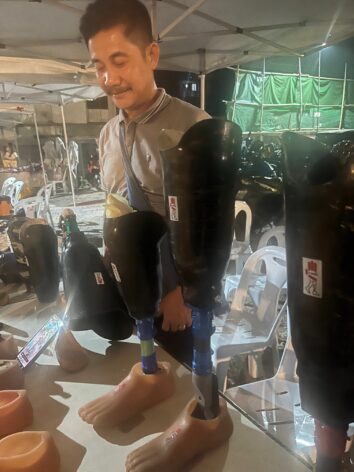
Prosthetics marketed by I-Walk at an event marking resistance to Myanmar’s military coup of five years ago. The enterprise has a waiting list of over 3,000 people. Credit: Guy Dinmore/IPS

Prosthetics marketed by I-Walk at an event marking resistance to Myanmar’s military coup of five years ago. The enterprise has a waiting list of over 3,000 people. Credit: Guy Dinmore/IPS

MYANMAR & THAILAND, Feb 4 2026 (IPS) – Five years of conflict since the military seized power have reduced Myanmar to a failed state and taken a huge toll of lives lost and destroyed. But with all sides seeking total victory, there is no end in sight.


Levels of medieval brutality enhanced by modern technology have enabled the military junta, with help from China, to swing the fortunes of war back in its favour, often through air strikes and drone attacks on civilian targets. Torched villages are deserted.

Kyaw Thurein Win, on the anniversary of the military’s February 1, 2021, coup against the elected civilian government, watched his village of Shut Pon burning in the southern region of Tanintharyi – through satellite imagery.

“Today my village is witnessing the cruelty of the military. They set the fires and ordered that they not be stopped. This is beyond inhuman and beyond cruel. Watching this happen from afar is unbearable,” he wrote on Facebook.

While the strength of anti-regime defiance and determination is undeniable among many in Myanmar, there is also a growing realisation – especially among former combatants — that the resistance will not win this war so soon, if at all.

“It is a stalemate. Nobody can win,” said one military defector, saying that cries of total victory by both the regime and the resistance ring hollow.

A young woman who runs a safe house for former child soldiers as young as 13 says she joined the People’s Defence Forces of the resistance that sprang up against military rule in 2021. But she soon came to realise that, for her at least, war was not the answer and started taking in children forced by poverty and displacement to become fighters against the regime.

She rails against the “whatever it takes” mentality and the toll it takes.

“The civilian suffering is ignored or exploited,” she says, attending a coup anniversary event – a mix of politics and culture and foodstalls –  organised by anti-regime civilian activists in Chiang Mai, northern Thailand. She shares a picture of ‘Commando’ in uniform, armed to the teeth. He was 12 at the time.

Sayarma Suzanna, fundraising for her school in Kayin State, the Dr Thanbyah Christian Institute for displaced and local children, said she and her 97 students spent all of November hiding in the nearby forest because of air strikes.

“You have to understand that when the students don’t listen to you during lessons, it is because of their trauma,” she said, recounting how one student lost seven family members in air strikes on their village.

At a nearby stall, the manager of I-Walk displayed an array of quality prosthetic limbs made by his enterprise as affordable as possible. He has a waiting list of over 3,000 people.

Myanmar is the most landmined country in the world with the highest rate of casualties. It also ranks as the biggest producer of illicit opium and a major source of synthetic drugs. Networks of online scam centres run by criminal gangs and militia groups close to the regime have trafficked tens of thousands of people from multiple countries, scamming billions of dollars.

The UN says 5.2 million people have been displaced by conflict inside the country and across borders. Cuts by rich countries to aid budgets have had a crippling impact. Some clinics are reduced to dispensing just paracetamol.

This year’s coup anniversary coincided with the conclusion of parliamentary and regional elections tightly orchestrated by the regime over the scattered and sometimes totally isolated areas of territory it controls, which include all major cities.

The three-phase polls – endorsed by China and Russia but slammed by the UN and most democracies except notably the US – excluded the National League for Democracy, which won landslide election victories in 2015 and 2020.

NLD leader Aung San Suu Kyi has been held in prison since the coup. There is speculation that Senior General Min Aung Hlaing might move her to better conditions of house arrest after the military’s Union Solidarity and Development Party, led by former senior officers, forms a nominally civilian government in April.

The USDP is cruising towards its managed landslide victory, according to almost complete results released last week.

The UN said it had reliable reports of at least 170 civilians killed in regime attacks during the month-long election period. Other estimates put the figure considerably higher.

One airstrike in Kachin State in northern Myanmar reportedly killed 50 civilians on January 22. Long-running attempts by the Kachin Independence Army and resistance forces to capture the nearby and heavily defended Bhamo town from the military have been costly. Some analysts ask, for what gain?’

Kachin State’s second biggest town is strategically located on a trade route to China but most of its 55,000 or so inhabitants have long since fled. The military would surely respond with heavy air strikes to any occupation by the resistance.

Data gathered by ACLED, a nonprofit organisation that analyses data on political violence, indicates over 90,000 total conflict-related deaths since the coup. The military, reliant on forced conscription, has borne the brunt of casualties, but civilian deaths are estimated at over 16,000.

“The military has carried out air strikes, indiscriminately or deliberately attacking civilians in their homes, hospitals, and schools,” said Nicholas Koumjian, head of the Independent Investigative Mechanism for Myanmar, adding that there is evidence that civilians have endured atrocities amounting to crimes against humanity and war crimes since the military takeover.

The IIMM is also investigating a growing number of allegations of atrocities committed by opposition armed groups, over which the parallel National Unity Government set up by lawmakers ousted in the coup has little or no control.

Former combatants say rogue People’s Defence Forces are also extorting money from local populations and holding people to ransom.

“Myanmar remains mired in an existential crisis – measured both in human security and the state’s shrinking sovereignty as rival centres of power harden on the ground,” the Institute for Strategy and Policy – Myanmar, a think-tank, stated in its recent annual review.

“The regime is meanwhile trying to break the current stalemate by accelerating counter-offensives on three fronts: military, diplomatic and political,” it said. The military-staged elections of 2010 led to a process of political and economic reforms but this time the regime intended to impose its own terms, the think tank said.

It warned of the risk that ethnic armed groups controlling swathes of border territories with Bangladesh, India, China and Thailand would end up – not for the first time – negotiating bilateral ceasefires and “rent sharing arrangements” with the regime. These would “consolidate the power of armed elites and reinforce central control rather than advance democracy, human rights or the rule of law.”

On Sunday, a panel discussion featuring anti-regime politicians and activists hosted by Chiang Mai University reinforced the sense of an opposition fragmented along ethnic and geographical lines, even if speakers upheld the principles behind their shared goal of a democratic federal union.

There was the customary rhetoric of “taking down this junta” and “whatever it takes”, but barely a mention of the National Unity Government that is struggling to knit together these diverse forces under the umbrella of a “Federal Supreme Council”.

On the panel, Debbie Stothard, a Malaysian democracy and women’s rights activist long involved with Myanmar, said the resistance needed two more years for victory, as the generals had “bought” one more year with their sham elections.

“Hang in there. We have to keep on going for at least two more years,” she said.

But in the big cities where the regime is starting to try and foster a sense of normality against a dire economic backdrop, the mood on the street appears more of resignation than defiance.

“When we started protesting against the regime in the streets in 2021, I told my husband we would defeat the military in three months,” an elderly Chin activist told IPS in Yangon, the former capital. “He replied it would take five years. Now I am afraid it will take another five years,” she said.

IPS UN Bureau Report

  Source

‘Since the Coup, Factory Employers Have Increasingly Worked with the Military to Restrict Organising and Silence Workers’

Active Citizens, Asia-Pacific, Child Labour, Civil Society, Crime & Justice, Economy & Trade, Featured, Gender Violence, Headlines, Health, Human Rights, Labour, TerraViva United Nations

Jan 28 2026 (IPS) –  
CIVICUS speaks to the Business and Human Rights Centre (BHRC) about labour rights abuses in Myanmar’s garment industry since the 2021 military coup.


Myanmar’s garment sector, which employs hundreds of thousands of workers, is in deep crisis. Since the coup, labour protections have collapsed, independent unions have been dismantled and workers who try to organise face intimidation, dismissal and arrest. Inside factories, reports show multiple cases of child labour, forced overtime, harassment, poverty wages and unsafe conditions. At the same time, rising living costs and US tariffs are pushing many workers further into insecurity as factories close and layoffs become more common. Garment workers, most of them women, are trapped between exploitation, repression and a rapidly shrinking industry.

How have conditions inside Myanmar’s garment factories changed since the coup?

Our monitoring between February 2021 and October 2024 shows a sharp rise in both the number and severity of pre-existing labour rights abuses. Since the coup, factory employers have increasingly worked with the military to restrict organising and silence workers. This collaboration has led to threats, arrests and violent attacks against workers. In one case, security forces carried out joint military and police raids on the homes of workers who demanded unpaid wages and limits on overtime.

Factories have also expanded surveillance. Workers report invasive searches, phone confiscation and installation of CCTV inside factories, including near toilets. Employers also force workers to lie during audits. These practices aim to hide abuses and have exacerbated the abuses workers already faced.

What abuses do garment workers suffer in the workplace?

Factories force workers to meet extreme production targets through excessive and often unpaid overtime. Many workers must stay overnight until dawn, often without enough food, water or ventilation, leading to exhaustion and health problems. Managers threaten and abuse workers who refuse to work overtime or fail to meet targets. We have documented a case where supervisors denied workers food and water as punishment for not meeting targets.

Health and safety conditions have worsened. Workers report dirty, insufficient toilets, poor food quality and unsafe drinking water. They’ve also reported blocked emergency exits, inadequate ventilation and leaking roofs that put lives at risk. Factory-provided transport creates further dangers, as they are often overcrowded and suffer frequent road accidents. In one case, a major crash involving a worker shuttle left several workers badly hurt, including one who needed abdominal surgery.

Women workers face particularly severe abuses, including hair-pulling, physical assault, sexual harassment and verbal attacks. In one case, supervisors punched and kicked women workers and called them ‘dogs’.

What happen to workers who try to speak out or organise?

Workers who dare speak out face brutal reprisals. After the military declared 16 labour unions and labour rights organisations illegal, arrests, home raids and surveillance increased, particularly against union leaders and activists linked to the Civil Disobedience Movement. The movement began after the coup and brings together workers who refuse to cooperate with military rule through strikes and other forms of non-violent resistance.

Inside factories, employers threaten and dismiss union leaders on false grounds. In one case, a factory reopened and refused to reinstate union members and publicly humiliated them. Employers have also created Workplace Coordination Committees to replace independent unions, denying workers the right to choose their representatives and silencing their complaints. Prominent union leaders such as Myo Myo Aye have been arrested multiple times simply for continuing to organise.

What should international brands be doing in this context?

Under the United Nations Guiding Principles on Business and Human Rights, brands operating in conflict settings must carry out heightened, conflict-sensitive due diligence and demonstrate, with independent and verifiable evidence, that it works. In Myanmar’s current context, where surveillance and violent repression run through all the supply chain, this standard is exceptionally hard to meet.

Any brand that stays must deliver clear and demonstrable improvements in working conditions. Brands that can’t meet this threshold must carry out a responsible exit, working with workers and their representatives and taking steps to reduce harm, rather than adding to the instability garment workers already face under military rule.

GET IN TOUCH
Website
BlueSky
Facebook
LinkedIn
Twitter
YouTube

SEE ALSO
Myanmar’s junta tightens its grip CIVICUS Lens 12.Dec.2025
Historic wins and hard truths at International Labour Conference CIVICUS Lens 27.Jun.2025
Business and Human Rights Treaty: a decade of struggle for corporate accountability CIVICUS Lens 08.Mar.2025

  Source

Steering Nepal’s Economy Amid Global Challenges

Asia-Pacific, Civil Society, Development & Aid, Featured, Global, Headlines, Humanitarian Emergencies, Sustainable Development Goals, TerraViva United Nations

Opinion

Steering Nepal 's Economy Amid Global Challenges

The country faces a challenging transition, but it can progress if the people work together.

WASHINGTON DC, Jan 22 2026 (IPS) – Nepal has a unique opportunity for transformation. The recent youth-led protests underscored aspirations for greater transparency, governance and a more equal distribution of economic opportunities and resources. This yearning resonated in Nepal and beyond.


Now, Nepal must find a balance in setting prudent political, economic and financial policies to steer a difficult transition in an orderly manner. Adding to the complex domestic situation is the lingering uncertainty in the global economy. The transition process in this challenging environment should ensure an inclusive future for Nepal’s people.

Economic challenges

History shows that more equal societies tend to be associated with greater economic stability and more sustained growth. This will be a helpful guiding strategy as Nepal charts its own path to change. Indeed, a solid strategy needs to be founded on two key pillars: economic stability and inclusive growth.

In 2022, stability was among the top priorities when the country’s leaders approached the IMF for support. The collapse of tourism in the wake of the Covid-19 pandemic took a heavy toll on Nepal’s economy, including on its job market.

The IMF’s financing package assisted the authorities’ Covid-19 response in mitigating the pandemic’s impact on economic activity, protecting vulnerable groups and laying the groundwork for sustained growth. The program also supported reforms to foster durable growth and reduce poverty over the medium term, including by implementing cross-cutting institutional reforms to improve governance and reduce corruption vulnerability.

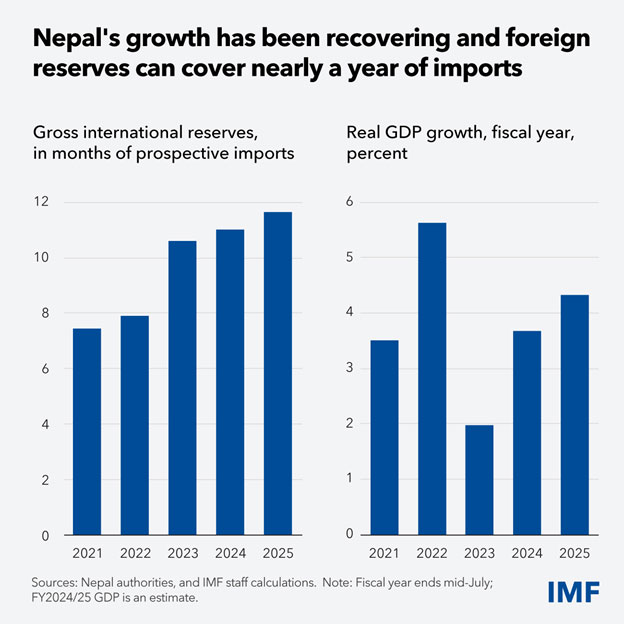
In October, Nepal completed the sixth of seven program reviews, showing tangible improvement in the economy. Indeed, Nepal has been seeing the green shoots of recovery with real GDP growth rising from a mere 2 percent in FY 2023, to 3.7 percent in FY 2024, to an estimated 4.3 percent in FY 2025—more than double the pace in just a few years.

In FY 2026, we still expect the country’s economic recovery to continue, though at a more moderate pace amid a complex domestic environment and global uncertainty.

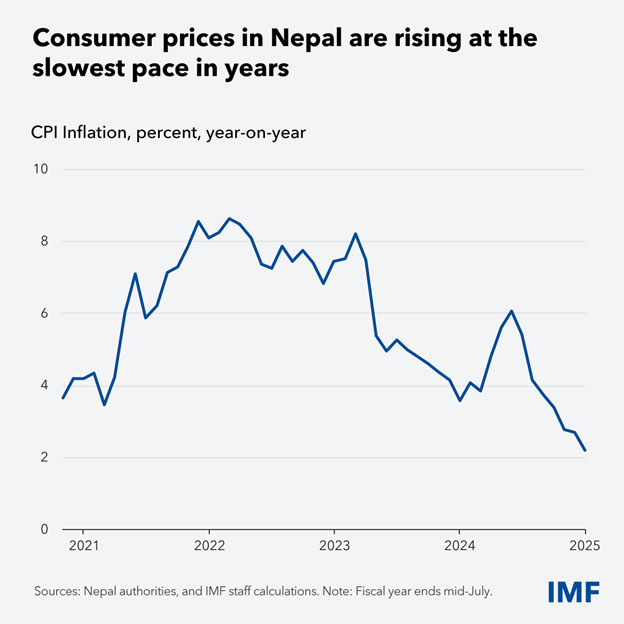
Nepal has also been very successful in rebuilding policy buffers. Foreign exchange reserves have risen to nearly $20 billion, enough to cover almost a full year of imports. Fiscal discipline has helped stabilise public debt. Inflation remains well below the Nepal Rastra Bank’s target.

This hard-won economic stability should be safeguarded. At the same time, the economy hasn’t fully recovered. Domestic demand remains subdued, investor confidence is waning, and more efforts are needed to protect vulnerable people.

Nepal has achieved significant milestones on structural reforms, in part with support from the IMF capacity development. On the fiscal front, frameworks for increasing government revenue and fiscal transparency have improved with the publication of the domestic revenue mobilization strategy, fiscal risk statement and the tax expenditure report. The National Planning Commission has issued revised guidelines for the National Project Bank, which will strengthen capital project selection and execution.

Likewise, in the financial sector, bank supervision has improved through the Supervisory Information System. The Nepal Rastra Bank has also recently launched a loan portfolio review of 10 large commercial banks, which is expected to provide deep insights into the health of the banking sector.

Measures have been taken to improve governance and transparency, including by improving the anti-money laundering framework, though further efforts are needed to enhance implementation.

As part of the program, four priority nonfinancial public enterprises had their financial statements audited. Work is underway to amend the Nepal Rastra Bank Act to strengthen its autonomy and governance.

Yet, unresolved structural issues and emerging headwinds are testing these gains. Policymakers must ensure that the fruits of macroeconomic stability and growth are broadly shared. Continued reforms will help. In the near term, this implies accelerating budget execution and improving project readiness—particularly in areas such as hydropower and trade-related infrastructure—and reducing logistics frictions, which will crowd-in private investment.

This will also lay the foundation for a more diversified, higher value-added growth model that creates more domestic jobs.

Unlocking private sector growth to deliver more jobs and better livelihoods is critical. This can only be accomplished when the basic building blocks of private enterprise are in place: Strong institutions, free and fair markets and a stable macroeconomic environment.

Over the medium term, strengthening governance and anti-corruption institutions, improving the investment climate, enhancing financial oversight, trade integration and expanding targeted social protection will be key to unlocking inclusive and sustainable growth.

Reason for hope

Let us conclude by expressing our deep sympathy for the profound loss during the recent social unrest. We are deeply saddened by the loss, but also heartened by the resilience of the Nepali people striving for a better future.

While global economic prospects remain dim amid uncertainty, Nepal gives reason for hope—a nation reimagined with greater equality and good governance. The country faces a challenging transition, but it can make the most progress if the people work together. For policymakers, this implies steering the economy on the course of continued reforms that safeguard macroeconomic and financial stability while laying strong foundations for durable and inclusive growth, coupled with good governance.

This is a unique moment in the country’s long history, and a time to set a new standard for the future. The IMF is ready to support Nepal in its journey.

Krishna Srinivasan is the head of the Asia and Pacific Department at the IMF. Sarwat Jahan is the mission chief for Nepal and a deputy division chief in the Asia and Pacific Department.

IPS UN Bureau

  Source

Tracking the Invisible: Monitoring Air Pollution from Space

Asia-Pacific, Civil Society, Climate Change, Development & Aid, Environment, Featured, Headlines, Humanitarian Emergencies, Sustainable Development Goals, TerraViva United Nations

Opinion

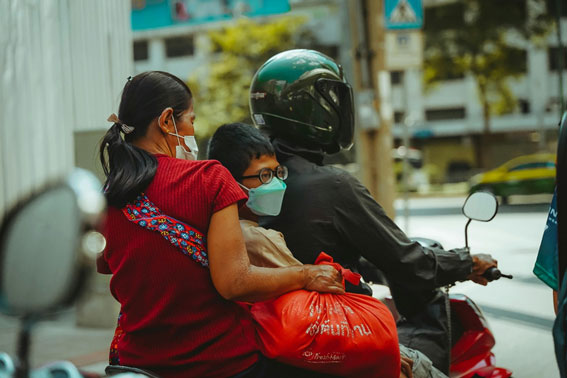
A mother and a son with mask were riding on a motorcycle in a street of Bangkok. The capital of Thailand experienced high level of PM2.5 particle pollution. Credit: Pexels/Maksim Romashkin

BANGKOK, Thailand, Jan 14 2026 (IPS) – Take a deep breath.

Did you know that in many countries in Asia and the Pacific, the air we breathe falls short of the safety standards for air quality set by the World Health Organization? While the start of a new year signals new beginnings, it also marks the continuation of the recurring air quality crisis across many countries in the region.


In 2024, 25 of the most polluted cities were in the Asia-Pacific region, with dangerous levels of fine particulate matter (PM2.5) that significantly exceeded the annual maximum levels of 5 micrograms per cubic meter.

Oftentimes, when we think of air pollution, we associate it with car exhaust and factory chimneys belching black smoke. But air pollution is not just the cost of urban development – it is a multi-hazard crisis caused by wildfires, sand and dust storms, and volcanic eruptions that respect no borders. Access to clean air is a human right and countries who contribute the least to air pollution are often the most vulnerable.

Rising temperatures create a vicious cycle: rising heat leads to intensifying wildfires, releasing toxic smoke composed of carbon dioxide, carbon monoxide, and PM2.5 into the air we breathe. Furthermore, heat accelerates the breakdown of waste, generating even more pollutants.

Volcanic eruptions add sulfur dioxide and volcanic ash to the mix, and these pollutants can linger in the atmosphere for months. The result? Climate change exacerbates air pollution, which in turn aggravates the climate crisis — a feedback loop that puts both human health and ecosystems at risk and transforms local hazards into regional challenges.

Can a heavily polluted environment be restored? In principle, yes, but doing so requires transformative change and collective action in our economy and society. Improving urban mobility requires prioritizing efficient public transport, including low-emission vehicles, cleaner, greener alternatives such as walking, cycling, and ride-sharing.

Nature-based solutions, including green cooling corridors, can further improve air quality by lowering surface temperatures and providing buffers against desertification, land degradation, drought, and sand and dust storms.

However, not all sources of air pollution can be addressed through emission reductions alone. There are inherent limits to prevention at the source, particularly for air pollution caused by natural hazards. This requires a shift in focus from mitigation toward adaptation and preparedness.

Earth observation plays a critical role in monitoring, early warning, and informed decision-making. Advanced sensors aboard platforms such as Sentinel-5 Precursor and Geostationary Environment Monitoring Spectrometer (GEMS) detect key atmospheric pollutants including nitrogen dioxide (NO2), sulfur dioxide (SO2), tropospheric ozone, and carbon monoxide at unprecedented spatial and temporal scales.

The collaboration of ESCAP with regional partners for the Pan-Asia Partnership for Geospatial Air Pollution Information exemplifies how satellite data can be integrated with surface observations to create robust monitoring systems. These datasets enable tracking transboundary pollution events, from agricultural fire smoke to volcanic sulfur emissions to urban photochemical smog.

Satellites bridge the existing gaps from ground-based observations, providing authorities with the spatial coverage needed to understand and monitor air pollution and formulate effective policies.

The Clean Air for Sustainable ASEAN project recognizes that addressing the transboundary air pollution crisis requires strengthened monitoring and decision-making capacities enabled by technology-driven solutions. The application, Check Phoon (Thai: Phoon, meaning dust), or the PM2.5 Monitoring System, developed by the Geo-informatics Information and Space Technology Development Agency of Thailand, is an innovative platform that leverages space technology to support air quality monitoring and public health protection by providing real-time, high-resolution PM2.5 concentration data across Thailand.

The application is available in both web-based and mobile applications, and the system integrates satellite data, such as from Himawari, meteorological information, PM2.5 sources including hotspots (active fire detections), and ground-based validation from PM2.5 monitoring stations.

Building on the framework of SatGPT for flood hotspot mapping, an iteration of SatGPT for volcanic hazards has been proposed with potential to support the understanding and management of air pollution linked to volcanic activity. has been proposed with potential to support the understanding and management of air pollution linked to volcanic activity.

The Regional Action Programme on Air Pollution advances air quality management through science-based cooperation, sharing of best practices, and strengthened technical and financial support across ESCAP member States.

Complementing this effort, the Regional Space Applications Programme facilitates the sharing of Earth observation data and expertise that are critical for monitoring air pollution and assessing the impacts.

These initiatives contribute to accessible and actionable geospatial information that strengthens early warning systems, enabling authorities to forecast and quantify air quality with greater precision.

The transboundary nature of air pollution demands a stronger and more urgent call to action. While the Asia-Pacific region has demonstrated remarkable resilience in the face of cascading disasters, regional cooperation must accelerate to match the scale and pace of this evolving crisis.

Keran Wang is Chief of Space Applications Section, ESCAP; Sheryl Rose Reyes is Consultant, Space Applications Section, ESCAP; Taisei Ukita is former Intern, Space Applications Section, ESCAP.

The authors would like to thank Sangmin Nam, Director of the Environment and Development Division of ESCAP, for his contributions to this article.

IPS UN Bureau

  Source