Women Advocates for Harvesting Rainwater in Salinity-Affected Coastal Bangladesh

Asia-Pacific, Climate Change, Development & Aid, Editors’ Choice, Environment, Featured, Headlines, Humanitarian Emergencies, Innovation, Natural Resources, TerraViva United Nations

Humanitarian Emergencies

Lalita Roy now has access to clean water and also provides a service to her community by working as a pani apa (water sister), looking after the community's rainwater harvesting plants. Credit: Rafiqul Islam/IPS

Lalita Roy now has access to clean water and also provides a service to her community by working as a pani apa (water sister), looking after the community’s rainwater harvesting plants. Credit: Rafiqul Islam/IPS

KHULNA, Bangladesh, Sep 23 2022 (IPS) – Like many other women in Bangladesh’s salinity-prone coastal region, Lalita Roy had to travel a long distance every day to collect drinking water as there was no fresh water source nearby her locality.


“In the past, there was a scarcity of drinking water. I had to travel one to two kilometers distance each day to bring water,” Roy, a resident of Bajua Union under Dakope Upazila in Khulna, told IPS.

She had to collect water standing in a queue; one water pitcher was not enough to meet her daily household demand.

“We require two pitchers of drinking water per day. I had to spend two hours each day collecting water. So, there were various problems. I had health complications, and I was unable to do household work for lack of time,” she said.

After getting a rainwater harvesting plant from the Gender-response Climate Adaptation (GCA) Project, which is being implemented by United Nations Development Programme (UNDP), Roy is now collecting drinking water using the rainwater harvesting plant, which makes her life easier.

“I am getting the facilities, and now I can give two more hours to my family… that’s why I benefited,” she added.

Shymoli Boiragi, another beneficiary of Shaheber Abad village under Dakope Upazila, said women in her locality suffered a lot in collecting drinking water in the past because they had to walk one to three kilometers every day to collect water.

“We lost both time and household work. After getting rainwater harvesting plants, we benefited. Now we need not go a long distance to collect water so that we can do more household work,” Boiragi said.

Shymoli revealed that coastal people suffered from various health problems caused by consuming saline water and spent money on collecting the water too.

“But now we are conserving rainwater during the ongoing monsoon and will drink it for the rest of the year,” she added.

THE ROLE OF PANI APAS

With support from the project, rainwater harvesting plants were installed at about 13,300 households under 39 union parishads in Khunla and Satkhira. One pani apa (water sister) has been deployed in every union from the beneficiaries.

Roy, now deployed as a pani apa, said the GCA project conducted a survey on the households needing water plants and selected her as a pani apa for two wards.

“As a pani apa, I have been given various tools. I go to every household two times per month. I clean up their water tanks (rainwater plants) and repair those, if necessary,” he added.

Roy said she provides services for 80 households having rainwater harvesting plants, and if they have any problem with their water tanks, she goes to their houses to repair plants.

“I go to 67 households, which have water plants, one to two times per month to provide maintenance services. If they call me over the cellphone, I also go to their houses,” said Ullashini Roy, another pani apa from Shaheber Abad village.

She said a household gives her Taka 20 per month for her maintenance services while she gets Taka 1,340 (US$ 15) from 67 households, which helps her with family expenses.

Ahoke Kumar Adhikary, regional project manager of the Gender-Response Climate Adaptation Project, said it supported installing rainwater harvesting plants at 13,300 households. Each plant will store 2,000 liters of rainwater in each tank for the dry season.

The water plants need maintenance, which is why the project has employed pani apas for each union parishad (ward or council). They work at a community level on maintenance.

“They provide some services, and we call them pani apas. The work of pani apas is to go to every household and provide the services,” Adhikary said.

He said the pani apas get Taka 20 from every household per month for providing their services, and if they need to replace taps or filters of the water plants, they replace those.

The pani apas charge for the replacements of equipment of the water plants, he added.

NO WATER TO DRINK

The coastal belt of Bangladesh is one of the most vulnerable areas to climate change as it is hit hard by cyclones, floods, and storm surges every year, destroying its freshwater sources. The freshwater aquifer is also being affected by salinity due to rising sea levels.

Ullashini Roy said freshwater was unavailable in the coastal region, and people drinking water was scarce.

“The water you are looking at is saline. The underground water is also salty. The people of the region cannot use saline water for drinking and household purposes,” Adhikary said.

Ahmmed Zulfiqar Rahaman, hydrologist and climate change expert at Dhaka-based think-tank Center for Environmental and Geographic Information Services (CEGIS), said if the sea level rises by 50 centimeters by 2050, the surface salinity will reach Gopalganj and Jhalokati districts – 50 km inside the mainland from the coastal belt, accelerating drinking water crisis there.

PUBLIC HEALTH AT RISK

According to a 2019 study, people consuming saline water suffer from various physical problems, including acidity, stomach problems, skin diseases, psychological problems, and hypertension.

It is even being blamed for early marriages because salinity gradually changes girls’ skin color from light to gray.

“There is no sweet water around us. After drinking saline water, we suffered from various waterborne diseases like diarrhea and cholera,” Ullashini said.

Hypertension and high blood pressure are common among coastal people. The study also showed people feel psychological stress caused by having to constantly collect fresh water.

Shymoli said when the stored drinking water runs out in any family; the family members get worried because it’s not easy to collect in the coastal region.

SOLUTIONS TO SALINITY

Rahaman said river water flows rapidly decline in Bangladesh during the dry season, but a solution needs to be found for the coastal area.

The hydrologist suggested a possible solution is building more freshwater reservoirs in the coastal region through proper management of ponds at a community level.

Rahaman said low-cost rainwater harvesting technology should be transferred to the community level so that coastal people can reserve rainwater during the monsoon and use this during the dry season.

He added that the government should provide subsidies for desalinization plants since desalinizing salt water is costly.

IPS UN Bureau Report

  Source

Monster Monsoon: “Pakistan and Its People Are Paying the Costs of What They Are Not Responsible For.”

Aid, Asia-Pacific, Civil Society, Climate Action, Climate Change, Development & Aid, Economy & Trade, Environment, Headlines, Inequality, TerraViva United Nations

Opinion

Credit: Pakistan Development Alliance

ISLAMABAD, Pakistan, Sep 1 2022 (IPS) – Pakistan has been going through the worst time of its recent history due to unprecedented colossal monsoon rains and devastating floods. The current floods would have been expected less than once a century, but climate experts claim that what we are seeing today is just a trailer of what’s in store for us if we don’t pay heed to climate change. More than 112 districts are currently afffected and around 30 million people; their property and land are totally devastated. Across the country, where hundreds of thousands of cattle died due to the Lumpy Skin Disease, now more than 727,000 have perished due to floods and rains. The number is increasing rapidly.


We were in the countryside conducting a study on the rights of women farm workers, when the Monster monsoon hit the country. We had to cut our field mission short and we are now relatively “safe” here in Islamabad, busy organising emergency relief and rescue operations.

Pakistan and its people are paying the costs of what they are not responsible for. For the past 20 years, Pakistan has consistently ranked among the top 10 most vulnerable countries on the Climate Risk Index. We are facing such climate change aggression and devastation while contributing only 0.8% of greenhouse carbon emissions to global warming. We are squeezed, geographically situtated between titans China and India, who are the top two emitters of greenhouse gases. This impacts the glaciers of the Himalaya. In Pakistan, our 7253 glaciers – more glaciers than almost anywhere on Earth – are melting faster than ice-cream in the sun due to climate change. Since the whole country is situated in the downstream of the Hamalaya, heavy floods have become the norm. To this scenario, you need to add flawed developement interventions, absence of rule of law and the lack of policy priorities towards the management of “everyday” disasters. This results in risks being left undone instead of being treated as full-fledged national security emergencies.

Today, the horrific scale of the floods are not in doubt, but the catastrophe is still unfolding. Rehabilitation and reconstruction activities need to be initiated immediately. Pakistan is already facing food insecurity due to this manmade disaster. In the long run, this crisis will increase poverty, inequality and economic instability in the country if we – supported by the world at large – fail to respond quickly.

Being part of a civil society network I see with my own eyes how civil society is vehementally engaged in rescue, relief and emergency activities through local resources and philanthropic initiatives. The international community and INGOs have not yet initiated their field operations. Although the government has officially appealed for the support of the international community and has levereged restrictions, the intensive regulatory frameworks are still working against rights based NGOs.

I have a message for the international community. Please support flood affected communities as early as possible. Local civil society needs to be strengthened and financed as well, as they are on the frontlines, they are the first reaching affected communities. In the future, there needs to be serious investments on addressing the impacts of climate change, particularly in vulnerable countries such as Pakistan, where climate change adaptation mechanism and infrastructure support should be mainstreamed. Now they are at the periphery, and it shows.

IPS UN Bureau

  Source

Gender Equality & Women’s Rights Wiped out Under the Taliban

Armed Conflicts, Asia-Pacific, Civil Society, Featured, Gender, Gender Violence, Headlines, IPS UN: Inside the Glasshouse, Peace, TerraViva United Nations

Opinion

The writer is UN Under-Secretary-General and Executive Director of UN Women

Women receive food rations at a food distribution site in Herat, Afghanistan. Credit: UNICEF/Sayed Bidel

NEW YORK, Aug 15 2022 (IPS) – In the year that has passed since the Taliban’s takeover in Afghanistan we have seen daily and continuous deterioration in the situation of Afghan women and girls. This has spanned every aspect of their human rights, from living standards to social and political status.


It has been a year of increasing disrespect for their right to live free and equal lives, denying them opportunity to livelihoods, access to health care and education, and escape from situations of violence.

The Taliban’s meticulously constructed policies of inequality set Afghanistan apart. It is the only country in the world where girls are banned from going to high school. There are no women in the Taliban’s cabinet, no Ministry of Women’s Affairs, thereby effectively removing women’s right to political participation.

Women are, for the most part, also restricted from working outside the home, and are required to cover their faces in public and to have a male chaperone when they travel. Furthermore, they continue to be subjected to multiple forms of Gender Based Violence.

This deliberate slew of measures of discrimination against Afghanistan’s women and girls is also a terrible act of self-sabotage for a country experiencing huge challenges including from climate-related and natural disasters to exposure to global economic headwinds that leave some 25 million Afghan people in poverty and many hungry.
The exclusion of women from all aspects of life robs the people of Afghanistan of half their talent and energies. It prevents women from leading efforts to build resilient communities and shrinks Afghanistan’s ability to recover from crisis.

There is a clear lesson from humanity’s all too extensive experience of crisis. Without the full participation of women and girls in all aspects of public life there is little chance of achieving lasting peace, stability and economic development.

That is why we urge the de facto authorities to open schools for all girls, to remove constraints on women’s employment and their participation in the politics of their nation, and to revoke all decisions and policies that strip women of their rights. We call for ending all forms of violence against women and girls.

We urge the de facto authorities to ensure that women journalists, human rights defenders, and civil society actors enjoy freedom of expression, have access to information and can work freely and independently, without fear of reprisal or attack.

The international community’s support for women’s rights and its investment in women themselves are more important than ever: in services for women, in jobs and women-led businesses, and in women leaders and women’s organizations.

This includes not only support to the provision of humanitarian assistance but also continued and unceasing efforts at the political level to bring about change.

UN Women has remained in country throughout this crisis and will continue to do so. We are steadfast in our support to Afghan women and girls alongside our partners and donors.

We are scaling up the provision of life-saving services for women, by women, to meet overwhelming needs. We are supporting women-led businesses and employment opportunities across all sectors to help lift the country out of poverty.

We are also investing in women-led civil society organizations to support the rebuilding of the women’s movement. As everywhere in the world, civil society is a key driver of progress and accountability on women’s rights and gender equality.

Every day, we advocate for restoring, protecting, and promoting the full spectrum of women’s and girls’ rights. We are also creating spaces for Afghan women themselves to advocate for their right to live free and equal lives.

One year on, with women’s visibility so diminished and rights so severely impacted, it is vital to direct targeted, substantial, and systematic funding to address and reverse this situation and to facilitate women’s meaningful participation in all stakeholder engagement on Afghanistan, including in delegations that meet with Taliban officials.

Decades of progress on gender equality and women’s rights have been wiped out in mere months. We must continue to act together, united in our insistence on guarantees of respect for the full spectrum of women’s rights, including to education, work, and participation in public and political life.

We must continue to make a collective and continuous call on the Taliban leadership to fully comply with the binding obligations under international treaties to which Afghanistan is a party.

And we must continue to elevate the voices of Afghan women and girls who are fighting every day for their right to live free and equal lives. Their fight is our fight. What happens to women and girls in Afghanistan is our global responsibility.

IPS UN Bureau

  Source

Sri Lanka: Why a Feudal Culture & Absence of Meritocracy Bankrupted a Nation

Asia-Pacific, Civil Society, Crime & Justice, Featured, Headlines, Human Rights, Humanitarian Emergencies, TerraViva United Nations

Opinion

Credit: Sunday Times, Sri Lanka

BROMLEY, UK, Jul 19 2022 (IPS) – Sri Lanka is officially bankrupt and a failed state in all but name. How did a country of 22 million people with a level of literacy on par with most of the developed world end up in such a dire position where the state coffers did not have the measly sum of 20 million dollars to purchase fuel to keep the country functioning beyond the next working day?


Whilst the vast majority of the population have concluded that the blame for this economic armageddon is due to the gluttony of corruption and greed, instigated and enabled by the Rajapaksa family , its acolytes and sycophantic nodding dogs, my own assessment is different.

It is a fact that vast sums , amounting to billions of dollars, were indeed stolen and moved overseas through various illegal networks by the Rajapaksa clan and their accomplices.

Many billions were also squandered on gargantuan white elephant vanity projects in order to glorify the Rajapaksa legacy. However, the seeds for the bankruptcy were sown when the country attained its independence from Great Britain in 1948.

Sri Lanka proudly proclaims itself as one of the oldest democracies in Asia which has had a functioning democracy since 1948. The democratic process has functioned like it should do and parliamentarians elected as they should be and the leaders who represent the aspirations and values of the people appointed as they should be.

Why then has the country reached this abyss?

For democracy to enrich the lives of the people and bring about economic prosperity, two essential and fundamental criteria have to be satisfied. The election of individuals based on merit and the adherence to a universal justice system.

In the absence of meritocracy and a universal justice system, democracy becomes meaningless – an utterly futile process which will not achieve what it is intended for.

Meritocracy is however an alien concept in Sri Lanka!

A universal justice system does not exist in Sri Lanka!

Meritocracy does not exist in Sri Lanka because the cultural DNA is that of a feudal society. Sri Lankan culture promotes race, religion, nepotism, old school connections, social connections, social influences, political influences and servitude (where one class of people are held in perpetual bondage or servants for life ) over and above the attributes and qualities of the individual.

That is a primitive mindset and a recipe for disaster.

In Sri Lanka, people are judged not by the content of their character but by their race, their religion, their socio-economic background, their family connections, the schools they attended, where they live, and who they know. (with apologies to the Rev Martin Luther King for using his words in a manner he did not intend)

When a society functions in such a feudal manner, such values permeate throughout and has a direct correlation with the workings of the justice system. The justice system replicates the culture and ultimately ends up being not fit for purpose.

If a justice system is unable to function based on facts and objectivity, the fabric of society slowly starts to tear apart because the checks and balances needed for a society to progress and for nations to grow, slowly start to dissipate.

Since 1948, Sri Lankan democracy has existed on the basis of nepotism, feudal, racial and religious criteria.

The feudal culture masquerading as democracy has elected the Senanayake family, the Bandaranaike family, the Premadasa family and the Rajapaksa family into the highest offices of the land.

The singular qualification that Prime Minister Dudley Senanayake had was that he was the son of the father.

The singular qualification Prime Minister Mrs Bandaranaike had was that she was the wife of the husband

The singular qualification President Chandrika B had was that she was the daughter of the father and the mother

The singular qualification that Prime Minister Ranil Wickremesinghe (now acting President) has is that he is the nephew of President JR Jayewardene.

The singular qualification that Sajith Premadasa has is that he is the son of the father

The singular qualification Gotabaya Rajapaksa has is that he is the brother of Mahinda

The singular qualification Namal has is that he is the son of the father

The singular qualification Basil has is that he is the brother of Mahinda and Gotabaya.

The singular qualification Thondaman had was that that he was the son of the father.

And this is called Democracy?

This is a banana republic in all but name where Nepotism is the ultimate passport to success – and all done through the ballot box !

This is a culture of entitlement masquerading as democracy , which in turn has given birth to a nation whose leaders are elected not by the content of their character but by their name and association.

It is the equivalent of death by a thousand cuts for what has been spawned is a society where quality has been superseded by mediocrity at best and incompetence at worst.

The end result is the economic armageddon that has destroyed the country.

When leaders of a nation are elected in such a manner, those who serve them and the very fabric of society itself replicates the structural fault line that promotes feudal nepotistic values. It becomes self-fulfilling, promotes mediocrity, encourages malpractice, and creates a culture of corruption.

The legal system, which on paper is there to oversee the rule of law, sadly becomes an extension of the structural fault line which then ensures that impunity and immunity against corruption , theft or even murder, becomes standard operating procedure.

Einstein’s definition of “insanity” is where he states that if we do the same thing over and over again, we end up with the same result. Sri Lanka’s sham democracy since 1948 has been exactly that. A culture based on feudal nepotistic values which enables the same results over and over again.

The people of Sri Lanka must break this vicious cycle if they are ever to escape from the death spiral they have created for themselves.

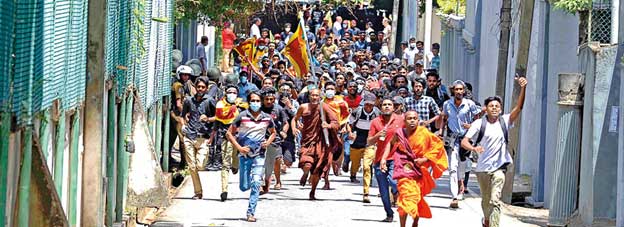
The critical mass of people who have recently demonstrated for structural change and the complete transformation of government and governance, have achieved more in the last few months than most of the corrupt incompetent deluded half-wits in parliament ever will.

A fundamental new approach to governance based on competence and the rule of law is a pre-requisite to stop Sri Lanka disintegrating into anarchy and chaos.

Does real democracy exist in Sri Lanka ? No !

Real democracy in Sri Lanka doesn’t exist because the culture prevents those with real ability and competence from being elected on merit alone. The vast majority of the electorate simply doesn’t understand that real democracy that provides a positive outcome is based on merit, first, second and last.

It is also unlikely that the majority of the electorate will understand this any time soon.

Can the country find a leader that replicates Singapore’s Lee Kuan Yew ? It is imperative that it does find such a leader who leads by example and who creates a structural transformation of society itself where honesty, integrity and the adherence to the rule of law becomes sacrosanct .

However, does such a leader exists within the current crop of parliamentarians? If not within in parliament , then where ?

A leader who will also ensure that all those who have been culpable in this bringing about this catastrophe are forced to change their ways as well as bringing to justice those who have systematically looted and stolen the countries’ wealth – politicians and non-politicians .

Does a universal justice system exist in Sri Lanka – No !

A justice system in a secular democracy has to be independent of parliament. The justice system is meant to be independent of state machinery and should not be influenced by state operatives.

However, in Sri Lanka the parliament overrules and effectively instructs how the justice system should act which in turn makes the whole system corrupt and not fit for purpose.

The country has huge numbers of legal eagles with more qualifications than they have had hot dinners and who know the finer points of the law better than most in the world.

However, they are rendered impotent and toothless because they are beholden to the political masters they serve – either through choice or otherwise.

The corrosive and toxic nature of a feudal culture which promotes false values over merit and the rule of law ensures even the greatest minds of the land are reduced to corrupt sycophantic nodding ponies.

The legal system in Sri Lanka is also an organised money printing racket where the ordinary citizen or client is entirely at the mercy of the corrupt and dysfunctional bureaucracy.

Those who operate within the system make the equivalent of monopoly money by effectively fleecing the unsuspecting and manipulating a system that is not fit for purpose.

As I write this , the elected leader of the country whose policies and incompetence were the catalyst for the economic meltdown, has fled overseas – the ultimate ” runner viruwa ” !

The man appointed as the acting leader of the nation is one whose party has a single seat in parliament – his own ! And that too not due to electoral votes but due to a corrupt system which enables ” grace and favour ” appointments to parliament.

Such is the abyss that Sri Lanka is in.

What truly beggars belief is that there are millions in the country who still believe that this corrupt rotten s–t show of a system can still be tweaked here and there and made to work.

It cannot and the saddest reality of all this is that millions of Sri Lankans will still cling to their delusional sense of self-importance and righteousness and even at this point where mass starvation is a real possibility, carry on repeating the same mistakes over and over again.

A country whose majority population follows the teachings of one of the greatest philosophers the world has known, is simply incapable of understanding some of the most basic lessons the great sage from Lumbini taught – honesty, integrity, introspection, reflection and truth !

If however, a NEW set of leaders with competence, honesty and integrity, whose primary purpose is to serve the people, can be found within parliament, within the Aragalaya movement , within the commercial sector or a combination of individuals from all three , there is still hope for Sri Lanka.

If however the same corrupt incompetent rotten thieves who still occupy positions of huge powers are allowed to maintain the status quo , the failed state that is Sri Lanka will descent into complete anarchy and bloodshed.

At the end of all that, arising out of the ashes, there will be a breakaway part of the country ………called Eelam !!!!!!!!

Charles Seevali Abeysekera, a semi-retired sales and marketing professional, has worked in the UK mailing industry for over 35 years. He also scribes a blog on current affairs as well as reflections and thoughts on his own life journey “

IPS UN Bureau

  Source

Sri Lankan Beggar’s Opera

Asia-Pacific, Civil Society, Crime & Justice, Featured, Headlines, Human Rights, Humanitarian Emergencies, TerraViva United Nations

Opinion

The ongoing financial crisis in Sri Lanka has also triggered a sharp drop in the value of the country’s currency.

LONDON, Jul 6 2022 (IPS) – When Ceylon- now Sri Lanka- gained independence from Britain in 1948 after almost 450 years of colonial rule under three western powers, it was one Asia’s most stable and prosperous democracies.


Today, after years of misrule, rampant corruption by the ruling class and a politicised administration, the country is bankrupt, its economy on the verge of collapse, and society in disarray while a discredited president still clings to power and manipulating the political system, determined to serve the rest of his term.

While the original 18th century Beggar’s Opera was a satire on the injustice in London society of the day and Prime Minister Robert Walpole’s corrupt government, Sri Lanka has not turned to opera but to begging and possibly borrowing if any international lending institution is willing to lend to a country that has recently defaulted on debt repayment for the first time in its post-independence history.

That speaks volumes for the fiscal and monetary policies of President Gotabaya Rajapaksa’s government, and its unthinking and ill- considered actions in the last two and a half years, that has “collapsed” the country’s economy— as the prime minister told parliament the other day.

Under the 10-year rule of elder brother Mahinda Rajapaksa (2005-2015), the government borrowed heavily from China for massive infrastructure projects. That included a huge international airport at Mattala in nearby Rajapaksa territory in the deep south. Some of them continue to be white elephants.

A joke at the time and resonating now and then was that even herds of roaming wild elephants in the area spurn the airport because of the colour bar!

Since Gotabaya Rajapaksa came to power in November 2019 and a year later brother Mahinda led their Sri Lanka People’s Party (SLPP) to a parliamentary victory, the Rajapaksas, now at the helm of power, strengthened their already close relationship with Beijing at the expense of ties with the West and international lending institutions and alienating UN bodies such as the UN Human Rights Council.

But in the last few months it has been a begging-bowl ‘opera’ as Sri Lanka scoured the world for loans after its foreign reserves started dipping drastically and leading international rating agencies took to downgrading the country’s sovereign rating.

Eventually the Rajapaksa government reneged on its debt repayments, humiliating Sri Lanka which had never defaulted in its 74-year history.

Trapped by a plunging economy Sri Lanka turned to Bangladesh to save it from emerging bankruptcy. Nothing could be more ironic. In its early years Bangladesh was perceived as a recipient of financial support, not a lender.

At that time Sri Lanka’s economy seemed stable enough despite its near 30 years of war against Tamil Tiger separatists.

In early, June Bangladesh agreed in principle to another currency swap of US$ 200 million. This is in addition to last year’s currency swap of $200 million whose repayment date of three months was extended to one year at Sri Lanka’s request last August.

Today, the country’s 22 million people are almost without petrol, cooking gas, kerosene, food, medicines, powdered milk, and other essentials as the government has no foreign currency to import them.

A common scenario in many parts of Sri Lanka are queues of people-men, women and even children- spending many hours and even days to buy the essentials that are scarce and a food shortage is predicted in the coming months.

As I sat down to write this, news reports said the 12th man died seated in his vehicle at a queue for fuel. A few days later the Sunday Times Political Editor upped the death toll to 16.

Meanwhile physical clashes are becoming common at filling station where thugs have muscled in. The other day a soldier was caught on video assaulting a policeman.

Such is the tension building up in society that the Sunday Times Political Editor reported of concerns among local intelligence services about national security.

While the long-drawn out covid pandemic did cripple the tourism industry, a major foreign currency earner, much of the blame rests on President Gotabaya Rajapaksa’s short-sighted policies as well as those of some of his ministers and close advisers whose arrogance and ignorance brushed aside warnings sounded a year or two ahead by reputed economists, former Central Bank professionals, academics and trade chambers.

Rajapaksa having denied any culpability for these errors of judgement ultimately conceded his responsibility but only when mass protests erupted in Colombo and elsewhere in the country with even the peasantry-a vital support base of the Rajapaksas- took to the streets castigating him and his government for creating shortages of essential fertilizers for agriculture.

After almost two months, thousands of anti-government protestors who set up camp on the seaside promenade opposite the presidential secretariat in the heart of Colombo, are still there raising their clarion call which has now spread across the country- “Gota Go Home”-demanding that the president return to whence he came.

While Sri Lanka struggles to survive and the Rajapaksas gradually reappear into public view, there has been a perceptible change in the government’s world view. Though Chinese leaders have often declared that Beijing is Colombo’s “all weather friend” it has been slow to come to Sri Lanka’s aid at a time of real crisis.

An appeal to China by the Rajapaksa government to restructure its loans as one of its biggest lenders had not produced the expected reaction from Beijing. Nor had there been a positive response at the time for another credit line of US$ 1.5 billion when Colombo’s foreign reserves were fast drying out.

Even President Xi Jinping’s birthday greeting to President Rajapaksa last month made no mention of any concrete assistance except references to the long-standing Sri Lanka-China relations.

Observers claimed that China was coaxing-if not actually pressuring- Sri Lanka to distance itself from India, its competitor for political positioning and an expanding stake in the strategically- located island.

While the immediate target was India, Beijing was also pointing its finger at Sri Lanka’s growing ties with the US and international institutions such as the IMF.

The fact that since January India has provided assistance to Sri Lanka with currency swaps, credit lines, loan deferments and humanitarian assistance to meet the mounting crisis and supported Colombo’s call for IMF aid, appeared unwelcome news to China which has been trying to persuade Sri Lanka to enter into a trade agreement with it.

In late June, a high-powered Indian delegation led by Foreign Secretary Vinay Kwatra made a quick few- hour visit to Colombo to meet President Rajapaksa and Prime Minister Ranil Wickremesinghe and discuss further strengthening of Indo-Lanka ties and bilateral investment partnerships including infrastructure and renewal energy.

New Delhi pointed out that this unprecedented recent economic, financial and humanitarian assistance including medicines and food valued at over US$ 3.5 b was guided by Prime Minister Narendra Modi’s “Neighbourhood First” policy.

Had it not been for the Indian central government and the Tamil Nadu state government responding fast with generous assistance Sri Lanka would have been struggling to find scarce food, fuel and medicines.

Meanwhile a nine-member team of senior IMF officials spent 10 days in Sri Lanka in late June to assess whether it could come up with a reform package to restore macroeconomic stability and debt sustainability.

Since Colombo approached the IMF for a bailout programme early this year the international lending institution has been monitoring the country’s economic and political situation, neither of which presented much confidence.

It is not only sustainable economic reforms that the IMF is after. It seeks substantial efforts to improve governance and a stable corruption-free government that the IMF and other lending institutions such as the World Bank and Asian Development Bank and donor nations could have confidence in.

The current government of bits and pieces could hardly provide evidence that it is fighting corruption when one of its stalwarts who was convicted the other day on extortion and sentenced to two years rigorous imprisonment but suspended for five years was reappointed to the cabinet by President Rajapaksa and made chief government whip in addition.

It is the need for clean government that causes concerns with President Rajapaksa reneging on promises he made to introduce constitutional amendments that will substantially prune the plethora of powers he grabbed on coming to power.

This is hardly likely as the world will see when the new 21st constitutional amendment is gazetted in a few days.

Neville de Silva is a veteran Sri Lankan journalist who held senior roles in Hong Kong at The Standard and worked in London for Gemini News Service. He has been a correspondent for the foreign media including the New York Times and Le Monde. More recently he was Sri Lanka’s Deputy High Commissioner in London

Source: Asian Affairs, London

IPS UN Bureau

  Source

Healthy Planet Needs ‘Ocean Action’ from Asian and Pacific Countries

Asia-Pacific, Climate Action, Climate Change, Conferences, Development & Aid, Economy & Trade, Environment, Headlines, Poverty & SDGs, Sustainability, TerraViva United Nations

Opinion

BANGKOK, Thailand, Jun 27 2022 (IPS) – As the Second Global Ocean Conference opens today in Lisbon, governments in Asia and the Pacific must seize the opportunity to enhance cooperation and solidarity to address a host of challenges that endanger what is a lifeline for millions of people in the region.


Armida Salsiah Alisjahbana

If done right ocean action will also be climate action but this will require working in concert on a few fronts.

First, we must invest in and support science and technology to produce key solutions. Strengthening science-policy interfaces to bridge practitioners and policymakers contributes to a sound understanding of ocean-climate synergies, thereby enabling better policy design, an important priority of the Indonesian Presidency of the G20 process. Additionally policy support tools can assist governments in identifying and prioritizing actions through policy and SDG tracking and scenarios development.

We must also make the invisible visible through ocean data: just three of ten targets for the goal on life below water are measurable in Asia and the Pacific. Better data is the foundation of better policies and collective action. The Global Ocean Accounts Partnership (GOAP) is an innovative multi-stakeholder collective established to enable countries and other stakeholders to go beyond GDP and to measure and manage progress towards ocean sustainable development.

Solutions for low-carbon maritime transport are also a key part of the transition to decarbonization by the middle of the century. Countries in Asia and the Pacific recognized this when adopting a new Regional Action Programme last December, putting more emphasis on such concrete steps as innovative shipping technologies, cooperation on green shipping corridors and more efficient use of existing port infrastructure and facilities to make this ambition a reality.

Finally, aligning finance with our ocean, climate and broader SDG aspirations provides a crucial foundation for all of our action. Blue bonds are an attractive instrument both for governments interested in raising funds for ocean conservation and for investors interested in contributing to sustainable development in addition to obtaining a return for their investment.

These actions and others are steps towards ensuring the viability of several of the region’s key ocean-based economic sectors, such as seaborne trade, tourism and fisheries. An estimated 50 to 80 per cent of all life on Earth is found under the ocean surface. Seven of every 10 fish caught around the globe comes from Pacific waters. And we know that the oceans and coasts are also vital allies in the fight against climate change, with coastal systems such as mangroves, salt marshes and seagrass meadows at the frontline of climate change, absorbing carbon at rates of up to 50 times those of the same area of tropical forest.

But the health of the oceans in Asia and the Pacific is in serious decline: rampant pollution, destructive and illegal fishing practices, inadequate marine governance and continued urbanization along coastlines have destroyed 40 per cent of the coral reefs and approximately 60 per cent of the coastal mangroves, while fish stocks continue to decline and consumption patterns remain unsustainable.

These and other pressures exacerbate climate-induced ocean acidification and warming and weaken the capacity of oceans to mitigate the impacts of climate change. Global climate change is also contributing to sea-level rise, which affects coastal and island communities severely, resulting in greater disaster risk, internal displacement and international migration.

To promote concerted action, ESCAP, in collaboration with partner UN agencies, provides a regional platform in support of SDG14, aligned within the framework of the UN Decade of Ocean Science for Sustainable Development (2021-2030). Through four editions so far of the Asia-Pacific Day for the Ocean, we also support countries in identifying and putting in place solutions and accelerated actions through regional dialogue and cooperation.

It is abundantly clear there can be no healthy planet without a healthy ocean. Our leaders meeting in Lisbon must step up efforts to protect the ocean and its precious resources and to build sustainable blue economies.

Armida Salsiah Alisjahbana is an Under-Secretary-General of the United Nations and Executive Secretary of the Economic and Social Commission for Asia and the Pacific (ESCAP)

IPS UN Bureau