Since the passing of the act around seven years ago, only a minor fraction of its extensive recommendations has been implemented. Picture courtesy: Adam Cohn.
MUMBAI, India, Mar 2 2022 (IPS) – In the second week of January 2022, Purushottam—locally known as Prashant—a street vendor in central Delhi’s Connaught Place area, died by suicide. It was later discovered that the reason for his death was his inability to pay certain debts.
Ground reports show that, since November 8, 2021, approximately 150 street vendors in Connaught Place, including Purushottam, have lost their livelihoods due to forced eviction by municipal authorities.
Over the past few years, the vast population of vendors has reported facing repeated harassment or eviction at the hands of the police, local authorities, and society. Therefore, street vendors remain marginalised and their situation grows increasingly precarious, despite the fact that they are protected by the law
It is a complex combination of pressures from market traders’ associations, insensitive court orders, bureaucracy, and non-existent planning standards that have disallowed street vending—one of the largest economies for self-employed workers—in Connaught Place.
This removal of street vendors has further been replicated in other well-established markets of Delhi such as Lajpat Nagar, Sarojini Nagar, and Chandni Chowk, and is now being extended to other cities across India.
Till 2014, street vending was an ungoverned territory where ‘regulation’ meant the removal of vendors, who were considered illegal and unfit to be in cities. The Street Vendors Act 2014 attempted to change this mindset in the following ways:
It acknowledged vendors as an integral part of Indian cities and granted legal recognition to them by protecting them from evictions till they were surveyed.
The act created a governance framework that is participatory and decentralised, and primarily led by the town vending committees (TVCs) located in urban local bodies. TVCs are in charge of enumerating, identifying, and allocating vending zones in a city. Each TVC requires at least 40 percent of its members to be street vendors, with the rest of the committee including representation from local authorities, planning authorities, police, residential welfare associations, nonprofits, and market associations.
It allowed street vendors to be included in the city planning process by letting up to 2.5 percent of the city population engage in street vending.
It specifically mandated prevention against eviction and harassment.
The act laid out various inclusionary measures for the legal support and promotion of street vending through vendors’ welfare, training, and capacity building.
Overall, the act is a nuanced, well-designed legislation that is a result of numerous years of contributions from social movements led by street vendors’ associations and incremental progressive court directives.
Why are forced evictions taking place in Delhi?
Poor implementation of the act
The evictions taking place in Delhi have set a dangerous precedent by undermining the Street Vendors Act 2014—the only progressive legislation enacted for the upliftment of working-class groups such as street vendors. Since the passing of the act around seven years ago, only a minor fraction of its extensive recommendations has been implemented.
With much reluctance, it is only now that street vendors are being surveyed and issued licenses and certificates of vending in Delhi. However, with no demarcation of the vending and non-vending zones in the city, the vendors find themselves without ‘space’ on the city streets.
Over the past few years, the vast population of vendors has reported facing repeated harassment or eviction at the hands of the police, local authorities, and society. Therefore, street vendors remain marginalised and their situation grows increasingly precarious, despite the fact that they are protected by the law.
Judicial apathy
In 2021, various market traders’ associations put forth petitions challenging the act. While listening to their grievances, the Delhi High Court passed unfavourable comments on the legal rights of street vendors in Delhi.
The bench further questioned the basis of the act and said that “the country will go to [the] dogs if this act is implemented in its entirety. What will happen if street vendors start sitting on your doorsteps?”
The court also raised concerns over the rising number of vendors in the city and questioned how Delhi could become like London if the planning aspect wasn’t focused on. These comments were made alongside the passing of a legal order to remove street vendors from their spaces of work.
The same bench also stated that the act is heavily biased towards the street vendors and that there are no experts in the TVCs.
It should be noted that street vendors in Delhi make up only 40 percent of the TVC by having 12 seats out of 30, whereas 10 seats are taken by local authorities, planning authorities, the police and traffic police, the revenue department, the medical officer, and the CPWD/PWD/works department of the local authority.
The committee also offers eight seats to nonprofits, resident welfare associations, community-based organisations, and market traders’ associations—independent bodies that are nominated by the state government itself. With such a comprehensive list, encompassing the economic, spatial, health, social, and administration perspectives, the TVC is full of experts and, therefore, is not tilted towards the vendors.
In spite of many deliberations in the TVCs where vendor representatives have pushed for a comprehensive survey to identify and register street vendors, there has been a bureaucratic lethargy and rigidness in execution. For example, the TVC meetings are not held regularly and survey and certificate issuance processes are slow.
Often the chairpersons—who are usually IAS officers—don’t listen to the TVC members, thus systematically undermining the democratic nature of TVCs.
From the minutes of the TVC meetings1 it is apparent that members representing government authorities such as the health, police, and planning departments do not attend them, thus missing the opportunity to make these meetings enriching and participatory. Together, the poor functioning of the TVCs inhibits the proper implementation of the act and allows forced evictions to continue.
Exclusionary urban planning
The recent eviction orders are unlawful also because they are based on the Master Plan of Delhi (MPD) 2021 and older vending zones—both of which were made prior to the passing of the Street Vendors Act 2014.
Moreover, as mentioned previously, the act mandates the right of TVCs to decide on vending and non-vending zones. Unfortunately, this right has been curtailed under the present MPD 2001–21 since the plan has not been amended in line with the Street Vendors Act 2014.
Now the latest draft of the MPD 2041 has also carried forward the same legacy by excluding the 2.5 percent norm on the number of street vendors in a city, TVCs, and participatory process on the vending zone demarcation. It is not a matter of coincidence that the North Delhi Municipal Corporation’s smart city plans—like the smart city plans of many other cities—have demarcated the central park and surrounding areas as ‘hawker-free zones’.
Outside the bureaucratic and city planning hurdle, societal apathy and disdain towards the vendors comes from a colonial mindset where they are viewed as smugglers and encroachers occupying public spaces, posing a threat to pedestrians’ right of way.
How do we move forward and course-correct?
The Street Vendors Act 2014 is the only legal framework that protects street vendors, as it focuses on enhancing their livelihoods and safeguarding them from evictions and harassments.
It uplifts the values of democracy by setting up the TVCs as decision-making authorities that conduct surveys, issue certificates of vending, and provide vendors with spatial right to the city.
Due to the COVID-19 pandemic, the last couple of years have been extremely difficult for street vendors and the informal economy.
Our research has shown that their incomes have reduced by more than 40 percent in the case of Delhi, and many vendors have reported falling into debt traps. The proactive measures taken by the government through the PM SVANidhi scheme and the Delhi government reaching out with PDS and non-PDS relief were only of temporary help.
The bigger problem for street vendors is that they were not legally permitted to work in the city even prior to the pandemic. Addressing this problem requires concrete efforts from the government at the central, state, and local levels.
The first step is to explicitly integrate urban development schemes such as the MPD, Smart Cities Mission, and Swachh Bharat Abhiyan with the objectives and mandates of the Street Vendors Act 2014. Since these schemes are integral to a city’s strategic planning and welfare, they must recognise the needs and aspirations of street vendors.
There is also a need to focus on training and capacity building of urban local bodies, TVCs, and vendors so that they can play a decisive role in executing the act, for example, to identify and demarcate vending zones.
Further, the Delhi Development Authority needs to acknowledge the absence of street vending and other informal livelihoods from the MPD. Lastly, there is a need to include natural markets, weekly markets, women’s markets, and other heritage markets in the MPD 2041.
Unless we reform urban planning both in theory and in practice, our cities will continue to see exclusionary development. The implementation of the Street Vendors Act 2014 could be seen as an opportunity to prioritise the welfare of the urban poor and enhance their livelihoods.
Aravind Unni is an urban rights activist and researcher associated with the National Hawker Federation.
Shalaka Chauhan is a social designer by training. Her work focuses on urban planning vis-à-vis urban poverty and inequality.
Sri Lankan Buddhist monks at the UN General Assembly session commemorating Vesak. Credit: Sri Lanka’s Permanent Mission to the United Nations
LONDON, Feb 3 2022 (IPS) – Driven by unprecedented hardship to pass round the begging bowl, Sri Lanka has become the centre of a tussle between Asia’s two superpowers.
There was a time in Asia’s predominantly Buddhist countries when saffron-robed monks walked from house to house in the mornings, standing outside in silence as lay people served up freshly cooked food into their ‘alms bowls’. The food was then taken to the temples, where it was shared among the monks.
That religious tradition has now largely given to other ways of serving alms to monks.
Today, governments and their aggrandising acolytes have converted this respected and virtuous tradition into one of begging richer nations to rescue them from economic deprivation, brought on largely by failed promises and disjointed and ill-conceived foreign and national policies.
This ‘begging bowl’ mentality in search of ‘alms’ is more likely to succeed if a nation is strategically-located in an area of big power contestation. Sri Lanka is just that, situated in the Indian Ocean and only a few nautical miles from the vital international sea lanes carrying goods from West to East and vice versa.
The country’s economy has been caught in a real bind. Buffeted by the Covid pandemic on the one hand and, on the other, ego-inflating economic and fiscal policies introduced by the new president Gotabaya Rajapaksa shortly before the country was pounded by the pandemic, Sri Lanka now has to beg or borrow to keep its head above water.
By December, Sri Lanka’s parlous foreign reserves situation had dropped to a perilous $1.2 billion – enough for three weeks of imports. The foreign debt obligation of $500 million that needed to be met last month was only the beginning. Another $1 billion is due in July. The total pay-off in 2022 will amount to some $7 billion.
Meanwhile the pandemic has virtually killed tourism, one of the country’s main foreign exchange earners, driving the hospitality industry into free-fall. If this was not bad enough, the Central Bank’s attempts to put a tight squeeze on incoming foreign currency led the country’s migrant labour remittances to drop drastically as overseas workers turned to the black market to earn real value for their money sent to families at home.
But nothing has had such widespread political repercussions as the government’s ill-advised policy of banning overnight chemical fertilisers last May, ahead of the country’s main agricultural season between October and April.
Its over-ambitious agenda of trying to turn Sri Lanka into the world’s first totally ‘green agriculture’ was laudable enough, but was botched when the sudden ban on chemical fertilisers and other agrochemicals – used by farmers for the last 50 years or so – left rice farming and other cultivations in disarray and farmers inevitably confused.
The government’s agenda of trying to turn Sri Lanka into the world’s first totally ‘green agriculture’ was botched.
While agricultural scientists and other experts warned of an impending food scarcity due to failed harvests and sparsely cultivated fields, the government ignored the warnings, sacking heads of the Agriculture Ministry and removing its qualified agricultural experts for spreading doom and gloom.
Against this backdrop of confused governance, probable food shortages due to poor harvests and slashing of imports and even essential medicines for lack of foreign currency, growing public unrest has seen even farmers take to the streets.
Consequently, a once-buoyant government confident of public popularity, especially among the Sinhala-Buddhist voters and the rural community, began to look beyond its faithful ally and ‘all weather’ friend China for ‘alms’ to pull it out of the morass.
China has already planted a large footprint in Sri Lanka, with massive infrastructure projects such as sea and airports in strategic areas, which allowed a monitoring of international sea lanes to make neighbouring India worry.
A major Chinese presence in Sri Lanka could endanger India’s security at a time when China continues to militarily pressurise India in the Himalayas.
From the early 1950s Sri Lanka, then called Ceylon, and China had established close ties. Despite threats of sanctions by the US, Colombo sold natural rubber to China – then involved in the Korean War –in exchange for rice, marking the beginning of the long standing ‘Rubber-Rice Pact’.
As long as China’s immediate concern was the Pacific theatre, where the US and its allies remained dominant, and China faced territorial disputes in the South China sea and elsewhere, India was not overly concerned with China-Sri Lanka bilateral ties.
But as soon as China began to expand into the Indian Ocean, challenging what India considered its sphere of influence, New Delhi’s concerns multiplied considerably, as did its disquiet over China’s growing influence over Colombo.
The 70th anniversary of that Sino-Ceylon agreement, which cemented bilateral relations at a time when the People’s Republic of China was not even a member of the UN, was commemorated last month when China’s Foreign Minister Wang Yi visited Colombo in early January during an influence-building visit to Africa, the Maldives and Sri Lanka.
This is the third high level visit by a Chinese official in little over a year, beginning with former foreign minister and Politburo member Yang Jiechi in October 2020, and followed last April by Chinese Defence Minister Gen. Wei Fenghe, a visible signal to India and US-led ‘Quad’ countries the importance that China attaches to its relations with Sri Lanka.
But Sri Lanka’s struggle against dwindling reserves, the need for foreign investment and expansion of trade relations at a time of economic hardship has shown the Rajapaksa regime that reliance on China alone will not suffice.
A more balanced foreign policy and an equidistant relationship between Asia’s two superpowers cannot remain at the level of diplomatic rhetoric. It is an imperative, given Sri Lanka’s geographical location in close proximity to India and the historical, cultural and ethnic ties with it huge neighbour.
Sri Lanka’s ambassador to Beijing, Dr Palitha Kohona, said recently that Colombo should not depend on China forever – a valid piece of advice Colombo should seriously consider.
India also cannot ignore that, security-wise, Sri Lanka lies in India’s underbelly, whose vulnerability was exposed during the Bangladesh Liberation War in 1971. So a major Chinese presence in Sri Lanka could endanger India’s own security at a time when China continues to militarily pressurise India in the Himalayas.
Last December Finance Minister Basil Rajapaksa’s hurried visit to New Delhi, even as his maiden budget was still being debated in parliament, was indicative of Sri Lanka’s anxiety to seek India’s economic and financial assistance, without depending solely on Beijing.
That visit led to the two countries agreeing on ‘four pillars’ of cooperation in the short term, including emergency support of a $1 billion line of credit for importing food and medicines and a currency swap to bolster Colombo’s dwindling foreign reserves.
Other assistance included investment in an oil tank farm for oil storage in northeastern Trincomalee, close to the vital natural harbour that served the British well during the Second World War.
An Indian company, the Adani Group, has already won a stake in the Colombo port, where it will engage in developing the western terminal while the Chinese build the eastern wing.
Meanwhile, Colombo is having talks with China for a new loan besides the $500 million loan and a $1.5 billion currency swap.
While the two major Indian Ocean powers tussle for supremacy in this vital maritime region, Sri Lanka is beginning to understand that it sometimes pays to dip one’s oars in troubled waters.
Source: Asian Affairs, a current affairs magazine.
Neville de Silva is a veteran Sri Lankan journalist who held senior roles in Hong Kong at The Standard and worked in London for Gemini News Service. He has been a correspondent for foreign media including the New York Times and Le Monde. More recently he was Sri Lanka’s deputy high commissioner in London
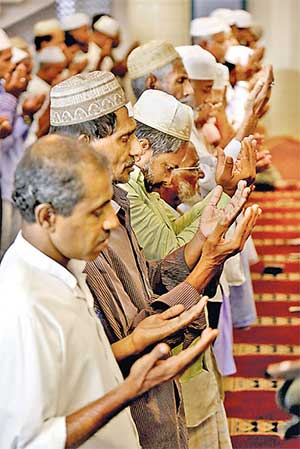
Muslims at a mosque in Sri Lanka. Credit: Financial Times, Sri Lanka
BRUSSELS, Jan 25 2022 (IPS) – On 28 October, President Gotabaya Rajapaksa appointed the militant Buddhist monk Galagoda Aththe Gnanasara to head a presidential task force on legal reforms, shocking many in Sri Lanka and beyond. Gnanasara is the public face of the country’s leading anti-Muslim campaign group, Bodu Bala Sena (Army of Buddhist Power, or BBS). He is widely accused of inciting inter-communal violence, including two deadly anti-Muslim pogroms in June 2014 and March 2018.
Convicted of contempt of court for a separate incident, Gnanasara was sentenced to six years in prison but received a presidential pardon from Rajapaksa’s predecessor, Maithripala Sirisena, in his final months in office. The act of clemency came after intensive lobbying by nationalist monks and an upsurge of anti-Muslim sentiment in the aftermath of the 2019 Easter bombings, a series of attacks on churches and tourist hotels carried out by a small group claiming allegiance to the Islamic State, or ISIS.
Observers across the Sri Lankan political spectrum, including some Buddhist nationalists, expressed dismay – at times, outrage – that the president could name someone whose disrespect for the law and hostility to non-Sinhala Buddhist minorities are a matter of public record to head a commission ostensibly designed to prevent “discrimination” and ensure “humanitarian values”. Critics have called the appointment “irrational” and even “incomprehensible”.
In fact, it is anything but. The Rajapaksa government is deeply unpopular, including among large sections of its core Sinhala Buddhist constituency, and desperate to divert public attention from its economic mismanagement.
There is thus a clear if deeply unfortunate logic for it to bring back to the fore the best-known proponent of a theme that was key to getting the president elected: fear of Muslims as a source of “religious extremism”.
While it was in one sense surprising to see the open affirmation of Rajapaksa’s active support for the controversial monk after many years of distancing himself from Gnanasara, tight links between Sri Lankan government officials and the Buddhist clergy are nothing new. The 1978 constitution gives Buddhism the “foremost place” in the country’s religious landscape and the state the duty to “protect” it.
There is nothing comforting in this history, however. The Sinhala Buddhist majoritarian nature of the Sri Lankan state – ie, the extent to which the state represents and enforces majority interests at the expense of the rights of other communities – has had disastrous effects on the country’s ethnic and religious minorities.
The state’s transition from being structurally discriminatory to openly hostile toward Tamils (who are Hindu or Christian) – a process fed by Sinhala politicians’ warnings about the threat the community allegedly posed – ultimately led to three decades of devastating civil war.
During that period, from 1983 to 2009, terrorist attacks by the Liberation Tigers of Tamil Eelam provided some objective grounds for Sinhalese fears, reinforcing the narrative that the majority community was under threat. Now, there is growing reason to fear that this pattern may be repeating itself in the Sri Lankan state’s interactions with its Muslim citizens.
Credit: Sunday Times, Sri Lanka
The Rise of Anti-Muslim Politics
In November 2019, Gotabaya Rajapaksa’s successful campaign for Sri Lanka’s presidency made much of the slogan “one country, one law”, which had gained popularity after the 2019 Easter bombings. Its ambiguity was useful: at one level, it could be interpreted as merely asking for uniform treatment of all citizens and resonated with voters angry at the impunity with which politicians and their powerful supporters are able to violate the law.
But its discriminatory implication was also obvious from the start, hinting at a need to “protect” the Buddhist nature of state and society by eliminating the separate rules and treatment that many Sinhalese believe Muslims use to gain economic and political advantages.
Many Sinhalese have for years held the view that Sri Lankan Muslims are more concerned with advancing their own interests than working for the larger national interest. Even during the civil war, when Muslims remained overwhelmingly loyal to the state and played a critical role in fighting the Tamil insurgency, one regularly heard complaints in Sinhalese (as well as Tamil) circles that they were exploiting the conflict for personal and collective economic benefit.
Because Muslim lawmakers held the balance of power in parliament between the two major Sinhala-dominated parties, they were commonly accused of using their “kingmaker” role to gain undue advantages for their co-religionists.
By the early 2000s, many Sinhalese had also begun to express discomfort at the increasing numbers of Muslims, especially women, wearing religious attire and the growing focus among Muslims on practices meant to demonstrate religious piety. Many interpreted this trend as Muslims deliberately distancing themselves from the majority.
With the arrival of BBS ultra-nationalists on the political scene in late 2012 – whose message was amplified by the smaller militant Sinhalese groups Sinhala Ravaya and Ravana Balakaya – the public portrayal of Sri Lankan Muslims rapidly took on more overtly hostile forms. (The decade earlier had seen organised Buddhist activism, at times violent, directed against the growing number of evangelical churches; pressure on Christian evangelicals continues today, though not on the scale of anti-Muslim campaigns.)
At the height of its influence, in 2013 and 2014, BBS dominated news coverage and helped set the political agenda through rallies, speeches and vigilante actions aimed at containing the threat Muslims’ alleged “extremism” posed to Sri Lanka’s Sinhala Buddhist character. The range of allegations promoted by BBS and like-minded organisations, often through online hate speech, was broad and shifting.
They claimed that population growth meant that Muslims would eventually overtake the Sinhalese majority; that Muslim-owned businesses were secretly distributing products to sterilise Sinhalese in order to keep their numbers down; and that the system of halal food labelling was encroaching on the religious rights of others and covertly funding Islamist militants.
More generally, conservative religious practices adopted by increasing numbers of Muslims in a quest for greater piety were read by ultra-nationalists as evidence of growing “extremism” that threatened other communities. These charges were based on either outright falsehoods or malicious misinterpretations of complex social and religious developments among Sri Lankan Muslims.
The anti-Muslim rhetoric helped set off inter-communal violence late in the presidency of Gotabaya’s brother Mahinda Rajapaksa (2005-2015). These years saw a series of attacks on Muslim-owned businesses (with many alleging that Sinhala business rivals were backing the attackers) and disruption of political meetings held by anyone daring to challenge the Buddhist militants, against the backdrop of mass rallies denouncing the alleged threat posed by Muslims’ “extremism”.
In a June 2014 speech in the town of Aluthgama, Gnanasara declared to a large crowd: “This country still has a Sinhala police. A Sinhala army. If a single Sinhalese is touched, that will be the end of them all [Muslims]”. Minutes later, hundreds of his supporters marched through a nearby Muslim neighbourhood, sparking two days of devastation that left three Muslims and one Tamil security guard dead. Sinhala rioters, many of them brought in from outside the area, targeted mosques and Muslim-owned shops and homes for arson and destruction. The police were widely accused of standing by or even assisting the rioters.
Despite government denials, many independent observers told Crisis Group at the time that the Mahinda Rajapaksa administration was actively supporting the BBS and other anti-Muslim campaigns. They suspected the government of executing an electoral strategy designed to consolidate the Sinhala vote behind the government, which projected itself as the defender of Sinhalese Buddhist identity. The appearance of Gotabaya Rajapaksa, then defence secretary, at a BBS event in March 2013, and his known connections with senior monks associated with the group, fuelled the speculation.
More tangible evidence of state backing lay in the fact that police gave BBS and like-minded groups permission to hold rallies at a time when government critics were not allowed to do so. Police took no apparent action, moreover, to prevent or investigate repeated vigilante raids on Muslim-owned shops or violent efforts to silence critics of militant Buddhist organisations.
Nor was anyone prosecuted for any of these crimes. Multiple sources told Crisis Group that Senior Deputy Inspector General of Police Anura Senanayake, who worked closely with Gotabaya at the time, led efforts to persuade victims not to press charges. Following Mahinda’s defeat in the January 2015 election, officials announced they had evidence of close ties between Buddhist militants and military intelligence units, confirming what Muslim community leaders had previously told Crisis Group.
With the 2015 election of President Maithripala Sirisena, representing a united opposition determined to end the Rajapaksas’ rule, the strategy of demonising Muslims for electoral ends seemed to have failed. Sirisena’s yahapaalanaya (good governance) coalition won in part through strong Muslim and Tamil backing based on its promises to end the BBS-led reign of terror.
But while the new administration stopped tacitly encouraging anti-Muslim violence and hate speech, it lacked the political courage – and possibly the necessary support within the police and intelligence agencies – to crack down on Buddhist militant groups.
After a brief lull in anti-Muslim activism, 2016 and 2017 saw a series of small attacks on Muslim businesses by unknown assailants, encouraged by sustained hate speech campaigns in traditional and social media, backed by effective local networks.
In February 2018, Buddhist militants in Ampara damaged a mosque and Muslim-owned shops as the police looked on, following social media rumours that a Muslim-owned restaurant had injected sterilising chemicals into Sinhala customers’ food. The following month, four days of anti-Muslim rioting shook the central hill district of Kandy, sparked by the death of a Sinhala man assaulted weeks earlier by four Muslim men.
Gnanasara visited the victim’s family and later joined other militant leaders to address a crowd of protesters just hours before the riots began. Videos later appeared to show local politicians from the Rajapaksa family’s party, the Sri Lanka Podujana Peramuna, taking part in the mayhem. Two people were killed, many injured, hundreds of Muslim-owned houses and shops destroyed, and at least a dozen mosques damaged. The violence was severe enough for President Sirisena to declare a state of emergency, during which the army eventually brought things under control.
President Sirisena, Prime Minister Ranil Wickremesinghe and senior ministers all condemned the violence and promised tough action in response. But despite hundreds of arrests, including of several prominent Buddhist activists, no one was held accountable for these incidents, which included well-documented attacks on Muslims by security forces, with eyewitnesses telling Crisis Group of numerous cases of complicity between the police and Buddhist rioters.
In August 2018, courts eventually convicted Gnanasara of contempt of court and criminal intimidation of a prominent Sinhala human rights activist. Many hailed his six-year sentence as a landmark, though Gnanasara has faced no jail time for attacks on or other actions against Muslims, and most of the slow-moving criminal cases against him in lower courts have now been dropped.
The partial victory over impunity was, however, short-lived. In 2019, in the aftermath of the horrific Easter Sunday suicide attacks, the Sri Lankan state for the first time adopted policies that directly discriminated against the Muslim minority. With tensions running high, President Sirisena’s government used the post-bombing state of emergency to prohibit the niqab, or full face covering, invoking national security concerns (the ban was rescinded in August 2019 when the emergency was lifted).
It also enacted new rules for government employees that, in effect, barred the full-length abaya, worn by many Muslim women teachers, especially in the Eastern Province (these were later withdrawn after being challenged by Sri Lanka’s Human Rights Commission). Anxious to salvage his sinking political fortunes as the November 2019 presidential election drew near, Sirisena then pardoned Gnanasara.
The nationalist monk immediately leapt into the political fray, joining his peers in protests demanding the resignation of Muslim ministers Rishad Bathiudeen and Azath Salley, accusing them – to date without convincing evidence – of involvement in the Easter attacks.
For many Sinhalese, especially Christians, as well as some Tamils, the Easter attacks seemed to confirm earlier warnings of a growing threat from “Islamic extremism”. Authorities responded to these fears in the attacks’ aftermath with what appeared to be the criminalisation of Muslims’ everyday practices.
Police arrested more than two thousand Muslims under emergency and terrorism laws, in all but a few cases with no evidence of links to the bombings or any threatening behaviour; they picked up many merely for having a Quran or other religious materials in Arabic script at home.
After the Easter bombings, the previously failed electoral strategy of shoring up Sinhala support through vilification of Muslims gained new traction. Gotabaya announced his candidacy just days after the attacks, promising to eradicate new forms of religiously motivated terrorism just as he had previously destroyed the Tamil Tigers when he was defence secretary.
At the polls, Gotabaya received overwhelming support from Sinhala voters, including many Catholics who had not previously backed him. The new president himself seemed to acknowledge the strategy’s success, declaring in his inaugural speech given in front of a Buddhist shrine: “I knew that I could win with only the votes of the Sinhala majority”.
Growing Tensions
Within months of taking office, Gotabaya deepened the state’s hostility toward Muslims on several fronts. His administration used COVID-19 lockdowns and ad hoc village-level quarantines to harass the community, which pro-government media outlets accused of spreading the virus. More damaging was the government’s decision on 1 April 2020 to ban burial of anyone even suspected of having died of the disease.
Announced the day after the first Muslim victim died, the decision was justified by a claim – quickly rejected by the World Health Organisation and Sri Lankan experts – that the virus could spread from interred remains through the groundwater. The policy, which stayed in place for nearly a year, had a profoundly cruel effect on Muslim families, who were forced to cremate their loved ones’ bodies against their religious convictions.
It was rescinded on 26 February, after a global advocacy campaign that sought to mobilise the Organisation of Islamic Cooperation and member states of the UN Human Rights Council, which was due to assess Sri Lanka’s human rights record weeks later. Even after the ban was lifted, however, Sri Lanka has allowed burials in only one remote location, heavily guarded by the military – a limitation that continues to impose hardships on Muslims, as well as the smaller number of Christians and Hindus who choose to bury their dead.
On 12 March, the government also announced new regulations for “deradicalisation” of those “holding violent extremist religious ideology”. Issued under the draconian Prevention of Terrorism Act, the rules allowed the defence ministry to detain anyone accused of causing “acts of violence or religious, racial or communal disharmony or feelings of ill will or hostility between different communities or racial or religious groups” for up to eighteen months, without any judicial process or oversight.
Human rights lawyers and Muslim leaders quickly filed suit in the Supreme Court, which in August put the measures on hold until it decides the case. Even if the court quashes the regulations, however, the government’s clear intention to establish a “deradicalisation” program leads some to believe it may enshrine similar powers in revisions to the counter-terrorism law it is presently preparing.
The regulations were issued without evidence that any significant number of Muslims in Sri Lanka posed a threat to security or would benefit from a program along the contemplated lines. They did, however, offer the government a face-saving way to release some of the hundreds of Muslims arrested after the Easter attacks who are still detained, in some cases without charge, by putting them into a “deradicalisation program”.
Holding large numbers of Muslims in special camps for another year or more, as the proposed deradicalisation program would do, however, would risk contributing to a collective sense of humiliation and anger that could itself push some toward “violent extremist religious ideology”. As Muslim activists regularly warn, the risk is particularly high as long as the government’s approach leaves no room for the possibility that Buddhists could promote their own forms of violent extremism.
Overlapping enquiries into the Easter bombings have, meanwhile, been politicised in ways that appear aimed at keeping alive fears of Muslims as a source of insecurity. As part of its broader attack on the independence of police and courts, Gotabaya’s government replaced the entire team looking into the bombings soon after coming to power, arrested the chief investigator, Shani Abeysekera, on what appear to be trumped-up charges, and demoted other officers. Another key investigator fled the country fearing arrest.
The administration has also refused to act on the key recommendations of a separate commission of enquiry – appointed by President Sirisena – into the bombings. These included, among others, prosecuting Sirisena, who is now a key government ally, and banning BBS, whose anti-Muslim incitement the commission found had contributed to the bombers’ turn to violence in a process of “reciprocal radicalisation”.
In what seems to be an attempt at maligning Muslim leaders, the Gotabaya administration also detained or charged a number of prominent Muslim personalities, seemingly without credible grounds. Ex-minister Bathiudeen faces terrorism and extremism charges – despite having been cleared of links to the Easter bombings by the presidential commission of enquiry.
On 2 December, a court released another Muslim lawmaker, Salley, after he had spent eight months in jail, citing lack of evidence. The prosecution of human rights lawyer and political activist Hejaaz Hizbullah for his supposed links to the Easter terrorist attacks also appears to be groundless, relying in part on coerced testimonies.
The government’s approach has angered Sri Lanka’s Catholic leadership, which has accused it, and the president himself, of covering up the “masterminds” behind the Easter bombings. Church leaders suggest that the government has been protecting Sirisena and refusing to follow up on evidence uncovered by the presidential commission that implies military intelligence officers had contact with some of the bombers before and on the day of the attack.
Backed by Pope Francis, Colombo’s archbishop Cardinal Malcolm Ranjith has called for an international investigation. Following an October online meeting that aired church criticisms, the police summoned one of the cardinal’s top advisers for three days of questioning.
A Dangerous Slogan
Stung by growing criticism of its handling of the Easter bombings investigation, and facing a grave economic crisis that has badly damaged its popular support, including among Sinhala Buddhists, the Rajapaksa government signalled with Gnanasara’s appointment that it is returning to the “one country, one law” agenda that helped get it elected.
Given the concept’s vagueness, however, and the deep contradiction between it and the explicit privileges that Buddhism enjoys under the constitution, no one is sure what Gnanasara’s task force will actually do. While it can, in principle, look into the practices of all religious and ethnic groups, few observers doubt that it will focus its attention on the Muslim minority.
It is expected to consider reforms to the madrasa education system – Muslim leaders have submitted proposals to the government – as well as government plans to regulate activities in mosques, monitor the import and translation of the Quran and other Arabic texts, ban the niqab and burqa, and outlaw cattle slaughter (an industry dominated by Muslims and often criticised by Buddhist activists).
Gnanasara’s task force also seems certain to weigh in on long-discussed changes to the Muslim Marriage and Divorce Act, a new version of which the cabinet approved in August. Over the past years, Muslims and others have bitterly debated possible reforms to the Act, with complicated overlap between human rights and feminist critiques of the legislation as patriarchal and oppressive and Buddhist nationalist criticisms of Muslims having their own marriage and family law.
Sri Lankan law enshrines distinct traditions of family law for Sinhalese in Kandy and Tamils in Jaffna, as well as for Muslims, but this Act has come in for particular criticism on account of allowing polygamy, setting no minimum age for marriage, requiring no explicit consent from the bride and establishing all-male courts to hear divorce cases.
It remains to be seen, however, how far the government will allow or encourage Gnanasara to go. On the one hand, Buddhist nationalists appear to see “one country, one law” as a call for “a single law” that gives pre-eminence to Buddhist institutions while denying those of other religions official recognition.
Some top officials clearly see things the same way: it was particularly revealing that Gnanasara’s appointment was followed three weeks later by a series of large-scale Buddhist religious ceremonies in the sacred city of Anuradhapura, featuring the president, cabinet and top military brass alongside the Mahanayakes, Sri Lanka’s most powerful Buddhist clerics.
The two days of ceremonies were grand displays of the government’s project of more fully integrating state, military and Buddhist clergy on the basis of an overtly Sinhala nationalist political vision. On the other hand, in a December meeting, Foreign Minister G.L. Peiris assured ambassadors from Muslim countries that Sri Lanka would “continue to retain” “personal laws specific to Muslim, Kandyan and Tamil communities”.
Moreover, to date, Colombo has carefully calibrated its anti-Muslim policies so as to keep the backing of its hardline Buddhist nationalist supporters and win a degree of international support for helping “counter violent extremism”, while maintaining good relations with economic and political allies in the Muslim world.
The government may as yet have no precise agenda for the task force, but given Gnanasara’s charisma and theatrical skills, he is a potentially powerful, and dangerous, asset for reframing political debate, deepening divisions between Tamils and Muslims and possibly even provoking a new round of anti-Muslim unrest. He has been central in propagating Buddhist nationalist ideology over the last decade.
There is little that those outside of Sri Lanka, concerned about the rule of law, religious harmony and political stability, can do directly to address these dynamics. Foreign partners of the Sri Lankan state, can, however, be more careful about not inadvertently strengthening them.
Following the Easter bombings, a range of new programming by foreign donors has focused on counter-terrorism, preventing “violent extremism” and building “social cohesion”. In the words of one activist, though, “There is a lot of foreign funding to the government for ‘countering violent extremism’ but it only targets one faith. … No one dares tell the government to ‘rehabilitate’ Gnanasara or other extremist monks”.
Until such programming finds – or creates – the space to name and challenge the violent history, rhetoric and exclusionary political projects of all communities, it is more likely to perpetuate, rather than resist, the anti-Muslim ideology that today poses the greatest risk of destabilising violence in a country that has yet to recover from decades of brutal civil war.
An includable leader knows that not everyone comes from the same space with the same privileges. They are aware of systemic barriers that dictate interactions between people of different genders, classes, or abilities, according to the author. Credit: United Nations
BENGALURU, India, Dec 2 2021 (IPS) – In her famous speech ‘The Danger of a Single Story’, Nigerian writer Chimamanda Ngozi Adichie warns us against a singular narrative of a person—a stereotype. This, Adichie asserts, is not because stereotypes are untrue, but because they are incomplete—“They make one story become the only story.” This is true in all walks of life, including in our interactions with people with disabilities at workplaces.
The consequence of the single story, according to Adichie, is that it robs people of dignity. “It makes our recognition of our equal humanity difficult. It emphasises how we are different rather than how we are similar.”
Take the example of my brother, Hari. He topped the MBA programme in Narsee Monjee Institute of Management Studies. He has a visual disability, and he managed his education with the help of audio cassettes, screen reader software, and the internet. But when it came to his placement, none of the employers wanted to hire him because of his ‘blindness’. He went through 70 interviews.
To go beyond the differences, leaders must focus on the commonalities between them and the person they are interacting with. To be an includable leader, one must do away with the us-versus-them narrative
The problem was not that the interviewers saw him as a person with vision impairment, but that they could see only one ‘story’ of him—his disability. It created fear and discomfort, and took precedence over any other stories that would have helped the interviewers see his personality, conduct the interview, and gauge his competence.
They focused so much on how he was different from them that they did not even try to look for similarities. Hari likes cricket, a sport with billions of admirers across the country, and this could have been a conversation starter for some of them. Or someone could have simply said, “Hey, I have never met a blind person. How do I interview you?”
EnAble India’s idea of includability—the ability to include—emerged from this and many other experiences I had with leaders, managers, and employees across organisations. I realised that awareness of differences is not the barrier to includability. It is the inability to create a common ground for dialogue, which requires strategic planning and building competency.
What is includability quotient?
Becoming an includable leader requires cultivating what we call an includability quotient (IncQ)—a competency framework for leaders on how to include diverse people in their organisation. A leader with a high IncQ is able to get the most out of their team, and is guided by three broad principles:
1. Internalising the landscape
An includable leader knows that not everyone comes from the same space with the same privileges. They are aware of systemic barriers that dictate interactions between people of different genders, classes, or abilities. They are also aware of how these barriers intersect, and actively plan strategies to overcome them.
For example, disability, lack of access to education, and poverty are often interlinked. To overcome this, we urged the leaders in a multinational corporation (MNC) we had worked with to hire persons with disabilities who had earned diplomas—for a position for which a degree was otherwise necessary.
The leader took the right decision to hire and provided a level playing field to overcome the inequities which come with the landscape. Their next step was to offer the employees a scholarship to pursue their degree later. Similarly, there are information technology (IT) companies that provide a loan for modified two-wheelers to people with disabilities for easy access to the workplace. In each example, the leader used their competency to distinguish a level playing field from an ‘excuse’.
2. Normalising the differences
To go beyond the differences, a leader must focus on the commonalities between them and the person they are interacting with. An includable leader does not function with an us-versus-them narrative. They actively try to facilitate conversations by using appropriate language and triggers.
However, like all conversations, this normalisation of differences is a two-way process. Employees with disabilities must be equipped with self-advocacy tools that help them to identify as more than their disability. The tools can include hobbies, adjectives, and aspirations that might spark an exchange.
For example, when a leader met Ajay*, a person with intellectual disability who is 38 years old and speaks in monosyllables, the leader didn’t know what to say. However, when Ajay presented them with a card where he described himself as a cricket lover and as Mr Dependable, the leader asked him about cricket. With this topic, Ajay gradually opened up and spoke a couple of sentences. The leader could see his personality, which may not have been possible if only the term ‘intellectual disability’ was ringing in his head.
In another instance, a manager had to familiarise his interns with domain-related video content in an American accent. To make it easier for the interns who might have found a non-Indian accent a barrier to understanding, the manager first introduced similar content in an Indian accent to them. This was a learner-centric approach that worked for people from different backgrounds.
3. Changing expectations
Every person is capable of growth. Our inadequacy as leaders and managers is that at times we fail to remember this. An includable leader uses appreciative inquiry (AI)—an evaluation mechanism that focuses on the strengths rather than the weaknesses of an employee. This is applicable to employees coming from all kinds of spaces—be it a person with or without disability. And it is done with the belief that what you focus on will grow.
Whenever a new employee joins the team, the leader figures out their strengths and gains an understanding of the systemic barriers they face. From here both of them can go on to co-create solutions. Once this is done, the boundaries need to be pushed by focusing on the employee’s strengths.
Take, for instance, the case of an MNC that hired a person with intellectual disability for an internship. In the initial days, the intern mostly interacted with their manager and a colleague who was assigned to them as a buddy. With time the intern was made to attend presentations, which interested them enough to want to present on their own.
The MNC’s strategy was to make the intern speak on any topic of their choice for five minutes to a small team. As a second step, the management provided the intern with the topic to speak on. And, finally, the intern was asked to make a formal presentation to a larger team.
The MNC’s process of gradually moving the metre helped the intern gain confidence to speak in front of people and accumulate technical knowledge from the interactions. This kind of intervention helps employees not only in their current job but also going forward in their career. Additionally, a leader skilled enough to design and implement such a process gathers the confidence to work with team members from various facets of society.
Lessons for nonprofits
These are not easy lessons to learn for even the most eager leaders and managers—not because they do not want to engage, but often because they do not have a language to communicate their guilt, worries, and discomfort when they encounter a person they see as different from themselves.
Finding that common language requires a leader and a colleague to first learn to self-include. This involves feeling comfortable about themselves by gaining awareness of their own space, which comes with its own difficulties. It includes being able to speak openly about their problems and concerns—be it personal or professional. It is only then that a workplace can become truly inclusive.
As facilitators working with organisations, our job is to make space for these conversations at various levels. This requires us to build a nuanced understanding of the various elements that form an organisation—only then can we come up with tools, methods, and strategies. Here are some of the lessons I have learnt over the years:
1. An includable workplace is more than the leader
While speaking with and educating leaders is an essential part of creating an inclusive workplace, the idea needs to travel across the organisation. The leadership has to play the role of an implementer in bringing changes at various levels. This includes individuals being comfortable with and understanding the needs of a colleague with disability, as well as people with disabilities being able to assert an identity that is more than their disability.
2. ‘Peacetime’ interactions go a long way
We have seen that people with disabilities and those without have more fruitful interactions when these are facilitated during ‘peacetime’—an informal, non-work setting. For instance, when a person without disability studies with a person with disability at school or when they work together as volunteers, there’s a chance that they might be able to build a sustainable bond that’s beyond notions of ability and disability. Peacetime creates an exposure opportunity where the knowing and acceptance happens in a non-threatening way.
3. Facilitators need to keep introspecting
Conversations around disabilities demand a space of vulnerability. This is true for participants across the intersections of people with disabilities, non-profit facilitators working with people with disabilities, and leaders. It is easy to form attachments, look out for each other, and become protective of each other. However, as facilitators, we must be wary of our actions that stem from these emotions.
Our well-intentioned protectiveness can stand in the way of a person being able to push their limits and prepare for the competitive world of employment. This is a clear deviation from our own idea of building together a more equitable world. Thus, we need to constantly evaluate our actions. Because that equitable world—in Adichie’s words, “a kind of a paradise”—will emerge not from our guilt or pity, but from our rejection of the singular narratives of individuals.
*Name changed to maintain confidentiality.
With contributions from Gayatri Gulvady.
Shanti Raghavan, the author of this article, is a social entrepreneur and the co-founder of EnAble India, which works towards providing economic independence to persons with disability
During the pandemic, there was little support from the government when it came to making funding and resources available to the nonprofits that were working closely with communities. | Picture courtesy: Digital Empowerment Foundation
Nov 23 2021 (IPS) – From its devastating economic impact and the migrant crisis to the startling death toll, the COVID-19 pandemic in India unfurled one crisis after the other. The glaring gaps in our system, which had always been there, became even more prominent during the pandemic. There is one question at the back of everyone’s mind that still remains unanswered: What went wrong?
No entity can operate in isolation, be it the government, the private sector, or civil society. During times of crisis, the government must ensure that all cogs in the wheel continue to work effectively. Civil society—local communities and nonprofits—must enable delivery of public services up until the last mile. And, finally, the private sector needs to step up in terms of financial resources and leveraging of networks and influence.
Nonprofits in 13 states and union territories were able to provide meals to more people during the lockdown than the concerned state governments – Would a collaborative relationship between the government and the social sector have aided a better response to the COVID-19 crisis?
However, when the pandemic was at its peak in India, these three entities failed to come together and work collaboratively to cushion the devastating effects of COVID-19 on the people.
The missing link between the government and the social sector
According to our village-level digital entrepreneurs in the SoochnaPreneur programme at Digital Empowerment Foundation (DEF), the four essential systems that were massively hit by the pandemic were education, healthcare, finance, and citizen entitlements. When the pandemic was raging, our SoochnaPreneurs reported that all people wanted was food and rations, a device to access online education for their children, the ability to talk to a doctor or health worker to learn how to keep themselves safe, and to make some money to meet their daily needs from the confines of their homes. Ironically, given the stringent nature of the lockdowns, all this needed access to the internet.
However, across the country, lack of access to resources, high levels of digital illiteracy, and the deepening digital divide exacerbated by the pandemic acted as major roadblocks in India’s COVID-19 response. Even as the government announced relief packages—food grains and cash payments—the mechanisms of delivery to beneficiaries at the last mile were unclear.
For instance, common service centres (CSCs), which are supposed to work as access points that enable digital delivery of services such as banking and finance across rural India, were mostly non-functional. During the pandemic, the government claimed that people could use their local CSCs to access various digital services including telehealth and registration for vaccinations. However, like any other office, shop, or business centre, almost all CSCs had closed their operations due to the strict lockdown rules in various states.
With government services not always being available, the social sector stepped up. Whether it was making access to digital tools and digital literacy a priority or the distribution of essentials, nonprofits across the country filled in the gaps. According to one report, nonprofits in 13 states and union territories were able to provide meals to more people during the lockdown than the concerned state governments.
The question that arises is: Would a collaborative relationship between the government and the social sector have aided a better response to the COVID-19 crisis?
For instance, the distribution of food grains could have been made efficient from the get-go if, rather than having long queues of people waiting at shops, organisations with the digital know-how had been allowed to deliver ration at the doorsteps of people with a biometric machine in hand. This synchronisation and management of resources is something that should have been under the government’s purview, while a partnership with civil society organisations could have helped with execution and delivery. Considering that hundreds of thousands of nonprofits working at the grassroots were tasked as frontline workers, the government could have tapped into this already existing infrastructure and network.
The lack of trust between the social sector and the government didn’t help. During the pandemic, there was little support from the government when it came to making funding and resources available to the nonprofits that were working closely with communities. For instance, while local nonprofits worked as service providers during the pandemic, funds lying with local government bodies could have been diverted to their operations to successfully navigate the panic-like situation brought on by the first lockdown when everything came to a halt.
Moreover, during the first lockdown, there was a diversion of CSR funds to PM Cares. At present, not only is there a lack of transparency on how these funds have been deployed, but this diversion of funds has also been a huge blow to nonprofits who have been struggling to look after their own employees and their organisations while providing relief to communities on the ground.
The private sector did not step up either
There was lack of communication and collaboration across business, and a piecemeal approach was adopted. Industry associations could have encouraged CEOs and company heads to interact with each other and solve issues on a larger scale. For instance, industry bodies such as the Confederation of Indian Industry (CII), Federation of Indian Chambers of Commerce & Industry (FICCI), and Associated Chambers of Commerce and Industry of India (ASSOCHAM) could have deployed their resources to help manage the mass migration of workers from industrial towns and urban centres more systematically and humanely.
In pre-pandemic times, CSR within corporates would ask nonprofits to work in areas where they have manufacturing facilities and offer localised support. Corporates could have extended this reasoning during the lockdown as well and enlisted the support of their nonprofit partners to help those workers and informal sector migrants who were homebound, while providing the nonprofits with the required monetary and infrastructure support.
There was also a reluctance from corporates to innovate in times of need. Since DEF works on digital integration to fight poverty, we reached out to many CSR funders to provide funds for buying smartphones, tablets, projectors, and other electronic devices to provide digital infrastructure in the villages. However, it took us more than a year to convince some of them to help us offer support to people with no digital access and empowerment through our Digital Daan initiative.
It is important to contextualise the social and economic support at the time of disaster and that can happen only if there is a relationship of trust between the stakeholders.
What the social sector could have done better
The onset of the pandemic brought with it uncertainty for most nonprofits. In addition to lack of funding and overstretched resources, many nonprofits had to take up the role of relief workers and divert efforts from their primary objectives, which would have been domestic violence, child protection, water and sanitation, and so on.
One important factor missing in this entire conversation was the inability of many nonprofits to adopt digital tools to improve operations, efficiency, and delivery of services. While webinars became a recurring feature in their calendars, thus creating a space for knowledge sharing, grassroots nonprofits were often not a part of these dialogues. Smaller nonprofits were also overwhelmed with work on the ground due to the needs of their communities coupled with inadequate support from either their funders or governments; hence, many of them had little time or resources to think or build their capacity to go digital.
The pandemic did however push several nonprofits to adopt digital tools for operations and delivery of services. Larger nonprofits with their own networks, adequate funding, and a strong digital presence were able to leverage digital platforms. However, many of the smaller nonprofits and those at the frontlines had to innovate to reach beneficiaries digitally.
Moreover, with the government aggressively pushing Digital India—from telehealth to online education and even the vaccine roll-out—it became imperative for organisations to incorporate digital and technological solutions in their everyday operations. Many nonprofits therefore had to work on building in-house digital capacity and infrastructure during the pandemic, while also serving their communities and raising funds.
In the case of mobilising money, digital platforms could have been a powerful tool for the sector, and they did help many nonprofits raise funds. However, this was not the case for the entire social sector.
According to the India Giving Report 2021 by the Charities Aid Foundation, individual donations were at an all-time high during the pandemic. Crowdfunding platforms such as GiveIndia provided people easy access to donate to various causes. However, this giving may not have been as diversified—the absence of reliable information online acted as a barrier for many givers while donating. Therefore, givers may have chosen to stick to organisations they trusted. And many local nonprofits with limited digital know-how had to rely on local giving or local resource mobilisation.
For example, our colleague Mohamed Arif, whom we lost in the second wave, was in charge of DEF’s digital centre at Nuh, Haryana. He was digitally savvy and active on social media and was thus able to raise approximately INR 25 lakh (in cash and food grains, and other essentials) through his personal Facebook profile and networks.
However, while the pandemic did push many nonprofits to incorporate technology-led solutions, I find that urgency dwindling again. Digital empowerment of the sector requires sustained efforts wherein organisations put aside certain funds every year for digitally upskilling their employees, maintaining digital collaterals, and modifying their approach to include technology in their everyday operations.
I see the pandemic as an inflection point in the future of nonprofits and civil society as a whole. Which organisations survive this period of transition will largely depend on how well they can adapt to these changing times. According to me, one of the key changes the sector will have to make to stay relevant is to become more digitally aligned.
Osama Manzar, the author of this article, is the founder and director of Digital Empowerment Foundation. He is a Senior Ashoka Fellow, a Chevening Scholar, and has served on several boards such as the Association for Affordable Internet, Association of Progressive Communications, World Summit Awards, and Down To Earth. He specialises in creating digital models for poverty alleviation and has travelled to more than 10,000 villages. Get in touch with him on Twitter: @osamamanzar
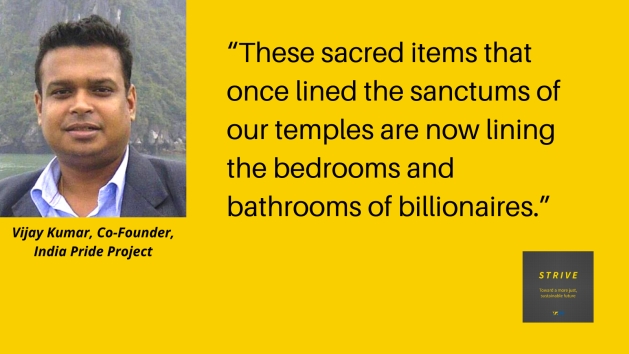
KATHMANDU, Nov 18 2021 (IPS) – The illicit trade in idols and other historical treasures looted from temples, archaeological digs and various sites globally has been estimated at $100 billion a year.
A more telling figure might be the nearly 18,000 villagers in India’s Tamil Nadu state who turned out to welcome home a god figure stolen from one of their temples. More revealing still is the image of a single villager who, seeing a stolen god displayed in a Singapore Museum, falls to the ground and starts to pray.
Vijay Kumar accompanied that villager to the museum, and has witnessed idols lovingly replaced to their ages-old spots in Tamil Nadu temples.
For 16 years he has been working to repatriate gods and goddesses looted from India over the years, and the challenges remain huge, he tells us in today’s episode. For example, in 2020, police seized 19,000 stolen artefacts in an international art trafficking crackdown. 101 suspects were arrested with treasures from around the world, including Colombian and Roman antiquities. One activist estimates that in France alone there are 116,000 African objects that should be returned.
But Vijay is encouraged by the successes of citizen-led movements like his own, which began with a blog, Poetry in Stone, then the launch of the group India Pride Project.
Success can be measured in the growing number of artefacts returned to India: 19, from 1970-2000; 0, from 2000-2013; but 300+ after 2013. That includes roughly 250 items valued at about $15 million, which were repatriated in October, among the treasures looted by disgraced art dealer Subhash Kapoor, the subject of Vijay’s book, The Idol Thief.
Today’s conversation is packed with information, including Vijay’s opinion that countries like India and Nepal, where idols are part of the living heritage and still prayed to daily, should be treated differently than countries whose artefacts are looted from buried remains. He also has advice for would-be activists — in the murky world of art repatriation, be very, very wary about accepting money from anyone.