The Spectre of Migration: A conversation with Hammoud Gallego

Civil Society, Climate Change, Economy & Trade, Energy, Global, Green Economy, Headlines, Human Rights, Inequality, Latin America & the Caribbean, Migration & Refugees, TerraViva United Nations

Opinion

Antonio Berni, Unemployed, 1934

STOCKHOLM, Sweden, Feb 1 2024 (IPS) – Karl Marx’s Manifesto of the Communist Party begins with the now worn-out phrase: “A spectre is haunting Europe – the spectre of communism. All the powers of old Europe have entered into a holy alliance to exorcise this spectre”. Nowadays the word “communism” could easily be substituted by “migration”. All over Europe, politicians claim that Europe is being destroyed by migrants. In country after country, ghosts of yesterday are awakened. Parliaments include xenophobic politicians who might be considered as inheritors of demagogs who once dragged Europeans into hate and bloodbaths.


Populists have successfully convinced voters that the greatest threat to their nations is neither inequality, nor climate change, but immigration. Politicized storytellers have found that fear of “the other” can be a means to gain power. Nevertheless, such a fear does not concern any “other” – respected professionals who move to another country are usually not labelled as “migrants”, neither are wealthy businessmen who acquire new passports as easily as they move their money around the world.

To obtain some insights to the often all overshadowing phenomenon of international migration, Jan Lundius recently met with Dr Omar Hammoud Gallego, a fellow at the London School of Economics and Political Science.
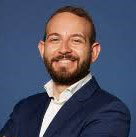
Omar Hammoud Gallego

IPS: Your research deals with migration, as well as civil society’s connection with international organisations. How did this interest develop?

Hammoud Gallego: Like many of my colleagues and friends, I am the son of migrants. My parents came from different parts of the world and met, married and established themselves in a third country. However, this was not the main reason for me to focus on migration in my research. In 2015, while working for UNHCR in Colombia, where I was engaged in supporting internally displaced Colombians, I soon found out that there was a lack of serious, in-depth research about migration within Latin America. I began to read about regional migration and decided eventually to pursue a PhD on this topic.

IPS: Was it the specific situation in Colombia that made you shift your main interest from internal to regional migration?

Hammoud Gallego: Yes, over the last few years Colombia has received a huge influx of migrants and refugees from Venezuela (although they are recognised as refugees only in a handful of countries). A phenomenon that has not abided. More than 7,7 million migrants and refugees have left Venezuela as a result of political turmoil, socio-economic instability and an ongoing humanitarian crisis, roughly a quarter of the country’s population. While democratic backsliding in the country began with Hugo Chávez, the situation worsened considerably during the presidency of his successor since 2013, Nicolás Maduro. Most refugees, more than 6,5 million, are hosted in Latin American and Caribbean countries; close to three million in Colombia, one and a half million in Peru, and close to half a million in both Chile and Ecuador.

IPS: And the cause of this exodus is mainly political?

Hammoud Gallego: To a certain degree – yes. The Venezuelan government inept and corrupt handling of the economy and plummeting oil prices caused the output of PDVSA (the national oil company) to decrease substantially, leading to lower revenues for the government. As it happens with many countries with vast oil reserves, Venezuela developed into a rentier state, receiving most of its income through the export of oil. Since 2013, the country’s economy has suffered greatly. In 2018, the inflation was more than 63,000 percent compared with the previous year, while nearly 90 percent of the population lives in poverty. Furthermore, estimates by the UN and Human Rights Watch indicate that under Maduro’s administration close to 20,000 people have been subject to alleged extrajudicial killings.

IPS: Is the current situation in Venezuela still excruciating?

Hammoud Gallego: Yes, and the current geopolitical landscape seems to have favoured Maduro’s regime rather than debilitated him. The country is Russia’s most important trading and military ally in South America. Due to the energy crisis linked to Russia’s criminal invasion of Ukraine, the US government in October last year lifted sanctions on the Venezuelan oil and mining sector, which had been in place since early 2019. In spite of this influx of money and support, the situation continues to be severe and so far, few Venezuelans are returning to their country of origin. Many are instead making their way to the Darien Gap, through Panama and from there continue north until they reach the United States. Elections in Venezuela are scheduled for this year, but it is hard to know if Maduro will allow them to take place fairly and transparently.

IPS: How is UNHCR handling the Venezuelan refugee crisis?

Hammoud Gallego: The UNHCR is one of the few UN agencies which depends almost entirely on voluntary contributions. Every year UNHCR funding shifts depending on the outcome of its Global Appeal, the process in which it asks governments and some private donors to contribute to the support of refugees. In 2023, about 74 percent of these funds came from 10 donors only, with much of the funding earmarked for specific crises and only 15% of it consisted of multi-year funds. Commitments are constantly shifting and crises around the world compete for limited resources. For example, when a refugee crisis erupted due to war in Ukraine it meant that less funding was dedicated to Latin American countries hosting Venezuelan refugees, as well as UNHCR commitments in other parts of the world. However, there are many NGOs across the region that also make a concrete difference in the lives of many refugees. For instance, the NGO VeneActiva, which was founded and is led by Venezuelan migrant women and operates in Peru, is one of the best examples in the Latin American region of how civil society can step in and provide the support refugees need. Its digital platform contains key information that helps Venezuelan nationals to restart their lives in Peru. The NGO provides a variety of services, including psychological support and advice on how to regularise one’s migratory status.

IPS: You are currently living in the UK, a country where migration, like in other European nations, is high up on the political agenda. Can you provide us with some insights about how the migration issue is dealt with in the UK?

Hammoud Gallego: Over the last few years, the Conservative government in the UK has been facing a dilemma of its own making. The Brexit decision was supposed to lead to a decrease in immigration, and instead the opposite seems now to have been the case. Still, the lack of enough immigrants to fill in positions in the public sector, particularly in education, and health, and to take on seasonal work in agriculture and construction, has limited economic growth in the country. The health sector was exceptionally hard hit by both Covid and Brexit.

IPS: How is the governing political party affected by the migration issue?

Hammoud Gallego: Since 2010 the UK has had a Conservative-led government, with Conservative party leaders making migration a prime electoral issue. However, according to the latest polling data, it is estimated that 46 percent of voters would vote for the Labour Party in a general election, compared with 22 percent voting for the Conservative Party. Understandably, conservative politicians are worried about losing votes to the far right, and specifically to the Reform Party, and are trying to out-do the far-right by adopting absurd measures to deter the arrival of asylum seekers. One such scheme is the recent Rwanda asylum plan.

IPS: Could you elaborate on whether the Rwanda plan is a feasible project, or not, and why some Conservative politicians actually proposed such a solution for asylum seekers.

Hammoud Gallego: It is a proposal that foresees that some of the asylum seekers who arrive to the UK irregularly will be relocated to Rwanda for processing. Those successful in claiming asylum would remain in Rwanda. It is an absurd proposal based on two wrong assumptions. The first, is that most asylum seekers will know about the scheme. The reality is that the information most of them get, comes from unofficial sources, oftentimes from the smugglers that organise their journeys. Second, even if they knew about the scheme, it is unlikely that it will deter them. For most of them, the choice of a country depends on several factors: the language they speak, the network they have, etc… Also, on their way to the UK asylum seekers have often taken several risks, and suffered greatly, so the minimal risk of being sent to Rwanda will be seen as an acceptable risk for most of them. The reality is that what this plan will only push individuals not to apply for asylum once in the UK, and in many cases simply live in the country with an irregular status, akin to the reality of many Mexican and Central Americans in the US.

IPS: How do you view the future for asylum seekers and so called “economic” migrants?

Hammoud Gallego: It looks bad. I believe that climate change will exacerbate conflicts in many regions of the world, thus forcing people to move. Such challenge needs urgently to be dealt with, both internationally and locally, and it might already be too late. Investments in green energy are far too limited, viable resettlement programs are not in place, leaving asylum seekers no option but to embark on dangerous journeys. Also, one of the main myths surrounding economic migration is that as countries become wealthier, people will have less incentives to leave. The reality is that the poorest individuals in the Global South have always been the ones least likely to travel, as they lack the means to do that. The poor cannot afford to move. As countries become wealthier, the middle classes will seek to travel and migrate more.

IPS: What can be done for migrants who are already in place in Europe, and elsewhere?

Hammoud Gallego: Well thought-through integration policies forcefully implemented and sensible migration policies would be a good place to start. There are many examples of how integration can be conducted successfully. Nations like the UK are to a certain degree proof of this, with a prime minister of Indian origin, and the Mayor of London and First Minister of Scotland both sons of Pakistani immigrants. Considering sudden refugee crises, the way European countries responded to the Ukrainian crisis shows the way forward: let refugees move wherever best suits them, and you will avoid a humanitarian catastrophe. However, politics in Europe seems to be going in the opposite direction. In Germany, Sweden, Hungary, Italy, the Netherlands and many other European nations anti-migration and nationalistic forces are gaining strength, not the least among young people who mistrust ageing and unrepresentative traditional parties. If everyone who voted in the election had been aged under 35, Geert Wilders’ Dutch Party for Freedom (PVV) might have won even more votes. In last year’s French presidential runoff, Marine le Pen won 39 percent of votes from people aged 18-24 and 49 percent of those aged 25-34, le Pen’s deputy is the 28 years old Jordan Bardella. Giorgia Meloni’s ruling Brothers of Italy was the preferred party among people under 35 years of age. I assume that the likely win of Donald Trump in the next US elections will boost European anti-migration politics.

IPS: What can immediately be done to address the issue of migrants and asylum seekers already in Europe, and maybe elsewhere as well?

Hammoud Gallego: If governments across Europe were to pursue sensible and evidence-based migration policies instead of replicating far-right talking points, it would be a start. Principled opposition politicians could, instead of focusing exclusively on migration to attract votes, focus more on those aspects of migration policies that might be improved, without resorting to a xenophobic rhetoric that normalises a polarising political discourse. Integration and inclusion are key for people coming to Europe. Integration is both a right and a duty, meaning that every member of a society has to adapt to and respect fundamental human rights, including democracy, the rule of law, freedom of speech and religion, as well as the rights to equality and non-discrimination.
Considering that migration has become a highly politicised issue it has been proposed that long-term immigrants ought to be given the right to vote, thus making their support more appealing to politicians and decision makers. A few countries, such as Chile and New Zealand, are allowing all residents to vote, hoping this would decrease polarisation and marginalisation, whether this will happen remains to be seen. Under all circumstances it would be desirable if we could live in a world where migrants were considered as fellow human beings, rather than as scapegoats for governments’ ineptitudes.

IPS UN Bureau

  Source

Serbia’s Suspicious Election

Civil Society, Crime & Justice, Democracy, Europe, Featured, Headlines, Human Rights, LGBTQ, Press Freedom, TerraViva United Nations

Opinion

Credit: Vladimir Zivojinovic/Getty Images

LONDON, Jan 26 2024 (IPS) – Serbia’s December 2023 elections saw the ruling party retain power – but amid a great deal of controversy.

Civil society has cried foul about irregularities in the parliamentary election, but particularly the municipal election in the capital, Belgrade. In recent times Belgrade has been a hotbed of anti-government protests. That’s one of the reasons it’s suspicious that the ruling Serbian Progressive Party (SNS) came first in the city election.


Allegations are that the SNS had ruling party supporters from outside Belgrade temporarily register as city residents so they could cast votes. On election day, civil society observers documented large-scale movements of people into Belgrade, from regions where municipal elections weren’t being held and from Bosnia and Herzegovina and Montenegro. Civil society documented irregularities at 14 per cent of Belgrade voting stations. Many in civil society believe this made the crucial difference in stopping the opposition winning.

The main opposition coalition, Serbia Against Violence (SPN), which made gains but finished second, has rejected the results. It’s calling for a rerun, with proper safeguards to prevent any repeat of irregularities.

Thousands have taken to the streets of Belgrade to protest about electoral manipulation, rejecting the violation of the most basic principle of democracy – that the people being governed have the right to elect their representatives.

A history of violations

The SNS has held power since 2012. It blends economic neoliberalism with social conservatism and populism, and has presided over declining respect for civic space and media freedoms. In recent years, Serbian environmental activists have been subjected to physical attacks. President Aleksandar Vučić attempted to ban the 2022 EuroPride LGBTQI+ rights march. Journalists have faced public vilification, intimidation and harassment. Far-right nationalist and anti-rights groups have flourished and also target LGBTQI+ people, civil society and journalists.

The SNS has a history of electoral irregularities. The December 2023 vote was a snap election, called just over a year and a half since the previous vote in April 2022, which re-elected Vučić as president. In 2022, the Organization for Security and Co-operation in Europe (OSCE) pointed to an ‘uneven playing field’, characterised by close ties between major media outlets and the government, misuse of public resources, irregularities in campaign financing and pressure on public sector staff to support the SNS.

These same problems were seen in December 2023. Again, the OSCE concluded there’d been systemic SNS advantages. Civil society observers found evidence of vote buying, political pressure on voters, breaches of voting security and pressure on election observers. During the campaign, civil society groups were vilified, opposition officials were subjected to physical and verbal attacks and opposition rallies were prevented.

But the ruling party has denied everything. It’s slurred civil society for calling out irregularities, accusing activists of trying to destabilise Serbia.

Backdrop of protests

The latest vote was called following months of protests against the government. These were sparked by anger at two mass shootings in May 2023 in which 17 people were killed.

The shootings focused attention on the high number of weapons still in circulation after the wars that followed the break-up of Yugoslavia and the growing normalisation of violence, including by the government and its supporters.

Protesters accused state media of promoting violence and called for leadership changes. They also demanded political resignations, including of education minister Branko Ružić, who disgracefully tried to blame the killings on ‘western values’ before being forced to quit. Prime Minister Ana Brnabić blamed foreign intelligence services for fuelling protests. State media poured abuse on protesters.

These might have seemed odd circumstances for the SNS to call elections. But election campaigns have historically played to Vučić’s strengths as a campaigner and give him some powerful levers, with normal government activities on hold and the machinery of the state and associated media at his disposal.

Only this time it seems the SNS didn’t think all its advantages would be quite enough and, in Belgrade at least, upped its electoral manipulation to the point where it became hard to ignore.

East and west

There’s little pressure from Serbia’s partners to both east and west. Its far-right and socially conservative forces are staunchly pro-Russia, drawing on ideas of a greater Slavic identity. Russian connections run deep. In the last census, 85 per cent of people identified themselves as affiliated with the Serbian Orthodox Church, strongly in the sway of its Russian counterpart, in turn closely integrated with Russia’s repressive machinery.

The Serbian government relies on Russian support to prevent international recognition of Kosovo. Russian officials were only too happy to characterise post-election protests as western attempts at unrest, while Prime Minister Brnabić thanked Russian intelligence services for providing information on planned opposition activities.

But states that sit between the EU and Russia are being lured on both sides. Serbia is an EU membership candidate. The EU wants to keep it onside and stop it drifting closer to Russia, so EU states have offered little criticism.

Serbia keeps performing its balancing act, gravitating towards Russia while doing just enough to keep in with the EU. In the 2022 UN resolution on Russia’s invasion of Ukraine, it voted to condemn Russia’s aggression and suspend it from the Human Rights Council. But it’s resisted calls to impose sanctions on Russia and in 2022 signed a deal with Russia to consult on foreign policy issues.

The European Parliament is at least prepared to voice concerns. In a recent debate, many of its members pointed to irregularities and its observation mission noted problems including media bias, phantom voters and vilification of election observers.

Other EU institutions should acknowledge what happened in Belgrade. They should raise concerns about electoral manipulation and defend democracy in Serbia. To do so, they need to support and work with civil society. An independent and enabled civil society will bring much-needed scrutiny and accountability. This must be non-negotiable for the EU.

Andrew Firmin is CIVICUS Editor-in-Chief, co-director and writer for CIVICUS Lens and co-author of the State of Civil Society Report.

  Source

Is Bangladesh Sleep Walking to Dictatorship ?

Asia-Pacific, Civil Society, Crime & Justice, Democracy, Economy & Trade, Headlines, TerraViva United Nations

Opinion

ROME, Jan 22 2024 (IPS) – The parliamentary elections held in Bangladesh on 7 January, 2024, has created much controversy in the country, terming it an “election of the Awami League (AL) government, for the AL government and by the AL government”, by many. Internationally, China and India have congratulated the government for victory and organization of a fair election. But, several western countries have termed it as unsatisfactory. However, irrespective of the diverse views, everyone agrees that it was not participatory elections. Voter turn out was significantly low and it was boycotted by the main opposition Bangladesh National Party (BNP).


Saifullah Syed

Prior to the election, the USA and several western countries indicated that failure to hold fair and free election will have consequences. As a result, Bangladesh’s policy analysts are concerned and discussing the likely implications of the election on the economy and in particular the garment industry.

While international push back are legitimate concerns, what is more worrisome is that Bangladesh may be unwittingly sleep walking to dictatorship under one party rule. Several commentators are suggesting that Sheikh Hasina is becoming an authoritarian ruler from being a champion of democracy and the AL is projecting itself as the sole guarantor of independence, sovereignty and secularism. Everyone else is out there to turn it into a hot bed of Islamic extremism. Such rationales alluding to moral right to rule are perfect ingredients for sleepwalking into dictatorship.

The one-party dictatorships are generally more stable and perverse and the elections legitimizes one party dictatorship by presenting an image of democracy.

History teaches us that one party rule or dictatorship goes against the basic foundation of Bengali values. However, successful moves to stop it can only be launched by understanding why and how it is emerging.

Democracy in Bangladesh

Bangladesh initiated non-party caretaker government (CGT) system for running elections as per demand of the AL in 1991. By all accounts the 1991 election was fair and the CGT worked satisfactorily to hold general elections also in 1996 and 2001. Interestingly, in 1991 the BNP won and in 1996 the AL won and in 2001 the BNP won again.

What went wrong thereafter ? The system ran into difficulties in 2006 due to BNP’s refusal to follow the rules governing the CTG . This led to political crisis of 2006-2008 and brought the military into power. However, a fair election was finally held in 2008 and the AL achieved overwhelming victory. Since then, the AL started getting emboldened and in 2011 it abolished the CTG system. Consequently, BNP launched movement to restore the CTG and started refusing to participate in elections unless it is done. The AL is adamantly refusing to reintroduce CTG, saying it is unconstitutional.

Therefore, it would seem that the core challenge facing our democratic system is two-fold: how to convince AL to introduce the CTG? or how to convince BNP to participate in elections under the ruling government? These challenges may appear easily resolvable through dialogue. Unfortunately, the two parties are mired in deep animosity. For AL, the founder of BNP is linked to the cruel murder of the founder of Bangladesh and his family and the current leader of BNP is accused of master minding the grenade attack on a AL rally on 21 August 2004, killing 24 people and injuring about 200. For the BNP, it has zero trust in AL and considers ditching of the current party leader, Begum Khaleda Zia – with the name Zia, as its existential threat.

Can the civil society or the international community mediate a solution ? Unfortunately, civil society is fragmented along party lines and partly lost its neutrality during the 2006-2008 crisis, when some components stepped into politics. The international community is also divided between the East and the West and a vast majority in the country believes that their call for democracy is motivated by geo-political interests.

Who will blink first ?

Judging from the past, neither is likely to give in under the present leadership. Hence, to save democracy in Bangladesh, everyone concerned needs to come out of hybernation and build a national consensus. BNP leadership must answer for the accusations and face the consequences. Its stalwart leaders should ensure that, instead of slavish subordination. The civil society should shade political color and influence of the ‘funders’, and the international community should accept local dynamics and realities. If all concerned fail to put the country first it will not bode well for democracy in Bangladesh.

The Bengali people will surely rise against one party rule. Success of rebellion will be shaped by the leadership it fosters. Any leadership tainted by criminal accusations and historical misdeeds will fail to obtain broad-based support. People may give the ‘benefit of doubt’ to civil crimes, but may not for criminal crimes, even if portrayed as ‘politically motivated’. Partisan support alone cannot bring down a one party dictatorship. A broad-based national movement is essential. It cannot happen under leadership tainted by criminal accusations. For a democratic Bangladesh, the country needs an opposition led by people who are not and cannot be tainted by criminal accusations and offer AL the moral high ground by default.

The author is a former UN official who was Chief of Policy Assistance Branch for Asia and the Pacific of the United Nations Food and Agriculture Organization of the United Nations (FAO).

IPS UN Bureau

  Source

The Ghost of Oil Haunts Mexico’s Lacandona Jungle

Civil Society, Conservation, Development & Aid, Economy & Trade, Editors’ Choice, Energy, Environment, Featured, Headlines, Human Rights, Indigenous Rights, Integration and Development Brazilian-style, Latin America & the Caribbean, Natural Resources, Projects, Regional Categories

Energy

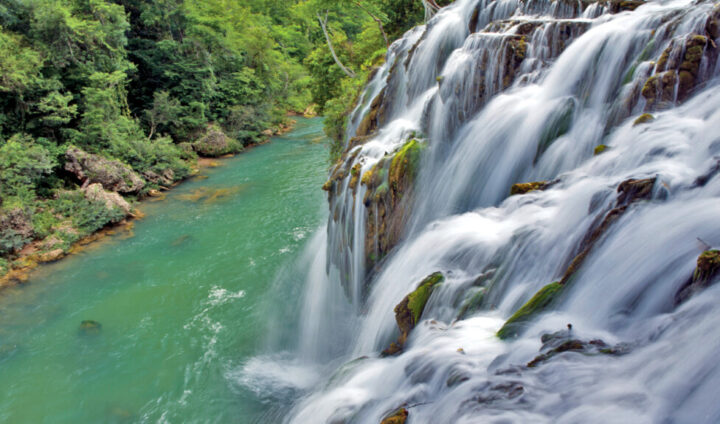
Lacandona, the great Mayan jungle that extends through the state of Chiapas in southern Mexico, is home to natural wealth and indigenous peoples' settlements that are once again threatened by the probable reactivation of abandoned oil wells. Image: Ceiba

Lacandona, the great Mayan jungle that extends through the state of Chiapas in southern Mexico, is home to natural wealth and indigenous peoples’ settlements that are once again threatened by the probable reactivation of abandoned oil wells. Image: Ceiba

MEXICO CITY, Jan 19 2024 (IPS) – The Lacandona jungle in the southern Mexican state of Chiapas is home to 769 species of butterflies, 573 species of trees, 464 species of birds, 114 species of mammals, 119 species of amphibians and reptiles, and several abandoned oil wells.


The oil wells have been a source of concern for the communities of the great Mayan jungle and environmental organizations since the 1970s, when oil prospecting began in the area and gradually left at least five wells inactive, whether plugged or not.

“The situation is always complex, due to legal loopholes that do not delimit the jungle, the natural protected areas are not delimited, it has been a historical mess. The search for oil has always been there.” — Fermín Domínguez

Now, Mexico’s policy of increasing oil production, promoted by the federal government, is reviving the threat of reactivating oil industry activity in the jungle ecosystem of some 500,000 hectares located in the east of the state, which has lost 70 percent of its forest in recent decades due to deforestation.

A resident of the Benemérito de las Américas municipality, some 1,100 kilometers south of Mexico City, who requested anonymity for security reasons, told IPS that a Mexican oil services company has contacted some members of the ejidos – communities on formerly public land granted to farm individually or cooperatively – trying to buy land around the inactive wells.

“They say they are offering work. We are concerned that they are trying to restart oil exploration, because it is a natural area that could be damaged and already has problems,” he said.

Adjacent to Benemérito de las Américas, which has 23,603 inhabitants according to the latest records, the area where the inactive wells are located is within the 18,348 square kilometers of the protected Lacandona Jungle Region.

It is one of the seven reserves of the ecosystem that the Mexican government decreed in 2016 and where oil activity in its subsoil is banned.

Between 1903 and 2014, the state-owned oil company Petróleos Mexicanos (Pemex) drilled five wells in the Lacandona jungle, inhabited by some 200,000 people, according to the autonomous governmental National Hydrocarbons Commission (CNH), in charge of allocating hydrocarbon lots and approving oil and gas exploration plans. At least two of these deposits are now closed, according to the CNH.

The Montes Azules Biosphere Reserve, in the Lacandona jungle in the southern Mexican state of Chiapas, faces the threat of oil exploration, which would add to phenomena such as deforestation, drought and forest fires that have occurred in recent years. Image: Semarnat

The Montes Azules Biosphere Reserve, in the Lacandona jungle in the southern Mexican state of Chiapas, faces the threat of oil exploration, which would add to phenomena such as deforestation, drought and forest fires that have occurred in recent years. Image: Semarnat

The Lacantun well is located between a small group of houses and the Montes Azules Biosphere Reserve (RBMA), the most megadiverse in the country, part of Lacandona and near the border with Guatemala. The CNH estimates the well’s proven oil reserves at 15.42 million barrels and gas reserves at 2.62 million cubic feet.

Chole, Tzeltal, Tzotzil and Lacandon Indians inhabit the jungle.

Other inactive deposits in the Benemérito de las Américas area are Cantil-101 and Bonampak-1, whose reserves are unknown.

In the rural areas of the municipality, the local population grows corn, beans and coffee and manages ecotourism sites. But violence has driven people out of Chiapas communities, as has been the case for weeks in the southern mountainous areas of the state due to border disputes and illegal business between criminal groups.

In addition, the Zapatista National Liberation Army (EZLN), an indigenous organization that staged an uprising on Jan. 1, 1994 against the marginalization and poverty suffered by the native communities, is still present in the region.

Chiapas, where oil was discovered at the beginning of the 20th century, is among the five main territories in terms of production of crude oil and gas in this Latin American country, with 10 hydrocarbon blocks in the northern strip of the state.

In November, Mexico extracted 1.64 million barrels of oil and 4.9 billion cubic feet of gas daily. The country currently ranks 20th in the world in terms of proven oil reserves and 41st in gas.

Historically, local communities have suffered water, soil and air pollution from Pemex operations.

As of November, there were 6,933 operational wells in the country, while Pemex has sealed 122 of the wells drilled since 2019, although none in Chiapas, according to a public information request filed by IPS.

Since taking office in December 2018, leftist President Andrés Manuel López Obrador has strengthened Pemex and the also state-owned Federal Electricity Commission by promoting the extraction and consumption of fossil fuels, to the detriment of renewable energy.

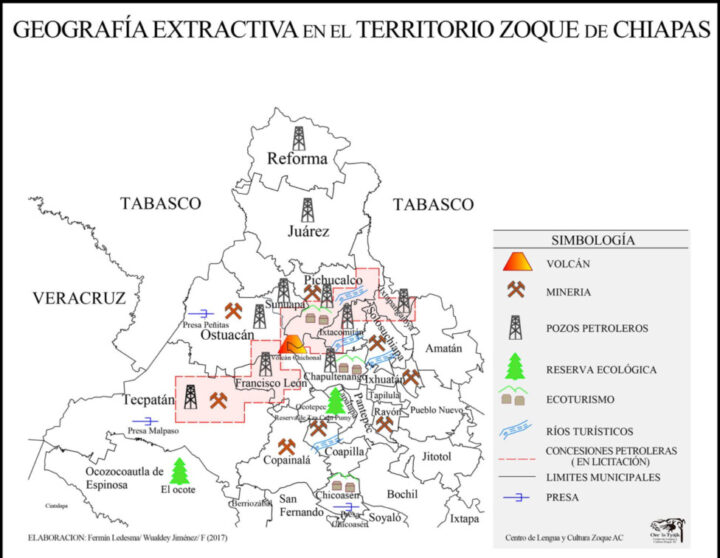
The state of Chiapas is home to hydroelectric power plants, mining projects, hydrocarbon exploitation blocks and a section of the Mayan Train, the most emblematic megaproject of the current Mexican government. Image: Center for Zoque Language and Culture AC

The state of Chiapas is home to hydroelectric power plants, mining projects, hydrocarbon exploitation blocks and a section of the Mayan Train, the most emblematic megaproject of the current Mexican government. Image: Center for Zoque Language and Culture AC

Territory under siege

The RBMA is one of Mexico’s 225 natural protected areas (NPAs) and its 331,000 hectares are home to 20 percent of the country’s plant species, 30 percent of its birds, 27 percent of its mammals and 17 percent of its freshwater fish.

Like all of the Lacandona rainforest, the RBMA faces deforestation, the expansion of cattle ranching, wildlife trafficking, drought, and forest fires.

Fermín Ledesma, an academic at the public Universidad Autónoma Chapingo, said possible oil exploration could aggravate existing social and environmental conflicts in the state, in addition to growing criminal violence and the historical absence of the State.

“The situation is always complex, due to legal loopholes that do not delimit the jungle, the natural protected areas are not delimited, it has been a historical mess. The search for oil has always been there,” he told IPS from Tuxtla Gutiérrez, the capital of Chiapas.

The researcher said “it is a very complex area, with a 50-year agrarian conflict between indigenous peoples, often generated by the government itself, which created an overlapping of plans and lands.”

Ledesma pointed to a contradiction between the idea of PNAs that are depopulated in order to protect them and the historical presence of native peoples.

From 2001 to 2022, Chiapas lost 748,000 hectares of tree cover, equivalent to a 15 percent decrease since 2000, one of the largest sites of deforestation in Mexico, according to the international monitoring platform Global Forest Watch. In 2022 alone, 26,800 hectares of natural forest disappeared.

In addition, this state, one of the most impoverished in the country, has suffered from the presence of mining, the construction of three hydroelectric plants and, now, the Mayan Train, the Mexican government’s most emblematic megaproject inaugurated on Dec. 15, one of the seven sections of which runs through the north of the state.

But there are also stories of local resistance against oil production. In 2017, Zoque indigenous people prevented the auction of two blocks on some 84,000 hectares in nine municipalities that sought to obtain 437.8 million barrels of crude oil equivalent.

The anonymous source expressed hope for a repeat of that victory and highlighted the argument of conducting an indigenous consultation prior to the projects, free of pressure and with the fullest possible information. “With that we can stop the wells, as occurred in 2017. We are not going to let them move forward,” he said.

Ledesma the researcher questioned the argument of local development driven by natural resource extraction and territorial degradation as a pretext.

“They say it’s the only way to do it, but that’s not true. It leaves a trail of environmental damage, damage to human health, present and future damage. It is much easier for the population to accept compensation or give up the land, because they see it is degraded. A narrative is created that they live in an impoverished area and therefore they have to relocate. This has happened in other areas,” he said.

  Source

Trapped and Trafficked—Fishers Tell of Forced Labor Horror

Active Citizens, Africa, Asia-Pacific, Civil Society, Economy & Trade, Editors’ Choice, Environment, Featured, Headlines, Human Rights, Human Trafficking, Humanitarian Emergencies, Labour, Migration & Refugees, TerraViva United Nations

Human Trafficking

Workers take a break after unloading fish from the Sor Somboon 19 fishing vessel. Initial screenings conducted by Greenpeace revealed that the crew of this Thai trawler met internationally accepted definitions of forced labour. Credit: Greenpeace

Workers take a break after unloading fish from the Sor Somboon 19 fishing vessel. Initial screenings conducted by Greenpeace revealed that the crew of this Thai trawler met internationally accepted definitions of forced labour. Credit: Greenpeace

BRATISLAVA, Jan 19 2024 (IPS) – “The thing is that when you come from an African country, they know that you’re basically trapped,” says Noel Adabblah.


“You have the wrong documents; you can’t go home because you’ve already borrowed money there to get here, and you won’t risk losing what work you have, no matter how bad, because of that. They know all the tricks.” 

The 36-year-old is speaking from Dublin, where he has managed to make a new life for himself after becoming a victim of what recent reports have shown to be widespread and growing forced labour in fishing fleets across the globe.

Adabblah, from Tema in Ghana, and three friends signed up with a recruitment agency back home to work as fishers on boats in the UK. They paid the equivalent of 1,200 EUR to be placed in jobs and were given letters of invitation and guarantees by their new employers, who said they would be met in Belfast, Northern Ireland, and who agreed to take care of all their documents and visas. Their employment contracts stated the men would be paid 1,000 GBP per month and employed for 12 months, with an option to reduce or extend that by three months upon mutual consent.

But when they arrived in January 2018, they were taken to Dublin and later split up. In the following months, they were taken to do various jobs at different ports in Ireland, sometimes late at night with no idea where they were going.

“We thought we were going there to sail and fish, but when we got there, we saw the boats were not ready; they were in poor condition, and we couldn’t fish, so the owner of the boats got us to do other jobs instead,” Adabblah tells IPS.

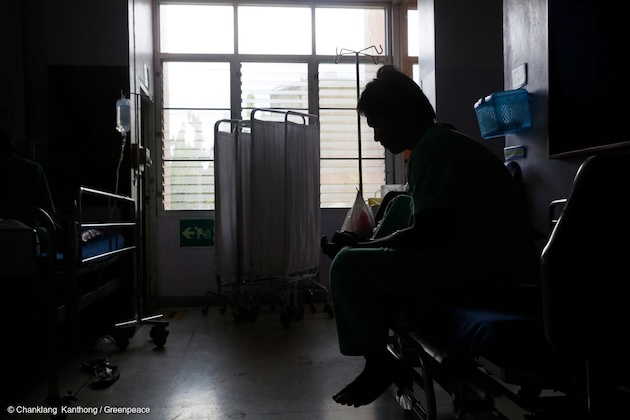
Cambodian fishermen from the fishing vessel Sor Somboon 19 recovers from beriberi at Ranong Hospital. The crew met internationally accepted definitions of victims of forced labour. Thai government investigations determined that the hospitalizations and deaths from the beriberi outbreak aboard Sor Somboon 19 were directly caused by a business model based on transshipment at sea. Credit: Greenpeace

A Cambodian fisher from the fishing vessel Sor Somboon 19 recovers from beriberi at Ranong Hospital. The crew met internationally accepted definitions of victims of forced labour. Credit: Greenpeace

“But after a few months, we said this is not what we came here to do. We had an argument over pay—he said he had no boats to fish with and wanted to lay us off, told us to go home. But we said no, that we had a 12-month contract we had signed for. He said he wouldn’t pay us, but could try to get us another job with someone else, but we said we couldn’t do that because the visas we had only applied to working for him. He told us if we didn’t like it, we could go home.”

It is at this point that many victims of forced labour often simply accept their fate and either go home or do whatever their employer wants. But Adabblah and his friends were determined to see the terms of their contract met, and they contacted the International Transport Workers’ Federation (ITF).

However, their problems deepened as they discovered they did not have the right documents for their work.

“We had no idea of the difference between Ireland and the UK. We thought the papers were OK. But when we went to the ITF, we realized they weren’t,” explains Adabblah.

At that point, the Irish police were obliged to open an investigation into the case.

Adabblah, who stayed in Ireland and has since managed to find work in the construction industry, says he heard nothing about the case until last year. “I heard that the police had said there was not enough evidence to pursue a conviction,” he says. Forced labour does not exist as an offense on the Irish statute books, so such cases are investigated under human trafficking legislation.

Regardless of the lack of a conviction in his case, he is clear that what he and his friends experienced was forced labour.

“They treated us badly. We worked 20-hour shifts some days. Once, when I was ill and couldn’t go on the boat, they said that if I couldn’t do the job, I could go home. They say stuff like that to threaten you,” he says.

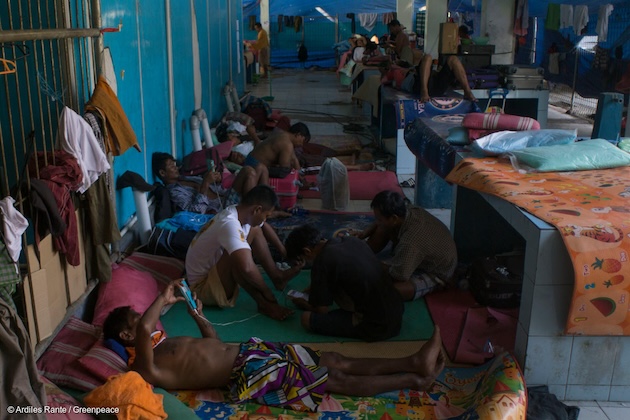
Burmese fishermen in temporary shelter in Ambon port, Indonesia. Hundreds of trafficked workers are waiting to be sent back home, with many facing an uncertain future. The forced labour and trafficking survivors interviewed by Greenpeace Southeast Asia detailed beatings and food deprivation for anyone who tried to escape. The tuna fishermen on their vessels were forced to work 20-22 hour days for little to no pay, often deprived of basic necessities like showers.

Burmese fishers in temporary shelter in Ambon Port, Indonesia. Hundreds of trafficked workers are waiting to be sent back home, with many facing an uncertain future. The forced labour and trafficking survivors interviewed by Greenpeace Southeast Asia detailed beatings and food deprivation for anyone who tried to escape. The tuna fishermen on their vessels were forced to work 20–22 hours a day for little to no pay, often deprived of basic necessities like showers. Credit: Greenpeace

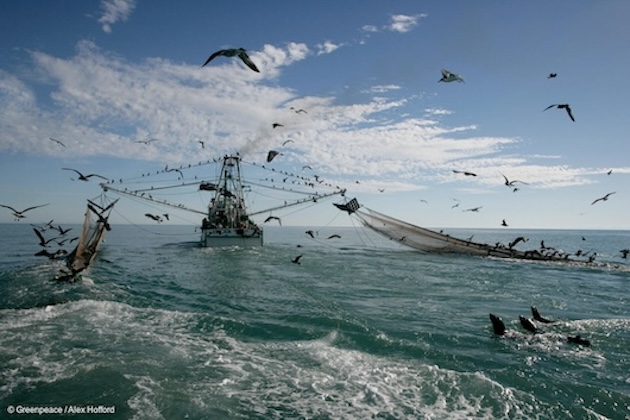
A commercial shrimp trawler is pursued by three Sea Lions near San Felipe. Shrimp trawlers, often entering into marine reserves illegally, pose a great threat to the marine environment at the northern end of the Gulf of California, due to the variety of marine wildlife, including Sea Lions that get caught in their bottom-trawling nets. The Greenpeace vessel 'MY Esperanza' is currently in Mexico to highlight the threats to the 'world's aquarium' from over-fishing, destructive tourism development, pollution and marine habitat loss.

A commercial shrimp trawler is pursued by three Sea Lions near San Felipe.
Shrimp trawlers, often entering into marine reserves illegally, pose a great threat to the marine environment at the northern end of the Gulf of California, due to the variety of marine wildlife, including Sea Lions, that get caught in their bottom-trawling nets. Credit: Greenpeace

Adabblah’s experience is far from unique among workers in the world’s fishing fleets. A recent report by the Financial Transparency Coalition, an international grouping of NGOs, said that more than 128,000 fishers were trapped in forced labour aboard fishing vessels in 2021. Its authors say there is a “human rights crisis” of forced labour aboard commercial fishing vessels, leading to horrific abuses and even deaths.

They point out that many of these victims of forced labour are from the global South, something that the people behind these crimes use to their advantage, experts say.

Michael O’Brien of the ITF’s Fisheries Section told IPS: “Those employing vulnerable migrants in forced labour scenarios rely upon the vulnerability of the victim, the potential lack of legal status of the victim in the country where they are working, and the victim’s reliance on an income that is unavailable to them in their country of origin.”

Mariama Thiam, an investigative journalist in Senegal who did research for the Financial Transparency Coalition report, said fishers often do not know what they are signing up for.

“Usually there is a standard contract that the fisher signs, and often they sign it without understanding it fully,” she told IPS.  “Most Senegalese fishermen have a low level of education. The contract is checked by the national fishing agency, which sees it, says it looks okay, approves it, and the fishers then go, but the fishers don’t understand what’s in it.”

Then, once they have started work, the men are so desperate to keep their jobs that they will put up with whatever conditions they have to.

“All the fishers I have spoken to say they have had no choice but to do the work because they cannot afford to lose their jobs—their families rely on them. Some of them were beaten or did not have any days off; captains systematically confiscate all their passports when they go on board—the captains say that if the fishermen have their passports, some will go on shore when they are in Europe and stay on there, migrating illegally,” she said.

“In the minds of Senegalese fishermen, their priority is salary. They can tolerate human rights abuses and forced labour if they get their salary,” Thiam added.

Adabblah agrees, adding though that this allows the criminals behind the forced labour to continue their abuses.

“The thing is that a lot of people are afraid to speak up because of where they are from, and they end up being too scared to say anything even if they are really badly treated. There are lots of people who are in the same situation as I was or experiencing much worse, but if no one speaks up, how can [criminals] be identified?” he says.

Experts on the issue say the owners of vessels where forced labour is alleged to have occurred hide behind complex corporate structures and that many governments take a lax approach to uncovering ultimate beneficial ownership information when vessels are registered or fishing licenses are applied for.

This means those behind the abuses are rarely identified, let alone punished.

“In Senegal, what happens is that the government doesn’t want to share information on owner control of boats. No one can get information on it, not journalists, not activists, sometimes not even people in other parts of government itself,” said Thiam.

Other problems include a lack of legislation to even deal with the problem. For instance, Thiam highlighted that fishers in Senegal work under a collective convention dating back to 1976 that does not mention forced labour.

O’Brien added: “In the Irish context, there has never been a prosecution for human trafficking for labour exploitation in fisheries or any other sector.

“There is a school of thought among progressive lawyers that we need a separate offense on the statute books of ‘labour exploitation’ to obtain convictions. In the case of fishers, some remedies can be obtained via the labour and maritime authorities, but these are lower-level offenses that do not have a dissuasive effect on the vessel owners.”

Victims also face difficulties seeking redress in their home countries.

Complaints to recruiting agencies in fishers’ home countries often come to nothing and can end up having serious consequences.

“The thing about the agency I dealt with at home and other agencies like it is that if you complain to them, they will just say that you are talking too much and you should come home and solve the situation there, and then when you get home, they just blacklist you and you won’t get any fishing work ever again; they will just recruit someone else,” says Adabblah.

Although Adabblah did not see the justice he had hoped for, he is aware his story has ended better than many other victims of forced labour. He, along with his three friends, have made new lives in Ireland, and he is hoping to soon begin the process of becoming a naturalised Irish citizen.

He urges anyone who finds themselves in the same situation to not stay quiet, and instead contact an organization like the ITF or something similar.

Doing so may not always bring victims a satisfactory resolution to their problems, but each publicized case may end up having a long-term positive effect on stopping others from being abused, said O’Brien.

“The ITF has significant resources but not enough to match the scale of the problem. The cases we take up like Noel’s are the tip of the iceberg. However, we use these cases, with the consent of the victims, to highlight the problem with governments and, in turn, campaign for changes in the law,” he said.

IPS UN Bureau Report

  Source

Guatemala’s Chance for a New Beginning

Civil Society, Crime & Justice, Democracy, Featured, Headlines, Indigenous Rights, Latin America & the Caribbean, TerraViva United Nations

Opinion

Credit: Emmanuel Andres/AFP via Getty Images

MONTEVIDEO, Uruguay, Jan 18 2024 (IPS) – Guatemala’s new president, Bernardo Arévalo, was expected to be sworn in on 14 January at 2pm –the 14th at 14:00, as people repeated in anticipation for months. It was a momentous event – but it wasn’t guaranteed to happen.


One year earlier, Arévalo – co-founder of the progressive Movimiento Semilla (Seed Movement), a political party born out of widespread 2015 anti-corruption protests – was largely unknown, freshly selected as his party’s presidential candidate. He wasn’t on the radar of opinion polls. A long chain of unlikely events later, he’s become the first Guatemalan president in living memory who doesn’t belong to the self-serving elites who Guatemalans call ‘the corrupt pact’, which he has credibly promised to dismantle.

The fear this caused among corrupt elite that has long ruled Guatemala was reflected in a series of attempts to try to stop Arévalo’s inauguration. The huge and sustained citizen mobilisation that came in response can largely be credited with keeping alive the spark of democracy in Guatemala.

Last-minute delays

All the Guatemalan Congress needed to do on the morning of 14 January was certify its newly elected members so the body could swear in the new president. But this routine administrative procedure was dragged on for many hours. The Indigenous movement, at the forefront of the months-long protests that had successfully kept at bay successive attempts to reverse the election results, called on Indigenous communities throughout Guatemala to remain on the alert.

In the late afternoon the Secretary General of the Organization of American States, Luis Almagro, surrounded by members of numerous foreign delegations, read a declaration calling on Congress to hand over power, ‘as required by the Constitution’, to the president-elect. This signalled that the world was watching.

As tensions mounted, Semilla reached an agreement for one of its representatives to be elected as president of Congress. This allowed the certification process to resume, and Arévalo was finally sworn in shortly after midnight. Night-long celebrations followed.

A coup attempt in stages

Arévalo’s election was unexpected. He only made it into the 20 August runoff because several other contenders not to the elite’s liking had been disqualified ahead of the first round. His candidacy wasn’t blocked because he scored so poorly in the polls. People’s expectations were extremely low, and first place went to invalid votes.

But once Arévalo entered the runoff, his rise was unstoppable. Death threats soon poured in, and an assassination plot involving state and non-state forces came to light days before the runoff.

As soon as the first-round results were announced, nine parties submitted complaints about supposed ‘irregularities’ that had gone undetected by all international observers. Their supporters converged outside the Supreme Electoral Tribunal (TSE) calling for a rerun.

The Constitutional Court instead ordered a recount and instructed the TSE to suspend official certification until complaints were resolved. Following the recount, the TSE eventually endorsed the results two weeks later.

But meanwhile, Attorney General Consuelo Porras Argueta, an official under US sanctions for corruption, launched an investigation into Semilla for alleged irregularities in its registration process and had its offices raided. She also ordered two raids on TSE offices, and when the TSE officially announced Arévalo as one of the runoff contenders, she ordered Semilla’s suspension. The Constitutional Court however blocked this order and the runoff ran its course. Arévalo took 58 per cent of the vote, compared to 37.2 per cent for the pro-establishment candidate.

Efforts to stop Arévalo’s inauguration began immediately, with yet another attempt by the Public Prosecutor to have Semilla suspended. The Constitutional Court continued to receive and reject legal challenges until the day of the inauguration.

For 100 days, two different visions of Guatemala wrestled with each other: people eager for change protested nonstop while corrupt forces linked to organised crime strove to preserve their privileges at any cost.

Democracy on life support

Guatemala has long been classified as a ‘hybrid regime‘ with a mix of democratic and authoritarian traits. Under outgoing president Alejandro Giammattei, civic freedoms steadily deteriorated. State institutions grew even weaker, ransacked by predatory elites and coopted by organised crime.

One of the last acts of Giammattei’s predecessor and ally, Jimmy Morales, was to end the work of the International Commission against Impunity in Guatemala (CICIG). Charged with supporting and strengthening state institutions to investigate and prosecute serious crimes, CICIG helped file over 120 cases in the Guatemalan justice system and its joint investigations with the Attorney General’s Office led to over 400 convictions.

Under Giammattei, the Attorney General’s Office dismantled all anti-corruption efforts and criminalised those in the legal profession who’d worked alongside CICIG. Impunity flourished. Transparency International’s 2022 Corruption Perceptions Index found evidence of strong influence by organised crime over politics and politicians, with some crime bosses seeking and securing office.

It’s no wonder that Guatemalans’ trust in state institutions hit rock bottom. According to the latest Latinobarómetro report, in 2021 satisfaction with the performance of democracy stood at a meagre 25 per cent.

Challenges ahead

Arévalo came to the presidency on a credible anti-corruption platform. But dismantling dense webs of complicity, rooting out entrenched corruption and rebuilding state institutions are no easy tasks.

Among the many challenges is a highly fragmented Congress in which 16 parties are represented, with Semilla on only 23 out of 160 seats. A large majority of Congress remains on the payroll of the interests Arévalo has promised to take on, along with most of the justice system. The 14 January events made clear that the ‘corrupt pact’ will do anything it can to stop Arévalo.

Arévalo’s to-do list is long, ranging from reducing political spending and improving social services to reversing laws that criminalise protest and establishing an effective protection mechanism for human rights defenders. At the top is forcing the resignation of Attorney General Consuelo Porras, the highest official presiding over a judicial network set up to ensure the impunity of the ‘corrupt pact’.

Arévalo can’t remove the Attorney General unilaterally, and so will have to negotiate her departure. This will be a key early test of the hope invested in him to keep democracy alive. Many more are sure to come.

Inés M. Pousadela is CIVICUS Senior Research Specialist, co-director and writer for CIVICUS Lens and co-author of the State of Civil Society Report.

  Source