Empowering Women in Assam: Livestock Farming Brings Economic Relief Post-COVID

Aid, Asia-Pacific, Civil Society, Development & Aid, Editors’ Choice, Featured, Food and Agriculture, Food Security and Nutrition, Food Sustainability, Headlines, Humanitarian Emergencies, Poverty & SDGs, Sustainable Development Goals, TerraViva United Nations

Food and Agriculture

Goat rearing is contributing to economic independence and improved livelihoods of women thanks to a post-COVID-19 empowerment project. CREDIT: Umar Manzoor Shah/IPS

Goat rearing is contributing to economic independence and improved livelihoods of women thanks to a post-COVID-19 empowerment project. CREDIT: Umar Manzoor Shah/IPS

MILONPUR, INDIA, Aug 8 2023 (IPS) – Seema Devi is a 39-year-old woman hailing from India’s northeastern state of Assam. She lives in a village called Milonpur, a small hamlet with no more than 1 000 inhabitants. While most men from the village, including Devi’s husband, move to cities and towns in search of work, women are left behind to take care of the house and kids.


Devi says that after the COVID-19 lockdown in India in the year 2020, the family income drastically plummeted. As most of the factories were shut for months, the workers, including Devi’s husband, were jobless. Even after the lockdown ended and workers were called back to the factories, the wages dipped.

“Earlier my husband would earn no less than Rs 10 000 a month (125 USD), and after the lockdown, it wasn’t more than a mere 6 000 rupees (70 USD). My children and I would suffer for the want of basic needs like medicine and clothing, but at the same time, I was considerate of the situation and helplessness of my husband,” Devi told IPS.

However, there were few alternatives available at home that could have mitigated Devi’s predicament. With the small area of ancestral land used for cultivation, the change in weather patterns caused her family and several households in the village to reap losses.

However, in 2021, a non-government organization visited the hamlet to assess the situation in the post-COVID scenario. The villagers told the team about how most of the men in the village go out to cities and towns in search of livelihood and work as labourers in factories and that their wages have come down due to economic distress in the country.

After hectic deliberations, about ten self-help groups of women were created. They trained in livestock farming and how this venture could be turned into a profitable business.

The women were initially reluctant because they were unaware of how to make livestock farming profitable. They would ask the members of the charitable organisation questions like, “What if it fails to yield desired results? What if some terrible disease affects the animals, and what if the livestock wouldn’t generate any income for them?”

Wilson Kandulna, who was the senior member of the team, told IPS that experts were called in to train the women about cattle rearing and how timely vaccinations, proper feed, and care could make livestock farming profitable and mitigate their basic living costs. “At first, we provided ten goat kids to each women’s group and made them aware of the dos and don’ts of this kind of farming. They were quick to learn and grasped easily whatever was taught to them,” Wilson said.

He added that these women were living in economic distress due to the limited income of their husbands and were desperately anxious about the scarcity of proper education for children and other daily needs.

Devi says that as soon as she got the goat kids, she acquired basic training in feeding them properly and taking them for vaccinations to the nearby government veterinary hospital.

“Two years have passed, and now we have hundreds of goats as they reproduce quickly, and we are now able to earn a good income. During the first few months, there were issues like feeding problems, proper shelter during monsoons and summers, and how and when we should take them out for grazing. As time passed and we learned the skills, we have become very trained goat rearers,” Devi said.

Renuka, another woman in the self-help group, told IPS that for the past year, they have been continuously getting demands for goat milk from the main towns. “People know about the health benefits of goat milk. They know it is organic without any preservatives, and that is the reason we have a very high demand for it. We sell it at a good price, and at times, demand surpasses the supply,” Renuka said.

For Devi, livestock farming has been no less than a blessing. She says she earns more than five thousand rupees a month (about 60 USD) and has been able to cover daily household expenses all by herself. “I no longer rely on my husband for household expenses. I take care of it all by myself. My husband, too, is relieved, and things are getting back on track,” Devi said, smiling.

Kalpana, a 32-year-old member of the group, says the goats have increased in number, and last year, several of them were sold in the market at a good price.

“The profits were shared by the group members. Earlier, women in this village were entirely dependent on their husbands for covering their basic expenses. Now, they are economically self-reliant. They take good care of the house and of themselves,” Kalpana told IPS News.

Note: Names of some of the women have been changed on their request.

IPS UN Bureau Report

  Source

Cambodia’s Election a Blatant Farce

Credit: Tang Chhin Sothy/AFP via Getty Images

By Inés M. Pousadela
MONTEVIDEO, Uruguay, Aug 4 2023 (IPS)

The title shouldn’t fool you: Cambodian Prime Minister Hun Sen is one of the world’s longest-ruling autocrats. A political survivor, this former military commander had been bolted to his chair since 1985, presiding over what he turned into a de facto one-party system – and now apparently a dynastic regime.


On 23 July, running virtually unopposed, Hun Sen’s Cambodian People’s Party (CPP) took 82 per cent of the vote, winning almost all seats. The only party that could have offered a challenge, the Candlelight Party, had been banned on a technicality in May.

Following the proclamation of his ‘landslide victory‘, Hun Sen finally announced his retirement, handing over his position to his eldest son, Hun Manet. Manet had already been endorsed by the CPP. Winning a parliamentary seat, which he just did, was all he had to do to become eligible. To ensure dynastic succession faced no obstacle, a constitutional amendment passed in August 2022 allows the ruling party to appoint the prime minister without parliamentary approval.

Hun Sen isn’t going away: he’ll remain CPP chair and a member of parliament, be appointed to other positions and stay at the helm of his family’s extensive business empire.

A slippery slope towards autocracy

Hun Sen came to power in a world that no longer exists. He managed to cling onto power as everything around him changed.

He fought as a soldier in the Cambodian Civil War before defecting to Vietnam, taking several government positions under the 1980s Vietnamese government of occupation. He was appointed prime minister in 1985, and when 1993 elections resulted in a hung parliament, Hun Sen refused to concede defeat. Negotiations resulted in a coalition government in which he served as joint prime minister, until he orchestrated a coup to take sole control in 1997. At the head of the CPP, he has won every election since.

In 2013 his power was threatened. A new opposition party, the Cambodia National Rescue Party (CNRP), offered a credible challenge. The CPP got its lowest share of votes and seats since 1998. Despite obvious fraud, the CNRP came dangerously close to defeating Hun Sen.

In the years that followed, Hun Sen made sure no one would challenge him again. In 2015, the CNRP’s leader Sam Rainsy was summarily ousted from the National Assembly and stripped of parliamentary immunity. A warrant was issued for his arrest, pushing him into exile. He was then barred from returning to Cambodia, and in 2017 convicted for ‘defaming’ Hun Sen. His successor at the head of the CNRP, Kem Sokha, soon faced persecution too.

In November 2017, the Supreme Court ordered the dissolution of the CNRP and imposed a five-year political ban on 118 opposition members.

As a result, the only parties that eventually ran on a supposedly opposition platform in 2018 were small parties manufactured by government allies to give the impression of competition. In the run-up to the vote, the CPP-dominated National Election Committee (NEC) threatened to prosecute anybody who urged a boycott and warned voters that criticising the CPP wasn’t allowed. What resulted was a parliament without a single dissenting voice.

There was no let off after the election, with mass arrests and mass trials of former CNRP members and civil society activists becoming commonplace. Rainsy was sentenced in absentia to life imprisonment, and Sokha was given 27 years for ‘treason’. At least 39 opposition politicians are behind bars, and many more have left Cambodia.

But as the CNRP faded, the torch passed to the Candlelight Party. In June 2022 local elections, Candlelight proved that Hun Sen was right to be afraid: in an extremely repressive context, it still took over 20 per cent of the vote. And sure enough, in May 2023 the NEC disqualified Candlelight from the July election.

Civic space under assault

Political repression has been accompanied by tightening civic space restrictions.

The crackdown on independent media, underway since 2017, intensified in the run-up to the latest electoral farce. In March 2022, the government stripped three digital media outlets of their licences after they published stories on government corruption. In February 2023, Hun Sen ordered the closure of Voice of Democracy, one of the few remaining independent media outlets, after it published a story about Manet. Severe restrictions weigh on foreign media groups, some of which have been forced out of the country.

In contrast, government-owned and pro-government media organisations are able to operate freely. Major media groups are run by magnates close to the ruling family. One media conglomerate is headed by Hun Sen’s eldest daughter. As a result, most information available to Cambodians comes through the filter of power. Most media work to disseminate state-issued disinformation and discredit independent voices as agents of propaganda.

The right to protest is heavily restricted. Gatherings by banned opposition parties are prohibited and demonstrations by political groups, labour unions, social movements and essentially anyone mobilising on issues the government doesn’t want raised are routinely dispersed by security forces, often violently. Protesters are subjected to threats, intimidation, arbitrary arrests and detention, and further criminalisation.

As if leaving people with no choice wasn’t enough, Hun Sen also mounted a scare campaign to force them to vote, since a low turnout would undermine the credibility of the outcome. People were threatened with repercussions if they attempted to boycott the election or spoil ballot papers. The election law was hastily amended to make this a crime.

Experience gives little ground to hope that repression will let up rather than intensify following the election. There’s also no reason to expect that Manet, long groomed for succession, will take a different path from his still-powerful predecessor. The very least the international community should do is to call out the charade of an election for what it was and refuse to buy the Cambodian regime’s whitewashing attempt.

Inés M. Pousadela is CIVICUS Senior Research Specialist, co-director and writer for CIVICUS Lens and co-author of the State of Civil Society Report.


!function(d,s,id){var js,fjs=d.getElementsByTagName(s)[0],p=/^http:/.test(d.location)?’http’:’https’;if(!d.getElementById(id)){js=d.createElement(s);js.id=id;js.src=p+’://platform.twitter.com/widgets.js’;fjs.parentNode.insertBefore(js,fjs);}}(document, ‘script’, ‘twitter-wjs’);  

Source

How Nigeria’s Legal System is Failing to Safeguard Widows’ Rights

Nigerian law protects widows, but the reality they face is quite different.

Nigerian law protects widows, but the reality they face is quite different.

By Promise Eze
SOKOTO, NIGERIA, Aug 3 2023 (IPS)

In February this year, Chichi Okonkwo not only lost her husband but was stripped of everything they owned together. Her husband was severely injured in a car accident about a month earlier. Despite being rushed to a hospital in Enugu, where they resided, he succumbed to his injuries weeks later. To compound her grief, Okonkwo’s late husband’s male siblings forcibly entered her home in the city a few hours after his passing, confiscating her husband’s land documents, car, money, clothes, and marriage certificate.


In the wake of these heart-wrenching events, Okonkwo was left with nothing but her six children. The eldest is just 18.

“They took everything my husband and I owned and forcibly evicted me and my children from our home,” laments Okonkwo. “They heartlessly claimed that, as a widow, I had no rights to any of my late husband’s possessions.”

Okonkwo’s children are now out of school because she was a housewife who depended on her husband’s income and is now left with nothing. She revealed that her late husband’s siblings, who seized and were aware of his bank PIN, callously left her with a mere 1 000 naira (approximately USD 2) out of the 2 million naira ($2,600) he had in his account.

Okonkwo said her husband’s relatives swore to drag her to court to challenge her rights, but she cannot afford a lawyer due to her financial situation.

In Nigeria, there are around 15 million widows.

Unfortunately, widows in the country often face the denial of their basic human rights due to traditional and cultural practices rooted in patriarchal beliefs.

According to The World Bank, “In much of Africa, marriage is the sole basis for women’s access to social and economic rights, and these are lost upon divorce or widowhood.”

In a country like Nigeria, where men dominate the economic and political systems, women are often expected to be submissive. The challenges women face are particularly amplified when they become widows, creating a doubly marginalized subgroup. Moreover, this vulnerable position sometimes exposes widows to dehumanizing rituals and harmful practices.

These harmful practices include mourning rites that involve widows sleeping with their deceased husbands’ corpses, shaving of widows’ heads, seclusion, wearing black or white clothes, and being forced to sleep and sit on the floor or mat. Additionally, some widows are coerced into marrying other members of the deceased husband’s family.

Despite laws granting women the right to inherit their husbands’ assets, many widows can still not claim their rightful share of land and property.

Efforts to combat these practices, such as the Violence Against Persons Prohibition Act (VAPP) enacted in 2015, have faced challenges in implementation and adoption by all states. According to the law, offenders are subject to a 500,000 naira ($648) fine or two years in prison. But arrests and prosecution of offenders are rare. And gender-based violence has persisted, which includes violence towards widows.

The enforcement of laws against offenders has been hindered by religious and cultural norms that promote silence and suppression of victimization cases. Victims often face threats or pressure from family members, community, or religious leaders whenever they try to report incidents to law enforcement.

Like Okonkwo, Sarah Temidayo’s life took a tragic turn when she lost her husband of four years to lung cancer in 2019. However, her grief was compounded by the actions of her husband’s relatives, who invaded her home in Lagos mere hours after his passing, intent on claiming everything that belonged to him. They even went so far as to take her wedding gown, certificates, and her then-five-year-old daughter’s clothes. Devastated and without recourse, Temitope sought justice through the legal system, but her efforts have yielded no results.

“I did not pick a pin out of my house. I had to start my life all over again,” she says.

Unfortunately, the nightmare did not end there for Temidayo. She was subjected to constant threats from her husband’s mother, who continued to torment her and accuse her of killing her son through witchcraft. These threats escalated to a terrifying climax when assassins attacked her at a bus stop in March 2021. She managed to survive, albeit with six bullets lodged in her leg. Despite reporting the incident to the police, no investigation was conducted, leaving her feeling abandoned by the system meant to protect her.

According to Ifeoma Oguejiofor, a legal practitioner in Southeast Nigeria, widows face challenges in seeking justice due to the understaffed courts, which can cause delays in the resolution of cases. Additionally, the financial burden of hiring a lawyer becomes a significant obstacle for many widows, making it difficult to access proper legal representation to handle their cases.

“There is a significant difference between the laws written in books and the actual pursuit of justice. According to the law, a surviving spouse, whether in a traditional marriage, a long period of cohabitation, or a marriage registered under the act, is entitled to inherit the estate of their deceased spouse. However, achieving justice through the legal system is often a prolonged and costly process, particularly for widows who have already lost a substantial portion of their assets to their husband’s relatives,” she explains.

“It’s high time the government, traditional rulers, and religious clerics enforce laws to protect widows in Nigeria. No woman should be discriminated against because she lost her husband,” says Hope Nwakwesi, the founder of Almanah Hope Foundation, a non-governmental organization focused on supporting Nigerian widows.

Nwakwesi, a widow who lost her police husband in 1994, endured distressing cultural rites, including having her hair shaved and wearing a mourning dress for a year. She faced further hardships as her relatives forcibly took her property, and she was expelled from her workplace and home in the police barracks. Despite seeking help, many, including police officers who offered assistance, demanded sexual favors in return.

Now, Nwakwesi is advocating for a bill in Nigeria’s legislative chamber. The bill aims to eradicate repressive cultural practices against widows and safeguard their fundamental human rights.

“My goal is to get the bill I’m fighting for approved and signed into law by the Senate. The current Violence Against Persons Prohibition Law is too vague and lacks specific clauses for protecting the rights of widows. Once the new bill becomes law, those who discriminate against widows will face arrest and prosecution by law enforcement agencies,” says Nwakwesi.

Abiola Akiyode-Afolabi, a civil rights activist and founding director of Women Advocates Research and Documentation Centre, noted that “For the government to protect widows effectively, they should review and update existing laws related to widows’ rights to ensure they are comprehensive, enforceable, and in line with international human rights standards.”

“Merely having laws in place is not enough; the government must ensure their effective implementation at all levels of the justice system. This requires training and sensitizing law enforcement officials, judges, and legal practitioners on the rights of widows and the importance of protecting them,” she adds.

IPS UN Bureau Report


!function(d,s,id){var js,fjs=d.getElementsByTagName(s)[0],p=/^http:/.test(d.location)?’http’:’https’;if(!d.getElementById(id)){js=d.createElement(s);js.id=id;js.src=p+’://platform.twitter.com/widgets.js’;fjs.parentNode.insertBefore(js,fjs);}}(document, ‘script’, ‘twitter-wjs’);  

Source

Civil Society Space in Southern Africa Shrinking as Government Repression Rises

Several Southern African countries have or are in the process of enacting legislation that limits the civil society space, with implications for human rights. Credit: CIVICUS Monitor

Several Southern African countries have or are in the process of enacting legislation that limits the civil society space, with implications for human rights. Credit: CIVICUS Monitor

By Busani Bafana
BULAWAYO, Jul 31 2023 (IPS)

Freedom of expression is under threat as governments in Southern Africa have enacted laws restricting civil society organizations, says global rights advocacy organisation, CIVICUS, warning that human rights violations are on the increase globally.


“The state of civil society is unfortunately not improving; civil restrictions continue across the world,” said David Kobe, the advocacy Lead at CIVICUS.

“More than 2 billion people live in countries that are rated as closed, which is the worst rating any country can have – this means that 28 percent of the world’s population are not able to speak out when there is corruption or human rights violations restrictions or cannot write articles as journalists without facing appraisals,” Kobe told IPS in an interview, noting that the organization’s human rights tool is indicating growing suppression of civil space across the world.

The CIVICUS Monitor, a tool accessing the state of civic space in more than 190 countries, provides evidence of restrictions on human rights by governments. The CIVICUS Monitor rates the state of civil space ‘open, ‘repressed’, and ‘closed’ according to each country.

Kobe notes that human rights violations are increasing globally with more restrictions on civil society in Australia, the United Kingdom and the United States. The picture is not different in the Southern Africa region where restrictions on civil space have been continuing, and these have included censorship, violent response to protests and restrictive laws as seen in Angola, Mozambique and Zimbabwe

Closing Civil Society Space

Zimbabwe remains on the CIVICUS Monitor Watchlist as attacks on civic space continue ahead of the scheduled 2023 national elections.

Last November, Zimbabwe approved the Criminal Law (Codification and Reform) Amendment Bill, 2022, known as the Patriotic Act. The law seeks to create the offence of “wilfully damaging the sovereignty and national interest of Zimbabwe” and will essentially criminalise the lobbying of foreign governments to extend or implement sanctions against Zimbabwe or its officials.

Furthermore, the Zimbabwe government gazetted the Private Voluntary Organisations Amendment Bill in November 2021, amending the Private Voluntary Organisations Act, which governs non-profit organizations. The main aim of the Bill is to comply with the Financial Action Task Force (FATF) recommendations to strengthen the country’s legal framework to combat money laundering, financing terrorism and proliferation.

Civil society organizations warn that the Bill could hinder their activities and financing with potential adverse impacts on economic development. Besides, NGOs argue that they are a low-risk sector with no precedence of financing terrorism and money laundering.

Musa Kika, Executive Director of Zimbabwe Human Rights NGO Forum, says the PVO will affect the operations of NGOs, including deterring donors from funding PVOs, fearing the money could end up under the grip of the government. Besides, the Bill has a provision giving the Minister of Justice unfettered powers to place under supervision or surveillance, using subjective discretion, those PVOs the Minister deems to be high risk.

“Continued hostility and harassment on the part of the government towards the work of CSOs in the country will thus only result in a hugely detrimental effect on their efforts in advancing the protection of and respect for the basic human rights and freedoms of ordinary Zimbabwean civilians as espoused under Zimbabwe’s Constitution,” Kika said. He noted that civil society organisations were operating in a tough environment in Zimbabwe where the government does not trust them, especially those working in the fields of governance and human rights.

“We have a government that does not want to account,” said Kika. “We have had many human rights activists who have been arrested on flimsy charges…Terrorism finance is being used as a cover, but the motive is to close the democratic space because the government and accountability in human rights and governance are sworn enemies.”

In Zimbabwe, NGOs have, in partnership with the government, supported development, providing a range of services in health, education, social protection, humanitarian assistance, environmental management, emergency response and democracy building.  A research report commissioned by the Zimbabwe Human Rights NGO Forum in collaboration with the Southern Defenders and Accountability Lab has warned of huge job and financial losses if the Bill is passed into law.

United Nations experts have urged Zimbabwe’s President Emerson Mnangagwa to reject enacting a bill that would severely restrict civic space and the right to freedom of association in the country.

However, President Mnangagwa has defended the passage of the PVO Bill, vowing to speedily “sign it into law once it reaches my desk”. In a commentary in his weekly column published by the government-owned Sunday Mail, Mnangagwa said signing the bill into law will usher Zimbabwe into a “new era of genuine philanthropic and advocacy work, unsullied by ulterior political or financial motives.”

Mnangagwa said the law was meant to defend the country from foreign infiltration.

Engendering Patriotism but Endangering Democracy

Zimbabwe has also recently approved another repressive law known as the ‘Patriot Act’.

“The Patriotic Act is an extremely repressive and unconstitutional piece of legislation that has serious ramifications for citizens’ rights, particularly the rights of freedom of expression in the lead up to the elections,” human rights lawyer, Dough Coltart, tells IPS in an interview.

“There is a very real need to educate the citizens on what the ramifications of this Act are for people’s lives because the Act has far-reaching consequences for the entire country and will essentially stifle any public dialogue around the challenges we are facing as a country.”

“The Patriot law is a bad piece of legislation which is an affront to the practice of ethical journalism in Zimbabwe,” Njabulo Ncube, Coordinator of the Zimbabwe National Editors’ Forum (ZINEF), told IPS. “It stinks to the highest skies as it criminalizes the practice of good journalism. It is anti-media freedom and free expression…civil society organisations have also been caught in the mix; they cannot effectively make government account for its actions.”

Democracy Dimming

The situation in Zimbabwe is echoed in some countries across Southern Africa, where governments are cracking down on CSOs in the name of protecting national sovereignty and the threats of money laundering and terrorism financing.

In Angola, the country’s National Assembly, on May 25 2023, passed a draft NGO Statute, which CSOs have criticized for limiting freedom of association by giving the state excessive powers to interfere with civil society activities.

According to the Movimento de Defensores de Direitos Humanos de Angola (Movement of Human Rights Defenders of Angola, KUTAKESA), the government has targeted civil society with legislation that is meant for terrorists and money launderers, though it has never been proven in any court that a CSO has committed an act of terrorism in Angola.

On the contrary, the rationale of this legislation constitutes institutional terrorism, the target of which are CSOs, said Godinho Cristóvão, a jurist, human rights defender and executive director of KUTEKA in an interview with the CIVICUS Monitor.

“The Angolan authorities should have aligned themselves with the democratic rule of law and respected the work of CSOs and HRDs,” Cristóvão is quoted as saying.

“Instead, there has been an increase in threats, harassment and illegal arrests of human rights defenders who denounce or hold peaceful demonstrations against acts of bad governance and violations of citizens’ rights and freedoms. There have been clear setbacks with regard to the guarantee of fundamental rights and freedoms enshrined in the constitution, as well as the rights set out in the African Charter on Human and Peoples’ Rights and other human rights treaties Angola has ratified.”

In Mozambique, a new NGO on Anti-Money Laundering and Terrorist Financing Act, which overregulates CSOs, is seen as the death knell for the civic movement in the country. The Act was approved in October 2022 under the pretext of fighting terrorism. It has further curtailed freedoms of expression, information, press, assembly and public participation.

Paula Monjane, Executive Director of the Civil Society Learning and Capacity Building Centre (CESC), a Mozambican non-profit civil society organisation, said currently, the legislation was being proposed to silence dissenting voices and people fighting for better governance of public affairs and the protection of human rights in the country.

The draft Anti-Money Laundering and Terrorism Financing Act law establishes a legal regime for the creation, organisation and functioning of CSOs, and Monjane highlighted that it contains several norms that violate freedom of association despite this right being safeguarded by the constitution and international human rights treaties.

“It gives the government absolute and discretionary powers to ‘create’, control the functioning of, suspend and extinguish CSOs,” said Monjane, adding, “If the bill is approved, it will legitimise already existing practices restricting civic space, allowing the persecution of dissenting voices and organisations critical of the government, up to banning them from continuing to operate.”

Monjane said if the bill is passed into law CSOs in Mozambique will push for it to be declared unconstitutional and will ask the African Union, through the African Commission on Human and Peoples’ Rights, and the United Nations, through the Special Rapporteur on the rights to freedom of peaceful assembly and of association to urgently condemn it.

On actions to foster human rights and human rights defenders, Kobe said civil society organisations must be supported to hold governments accountable for upholding national and international human rights conventions that they have subscribed to.

The Universal Periodic Review, an assessment of the state of civic and human rights of a country over a four-year period, provides recommendations to governments enabling them to open civic space and remove restrictive laws.

“Governments need to implement the recommendations of the UPR and not treat them as a formality for them to be seen by the international community as respecting human rights when they are not,” said Kobe, adding that encouraging governments to implement the 2030 Agenda on Sustainable Development was also a way of getting them to see development alongside human rights.

IPS UN Bureau Report



!function(d,s,id){var js,fjs=d.getElementsByTagName(s)[0],p=/^http:/.test(d.location)?’http’:’https’;if(!d.getElementById(id)){js=d.createElement(s);js.id=id;js.src=p+’://platform.twitter.com/widgets.js’;fjs.parentNode.insertBefore(js,fjs);}}(document, ‘script’, ‘twitter-wjs’);  

Source

Nepal’s Same-Sex Marriage Breakthrough

Credit: Prakash Mathema/AFP via Getty Images

By Andrew Firmin
LONDON, Jul 28 2023 (IPS)

Nepal is the latest country to join the global wave of marriage equality. On 28 June, its Supreme Court ruled that the government must immediately offer temporary registration of same-sex marriages, pending a change in the law. Around 200 couples reportedly sought to register as soon as the court judgment was made.


Nepal will therefore become the second country in Asia, after Taiwan, to recognise the right of all couples to marry. It’s little surprise that, as in many countries that have achieved marriage equality, it’s civil society that’s making the change happen, having brought the decisive court case.

Civil society’s breakthrough

Each year brings further important steps forward on two crucial fronts: decriminalisation of same-sex relations in the many countries where they’re still criminalised and recognition of marriage equality in countries that have made more progress.

Only last month a landmark was achieved in Estonia, which became the first post-Soviet state to legalise same-sex marriage. Now Nepal should become the 36th country in the world where LGBTQI+ people can marry, and the ninth this decade.

In Nepal, these efforts built on an earlier legal breakthrough, when in 2007 the Supreme Court ruled that the government must take measures to guarantee equal rights and end discrimination against LGBTQI+ people. This too was the result of a legal petition filed by several LGBQTI+ rights organisations following the country’s transition from a monarchy to a democratic republic. LGBTQI+ people had been as active as anyone else in demanding democracy but LGBTQI+ rights weren’t immediately recognised in the new Nepal.

The 2007 ruling unlocked significant progress: laws that banned gay sex were repealed that year. In 2015, Nepal’s new constitution recognised the fundamental rights of LGBQTI+ people and forbade discrimination. The court also recognised a third gender – a longstanding identity in the cultures of Nepal and other South Asian countries – and the right to have it registered on official documents.

Nepali schools now offer comprehensive sexuality education to students aged 13 to 15, which includes discussion of LGBTQI+ issues. This came as a result of a campaign by the Blue Diamond Society, a civil society organisation that has led the fight for LGBTQI+ rights in Nepal since 2001.

As further rights were recognised, continuing marriage discrimination increasingly stood out. A bill to legalise it was drafted soon after the 2007 ruling, consistent with the court’s order to guarantee equal rights, but not much happened after that. It fell on civil society to hold the government to account.

There are still challenges ahead. As yet, the government hasn’t responded to the court ruling, which suggests it’s hardly in a hurry to legislate. That means people’s rights remain vulnerable to administrative resistance, leading to uneven enforcement. On 13 July, for instance, the Kathmandu District Court rejected an application from a male couple to register their marriage.

Anti-rights backlash

Litigation has become the key means by which civil society wins change on LGBTQI+ rights, as reflected by a recent string of decriminalisation rulings in Caribbean countries. This strategy has the potential to bring legal and policy changes that are ahead of social attitudes. That’s been the case in Nepal, where there’s still stigma, social bias and discrimination, and in Nepal’s often fractious politics, some politicians seek to capitalise on that.

Globally, progress towards the recognition of LGBTQI+ rights is a much stronger trend than regression. But steps forward are inevitably followed by an anti-rights backlash, combined with politically opportunistic efforts to mobilise anti-LGBQTI+ sentiment.

This backlash is seen in the USA, from which emanates most of the funding that enables anti-rights campaigning around the world, as well as in European countries, including Hungary, Spain and Turkey.

But it’s felt most strongly in global south countries, where forces opposing LGBTQI+ rights spread disinformation that these are some kind of western imposition. This is apparent in several countries in Africa – such as Kenya, Nigeria and Uganda – and Asia – including Indonesia, where a new criminal code effectively criminalises same-sex activity, and Malaysia, where politicians profit from vilifying LGBTQI+ people.

That’s why positive moves in Africa and Asia are so valuable: they offer hope to embattled LGBTQI+ people not just domestically but around the world.

Progress in Nepal should particularly give heart to activists in India, where the Supreme Court is currently considering a case demanding the recognition of same-sex marriage, and Japan, where attempts to win court judgments have encountered setbacks. The good news should also resonate in Thailand, a country with a relatively progressive reputation on LGBTQI+ rights but where same-sex marriage still isn’t allowed.

(function(d){var js, id=”pikto-embed-js”, ref=d.getElementsByTagName(“script”)[0];if (d.getElementById(id)) { return;}js=d.createElement(“script”); js.id=id; js.async=true;js.src=”https://create.piktochart.com/assets/embedding/embed.js”;ref.parentNode.insertBefore(js, ref);}(document));

Shifting attitudes

Evidence from the countries that have adopted marriage equality shows that public attitudes to same-sex marriage tend to shift in the wake of legal change. In the countries that introduced it in the early years of this century, it now has majority support.

That’s also the case in Taiwan, which legalised same-sex marriage in 2019. And there, changing social attitudes have gone hand-in-hand with further reforms: in January, the government recognised same-sex marriages of Taiwanese people with foreign partners. In May, same-sex couples were given full adoption rights.

When it comes to changing social attitudes in Nepal, the annual roster of Pride events – the main Nepali Pride Parade held each June, a trans parade in December and an LGBQTI+ women’s rally that marks International Women’s Day each March – will remain vital spaces to make LGBTQI+ people more visible and assert their right to exist in public space.

Nepali civil society will hope that by the next Pride event, the law will have changed. But they’ll do more than hope. They’ll keep campaigning until the law is changed – and after that, they’ll stay alert to backlash and keep pushing back against discrimination.

Andrew Firmin is CIVICUS Editor-in-Chief, co-director and writer for CIVICUS Lens and co-author of the State of Civil Society Report


!function(d,s,id){var js,fjs=d.getElementsByTagName(s)[0],p=/^http:/.test(d.location)?’http’:’https’;if(!d.getElementById(id)){js=d.createElement(s);js.id=id;js.src=p+’://platform.twitter.com/widgets.js’;fjs.parentNode.insertBefore(js,fjs);}}(document, ‘script’, ‘twitter-wjs’);  

Source

Biodigesters Light Up Clean Energy Stoves in Rural El Salvador

Marisol and Misael Menjívar pose next to the biodigester installed in March in the backyard of their home in El Corozal, a rural settlement located near Suchitoto in central El Salvador. With a biotoilet and stove, the couple produces biogas for cooking from feces, which saves them money. The biotoilet can be seen in the background. CREDIT: Edgardo Ayala / IPS

Marisol and Misael Menjívar pose next to the biodigester installed in March in the backyard of their home in El Corozal, a rural settlement located near Suchitoto in central El Salvador. With a biotoilet and stove, the couple produces biogas for cooking from feces, which saves them money. The biotoilet can be seen in the background. CREDIT: Edgardo Ayala / IPS

By Edgardo Ayala
SUCHITOTO, El Salvador , Jul 25 2023 (IPS)

A new technology that has arrived in rural villages in El Salvador makes it possible for small farming families to generate biogas with their feces and use it for cooking – something that at first sounded to them like science fiction and also a bit smelly.


In the countryside, composting latrines, which separate urine from feces to produce organic fertilizer, are very popular. But can they really produce gas for cooking?

“It seemed incredible to me,” Marisol Menjívar told IPS as she explained how her biodigester, which is part of a system that includes a toilet and a stove, was installed in the backyard of her house in the village of El Corozal, near Suchitoto, a municipality in the central Salvadoran department of Cuscatlán.”When the first ones were installed here, I was excited to see that they had stoves hooked up, and I asked if I could have one too.” — Marisol Menjívar

“When the first ones were installed here, I was excited to see that they had stoves hooked up, and I asked if I could have one too,” added Marisol, 48. Hers was installed in March.

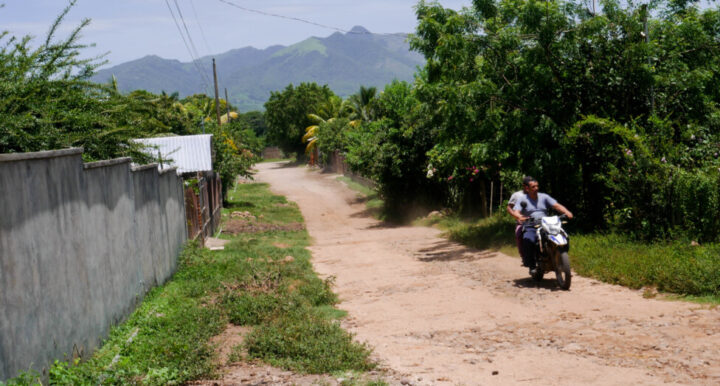
El Corozal, population 200, is one of eight rural settlements that make up the Laura López Rural Water and Sanitation Association (Arall), a community organization responsible for providing water to 465 local families.

The families in the small villages, who are dedicated to the cultivation of corn and beans, had to flee the region during the country’s 1980-1992 civil war, due to the fighting.

After the armed conflict, they returned to rebuild their lives and work collectively to provide basic services, especially drinking water, as have many other community organizations, in the absence of government coverage.

In this Central American country of 6.7 million inhabitants, 78.4 percent of rural households have access to piped water, while 10.8 percent are supplied by wells and 10.7 percent by other means.

With small stoves like this one, a score of families in El Corozal in central El Salvador cook their food with biogas they produce themselves, thanks to a government program that has brought clean energy technology to these remote rural villages. CREDIT: Edgardo Ayala / IPS

With small stoves like this one, a score of families in El Corozal in central El Salvador cook their food with biogas they produce themselves, thanks to a government program that has brought clean energy technology to these remote rural villages. CREDIT: Edgardo Ayala / IPS

Simple green technology

The biodigester program in rural areas is being promoted by the Salvadoran Water Authority (Asa).

Since November 2022, the government agency has installed around 500 of these systems free of charge in several villages around the country.

The aim is to enable small farmers to produce sustainable energy, biogas at no cost, which boosts their income and living standards, while at the same time improving the environment.

The program provides each family with a kit that includes a biodigester, a biotoilet, and a small one-burner stove.

In El Corozal, five of these kits were installed by Asa in November 2022, to see if people would accept them or not. To date, 21 have been delivered, and there is a waiting list for more.

In El Corozal, a rural settlement in the municipality of Suchitoto in central El Salvador, the technology of family biodigesters arrived at the end of last year, and some families are now producing biogas to light up their stoves and cook their food at no cost. CREDIT: Edgardo Ayala / IPS

In El Corozal, a rural settlement in the municipality of Suchitoto in central El Salvador, the technology of family biodigesters arrived at the end of last year, and some families are now producing biogas to light up their stoves and cook their food at no cost. CREDIT: Edgardo Ayala / IPS

“With the first ones were set up, the idea was for people to see how they worked, because there was a lot of ignorance and even fear,” Arall’s president, Enrique Menjívar, told IPS.

In El Corozal there are many families with the surname Menjívar, because of the tradition of close relatives putting down roots in the same place.

“Here we’re almost all related,” Enrique added.

The biodigester is a hermetically sealed polyethylene bag, 2.10 meters long, 1.15 meters wide and 1.30 meters high, inside which bacteria decompose feces or other organic materials.

This process generates biogas, clean energy that is used to fuel the stoves.

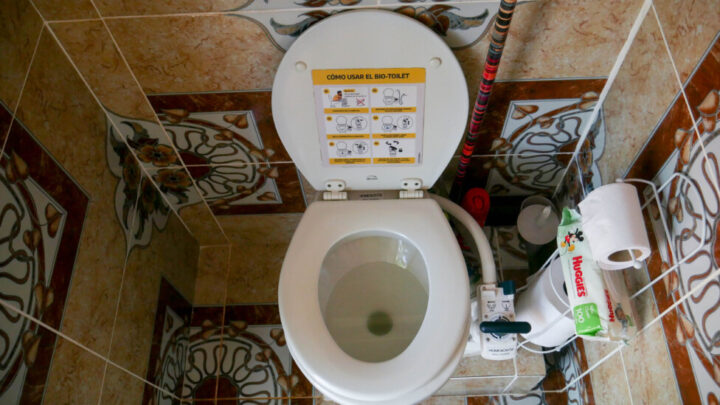
The toilets are mounted on a one-meter-high cement slab in latrines in the backyard. They are made of porcelain and have a handle on one side that opens and closes the stool inlet hole.

 One of the main advantages that family biodigesters have brought to the inhabitants of El Corozal, a small village in the Salvadoran department of Cuscatlán, is that the whole process begins with clean, hygienic toilets, like this one set up in Marleni Menjívar's backyard, as opposed to the older dry composting latrines, which drew flies and cockroaches. To the left of the toilet is the small handle used to pump water to flush the feces into the biodigester. CREDIT: Edgardo Ayala / IPS

One of the main advantages that family biodigesters have brought to the inhabitants of El Corozal, a small village in the Salvadoran department of Cuscatlán, is that the whole process begins with clean, hygienic toilets, like this one set up in Marleni Menjívar’s backyard, as opposed to the older dry composting latrines, which drew flies and cockroaches. To the left of the toilet is the small handle used to pump water to flush the feces into the biodigester. CREDIT: Edgardo Ayala / IPS

They also have a small hand pump, similar to the ones used to inflate bicycle tires, and when the handle is pushed, water is pumped from a bucket to flush the waste down the pipe.

The underground pipe carries the biomass by gravity to the biodigester, located about five meters away.

The system can also be fed with organic waste, by means of a tube with a hole at one end, which must be opened and closed.

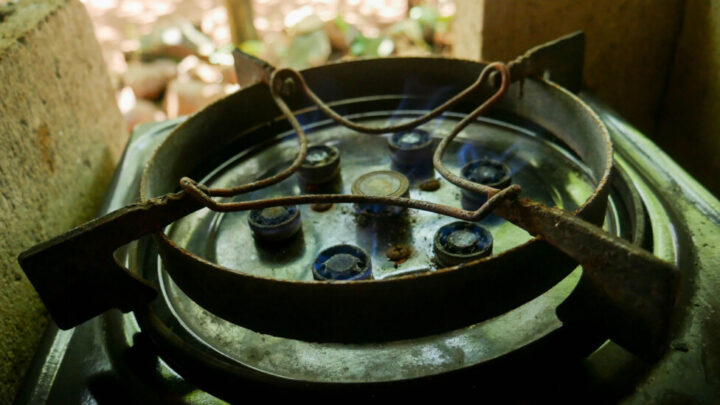
Once it has been produced, the biogas is piped through a metal tube to the small stove mounted inside the house.

“I don’t even use matches, I just turn the knob and it lights up,” said Marisol, a homemaker and caregiver. Her husband Manuel Menjívar is a subsistence farmer, and they have a young daughter.

In El Corozal, biodigesters have been installed for families of four or five members, and the equipment generates 300 liters of biogas during the night, enough to use for two hours a day, according to the technical specifications of Coenergy, the company that imports and markets the devices.

But there are also kits that are used by two related families who live next to each other and share the equipment, which includes, in addition to the toilet, a larger biodigester and a two-burner stove.

With more sophisticated equipment, electricity could be generated from biogas produced from landfill waste or farm manure, although this is not yet being done in El Salvador.

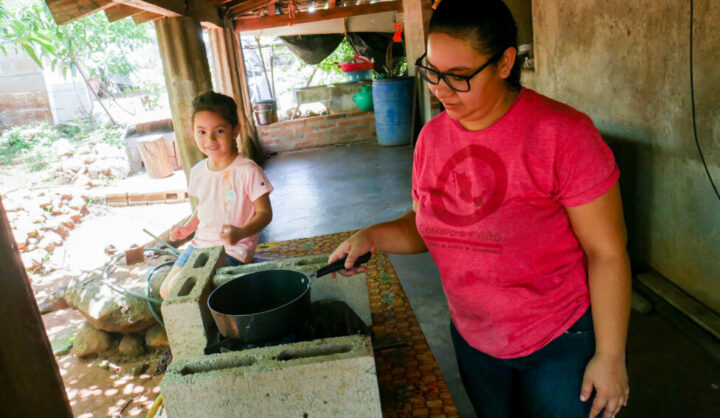
 Marleni Menjivar gets ready to heat water on her ecological stove, watched closely by her four-year-old daughter, in El Corozal in central El Salvador, where an innovative government program to produce biogas has arrived. With this technology, people save money by buying less liquefied gas while benefiting the environment. CREDIT: Edgardo Ayala / IPS

Marleni Menjivar gets ready to heat water on her ecological stove, watched closely by her four-year-old daughter, in El Corozal in central El Salvador, where an innovative government program to produce biogas has arrived. With this technology, people save money by buying less liquefied gas while benefiting the environment. CREDIT: Edgardo Ayala / IPS

Saving money while caring for the environment

The families of El Corozal who have the new latrines and stoves are happy with the results.

What they value the most is saving money by cooking with gas produced by themselves, at no cost.

They used to cook on wood-burning stoves, in the case of food that took longer to make, or on liquefied gas stoves, at a cost of 13 dollars per gas cylinder.

Marleni Menjívar, for example, used two cylinders a month, mainly because of the high level of consumption demanded by the family business of making artisanal cheeses, including a very popular local kind of cottage cheese.

Every day she has to cook 23 liters of whey, the liquid left after milk has been curdled. This consumes the biogas produced overnight.

For meals during the day Marleni still uses the liquefied gas stove, but now she only buys one cylinder a month instead of two, a savings of about 13 dollars per month.

“These savings are important for families here in the countryside,” said Marleni, 28, the mother of a four-year-old girl. The rest of her family is made up of her brother and grandfather.

“We also save water,” she added.

The biotoilet requires only 1.2 liters of water per flush, less than conventional toilets.

In addition, the soils are protected from contamination by septic tank latrines, which are widely used in rural areas, but are leaky and unhygienic.

The new technology avoids these problems.

The liquids resulting from the decomposition process flow through an underground pipe into a pit that functions as a filter, with several layers of gravel and sand. This prevents pollution of the soil and aquifers.

Also, as a by-product of the decomposition process, organic liquid fertilizer is produced for use on crops.

Most families in the rural community of El Corozal have benefited from one-burner stoves that run on biogas produced in family biodigesters. Larger two-burner stoves are also shared by two related families, where they cook on a griddle one of the favorite dishes of Salvadorans: pupusas, corn flour tortillas filled with beans, cheese and pork, among other ingredients. CREDIT: Coenergy El Salvador

Most families in the rural community of El Corozal have benefited from one-burner stoves that run on biogas produced in family biodigesters. Larger two-burner stoves are also shared by two related families, where they cook on a griddle one of the favorite dishes of Salvadorans: pupusas, corn flour tortillas filled with beans, cheese and pork, among other ingredients. CREDIT: Coenergy El Salvador

Checking on site: zero stench

Due to a lack of information, people were initially concerned that if the biogas used in the stoves came from the decomposition of the family’s feces, it would probably stink.

And, worst of all, perhaps the food would also smell.

But little by little these doubts and fears faded away as families saw how the first devices worked.

“That was the first thing they asked, if the gas smelled bad, or if what we were cooking smelled bad,” said Marleni, remembering how the neighbors came to her house to check for themselves when she got the latrine and stove installed in December 2022.

“That was because of the little information that was available, but then we found that this was not the case, our doubts were cleared up and we saw there were no odors,” she added.

She said that, like almost everyone in the village, her family used to have a dry composting toilet, but it stank and generated cockroaches and flies.

“All that has been eliminated, the bathrooms are completely hygienic and clean, and we even had them tiled to make them look nicer,” Marleni said.

She remarked that hygiene is important to her, as her little girl can now go to the bathroom by herself, without worrying about cockroaches and flies.

Source