Make Health Top of Climate Negotiations Agenda—Global Climate & Health Alliance

Climate Action, Climate Change Finance, Climate Change Justice, Conferences, COP29, Editors’ Choice, Featured, Global, Headlines, Health, Human Rights, Humanitarian Emergencies, Sustainable Development Goals, TerraViva United Nations

COP29

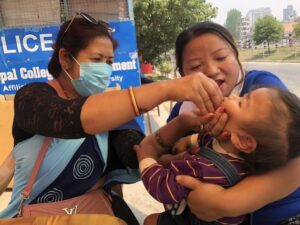
Community health worker in Nepal helping giving polio vaccine to a child. Climate change-induced events are affecting basic health facilities directly. Photo: Tanka Dhakal/IPS

Community health worker in Nepal helping giving polio vaccine to a child. Climate change-induced events are affecting basic health facilities directly. Photo: Tanka Dhakal/IPS

BAKU, Nov 14 2024 (IPS) – Climate change and its impact on public health hasn’t made the top of the agenda even at a forum like the UN Climate Conference, but is should, say the health community.


Understanding the gap, more than 100 organizations from across the international health and climate community came together as the Global Climate and Health Alliance and have called wealthy countries to protect people’s health by committing to provide climate finance in the order of a trillion dollars annually, in addition to global action with leadership from the highest emitting countries to end the fossil fuel era.

Alliance endorsed nine recommendations for the summit through a policy brief—‘A COP29 for People and Planet’ which includes financing to community engagement.

In an interview with Dr. Jeni Miller, Executive Director of the Global Climate and Health Alliance IPS asked about the recommendations and why they were necessary.

Dr. Jeni Miller, Executive Director of the Global Climate and Health Alliance.

Dr. Jeni Miller, Executive Director of the Global Climate and Health Alliance.

IPS: How and why the international health and climate community came together—why was it necessary, right before COP29?

Miller: For many years, the UN climate negotiations have been going on. For many years, health was not a part of the conversation. And in fact, the Global Climate and Health Alliance was established because a handful of health organizations felt like this is an important health issue, and we need to get health into that conversation, and we’re not seeing it there. Over the years, more and more health organizations have really begun to understand the threat that climate change poses to people’s health. I think a big contributing factor as well is that we are now seeing those impacts of climate change in real time in communities all over the world—every country, every region, is seeing some combination of extreme weather events.

This is directly impacting the communities that we serve, and we have to raise the alarm bell and make sure that we’re pushing for those solutions that are going to protect people’s health. The report, specifically the policy recommendations, is really an attempt to take what we’re seeing from the health perspective, the concerns that we have. About the threat that this poses for people’s health and the reality of the impacts on people’s health, and somewhat translate that into terms that make sense for negotiators to pick that up, understand it, and use it in the context of those actual decision-making processes in the climate talks.

IPS: Wealth is concentrated on one side of the world or one section of the community, but burden—especially public health burden—is on marginalized communities who don’t have access to basic resources. Is there any way that gap will be narrowed in the near future?

Miller: This is such a critically important issue. And unfortunately, we’re seeing some real extremes of wealth disparity—ironically, in countries that have huge wealth disparity within the country, everyone is less healthy than they would be if there was less health disparity. If people were more equal, that would be healthier for everyone. But the reality is, many people, as you say, don’t have the resources to access the basic necessities of life. Healthy food, clean water, electricity of any kind, but particularly clean energy, even access to education, access to basic health care—all of those things are really vital to growing up healthy and to living a healthy life. And the thing that is so clear is that access to those basic necessities early in life makes a tremendous difference in being able to grow up healthy, resilient, and productive.

It’s a huge impact on the individual that’s growing up without those resources—it’s also an impact on society. So, a society that has people that grow up with enough resources to be resilient, healthy, and well educated is a healthier society. And I would argue that that extends not only within a community or even a country but also internationally. So, if we have huge disparities internationally, that’s also kind of a drain on the world, a challenge for the world as a whole. It leads to conflict, it leads to friction, and it leads to difficulty making decisions to tackle climate change together. I would argue that it’s really in the best interest of wealthy countries to make those investments to help the lowest-income, vulnerable countries have the resource they need to address those basic necessities. I think it’s fundamental. It’s the right thing to do.

I think for so many reasons, it’s important that the wealthy countries do step up and provide this kind of resources.

IPS: While talking about the resources, wealthy countries are already far behind on their climate finance commitment. Do you think they will consider financing to protect people’s health?

Miller: This is a major focus of this year’s climate negotiations. In fact, on the table is a major discussion about a new pot of financing for climate change, and I don’t think we know the answer yet as to how that’s going to come out.

It often gets talked about as we can’t economically afford to put in that money. I think a key question is, what is the cost of inaction? If we fail to act, we’re already seeing. The cost of failing to act on climate change is immense. The cost of failing to enable countries to be better, prepared to be better, to have their systems, their water and sanitation systems be stronger, their hospitals be more prepared, etc. The costs are just staggering. So, when we’re talking about, can we afford to put the money into climate action, I think we also need to ask the question, can we afford not to? I think the answer is no. And then the last thing that I’ll say about this is, and this is also important, we are currently subsidizing fossil fuels more than a trillion a year in direct public subsidies. So that’s public money going into supporting the production and use of fossil fuels, and fossil fuels are the primary driver of climate change.

So again, when we’re talking about, can we afford to or are we prepared to invest in climate action and put money into a Climate Fund? We need to ask ourselves the question. What is the cost of not doing so? And then where else is public money going that could be going into moving us in the right direction, towards clean energy, towards climate resilience?

IPS: You talked about the extreme weather events. In recent years, extreme events contributed by climate change are causing destruction en masse; often its monetary losses will be counted but its public health impact is still to be discussed. How do you see climate and health discussion moving forward especially regarding financing?

Miller: I don’t think it happens by itself. In my own country, the US, we are seeing climate-exacerbated disaster, and yet people not accepting the role of climate change in that and not accepting that the health impacts, the dislocation, and the trauma that they’re experiencing were caused by climate change.

It’s not necessarily going to happen just by itself, in in other countries as well. People may be feeling the impacts, but not connecting the dots, and not because of disinformation, not recognizing.

I do think that it’s important for those who know about those connections—the scientists, the advocates, the health professionals who are looking at these issues, the academic departments—to talk about it and articulate what those connections are.

But then I do think that each time one of those extreme weather events does create the opportunity for that conversation to happen, and we need to step up to those opportunities.

And I think that can make a really big difference in changing the nature of the conversation and opening-up possibility for a deeper conversation about what we need to do about this.

IPS: Let’s talk about the report. It talks about healthy climate action for most affected communities. Can you explain it for our audience and what would be the role of the community?

Miller: It’s so often the case that decisions get made without consulting communities affected by those decisions. There can be very good will that is, and good intentions behind that, and yet the results are not going to be as good if you’re not working with the people affected by the issue. The thing that community members know that nobody else knows in the way that they know it is their lived experience of what’s going on in their community, their resources in terms of their own knowledge, their own community relationships, their own resilience, their own techniques. There may be techniques that they know for growing food and their ecosystem.

There may be knowledge you know for forced communities, knowledge that they have of the force that they live in. There is very deep knowledge that communities have about their circumstances, their context, and their needs and what they can bring in terms of solutions, so effectively working with communities means really involving them in the conversation from the get-go when designing programs and projects and all of that sort of thing. And I think when it comes even to financing, thinking about how finance for Climate Solutions reaches that community level.

I think another thing that’s really important to recognize is that climate change puts a huge strain on all of us. It’s a huge psychological strain just to live in the climate era. Enabling communities to come together and be a part of the solution helps to heal that burden.

IPS: You touched on mental health. The report also talks about mental health and wellbeing outcomes—we are seeing people struggling with climate-related post- and pre-event psychological burden in different forms. How do you see this dimension moving forward?

Miller: That is one area where I’ve definitely seen significant progress in the last several years. I think I’ve seen significant progress in increasingly recognizing the health impacts of climate change and the health threat that climate change poses, and then within that, significant progress in beginning to recognize and acknowledge and understand the mental health dimensions of this. There’s a long way to go, but it is a part of the conversation, and it’s an important one.

There are mental health impacts before or after an extreme weather event, and that can show up as kind of anxiety and stress, a variety of things. People who go through major extreme weather events, like the post-traumatic stress of having experienced that and having gone through it, not knowing if it might happen again or when it might happen again.

There’s also the sense of losing one’s world, losing the world that one grew up in, losing the environment that one, the world that one grew up in and seeing those things kind of slip away—this sort of a cultural, ecological and cultural dimension to that. And if you know, failing to acknowledge that mental health dimension both leaves people suffering and also leaves people sort of disempowered.

I think community is important in response to those kinds of mental health challenges—the kind of recognition that there are actions that one can take and ways that one can come together. And some of those actions may be kind of the direct actions of sustainability, working to live a more sustainable lifestyle. I think even, maybe even more important than that, are actions of coming together with the community to influence the kinds of decisions that get made, to call for the kinds of policies that will turn the needle on climate change, to have a voice in the larger conversation. I think that can be even more powerful.

IPS: Do you have anything to add that we may have missed or you wanted to add?

Miller: I think the one thing that I would add is that, right now, every government that’s part of the Paris Agreement is in the process of drafting new national climate commitments.

It’s an important opportunity, not just at the international level, and as at these big international climate talks, but at home, in every single country, for people to call on their governments to make commitments that are aligned with protecting their health from climate change.

Also, I think it’s important to continue to focus on what we can do. The headwinds can feel pretty strong. Addressing climate change will be something that we’re doing for the rest of our lives, not just for the rest of my life—anybody alive today will be dealing with this issue for the rest of our lives. So, we need to maintain our stamina around it and know that this is a long-term commitment and know that it’s worth it.

IPS UN Bureau Report


UNDP’s Sustainable Energy Director Calls For Innovative Financial Solutions for Adaptation, Mitigation

Climate Action, Climate Change, Climate Change Finance, Climate Change Justice, Conferences, COP28, COP29, Editors’ Choice, Environment, Featured, Global, Headlines, Humanitarian Emergencies, Sustainable Development Goals, TerraViva United Nations

COP29

Financial solutions for the global South are under the spotlight during COP29. Credit: UN Climate Change/ Habib Samadov

Financial solutions for the global South are under the spotlight during COP29. Credit: UN Climate Change/ Habib Samadov

BAKU, Nov 13 2024 (IPS) – Riad Meddeb, Director of the Sustainable Energy Hub at the United Nations Development Programme (UNDP), stressed the urgency of finding innovative financial solutions during COP29.


Meddeb was speaking to IPS in an exclusive interview at the conference. He said the negotiations were expected to focus heavily on finance—a core issue that has historically hampered climate action in developing and least-developed nations.

The Finance COP Expectations

Meddeb highlighted the historical challenge of meeting the USD 100 billion annual target for climate finance, which has been a central but elusive goal in previous COPs. He noted that Azerbaijan’s COP 29 presidency aims to overcome this by ensuring the necessary funds are available, especially for countries most vulnerable to climate impacts. 

“This year’s COP is considered the ‘Finance COP’ because it’s crucial we not only set targets but also mobilize the resources to help countries adapt and mitigate climate impacts,” he explained.

A key focus will be developing sustainable financing mechanisms for countries that struggle with debt. Many nations in the global South face significant financial burdens, and accelerating their energy transitions requires resources that may be challenging to secure within their existing economic constraints. Meddeb also stressed the need for concrete financial schemes that can attract private sector investments to supplement international climate funding.

Riad Meddeb, Director of the Sustainable Energy Hub at the United Nations Development Programme (UNDP)

Riad Meddeb, Director of the Sustainable Energy Hub at the United Nations Development Programme (UNDP).

Progress at COP 28 and Hopes for COP 29

Reflecting on COP 28, Meddeb noted key successes, including establishing the Loss and Damage Fund and reaching consensus on a targeted increase in renewable energy capacity.

“The agreement to triple renewable energy and double energy efficiency by 2030 was a significant breakthrough at COP28,” he said. “Now, COP29 must translate that ambition into action by securing the financial support needed to achieve these goals.”

Making sure that the commitments made at COP28 are more than just empty words is one of the main challenges going forward, according to Meddeb.

“By COP30, we want a global commitment on the pathway to adaptation and mitigation,” he added.

UNDP’s Role in the Climate Action Landscape

UNDP plays a critical role in translating international climate targets into real, on-the-ground actions. Through initiatives like the UN’s “Climate Promise,” UNDP supports countries in implementing Nationally Determined Contributions (NDCs) and operationalizing climate goals. Meddeb explained that UNDP is uniquely positioned to facilitate these efforts due to its extensive network of country offices in 170 nations. This network enables UNDP to address climate issues from a development perspective, integrating energy solutions into broader sectors such as health, education, and poverty alleviation.

“UNDP’s approach is not just about energy,” he said. “It’s about sustainable energy for development. We link energy needs with development needs, connecting climate action to real improvements in health, education, and economic opportunities. This is the difference UNDP makes.”

Addressing the Debt Issue in Climate Finance

A significant portion of the interview focused on the complex financial situations faced by many global South nations, where debt often limits capacity to implement ambitious climate plans. Meddeb pointed out that addressing these financial constraints is essential for equitable progress toward climate goals. He suggested that international financial institutions should provide debt relief or restructuring options to allow these countries to invest more readily in clean energy and climate adaptation.

“Pushing countries with heavy debt burdens to accelerate their energy transition requires a nuanced approach,” Meddeb said. “We need financial structures that acknowledge their debt situations while still allowing them to contribute meaningfully to global climate targets.”

Implementation of the Paris Agreement: From Words to Action

Meddeb stressed the importance of shifting the Paris Agreement’s commitments from paper to practice, especially regarding emission reductions by developed nations. He believes that developed countries have a moral obligation to reduce their carbon footprints, given their historical contribution to climate change and their financial capacity.

“The plan is clear, and it’s agreed upon by all parties in the Paris Agreement. Now it’s just about accelerating implementation,” he asserted. “We don’t need to reinvent the wheel—we need to get it moving.”

When asked whether the current pace of implementation is sufficient, Meddeb offered a candid view: “The Secretary General was very clear—it’s now or never. We need optimism and ambition but also an unyielding focus on practical solutions. There are obstacles, yes, but there are solutions too. Together, we can save our planet.”

The Responsibility of Developed Nations Toward Vulnerable Countries

As climate impacts disproportionately affect poorer nations, Meddeb urged developed countries to support those bearing the brunt of climate change. He pointed to the Loss and Damage Fund as a critical mechanism for this purpose. Set up at COP28, the fund has already garnered around USD 700 million, and Meddeb hopes COP29 will build on this initial success by accelerating funding mobilization.

After all, as the UN secretary general António Guterres noted this week, while the Loss and Damage Fund was a victory, the initial capitalization of USD 700 million doesn’t come close to righting the wrong inflicted on the vulnerable.  “USD 700 million is roughly the annual earnings of the world’s ten best-paid footballers,” Guterres said.

Meddeb agrees. “Mobilizing funds for loss and damage is a positive first step. But we must continue pushing to ensure that the support reaches the most affected communities quickly and effectively.”

A Call to Action

For Meddeb, the stakes could not be higher, and the time for incremental progress is over. He said that COP 29 must not only focus on setting ambitious goals but also make real progress on securing the necessary financing to turn aspirations into achievements.

“Now is the moment to turn pledges into action,” he said. “We’ve reached a point where the world cannot afford to wait any longer. This is the COP for finance, and we need to ensure the resources are in place for meaningful climate action.”

IPS UN Bureau Report

 

How Blue Carbon Ecosystems are Saving the Philippines’ Sinking Islands

Asia-Pacific, Civil Society, Climate Action, Climate Change, Environment, Featured, Headlines, Human Rights, Humanitarian Emergencies, Small Island Developing States, Sustainable Development Goals, TerraViva United Nations

Opinion

Submerged structure in Tubigon, Philippines. Credit: Greenpeace

 
In the Philippines, a group of islands is rapidly sinking due to an unprecedented rise in sea levels. This blog dives into how these coastal communities are utilizing marine resources and ecosystems to find solutions and build resilience against climate risks.

KUALA LUMPUR, Malaysia, Nov 6 2024 (IPS) – Imagine living with water up to your knees for half of the year, where homes are flooded, and people constantly fear that the sea might one day engulf the town and everyone in it.


This is the reality for the sinking islands in the Philippines—a cluster of four island barangays in Tubigon located in the south-central region of Bohol. Here, the sea level is rising at an alarming rate of 10.8 millimeters per year, three times faster than the global average. If this continues, these islands could disappear by 2100.

Tubigon sank by one meter after being hit by a 7.2 magnitude earthquake over a decade ago. While still recovering, the islands were devastated by a super typhoon in 2021, unleashing four-meter-high tidal waves that destroyed over 1.7 million homes and displaced more than 3 million people. This year, the islands were declared inhabitable by the government.

Existential Climate Threats to Coastal Communities

Coastal communities like the Philippines are severely threatened by accelerating sea level rise compounded by extreme weather events. Similar to small island developing states, also known as SIDS, low-lying coastal areas are the most vulnerable to climate change.

Their geographic location leaves them highly-exposed to natural disasters and hazards like cyclones and tidal flooding. These vulnerabilities exacerbate coastal communities’ unique development challenges.

The Intergovernmental Panel on Climate Change (IPCC) reports that with the current 1.5 degree temperature increase, global sea levels will continue to rise and low-lying coastal regions are to experience extreme sea events such as storm surges and massive tides annually by 2050.

SIDS, including Tuvalu and the Maldives, along with the sinking islands of Tubigon, are proof of the existential threats of climate change. These communities are at risk of vanishing unless urgent action is taken.

Bouncing Back from Climate Risks

While island communities are under threat, they are not powerless. Many of them have shown commitment to addressing climate-related risks in their national climate action plans. Their goal is to build climate resilience.

The term “resilience” is often mentioned in climate change discussions, but what does it really mean? It comes from the Latin verb resilire, meaning “to bounce back.” Resilience refers to the ability to recover from risks, which, in the context of climate change, is determined by the degree of vulnerability and exposure to climate-related threats.

For coastal communities and low-lying islands, rising sea levels pose a significant risk, so they must build resilience to endure and recover from climate-related hazards and disasters.

Turning to Blue Carbon Ecosystems for Solutions

Many SIDS set a good example in piloting measures to build resilience and adapt to the impacts of climate change. Similarly, the residents of Tubigon, many of whom are fisherfolks, have learned to adapt to the rising tides.

The local community has developed resilience strategies and initiatives to help them sustain their lives on the islands. One promising solution involves utilizing the sea and its resources, part of what is called the blue carbon ecosystem.

Blue carbon ecosystem is a collective term for natural marine resources such as mangroves, seagrasses, and marshes known for their ability to capture and store carbon dioxide from the atmosphere. Research shows that these coastal resources can transfer and store carbon ten times more effective than tropical forests.

These ecosystems also support fishery production, protect shorelines and reduce flooding, and provide habitats for wildlife and migratory species. Studies indicate that conserving blue carbon ecosystems is a timely and cost-effective strategy to help coastal communities adapt to climate change.

Harnessing Coastal Resources for Climate Change Adaptation

Tubigon and the Bohol region have long implemented measures to protect their blue carbon ecosystems, helping residents adapt to climate-related risks. Their strategy is two-fold: eliminating destructive fishing practices and conserving coastal resources particularly mangroves.

The local community has designated bantay dagat (which translates literally to sea protectors) to patrol its marine area spanning 156 hectares of coral reefs and 335 hectares of mangroves. These protectors report illegal fishing activities and safeguard the mangrove forests.

Over time, many locals have transitioned from destructive fishing methods, such as dynamite and cyanide use, to more sustainable aquaculture and alternative livelihoods, including crab and squid jigging, grouper farming, and ecotourism.

Moreover, particular focus is given to mangrove conservation. The vast mangrove area in Tubigon is considered a valuable blue ecosystem resource playing an important role in sequestering carbon. Experts estimate that a 4-decade mangrove plantation can store over 370 tons of carbon per hectare.

Additionally, mangroves act as natural seawalls, reducing wave energy and shielding residents from rising sea levels and tidal flooding. By investing in the preservation of blue carbon ecosystems, coastal communities like Tubigon tap into an essential resource that supports their livelihoods and enhances their resilience to the effects of climate change.

Turning the Tide

The islands of Tubigon stay afloat amidst the intensifying battle against climate threats. Most recently, the Philippines joined an alliance to build the resilience of coastal communities. It was also selected as the host of a fund dedicated to supporting countries to respond to loss and damage, enabling them to recover and rebuild from the adverse effects of the climate crisis.

Allowing islands to sink and entire communities to disappear is unimaginable, especially when we have the resources and tools to address the planet’s most significant crisis. Time is running out, but there is still hope to turn the tide.

This article is originally published in Global Dev as part of its Climate Resilience series.

Anne Cortez is a communications and knowledge management consultant with over a decade of experience working with governments, academic institutions, and international organizations including the UN, ADB, and The Asia Foundation. She has spearheaded and managed development programs and capacity building initiatives promoting climate action, digital inclusion, and health equity across Asia and the Pacific. Previously, she led the knowledge and communications team at the UN think tank for global health based in Malaysia, and the social mobilization division at the Department of Education in the Philippines. Anne has a master’s degree in international studies and an undergraduate degree in communications. Learn more about her work here.

IPS UN Bureau

  Source

Tanzanian Students Drive Climate Action Through Tree Planting

Active Citizens, Africa, Civil Society, Climate Action, Climate Change, Climate Change Finance, Climate Change Justice, COP29, Development & Aid, Editors’ Choice, Education, Environment, Featured, Food and Agriculture, Headlines, Sustainable Development Goals, TerraViva United Nations, Youth Thought Leaders

Climate Change Justice

The act of planting trees offers more than shade and fruit. It symbolizes a deeper mission—restoring soil, preserving water, and, for these students, living in Tanzania’s northern Rorya district, delivering a form of climate justice. The reforestation efforts are in step with Tanzania’s broader plans to fortify its agriculture and water systems against the advancing climate crisis.

Faiza Ally, a pupil at Mtoni Primary School in Mara Region, plants a tree. Credit: Kizito Makoye/IPS

Faiza Ally, a pupil at Mtoni Primary School in Mara Region, plants a tree. Credit: Kizito Makoye/IPS

MUSOMA, Tanzania, Oct 30 2024 (IPS) – At Gabimori primary school, located at Nyamagaro ward in Tanzania’s northern Rorya district, a 15-year-old  Florence Sadiki kneels among polyethylene bags, carefully examining the seedlings she and her classmates  have nurtured from tiny sprouts “We’ve planted many trees to make our school look better and to help fight climate change,” she says.


Sadiki is part of an inspiring grassroots movement in the east African country where students, teachers, and community members team up to fight environmental degradation through reforestation. In Rorya district, nestled on the shores of Lake Victoria, rampant deforestation driven by charcoal production has left the land barren. But the efforts of school environmental clubs, supported by the Lake Community Program (LACOP), are working to repair the damage.

The reality in Rorya is grim. Erratic rainfall and prolonged droughts have changed swathes of once-fertile land into dry savannas, a trend that has only accelerated since the initiative began in 2022. Spearheaded by the global charity World Neighbors and the Lake Community Development Foundation (LACODEFO), this initiative empowers students to plant trees and learn the entire process of growing them.

Daudi Lyamuru speaks during a village meeting to mobilize the community to plant trees and support the climate mitigation project. Credit: Kizito Makoye/IPS

Daudi Lyamuru speaks during a village meeting to mobilize the community to plant trees and support the climate mitigation project. Credit: Kizito Makoye/IPS

Pupils at Mwenge primary school pose for a photo after tree planting exercise. Credit: Kizito Makoye/IPS

Pupils at Mwenge primary school pose for a photo after tree planting exercise. Credit: Kizito Makoye/IPS

“We’re teaching students to set up their own nurseries,” says Idrisa Lema, the project officer. “It’s not enough to hand out seedlings. They need to learn the whole process—choosing drought-resistant species, improving soil with organic manure, and using techniques like mulching.” This holistic approach  promotes sustainability and equips students with transferable skills that can help them for the rest of their lives.

In the past two years, the students have successfully planted 2,800 trees across five villages, a remarkable achievement that has already begun to bear fruit. Some once-dry water springs are starting to flow again. Yet challenges remain, particularly in Nyamagaro and neighboring Kyangasaga villages, where erratic rainfall and drought continue to hinder progress.

“Watering the trees is tough,” admits Alex Lwitiko, an environmental teacher at Rorya Girls’ School. “We’ve had to be strict with the students—otherwise, the trees wouldn’t survive.”

To adapt, students have switched to innovative solutions like bottle irrigation and even drilled water wells to support their young trees. “We focus on drought-resistant species and organic farming methods to give the trees the best chance,” Lwitiko says, emphasizing the program’s commitment to teaching sustainability.

Sadiki herself has learned to adapt. “I know how to graft trees and grow them in tough conditions now,” she says. “These trees are our future. They fight climate change, provide shade, and even improve soil fertility.”

A government official, Aloycia Mdeme, plants a tree to signify the launch of the school environmental club. Credit: Kizito Makoye/IPS

A government official, Aloycia Mdeme, plants a tree to signify the launch of the school environmental club. Credit: Kizito Makoye/IPS

Mtoni primary school pupils plant trees, this project has become central to the region's contribution to climate change mitigation. Credit: Kizito Makoye/IPS

Mtoni Primary School pupils plant trees; this project has become central to the region’s contribution to climate change mitigation. Credit: Kizito Makoye/IPS

In Tanzania, the impact of climate change is becoming increasingly severe. The country aims to reduce greenhouse gas emissions by 30 to 35 percent by 2030, a goal outlined in its Nationally Determined Contributions (NDCs). Despite its low carbon footprint—just 0.22 tons per capita compared to the global average of 7.58—Tanzania is reeling from climate-related disasters. Droughts, floods, and erratic weather patterns disrupt agriculture, drying up water sources and threatening economic stability.

For the rural poor, especially those who rely on farming—the backbone of the economy, making up 28 percent of GDP—the stakes are higher. But in places like Nyagisya and Rorya Girls Secondary Schools, students have taken up the fight. Through tree planting, they have become unlikely climate crusaders, tackling environmental degradation while improving food security and boosting local livelihoods.

The act of planting trees offers more than shade and fruit. It symbolizes a deeper mission—restoring soil, preserving water, and, for these students, delivering a form of climate justice. The reforestation efforts are in step with Tanzania’s broader plans to fortify its agriculture and water systems against the advancing climate crisis.

As these student-led initiatives flourish, they mirror Tanzania’s urgent call for global support. With limited resources, the country is striving to fulfill its commitments yet it recognizes that the battle against climate change is a collective endeavor that requires unity on a global scale.

Despite the promising efforts in Tanzania, significant challenges remain. One of the main hurdles is the unpredictability of funding. Tree-planting initiatives and climate adaptation programs require sustained financial support, but resources are often limited, local analysts say.

Without consistent funding, scaling up projects and maintaining long-term impact becomes difficult.

Community members plant trees in Rorya district. Credit: Kizito Makoye/IPS

Community members plant trees in Rorya district. Credit: Kizito Makoye/IPS

While students have embraced environmental stewardship, not all local households are on board. In some areas, livestock continues to graze on young saplings, undoing the hard work of reforestation. Additionally, cultural and economic pressures, such as the reliance on charcoal for income and firewood for cooking, contribute to ongoing deforestation, making conservation efforts harder.

Erratic rainfall and worsening drought conditions present another barrier. Water scarcity makes it harder to nurture newly planted trees, despite innovative solutions. These conditions also strain local agriculture, which many families depend on, increasing the urgency of balancing conservation with survival needs.

While Tanzania has ambitious climate goals, the gap between policy and practical implementation remains wide, particularly in rural areas where the effects of climate change are felt most acutely. 

At Gabimori Primary School, students have embraced their role as environmental stewards. “They’ve seen how conservation affects their daily lives,” says teacher Witinga Mattambo. “They now understand the link between the trees and the food they eat.”

The impact is vivid for students like Sadiki. “I never realized trees were this important,” she says. “They bring rain and improve our environment.”

For Lema, this is only the beginning. By fostering leadership skills and engaging the broader community, the program is building a new generation of Tanzanians dedicated to environmental protection. “We’ve even seen parents get involved,” Lwitiko says. “They’re starting to plant trees in their own yards.”

Still, the program faces hurdles. Some households allow their livestock to graze on young saplings, undoing the hard work of the students. “It’s frustrating,” admits Lwitiko, “but we’re making progress, step by step.”

Lema has ambitious plans to expand the initiative.

“We’re training students to pass on their knowledge,” he says. “As they move on, they’ll teach younger students, and we’ll spread this effort to other schools.” But scaling the program will require more funding.

“We’re working on securing more resources and partnering with local governments to enforce tree-planting bylaws,” Lema explains. There are also plans to set up household tree nurseries, allowing families to earn extra income while contributing to conservation.

For Sadiki, the program’s impact is lasting.

“We have the duty to plant trees and protect our environment. It’s something we’ll carry with us for the rest of our lives.”

IPS UN Bureau Report

  Source

At COP16, Biodiversity Credits Raising Hopes and Protests

Active Citizens, Biodiversity, Climate Action, Conferences, COP16, Editors’ Choice, Environment, Featured, Global, Headlines, Indigenous Rights, Latin America & the Caribbean, TerraViva United Nations

COP16

Indigenous women in Cali hold a protest commodificationof their traditional natural products. Majority of the indigenous organizations participants in the COP have been vocal about their opposition to biodiversitycredits, which they think is a false solution to halt biodiversity loss. Credit:Stella Paul/IPS COP16 Logo, installed at the conference venue atCali, Colombia. Credit: Stella Paul/IPS

Indigenous women in Cali hold a protest commodificationof their traditional natural products. Majority of the indigenous organizations participants in the COP have been vocal about their opposition to biodiversitycredits, which they think is a false solution to halt biodiversity loss. Credit:Stella Paul/IPS
COP16 Logo, installed at the conference venue atCali, Colombia. Credit: Stella Paul/IPS

CALI, Columbia, Oct 26 2024 (IPS) – At the end of the first week at the 16th Conference of Parties on Biodiversity (COP16), finance emerges as the biggest issue but also shrouded in controversies.


On Saturday, as the COP moved closer to its most crucial phase of negotiations, resource mobilization—listed under Target 19 of the Kunming-Montreal Global Biodiversity Framework (KMGBF)—took centerstage, with most parties demanding faster action, greater transparency and the adoption of true solutions to halt biodiversity loss. 

Biodiversity finance: Expectation vs Reality

On Thursday, October 24, the government of China formally announced that the Kunming Biodiversity Fund—first announced by Chinese president Xi Jinping in 2021—was now fully in operation. The fund promises to contribute USD 220 million over the next 10 years, which would be spent especially to help developing countries in implementation of the KMGBF and achieve its targets, said Huang Runqiu, Minister of Environment and Ecology, China, at a press conference. It wasn’t clear, however, how much of the promised amount had been deposited.

This has been the only news of resource mobilization for global biodiversity conservation received at COP16, as no other donors came forth with any further announcements of new financial pledges or contributions to the Global Biodiversity Framework Fund (GBFF), which was expected to receive USD 400 billion in contribution by now but has only received a paltry USD 250 million.  In addition, there were no announcements of the countries reducing their current spending on harmful subsidies that amount to USD 500 billion and cause biodiversity degradation and biodiversity loss.

In absence of new contributions and lack of any concrete progress on reduction of harmful subsidies, the new mechanisms like biodiversity credits to mobilize resources for implementation of the Global Biodiversity Fund is fast gaining traction.

From October 21–24, the COP16 witnessed a flurry of activities centered primarily around biodiversity credits and the building of new pathways to mobilize finance through this means. Experts from both the UN and the private sector were heard at various forums discussing the needs of developing tools and methodologies that would help mobilize new finance through biodiversity credits while also ensuring transparency.

COP16 logo, installed at the conference venue in Cali, Colombia. Credit: Stella Paul/IPS

COP16 logo, installed at the conference venue in Cali, Colombia. Credit: Stella Paul/IPS

Inclusiveness and the Questions

According to a 2023 report by the World Economic Forum, the demand for biodiversity credits could rise to USD 180 billion annually by 2050. The report said that if major companies stepped into the market, the annual demand for biodiversity credits could go to as high as USD 7 billion per year by 2030.

Experts from the UN and a variety of technical people with various backgrounds said that since biodiversity credits are still in their infancy, there will undoubtedly be a lot of scrutiny and criticism. The Biodiversity Credit Alliance is a group that provides guidance for the establishment of a biodiversity credit market. The urgent need, they said, was to develop infrastructure and policies that would help answer those questions and tackle the scrutiny. The first and foremost of them was to help build digital tools and infrastructure that could be used to share and store biodiversity data in a credible and transparent manner.

Nathalie Whitaker, co-founder of Toha Network in New Zealand, a group of nature-based business investors, said that her organization is building digital tools, especially for helping local communities to participate in biodiversity credit programs and access the benefits.

“Once the communities have these tools, they can instantly see what data is being used to pay for the biodiversity credits or even decide the value of the natural sources in their territory. So, they can see what resources are being discussed, what is being valued, how it’s being done and how the whole discussion is moving forward,” Whitaker said.

Fabian Shimdt-Pramov, another speaker at the event, said that the quality of the tools would decide the course and results of a biodiversity credits project.

Shimdt-Pramov, chief business development officer at Biometric Earth, a German company that uses artificial intelligence to build biodiversity analytics tools from different sources such as remote sensing, wildlife cameras, acoustic monitoring, etc.

“If methodology is not correct, if the data is not correct, the system doesn’t work,” he said, emphasizing on the requirement of high-level technological expertise that is needed to get a biodiversity credit project off the ground.

However, when questioned on the cost of buying such high-end technologies and tools, especially by Indigenous communities living in remote areas without any internet connectivity, both speakers appeared to be at a loss for words.

“I have seen in the Amazon a community selling five mahogany trees on the internet, so I am guessing it’s not a big challenge,” Shmidt-Pramov said in a dismissive voice. Whitaker acknowledged that lack of access to digital technology in Indigenous Peoples communities was an issue but had no solutions to propose.

Terence Hay-Edie of Nature ID, UNDP, however, stressed the need to empower the communities with the knowledge and skills that would help them access the tools and be part of a biodiversity credit.

As an example, he cites restoration of river-based biodiversity as a biodiversity credit project where a river is considered to have the same rights as a human being. According to him, if values of credits are counted and traded for restoration of biodiversity around a river, it will require recognition of all these rights that a river has, which is only possible when the community living along the river has full knowledge of what is at stake, what is restored, what value of the restored biodiversity is to be determined and how the pricing of that value will be decided.

“A river can be a legal entity and have a legal ID. Now, can we build some tools and put them in the hands of the community that is doing the restoration to know the details of it? That’s what we are looking at,” Hay-Edie said.

A False Solution?

However, Indigenous peoples organizations at the COP16 were overwhelmingly opposing biodiversity credits, which they called “commodifying nature.”

What are biodiversity credits? It’s basically regenerating biodiversity where it is destroyed and earning money from that. But it doesn’t work that way, according to Souparna Lahiri, senior climate change campaigner at Global Forest Coalition.

“If we talk of a forest, the ecosystem is not just about trees but about every life that thrives in and around it—the rivers, the animals, plants, bees, insects, flowers and all the organisms. Once destroyed, it’s lost forever. And when you regenerate it elsewhere, you can never guarantee that it will be an exact replica of what has been lost.  This is why the very concept of biodiversity credit is a destructive idea,” says Lahiri.

Valentina Figuera, also of the Global Forest Coalition, said that while trading carbon credits could work as a tool in carbon change mitigation, it would not be the same in biodiversity.

“In climate change, you can measure the total carbon generated by a forest, for example. But in biodiversity, how do you measure it? What is the mechanism? How do you even value life that thrives there? So, this concept is a straight import from climate change and forcefully imposed in biodiversity, which is nothing but a false solution, so that businesses that cause biodiversity loss can conduct their business as usual.

The Dilemma of Participation

COP16, dubbed the “People’s Cop” by Colombia, the host country, has drawn several hundred representatives of Indigenous Peoples and Local Communities (IPLC), especially from across Latin America, including Colombia, Brazil, Panama, Venezuela and Peru. While the Latin American IPLC organizations appeared united in their opposition to biodiversity credits, African organizations seemed to be willing to consider it.

Mmboneni Esther Mathobo of the South African NGO International Institute of Environment said that her organization was in support of biodiversity credits, which could, she said, not only help the community earn money but also motivate them further to preserve biodiversity.

“We are influencing and making sure that our rights are safeguarded and protected in this newly emerging market of bringing biodiversity credits,” said Mathobo.

Currently, Namibia is implementing its first biodiversity carbon credits project in partnership with the World Wildlife Fund (WWF). Known as the Wildlife Credits Scheme, the project is known as a Payment for Ecosystem Services (PES) that rewards communities for protecting wildlife and biodiversity.  Mathobo said that the project in Namibia made her realize that there was a great opportunity for local communities to conserve and restore biodiversity and earn from it.

“We faced many challenges to earn carbon credits because that system was established and created behind our heads. And now we wake up, but we find ourselves sitting with a lot of problems in that market where our communities are not even benefiting. But we believe that with the engagement of the biodiversity alliance, UNDP, we are going to be the ones making sure that whatever happens in the biodiversity credit market, it benefits all our regions and all our communities, as well as safeguarding and protecting our rights,” she said.

“To each their own, if Latin American indigenous communities feel they don’t want to trade natural resources, that’s their right. But in Africa, we have the potential to earn biodiversity credits and we need the money, so we are supporting it,” Mahobo commented when reminded of the opposition of Latin American countries to biodiversity credits.

Source: World Economic Forum Report on Biodiversity Credit

IPS UN Bureau Report


The Future of Food Security Lies Beyond COP29’s Negotiation Tables

Biodiversity, Climate Action, Climate Change, Climate Change Justice, Conferences, COP29, Economy & Trade, Environment, Food and Agriculture, Food Security and Nutrition, Food Sustainability, Global, Green Economy, Headlines, Natural Resources, TerraViva United Nations

Opinion


ASUNCION, Paraguay, Oct 21 2024 (IPS) – Climate change has thrown our food systems into chaos. Extreme weather events and dramatic climate variations are hammering food production and supply chains across the world. As global leaders gear up for COP29, there’s plenty of buzz about climate action. But can we really expect these slow-moving, bureaucratic negotiations to deliver tangible and swift results to decarbonize and insulate our agri-food systems? Most likely not. But do not despair. While the COP29 talks unfold, crucial climate solutions for transforming food systems are already taking root on the ground.


Jesus Quintana

In the exhilarating, Oscar-winning movie “Everything Everywhere All at Once”, the leading characters are surrounded by overwhelming chaos and complexity. Yet, within this confusion, small actions, and the determination of people behind them, spark powerful change. In stunning similarity, the climate crisis —particularly in food systems— feels like an insurmountable challenge with everything, droughts, floods, storms, hunger and other interlocked crises, striking everywhere, and all at once.

Urgent action is needed. Where do we turn? COP 29 will likely be stuck in slow-paced discussions. Meanwhile, transformative solutions are taking shape on the ground. Across the globe, communities, farmers, sponsors and innovators are quietly building resilience in their food systems, demonstrating that true progress often emerges from the margins, not the center of chaos. Just like in the metaphoric film, finding purpose and action amid disorder is where meaningful change begins.

Grassroots solutions for climate-resilient food systems

While world leaders talk and officials try to turn decisions into workable policies, local communities are already acting. Across the Global South, where the effects of climate change are being felt most acutely, smallholder farmers and grassroots organizations are implementing innovative practices that build resilience to climate shocks.

In regions like Sub-Saharan Africa and parts of Latin America, agroecology is gaining traction as a powerful tool for both mitigating and adapting to climate change. This farming approach, which draws on traditional knowledge and emphasizes sustainable, low-emission methods, is helping communities adapt to changing weather patterns while improving food security. Agroecology promotes biodiversity, improves soil health, and reduces dependency on chemical inputs, all of which enhance the resilience of agricultural systems to climate impacts and helps decarbonize them.

The private sector’s role in transforming food systems

Community movements and local governments are playing a vital role, but the private sector is also increasingly driving climate solutions in food systems. Market forces are pushing companies to innovate in ways that reduce agriculture’s climate footprint. The plant-based food revolution is an example of how the private sector is responding to the need for more sustainable diets that lower greenhouse gas emissions. Similarly, alternative protein food-tech startups are leading the way towards a sustainable and tasty food future. These unconventional substitutes for traditional livestock farming offer a glimpse of how innovation can drive systemic changes in food production.

In addition to product innovation, there is growing corporate investment in regenerative agriculture—a practice that rebuilds soil health, captures carbon, and improves biodiversity. Large food companies, driven by consumer demand for sustainable products, are making commitments to source ingredients from regenerative farms, contributing to both climate mitigation and long-term food security.

Climate finance outside the COP processes

One of the most significant barriers to transforming food systems in the face of climate change is the lack of adequate financing. While COPs have made important commitments, such as the creation of the Green Climate Fund, the flow of funds has been slow and insufficient to meet the needs of vulnerable communities. In response, philanthropy and private finance are stepping in.

Some patrons and foundations are funding initiatives that help smallholder farmers adapt to climate change, while impact investors are supporting agri-tech innovations that boost productivity in a sustainable way. These efforts, although outside the COP framework, are critical in scaling climate-resilient food systems and achieving global net-zero targets.

Real solutions are happening now

While COP29 will no doubt produce important global agreements, the truth is that many of the solutions to the climate crisis—especially when it comes to food—are already in motion. Farmers, local communities, philanthropies and private companies are building a food system that is more resilient, sustainable, and low-carbon.

Global leaders must take notice. Yes, we need ambitious targets and international commitments. But we also need to support and scale the grassroots movements and private-sector innovations that are already leading the way. Real food security in a climate-challenged world will not be achieved through top-down solutions alone—it will come from empowering those on the frontlines.

As COP29 approaches, let’s not lose sight of what is happening beyond the negotiation tables. The future of food security depends on action today, led by those who can’t afford to wait.

Jesus Quintana is Senior Advisor on Sustainable Food Systems and former Director General, CIAT

IPS UN Bureau