Civil Society Organizations Unite to Urge Public Development Banks to Change the Way Development Is Done

Biodiversity, Civil Society, Climate Change, Development & Aid, Economy & Trade, Energy, Environment, Green Economy, Headlines, Human Rights, Latin America & the Caribbean, TerraViva United Nations

Opinion

CARTAGENA, Colombia, Sep 4 2023 (IPS) – In the midst of a complex web of crises, spanning climate change, biodiversity depletion, constraints on civic space and mounting debt burdens, civil society organizations and human rights defenders from over 50 countries have united their voices to call for immediate and impactful action from Public Development Banks (PDBs).


The global coalition’s message is clear: when it comes to financing for development, principles of rights, justice, sustainability, transparency, accountability and dignity for all cannot remain mere slogans. They must form the core of all projects undertaken by all Public Development Banks.

The Finance in Common Summit has become a pivotal platform for Public Development Banks from around the world. The fact that this year’s summit is taking place in Cartagena, Colombia, the deadliest country in the world in 2022 for human rights, envrionmental and indigenous activists, development banks must acknowledge and integrate the protection of human rights into their projects.

“Development banks are advocating to play an even bigger role in the global economy. But are they truly fit for this purpose? Unfortunately, the stories of communities around the world show us that development banks are failing to address the root causes of the very problems they claim to solve. We need to hold them accountable for this,” says Ivahanna Larrosa, Regional Coordinator for Latin America at the Coalition for Human Rights in Development.

“When PDB projects cause harm to people and the environment, PDBs must remedy these harms. All PDBs should implement an effective accountability mechanism to address concerns with projects and should commit to preventing and fully remediating any harm to communities,” adds Stephanie Amoako, Senior Policy Associate at Accountability Counsel.

The ongoing crises demand a transformation in the quality of financing and a power shift to include the voices of communities. The existing financial architecture not only impedes governments’ ability to safeguard both their citizens and the environment but also contributes to the escalating issue of chronic indebtedness. Policy-based lending and conditionalities enforced by International Financial Institutions have steered countries toward privatization of essential services, reduced social spending and preferential treatment for the private sector. This burdens the population with higher taxes, inflation, and weakened social safety nets.

“The same multinational companies that have polluted and violated human rights in Latin America are now obtaining financing from development banks for energy transition projects. Another example is the development of the green hydrogen industry in Chile, which carries a very high environmental and social risk,” says Maia Seeger, director of the Chilean civil society organization Sustentarse.

Addressing these issues requires a comprehensive and sustainable transformation of the financial architecture as well as holistic reforms and synergies with civil society and communities. Environmental and neo-colonial debts need to be a thing of the past and equitable reforms the thing of the present.

Global civil society, in response to these challenges, demands bold and decisive actions in a collective declaration signed by over 100 organisations. The demands are the result of a 4-year process in which a coalition of civil society organisations has come together to call on all PDBs at the Finance in Common Summit to embrace tangible actions that genuinely prioritize and protect people.

Just last month we have seen that change is possible when communities are involved, as the people of Ecuador voted to ban oil drilling in one of the most biodiverse places on the planet, the Yasuní National Park in the Amazon rainforest.

“The global financial system needs not just a rethink but a surgical operation, and that requires bold action. Governments and institutions such as the Public Development Banks must cancel the debt of the countries that require it and put in place concrete and immediate measures to put an end to public financing of fossil fuels, to have financing based on subsidies so as not to fall into the debt trap once again. It is time for the rich countries, the biggest polluters and creditors, to offer real solutions to the multiple crises we are currently experiencing,” says Gaïa Febvre, International Policy Coordinator at Réseau Action climat France.

“Public and Multilateral Development Banks must divest from funding false climate solutions and projects that harm forests, biodiversity and communities. Instead, they should redirect finance to support gender just, rights based and ecosystems approaches that contribute to transformative changes leading to real solutions that address climate change, loss of biodiversity and create sustainable livelihoods for Indigenous Peoples, women in all their diversities and local communities. Public funds must support community governed agroecological practices, small scale farming and traditional animal rearing practices instead of large scale agri-business which perpetuates highly polluting and emitting industrial agriculture and unsustainable livestock production, the root cause for deforestation and food insecurity,” adds Souparna Lahiri, Senior Climate and Biodiversity Policy Advisor at the Global Forest Coalition (GFC).

The call to action emphasizes that achieving the Sustainable Development Goals (SDGs), effective climate action aligned with the Paris Agreement and successful implementation of the Kunming-Montreal Global Biodiversity Framework require Public Development Banks to pivot from a top-down profit-driven approach to one that prioritizes community-led involvement and human rights-based approaches.

“It is important that civil society participation be strengthened at the Finance in Common Summit (FICS). In previous years, civil society has been sidelined. Clearly, there is still some room for improvement for civil society participation to become truly meaningful. The lack of civil society representative on the opening panel this year is just one example of that. PDBs should promote and support an enabling environment for civil society and systematically incorporate civic space, human rights and gender analysis. This year, we are working towards ensuring that civil society voices, including those from communities are heard at the FICS. In collaboration with the FICS Secretariat, Forus seeks to establish a formal mechanism between civil society and PDBs and to ensure that civil society is recognised as an official engagement group,” says Marianne Buenaventura Goldman, Project Coordinator, Finance for Development at the global civil society network Forus.

IPS UN Bureau

  Source

Biodiversity Credits: Solution or Empty Promise for Latin America?

Biodiversity, Civil Society, Climate Action, Climate Change, Climate Change Finance, Conservation, Development & Aid, Economy & Trade, Editors’ Choice, Environment, Green Economy, Headlines, Latin America & the Caribbean, Natural Resources, Regional Categories, Sustainable Development Goals, TerraViva United Nations

Climate Change Finance

In the Bosque de Niebla, located in the department of Antioquia in northwestern Colombia, biodiversity bonds have emerged to push for protection of the ecosystem from threats such as deforestation and rising temperatures. But these instruments are still very green in Latin America. CREDIT: Courtesy of Terraso - Unlike offsets for environmental damage due to infrastructure projects, biodiversity credits are an economic instrument that can be used to finance actions that result in measurable positive outcomes through the issuance and sale of biodiversity units

In the Bosque de Niebla, located in the department of Antioquia in northwestern Colombia, biodiversity bonds have emerged to push for protection of the ecosystem from threats such as deforestation and rising temperatures. But these instruments are still very green in Latin America. CREDIT: Courtesy of Terraso

MEXICO CITY, Aug 28 2023 (IPS) – Located in northwestern Colombia, the Bosque de Niebla is home to 154 species of plants, 120 bird species, 21 species of mammals, 16 water springs and five hectares of wetlands.


Forming part of the Cuchilla Jardín-Támesis Integrated Management District in the department of Antioquia, the ecosystem provides water and climate regulation to the entire northwestern region of the country.

“Not all ecosystem services are the same, it has to be a very judicious system. And there have to be local regulations, from green taxonomies (classification of activities) to regulations. Therein lies the dilemma of where the sector has to go.” — Lía González

For this reason, an innovative financing scheme, biodiversity bonds, seeks to strengthen the protection of this area for 30 years, in the face of threats such as deforestation, drought and rising temperatures due to the climate crisis.

Private Colombian investor Terraso and Spanish carbon offset seller ClimateTrade, a climate solutions company that utilizes blockchain technology to facilitate large-scale decarbonization efforts through innovation, created voluntary biodiversity bonds for the Bosque de Niebla in May 2022.

The aim is to care for 340 hectares registered as a habitat bank by the Ministry of Environment and Sustainable Development of Colombia, one of the 10 most biologically diverse countries in the world.

Habitat banks are areas where conservation initiatives are aggregated and ecosystem preservation, enhancement or restoration actions are implemented to generate quantifiable biodiversity gains.

Each biodiversity credit represents 10 square meters of threatened, conserved or restored land. Technical, financial and legal guarantees will sustain the project for at least 30 years. Each bond, worth 30 dollars, corresponds to 30 years of conservation and/or restoration.

But the scheme raises concerns about the commercialization of wildlife and the pursuit of profit over ecological benefits.

Patricia Balvanera, an academic at the Institute for Research on Ecosystems and Sustainability of the public National Autonomous University of Mexico, said the financial market approach does not address the full spectrum of environmental, cultural and social issues, which can cloud the vision of the integral importance of nature.

“Other non-integrated values have to do with social, ethical principles that have developed around nature. We have bought ourselves an image as a factory of resources at the service of people and we have discarded the role of nature and society through a relationship of care and reciprocity,” she told IPS from the northern Mexican city of San Luis Potosí.

The expert is co-author of the study “Diverse values of nature for sustainability”, published on Aug. 9, which addresses a more holistic view of care.

Unlike offsets for environmental damage due to infrastructure projects, biodiversity credits are an economic instrument that can be used to finance actions that result in measurable positive outcomes through the issuance and sale of biodiversity units.

The buyers of biodiversity bonds gain in reputational aspects, by promoting the restoration and protection of ecosystems, and obtain funds by reselling the bonds, as it is a voluntary market.

These are different from carbon credits, where companies and individuals can buy the reduced emissions credits in what is known as the voluntary carbon market, to offset their polluting emissions: each one represents the elimination of one metric ton of carbon from the atmosphere.

For the carbon dioxide equivalent trapped and stored in ecosystems such as forests, project owners can issue certificates for sale in national and international markets to national and international corporations and individuals who want to reduce their polluting emissions.

Mangroves, such as these in the municipality of Paraíso in the southeastern Mexican state of Tabasco, are candidates for biodiversity bonds because of the services they provide and the need to protect them, like other ecosystems. But these credits still need international standards, verification and monitoring guidelines, as well as tangible results. CREDIT: Emilio Godoy / IPS - Unlike offsets for environmental damage due to infrastructure projects, biodiversity credits are an economic instrument that can be used to finance actions that result in measurable positive outcomes through the issuance and sale of biodiversity units

Mangroves, such as these in the municipality of Paraíso in the southeastern Mexican state of Tabasco, are candidates for biodiversity bonds because of the services they provide and the need to protect them, like other ecosystems. But these credits still need international standards, verification and monitoring guidelines, as well as tangible results. CREDIT: Emilio Godoy / IPS

On hold

In Honduras, a project similar to the Colombian one is advancing in Cusuco National Park, in the northwestern department of Cortés.

In the 22,200-hectare forest, decreed in 1987, the international alliance of environmental organizations rePlanet seeks the conservation of 1,883 hectares in 25 years in the face of threats such as deforestation and the risk to 24 species.

The project could issue bonds this year.

Lía González, director for Latin America of the Belgian social impact investment firm Incofin, said the instrument involves several challenges, such as monetization, assigning value to the blocks of land, the creation of standards for measurement, verification, monitoring and issuance, as well as the involvement of the communities.

“Not all ecosystem services are the same, it has to be a very judicious system. And there have to be local regulations, from green taxonomies (classification of activities) to regulations. Therein lies the dilemma of where the sector has to go,” she told IPS from Bogotá.

The executive stressed that the scheme should avoid the carbon credits model and learn from its mistakes, such as inaccurate calculation of carbon sequestration and violations of community rights.

In 2022, Incofin’s portfolio covered 111 clients in 14 Latin American countries for a total of 400 million dollars in segments such as sustainable agriculture and microfinance. In Colombia, it supported eight clients and totaled 44.3 million dollars.

The company focuses on medium-term investments, so that beneficiaries have an additional source of income within the area being protected or restored.

So far, so-called green bonds have fallen short in financing for the conservation of natural wealth and sustainable land use, according to a 2020 report by the Luxembourg Green Exchange and the Global Landscapes Forum, entitled: “How can Green Bonds catalyse investments in biodiversity and sustainable land-use projects?”

Colombia and Honduras are the countries that have moved forward with these instruments, because they have regulations and several financial instruments related to biodiversity, although bonds are still a rarity.

In this regard, the Organisation for Economic Co-operation and Development (OECD), which groups the world’s 38 most developed economies, noted in its 2021 report “Tracking Economic Instruments and Finance for Biodiversity” that, despite the progress made, the substantial potential depends on increasing the use and ambition of biodiversity-relevant economic instruments.

In its Sixth National Biodiversity Report 2020, Honduras recognized the need to improve the monetary and non-monetary valuation of environmental services.

Financing schemes are essential to the development of the United Nations Decade on Ecosystem Restoration 2021-2030, adopted by the U.N. General Assembly in 2019, which seeks to prevent, halt and reverse the degradation of terrestrial and marine ecosystems, to eradicate poverty, combat climate change and prevent the mass extinction of species.

Moving towards a take-off?

In order for it to be successful, the mechanism requires integrity of the projects and the inclusion of all stakeholders, according to the World Economic Forum, dedicated to multinational business lobbying.

The Colombian Bosque de Niebla initiative has already placed 62,063 credits and has 61,773 available.

The investor Terraso has seven other habitat banks in various areas of Colombia that could generate more bonds.

Balvanera warned of perverse incentives that could undermine protection.

“If we think about financial schemes, the link should not only be transactional. There must be involvement of different stakeholders who collectively identify the mechanism that promotes conservation, respects the vision of care and maintains the livelihoods of the inhabitants of these areas,” she said.

The academic argued that “this generates a circular system that connects forest protection, water care, food production and sustainable consumption.”

For her part, González was open to analyzing these investments.

“Water could be a viable focus for climate resilience and its impact on the region’s climate. We are interested in learning about monetization and that additional sources of income can benefit protection processes, so that it is complementary to what we do,” she said.

Last December, the 15th Conference of the Parties (COP15) to the Convention on Biological Diversity (CBD) adopted the Kunming-Montreal Global Biodiversity Framework, which includes cumulative biodiversity funding of at least 200 billion dollars by 2030 from public and private sources.

One of its goals is to encourage innovative schemes such as payment for environmental services, green bonds, offsets, biodiversity credits and benefit-sharing mechanisms that include environmental and social safeguards.

To meet these objectives, the 196 States Parties to the CBD created the Global Biodiversity Framework Fund, which is managed by the Global Environment Facility and whose governing council was approved in June in Brazil.

In addition, the agreement includes the complete or partial restoration of at least 30 percent of degraded terrestrial and marine ecosystems by 2030, as well as the reduction of the loss of areas of high biological importance to almost zero.

  Source

Biodigesters Light Up Clean Energy Stoves in Rural El Salvador

Marisol and Misael Menjívar pose next to the biodigester installed in March in the backyard of their home in El Corozal, a rural settlement located near Suchitoto in central El Salvador. With a biotoilet and stove, the couple produces biogas for cooking from feces, which saves them money. The biotoilet can be seen in the background. CREDIT: Edgardo Ayala / IPS

Marisol and Misael Menjívar pose next to the biodigester installed in March in the backyard of their home in El Corozal, a rural settlement located near Suchitoto in central El Salvador. With a biotoilet and stove, the couple produces biogas for cooking from feces, which saves them money. The biotoilet can be seen in the background. CREDIT: Edgardo Ayala / IPS

By Edgardo Ayala
SUCHITOTO, El Salvador , Jul 25 2023 (IPS)

A new technology that has arrived in rural villages in El Salvador makes it possible for small farming families to generate biogas with their feces and use it for cooking – something that at first sounded to them like science fiction and also a bit smelly.


In the countryside, composting latrines, which separate urine from feces to produce organic fertilizer, are very popular. But can they really produce gas for cooking?

“It seemed incredible to me,” Marisol Menjívar told IPS as she explained how her biodigester, which is part of a system that includes a toilet and a stove, was installed in the backyard of her house in the village of El Corozal, near Suchitoto, a municipality in the central Salvadoran department of Cuscatlán.”When the first ones were installed here, I was excited to see that they had stoves hooked up, and I asked if I could have one too.” — Marisol Menjívar

“When the first ones were installed here, I was excited to see that they had stoves hooked up, and I asked if I could have one too,” added Marisol, 48. Hers was installed in March.

El Corozal, population 200, is one of eight rural settlements that make up the Laura López Rural Water and Sanitation Association (Arall), a community organization responsible for providing water to 465 local families.

The families in the small villages, who are dedicated to the cultivation of corn and beans, had to flee the region during the country’s 1980-1992 civil war, due to the fighting.

After the armed conflict, they returned to rebuild their lives and work collectively to provide basic services, especially drinking water, as have many other community organizations, in the absence of government coverage.

In this Central American country of 6.7 million inhabitants, 78.4 percent of rural households have access to piped water, while 10.8 percent are supplied by wells and 10.7 percent by other means.

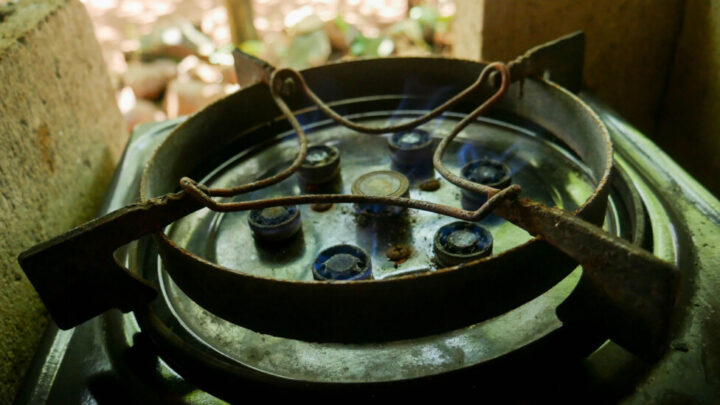
With small stoves like this one, a score of families in El Corozal in central El Salvador cook their food with biogas they produce themselves, thanks to a government program that has brought clean energy technology to these remote rural villages. CREDIT: Edgardo Ayala / IPS

With small stoves like this one, a score of families in El Corozal in central El Salvador cook their food with biogas they produce themselves, thanks to a government program that has brought clean energy technology to these remote rural villages. CREDIT: Edgardo Ayala / IPS

Simple green technology

The biodigester program in rural areas is being promoted by the Salvadoran Water Authority (Asa).

Since November 2022, the government agency has installed around 500 of these systems free of charge in several villages around the country.

The aim is to enable small farmers to produce sustainable energy, biogas at no cost, which boosts their income and living standards, while at the same time improving the environment.

The program provides each family with a kit that includes a biodigester, a biotoilet, and a small one-burner stove.

In El Corozal, five of these kits were installed by Asa in November 2022, to see if people would accept them or not. To date, 21 have been delivered, and there is a waiting list for more.

In El Corozal, a rural settlement in the municipality of Suchitoto in central El Salvador, the technology of family biodigesters arrived at the end of last year, and some families are now producing biogas to light up their stoves and cook their food at no cost. CREDIT: Edgardo Ayala / IPS

In El Corozal, a rural settlement in the municipality of Suchitoto in central El Salvador, the technology of family biodigesters arrived at the end of last year, and some families are now producing biogas to light up their stoves and cook their food at no cost. CREDIT: Edgardo Ayala / IPS

“With the first ones were set up, the idea was for people to see how they worked, because there was a lot of ignorance and even fear,” Arall’s president, Enrique Menjívar, told IPS.

In El Corozal there are many families with the surname Menjívar, because of the tradition of close relatives putting down roots in the same place.

“Here we’re almost all related,” Enrique added.

The biodigester is a hermetically sealed polyethylene bag, 2.10 meters long, 1.15 meters wide and 1.30 meters high, inside which bacteria decompose feces or other organic materials.

This process generates biogas, clean energy that is used to fuel the stoves.

The toilets are mounted on a one-meter-high cement slab in latrines in the backyard. They are made of porcelain and have a handle on one side that opens and closes the stool inlet hole.

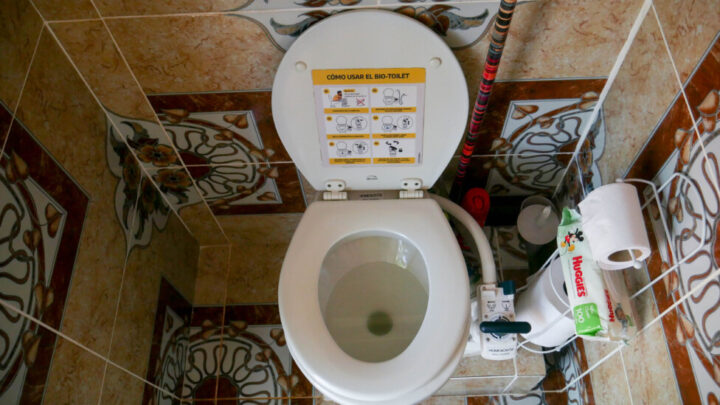
 One of the main advantages that family biodigesters have brought to the inhabitants of El Corozal, a small village in the Salvadoran department of Cuscatlán, is that the whole process begins with clean, hygienic toilets, like this one set up in Marleni Menjívar's backyard, as opposed to the older dry composting latrines, which drew flies and cockroaches. To the left of the toilet is the small handle used to pump water to flush the feces into the biodigester. CREDIT: Edgardo Ayala / IPS

One of the main advantages that family biodigesters have brought to the inhabitants of El Corozal, a small village in the Salvadoran department of Cuscatlán, is that the whole process begins with clean, hygienic toilets, like this one set up in Marleni Menjívar’s backyard, as opposed to the older dry composting latrines, which drew flies and cockroaches. To the left of the toilet is the small handle used to pump water to flush the feces into the biodigester. CREDIT: Edgardo Ayala / IPS

They also have a small hand pump, similar to the ones used to inflate bicycle tires, and when the handle is pushed, water is pumped from a bucket to flush the waste down the pipe.

The underground pipe carries the biomass by gravity to the biodigester, located about five meters away.

The system can also be fed with organic waste, by means of a tube with a hole at one end, which must be opened and closed.

Once it has been produced, the biogas is piped through a metal tube to the small stove mounted inside the house.

“I don’t even use matches, I just turn the knob and it lights up,” said Marisol, a homemaker and caregiver. Her husband Manuel Menjívar is a subsistence farmer, and they have a young daughter.

In El Corozal, biodigesters have been installed for families of four or five members, and the equipment generates 300 liters of biogas during the night, enough to use for two hours a day, according to the technical specifications of Coenergy, the company that imports and markets the devices.

But there are also kits that are used by two related families who live next to each other and share the equipment, which includes, in addition to the toilet, a larger biodigester and a two-burner stove.

With more sophisticated equipment, electricity could be generated from biogas produced from landfill waste or farm manure, although this is not yet being done in El Salvador.

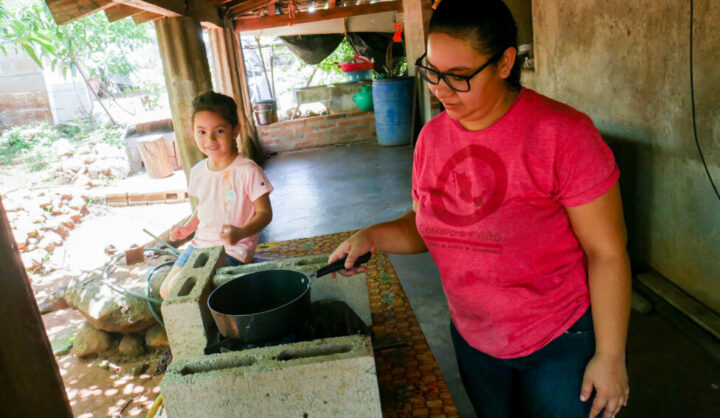
 Marleni Menjivar gets ready to heat water on her ecological stove, watched closely by her four-year-old daughter, in El Corozal in central El Salvador, where an innovative government program to produce biogas has arrived. With this technology, people save money by buying less liquefied gas while benefiting the environment. CREDIT: Edgardo Ayala / IPS

Marleni Menjivar gets ready to heat water on her ecological stove, watched closely by her four-year-old daughter, in El Corozal in central El Salvador, where an innovative government program to produce biogas has arrived. With this technology, people save money by buying less liquefied gas while benefiting the environment. CREDIT: Edgardo Ayala / IPS

Saving money while caring for the environment

The families of El Corozal who have the new latrines and stoves are happy with the results.

What they value the most is saving money by cooking with gas produced by themselves, at no cost.

They used to cook on wood-burning stoves, in the case of food that took longer to make, or on liquefied gas stoves, at a cost of 13 dollars per gas cylinder.

Marleni Menjívar, for example, used two cylinders a month, mainly because of the high level of consumption demanded by the family business of making artisanal cheeses, including a very popular local kind of cottage cheese.

Every day she has to cook 23 liters of whey, the liquid left after milk has been curdled. This consumes the biogas produced overnight.

For meals during the day Marleni still uses the liquefied gas stove, but now she only buys one cylinder a month instead of two, a savings of about 13 dollars per month.

“These savings are important for families here in the countryside,” said Marleni, 28, the mother of a four-year-old girl. The rest of her family is made up of her brother and grandfather.

“We also save water,” she added.

The biotoilet requires only 1.2 liters of water per flush, less than conventional toilets.

In addition, the soils are protected from contamination by septic tank latrines, which are widely used in rural areas, but are leaky and unhygienic.

The new technology avoids these problems.

The liquids resulting from the decomposition process flow through an underground pipe into a pit that functions as a filter, with several layers of gravel and sand. This prevents pollution of the soil and aquifers.

Also, as a by-product of the decomposition process, organic liquid fertilizer is produced for use on crops.

Most families in the rural community of El Corozal have benefited from one-burner stoves that run on biogas produced in family biodigesters. Larger two-burner stoves are also shared by two related families, where they cook on a griddle one of the favorite dishes of Salvadorans: pupusas, corn flour tortillas filled with beans, cheese and pork, among other ingredients. CREDIT: Coenergy El Salvador

Most families in the rural community of El Corozal have benefited from one-burner stoves that run on biogas produced in family biodigesters. Larger two-burner stoves are also shared by two related families, where they cook on a griddle one of the favorite dishes of Salvadorans: pupusas, corn flour tortillas filled with beans, cheese and pork, among other ingredients. CREDIT: Coenergy El Salvador

Checking on site: zero stench

Due to a lack of information, people were initially concerned that if the biogas used in the stoves came from the decomposition of the family’s feces, it would probably stink.

And, worst of all, perhaps the food would also smell.

But little by little these doubts and fears faded away as families saw how the first devices worked.

“That was the first thing they asked, if the gas smelled bad, or if what we were cooking smelled bad,” said Marleni, remembering how the neighbors came to her house to check for themselves when she got the latrine and stove installed in December 2022.

“That was because of the little information that was available, but then we found that this was not the case, our doubts were cleared up and we saw there were no odors,” she added.

She said that, like almost everyone in the village, her family used to have a dry composting toilet, but it stank and generated cockroaches and flies.

“All that has been eliminated, the bathrooms are completely hygienic and clean, and we even had them tiled to make them look nicer,” Marleni said.

She remarked that hygiene is important to her, as her little girl can now go to the bathroom by herself, without worrying about cockroaches and flies.

Source

Brazil Back on the Green Track

Credit: Mauro Pimentel/AFP via Getty Images

By Inés M. Pousadela
MONTEVIDEO, Uruguay, Jul 24 2023 (IPS)

At a meeting with European and Latin American leaders in Brussels this July, Brazil’s President Lula da Silva reiterated the bold commitment he had made in his first international speech as president-elect, when he attended the COP27 climate summit in November 2022: bringing Amazon deforestation down to zero by 2030.


Lula’s presence at COP27 was a signal to the world that Brazil was willing to become the climate champion it needs to be. Following a request by the Brazilian Forum of NGOs and Social Movements for Environment and Development, Lula offered to host the 2025 climate summit in Brazil; it has now been confirmed that COP30 will be held in Belém, gateway to the Amazon River.

At COP27 Lula also said he intended to revive and modernise the 45-year old Amazon Cooperation Treaty Organisation, a body bringing together the eight Amazonian countries – Bolivia, Brazil, Colombia, Ecuador, Guyana, Peru, Suriname and Venezuela – to take concerted steps to protect the Amazon rainforest.

Four years of regression

In his four years in office, Lula’s far-right climate-denier predecessor Jair Bolsonaro dismantled environmental protections and paralysed key environmental agencies by cutting their funding and staff. He vilified civil society, criminalised activists and discredited the media. He allowed deforestation to proceed at an astonishing pace and emboldened businesses to grab land, clear it for agriculture by starting fires and carry out illegal logging and mining.

Under Bolsonaro, already embattled Indigenous communities and activists became even more vulnerable to attacks. By encouraging environmental plunder, including on protected and Indigenous land, the government enabled violence against environmental and Indigenous peoples’ rights defenders. A blatant example was the murder of Brazilian Indigenous expert Bruno Pereira and British journalist Dom Phillips in June 2022. The two were ambushed and killed on the orders of the head of an illegal transnational fishing network. Both the material and intellectual authors of the crimes have now been charged and await trial.

Reversing the regression

Having being elected on a promise to reverse environmental destruction, the new administration has sought to restructure and resource monitoring and enforcement institutions. It strengthened the Brazilian Institute for the Environment and Renewable Natural Resources (IBAMA), the federal agency in charge of enforcing environmental policy, and the National Foundation of Indigenous Peoples (FUNAI), which for the first time is now headed by an Indigenous person, Joenia Wapichana.

Bolsonaro had transferred FUNAI to the Ministry of Agriculture, run by a leader of the congressional agribusiness caucus. Instead of protecting Indigenous land, it enabled deforestation and the expansion of agribusiness.

In contrast, Lula’s first political gestures were to create a new ministry for Indigenous peoples’ affairs, appointing Indigenous leader Sonia Guajajara to lead it, and to make Marina Silva, a leader of the environmentalist party Rede Sustentabilidade, Minister for the Environment, a position she had held between 2003 and 2008.

Lula also restored the Action Plan for the Prevention and Control of Deforestation in the Amazon, launched in 2004 and implemented until Bolsonaro took over. In February, the government set up a Permanent Inter-Ministerial Commission for the Prevention and Control of Deforestation and Fires in Brazil to coordinate actions across 19 ministries and develop zero deforestation policies.

The strategy establishes a permanent federal government presence in vulnerable areas with the aim of eliminating illegal activities, setting up bases and using intelligence and satellite imagery to track criminal activity.

The newly appointed Federal Police’s Director for the Amazon and the Environment, Humberto Freire, launched a campaign to rid protected Indigenous land of illegal miners. It appears to be paying off: in July he announced that around 90 per cent of miners operating in Yanomami territory, Brazil’s largest protected Indigenous land, had been expelled. According to police sources, there were 19 mine-related deforestation alerts in April 2023 – compared to 444 in April 2022.

But the fight isn’t over. There are still a couple of thousand miners active and the criminal enterprises employing them remain very much alive. The key task of recovering damaged land and rivers can only begin once they’re all driven away for good. And an issue that cries out for international cooperation remains unresolved: violence and environmental degradation continue unabated in Yanomami communities across the border in Venezuela, and will only increase as illegal miners jump jurisdictions.

Achieving the ambitious zero-deforestation goal will require efforts on a much bigger scale than those of the past. And such efforts will further antagonise very powerful people.

Obstacles ahead

With the environmental agenda back on track, the pace of Amazon deforestation slowed down in the first six months of 2023, falling by 34 per cent compared to the same period in 2022. However, numbers still remain high and reductions are uneven, with two states – Roraima and Tocantins – showing increases. Deforestation is also still rising in another important part of Brazil’s environment, the Cerrado, where preservation areas are few and most deforestation happens on private properties.

For the Amazon, a crucial test will come in the second half of the year, when temperatures are higher. A stronger El Niño phase, with warming waters in the Pacific Ocean, will make the weather even drier and hotter than usual, helping fires spread fast. Anticipating this, IBAMA has scaled up its recruitment of firefighters to expand brigades in Indigenous and Black communities and conduct inspections and impose fines and embargoes. To discourage people from starting fires to clear land for agriculture, the agency prevents them putting that land to agricultural use.

But in the meantime, Brazil’s Congress has gone on the offensive. In June, the Senate made radical amendments to the bill on ministries sent by Lula, diluting the powers of the Ministries of Indigenous Peoples and Environment and limiting demarcation of Indigenous lands to those already occupied by communities by 1998, when the current constitution was enacted.

Indigenous leaders have complained that many communities weren’t on their land in 1998 because they’d been expelled over the course of centuries, and particularly during the 1964-1985 military dictatorship. They denounced the new law as ‘legal genocide’ and urged the president to veto it. Civil society has taken to the streets and social media to support the government’s environmental policies.

They face a formidable enemy. A recent report by the Brazilian Intelligence Agency exposed the political connections of illegal mining companies. Two business leaders directly associated with this criminal activity are active congressional lobbyists and maintain strong links with local politicians. They also stand accused of financing an attempted insurrection on 8 January.

Against these shady elites, civil society wields the most effective weapon at its disposal, shining a light on their dealings and letting them know that Brazil and the world are watching, and will remain vigilant for as long as it takes. The stakes are too high to drop the guard.

Inés M. Pousadela is CIVICUS Senior Research Specialist, co-director and writer for CIVICUS Lens and co-author of the State of Civil Society Report.


!function(d,s,id){var js,fjs=d.getElementsByTagName(s)[0],p=/^http:/.test(d.location)?’http’:’https’;if(!d.getElementById(id)){js=d.createElement(s);js.id=id;js.src=p+’://platform.twitter.com/widgets.js’;fjs.parentNode.insertBefore(js,fjs);}}(document, ‘script’, ‘twitter-wjs’);  

Source

Forus Civil Society Network Urges that Respect for Human Rights, Climate Justice and Accountability should be at the core of the New Global Financing Pact

Indigenous activist protesting in Colombia. Credit: Sebastian Barros

By Marianne Buenaventura
PARIS, Jun 23 2023 (IPS)

As the Summit for a New Global Financing Pact unfolds in Paris on 22-23 June, Forus, a global network representing over 22,000 civil society organisations across Africa, Latin America, Asia, Europe and the Pacific, calls for the respect of human rights and for meaningful inclusion of civil society in shaping financial systems and structures.


The summit, co-hosted by India, could help find common ground on finance that drives progress at key events later in 2023 and in 2024 – the G20 summit in New Delhi, the COP28 climate talks in Dubai, and the Finance in Common summit with public development banks in Cartagena.

As part of the summit, Sarah Strack, Forus Director, is amplifying civil society’s voices at the high-level Finance in Common event in the presence of French President Emmanuel Macron and other leaders, to discuss and leverage the role of Public Development Banks in financing the SDGs, scaling up sustainable finance, and supporting inclusion. Forus has been engaging in the Finance in Common initiative since its inception in 2020 with the aim to ensure that a people-based approach to development is pursued.

“If we want to have a chance to tackle the most pressing challenges and the multiple crises of our time in a way that really puts first the interests and needs of people, then a shift of mindset and a new financial framework are absolutely necessary. It is essential that civil society plays a central role in shaping this new paradigm at every stage. Let us not forget the wealth of knowledge and leadership present at the local level. By actively engaging and collaborating with communities, we can genuinely measure our progress and honor the commitments we have made to those most in need,” says Sarah Strack.

Harsh Jaitli, CEO of the Voluntary Action Network India (VANI), is representing Forus as an official respondent in the Summit Roundtable “Power Our Planet: Act today. Save tomorrow”, co-hosted by Global Citizen and CISCO. The event seeks to rally for immediate action on economic, social, and climate justice, engaging both public and private sectors to catalyze renewable energy investment in climate-vulnerable countries to reduce energy poverty and accelerate the low-carbon transition.

Harsh Jaitli of VANI states that the New Global Financial Pact will require improved partnerships and the building of trust.

“Double standards have negatively impacted our collective capacity to deliver on effective development and climate related programmes. In some countries, multinational corporations respect human rights, fiscal and climate regulations, but in other countries decisions are made to violate them. Not only does this send the wrong message that some countries and populations are more important than others, but also jeopardizes our collective efforts to affect change. Multinational corporations should commit to respecting human rights, fiscal and climate regulations in all countries and in a consistent manner. When no strong regulations exist, this is the opportunity for multinationals to be proactive and to apply strong rules, which are coherent with their policies,”says Harsh Jaitli.

Julien Comlan Agbessi, Coordinator of the Regional Coalition of West Africa (REPAOC) emphasizes the importance of multi-stakeholder cooperation. Agbessi explains that cooperation between the private sector and the civil society organisations is possible, since the private sector could leverage hugely on the experience and outreach of civil society. “Many poverty alleviation programs and projects with significant funding implemented over the past decades have failed to deliver for communities. Transformative investments in low-income countries and climate impacted countries require putting the needs of people first,” says Julien Comlan Agbessi.

Lina Paola Lara Negrette, Coordinator of the Confederación Colombiana de ONG (Ccong), states that the New Global Financial Pact must incorporate stronger and more meaningful engagement with civil society.

“Civil society has an important role to play in ensuring the accountability and transparency of both government and private sector actors. Civil society can work closely with governments and the private sector to ensure the delivery of social and environmental needs in all investments, which includes respect of human rights”.

Olivier Bruyeron, President of the French platform of CSOs Coordination SUD, equally emphasizes the importance of partnerships with the public and private sector, “CSOs hold valuable knowledge and expertise on international solidarity needed to construct sustainable global solutions and to link them with local development” adds Olivier Bruyeron.

Marianne Buenaventura is project coordinator at Forus.

IPS UN Bureau


!function(d,s,id){var js,fjs=d.getElementsByTagName(s)[0],p=/^http:/.test(d.location)?’http’:’https’;if(!d.getElementById(id)){js=d.createElement(s);js.id=id;js.src=p+’://platform.twitter.com/widgets.js’;fjs.parentNode.insertBefore(js,fjs);}}(document, ‘script’, ‘twitter-wjs’);  

Source

Transforming Food Systems through Conscious, Mindful Practices

Climate Action, Climate Change, Development & Aid, Editors’ Choice, Environment, Featured, Food and Agriculture, Global, Headlines, Innovation, Sustainability, Sustainable Development Goals, TerraViva United Nations

Sustainability

Conscious Food Systems Alliance (CoFSA) promotes consciousness as a key evidence-based practice to support systemic change – reframing how people think about food to unlock food systems transformation, nourishing all people, and regenerating planet Earth. Pictured here a farmer in Katfoura village on the Tristao Islands in Guinea benefits from opportunities to generate income and improve community life. Credit: UN Women/Joe Saade

Conscious Food Systems Alliance (CoFSA) promotes consciousness as a key evidence-based practice to support systemic change – reframing how people think about food to unlock food systems transformation, nourishing all people, and regenerating planet Earth. Pictured here a farmer in Katfoura village on the Tristao Islands in Guinea benefits from opportunities to generate income and improve community life. Credit: UN Women/Joe Saade

NAIROBI, Jun 12 2023 (IPS) – Deep in the Egyptian desert, the SEKEM community celebrates its first wheat crop – grown to alleviate shortages and price increases caused by the war in Ukraine, and the latest crop in a 46-year history of regenerative development, which has effectively made the desert bloom. On another continent, a consumer who buys acai collected and produced by the Yawanawá in Brazil helps protect 200,000 acres of land.


Food connects people, cultures, and planet Earth. But rather than nourishing global health and well-being, food systems remain at the heart of the global community’s social and environmental crises today.

Massive investment and efforts to transform food systems and existing policy and technical solutions are not delivering the desired impact. In the face of the global food systems crises manifested in food insecurity, unsustainable agricultural practices, and climate change, re-examining the origins of ongoing crises and barriers to transformation is critical.

Reframing How People Think About Food

Against this backdrop, the Conscious Food Systems Alliance (CoFSA) promotes consciousness as a key evidence-based practice to support systemic change. The alliance is built on the premise that reframing how people think about food is the key to unlocking food systems transformation, nourishing all people, and regenerating planet Earth.

“We know our food systems are in a critical state and sit at the core of the regeneration process this world greatly needs, and we believe this can only happen with a change of mindsets and heart-sets, with different values and worldviews,” says Thomas Legrand, CoFSA Lead Technical Advisor.

Convened by UNDP, CoFSA is a movement of food, agriculture, and consciousness practitioners united around a common goal: to support people from across food and agriculture systems to cultivate the inner capacities that activate systemic change and regeneration.

The alliance aims to leverage “the power of consciousness and inner transformation, including proven approaches such as mindfulness, compassion, systems leadership, indigenous and feminine wisdoms, to support systemic change towards sustainability and human flourishing in the food and agriculture sector.”

CoFSA Challenge Fund to Support Regenerative Food System Projects

The CoFSA Challenge Fund, which is about to be launched, intends to support the development of strategic, innovative ideas and solutions to scale up and accelerate progress toward the 2030 Agenda for Sustainable Development through the transformation of food systems, which is critical to achieving the UN’s SDGs.

The Challenge Fund focuses on cultivating inner capacities for regenerative food systems. This constitutes a new field of practice that requires testing and innovation to identify, develop and nurture potentially transformative solutions.

In this first round of calls for proposals, UNDP will support approximately four pilot projects of up to USD 20,000.

[embedded content]

Conscious Food System Links Supply Chain

A conscious food system is a holistic approach to the well-being of people and ecosystems, and where there is a connection and awareness between stakeholders across the whole supply chain, says Helmy Abouleish, SEKEM’s CEO. He heads the holistic, sustainable development community established in 1977 by his father, Dr Ibrahim Abouleish, in the Egyptian desert.

According to UNDP, to transform the systems that harm people and the planet and how food is produced and consumed, “We need to look beyond the problems’ symptoms and even systems’ patterns and structures, at what fundamentally drives the systems.”

Consciousness and mental models, or regenerative mindsets and cultures, are increasingly recognized as the key to unlocking systems change in food and agriculture. To this end, CoFSA applies consciousness approaches to technical solutions to support the cultivation and consideration of inner capacities based on the premise that sustainable change comes from within.

Christine Wamsler, Professor of Sustainability Science at LUND University, emphasizes that there is “increasing scientific consensus that creating sustainable, regenerative systems do not only require a change in our external worlds. Instead, it has to go hand-in-hand with a fundamental shift in our relationships — in the way we think about ourselves, each other, and life as a whole.”

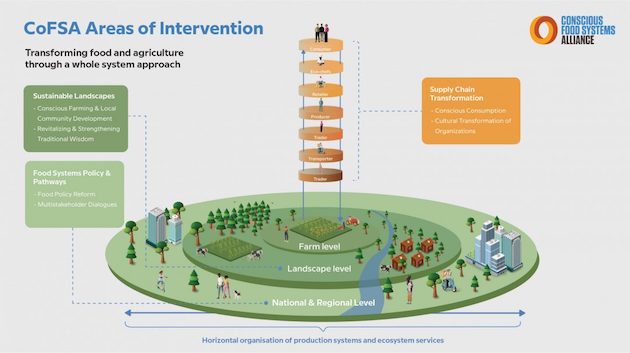
Graphic representation of the Conscious Food Systems Alliance (CoFSA) concept. Credit: UNDP/CoFSA

Graphic representation of the Conscious Food Systems Alliance (CoFSA) concept. Credit: UNDP/CoFSA

Similarly, senior lecturer at the Massachusetts Institute of Technology, Otto Scharmer, stresses, “You cannot change a system unless you change the mindsets or the consciousness of the people who are enacting that system.”

At the heart of it, mindful eating and activating transformation from the inside is a recognition that changing behavior is, at times, more about identity, emotions, and connections than data and analyses in the same way elections are campaigned and won against a backdrop of long-held beliefs and opinions.

Question Impact of Consumer Choices

“I think today, whatever you eat, however you dress, you need to ask yourself where they come from, what kind of impact they are giving back to the Mother Earth, cultural, economic, and spiritual environment,” says Tashka Yawanawá, Chief of the Yawanawá that has survived for centuries in the Brazilian rainforests.

Awareness of the people and processes in food and agriculture systems aligns with indigenous wisdom and is at the heart of the approach taken by the Yawanawá people. For instance, Tashka Yawanawá says: “When somebody drinks the acai collected and produced by the Yawanawá, they’re helping protect 200,000 acres of land.”

“They are also supporting the preservation of our language, our culture, our cultural and spiritual manifestation. Making that link gives value to where you source these products from … when you buy acai made by Yawanawá, you have an awareness that you’re supporting conscious food.”

UNDP stresses that farmers’ lives depend on being seen as human beings, not just economic agents, and says it is “Time to build safe, reflective and connecting spaces to engage in the deep conversations we need for right relationships to replace market rules.”

In the world of conscious thinking and mindful eating, everyone has a role.

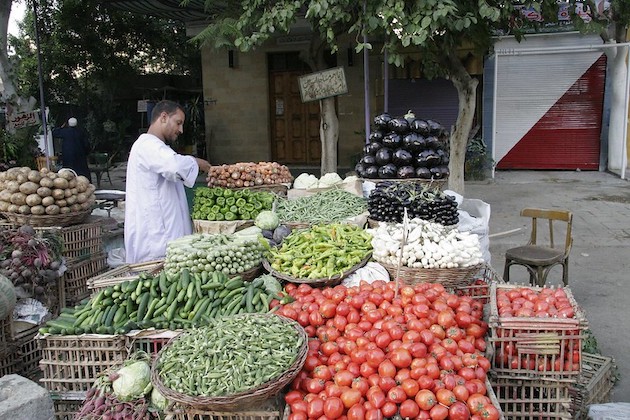
A marker trader at a vegetable stall in the village of El-Maadi near Cairo with heaps of fresh vegetables. CoFSA aims to renew lost ties between producers, the foods they grow, cooks, and consumers. Credit: Gavin Bell/Climate Visuals

A marker trader at a vegetable stall in the village of El-Maadi near Cairo with heaps of fresh vegetables. CoFSA aims to renew lost ties between producers, the foods they grow, cooks, and consumers. Credit: Gavin Bell

Teresa Corção, founder of Instituto Maniva, a non-profit in Brazil that values ​​traditional food knowledge and renews the ties lost between producers, the foods they grow, cooks, and consumers, says chefs have a critical role in listening more to the people who grow the food.

“I think we all see now more and more we need other ways of both changing ourselves and helping others change the way they think in order for us to have the right mindsets to make choices that are more sustainable,” says Andrew Bovarnick, UNDP’s Food, and Agricultural Commodity Systems, Global Head.

CoFSA is built on bringing consciousness to food systems to support the transition to a holistic, bio-regional approach and creating productive landscapes of regeneration.

That consciousness can help restore the balance in food systems between food production, conservation, and well-being, support the uptake of agroecological practices which regenerate the soil, and strengthen the capacity of food to distribute wealth and well-being in communities.

IPS UN Bureau Report

  Source