Guatemala’s Chance for a New Beginning

Civil Society, Crime & Justice, Democracy, Featured, Headlines, Indigenous Rights, Latin America & the Caribbean, TerraViva United Nations

Opinion

Credit: Emmanuel Andres/AFP via Getty Images

MONTEVIDEO, Uruguay, Jan 18 2024 (IPS) – Guatemala’s new president, Bernardo Arévalo, was expected to be sworn in on 14 January at 2pm –the 14th at 14:00, as people repeated in anticipation for months. It was a momentous event – but it wasn’t guaranteed to happen.


One year earlier, Arévalo – co-founder of the progressive Movimiento Semilla (Seed Movement), a political party born out of widespread 2015 anti-corruption protests – was largely unknown, freshly selected as his party’s presidential candidate. He wasn’t on the radar of opinion polls. A long chain of unlikely events later, he’s become the first Guatemalan president in living memory who doesn’t belong to the self-serving elites who Guatemalans call ‘the corrupt pact’, which he has credibly promised to dismantle.

The fear this caused among corrupt elite that has long ruled Guatemala was reflected in a series of attempts to try to stop Arévalo’s inauguration. The huge and sustained citizen mobilisation that came in response can largely be credited with keeping alive the spark of democracy in Guatemala.
Last-minute delays

All the Guatemalan Congress needed to do on the morning of 14 January was certify its newly elected members so the body could swear in the new president. But this routine administrative procedure was dragged on for many hours. The Indigenous movement, at the forefront of the months-long protests that had successfully kept at bay successive attempts to reverse the election results, called on Indigenous communities throughout Guatemala to remain on the alert.

In the late afternoon the Secretary General of the Organization of American States, Luis Almagro, surrounded by members of numerous foreign delegations, read a declaration calling on Congress to hand over power, ‘as required by the Constitution’, to the president-elect. This signalled that the world was watching.

As tensions mounted, Semilla reached an agreement for one of its representatives to be elected as president of Congress. This allowed the certification process to resume, and Arévalo was finally sworn in shortly after midnight. Night-long celebrations followed.

A coup attempt in stages

Arévalo’s election was unexpected. He only made it into the 20 August runoff because several other contenders not to the elite’s liking had been disqualified ahead of the first round. His candidacy wasn’t blocked because he scored so poorly in the polls. People’s expectations were extremely low, and first place went to invalid votes.

But once Arévalo entered the runoff, his rise was unstoppable. Death threats soon poured in, and an assassination plot involving state and non-state forces came to light days before the runoff.

As soon as the first-round results were announced, nine parties submitted complaints about supposed ‘irregularities’ that had gone undetected by all international observers. Their supporters converged outside the Supreme Electoral Tribunal (TSE) calling for a rerun.

The Constitutional Court instead ordered a recount and instructed the TSE to suspend official certification until complaints were resolved. Following the recount, the TSE eventually endorsed the results two weeks later.

But meanwhile, Attorney General Consuelo Porras Argueta, an official under US sanctions for corruption, launched an investigation into Semilla for alleged irregularities in its registration process and had its offices raided. She also ordered two raids on TSE offices, and when the TSE officially announced Arévalo as one of the runoff contenders, she ordered Semilla’s suspension. The Constitutional Court however blocked this order and the runoff ran its course. Arévalo took 58 per cent of the vote, compared to 37.2 per cent for the pro-establishment candidate.

Efforts to stop Arévalo’s inauguration began immediately, with yet another attempt by the Public Prosecutor to have Semilla suspended. The Constitutional Court continued to receive and reject legal challenges until the day of the inauguration.

For 100 days, two different visions of Guatemala wrestled with each other: people eager for change protested nonstop while corrupt forces linked to organised crime strove to preserve their privileges at any cost.

Democracy on life support

Guatemala has long been classified as a ‘hybrid regime‘ with a mix of democratic and authoritarian traits. Under outgoing president Alejandro Giammattei, civic freedoms steadily deteriorated. State institutions grew even weaker, ransacked by predatory elites and coopted by organised crime.

One of the last acts of Giammattei’s predecessor and ally, Jimmy Morales, was to end the work of the International Commission against Impunity in Guatemala (CICIG). Charged with supporting and strengthening state institutions to investigate and prosecute serious crimes, CICIG helped file over 120 cases in the Guatemalan justice system and its joint investigations with the Attorney General’s Office led to over 400 convictions.

Under Giammattei, the Attorney General’s Office dismantled all anti-corruption efforts and criminalised those in the legal profession who’d worked alongside CICIG. Impunity flourished. Transparency International’s 2022 Corruption Perceptions Index found evidence of strong influence by organised crime over politics and politicians, with some crime bosses seeking and securing office.

It’s no wonder that Guatemalans’ trust in state institutions hit rock bottom. According to the latest Latinobarómetro report, in 2021 satisfaction with the performance of democracy stood at a meagre 25 per cent.

Challenges ahead

Arévalo came to the presidency on a credible anti-corruption platform. But dismantling dense webs of complicity, rooting out entrenched corruption and rebuilding state institutions are no easy tasks.

Among the many challenges is a highly fragmented Congress in which 16 parties are represented, with Semilla on only 23 out of 160 seats. A large majority of Congress remains on the payroll of the interests Arévalo has promised to take on, along with most of the justice system. The 14 January events made clear that the ‘corrupt pact’ will do anything it can to stop Arévalo.

Arévalo’s to-do list is long, ranging from reducing political spending and improving social services to reversing laws that criminalise protest and establishing an effective protection mechanism for human rights defenders. At the top is forcing the resignation of Attorney General Consuelo Porras, the highest official presiding over a judicial network set up to ensure the impunity of the ‘corrupt pact’.

Arévalo can’t remove the Attorney General unilaterally, and so will have to negotiate her departure. This will be a key early test of the hope invested in him to keep democracy alive. Many more are sure to come.

Inés M. Pousadela is CIVICUS Senior Research Specialist, co-director and writer for CIVICUS Lens and co-author of the State of Civil Society Report.

  Source

Iran, Back to the Grim Normal

Civil Society, Crime & Justice, Featured, Gender, Gender Violence, Headlines, Human Rights, Middle East & North Africa, Press Freedom, Religion, TerraViva United Nations

Opinion

Credit: Mike Segar/Reuters via Gallo Images

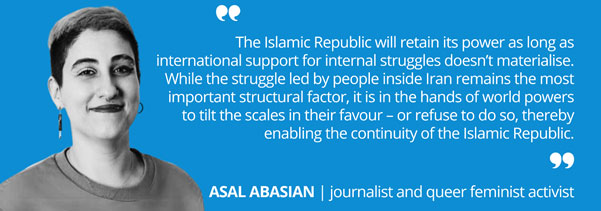
MONTEVIDEO, Uruguay, Jan 16 2024 (IPS) – Iran’s time of public rebellion has ended. The protesters marching, chanting, and dancing under the ‘Woman, Life, Freedom’ banner have long stopped. And shifting regional dynamics may play to the regime’s favour.


Protest wave repressed

The wave of protest against the theocratic regime started on 16 September 2022 and lasted far longer than anyone could have predicted. But by the one-year mark it had all but died down, its unprecedented scale and reach superseded by the unparalleled brutality of the crackdown.

The regime murdered hundreds of protesters, injured thousands and arrested tens of thousands. It subjected many to torture, sexual abuse and denial of medical treatment while in detention.

It weaponised the criminal justice system, holding express trials behind closed doors in ‘revolutionary courts’ presided over by clerics, with zero procedural guarantees. It sentenced hundreds – including journalists – to years in jail and handed out several death sentences. According to the UN Special Rapporteur on Iran, some of the human rights violations committed by the regime could constitute crimes against humanity.

Shortly after the first anniversary of the protests, on 6 October, it was announced that the 2023 Nobel Peace Prize had been awarded to Narges Mohammadi, an imprisoned Iranian woman activist with 20 years of struggle for democracy, human rights and women’s rights under her belt. Over the years, she’d been arrested 13 times, sentenced to 31 years in prison and 154 lashes, and been in prison three times. She received the news behind bars.

Ahead of the anniversary, afraid of protests returning, the theocratic regime put back on the streets the morality police whose intervention had resulted in Mahsa Amini’s death. Conservatives proposed a new ‘hijab and chastity’ law that would impose a stricter dress code and harsher penalties for violations.

The reinforcement of morality rules soon claimed its next victim. On 1 October, high school student Armita Garawand was left unconscious, reportedly assaulted by a hijab enforcer for not wearing a headscarf. She remained in a coma for several weeks before dying on 28 October. At her funeral mourners were assaulted and dozens were arrested, including well-known human rights lawyer Nasrin Sotoudeh.

Succession

Battered but unbeaten, the Iranian regime views upcoming legislative elections as part of its road to recovery. On 1 March, people will be called on to vote for all 290 members of the Islamic Consultative Assembly. The key battle will be over turnout, which was already down to 42 per cent in 2020 – the lowest since the 1979 revolution. That record could be shattered, as opposition and reformists call for abstention or boycott.

Along with parliamentary elections, in March Iran will hold elections for the Council of Experts, the body of clerics that appoints Iran’s Supreme Leader. The Council has recently faced criticism for its lax oversight of 84-year-old Supreme Leader Ayatollah Ali Khamenei’s performance, and might have to step in relatively soon.

In power since 1989, Khamenei is in a race against the clock. Bent on ensuring that the theocracy he largely built stands strong after he’s gone, he’s preparing his 54-year-old second son to succeed him. But the ongoing economic crisis may conspire against his plans. The cumulative impacts of international sanctions, fluctuating oil prices, mismanagement and rampant corruption have fuelled inflation and unemployment, and discontent runs high.

To prevent accumulated grievances from translating into mass protest, the regime will likely try to tread a fine line between displaying indestructible power and offering minor concessions.

Regional balance shifts

When the protests erupted international support poured in. People around the world showed solidarity with Iranian women and called on their governments to act. Early on, the USA imposed sanctions on the morality police and several senior leaders of the force and other security agencies. New sanctions by the European Union, UK and USA were announced on the eve of the anniversary of the protests.

On International Women’s Day in 2023, a group of Afghan and Iranian women launched the End Gender Apartheid campaign, which seeks recognition and condemnation of the two regimes as based on gender apartheid. They want the 1973 UN Convention on the Suppression and Punishment of the Crime of Apartheid, which so far applies only to racial hierarchies, extended to gender. The campaign wants this specific and extreme form of exclusion to be codified as a crime under international law so those responsible can be prosecuted and punished.

There was hope that such moves would foster action to hold those responsible to account. Civil society called for the creation of a dedicated accountability mechanism to work alongside the UN Special Rapporteur on Iran.

But on 7 October, as Armita lay in a coma, the paramilitary wings of Hamas launched their attacks into Israeli territory, and global attention shifted to this outrage and Israel’s murderous campaign of revenge. As a key source of support for Hamas, Iran was far from out of the spotlight – but condemnation of theocracy and gender apartheid now took a back seat to geopolitical considerations.

Khamenei publicly stated that Iran wasn’t involved in the 7 October attacks, and although he reiterated Iran’s political and moral support for Hamas, he reportedly told Hamas leader Ismail Haniyeh that Iran wouldn’t directly intervene unless it was attacked by Israel or the USA. But Iran’s leadership of the anti-Israeli and anti-western ‘Axis of Resistance’ and the key role it can play in either expanding or limiting the scope of the conflict means it will be included in any attempt to redefine the regional order, and could well emerge stronger.

Amid the chaos and in the search for security, the international community might be increasingly willing to look the other way. Iran’s search for international respectability saw a milestone in November, when it took advantage of other states’ lack of interest to claim the chair of the UN Human Rights Council’s Social Forum. The result was a largely empty room – but it remains the case that Iran succeeded in occupying institutional space to whitewash its blood-soaked image.

This mustn’t be allowed to happen. Iranian women mustn’t be left to their own devices. Iranian pro-democracy and human rights activists, both inside and outside Iran, need the support of the international community if they’re to have any chance.

Inés M. Pousadela is CIVICUS Senior Research Specialist, co-director and writer for CIVICUS Lens and co-author of the State of Civil Society Report.

  Source

Bangladesh: Election with a Foregone Conclusion

Asia-Pacific, Civil Society, Crime & Justice, Democracy, Economy & Trade, Featured, Headlines, Human Rights, Labour, Press Freedom, TerraViva United Nations

Opinion

Credit: Munir Uz Zaman/AFP via Getty Images

LONDON, Jan 12 2024 (IPS) – Bangladesh just held an election. But it was far from an exercise in democracy.

Sheikh Hasina won her fourth consecutive term, and fifth overall, as prime minister in the general election held on 7 January. The result was never in doubt, with the main opposition party, the Bangladesh National Party (BNP), boycotting the vote over the ruling Awami League’s refusal to let a caretaker government oversee the election. This practice, abolished by the Awami League government in 2011, was, the BNP asserted, the only way to ensure a free and fair vote.


The BNP’s boycott was far from the only issue. A blatant campaign of pre-election intimidation saw government critics, activists and protesters subjected to threats, violence and arrests.

At the government’s urging, court cases against opposition members were accelerated so they’d be locked away before the election, resulting in a reported 800-plus convictions between September and December 2023. It’s alleged that torture and ill-treatment were used against opposition activists to force confessions. There have been reports of deaths in police custody.

Police banned protests, and when a rare mass opposition protest went ahead on 28 October police used rubber bullets, teargas and stun grenades. Following the protest, thousands more opposition supporters were detained on fabricated charges. As well as violence from the notorious Rapid Action Battalion (RAB) – an elite unit notorious for excessive and lethal force – and other elements of the police force, opposition supporters faced attacks by Awami League supporters. Journalists have also been smeared, attacked and harassed, including when covering protests.

As a direct result of the ruling party’s pre-election crackdown, in December 2023 Bangladesh’s civic space rating was downgraded to closed by the CIVICUS Monitor, the collaborative research project that tracks the health of civic space in every country. This places Bangladesh among the world’s worst human rights offenders, including China, Iran and Russia.

Civil society’s concerns were echoed in November 2023 by UN human rights experts who expressed alarm at political violence, arrests, mass detention, judicial harassment, excessive force and internet restrictions.

All-out assault

Such is the severity of the closure of Bangladesh’s civic space that many of the strongest dissenting voices now come from those in exile. But even speaking out from outside Bangladesh doesn’t ensure safety. As a way of putting pressure on exiled activists, the authorities are harassing their families.

Activists aren’t safe even at the UN. A civil society discussion in the wings of the UN Human Rights Council in November was disrupted by government supporters, with Adilur Rahman Khan, a leader of the Bangladeshi human rights organisation Odhikar, subjected to verbal attacks.

Khan is currently on bail while appealing against a two-year jail sentence imposed on him and another Odhikar leader in retaliation for their work to document extrajudicial killings. Following the session in Geneva, Khan was further vilified in online news sites and accused of presenting false information.

Others are coming under attack. Hasina and her government have made much of their economic record, with Bangladesh now one of the world’s biggest garment producers. But that success is largely based on low wages. Like many countries, Bangladesh is currently experiencing high inflation, and garment workers’ recent efforts to improve their situation have been met with repression.

Workers protested in October and November 2023 after a government-appointed panel raised the minimum wage for garment sector workers to a far lower level than they’d demanded. Up to 25,000 people took part in protests, forcing at least 100 factories to close. They were met with police violence. At least two people were killed and many more were injured.

Seemingly no one is safe. Nobel laureate Muhammad Yunus, who founded the Grameen Bank that has enabled millions to access small loans, was recently convicted of labour law offences in a trial his supporters denounced as politically motivated. Yunus has long been a target for criticism and threats from the ruling party.

Democracy in name only

The quality of Bangladesh’s elections has dramatically declined since the Awami League returned to power in the last reasonably free and fair election in 2008. Each election since has been characterised by serious irregularities and pre-voting crackdowns as the incumbents have done everything they could to hold onto power.

But this time, while the Awami League victory was as huge as ever, turnout was down. It was almost half its 2018 level, at only 41.8 per cent, and even that figure may be inflated. The lack of participation reflected a widespread understanding that the Awami League’s victory was a foregone conclusion: many Awami League supporters didn’t feel they needed to vote, and many opposition backers had no one to vote for.

People knew that many supposedly independent candidates were in reality Awami League supporters running as a pseudo-opposition to offer some appearance of electoral competition. The party that came second is also allied with the ruling party. All electoral credibility and legitimacy are now strained past breaking point.

The government has faced predictably no pressure to abide by democratic rules from key allies such as China and India, although the once-supportive US government has shifted its position in recent years, imposing sanctions on some RAB leaders and threatening to withhold visas for Bangladeshis deemed to have undermined the electoral process.

If the economic situation deteriorates further, discontent is sure to grow, and with other spaces blocked, protests and their violent repression will surely follow. International partners must urge the Bangladeshi government to find a way to avoid this. More violence and intensifying authoritarianism can’t be the way forward. Instead Bangladesh should be urged to start the journey back towards democracy.

Andrew Firmin CIVICUS Editor-in-Chief, co-director and writer for CIVICUS Lens and co-author of the State of Civil Society Report.

  Source

Fear as Russian Anti-LGBT Law Comes into Effect

Civil Society, Crime & Justice, Democracy, Editors’ Choice, Europe, Featured, Freedom of Expression, Gender, Headlines, Human Rights, LGBTQ, TerraViva United Nations

Human Rights

The Russian Supreme Court ruling making the “international LGBT movement” an extremist organization will come into effect on January 9, 2024. Graphic: IPS

The Russian Supreme Court ruling making the “international LGBT movement” an extremist organization will come into effect on January 9, 2024. Graphic: IPS

BRATISLAVA, Jan 3 2024 (IPS) – “This is what you get after ten years of state propaganda and brainwashing,” says Anatolii*.

The Moscow-based LGBT rights activist’s ire is directed at a recent ruling by Russia’s Supreme Court declaring the “international LGBT movement” an extremist organization.


Details of the ruling, made on November 30 after a closed hearing, have yet to be made public—it will not be enforced until January 9, 2024, and until then, no one is likely to be any the wiser about its practical implementation, says Anatolii.

But its vagueness—critics point out that no “international LGBT movement” exists as an organization—has already fueled fears that it could lead to the arbitrary prosecution of anyone involved in any activities supporting the LGBT community.

And the potential punishments for such support are draconian, with participating in or financing an extremist organization carrying a maximum 12-year prison sentence under Russian law.

In the weeks since the ruling was announced, fear has spread among LGBT people.

“Russian queers are really scared,” Anatolii tells IPS.

But while fearful, many see it as the latest, if potentially the most drastic, act in a decade-long campaign by the Kremlin to marginalise and vilify the LGBT community in the country through legislation and political rhetoric.

The first legislative attack on the community came in 2013, not long after Vladimir Putin had returned to power as President, when a law came into effect banning “the propaganda of non-traditional sexual relations” to anyone under the age of 18.

This was followed by increasingly homophobic political discourse, and Kremlin campaigns—prominently backed by the country’s powerful Orthodox Church—promoting ‘traditional family values’ in society and casting LGBT activism as a product of the degenerate West and a threat to Russian identity.

Then in 2022, the ban on “LGBT propaganda” was extended to cover all public information or activities supporting LGBT rights or displaying non-heterosexual orientation and implicitly linked the LGBT community with paedophilia—the law refers to the “propaganda of nontraditional sexual relations and/or preferences, paedophilia, and sex change.”

A ban on same sex marriage has also been written into the constitution; authorities have labelled a number of LGBT organizations as “foreign agents,” stigmatizing them and forcing them to adhere to a set of funding and bureaucratic requirements that can be liquidating, and earlier this year a law was passed banning transgender people officially or medically changing their gender.

With each new piece of pernicious legislation, and an accompanying rise in intensity and normalization of homophobic hate speech from politicians, the LGBT community has suffered, its members say.

“The Supreme Court ruling is just a continuation of Russia’s homophobic policies. The amount of physical violence against LGBT people has been growing in Russia for 10 years. After each such law, it intensifies even more noticeably,” Yaroslav Rasputin, editor at the Russian-language LGBT website www.parniplus.com, told IPS.

“We expect homophobes will feel justified in attacking LGBT people [after the ruling], both through cyberbullying and physical assaults,” he added.

Members of the LGBT community and rights campaigners who spoke to IPS said there was a desperate fear among many LGBT people now. While the threat of physical violence was often felt as being very real, there was also a crippling concern over the uncertainty many would now face in their daily activities.

Many do not know what will constitute “support” for the LGBT community. Some are trawling through years of social media records, deleting any possible positive references to LGBT or reposted messages on the topic for fear of the information being used against them by authorities.

And there are worries that simply being openly gay could somehow be interpreted as extremism.

Lawyers who have advised LGBT people and groups in the past say that it will be much easier for security forces to initiate and prosecute cases of extremism than propaganda, as the latter is more difficult to prove.

“Although the government says these ‘repressions’ concern only political activists, in reality this is not the case. We know this from previous homophobic laws. Sometimes people spontaneously get caught for who they are. No one knows when it will be safe to come out and when not,” said Rasputin.

Anatolii said the organisation he works for has been inundated with calls from people “in panic and despair” over the ruling, many of whom are looking for help to leave the country.

LGBT groups outside Russia have also reported a huge uptick in calls from people trying to find safe passage to other countries.

“We have seen a dramatic increase in the number of people contacting us, perhaps three or four times more. LGBT people in Russia are really worried about the ruling; they don’t know what might be defined as extremist,” Aleksandr Kochekovskii from the Berlin-based organisation Quarteera e. V, which helps LGBT refugees and migrants to arrive and find their way around Germany, told IPS.

“Unfortunately, a lot of people will leave Russia because of this ruling because they feel in danger. There is a ubiquitous psychological pressure on LGBT people in Russia now,” he added.

Even some openly gay figures in Russia have publicly acknowledged that LGBT people may be forced to flee the country.

“This is real repression. There is panic in Russia’s LGBT community. People are emigrating urgently. The actual word we’re using is evacuation. We’re having to evacuate from our own country. It’s terrible,” Sergei Troshin, a gay municipal deputy in St Petersburg, told the BBC.

But others warn the Kremlin may be looking to use the ruling to crack down on the community as a whole as much as individuals.

“At this point, the state’s main goal is to erase the LGBT community from society and [the country’s] history,” Mikhail*, a Russian LGBT activist who recently left the country and now works for a pan-European NGO campaigning for minority health rights, told IPS. “It is hard to imagine how many organisations defending the rights of LGBT people will be able to exist in Russia any more since such support is [considered to be] advocating terrorism,” he added.

Some such organisations have already decided to close in the wake of the ruling. The Russian LGBT Sports Federation announced it had stopped its activities, and one of the most prominent LGBT groups in the country, Delo, which provided legal assistance to people in the community, also closed following the court decision.

But other mainstays of the LGBT community are also shutting their doors. The owners of one of the oldest gay clubs in Russia, “Central Station” in St Petersburg, said they had been forced to close the club after the site’s owners refused to rent to them. Its closure came as other gay clubs and bars in Moscow were raided by police just 24 hours after the Supreme Court ruling. People’s names taken, and ID documents copied.

Although police said the raids were part of anti-drug operations, LGBT activists said they could see the true purpose behind them.

“The state has made it very clear that it is ready to use the apparatus of force against LGBT people in Russia,” said Mikhail.

But the ruling is also expected to have effects for LGBT people beyond their interactions with other individuals or groups within the community.

Accessing specific healthcare services, for instance, seems likely to become more difficult.  Some practitioners, such as psychiatrists and psychologists, have until now openly indicated their services as LGBT-friendly. But according to some Russian media reports, it is thought many will no longer be able or willing to do so, and that others may simply stop providing their services to LGBT people altogether out of fear of repercussions.

Experts warn that without qualified help, the risks of suicide, PTSD, and the development of other mental disorders will rise, especially among children, something that was seen after the first law banning the promotion of LGBT to minors was passed in 2013.

International rights groups have condemned the court ruling and urged other countries to provide a safe haven for those forced to flee Russia and to support Russian LGBT activists working both inside and outside the country.

Whatever the effects of the law eventually are once it is fully implemented, it looks unlikely there will be any improvement for the LGBT community in the near future.

Activists predict anti-LGBT political rhetoric will probably only intensify as President Putin looks to cement support among voters ahead of elections in March, and as the Kremlin tries to draw the public’s attention away from the country’s problems, not least those connected to the war raging in Ukraine.

“It’s easier to create an artificial enemy than to struggle with the real problems the war has caused. The LGBT+ community in Russia is a kind of collective scapegoat, taking a punch and feeling the people’s wrath,” said Anatolii.

Others say that as the war drags on, repression of the LGBT community may start being repeated among other minority groups.

“Everything the Kremlin does in Russia is an attempt to divert people’s attention from the war. ‘Othering’ is typical for all dictatorial regimes. I am quite sure that soon [the Kremlin] will start targeting other groups like migrants and foreigners,” Nikolay Lunchenkov, LGBT Health Coordinator for the Eurasian Coalition on Health, Rights, Gender, and Sexual Diversity NGO, which works with the LGBT community in Russia, told IPS.

Note: *Names have been changed for safety reasons.

IPS UN Bureau Report

  Source

COP28: Climate Summit in Closed Civic Space

Civil Society, Climate Action, Climate Change, Crime & Justice, Energy, Environment, Featured, Global, Headlines, Human Rights, Press Freedom, TerraViva United Nations

Opinion

Credit: Bryan Bedder/Getty Images for Bloomberg Philanthropies

LONDON, Nov 17 2023 (IPS) – The need to act on the climate crisis has never been clearer. In 2023, heat records have been shattered around the world. Seemingly every day brings news of extreme weather, imperilling lives. In July, UN Secretary-General António Guterres grimly announced that ‘the era of global boiling has arrived’.


In short, there’s a lot at stake as the world heads into its next climate summit.

But there’s a big problem: COP28, the latest in the annual series of conferences of parties (COP) to the UN Framework Convention on Climate Change, will be held in the United Arab Emirates (UAE). This is a country with closed civic space, where dissent is criminalised and activists are routinely detained. It’s also a fossil fuel power bent on continuing extraction.

At multilateral summits where climate change decisions are made, it’s vital that civil society is able to mobilise to demand greater ambition, hold states and fossil fuel companies and financiers to account and ensure the views of people most affected by climate change are heard. But that can’t happen in conditions of closed civic space.

Concerning signs

In September, the UAE was added to the CIVICUS Monitor Watchlist, which highlights countries experiencing significant declines in respect for civic freedoms. Civic space in the UAE has long been closed: no dissent against the government or advocacy for human rights is allowed, and those who try to speak out risk criminalisation. In 2022, a Cybercrime Law introduced even stronger restrictions on online expression.

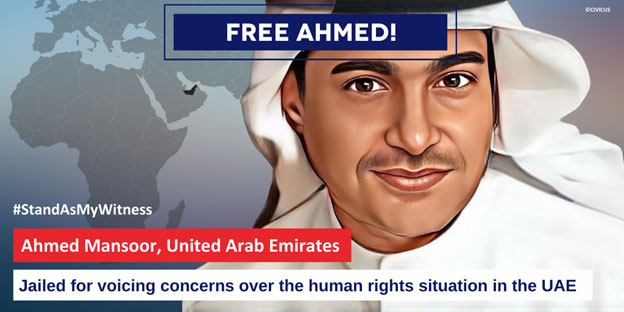
There’s widespread torture in jails and detention centres and at least 58 prisoners of conscience have been held in prison despite having completed their sentences. Many of them were part of a group known as the UAE 94, jailed for the crime of calling for democracy. Among the ranks of those incarcerated is Ahmed Mansoor, sentenced to 10 years in jail in 2018 for his work documenting the human rights situation, and held in solitary confinement for over five years and counting.

Ahead of COP28, civil society has worked to highlight the absurdity of holding such a vital summit in closed civic space conditions. Domestic civil society is unable to influence COP28 and its preparatory process, and it’s hard to see how civil society, both domestic and international, will be able to express itself freely during the summit.

Civil society is demanding that the UAE government demonstrate that it’s prepared to respect human rights, including by releasing political prisoners – something it’s so far failed to budge on.

An ominous sign came when the UAE hosted a climate and health summit in April. Participants were reportedly instructed not to criticise the government, corporations, individuals or Islam, and not to protest while in the UAE.

Civic space restrictions aren’t the only indication the UAE isn’t taking COP28 seriously. The president of the summit, Sultan Ahmed Al Jaber, also happens to be head of the state’s fossil fuel corporation ADNOC, the world’s 11th-biggest oil and gas producer. It’s like putting an arms manufacturer in charge of peace talks. Multiple other ADNOC staff members have roles in the summit. ADNOC is currently talking up its investments in renewable energies, all while planning one of the biggest expansions of oil and gas extraction of any fossil fuel corporation.

Instead of real action, all the signs are that the regime is instrumentalising its hosting of COP28 to try to launder its reputation, as indicated by its hiring of expensive international lobbying firms. An array of fake social media accounts were created to praise the UAE as host and defend it from criticism. A leaked list of key COP28 talking points prepared by the host made no mention of fossil fuels.

A summit that should be about tackling the climate crisis – and quickly – is instead being used to greenwash the image of the host government – something easiest achieved if civil society is kept at arm’s length.

Fossil fuel lobby to the fore

With civil society excluded, the voices of those actively standing in the way of climate action will continue to dominate negotiations. That’s what happened at COP27, also held in the closed civic space of Egypt, where 636 fossil fuel lobbyists took part – and left happy. Like every summit before it, its final statement made no commitment to reduce oil and gas use.

The only way to change this is to open the doors to civil society. Civil society has consistently sounded the alarm and raised public awareness of the need for climate action. It’s the source of practical solutions to cut emissions and adapt to climate impacts. It urges more ambitious commitments and more funding, including for the loss and damage caused by climate change. It defends communities against environmentally destructive impacts, resists extraction and promotes sustainability. It pressures states and the private sector to stop approving and financing further extraction and to transition more urgently to more renewable energies and more sustainable practices. These are the voices that must be heard if the cycle of runaway climate change is to be stopped.

COPs should be held in countries that offer an enabling civic space that allows strong domestic mobilisation, and summit hosts should be expected to abide by high standards when it comes to domestic and international access and participation. That should be part of the deal hosts make in return for the global prestige that comes with hosting high-level events. Civil society’s exclusion mustn’t be allowed to happen again.

Andrew Firmin is CIVICUS Editor-in-Chief, co-director and writer for CIVICUS Lens and co-author of the State of Civil Society Report.

  Source

Hurricane Otis and the Indifference Toward the Children of Acapulco

Civil Society, Crime & Justice, Gender, Gender Violence, Headlines, Human Rights, Inequality, Labour, Latin America & the Caribbean, Poverty & SDGs, TerraViva United Nations

Opinion

ACAPULCO, Mexico, Nov 2 2023 (IPS) – Acapulco is a paradise. A port of golden sunsets, toasted sand, and deep blue sea. Its dream beaches captivated the hearts of Elvis Presley and Elizabeth Taylor. US President John F. Kennedy chose its shores to spend his honeymoon with Jackie Kennedy. Its luxury hotels and the untamed sea made it the most famous tourist destination in Mexico.


Rosi Orozco

Today, Acapulco is devastated. A Category 5 hurricane—the deadliest possible rating—called “Otis” hit the beach on October 25 with incomparable force. No one anticipated it. Hours before it made landfall, it was just an inconvenient storm. Suddenly it became a deadly cyclone. Most of the hotels are destroyed, the sea swallowed people, houses were blown away, and dozens of people are dead.

In the last century, its beauty attracted the world’s most influential celebrities. Its tranquil mornings and lively nightlife attracted actresses, singers, politicians, aristocratic musicians, and families who wanted to spend their summers by the sea. I myself spent my youth at the family timeshare apartment in Acapulco, and it was there that I met my husband Alejandro, with whom I’ve been married for 40 years. My life is permanently connected to Acapulco.

Luxury businessmen, millionaire athletes, and Michelin-starred chefs arrived. Also drug dealers, money launderers, and men looking for girls and boys to rape in exchange for food or a few dollars for their parents who lived in the city’s poor areas.

Because there are two Acapulcos. They both share an airport and roads, so all roads lead to that pair of versions of the same city. There is a “diamond Acapulco” where the rich vacation with all the amenities at their disposal. And there is a “traditional Acapulco,” where the poor live who work for wealthy tourists.

The people who inhabit “diamond Acapulco” and “traditional Acapulco” do not usually cross paths. They live in the same city, but they are separated by golf courses and exclusive shopping malls. Only rich foreigners and wealthy nationals cross to the poor side when they feel a repugnant urge: to make their plans for child sex tourism a reality with girls and boys as young as 3 years old.

Acapulco is one of the most unequal tourist destinations in the world. In Mexico, it is the most unequal municipality of all: more than 60% of its 900,000 inhabitants live in extreme poverty, which means they do not know what they will eat today or tomorrow. They are the workers who serve plates of fresh seafood, who sweep marble floors, who fill the wine glasses of tourists.

For years, journalists and human rights organizations have told horrific stories that combine poverty, inequality, and sex tourism: a 6-year-old boy rented out to be photographed naked in exchange for milk and eggs; a 9-year-old girl sold to a Canadian tourist to be his wife for a month; homeless teenagers invited to sex parties on lavish yachts in exchange for food; parents and mothers waiting outside hotels for their children to be raped for a price paid in dollars per hour.

Those pedophiles and child molesters turned Acapulco into the country’s primary destination for child sexual tourism. They also led Mexico to the disgraceful second position in the production of child pornography, only surpassed by Thailand, according to data from the Mexican Chamber of Deputies and the United Nations Children’s Fund.

Today, Acapulco is a different place. Little remains of the port that enchanted singers Agustín Lara and Luis Miguel. There are thousands of poor families without homes, hundreds of workers who lost their jobs, and dozens of fishermen without boats to go out to sea to find sustenance. The destruction is so extensive that complete economic recovery is estimated to take decades, not years.

Under these conditions, childhood is at very high risk. Many families have lost so much that their bodies are the only currency they have left. And in the dirty business of forced prostitution, child bodies are the most sought after.

Amid this unprecedented crisis in Mexico, the Chamber of Deputies approved amendments to the general law against human trafficking. These changes aim to broaden the scope of the law enacted in 2012 and update it to address new technologies that traffickers and organized crime engaged in sexual exploitation can use. The wording has some issues that we are still analyzing, but it also includes positive aspects.

For example, it introduces new protections for individuals with injuries, intellectual disabilities, and Afro-Mexican towns and communities. The latter represent 6.5% of the total population in Guerrero and 4% of the residents in Acapulco, according to the National Population Council.

Civil society organizations are monitoring these changes and hope that the deputies will honor their commitment to protecting the victims.

Meanwhile, it is the responsibility of all, not just in Mexico, to help Acapulco back on its feet, a place that has given so much to both nationals and foreigners. It won’t be easy or quick, but every day we delay puts the vulnerable children at risk due to the magnitude of sexual tourism in that beautiful port.

After Hurricane Otis, Acapulco will be different. Its reconstruction is an opportunity to build a new city on the ruins of depravity, one with values and respect for human dignity. I long for the day to see it standing and for its coastline, beach, and air to remain a paradise, especially for children like me who grew up happily by the sea.

IPS UN Bureau

  Source