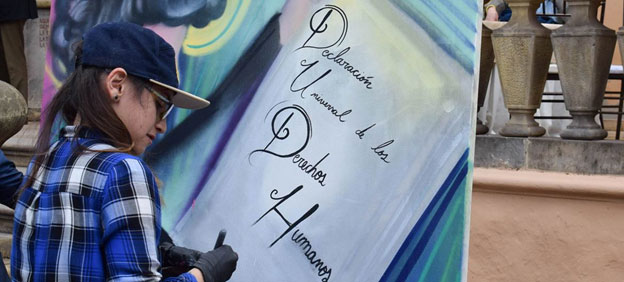
An artist in Colombia draws an image of the Universal Declaration of Human Rights. Credit: UN Colombia/Jose Rios Source: UN News
GENEVA, Feb 6 2026 (IPS) – The UN High Commissioner for Human Rights Volker Türk has launched a USD 400 million funding appeal for 2026 to address global human rights needs, warning that with mounting crises, the world cannot afford a human rights system in crisis.
“The cost of our work is low; the human cost of underinvestment is immeasurable,” Türk told States at the launch. “In times of conflict and in times of peace, we are a lifeline for the abused, a megaphone for the silenced, a steadfast ally to those who risk everything to defend the rights of others.”
In 2025, staff working for the UN Human Rights Office in 87 countries observed more than 1,300 trials, supported 67,000 survivors of torture, documented tens of thousands of human rights violations, and contributed to the release of more than 4,000 people from arbitrary detention.
Türk also stressed that addressing inequalities and respecting economic and social rights are vital to peace and stability. “Human rights make economies work for everyone, rather than deepening exclusion and breeding instability,” he said.
The Office in 2025 worked with more than 35 governments on the human rights economy, which aims to align all economic policies with human rights. For example, in Djibouti, it helped conduct a human rights analysis of the health budget, with a focus on people with disabilities. It provided critical human rights analysis to numerous UN Country Teams working on sustainable development.
Türk outlined several consequences of reduced funding in 2025. For instance, the Office conducted only 5,000 human rights monitoring missions, a decrease from 11,000 in 2024. The Office’s programme in Myanmar suffered cuts of more than 60 percent. In Honduras, support for demilitarisation of the prison system and for justice and security sector reforms was reduced. In Chad, advocacy and support for nearly 600 detainees held without legal basis had to be discontinued.
“Our reporting provides credible information on atrocities and human rights trends at a time when truth is being eroded by disinformation and censorship. It informs deliberations both in the UN Security Council and the Human Rights Council, and is widely cited by international courts, providing critical evidence for accountability,” he said.
The liquidity crisis of the regular budget also significantly affected the work of the broader human rights ecosystem. For instance, 35 scheduled State party dialogues by UN Human Rights Treaty Bodies could not take place.
Four out of eight planned country visits by the Sub-Committee on Prevention of Torture had to be cancelled. UN Special Rapporteurs’ ability to carry out country visits was curtailed, and the Human Rights Council’s investigative bodies were unable to fulfil their mandates fully.
The UN Human Rights Chief also regretted that the Office lost approximately 300 staff out of a total of 2,000 and was forced to close or radically reduce its presence in 17 countries, erasing entire programmes critical for endangered, threatened, or marginalised communities, from Colombia and Guinea-Bissau to Tajikistan.
“All this is weakening our ‘Protection by Presence’ – a simple idea with powerful impact: that the physical presence of trained human rights officers on the ground deters violations and reduces harm,” Türk said.
In 2025, the Office’s approved regular budget was USD 246 million, but it received only USD 191.5 million, resulting in a USD 54.5 million shortfall. It had also requested USD 500 million in voluntary contributions and received only USD 257.8 million.
The UN Human Rights Chief thanked the 113 funding partners – Governments, multilateral donors, private entities, among others – who contributed to the 2025 budget and helped save and improve lives.
For 2026, the UN General Assembly has approved a regular budget of USD 224.3 million, which is based on assessed contributions from Member States. This amount is 10 per cent lower than in 2025, and further uncertainty remains about the actual amount the Office will receive due to the liquidity crisis the UN is facing.
Through its 2026 Appeal, the Office is requesting an additional USD 400 million in voluntary contributions.
“Historically, human rights account for an extremely small portion of all UN spending. We need to step up support for this low-cost, high-impact work that helps stabilise communities, builds trust in institutions, and supports lasting peace,” the High Commissioner said.
“And we need more unearmarked and timely contributions so we can respond quickly, as human rights cannot wait.”
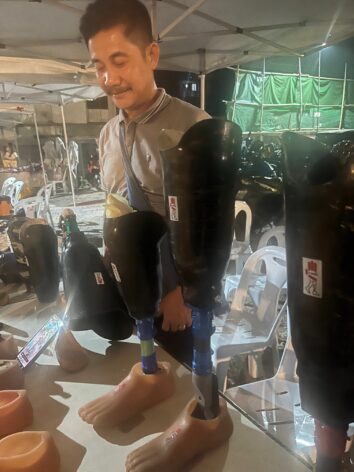
Prosthetics marketed by I-Walk at an event marking resistance to Myanmar’s military coup of five years ago. The enterprise has a waiting list of over 3,000 people. Credit: Guy Dinmore/IPS
MYANMAR & THAILAND, Feb 4 2026 (IPS) – Five years of conflict since the military seized power have reduced Myanmar to a failed state and taken a huge toll of lives lost and destroyed. But with all sides seeking total victory, there is no end in sight.
Levels of medieval brutality enhanced by modern technology have enabled the military junta, with help from China, to swing the fortunes of war back in its favour, often through air strikes and drone attacks on civilian targets. Torched villages are deserted.
Kyaw Thurein Win, on the anniversary of the military’s February 1, 2021, coup against the elected civilian government, watched his village of Shut Pon burning in the southern region of Tanintharyi – through satellite imagery.
“Today my village is witnessing the cruelty of the military. They set the fires and ordered that they not be stopped. This is beyond inhuman and beyond cruel. Watching this happen from afar is unbearable,” he wrote on Facebook.
While the strength of anti-regime defiance and determination is undeniable among many in Myanmar, there is also a growing realisation – especially among former combatants — that the resistance will not win this war so soon, if at all.
“It is a stalemate. Nobody can win,” said one military defector, saying that cries of total victory by both the regime and the resistance ring hollow.
A young woman who runs a safe house for former child soldiers as young as 13 says she joined the People’s Defence Forces of the resistance that sprang up against military rule in 2021. But she soon came to realise that, for her at least, war was not the answer and started taking in children forced by poverty and displacement to become fighters against the regime.
She rails against the “whatever it takes” mentality and the toll it takes.
“The civilian suffering is ignored or exploited,” she says, attending a coup anniversary event – a mix of politics and culture and foodstalls – organised by anti-regime civilian activists in Chiang Mai, northern Thailand. She shares a picture of ‘Commando’ in uniform, armed to the teeth. He was 12 at the time.
Sayarma Suzanna, fundraising for her school in Kayin State, the Dr Thanbyah Christian Institute for displaced and local children, said she and her 97 students spent all of November hiding in the nearby forest because of air strikes.
“You have to understand that when the students don’t listen to you during lessons, it is because of their trauma,” she said, recounting how one student lost seven family members in air strikes on their village.
At a nearby stall, the manager of I-Walk displayed an array of quality prosthetic limbs made by his enterprise as affordable as possible. He has a waiting list of over 3,000 people.
Myanmar is the most landmined country in the world with the highest rate of casualties. It also ranks as the biggest producer of illicit opium and a major source of synthetic drugs. Networks of online scam centres run by criminal gangs and militia groups close to the regime have trafficked tens of thousands of people from multiple countries, scamming billions of dollars.
The UN says 5.2 million people have been displaced by conflict inside the country and across borders. Cuts by rich countries to aid budgets have had a crippling impact. Some clinics are reduced to dispensing just paracetamol.
This year’s coup anniversary coincided with the conclusion of parliamentary and regional elections tightly orchestrated by the regime over the scattered and sometimes totally isolated areas of territory it controls, which include all major cities.
The three-phase polls – endorsed by China and Russia but slammed by the UN and most democracies except notably the US – excluded the National League for Democracy, which won landslide election victories in 2015 and 2020.
NLD leader Aung San Suu Kyi has been held in prison since the coup. There is speculation that Senior General Min Aung Hlaing might move her to better conditions of house arrest after the military’s Union Solidarity and Development Party, led by former senior officers, forms a nominally civilian government in April.
The USDP is cruising towards its managed landslide victory, according to almost complete results released last week.
The UN said it had reliable reports of at least 170 civilians killed in regime attacks during the month-long election period. Other estimates put the figure considerably higher.
One airstrike in Kachin State in northern Myanmar reportedly killed 50 civilians on January 22. Long-running attempts by the Kachin Independence Army and resistance forces to capture the nearby and heavily defended Bhamo town from the military have been costly. Some analysts ask, for what gain?’
Kachin State’s second biggest town is strategically located on a trade route to China but most of its 55,000 or so inhabitants have long since fled. The military would surely respond with heavy air strikes to any occupation by the resistance.
Data gathered by ACLED, a nonprofit organisation that analyses data on political violence, indicates over 90,000 total conflict-related deaths since the coup. The military, reliant on forced conscription, has borne the brunt of casualties, but civilian deaths are estimated at over 16,000.
“The military has carried out air strikes, indiscriminately or deliberately attacking civilians in their homes, hospitals, and schools,” said Nicholas Koumjian, head of the Independent Investigative Mechanism for Myanmar, adding that there is evidence that civilians have endured atrocities amounting to crimes against humanity and war crimes since the military takeover.
The IIMM is also investigating a growing number of allegations of atrocities committed by opposition armed groups, over which the parallel National Unity Government set up by lawmakers ousted in the coup has little or no control.
Former combatants say rogue People’s Defence Forces are also extorting money from local populations and holding people to ransom.
“Myanmar remains mired in an existential crisis – measured both in human security and the state’s shrinking sovereignty as rival centres of power harden on the ground,” the Institute for Strategy and Policy – Myanmar, a think-tank, stated in its recent annual review.
“The regime is meanwhile trying to break the current stalemate by accelerating counter-offensives on three fronts: military, diplomatic and political,” it said. The military-staged elections of 2010 led to a process of political and economic reforms but this time the regime intended to impose its own terms, the think tank said.
It warned of the risk that ethnic armed groups controlling swathes of border territories with Bangladesh, India, China and Thailand would end up – not for the first time – negotiating bilateral ceasefires and “rent sharing arrangements” with the regime. These would “consolidate the power of armed elites and reinforce central control rather than advance democracy, human rights or the rule of law.”
On Sunday, a panel discussion featuring anti-regime politicians and activists hosted by Chiang Mai University reinforced the sense of an opposition fragmented along ethnic and geographical lines, even if speakers upheld the principles behind their shared goal of a democratic federal union.
There was the customary rhetoric of “taking down this junta” and “whatever it takes”, but barely a mention of the National Unity Government that is struggling to knit together these diverse forces under the umbrella of a “Federal Supreme Council”.
On the panel, Debbie Stothard, a Malaysian democracy and women’s rights activist long involved with Myanmar, said the resistance needed two more years for victory, as the generals had “bought” one more year with their sham elections.
“Hang in there. We have to keep on going for at least two more years,” she said.
But in the big cities where the regime is starting to try and foster a sense of normality against a dire economic backdrop, the mood on the street appears more of resignation than defiance.
“When we started protesting against the regime in the streets in 2021, I told my husband we would defeat the military in three months,” an elderly Chin activist told IPS in Yangon, the former capital. “He replied it would take five years. Now I am afraid it will take another five years,” she said.
NEW YORK, Feb 3 2026 (IPS) – In the month of February 2025, one year ago, United Nations Secretary-General Antonio Guterres commenced his briefing of the media by announcing that “I want to start by expressing my deep concern about information received in the last 48 hours by UN agencies — as well as many humanitarian and development NGOs — regarding severe cuts in funding by the United States.” He went on to warn that ““The consequences will be especially devastating for vulnerable people around the world.”
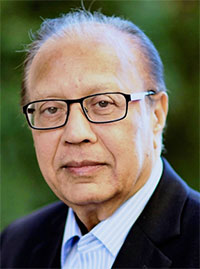
Anwarul K. Chowdhury
UN80 Initiative – Reform or Pressure?
That budgetary crisis was attempted to be put off by launching the anniversary-rationaled and liquidity-crunch-panic-driven, window-dressing reform agenda – the so-called UN80 Initiative. These long overdue structural and programmatic reforms of the UN system have been on the agenda of at least for the last four Secretaries-General but without having much significant impact, except acronym-changing, mandate-creeping and structure-tweaking, and now these days, staff-relocating.
An Alarm Bell for Financial Collapse
End of this January again the Secretary-General said in a letter to all UN Member States that cash for its regular operating budget could run out by July, which could dramatically affect its operations. He also called on the to fundamentally overhaul the UN’s financial rules to prevent an “imminent financial collapse”.
Why now ask the member states to do something concrete? Why not in February 2025 when he sounded the alarm himself?
It reminds me of the somewhat similar Aesop’s fable about boy who cried wolf.
Lamenting Limited Power – No Power, No Money
In the past, Secretary-General Guterres lamented to the media asserting that “… it is absolutely true that the Secretary-General of the United Nations has very limited power, and it’s also absolutely true that he has very little capacity to mobilize financial resources. So, no power and no money.”
That is the reality which every Secretary-General faces and has been aware of. That is also known generally to the people who follow the United Nations regularly and thoroughly understand the functional complexity of the world’s largest multilateral apparatus.
Why then does this reality surfaces and brought to public attention only when the UN leadership fails to carry out the mandated responsibilities?
I believe strongly that this “very limited power”, as worded by SG Guterres, should be highlighted as often as possible to avoid unnecessary and undue expectations of the global community about the UN and its top leadership. No Secretary-General has pointed out these limitations as he campaigned for the post and on assuming the office, as far as I know.
Current SG Guterres is no exception. He would have been realistic and factual if he had pointed out the limitations – better termed as obstacles – to his leadership as he took office in 2017, and not in 2026 after being in office for nearly nine years. This built-in operational weakness and inability of the world’s most important diplomat have always been there.
Controlling Or Quitting?
Some people speculate that the US is using its financial clout and pressure to threaten the collapse of the UN.
The US has always been using its huge power of veto and almost one-fourth of the budgetary contributions to the operations of the UN system. That is a reality which should be kept in mind by the leadership of the UN and its Member States, unless the Charter of the UN is changed to create a more democratic organization in the true sense.
For a long time, the US has used the part payment arrangements for its legally due contributions, with full understanding and acceptance of the Secretary-General, so that it can avoid losing its voting power and get its own pound of flesh each time such instalment payments are made.
I believe the US wants to use the world body in its own way by controlling, not quitting.
A Woman at the Helm for The UN
In this context, let me reiterate that after eight decades of its existence and choosing nine men successively to be the world’s topmost diplomat, it is incumbent on the United Nations to have the sanity and sagacity of electing a woman as the next Secretary-General in 2026 when the incumbent’s successor would be chosen.
There is a need for creative, non-bureaucratic and pro-active leadership initiative for a real change to ensure avoidance of “crying wolf” syndrome disrupting the work and activities of the most universal multilateral body with the mandate for working in the best interest of humanity.
Ambassador Anwarul K. Chowdhury is a former UN Under-Secretary-General, one-time Permanent Representative of Bangladesh to the United Nations, Chairman of the UN General Assembly’s Administrative and Budgetary Committee (1997-1998), former Senior Special Adviser to UN General Assembly President (2011-2012) and President of the UN Security Council (2000 and 2001) and a two-term Vice Chairman of the all-powerful UN Committee on Programme and Coordination (1984-85).
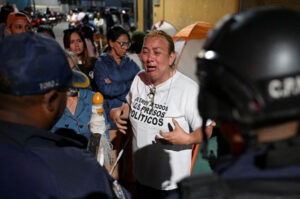
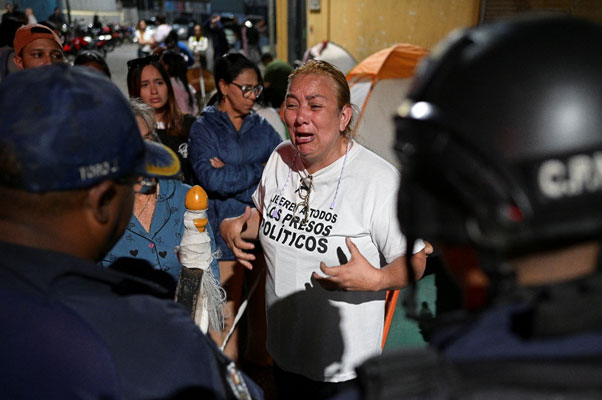
Evelis Cano, mother of political prisoner Jack Tantak Cano, pleads with the police for her son’s release outside a detention centre in Caracas, Venezuela, 20 January 2026. Credit: Gaby Oraa/Reuters via Gallo Images
MONTEVIDEO, Uruguay, Feb 2 2026 (IPS) – When US special forces seized Nicolás Maduro and his wife from the presidential residence in Caracas on 3 January, killing at least 24 Venezuelan security officers and 32 Cuban intelligence operatives in the process, many in the Venezuelan opposition briefly dared hope. They speculated that intervention might finally bring the democratic transition thwarted when Maduro entrenched himself in power after losing the July 2024 election. But within hours, those hopes were crushed. Trump announced the USA would now ‘run’ Venezuela and Vice-President Delcy Rodríguez was sworn in to replace Maduro. Venezuela’s sovereignty had been violated twice: first by an authoritarian regime that usurped the popular will, and then by an external power that deliberately violated international law.
A cynical intervention
Under Trump, the USA has abandoned any pretence of promoting democracy. Trump wrapped the intervention in the rhetoric of anti-narcotics operations while openly salivating over Venezuela’s oil reserves, rare earth deposits and investment opportunities. He repeatedly made clear that US regional hegemony is the number one priority. His contempt for Venezuelans’ right to self-determination was explicit: when asked about opposition leader María Corina Machado, Trump dismissed her as lacking ‘respect’ and ‘capacity to lead’. The message to Venezuela’s democratic movement was clear: your struggle doesn’t matter, only our interests do.
Ironically, the US intervention achieved what years of Maduro’s propaganda failed to do, giving anti-imperialist rhetoric a shot in the arm. For decades, Latin American authoritarian regimes have justified repression by pointing to the threat of US intervention, even though this was a largely historical grievance. Not anymore: Trump has handed every Latin American dictator the perfect justification for continuing authoritarian rule.
The global response has been equally revealing. The loudest defenders of national sovereignty are authoritarian powers such as China, Iran and Russia: states that routinely violate their citizens’ rights expressed their ‘solidarity with the people of Venezuela’ and positioned themselves as champions of international law. By blatantly violating a foundational principle of the post-1945 international order, Trump made the leaders of some of the world’s most repressive regimes look like the adults in the room. And across Latin America, the political conversation has now shifted dramatically: the question is no longer how to restore democracy in Venezuela, but how to prevent the next US military adventure in Latin America.
Authoritarianism continues
Meanwhile, Venezuela’s authoritarian regime remains intact. Maduro may be in a New York courtroom, but the structures that kept him in power – the corrupt military, embedded Cuban intelligence, patronage networks and the repressive apparatus – continue unchanged. Rodríguez will likely try to run down the clock, claiming Maduro could return at any moment to avoid calling elections while quietly negotiating oil deals with US companies and reasserting authoritarian control. For both Rodríguez and Trump, democracy seems like an inconvenient obstacle to resource extraction.
For Venezuelan civil society, this creates real dilemmas. As she was sworn in, Rodríguez denounced the operation that put her in charge and vowed that Venezuela would ‘never again be a colony of any empire’. She has wrapped herself in the flag, framing regime continuity as a patriotic stand against western imperialism, and can now easily paint opposition activists who have long demanded international pressure for democracy as treasonous collaborators with foreign powers. This is despite being an insider of a regime that welcomed Cuban intelligence, Iranian oil traders and Russian military advisers, and is now negotiating oil deals with the USA and crossing its own red line by promising legal changes to enable private investment.
A Venezuelan solution for Venezuela
But there may be some cracks in the regime. With Maduro gone, frictions inside the ruling party have become apparent. For instance, there have been obvious disagreements on how to handle the pressure to free Venezuela’s over 800 political prisoners. These may yield opportunities the democracy movement can exploit.
This is the time for the democratic opposition to reclaim the narrative. In the immediate aftermath of the intervention, families of political prisoners mounted vigils outside detention centres, demanding releases the government has only partially delivered. Civil society must amplify these voices, making clear that any transitional arrangement requires the dismantling of the repressive apparatus, not merely a change of faces at the top.
A broad coalition of civil society organisations has issued 10 demands that chart a path to democratic transition. They call for the immediate and unconditional release of political prisoners, the dismantling of irregular armed groups, unfettered access for human rights monitors and humanitarian aid and, crucially, a free and fair presidential election with international observers. These demands deserve international backing, not as conditions for oil contracts, but as non-negotiable requirements for any government that can claim to represent Venezuela.
Venezuela’s democratic forces can either accept marginalisation as Trump and Rodríguez carve up their country’s resources, or use this chaotic moment to advance a genuinely Venezuelan democratic agenda. That means rejecting both Maduro’s authoritarianism and Trump’s intervention, and insisting that any legitimacy Rodríguez’s government claims must come from Venezuelan voters, not US armed forces or oil contracts. Any window of opportunity may however be closing fast. The question is whether Venezuela’s democratic movement can seize it to build the country they have strived for, or whether they will remain spectators while others decide their fate.
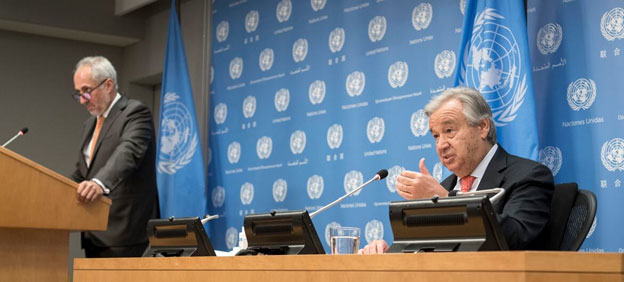
UN Secretary-General António Guterres (seated at right) speaks to reporters at a press conference at UN Headquarters, in New York. UN Photo/Mark Garten
UNITED NATIONS, Jan 30 2026 (IPS) – UN Secretary-General Antonio Guterres was dead on target when he told the Security Council last week that the rule of law worldwide is being replaced by the law of the jungle.
“We see flagrant violations of international law and brazen disregard for the UN Charter. From Gaza to Ukraine, and around the world, the rule of law is being treated as an à la carte menu,” he pointed out, as mass killings continue.
“The New York Times on January 28 quoted a recent study pointing out the four-year war between Russia and Ukraine has resulted in over “two million killed, wounded or missing”. The study published last week by the Center for Strategic and International Studies in Washington says nearly 1.2 million Russian troops and close to 600,000 Ukrainian troops have been killed, wounded or are missing.
In the war in Gaza, over 70,000 Palestinians, mostly civilians, including women and children, have been killed since October 7, 2023, with figures reaching over 73,600 by early January 2026, according to various reports from the Gaza Health Ministry and human rights organizations.
These killings have also triggered charges of war crimes, genocide and violations of the UN charter, as in the US invasion of Venezuela and the takeover threats against Greenland.
Guterres said in an era crowded with initiatives, the Security Council stands alone in its Charter-mandated authority to act on behalf of all 193 Member States on questions of peace and security. The Security Council alone adopts decisions binding on all.
No other body or ad hoc coalition can legally require all Member States to comply with decisions on peace and security. Only the Security Council can authorize the use of force under international law, as set out in the Charter. Its responsibility is singular. Its obligation is universal, declared Guterres.
Dr Ramzy Baroud, Editor of Palestine Chronicle and former Managing Editor of the London-based Middle East Eye, told IPS the statement by the Secretary-General is long overdue.
Too often, he said, UN officials resort to cautious, euphemistic language when describing egregious violations of international law—especially when those responsible are UN Security Council veto holders, states that have ostensibly sworn to uphold the UN Charter and the core mission of the international system.
Unfortunately, the UN itself has become a reflection of a rapidly shifting world order—one in which those with overwhelming military power sit at the top of the hierarchy, abusing their dominance while steadily hollowing out the very institutions meant to restrain them, he pointed out.
“We must be honest with ourselves and acknowledge that this crisis did not begin with the increasingly authoritarian misuse of law by the Trump administration, nor is it limited to Israel’s absolute disregard for the international community during its two-year-long genocide in Gaza.”
The problem is structural. It is rooted in the way Western powers have long identified—and exploited—loopholes within the international legal system, selectively weaponizing international law to discipline adversaries while shielding allies and advancing their own strategic agendas, he declared.
Responding to a question at the annual press briefing on January 29, Guterres told reporters it is obvious that members of the Security Council are themselves violators of international law –and it doesn’t make life easy for the UN in its efforts.
Unfortunately, he said, there is one thing that we miss. “It’s leverage. It’s the power that others eventually have, to force countries and to force leaders to abide by international law. But not having the power, we have the determination, and we’ll do everything possible with our persuasion, with our good offices, and building alliances to try to create conditions for some of these horrible tragedies we are witnessing. And from Ukraine to Sudan, not to mention what has happened in Gaza, we will be doing everything we can for these tragedies to stop”.
Dr Jim Jennings, President of Conscience International, told IPS the global humanitarian situation described by the Secretary-General is grim but very real. The climate crisis, natural disasters, numerous ongoing and expanding conflicts, and the impact of new technologies, all add to today’s global economic instability and affect every person on earth.
While President Trump continues bombing countries and strutting the world stage with his adolescent dream of US territorial expansion, a major readjustment of the global power balance among China, the US, Europe, and the BRICS nations is underway, he noted.
Stripping life-giving aid away from the poorest countries on earth to benefit those already rich, as his policies guarantee, is a recipe for even more global suffering and violence.
“Clearly one of the most blatant and harmful reasons for the present disastrous situation worldwide is the reduction of funding for UN agencies by the United States, which has traditionally paid a high percentage of their costs”.
With the further curtailment of The Department of State-USAID’s enormous support for people in critical need in almost every country in the world, the Trump administration’s one-two punch has already threatened to make a challenging set of problems unmanageable.
What is to be done? People and governments everywhere must stand up, speak out, and act against the colossal forces now arrayed against some of the world’s most vulnerable populations. How to do that has never been easy, Dr Jennings argued.
Put in the simplest terms, Secretary-General Guterres was merely pointing out the glaring fact of the true global situation and appealing for the critical need UN agencies have for support if their mission is not to fail. The answer is straightforward— more private funding.
Why not raise the level of our individual, corporate, and foundation donations to the UN Agencies and other aid organizations while continuing to advocate for responsible government backing for the irreplaceable United Nations agencies? he asked.
Dr Palitha Kohona, a former Chief of the UN Treaty Section, told IPS international relations, for a very long time, were dependent on the whims of powerful states and empires. Might was right and disputes were settled by using force. Land inhabited for centuries was annexed to empires and native populations were dispossessed or even exterminated.
From such fractured beginnings, an orderly world governed by agreed rules began to emerge gradually, although most of the rules were established by the powerful.
Thousands of treaties were concluded, customary rules were respected and a rudimentary judicial structure began to be established. The world rejoiced in the establishment of the United Nations.
Though lacking in proper enforcement mechanisms and largely dependent on voluntary mutually beneficial compliance, a rule based international order was beginning to emerge.
“Many, including the present writer, wrote enthusiastically about the consolidation of a rules-based international order. The violence that was commonplace in international dispute resolution prior to the Second World War appeared to be limited to distant parts of the world.”
But like a cozy dream being shattered in mid-sleep, he said, the USA has rudely disrupted the illusion of a new international rules-based world order of which it was once a champion. The trade rules, so painfully developed, have been ditched. Mutual deal making has resurfaced, he said.
“Now it would seem that the powerful would determine the rules, based on self-interest. Rules relating to sovereignty, territorial integrity and rights of people would now seem to depend on the whims of the powerful. The weak will draw their own conclusions. Acquire counterattack capabilities that would make an aggressor think twice”.
“Unless the medium powers and powerless band together and resolve to maintain the international rule of law, we may be entering an era of extreme uncertainty in international relations”, declared Dr Kohona, a former Permanent Representative of Sri Lanka to the UN and Ambassador to China.
Dr Baroud also pointed out that the 2003 US-British invasion of Iraq stands as a textbook example, but the same pattern has repeated itself in Libya, Syria, and across large parts of the Middle East and beyond. In each case, international law was either manipulated, ignored, or retroactively justified to accommodate power rather than principle.
Israel’s genocide in Gaza, the war in Ukraine, and the ongoing atrocities in Sudan and elsewhere are not aberrations. They represent the culmination of decades of legal erosion, selective enforcement, and the systematic degradation of the international legal order.
While I agree—and even sympathize—with Canadian Prime Minister Mark Carney’s comments at the World Economic Forum in Davos, in which he expressed criticism of the new power dynamics that have rendered the international political system increasingly defunct, one cannot help but ask why neither he nor other Western leaders are willing to confront their own governments’ historical role in creating this reality.
Without such reckoning, calls to defend international law risk sounding less like principled commitments and more like selective outrage in a system long stripped of credibility.
European powers that are critical of Trump have not raised their voice with the same intensity and vigor against Netanyahu for doing a lot worse than anything that Trump has done or threatened to do.
This also begets the same question about the latest comments by the UN Secretary-General. He should offer more specifics than generalized decrying the collapse of international morality.
“Moreover, we expect a roadmap that will guide us in the process of re-establishing some kind of a sane global system in the face of the growing authoritarianism, dictatorship, and criminality all around”, declared Dr Baroud.
Science, research, and scientific discoveries provide solutions to the pressing challenges our society faces and can improve people’s lives. Credit: Shutterstock
URBANA, Illinois, US, Jan 27 2026 (IPS) – Scientists across the U.S., including me, are stressed after a year marked by several changes and challenges, including cuts to science funding that have stalled clinical trials and studies that could improve and save lives. Without funding, scientists worry about how they will support ongoing research and train America’s future workforce, including the next generation of innovators.
These scientific advances have supported agricultural and healthcare advances, expanding U.S. life expectancy by almost 20 years. From vaccines to early disease detection to novel drugs, the returns on funding science are substantial.
We need science. Moments like the challenges of today call for reflection and offer opportunities to readjust, evolve, and move forward, including finding new ways to engage with the public and policymakers and to fund and conduct science creatively
Science, research, and scientific discoveries, after all, provide solutions to the pressing challenges our society faces and can improve people’s lives. Science guides us through these challenges, inspires us, and unites many curious minds.
We need science. Moments like the challenges of today call for reflection and offer opportunities to readjust, evolve, and move forward, including finding new ways to engage with the public and policymakers and to fund and conduct science creatively.
So how do we adjust? What actions can scientists take now?
First, scientists need to keep showing up and find creative ways to communicate science and the solutions being generated to the public, policymakers, and government administrators.
This includes unpacking how science solutions address the issues everyday people face, including their economic future, and how science advancements align with the challenges people face now.
Communicating science and research outcomes to the broader public, policymakers, and other stakeholders in the science enterprise is not easy. However, scientists have continued to develop creativeways to improve how we communicate science. Specifically, scientists are using multiple formats, including storytelling, infographics, animations, and interactive games and graphics.
These efforts must continue to expand, tapping into the many available ways to communicate science, including podcasts, blogs, social media, radio, TV, and op-eds.
To ensure maximum participation by scientists, universities and research institutions should find innovative ways to incentivize students and scientists to engage with the public and share their research.
Complementing these efforts, universities and research institutions, along with professional societies to which scientists belong, can continue to offer workshops and training to help scientists become better communicators.
For example, between 2008 and 2022, the American Association for the Advancement of Science offered several science communication workshops.
Alongside these efforts, professional societies have also recognized elected officials who have continued to champion the role of science in addressing persistent societal challenges. For example, in 2025, ESA recognized Senator Susan Collins of Maine as the society’s 2025 Champion of Entomology for her continued support for science and research funding and for introducing several bills that are still pending Senate and House votes.
Second, we need to continue strengthening public and policymakers’ trust in science by improving peer review processes and ensuring that science remains transparent, rigorous, and repeatable, and that the credibility of published science remains intact. In recent years, there has been a rapidincrease in the number of paper mills producing fraudulent scientific papers. These science integrity challenges undermine scientific enterprises and create distrust among the public.
Strengthening public trust in science and scientists can take many forms, including convening town halls and public forums. Other creative ways include involving the public in citizen science research and fieldwork, allowing the public to be involved from the outset, including building the research project goals and a compelling justification for why the research question being addressed is important.
Engaging the public and involving them in shaping the scientific questions scientists pursue can not only strengthen public trust in science but also enrich outcomes by incorporating local or experiential knowledge. In doing so, public engagement helps ensure that the solutions generated by these shared projects address and solve challenges that are grounded, relevant, and meaningful to communities and the public we aim to serve.
For example, in my research on plant-microbe-insect interactions, which aims to help feed a growing population sustainably amid changing environments and to strengthen plant resilience against biotic and abiotic stressors such as insects, drought, and flooding, collaborating with farmers can directly shape the pests and crops I study and guide the questions I pursue. By doing so, the resulting research insights become responsive to the current agricultural challenges American farmers face.
Thirdand most importantly, there is an urgent need to develop a long-term vision and establish unbreakable funding frameworks for science to ensure that the gains we have made so far are preserved. Scientists, national academies of science, government administrators, elected officials, policymakers, the military, industry, NGOs, the public, think tanks, foundations, and all stakeholders in the science enterprise must work together to chart a new path forward.
Without bending back too far, scientists can stop, reflect, and find their path forward.
It is necessary to bring together all stakeholders in the science enterprise to create new science funding frameworks that are both acceptable and reasonable. Otherwise, the value of science and research, along with the gains made to date, could be lost.
It’s time for scientists to extend the olive branch, redouble our efforts to communicate science to society, and chart a path forward that brings everyone on board.
Esther Ngumbi, PhD is Assistant Professor, Department of Entomology, African American Studies Department, University of Illinois at Urbana-Champaign