A New World Order Where Might is Right

Armed Conflicts, Civil Society, Crime & Justice, Democracy, Featured, Global, Headlines, Human Rights, International Justice, IPS UN: Inside the Glasshouse, TerraViva United Nations
A New World Order Where Might is Right

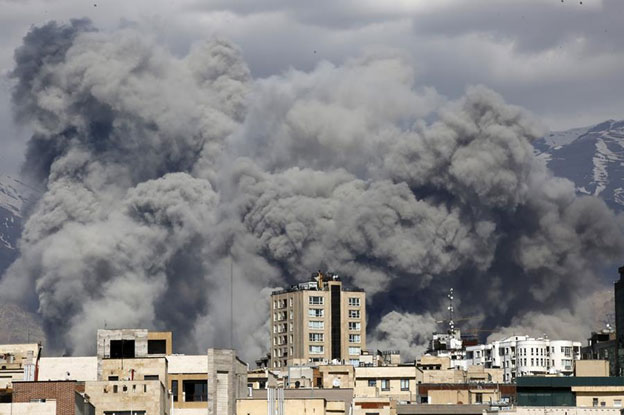
Credit: Global Centre for the Responsibility to Protect

UNITED NATIONS, Mar 3 2026 (IPS) – As the build-up for a proposed “new world order” continues, a lingering question remains: will the country with the most powerful military reign supreme?

The United Nations remains politically impotent. The UN charter is in tatters. The sovereignty of nation states and their territorial integrity have been reduced to political mockery. And the law of the jungle prevails—be it Palestine, Ukraine, Venezuela or Iran.


What’s next: Colombia? Cuba? Greenland? North Korea?

The widespread condemnation of the ongoing conflicts – including charges of war crimes and genocide— has continue to fall on deaf ears.

UN Secretary-General Antonio Guterres told the Security Council that under Article 2 of the UN Charter, all member states shall “refrain in their international relations from the threat or use of force against the territorial integrity or political independence of any state.”

But is anybody out there listening?

Norman Solomon, executive director, Institute for Public Accuracy and national director, RootsAction.org, told IPS killing from the sky has long offered the sort of detachment that warfare on the ground can’t match. Far from its victims, air power remains the height of modernity

Reliance on overwhelming air power is key to what the U.S. is doing in tandem with Israel. Bombing from the skies while not attacking with ground forces is the ultimate way of killing without suffering many casualties.

This reduces political blowback at home in a political and media culture that values American lives but sees the lives of “others” as readily expendable, he pointed out.

“This flagrant war of shameless aggression, launched by the United States and Israel, cannot be contained — much less rolled back — by the typical diplomatic euphemisms and caution.”

The U.S. and Israeli governments, said Solomon, are too completely run by psychopathic leaders who adhere only to the “principle” that might makes right. If ever there were a time that the vaunted “international community” should step up and confront an alliance of reckless outlaw governments, this is it.

The European allies of the United States, he said, should stop their cowardly vagueness and finally step up to demand a halt to this aggression that is setting the Middle East tinderbox on fire. The EU should be threatening huge countermeasures against the United States and Israel unless that pair of sociopathic governments immediately halts their assault on Iran.

“Playing evasive games with Washington makes the leaders in London, Paris, Berlin and elsewhere accomplices to methodical ongoing war crimes”, declared Solomon, author of “War Made Invisible: How America Hides the Human Toll of Its Military Machine”

According to the Global Centre for the Responsibility to Protect, the US-Israeli act of aggression against Iran was undertaken in violation of international law and the UN Charter, as they exercised use of force without authorization from the UN Security Council (UNSC) or without a demonstrated threat to their security that would trigger the right to self-defense under Article 51 of the UN Charter.

“The attack came amid ongoing nuclear talks between the US and Iran and just hours after Oman’s Foreign Minister – a key mediator in the negotiations – shared details on progress achieved and announced that a breakthrough was near. The attack also mirrors the recent unlawful actions undertaken by the US in Venezuela on 3 January, culminating in the kidnapping of the head of state and setting in motion profound uncertainty for the region and the global order.”

Meanwhile, the Geneva-based UN refugee agency, the UNHCR, said it is deeply concerned about the escalation of conflict in the Middle East and its impact on civilians and further displacement in the region.

“Many affected countries already host millions of refugees and internally displaced people. Further violence risks overwhelming humanitarian capacities and placing additional pressure on host communities”.

“We echo the UN Secretary-General’s urgent call for dialogue and de-escalation, respect for human rights, the protection of civilians and full adherence to international law”.

James Jennings, President of Conscience International, told IPS the joint US-Israeli attack on Iran was misguided, illegal, and based on lies. It will retard, not advance, any future nuclear agreement, perhaps for decades.

It was illegal, he pointed out, because it violates both the US constitution and international law as enshrined in the UN Charter. It was based on lies because the nuclear watchdog groups have clearly indicated in essence that “There’s nothing to see here.”

“Trump regularly claims that June’s joint “Operation Midnight Hammer” obliterated Iran’s nuclear capability, yet his weak case for the current “Operation Epic Fury” war rests on the idea that perhaps someday in the future Iran might get a bomb. Several US administrations have worked diplomatically to prevent that, yet Trump tore the agreement up”.

Trump claims to be limited by no law, constitution, or the UN Charter. Guided only by his own morality, as he said recently, he followed Israel obediently in launching a massive war against a sleeping country of 92 million people, said Jennings.

“All the while, his amateur diplomats were negotiating deceptively for a compromise like Imperial Japan did in the run-up to the WW II Pearl Harbor attack. Ask the parents of the more than l00 schoolgirls killed on the first horrifying day of joint US-Israel bomb attacks at Minaj, Iran, and they will probably not see Mr. Trump as particularly moral”.

George W. Bush called himself “The Decider, so he foolishly decided to take the US into two unwinnable wars that most politicians in Washington, and even Trump himself, now consider monumental mistakes. Trump campaigned vigorously on keeping the US out of mistaken Middle East wars that became “Forever Wars,” said Jennings.

“Yet here he is being pulled around by the nose by Mr. Netanyahu. According to a classic rule when launching a war, one must recognize that two things cannot be changed: one is history and the other is geography. It is stunning that the leader of the United States is cavalier about going to war without understanding that or clearly stating the mission’s purpose or end game.”

Pundits and TV reporters are calling the attack on Iran “a war of choice,” said Jennings.

“Why not call it what it really is–a war of naked aggression? Nobody knows when will it end. Trump’s claim that the war will be over in a few days is a cruel joke. The other side gets a vote. Iran celebrated its 2,500th anniversary in 1971. Maybe people who have been around so long know a few things about survival,” declared Jennings.

IPS UN Bureau Report
  Source

Over 25,500 Palestinians Killed: Absence of Accountability is Nothing Short of Shameful

Armed Conflicts, Civil Society, Crime & Justice, Democracy, Headlines, Human Rights, IPS UN: Inside the Glasshouse, Middle East & North Africa, TerraViva United Nations

Opinion

Over 25,500 Palestinians Killed: Absence of Accountability is Nothing Short of Shameful

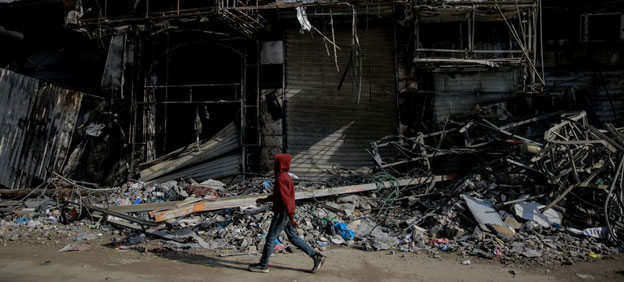
A boy walks through a destroyed neighbourhood in Gaza City. Credit: UNICEF/Omar Al-Qattaa

 
UN High Commissioner for Human Rights, Volker Türk’s remarks to the Interactive Dialogue on the human rights situation in the Occupied Palestinian Territory, at the 61st session of the Human Rights Council in Geneva on February 26 2026.

GENEVA, Feb 27 2026 (IPS) – The situation in the Occupied Palestinian Territory is a human-made disaster.

The report before you sets out events between 1 November 2024 and 31 October 2025 that show Israel’s utter disregard for human rights in Gaza and the West Bank, and the serious violations also committed by Hamas and other Palestinian armed groups.


The evidence gathered by my Office reveals a consistent pattern of gross violations and abuses of human rights, serious violations of international humanitarian law and atrocity crimes – that remain unpunished.

Israel’s continued attacks on residential buildings and makeshift tents, destroying entire neighbourhoods, caused mass civilian deaths. More than 25,500 Palestinians were killed, including entire families, and more than 68,800 were injured during the reporting period.

Among those killed were many Palestinian journalists. My Office has verified that 292 were killed in Israeli operations since 7 October 2023.

Israel’s militarization of humanitarian aid, through the Gaza Humanitarian Foundation, also led to large-scale killings. Between late May and 8 October 2025, my Office recorded 2,435 Palestinians killed by the Israeli military near food collection points — mostly young men and boys.

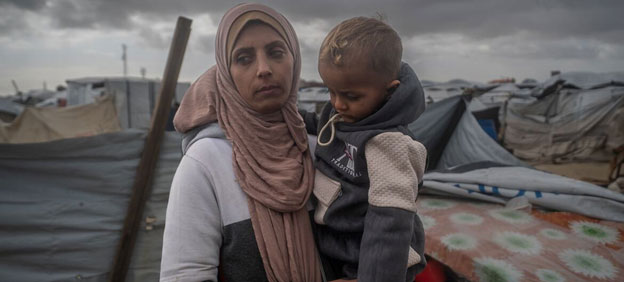
In August 2025, famine was declared in Gaza, affecting more than half a million people. According to the Palestinian Ministry of Health, at least 463 Palestinians, including 157 children, died from starvation. This was the direct result of Israel’s blocking of humanitarian aid and other deliberate actions.

A woman holds a child as a storm approaches Khan Younis in Gaza. Credit: WFP/Maxime Le Lijour

Israeli forces continued to kill humanitarian and medical personnel during this period, and to make mass arrests of Palestinians across Gaza and the West Bank. These arrests often amounted to arbitrary detention, and included enforced disappearances.

Since 7 October 2023, my Office has verified that at least 89 Palestinians have died in Israeli custody. Torture and other ill-treatment of Palestinians in Israeli detention remain widespread.

Israeli operations destroyed some 80 percent of civilian infrastructure in Gaza – including homes, schools, hospitals, cultural sites, and water treatment plants.

During the reporting period, Israel continued to forcibly displace Palestinians, into ever-shrinking areas of the Gaza strip. Over the course of 2025, Hamas and other Palestinian armed groups continued to hold hostages in blatant violation of international law.

Fifty-one hostages who were seized on 7 October 2023 were returned to their loved ones. On their release, the hostages recounted their traumatic ordeals, including sexual and gender-based violence, torture, beating, and prolonged confinement underground.

In June, there were reports that armed men, allegedly affiliated with Hamas, summarily executed 12 Palestinians associated with the Gaza Humanitarian Foundation. In the West Bank, including East Jerusalem, Israeli security forces continued to launch airstrikes and use unlawful force, killing hundreds of Palestinians.

In January 2025, Israeli forces launched Operation Iron Wall in the northern West Bank, which is still ongoing. So far, they have forced 32,000 Palestinians from their homes.

Meanwhile, Palestinian security forces increased the use of unnecessary or disproportionate force, resulting in the unlawful killing of at least 8 Palestinians. They also arbitrarily detained and ill-treated more than 300 Palestinians.

The ceasefire of 11 October 2025 brought some measure of relief. But we must not mistake this for peace or safety. People are still dying in Gaza from Israeli fire, cold, hunger, and treatable diseases and injuries.

Since the ceasefire, Israeli attacks in Gaza have killed more than 600 Palestinians and injured more than 1,600, according to the Palestinian Ministry of Health. Anywhere else, this would be considered a major crisis.

My Office has also recorded at least 80 reported killings of Palestinians by Hamas since the ceasefire, mostly by summary executions and in clashes with rival factions. Gaza now has the highest number of amputee children per capita in the world.

Israel continues to destroy civilian infrastructure and forcibly transfer Palestinians within the Occupied Palestinian Territory. The humanitarian situation is still extremely precarious, as Israel continues to impede the humanitarian community’s ability to bring in food, shelter, fuel, medical supplies, and other essential items.

Since the ceasefire, at least 11 children have died from hypothermia. I deplore Israel’s decision at the end of last year to suspend some 37 aid groups from Gaza. I also deplore the ban on UNRWA operations and the demolition of its premises in East Jerusalem in blatant violation of international law.

Today, the situation in the West Bank is particularly disturbing. Recent Israeli measures expanding land expropriation consolidate the annexation of Palestinian territory. This is in flagrant breach of the Palestinian right to self-determination.

Israeli security forces continue to use unnecessary and disproportionate force, and have killed 1,020 Palestinians since 7 October 2023, according to figures verified by my Office.

Taken together, Israel’s actions appear aimed at making a permanent demographic change in Gaza and the West Bank, raising concerns about ethnic cleansing.

The absence of accountability for the egregious violations committed is nothing short of shameful. Instead, there are efforts to obstruct accountability. The unilateral sanctions imposed on 11 judges and prosecutors of the International Criminal Court are completely unacceptable.

As are those imposed on the Special Rapporteur on the Occupied Palestinian Territory, appointed by this Council. Time and again, I stand before this Council and brief on the litany of violations. I make recommendations, plead for accountability, and for respect for international law.

I do so again today, because it is crucial. The ongoing violations of international law in Gaza must stop. I need to issue a stark warning about the rapidly deteriorating situation in the West Bank. Israel must end its unlawful occupation, in line with the conclusion of the International Court of Justice. And Israel must lift undue restrictions on the flow of humanitarian aid.

We have thought a lot about the contribution my Office can make to shift the trajectory of this awful situation. It may seem incongruous or inappropriate to talk about reconstruction as the suffering continues unabated.

But we have a responsibility to think about what is needed to break this senseless cycle. To talk about lasting peace. Human rights have been crushed in the Occupied Palestinian Territory.

Any realistic effort to rebuild and move toward lasting stability will have to be anchored in human rights. And this is urgent. The reconstruction of Gaza is not a logistics exercise.

Rebuilding Gaza and restoring human rights throughout the Occupied Palestinian Territory requires focusing on what people have lived through over many generations and cutting through the contested narratives.

I see five elements that can help us get there.

First, there need to be meaningful steps towards accountability for all human rights violations and abuses. My Office’s reports form part of this record. Continued monitoring and reporting of the human rights situation is critical.

Second, there must be the long-overdue realization of Palestinians’ right to self-determination, including full responsibility for their own governance and control over their land and resources. Palestinians must be able to shape their own futures and lead reconstruction efforts in Gaza.

Third, security is more than weapons and walls. Unequal treatment is feeding grievances. People can only feel safe when they have faith in equal justice and the rule of law. All segregationist laws and policies that resemble the kind of apartheid system we have seen before must be dismantled.

Fourth, Palestinian and Israeli civil society organizations and human rights defenders that are trusted by their communities need to be central partners in safeguarding human rights going forward. They need the support and protection of the international community.

And finally, we need understanding and healing among Palestinian communities, and between Palestinians and Israelis. This means working to undo the dehumanization which has fuelled this decades-long conflict.

The voices of peace movements – Palestinian, Israeli, and those that bring together Palestinians and Israelis – must be heard and heeded. This can strengthen the constituency for dialogue and increase the space for shared narratives.

The international community needs to step into the moral vacuum and seize the moment – not to return to the pre-October 2023 status quo, but to finally address the underlying causes of this conflict.

Member States need to pursue a path to sustainable peace — one in which Palestine and Israel live side by side in equal dignity and rights, in line with UN resolutions and international law.

IPS UN Bureau

  Source

After a Brutal Winter, Millions of Ukrainians Face Deepening Displacement and Uncertainty

Armed Conflicts, Civil Society, Crime & Justice, Democracy, Europe, Headlines, Human Rights, IPS UN: Inside the Glasshouse, TerraViva United Nations

Opinion

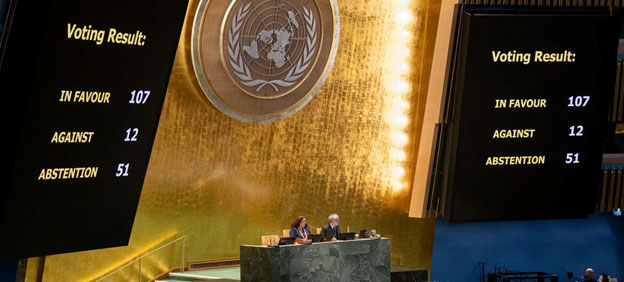
Result of the General Assembly vote on the draft resolution “Support for lasting peace in Ukraine” adopted during the emergency special session. 24 February 2026
Four years after Russia launched its full-scale invasion of Ukraine, the UN is marked the day with high-level debate and renewed calls to end the war – including in the General Assembly which passed a resolution reaffirming its strong commitment to the sovereignty, independence and territorial integrity of Ukraine. Credit: UN Photo/Manuel Elías

GENEVA, Feb 25 2026 (IPS) – After surviving the harshest winter in a decade, millions of displaced Ukrainians are confronting a growing crisis marked by hardship and ongoing attacks as peace prospects remain distant.


Inside Ukraine, repeated attacks on housing, energy systems and essential services throughout the winter left millions without heating or electricity for prolonged periods. While temperatures are slowly rising, the damage remains. An estimated 10.8 million people inside the country need humanitarian assistance in 2026, and 3.7 million are internally displaced.

At the same time, 5.9 million Ukrainians remain refugees abroad. Across Europe, host countries have provided protection and opportunities at an unprecedented scale, giving refugees access to education, healthcare and employment. This has helped millions regain stability and contribute to host communities.

As the war continues, however, more is needed to support refugees from a displacement crisis with no clear end. Alongside Temporary Protection, States should explore options for alternative arrangements for longer stay. These can bring stability for the most vulnerable in particular, for whom return may not be immediately possible even after the war.

Evidence shows that meaningful inclusion delivers results and refugees significantly boost host country economies. In Poland, analysis by UNHCR and Deloitte showed that Ukrainian refugees’ net impact amounted to 2.7 per cent of the Polish GDP, in 2024. With increased language training and wider recognition of credentials, access to decent work and self-reliance can improve for refugees across the region.

Inside Ukraine, communities continue to repair homes, restore services and rebuild livelihoods, with the support of UNHCR and NGO partners. But after four years of war, resilience has limits. Sustained humanitarian assistance remains essential, alongside scaled-up recovery and reconstruction support to prevent further displacement and enable safe conditions for return.

When conditions allow, gradual and voluntary returns will be critical for Ukraine’s recovery. UNHCR is working with the Government and partners to restore people’s documents, support rehabilitation of social infrastructure and repair war-damaged homes. UNHCR also works with partners to analyse refugees’ intentions, forecast return movements and support Ukraine’s recovery planning.

Since the start of the full-scale war, UNHCR and partners have supported 10 million people with emergency aid, protection services and psychosocial support. In 2026, UNHCR plans to assist a further 2 million people inside the country, subject to sufficient funding. Across the region, UNHCR and partners are supporting 1.7 million refugees and the States hosting them, with a focus on inclusion and self-reliance.

As winter fades, the humanitarian crisis does not. We must support the people of Ukraine with humanitarian relief and recovery inside the country, and with safety and self-reliance abroad.

Philippe Leclerc is UNHCR’s Regional Director for Europe and Regional Refugee Coordinator for the Ukraine Situation

IPS UN Bureau

  Source

UN Report Details Grave Abuses Against those Trafficked into Scam Centres

Civil Society, Crime & Justice, Democracy, Global, Global Governance, Headlines, Human Rights, IPS UN: Inside the Glasshouse, TerraViva United Nations

Opinion

UN Report Details Grave Abuses Against those Trafficked into Scam Centres

A UN human rights report has found that people trafficked and forced to work at scam centres are subjected to torture, sexual abuse and prison-like conditions. (representational photo). Credit: UNICEF/Ron Haviv

GENEVA, Feb 23 2026 (IPS) – A report published today by the UN Human Rights Office graphically details the lived experiences of some of the hundreds of thousands of people trafficked from dozens of countries around the world into working in entrenched scam operations mostly in Southeast Asia, as well as far beyond.


The report documents instances of torture and other ill-treatment, sexual abuse and exploitation, forced abortions, food deprivation, solitary confinement, among other grave human rights abuses. Survivors also shared experiences of border officials aiding scam recruiters, and of threats and extortion by police.

Satellite imagery and on-ground reports show that nearly three-quarters of the scam operations are in the Mekong region, which have also spread to some Pacific Island countries and South Asia, as well as Gulf States, West Africa and the Americas.

“The treatment endured by individuals within the context of scam operations is alarming,” finds the report, based on interviews with survivors originating from Bangladesh, China, India, Myanmar, Sri Lanka, South Africa, Thailand, Viet Nam and Zimbabwe.

They had been trafficked into scam centres in Cambodia, Lao People’s Democratic Republic, Myanmar, the Philippines and the United Arab Emirates between 2021 and 2025. It is also based on interviews with police and border officials, as well as civil society and others with knowledge of such operations.

Victims described being lured into scamming jobs under false pretences and then being coerced into perpetrating online fraud ranging from impersonation scams, online extortion, financial fraud as well as romantic scams.

The operations described are fluid, with some survivors sharing experiences of being held in immense compounds resembling self-contained towns, some over 500 acres in size, made up of heavily fortified multi-storey buildings with barbed wire-topped high walls, guarded by armed and uniformed security personnel.

“A victim from Sri Lanka related how those who failed to meet monthly scamming targets were subject to immersion in water containers (known as ’water prisons’) for hours,” said the report, which updates a 2023 UN Human Rights report.

“Victims also recounted being forced to witness or even conduct grave abuse of others as a means to ensure compliance; one Bangladeshi victim said that he was ordered to beat other workers and a victim from Ghana recounted being forced to watch his friend being beaten in front of him.”

They told of people losing their lives as they attempted to escape, including falling from balconies and roofs in the compounds.

Failed rescue attempts were also punished severely, the report finds. One Vietnamese victim described how her sister was beaten, tasered and locked in a room with no food for seven days after her sister had tried to engineer her escape.

It found traffickers would video call family members to watch their loved one being abused and mistreated in order to pressure families to pay extortionate ransoms.

While most victims described receiving some wages, all those interviewed by UN Human Rights experienced a range of escalating deductions and none received the entirety of the promised salary. A Thai victim reported that they were ordered to meet steep scamming targets of some $9,500 per day to avoid fines, beatings, or even being “sold” to another compound with harsher conditions.

“The litany of abuse is staggering and at the same time heart-breaking,” UN Human Rights Chief Volker Türk said. “Yet, rather than receiving protection, care and rehabilitation as well as the pathways to justice and redress to which they are entitled, victims too often face disbelief, stigmatization and even further punishment.”

“Effective responses need to be centred in human rights law and standards. Crucially, that means explicitly recognizing forced criminality within anti-trafficking laws and regulations and guaranteeing the non-punishment principle for victims of trafficking.”

“Victims of such abuses require coordinated timely, safe and effective rescue operations, respect for the principle of non-refoulement, as well as available support mechanisms to ensure torture and trauma rehabilitation and address risks of reprisals or re-trafficking.”

The report uniquely applies a behavioural science and systems analysis to explore why people continue to fall prey to fraudulent recruitment into scam operations and to suggest rights-based and effective prevention responses.

“There must be increased availability and accessibility of safe labour migration pathways and meaningful oversight of recruitment such as verification of online job postings and flagging suspicious recruitment patterns,” Türk said.

He called on States and relevant stakeholders to engage trusted and community-based actors, such as survivor-led groups, in outreach to individuals considered at risk of trafficking into scam operations. Awareness activities need to be accessible, concrete and available through trusted media.

Türk also urged States and regional bodies to act effectively against corruption, which he said was deeply entrenched in such lucrative scamming operations, and to prosecute the criminal syndicates behind them. He also recalled the importance of independent media, human rights defenders and civil society organisations being able to carry out their vital anti-trafficking work free from interference.

IPS UN Bureau

  Source

Ode to U.S. Civil Rights Icon Rev. Jesse Jackson Sr: A Life That Carried the Rainbow

Civil Society, Democracy, Featured, Global, Headlines, Human Rights, IPS UN: Inside the Glasshouse, TerraViva United Nations

Opinion

Ode to U.S. Civil Rights Icon Rev. Jesse Jackson Sr: A Life That Carried the Rainbow

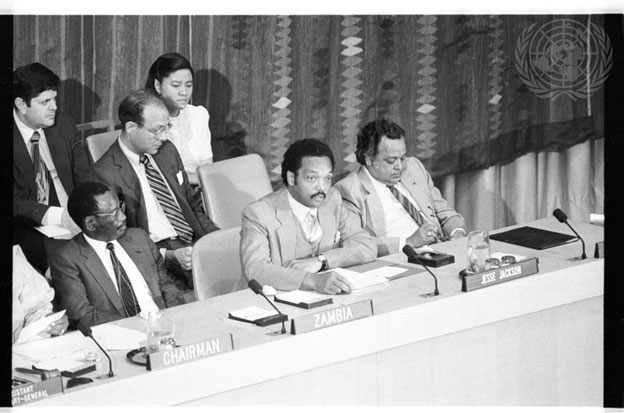
Secretary-General Antonio Guterres was saddened to learn of the passing of the Rev. Jesse Jackson, a giant of the civil rights movement in the US and a longtime champion of human rights, equality and justice around the world. Credit: United Nations

NEW YORK, Feb 20 2026 (IPS) – When the Rev. Jesse Jackson Sr. declared, “Keep hope alive,” it was not a slogan. It was a discipline. It was a moral posture. It was a promise to those America had locked out of its prosperity and pushed to the margins of its democracy. And for more than five decades, Jackson kept that promise – organizing, marching, preaching, negotiating, and standing in solidarity with oppressed peoples at home and abroad.


In mourning Jackson, the United States does not simply bid farewell to a towering civil rights leader. It salutes one of the architects of modern American conscience.

The Heir to a Movement, the Builder of a Coalition

Born in Greenville, South Carolina, in 1941, Jackson came of age in the crucible of segregation. As a young activist, he worked alongside the Rev. Dr. Martin Luther King Jr. and the Southern Christian Leadership Conference, absorbing the lessons of nonviolent resistance while sharpening his own gifts for oratory and mobilization. After King’s assassination in 1968, Jackson did not retreat into despair. He stepped forward.

In 1971, he founded Operation PUSH (People United to Save Humanity), later merging it into the Rainbow Coalition. That phrase – Rainbow Coalition – was not rhetorical flourish. It was strategic genius. Jackson understood that America’s power structure thrived on division: Black against white, native-born against immigrant, worker against worker. His coalition sought to transcend those fault lines.

Black, brown, yellow, and poor white Americans; labor unions; family farmers; peace activists; Arab Americans; Jewish progressives; Asian Americans; Latinos; Native Americans—Jackson invited them all into a shared moral project. In the 1980s, when he ran for the Democratic presidential nomination in 1984 and 1988, millions who had never seen themselves reflected in presidential politics suddenly felt visible. He did not win the presidency. But he expanded the boundaries of who could plausibly seek it.

In doing so, Jackson helped pave the road that others would travel – most notably Barack Obama who went on to become the first African American President of the United States of America. Without the Rainbow Coalition, the arc of American political inclusion would have bent far more slowly.

Internationalism as Moral Imperative

Jackson’s courage was not confined to domestic battles. At a time when Cold War orthodoxy and Middle East politics discouraged nuance and punished dissent, he insisted that American moral credibility required consistency.

He extended solidarity to the oppressed people of Palestine long before it was politically fashionable – or safe – to do so. Jackson argued that the dignity and rights of Palestinians were inseparable from the universal principles Americans claimed to cherish. He sought dialogue with leaders across divides, believing that empathy was not endorsement, and that engagement was a prerequisite for peace.

He was equally forthright in condemning South Africa’s apartheid regime. While many U.S. leaders hedged or prioritized strategic interests, Jackson stood with the anti-apartheid movement. He supported sanctions and economic pressure to dismantle a system that codified racial subjugation. When Nelson Mandela emerged from 27 years of imprisonment, Jackson was among those who celebrated not only a man’s freedom but a nation’s rebirth.

In both Palestine and South Africa, Jackson’s stance reflected a deeper conviction: that civil rights were not an American export but a universal birthright. His faith demanded it. His politics operationalized it.

Faith, Integrity, and the Politics of Presence

Jackson was first and always a preacher. His sermons were political, but his politics were pastoral. He believed that despair was the greatest ally of injustice. To tell the forgotten that they mattered was itself an act of resistance.

He traveled where others would not. He negotiated for the release of hostages in Syria and Cuba. He met with heads of state and with families in housing projects. He listened.

Critics sometimes accused him of courting controversy or of grandstanding. But Jackson understood a hard truth: marginalized communities often need someone willing to occupy uncomfortable space on their behalf. Silence, in his view, was complicity.

His life was not without flaws or missteps. No life of consequence is. Yet what distinguished Jackson was his refusal to abandon the struggle. He endured political setbacks, media caricatures, and internal party resistance. He persisted.

Leadership, he demonstrated, is not about perfection. It is about fidelity—to principles, to people, to purpose.

The Rainbow as a Democratic Blueprint

In an era increasingly defined by polarization, Jackson’s Rainbow Coalition reads less like a relic of the 1980s and more like a blueprint for democratic survival. He recognized demographic change not as a threat but as a promise. He saw in America’s diversity the possibility of moral and economic renewal.

He championed voting rights, labor protections, public education, and economic justice. He opposed apartheid abroad and discrimination at home. He insisted that foreign policy reflect domestic values and that domestic policy reckon with global inequality.

The Rainbow was not naïve about power. It was strategic. It sought to translate moral energy into electoral leverage. Jackson registered voters. He built grassroots networks. He forced party platforms to incorporate issues once dismissed as fringe.

His presidential campaigns altered the calculus of American politics. They demonstrated that Black candidates could compete nationally, that poor and working-class voters could be mobilized across racial lines, and that progressive foreign policy positions had a constituency.

A Hand Extended Across Divides

Perhaps Jackson’s most underappreciated gift was his willingness to extend a hand of friendship where animosity seemed entrenched. He believed in meeting adversaries face-to-face. He believed that even hardened systems could yield to persistent moral pressure.

In Palestine, Rev. Jesse Jackson Senior spoke of human rights and mutual recognition. In South Africa, he, spoke of freedom and reconciliation. At home, he, spoke of multiracial democracy.

When few American leaders dared to articulate solidarity with Palestinians living under occupation, Jackson did. When Washington’s establishment hesitated to confront Pretoria’s apartheid regime, Jackson did not. His courage was not abstract. It was embodied in travel, in speeches, in alliances, in risks taken.

He paid political costs for these positions. But he did not recalibrate his convictions to suit prevailing winds.

The Best of the United States

To commemorate Jesse Jackson is to acknowledge the paradox of America itself. He emerged from a nation scarred by slavery and segregation, yet he believed in its redemptive capacity. He criticized its failures unsparingly, yet he invested his life in its institutions.

He was, in that sense, profoundly patriotic.

The United States at its best is not defined by military might or economic dominance. It is defined by its capacity for self-correction. By its willingness to expand the circle of belonging. By its recognition that justice delayed is democracy diminished.

Jackson embodied that tradition. He did not romanticize America. He challenged it. He called it to live up to its founding ideals – not selectively, but universally.

As debates rage today over voting rights, racial equity, immigration, Middle East policy, and America’s global role, Jackson’s life offers a moral compass. He reminds us that coalitions are built, not assumed. That solidarity is practiced, not proclaimed. That hope is sustained through organization.

Keeping Hope Alive

In the final analysis, Jesse Jackson’s greatest achievement may have been psychological. He taught millions that their voices mattered. That they were not condemned to permanent marginalization. That politics could be an instrument of empowerment rather than exclusion.

For Black Americans who had never seen a serious presidential bid from one of their own, he opened a door. For Palestinians seeking recognition of their humanity, he offered validation. For South Africans resisting apartheid, he offered solidarity. For workers, immigrants, and the poor, he offered a coalition.

He lived the conviction that the struggle for justice is indivisible.

Today, as the rainbow he envisioned faces new storms, the measure of our tribute will not be in words but in action. To honor Jesse Jackson is to organize. To vote. To speak. To stand with the oppressed – whether in Chicago, Johannesburg, or Gaza. To build alliances across lines others insist are permanent.

He demonstrated that leadership grounded in faith, integrity, and courage can alter a nation’s trajectory. He showed that America’s story is not finished – and that its best chapters are written by those who refuse to surrender to cynicism.

Rev. Jesse Jackson Sr. kept hope alive.

The question now is whether we will.

Purnaka L. de Silva, Ph.D., is College and University Adjunct Professor of the Year 2022, Best Adjunct Professor 2024-2025 and Nominated Best Adjunct Professor 2026 at the School of Diplomacy and International Relations Seton Hall University; Visiting Professor Sol Plaatje University Faculty of Humanities; Director Institute of Strategic Studies and Democracy (ISSD) Malta; and Strategic Advisor Lead Integrity.

IPS UN Bureau

  Source

International Humanitarian Law is at Breaking Point – but not Beyond Repair

Armed Conflicts, Civil Society, Crime & Justice, Democracy, Global, Headlines, Human Rights, IPS UN: Inside the Glasshouse, TerraViva United Nations

Opinion

Credit: UNICEF/Eyad El Baba

 
What is international humanitarian law? Families flee their shattered homes in Tal al-Hawa neighbourhood in Gaza city. While aid workers serving conflict-affected civilian populations depend on a set of laws to protect them, some warring parties violate these global agreements, from targeting hospitals and schools to blocking aid workers from reaching civilians with lifesaving goods and services. Source: UN News

GENEVA, Feb 17 2026 (IPS) – International humanitarian law is at a breaking point, as rampant impunity for serious violations is enabling even greater abuses against civilians and detainees.


Across today’s wars, violations are no longer concealed or exceptional. They are increasingly open, systematic, and unpunished, with catastrophic consequences for those whom the law is supposed to protect.

New analysis of 23 situations of armed conflict between July 2024 and the end of 2025 reveals a consistent pattern: civilians are being killed, abused and starved at scale, while accountability mechanisms either falter or are actively undermined. Genocidal violence in Gaza, a renewed risk of genocide in Sudan, and mass atrocities elsewhere are not isolated horrors. Taken together, they point to a deeper failure – the collapse of meaningful restraint in the conduct of hostilities.

Conflict-related sexual violence has reached epidemic levels. Rape, sexual slavery, and sexual violence used as punishment or as a tool of territorial control have been documented across multiple conflicts, including in Colombia, the Democratic Republic of Congo, Myanmar, and Sudan. Particularly alarming is the growing number of cases involving attacks children, including victims as young as one.

These are not by-products of war, but violations long prohibited under international humanitarian law, now committed with near-total impunity. This occurs with the complicity of many other States, which have a duty to respect and ensure respect international humanitarian law.

This erosion of civilian protection is not primarily the result of gaps in legal knowledge. The rules exist. The problem is political choice – and a persistent failure to enforce, clarify and update the law where it no longer offers meaningful restraint.

Nowhere is this clearer than in the global arms trade. The United Nations Arms Trade Treaty has been widely ratified, including by major exporters such as China, France, and the United Kingdom. In theory, it requires its member States to deny arms transfers where there is a clear risk that weapons will be used to commit serious violations of international law. In practice, legal risk assessments are all too often overridden by strategic and political considerations.

Continued arms exports to Israel, Russia, and others, despite overwhelming evidence of civilian harm, have had devastating consequences on the ground.

Closing this gap does not require a raft of new rules in the short term. It requires the consistent application of existing ones: enforceable, evidence-based export controls; independent scrutiny of licensing decisions; and real accountability where transfers are authorised despite a clear risk that the law will be breached by the recipient.

Certain categories of weapons are though incompatible with the protection of civilians, but do not necessarily violate the already permissive standards. Repeated firing into populated areas of gravity ordnance from the air and inaccurate long-range artillery from the ground has been a major driver of civilian casualties across multiple conflicts.

There is a fundamental lack of clarity on two key rules: first, how close an attack may be launched to a military target while still complying with the law; and second, how much incidental civilian harm is permissible when targeting a military objective.

On both issues, the law urgently requires clarification. Restricting air-delivered weapons to precision-guided munitions alone would already make a measurable difference to civilian survival. Achieving this, however, requires States to clarify and update the rules of international humanitarian law that were drafted in the 1970s.

In State-on-State conflicts such as in Kherson province in Ukraine, drones have been used by Russian forces – and others – to target civilians, sometimes with real-time video footage disseminated online by the perpetrators.

At the same time, armed drones are no longer the preserve of States. Their use by non-State armed groups is increasing rapidly, including by JNIM in the Sahel, Islamic State in Somalia, and the Arakan Army in Myanmar. There is an urgent need for stronger mechanisms to attribute, investigate, and prosecute unlawful drone and autonomous weapon attacks.

Impunity on this scale is not inevitable. It is the product of sustained political and financial neglect. Institutions designed to promote compliance with international humanitarian law – including domestic courts and international tribunals – are under severe strain, with some facing paralysis or closure due to lack of resources.

Judges at bodies such as the International Criminal Court have even been sanctioned simply for carrying out their mandates. If States are serious about protecting civilians, political and financial support for these institutions must be treated as a core obligation and a policy priority, not an optional gesture.

The current moment represents a critical test for international humanitarian law itself. The international lawyer Hersch Lauterpacht once warned that the law existed at the “vanishing point” of international law. That warning is no longer theoretical.

Whether humanitarian law continues to function as a real constraint on warfare, or recedes into symbolic rhetoric, will depend on the political choices states make now – and on whether civilian protection is treated as a legal duty rather than a discretionary one.

Stuart Casey-Maslen is an international lawyer and lead author of War Watch: International Humanitarian Law in Focus at the Geneva Academy of International Humanitarian Law and Human Rights

IPS UN Bureau

  Source