Is the UN’s Human Rights Agenda in Jeopardy?

Civil Society, Democracy, Featured, Global, Global Governance, Headlines, Human Rights, Indigenous Rights, IPS UN: Inside the Glasshouse, TerraViva United Nations

Credit: United Nations

UNITED NATIONS, Feb 24 2025 (IPS) – The UN’s human rights agenda is in danger of faltering since the Geneva-based Office of the High Commissioner for Human Rights (UNHCHR) is planning to “restructure” the office, under the moniker OHCHR 2.0.

But this proposal, if implemented, would result in the abolition of the Special Procedures Branch, established by the Human Rights Council (HRC), to report and advise on human rights from thematic and country-specific perspectives.


The question remains whether or not the HRC will give its blessings to the proposed restructuring. Currently, there are more than 46 thematic mandates and 14 country-specific mandates.

The Special Rapporteurs (who are also designated “independent UN human rights experts”) cover a wide range of thematic issues, including investigations into extrajudicial, summary or arbitrary executions, racism and xenophobia, human rights in the Palestinian territories, right to freedom of opinion and expression, rights of the indigenous peoples, violence against women, human rights of immigrants, among others.

https://www.ohchr.org/en/special-procedures-human-rights-council/current-and-former-mandate-holders-existing-mandates

Ian Richards, an economist at the Geneva-based UN Conference on Trade and Development (UNCTAD) and former President of the Coordinating Committee of International Staff Unions and Associations, told IPS the staff of the Special Procedures Branch play an essential role in supporting the work of the special rapporteurs.

He said former UN Secretary-General Kofi Annan described their work as the jewel in the crown of the UN human rights system.

“We know that some of their recent work has created pushback. There is a belief is that they are being penalized for this”.

“The High Commissioner for Human Rights “hasn’t accepted to meet with the staff union to discuss this, which is unusual. We hope he will change his mind,” said Richards.

Some of the Special Rapporteurs have been vociferously critical of member states, including Israel, on war crimes charges in Gaza, and also countries in the Middle East and South-east Asia, like Singapore and Saudi Arabia, for continuing to enforce the death penalty.

In a press release last week, two Special Rapporteurs said Singapore must urgently halt the execution of Malaysian national Pannir Selvam Pranthaman for drug trafficking.

“We have repeatedly** called on Singapore to halt executions for drug offences which are illegal under international human rights law on several grounds,” the experts said.

“We reiterate that under international law, only crimes of extreme gravity involving intentional killing meet the threshold for the death penalty,” the experts said. “Mandatory death sentences are inherently over-inclusive and inevitably violate human rights law.”

“There is no evidence that the death penalty does more than any other punishment to curb or prevent drug trafficking,” they said.

The experts warned that the rate of execution notices for drug-related offences in Singapore was “highly alarming”. They noted that eight people have already been executed on these charges since 1 October 2024, a period of just four and a half months.

Speaking off-the-record, a UN source told IPS the staff of the Special Procedures Branch fear the “re-structuring” is being done in order to reduce the effectiveness and voice of the Special Rapporteurs. And the High Commissioner’s refusal to consult with the union may be evidence of this, he said.

“As you may be aware, the special rapporteurs, and one in particular, have been vocal on the issue of Gaza, which has generated complaints from a number of member states to the High Commissioner. To seek a second term, he needs their support”.

According to the UN, Special Rapporteurs/Independent Experts/Working Groups are independent human rights experts appointed by the United Nations Human Rights Council. Together, these experts are referred to as the Special Procedures of the Human Rights Council.

Special Procedures experts work on a voluntary basis; they are not UN staff and do not receive a salary for their work. While the UN Human Rights office acts as the secretariat for Special Procedures, the experts serve in their individual capacity and are independent from any government or organization, including OHCHR and the UN.

Any views or opinions presented are solely those of the author(s) and do not necessarily represent those of the UN or OHCHR. Country-specific observations and recommendations by the UN human rights mechanisms, including the special procedures, the treaty bodies and the Universal Periodic Review, can be found on the Universal Human Rights Index https://uhri.ohchr.org/en/

The Office of the High Commissioner is being funded by the UN regular budget and voluntary contributions.

But UN Special Rapporteurs are not paid a salary by the United Nations. They receive funding primarily through logistical and personnel support from the Office of the High Commissioner.

They often also receive additional funding from private foundations and NGOs like the Ford Foundation and Open Society Foundations, which can raise concerns about potential conflicts of interest due to the source of funding.

Special procedures cover all human rights: civil, cultural, economic, political and social as well as issues relating to specific groups. Special procedures mandate-holders are either an individual (called a Special Rapporteur (SR) or Independent Expert (IE)) or a Working Group (WG) of five members, according to the UN.

As part of their mandates, special procedures examine, advise and publicly report on human rights issues and situations. They conduct thematic studies and convene expert consultations, contribute to the development of international human rights standards, engage in advocacy and provide advice for technical cooperation.

Upon the invitation from Governments, they visit particular countries or territories in order to monitor the situation on the ground. Special procedures also act on individual cases and concerns of a broader, structural nature by sending communications to States and other entities in which they bring alleged violations or abuses to their attention.

Finally, they raise public awareness of a specific topic through press releases or other public statements. Special procedures report annually to the Human Rights Council; the majority of the mandates also report annually to the General Assembly

In 2024, OHCHR received a total of US$268.9 million in voluntary contributions. As in previous years, the overwhelming majority of voluntary contributions came from Member States and International organizations including the European Commission and UN partners.

IPS UN Bureau Report
  Source

Trump’s War on Global Governance: Lessons from the Past on How to Fight Back

Civil Society, Democracy, Featured, Global, Global Governance, Headlines, Human Rights, International Justice, IPS UN: Inside the Glasshouse, TerraViva United Nations

Opinion

Daniel D. Bradlow is Professor/Senior Research Fellow, Centre for the Advancement of Scholarship, University of Pretoria, South Africa.

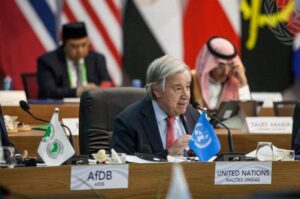
In a powerful appeal to the world’s largest economies during the G20 Summit, November 2024, UN Secretary-General António Guterres called for urgent climate action and reform of international institutions, warning that current systems are failing to meet global challenges. Credit: UN Photo/Gustavo Stephan

PRETORIA, South Africa, Feb 19 2025 (IPS) – US president Donald Trump’s recent actions seem designed to reassert American power and demonstrate that it is still the dominant global power and is capable of bullying weaker nations into following America’s lead.


He has shown contempt for international collaboration by withdrawing from the UN climate negotiations and the World Health Organization. His officials have also indicated that they will not participate in upcoming G20 meetings because he does not like the policies of South Africa, the G20 president for 2025.

In addition, he’s shown a lack of concern for international solidarity by halting US aid programmes and by undermining efforts to keep businesses honest. He has demonstrated his contempt for allies by imposing tariffs on their exports.

These actions demand a response from the rest of the international community that mitigates the risk to the well-being of people and planet and the effective management of global affairs.
My research on global economic governance suggests that history can offer some guidance on how to shape an effective response.

Such a response should be based on a realistic assessment of the configuration of global forces. It should seek to build tactical coalitions between state and non-state actors in both the global south and the global north who can agree on clear and limited objectives.

The following three historical lessons help explain this point.

Cautionary lessons

The first lesson is about the dangers of being overoptimistic in assessing the potential for change. In the late 1960s and early 1970s, the US was confronting defeat in the war in Vietnam, high inflation and domestic unrest, including the assassination of leading politicians and the murder of protesting students.

The US was also losing confidence in its ability to sustain the international monetary order it had established at the Bretton Woods conference in 1944.

In addition, the countries of the global south were calling for a new international economic order that was more responsive to their needs. Given the concerns about the political and economic situation in the US and the relative strength of the Soviet bloc at the time, this seemed a realistic demand.

In August 1971, President Richard Nixon, without any international consultations, launched what became known as the Nixon Shock. He broke the link between gold and the US dollar, thereby ending the international monetary system established in 1944. He also imposed a 10% surcharge on all imports into the US.

When America’s European allies protested and sought to create a reformed version of the old monetary order, US treasury secretary John Connolly informed them that the dollar was our currency but your problem.

Over the course of the 1970s, US allies in western Europe, Asia and all countries that participated in the old Bretton Woods system were forced to accept what the US preferred: a market-based international monetary system in which the US dollar became the dominant currency.

The US, along with its allies in the global north, also defeated the calls for a new international economic order and imposed their neo-liberal economic order on the world.

The second cautionary lesson highlights the importance of building robust tactical coalitions. In 1969, the International Monetary Fund member states agreed to authorise the IMF to create special drawing rights, the IMF’s unique reserve asset.

At the time, many IMF developing country member states advocated establishing a link between development and the special drawing rights. This would enable those countries most in need of additional resources to access more than their proportionate share of special drawing rights to fund their development.

All developing countries supported this demand. But they couldn’t agree on how to do it. The rich countries were able to exploit these differences and defeat the proposed link between the special drawing rights and development.

As a result, the special drawing rights are now distributed to all IMF member states according to their quotas in the IMF. This means that most allocations go to the rich countries who do not need them and have no obligation to share them with developing countries.

A third lesson arises from the successful Jubilee 2000 campaign to forgive the debts of low-income developing countries experiencing debt crises. This campaign, supported by a secretariat in the United Kingdom, eventually involved: civil society organisations and activists in 40 countries a petition signed by 21 million people and governments in both creditor and debtor countries.

These efforts resulted in the cancellation of the debts of 35 developing countries. These debts, totalling about US$100 billion, were owed primarily to bilateral and multilateral official creditors.

They were also a demonstration of the political power that can be generated by the combined actions of civil society organisations and governments in both rich and poor countries.

They can force the most powerful and wealthy institutions and individuals in the world to accept actions that, while requiring them to make affordable sacrifices, benefit low-income countries and potentially poor communities within those states.

What conclusions should be drawn?

We shouldn’t under-estimate the power of the US or the determination of the MAGA movement to use that power. However, their power is not absolute. It is constrained by the relative decline in US power as countries such as China and India gain economic and political strength.

In addition, there are now mechanisms for international cooperation, such as the G20, where states can coordinate their actions and gain tactical victories that are meaningful to people and planet.

But gaining such victories will require the following:

Firstly, the formation of tactical coalitions that include states from both the global south and the global north. If these states cooperate around limited and shared objectives they can counter the vested interests around the world that support Trump’s objectives.

Secondly, a special kind of public-private partnership in which states and non-state actors set aside their differences and agree to cooperate to achieve limited shared objectives. Neither states alone nor civil society groups alone were able to defeat the vested interests that opposed debt relief in the late 1990s. Working together they were able to defeat powerful creditor interests and gain debt relief for the poorest states.

Thirdly, this special partnership will only be possible if there’s general agreement on both the diagnosis of the problem and on the general contours of the solution. This was the case with the debt issue in the 1990s.

There are good candidates for such collaborative actions. For example, many states and non-state actors agree that international financial institutions need to be reformed and made more responsive to the needs of those member states that actually use their services but lack voice and vote in their governance.

The institutions also need to be more accountable to those affected by their policies and practices. They also agree that large corporations and financial institutions should pay their fair share of taxes and should be environmentally and socially responsible.

The urgency of the challenges facing the global community demands that the world begin countering Trump as soon as possible. South Africa as the current chair of the G20 has a special responsibility to ensure that this year the G20, together with its engagement groups, acts creatively and responsibly in relation to people and planet.

Source: Conversation Africa

IPS UN Bureau

  Source

Human Rights, Healthcare Disrupted in Eastern Europe With USAID Funding Freeze

Aid, Civil Society, Democracy, Development & Aid, Editors’ Choice, Education, Europe, Featured, Headlines, Health, Human Rights, Humanitarian Emergencies, Sustainable Development Goals, TerraViva United Nations

Aid

Crowley Logistics in Miami, Florida, was one of three USAID shipping and logistics facilities in the nation. It could, in times of emergency humanitarian relief aid, respond with supplies delivered to aircraft at Miami International Airport within two hours. Credit: USDAID/Lance Cheung

Feb 17 2025 (IPS) – As the full effects of the US decision to freeze foreign aid funding begin to be felt across the world, organizations in Eastern Europe and Central Asia (EECA) are warning years of work in everything from delivering life-saving healthcare to defending human rights and strengthening democracy could be undone.


In many countries in the region, foreign aid is vital for the continued functioning of large parts of civil society and the activities NGOs and other groups carry out.

But since US President Donald Trump’s executive order on January 20 freezing foreign aid for 90 days and a ‘stop work order’ announced four days later, some groups have had to entirely, or partly, shut down their operations—with potentially devastating consequences.

One area that has been heavily affected is the fight against HIV/AIDS.

According to a UN report published in 2024, only half of the 2.1 million people living with HIV in the EECA region have access to treatment, and just 42% of people living with HIV have suppressed viral loads—the lowest rate in the world. In 2023, 140,000 new cases of HIV infection were registered in the region.

US funding has been central to the HIV response in EECA, including through the US President’s Emergency Plan for AIDS Relief (PEPFAR), as well as USAID.

According to UNAIDS, this support has helped fund community-based HIV prevention programmes, provision of antiretroviral therapy (ART), development of laboratory and diagnostic infrastructure, and training of health workers. It has also played a key role in prevention and harm reduction programmes among key populations.

This is critical in a region where 94 percent of new HIV cases occur among key populations and their partners.

While US aid is not the primary source of funds for HIV programmes in some countries in the region, in others it is vital.

In Ukraine, which has Europe’s second worst HIV epidemic, local groups working with key populations and people living with HIV say the aid freeze has had a dramatic impact.

The charity 100% Life provides treatment and prevention services to marginalized communities, including drug users and people with HIV, TB, and other diseases, often operating in frontline areas.

Dmytro Sherembei, head of the Coordination Council of 100% Life, told IPS that up to 25 percent of specialist staff carrying out testing, monitoring and other tasks would have to be laid off, while testing programmes and other assistance for state healthcare projects would be stopped.

“The funding suspensions stopped our whole programme, and it will cause a lot of damage,” he said.

Meanwhile, the Alliance for Public Health (APH), one of the country’s largest healthcare NGOs, said its HIV case-finding operations had been suspended after the aid freeze.

“About 35-40 percent of all HIV-positive cases in Ukraine are found, tested, and referred for treatment by APH and its partners. It will be difficult to find alternative funding,” Andriy Klepikov, Executive Director of APH, told IPS.

APH estimates the halt to testing could mean thousands of cases going undetected during the 90-day suspension of aid.

There are also concerns that treatment for more than 100,000 patients with HIV may be interrupted. Since the beginning of Russia’s full-scale invasion, the Ukrainian government has not had funds to procure antiretroviral drugs (ARVs), and PEPFAR has been procuring ARVs for all patients.

The country has ARV stocks for the next six months, “but a suspension of funding could impact the next delivery of medications planned for March,” Klepikov said.

“This funding stop threatens to turn a manageable epidemic into a deadly crisis,” warned Sherembei.

In Tajikistan, US funding has supported services including treatment and prevention among key populations, training of professionals, strengthening of local organizations, and support for community-led initiatives.

But the funding freeze is threatening to undo years of progress, local HIV activists told IPS.

Pulod Dzhamalov, Director of the Tajik NGO SPIN PLUS, said services for people living with HIV and other key populations in many places had “simply ceased to exist.”

“For many people who sought these services, it was the only place where they felt safe. And staff who worked on these projects have suddenly found themselves unemployed, without any means of livelihood or hope for the future. Significant resources were invested in building a positive image of these services, and now all of that has gone to waste. A considerable portion of the national HIV prevention programme’s budget was covered by PEPFAR funding, and this will inevitably impact the healthcare system as a whole,” he said.

Takhmina Haiderova, head of the Tajik Network of Women Living with HIV, said her organization was “facing serious challenges” and that the freeze on US funds had had a significant impact on all HIV-service NGOs in the country.

“Reduced funding results in fewer HIV prevention and treatment projects, staff reductions, and limited access to life-saving services such as testing, counseling, and treatment. In addition, it negatively affects the achievement of the Sustainable Development Goals, such as reducing the spread of HIV, improving the quality of life of people living with HIV, ensuring gender equality, and upholding human rights,” she said.

The decision to freeze funding, especially in places where the epidemic is not improving, such as EECA, risks doing irreparable harm to global efforts to fight HIV, activists say.

“[The Trump administration’s] efforts are doing irreparable harm to the global HIV response and global health more broadly. These are inefficient, wasteful  and deadly policy moves,” Asia Russell, Executive Director of the Health Gap advocacy organization, told IPS.

But it is far from just efforts to fight HIV/AIDS in the region that have been affected by the pause on US aid.

In many countries, foreign funding is essential to the survival of independent media, keeping a check on autocracies and serving audiences living under repressive regimes.

Press freedom watchdogs say the aid freeze has created confusion, chaos, and uncertainty among media organizations and outlets that rely heavily, or completely, on American funds.

Exiled media reporting for audiences in countries such as Russia, Belarus, and others from outside those states are particularly vulnerable.

“This is very bad news for exiled media that relocated to democratic countries after crackdowns. Some newsrooms from Belarus have reported a complete lack of funding due to the current [US aid] freeze, which may lead to a complete cessation of these projects due to the inability to pay employees. Others have been forced to cut their staff, which is very worrying since they have so far managed to keep their audience in their country, despite being forced into exile. Their efforts made it possible to effectively counter official Belarusian and Kremlin propaganda,” Jeanne Cavelier, Head of Eastern Europe & Central Asia Desk at Reporters Without Borders (RSF), told IPS.

Meanwhile, in Ukraine, where nine out of ten outlets rely on subsidies and USAID is the primary donor, a survey after the aid freeze showed that almost 60% of media professionals surveyed believe that the suspension of US media support programmes could have ‘catastrophic consequences and lead to the closure or significant reduction in the work of many independent media outlets,’ according to RSF.

“Projects funded by American aid, such as USAID, were mostly intended to enable the media to investigate corruption and public spending. This is critical for reliable information, as well as for small media outlets reporting from the frontline,” said Cavelier.

“The freeze has already led a number of newsrooms to cut back on content, lower salaries, increase part-time working and reduce staff numbers,” she added.

Editors at local independent media outlets fear the suspension could lead to publications turning to other sources of funding, which could then look to change editorial stances, influence the independence of these media and, potentially, become tools for Russian propaganda.

There are similar fears in other parts of the region.

“The independent media here relies very much on foreign funding because otherwise they would not be economically viable in a country that is poor and in a market where some media are financed by shady Russian money,” Valeriu Pasha, Programme Manager at Moldovan think tank WatchDog.Md, told IPS.

“I think we could definitely see some deals where some media that are now struggling with funding could be bought by, or would start to be funded through, Russian sources in some way,” he added.

However, he pointed out that it was not just independent media that had been affected by the US aid freeze.

“This will have quite an effect on civil society here; plenty of organizations will feel its impact,” he said, pointing out that groups involved in everything from local election observation to healthcare, rights defense, and even working with the government on judicial reform were reliant to some extent on US aid.

“Even our organization, which has not really been affected by this so far, could well be affected in the future. We don’t know,” he added.

The freezing of US funding may also have had an unexpected, although equally pernicious, effect on civil society in the region.

The US administration’s apparent efforts to effectively shutter USAID have been welcomed by authoritarian leaders who have already been cracking down on NGOs and others they see as critical of their regimes.

In Georgia, USAID is currently investing in scores of programmes across the country with a total value of USD 373 million, according to local media. These initiatives focus on, among others, strengthening democratic institutions and increasing public resilience to disinformation.

Much US funding to the country was stopped last year in response to increasingly authoritarian behavior by the ruling regime—including legislative crackdowns on civil society.

But Prime Minister Irakli Kobakhidze earlier this month told local journalists the stop on USAID activities proved his government’s previous claims that the organization’s funds were used not for humanitarian goals but to “stage revolutions, sow disorder, and destabilize countries, including Georgia.”

Lawmakers appear to have also taken it as confirmation of the hardline approach they have already taken to civil society and the media—including a controversial law on foreign funding of NGOs introduced last year, which forced many to close—and emboldened them to tighten restrictions even further. On February 5, a media regulation law was announced that would ban foreign funding of media, as well as an even more restrictive version of the law on foreign funding for NGOs.

Reports have suggested authorities in Russia, where a swathe of laws and repressive measures have already forced the closure of many key services provided by civil society groups in areas from HIV prevention and help for marginalized groups to rights organizations, may be planning to ask US Congress to share a list of Russian citizens who received US funding with Russia’s Federal Security Service (FSB).

Groups affected by the funding freeze are looking to find alternative sources of finance. Some have called for governments, particularly in Europe, to step in and fill the gap left by the withdrawal of American money.

In a statement, a group of European disability organizations and services called on the European Union and non-governmental donors to provide emergency and long-term funding to disability organizations affected by the cuts in US funding.

They highlighted that organizations were implementing lifesaving programs in countries such as Ukraine, Moldova, Georgia and Albania and that the loss of funding will put at risk organizations and persons with disabilities in the Balkans, Eastern Europe and South Caucasus, leaving hundreds of thousands without support.

While there are hopes that US funding will, sooner or later, resume once the Trump administration finishes its review, whatever US foreign aid is resumed, it is unlikely to be disbursed in the same way as it was previously, said Pasha.

“I expect that some aid will resume in some form after the 90-day freeze, but it will reflect the priorities of the new US administration—in the future it will likely be less connected to values and more to economics,” he said.

IPS UN Bureau Report

  Source

Afghan Refugees, Among Others, Feel the Impact of USAID Funding Freeze

Aid, Asia-Pacific, Civil Society, Democracy, Development & Aid, Featured, Headlines, Human Rights, Humanitarian Emergencies, Migration & Refugees, Sustainable Development Goals, TerraViva United Nations, Women’s Health

Aid

Flashback to the opening of a USAID project. Credit: Ashfaq Yusufzai/IPS

PESHAWAR, Pakistan, Feb 16 2025 (IPS) – “I was shocked when told by a security guard that the clinic has been closed down. I, along with my relatives, used to visit the clinic for free checkups,” Jamila Begum, 22, an Afghan woman, told IPS.


The clinic has been established by an NGO with the financial assistance of the USAID to reduce maternal complications on the outskirts of Peshawar, the capital of Khyber Pakhtunkhwa, one of Pakistan’s four provinces. Begum, who is near to delivering a baby, says she couldn’t afford the high fee of blood tests and ultrasound examinations in private hospitals and is concerned about her delivery. Fareeda Bibi, an Afghan refugee, is concerned too.

“We have been receiving more than a dozen Afghan women for pre- and post-natal checkups through a clinic funded by the U.S., which has now been shut down,” Bibi, a female health worker, said at a clinic on the outskirts of Peshawar.

Pakistan is home to 1.9 million Afghan refugees and most of the women seek health services in NGO-run health facilities funded by the United States.

“The Afghan women cannot visit remote hospitals and came here conveniently because we have all female staff but all of a sudden, the small clinics have been closed, leaving the population high and dry,” Bibi says. “In the past year, we have received 700 women for free check-ups and medicines, due to which they were able to stay safe from delivery-related complications.”

Jamila Khan, who runs an NGO helping women in rural settings of the Khyber Pakhtunkhwa, one of Pakistan’s four provinces, is also upset by the funding freeze.

“Most of the USAID’s funds were used by NGOs, who will now either be completely closed down or will look for new sources of funds. For the time being, they are struggling to continue operations after the withdrawal of promised funds,” she says.

The suspension of funds by the USAID has hit all sectors in Pakistan, a former employee of USAID, Akram Shah, told IPS.

“The 39 projects funded by the United States included energy, economic development, agriculture, democracy, human rights and governance, education, health, and humanitarian assistance. The suspension order has impacted all,” he says.

President Donald Trump’s directives of suspending USAID funding worldwide after assuming his office also brought to a standstill several projects worth over USD 845 million in Pakistan.

Shah says the abrupt funding cut will badly harm the small landowners who looked towards the USAID but now we are immensely concerned about how to go ahead with our annual plan of going crops without financial assistance.

Our farming has been worst hit as farmers banked on the financial and technical assistance provided by the U.S. to enhance agricultural productivity.

“Most farmers in rural areas have been benefitting from the USAID for a long time, as we got high-quality seeds, tools, fertilizers, etc., which helped us to grow more crops and earn for our sustenance,” Muhammad Shah, a farmer, says.

The health sector is also badly hit, as USAID’s money kept running the Integrated Health Systems Strengthening and Service Delivery Integrated Health System Program, says Dr. Raees Ahmed at the Ministry of National Health Services Regulations and Coordination.

The promised funds of USD 86 million aimed at strengthening Pakistan’s healthcare infrastructure would leave the program half finished, he says. Additionally, Pakistan was supposed to receive USD 52 million under the Global Health Supply Chain Program to ensure the availability of essential medical supplies, but it will be closed down for want of funds.

Education officer Akbar Ali says they had pinned hopes on USAID’s assistance of USD 30.7 million for the Merit and Needs-Based Scholarship Program for the poor students to continue their studies but it has become a dream now.

Ali says the inclusive democratic processes and governance projects, of which USD 15 million was promised, have been halted. The program, in which teachers were also included, was intended to enhance democratic governance and transparency.

Funds for improving governance and the administrative system in the violence-stricken tribal areas along Afghanistan’s border will also stop. The USAID had pledged USD 40.7 million.

Muhammad Wakil, a social activist, says his organization, which is working for a U.S.-funded Building Peace in Pakistan, is also suffering. The program, worth USD 9 million, aimed at fostering religious, ethnic, and political harmony, has had to close.

“We have asked our workers to stay home and have suspended at least 20 workshops scheduled this year,” Wakil says.

He wondered why the United States, a staunch supporter of peace and religious harmony, has stopped funds.

The Mangla Dam Rehabilitation Project, a USD 150 million initiative essential for Pakistan’s energy and water security, has also suffered.

The decision to suspend these aid programs comes as part of a broader restructuring of US foreign assistance under Trump’s “America First” policy.

USAID, established in 1961 under President John F. Kennedy, has long been a cornerstone of US foreign policy, administering approximately 60 percent of the country’s aid budget. In the 2023 fiscal year alone, USAID disbursed USD 43.79 billion in global assistance, supporting development efforts in over 130 countries, media reported.

IPS UN Bureau Report

  Source

Pakistan: Freedom of Expression at Stake With New Cybercrime Law

Asia-Pacific, Civil Society, Democracy, Editors’ Choice, Featured, Freedom of Expression, Headlines, Human Rights, Sustainable Development Goals, TerraViva United Nations

Freedom of Expression

Pakistani journalists speak out about cybercrimes law from left to right Hamid Mir, Munazza Siddiqui and Umar Cheema. Credits: Jang News, and TikTok

Pakistani journalists speak out about cybercrimes law from left to right Hamid Mir, Munazza Siddiqui and Umar Cheema. Credits: Jang News, and TikTok

KARACHI, Feb 5 2025 (IPS) – “I may not be able to continue hosting my show because the content I put up will most certainly land me in prison,” said senior correspondent Azaz Syed who works for a private TV channel, but who also has his own private online digital channel. He was referring to the recent amendment in the already existing cybercrime law, terming it a “wild” law which has been instituted to grapple with fake news among other online harms.


The new version—Prevention of Electronic Crimes (Amendment) Act, 2025—passed hurriedly, within a week, in both the houses without debate, and signed into a law by President Asif Ali Zardari on January 29, has triggered nationwide protests by the country’s media personnel.

“They have taken away my right to freedom of expression,” Syed told IPS.

“I fail to understand the uproar among journalists working in electronic media. They already have PEMRA, [the Pakistan Electronic Media Regulatory Authority] which is responsible for facilitating and regulating private electronic media,” said Minister for Information and Broadcasting Atta­ullah Tarar. “This law is to regulate the social media and countries across the world have some codes or standards under which social media operate; but there was none in our country.”

He said the existing authority, which is the Federal Investigation Authority, that looked into cybercrimes seemed ill-equipped to handle the expanding nature of online crimes taking place—harassment, pornography, national security threats, spreading economic uncertainty; just look at the conviction rate, which is dismal,” he defended the amendment.

Tarar’s reference to the “uproar” stems from TV journalists, like Syed, who have gigs on online platforms and fear the restrictions on content imposed by PECA.

For the past two years, Syed has been hosting a popular show on YouTube called Talk Shock, focusing on sensitive topics like the Pakistan army, intelligence agencies, blasphemy laws, persecution of Ahmadis, and forced conversions of Hindu girls. He described it as a passion project addressing issues close to his heart, despite potential disapproval from authorities. His show has gained over eight million viewers and 174,000 followers, also providing him with extra income.

Hamid Mir, host of Capital Talk, one of the oldest and highest-rated political talk shows, launched his digital TV channel on YouTube after being banned from TV in 2021 (he had already been banned twice, in 2007 by military dictator Pervez Musharraf  and in 2008 by the ruling Pakistan People’s Party) for  speaking against the country’s powerful military for persecuting journalists. “I share my opinions there when I am unable to on the channel that I’m employed in. Having your own platform is liberating,” he told IPS. He has 263,000 viewers.

Azaz Syed, who has his digital TV programme on YouTube called Talk Shock. Credit: Azaz Syed

Azaz Syed, who has his digital TV programme on YouTube called Talk Shock. Credit: Azaz Syed

Mir’s greater worry though is the possibility of losing his voice on X, where he connects with over eight million followers. “If I can’t speak my mind, it will have a profound impact on me,” he said.

But even those journalists who otherwise feel social media is being misused find the law distasteful.

“I have zero tolerance for fake news, and am all for regulating the beast that social media has become, but not this way, certainly” said senior investigative journalist, Umar Cheema, terming it a “third class” law.

The law was originally passed in 2016, by the same ruling party that has brought the current amendments – the Pakistan Muslim League-N. It had been met with much criticism even then.

“The reason for the need for the law given back in 2016 was to counter hate speech, terrorist content and harassment of women—this time the ruse is fake news,” said Farieha Aziz’s co-founder of Bolo Bhi, an advocacy forum for digital rights. The suspicion and criticism against the law now and then is the same—the government is using this law to “stifle political dissent and rein in freedom of expression” she said.

The amendment to the law, criminalises fake news and its dissemination with a prison term of up to three years and a fine of up to Rs 2 million (about USD 7,200).

But, pointed out Aziz, the concern went beyond just the penalties associated with the amendment to the law—it is the “potential for misuse” in the process of determining what constitutes fake news. “People will be reluctant to share or even discuss information out of fear that it might be deemed false or harmful, leading to criminal charges,” she explained, adding the definition of fake news was vague and broad. “They have created a vagueness through the use of language taken from the anti-terrorism act, around the offence,” she pointed out.

“The government operates in grey areas and likes to keep people in a state of confusion,” agreed Cheema.

Moreover, pointed out, Munazza Siddiqui, senior producer on a private TV channel: “The law is unconstitutional as it violates the fundamental right to freedom, a core principle enshrined in our Constitution.” She uses TikTok, a platform predominantly used for putting up entertaining content, for disseminating news and opinions. “It’s popular with young people but works superbly for me as they are my audience. The millennials and Gen Z want to stay informed about the world around them, but they lack the patience to sit through long articles or watch lengthy news segments on TV. I provide them with both in just a minute or so!”

However, Siddiqui acknowledged that her vlogging might be impacted. With the sword of Damocles hanging over her, in the form of the newly revised cyber law, she said, “We already navigate a space of self-censorship, and now there’s an added layer of fear.”

The law establishes four bodies—the Social Media Protection and Regulatory Authority, the Social Media Complaints Council, the Social Media Protection Tribunal, and the National Cyber Crime Investigation Agency—concentrating significant power. Aziz warned that these bodies, appointed by the federal government, could lack independence, creating potential conflicts of interest and undermining fairness and accountability.

“And the window of appeal has also been closed as I can only go to the Supreme Court of Pakistan,” said Azaz, which was an expensive route to prove your innocence.

Although the 2016 cybercrime law was already considered draconian by experts, the reason to tweak it further, explained Cheema, was that “the nature and use of social media has changed and become more sophisticated since then, adding that the media needed to share the blame for the recent shape the law has taken.

Cheema said the media did not establish a code of conduct for responsible social media use which led the government to step in, using the fake news excuse to silence dissenting voices. He emphasized that while media can express opinions, facts must be solid, and journalists should hold each other accountable. “Yet, we don’t even call out our colleagues for lying.”

Finding the nationwide protest hypocritical, he questioned, “The bill wasn’t a surprise—everyone knew it was being revised. Why didn’t anyone speak up then? Where were the protests and revisions when it was in the National Assembly and Senate? There was silence, and now, after it’s law, they’re out on the streets.”

“The law is in place,” Tarrar said with finality. However, he added: “The rules are still being worked out, and we’re open to media input to refine them.”

“Recalling the law may be tough,” agreed Cheema, but if the media is concerned, “They can come up with their own system; no one is stopping them; but that’s the real test for our community.”

IPS UN Bureau Report

  Source

Venezuela: The Democratic Transition That Wasn’t

Civil Society, Crime & Justice, Democracy, Economy & Trade, Featured, Headlines, Latin America & the Caribbean, Migration & Refugees, TerraViva United Nations

Opinion

Credit: Juan Barreto/AFP via Getty Images

MONTEVIDEO, Uruguay, Feb 3 2025 (IPS) – Venezuela stands at a critical juncture as Nicolás Maduro begins a controversial third term as president. His 10 January inauguration, following a post-election period marked by widespread protests against election fraud and heightened repression, represents a significant setback for democratic aspirations in a country devastated by years of economic collapse and political oppression. Maduro’s confirmation at the helm is the latest chapter in a decades-long process that has transformed Venezuela from a beacon of leftist democratic aspirations into a full-blown authoritarian regime, where the last shred of legitimacy – popular election – has now vanished.


The implications of Venezuela’s crisis extend far beyond its borders, triggering the largest refugee exodus in the Americas and creating significant challenges for neighbouring countries. Almost eight million Venezuelans live abroad, with projections suggesting another two or three million might leave in the coming years.

This crisis comes at a moment when, unlike in the past, two key factors potentially leading to a democratic transition are present: unprecedented opposition unity capable of sustaining a protest movement and growing international support, with progressive Latin American governments increasingly distancing themselves from Maduro. However, Maduro’s willingness to use violent repression and his ability to maintain military loyalty suggest a difficult path ahead for democratic restoration.

Election fraud and post-election repression

The 2024 presidential election initially sparked hopes for democratic change. These hopes were crushed when Maduro declared himself the winner despite clear evidence that opposition candidate Edmundo González Urrutia had secured a significant victory.

The election campaign unfolded against a backdrop of intensifying civic space restrictions and was far from free and fair. The government disqualified popular opposition leader María Corina Machado and blocked her proposed replacement, forcing the opposition to field González Urrutia. Additional irregularities included systematic persecution of opposition leaders, abuse of public resources, media manipulation and voter suppression tactics, particularly targeting the estimated four million Venezuelan voters abroad.

Despite these challenges, the opposition demonstrated unprecedented unity and organisation. Through its Plan 600K initiative, it mobilised around 600,000 volunteers to monitor polling stations, collect the tallies produced by voting machines and independently calculate results. Their parallel count revealed that González won around 67 per cent of votes compared to Maduro’s 29 per cent, figures supported by independent exit polls. However, the National Electoral Council stopped publishing results after counting 40 per cent of votes, eventually declaring an implausible Maduro victory without providing any supporting data.

Fraud sparked widespread unrest, with 915 spontaneous protests erupting across Venezuelan cities in the two days following the election. The regime’s response was swift and severe. It labelled protests a ‘fascist outbreak’ and charged many protesters with terrorism and incitement to hatred. Security forces used deadly force, resulting in at least 25 deaths, while pro-government paramilitaries engaged in intimidation and violence.

The crackdown extended beyond protesters to target opposition and civil society leaders. Several prominent figures were forced into hiding or exile, while others faced arbitrary detention. Repression intensified in the lead-up to Maduro’s inauguration, with 75 new political detentions in the first 11 days of January alone.

Inauguration day

Maduro’s inauguration reflected both the regime’s isolation and its increasingly authoritarian character. Only two presidents – from Cuba and Nicaragua – attended the ceremony, while other governments sent lower-level representatives. The swearing-in ceremony took place 90 minutes earlier than scheduled, out of fear that the opposition’s president-elect, in exile in Spain, could somehow materialise its declared intention to enter Venezuela and hold a parallel counter-inauguration.

The government implemented extraordinary security measures to make sure this wouldn’t happen, closing land borders with Brazil and Colombia, shutting down Venezuelan airspace and deploying an unprecedented number of security forces throughout Caracas. The militarisation extended to the closure of opposition-controlled neighbourhoods and the pre-emptive detention of dozens of opposition figures.

Maduro’s inaugural address and subsequent appearances were particularly confrontational. He announced plans for constitutional changes to further consolidate power and declared the beginning of a new phase of governance based on a strong alliance between civilian authorities, military forces, the police and the intelligence apparatus. He openly discussed Venezuela’s readiness to take up arms against intervention alongside Cuba and Nicaragua, framing political opposition as a threat to national sovereignty.

International responses and regional implications

In the Americas, only Bolivia, Cuba, Honduras and Nicaragua recognise Maduro as the legitimately elected president, with only an additional handful worldwide, including China, Iran and Russia, maintaining their support.

The USA responded to Maduro’s inauguration by increasing the reward it offers for information leading to Maduro’s arrest to US$25 million, while also targeting his inner circle with new sanctions. The European Union also imposed new sanctions. The G7’s foreign ministers and the High Representative of the European Union issued a joint statement condemning Maduro’s ‘lack of democratic legitimacy’ and the ongoing repression of civil society and the political opposition.

Most significantly, the positions of Latin American states appear to be slowly shifting, with some left-wing leaders, notably those of Brazil and Colombia, not automatically siding with the Maduro regime for the first time. However, Colombia’s pragmatic approach reveals the complexities faced by Venezuela’s neighbours: while not accepting the official election results at face value, Colombia has stopped short of condemnation and has been careful to maintain its diplomatic relations, citing the need to manage border issues and the refugee situation.

Prospects for democratic change

The path to democratic transition faces significant obstacles, with military support remaining crucial to Maduro’s hold on power. The regime has secured military loyalty through a combination of institutional integration, coercion and economic privilege, with high-ranking military officers reaping generous rewards. The regime has found additional layers of protection in security structures including the National Bolivarian Guard, special police units and pro-government militias, and the Bolivarian National Intelligence Service, strongly backed by G2, Cuba’s secret service.

But the authoritarian regime has vulnerabilities. Growing international isolation, combined with continued economic deterioration, may eventually strain the system of patronage that maintains elite loyalty, including among the military. The opposition’s commitment to peaceful resistance, while seemingly ineffective in the short term, continues to earn it moral authority and international support.

While the combination of peaceful resistance, international pressure and potential internal divisions within the regime may eventually create conditions for change, the immediate future suggests a continuing struggle between an entrenched authoritarian system and a resilient democratic movement. The outcome will have profound implications for Venezuela and for all of Latin America.

Inés M. Pousadela is CIVICUS Senior Research Specialist, co-director and writer for CIVICUS Lens and co-author of the State of Civil Society Report.

For interviews or more information, please contact research@civicus.org.

  Source



