‘Worrying’ War on Drugs Rhetoric Comes with Human, Financial Costs

Civil Society, Crime & Justice, Editors’ Choice, Featured, Freedom of Expression, Global, Headlines, Human Rights, TerraViva United Nations

Crime & Justice

Policing exhibit at the Museum of Weed. An IDPC report paints a picture of an increasingly punitive approach to drugs in some countries, but also highlights reforms. Credit: Bret Kavanaugh/Unsplash

Policing exhibit at the Museum of Weed. An IDPC report paints a picture of an increasingly punitive approach to drugs in some countries, but also highlights reforms. Credit: Bret Kavanaugh/Unsplash

BRATISLAVA, Feb 19 2026 (IPS) – Drug reform campaigners have called for an overhaul of global drug controls amid an increasingly complex and deadly drug situation in the world and as hardline anti-drug approaches are increasingly being used as cover for repression of civil society and human rights defenders.


A report released earlier this month by the International Drug Policy Consortium (IDPC) assessed progress made since the 2016 UN General Assembly Special Session (UNGASS) on drugs, widely viewed as a potential turning point in global drug policy.

It found that the promise of UNGASS remains largely unfulfilled – despite notable progress in some areas – and that punitive and prohibitionist approaches continue to dominate global drug control, despite their enormous human and financial cost.

“Punitive approaches [to drugs] are costing lives, undermining human rights and wasting public resources, while silencing the very communities that hold the solutions. This report shows why governments must move beyond rhetoric and commit to real structural reform,” Ann Fordham, IDPC Executive Director, said.

Advocates of drug policy reform have for decades pointed to evidence showing how hardline drug policies have completely failed.

The IDPC report documents how current prohibitive policies have, far from curbing drug markets, contributed to their massive expansion and diversification, while at the same time the number of people who use drugs continues to rise and is now estimated at 316 million worldwide – a 28 percent increase since 2016.

The group says repressive policies are also driving devastating and preventable harms. These include:  2.6 million drug use-related deaths between 2016 and 2021, with projections indicating further sharp increases since; mass incarceration – one in five people globally incarcerated are for drug offences – disproportionately affecting marginalised communities; over 150 countries report inadequate access to opioid pain relief due to overly restrictive controls on essential medicines;  expanding use of the death penalty for drug offences; and the displacement of illegal drug activities into remote and environmentally fragile regions, including Central America and the Amazon basin, as a result of interdiction and eradication efforts.

Despite this evidence, many countries continue to pursue hardline drug policies.

Fordham said this was because of “the vast vested interests in the status quo”.

“The prison industrial complex is a prime example of this. Our report documents that one in five people in prison are incarcerated for drugs globally, while evidence shows that this strategy has done nothing to reduce the scale of the illegal drug markets,” she told IPS.

The group has also highlighted a worrying return to prominence of ‘war on drugs’ rhetoric – popular in the 1970s and 1980s – which it says is increasingly being used to justify militarisation, repression and violations of international law, including the Trump Administration’s weaponising of ‘narco-terrorism’ narratives to legitimise extraterritorial force and roll back rights, health and development commitments enshrined in the UNGASS Outcome Document.

“Punitive and hard-on-drugs narratives serve other interests for populist leaders, with drug policies being used to scapegoat people who use drugs and other people involved in the illegal drug market for broader societal issues, including homelessness and increases in levels of violence.

“Drug control is also increasingly used to restrict civil society space by threatening or attacking civil society and community organisations promoting much-needed reforms and condemning their governments for egregious human rights violations,” said Fordham.

Other drug policy reform advocates and experts have said this trend has become increasingly evident in the last year.

“Over the last year, we can definitely see the emergence of some new [drug policy] trends. First of all, there has been a radical change of rhetoric and narratives under US President Donald Trump’s administration,” Anton Basenko, Executive Director of the International Network of People Who Use Drugs (INPUD), told IPS.

He also highlighted how governments are using drug policy as a cover for breaches of international law to further other political aims, citing the claim by the US administration that the recent abduction of Venezuelan leader Nicolás Maduro by US forces was connected to stopping illegal drugs from coming into America.

“Over the last year, there have been completely different narratives from leading countries [on drug policy], like the U.S. And of course, some countries politically are always looking to the U.S. and listening to what they are saying and they might try to replicate something similar politically, using America’s action as an example,” he said.

Other experts fear there is a real risk this could lead to a worsening of wider human rights problems in other countries.

“The shamelessness with which the US is now trampling on international law, using the war on drugs as cover for some of its most egregious violations, is deeply troubling. There is certainly a risk that it licenses other actors to be even more brazen in their abuses of international human rights law regarding drugs and more generally,” Steve Rolles, Senior Policy Analyst at the UK-based Transform Drug Policy Foundation, told IPS.

The IDPC report draws a set of conclusions emphasising the need for reform and modernisation of current UN drug control treaties as well as, among others, a reconfiguration of the global drug control system so that it is orientated on rights, health and development.

The group says this is especially important now as the United Nations prepares to implement system-wide reforms and an independent expert panel begins reviewing the international drug control regime, providing a rare opportunity to “correct course”.

But that call also comes at a time when, as the IDPC points out, the work of organisations which have been successful in driving drug policy reform, as well as the implementation of life-saving harm-reduction programmes, community advocacy and civil society are battling funding crises.

Cuts to foreign aid funding by major donor states, especially the US, over the last year have been devastating for civil society, including groups working  to combat HIV and help vulnerable communities, including drug users, around the world. Funding for harm reduction, which has historically been low, is now in crisis, campaigners say.

“In 2022, available harm reduction funding amounted to just 6% of the USD 2.7 billion needed annually. The Trump administration’s decision to halt funding for HIV and harm reduction in 2025 has turned the harm reduction funding crisis into a catastrophe,” said Fordham.

“State-funded and third-sector voluntary services are all feeling the pinch, and even services funded by philanthropy are seeing priorities shift towards emerging crises. Many services will struggle on as best they can, but inevitably there is a terrible cost when services proven to save lives are starved of funds or closed down,” added Rolles.

However, it is precisely because of these funding constraints that it is vital, IDPC argues, that its recommendations are taken on board by global policymakers.

“The funding constraints and current challenges faced by the UN and multilateralism more broadly make our recommendations all the more important. The current system is clearly outdated and harmful, only serving to undermine health, human rights, development, human security, and environment protection – all the key objectives that the UN was created to uphold in the first place,” said Fordham.

But while the IDPC report paints a picture of an increasingly punitive and prohibitive approach to drugs in some countries, it also highlights significant progress in the introduction of more progressive policies in a number of countries.

These include important policy shifts in many jurisdictions towards decriminalisation and the legal regulation of cannabis, both for medical and recreational purposes.

Hundreds of millions of people now live in jurisdictions where recreational cannabis is legal, with markets having been created in Africa, Asia, Europe, and the Americas. The IDPC report also suggests a renewed interest in psychedelics may soon drive a new wave of regulatory innovation.

“Just over 10 years ago, nowhere in the world had legally regulated adult-use cannabis. Today more than 500 million people live in over 40 jurisdictions with some form of legally regulated adult access… for me, this demonstrates how reforms that seemed impossible just a few years ago are now being realised on every continent,” said Rolles.

He added that there had been “notable progress [on drug policy reform] across the last decade, including the continuing wave of cannabis reforms across the Americas, the EU and much of the world; the spread of innovative harm reduction in response to the opioid epidemic; progress on decriminalisation in other jurisdictions; and an increasingly sophisticated reform narrative gaining traction in high-level forums – including endorsements for reform, including regulation of all drugs”.

“An increase in jurisdictions legalising and regulating cannabis feels inevitable. There are strong movements and political support for change in a number of Latin American and European countries,” Rolles said.

These reforms were driven in large part by non-state and civil society organisations – those same organisations which are seeing their funding and the freedom to press their case increasingly shrinking in many states.

But drug policy reform advocates are not expecting progress to stop despite the challenges such groups face.

“Almost all of the [cannabis legal regulation] reform has been driven by civil society advocacy, rather than top-down leadership from governments. Just as with harm reduction and decriminalisation reforms over the past decades, civil society is showing the leadership where elected politicians so often fall down. This will doubtless continue to be the case going forward. This is the moment to step up the fight, not to cower in the face of rising authoritarianism,” said Rolles.

IPS UN Bureau Report
  Source

From Pledges to Proof: UN Biodiversity Meeting Begins First Global Review of Nature Action

Biodiversity, Climate Action, Conferences, Development & Aid, Editors’ Choice, Environment, Featured, Gender, Global, Headlines, Indigenous Rights, Natural Resources, Sustainable Development Goals, TerraViva United Nations

Biodiversity

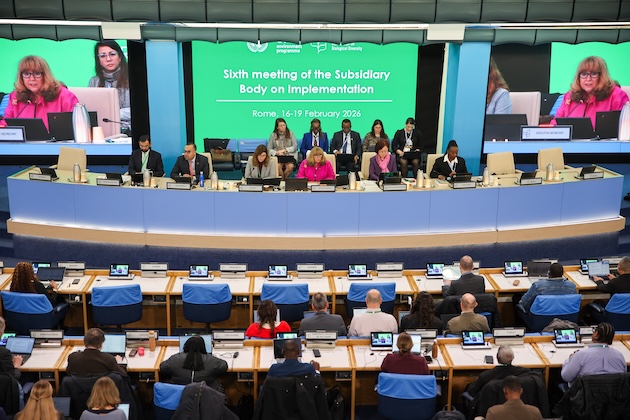
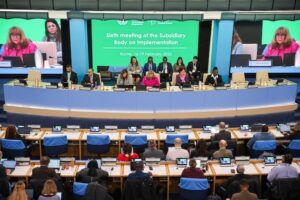
The 6th meeting of the Subsidiary Body of Implementation (SBI-6) is in progress in Rome. Credit: Mike Muzurakis | IISD/ENB

The 6th meeting of the Subsidiary Body of Implementation (SBI-6) is in progress in Rome. Credit: Mike Muzurakis | IISD/ENB |

ROME & DELHI, Feb 17 2026 (IPS) – Governments convened in Rome on Monday (February 16) for a critical round of UN biodiversity negotiations, launching the world’s first global review of how countries are acting to protect nature.


The sixth meeting of the Subsidiary Body on Implementation (SBI-6) of the Convention on Biological Diversity opened at the headquarters of the Food and Agriculture Organization (FAO), drawing government negotiators, technical experts and civil society observers from around the world. It will continue until February 19.

Although considered a technical gathering, the four-day session is expected to play a decisive role in shaping how progress under the Kunming–Montreal Global Biodiversity Framework will be assessed and whether political promises can be translated into measurable, on-the-ground action.

“This is a moment to move from commitments to delivery,” said Clarissa Souza Della Nina of Brazil, Chair of the Subsidiary Body on Implementation. “The task before us is to help countries accelerate action to halt and reverse biodiversity loss.”

Clarissa Souza Della Nina of Brazil, Chair of the Subsidiary Body on Implementation. Credit: Mike Muzurakis | IISD/ENB

Clarissa Souza Della Nina of Brazil, Chair of the Subsidiary Body on Implementation. Credit: Mike Muzurakis | IISD/ENB

A Global Stocktake for Nature

The Rome talks come two years after countries completed the first global stocktake under the Paris Agreement, which confirmed the world remains far off track on climate goals.

Now, a parallel exercise begins for biodiversity.

Under the CBD, governments will undertake the first global review of progress in implementing the Kunming–Montreal Global Biodiversity Framework (KMGBF), adopted in 2022. The framework includes 23 targets spanning conservation, finance, equity and economic transformation, with the overarching objective of halting and reversing biodiversity loss by 2030.

Biodiversity tracking is more complex than emissions accounting, but, according to CBD leadership, it is urgently needed.

“The time has come to make peace with nature… the implementation of the Kunming-Montreal Global Biodiversity Framework and the Paris Agreement in a synergistic fashion will make peace with nature within reach,” said Astrid Schomaker, Executive Secretary of the Convention on Biological Diversity.

Why Rome Matters

SBI-6 plays a central role in preparing for the upcoming global biodiversity review by examining implementation progress, highlighting gaps, and proposing ways to accelerate action. Negotiators will submit the outcomes directly to COP17 in Yerevan, Armenia, later this year.

“One year after COP16 concluded here in Rome, we must ensure these meetings deliver real progress. Submitting national reports on time is essential for a strong and credible global review in the race to 2030,” Schomaker said.

A major focus of SBI-6 is the Secretariat’s analysis of national biodiversity strategies and action plans submitted since 2022. But despite growing momentum, significant gaps persist. Many strategies still do not adequately integrate Indigenous Peoples, local communities, women, youth, or the private sector. Crucial targets relating to economic and social transformation — including sustainable consumption, equity and benefit sharing — remain underemphasised.

Inger Andersen, Executive Director of the United Nations Environment Programme (UNEP), underscored the stakes at the launch of the State of Finance for Nature 2026 report:

“Whether investments flow into nature’s destruction or into its protection will determine if we live in climate-vulnerable concrete jungles or in climate-resilient green cities,” she warned, stressing that financial and policy decisions made today will shape countries’ ability to meet biodiversity goals.

An indigenous woman and biodiversity defender from the Amazon is pictured holding a forest coconut. Women are asking for better implementation of article 23 of the KMGBF. Credit: Stella Paul/IPS

An indigenous woman and biodiversity defender from the Amazon is pictured holding a forest coconut. Women are asking for better implementation of article 23 of the KMGBF. Credit: Stella Paul/IPS

Gender, Finance and Capacity Challenges

Delegates are also reviewing progress under the CBD Gender Plan of Action (2023–2030). Early assessments show that only a quarter of countries involved women’s groups in shaping biodiversity strategies, and just 12 percent plan to do so in the future.

“Ensuring the full, effective and meaningful participation of women and other rights holders is fundamental to accountability, inclusivity and the effectiveness of biodiversity action, and to achieving the full ambition of the global framework,” the CBD Women’s Caucus stated in its official submission.

Finance remains another major point of discussion. While major funding decisions are expected later this year, Rome’s deliberations draw heavily on new research on biodiversity finance, sovereign debt, and the connections between climate and nature funding.

“If we want to mobilise the finance and resources that nature critically needs, business, finance and governments must confront the reality that persistent gaps in reliable data, incentives and institutional capacity are holding back meaningful action — and unless these barriers are addressed, many countries and sectors will continue to struggle to turn agreed goals into results,” said Matt Jones, Co-Chair of the IPBES Business and Biodiversity Assessment 2026.

Countdown to National Reports

The Rome meeting comes just weeks before countries must submit their Seventh National Reports under the CBD, due on 28 February 2026.

These national publications will serve as a principal source of information for the global biodiversity review, alongside national strategies and targets.

However, many countries remain unprepared to submit on time. On day one, Brazil, one of the most influential players in global biodiversity policy, stressed the need for flexibility.

“Ensuring the quality, consistency and internal validation of data and indicators requires additional time. In this context, Brazil suggests that SBI recommendations prioritise technical guidance, operational flexibility and targeted capacity-building support to enable high-quality reporting, rather than focusing solely on reinforcing deadlines,” the country’s delegate said.

A Test of Accountability

While SBI-6 is unlikely to produce headline-grabbing announcements, it will shape how global biodiversity action is evaluated over the next decade.

For Indigenous Peoples and local communities—who steward a significant share of the world’s remaining biodiversity—the meeting represents a critical test of whether rights, participation and lived realities will be meaningfully reflected in the global assessment process.

“This process must lead to accountability, not just documentation,” emphasised Pirawan Wongnithisathaporn, the Environment Program Officer at the Asia Indigenous Peoples Pact (AIPP), calling for tangible action rather than reporting alone.

SBI-6 will conclude on Thursday, February 19. Negotiations will continue at SBI-7 in August 2026 as governments move steadily toward the first global biodiversity review at COP17.

IPS UN Bureau Report

 

‘When Rains Come, Our Hearts Beat Faster’

Aid, Asia-Pacific, Civil Society, Climate Change, Climate Change Justice, Development & Aid, Disaster Management, Economy & Trade, Editors’ Choice, Environment, Featured, Headlines, Human Rights, Humanitarian Emergencies, Sustainable Development Goals, TerraViva United Nations

Disaster Management

A recent report reveals that Asia faces about 100 natural disasters every year, affecting 80 million people. Beyond the statistics are the disrupted lives, damaged homes, and a cycle of repair that drains communities.

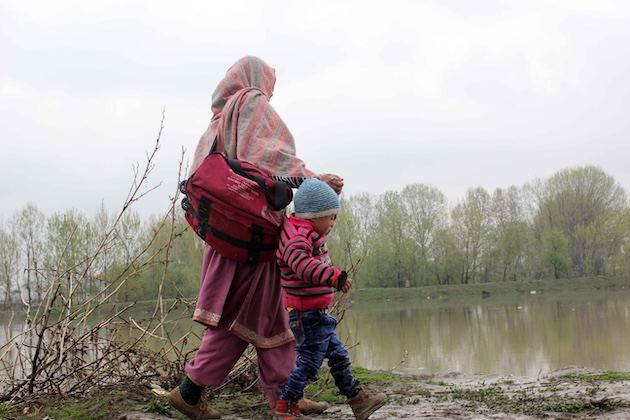
A woman in a remote hamlet in Kashmir, India, migrates to a safer location with her child as floodwater inundates her hometown. Credit: Umar Manzoor Shah/IPS

A woman in a remote hamlet in Kashmir, India, migrates to a safer location with her child as floodwater inundates her hometown. Credit: Umar Manzoor Shah/IPS

SRINAGAR & NEW DELHI, Feb 9 2026 (IPS) – When the rain begins in Kashmir’s capital Srinagar, Ghulam Nabi Bhat does not watch the clouds with relief anymore. He watches them with calculation. How much can the gutters take? How fast will the river rise? Which corner of the house will leak first? Where should the children sleep if the floor turns damp?


“Earlier, rain meant comfort,” said Bhat, a resident of a low-lying neighbourhood close to the city’s waterways. “Now it feels like a warning.”

On many days, the rain does not need to become a flood to change life. Streets fill up within hours. Shops shut early. The school van turns back. A phone call spreads across families, asking the same question, “How is your area?”

For millions across India and the wider region of emerging Asia (a group of rapidly developing countries in the region, including China, India, Indonesia, Malaysia, the Philippines, Thailand, and Vietnam), this is the new normal. Disasters no longer arrive as rare, once-in-a-generation ruptures. They come as repeated shocks, each one leaving behind repair bills, lost wages, and a deeper sense that recovery has become a permanent routine.

A recent analysis from the OECD Development Centre shows that emerging Asia has been facing an average of around 100 disasters a year over the past decade, affecting roughly 80 million people annually. The rising trend is powered by floods, storms, and droughts. The report estimates that natural disasters have cost India an average of 0.4 percent of GDP every year between 1990 and 2024.

Behind the national figure lies a quieter, more poignant story. It is the story of how repeated climate and weather shocks get absorbed by households and not just spreadsheets. By the savings a family built for a daughter’s education. By a shopkeeper’s stock bought on credit. By a farmer’s seed money saved from the last season.

In the north Indian state of Bihar’s flood-prone belt, Sunita Devi, a mother of three, says she has stopped storing anything valuable on the floor. Clothes sit on higher shelves. The grain container has moved to a safer corner. The family’s documents stay wrapped in plastic.

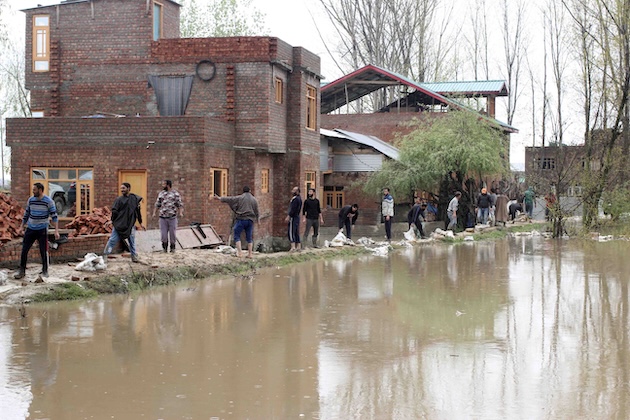
Local residents in Kashmir's capital, Srinagar, stack sandbags to safeguard their homes from floods in 2025. Credit: Umar Manzoor Shah/IPS

Local residents in Kashmir’s capital, Srinagar, stack sandbags to safeguard their homes from floods in 2025. Credit: Umar Manzoor Shah/IPS

“When water comes, you run with children,” she said. “The rest is left to fate. You can rebuild a wall. You cannot bring back the days you lost.”

Her village has lived with floods for decades, but she says what has changed is frequency, uncertainty, and cost. It is not only about big river floods that make headlines. It is also about sudden waterlogging, damaged roads, broken embankments, and illnesses that rise after the water recedes.

“Earlier we could predict. Now we cannot. Sometimes the water comes fast. Sometimes it stays. Sometimes it leaves and then comes again,” Devi told IPS.

Professor Kaveh Madani, director of the United Nations University’s Institute for Water, Environment, and Health, told IPS that water bankruptcy in Asia should be treated as a national security issue, not a sector issue.

“The priority is shifting from crisis response to bankruptcy management: honest accounting, enforceable limits, protection of natural capital, and a just transition that protects farmers and vulnerable communities,” said Madani.

Across emerging Asia, floods have emerged as one of the strongest rising trends since the early 2000s, the OECD Development Centre report notes. The reasons vary from place to place, but the result looks familiar: disrupted lives, damaged homes, and a cycle of repair that drains communities.

In Kashmir’s capital Srinagar, small shop owner Bashir Ahmad keeps an old wooden rack near the entrance. It is not for display. It is for emergencies. When rain intensifies, he quickly moves cartons of goods off the floor.

“My shop is small; my margin is smaller. One day of water is enough to destroy many things. Customers do not come. Deliveries stop. You just wait and watch,” Ahmad said.

He says the biggest loss is not always the damaged stock. It is the days without work. For families that live week to week, even a short shutdown becomes a long crisis. Rent does not pause. School fees do not pause. Loans do not pause.

The OECD analysis, while regional in scope, points to a hard truth that communities already know. It claims that disasters have economic aftershocks that last long after television cameras leave. When repeated losses occur every year, they reduce growth and reshape choices. Families postpone building stronger houses. They avoid investing in small businesses. They spend more time recovering than progressing.

“Disasters are no longer exceptional events. They have become recurring economic shocks. The problem is not only the immediate damage. It is the repetition. Repetition breaks household resilience,” Dr Ritu Sharma, a climate risk researcher based in Delhi, said.

Sharma says India’s disaster losses should not be viewed as a headline percentage alone.

They should be viewed as accumulated pressure on ordinary life.

“A flood does not only damage a bridge. It delays healthcare visits. It interrupts immunisation drives. It breaks supply chains for food and medicines. It can push vulnerable families into debt traps. What looks like a climate event becomes a social event. It becomes a health event. It becomes an education event.”

In the report’s regional comparisons, the burden is uneven. Some countries face higher average annual losses as a share of GDP, especially those exposed to cyclones and floods. India’s size allows it to absorb shocks on paper, but that size also means more people remain exposed. From Himalayan slopes vulnerable to landslides to coastal districts bracing for cyclones to plains dealing with floods and heat, risk is spread across geography and across livelihoods.

Prof. Nasar Ali, an economist who studies climate impacts, says the real damage is often hidden in the informal economy.

“A formal sector company can claim insurance, borrow on better terms, and restart faster. A vegetable vendor cannot. A small grocery shop cannot. A family with a single daily wage earner cannot. Their loss is immediate and personal. They also take the longest to recover,” Ali said.

He believes disaster impacts also deepen inequality because the poorest households lose what they cannot replace.

“A damaged roof for a rich family is a renovation problem. A damaged roof for a poor family can mean sleeping in damp rooms for weeks, infections, missed work and children dropping out temporarily.”

The report also turns attention toward a policy question that has become urgent across Asia: how should governments pay for disasters in a way that does not repeatedly divert development funds?

The analysis highlights disaster risk finance, tools that help governments prepare money in advance rather than relying mainly on post-disaster relief. This includes dedicated disaster funds, insurance mechanisms, and rapid financing that can be triggered quickly after a shock.

For communities, the debate may sound distant. But the outcomes are visible in the speed of recovery and the dignity of response.

“When a disaster happens, help should come fast,” said Meena Devi, who runs a small grocery shop in Jammu’s RS Pura area and has seen repeated waterlogging during intense rains. “We close our shop. Milk spoils. People cannot buy things. Then we borrow money to restart. If support is slow, we fall behind.”

She said her biggest fear is not a single disaster but the feeling that another one is always near.

“If it happens once, you survive. If it happens again and again, you get tired from inside,” she said.

For Sharma, preparedness must be more than emergency drills. It must include planning that reduces exposure in the first place.

“Some risks are unavoidable, but many are amplified by where and how we build,” she said. “If cities expand without drainage capacity, or if construction spreads into floodplains, then disasters become predictable. That is not nature alone. That is policy.”

In Srinagar, Bhat says residents often feel they fight the same battle every year. Cleaning drains. Stacking sandbags. Moving belongings. Calling relatives. Watching the river level updates. The work looks small, but it is exhausting because it never ends.

He pointed to marks on a wall that show where water once reached.

“We always think, maybe this year it will be better,” he said. “Then rain comes, and your heart starts beating faster.”

Asked what would make him feel safe, he did not talk about big promises. He spoke about basics. A drain that works. A road that does not collapse. A warning that comes early. Help that comes on time.

For Sunita Devi in Bihar, the dream is even simpler: a season where the family can plan without fear.

“We want to live like normal people. We want to save money, not spend it on repairing what the water broke,” she said.

IPS UN Bureau Report

  Source

Myanmar: Five Years Since the Coup and No End in Sight To War

Armed Conflicts, Asia-Pacific, Civil Society, Democracy, Editors’ Choice, Featured, Headlines, Human Rights, Humanitarian Emergencies, International Justice, TerraViva United Nations

Armed Conflicts

Prosthetics marketed by I-Walk at an event marking resistance to Myanmar’s military coup of five years ago. The enterprise has a waiting list of over 3,000 people. Credit: Guy Dinmore/IPS

Prosthetics marketed by I-Walk at an event marking resistance to Myanmar’s military coup of five years ago. The enterprise has a waiting list of over 3,000 people. Credit: Guy Dinmore/IPS

MYANMAR & THAILAND, Feb 4 2026 (IPS) – Five years of conflict since the military seized power have reduced Myanmar to a failed state and taken a huge toll of lives lost and destroyed. But with all sides seeking total victory, there is no end in sight.


Levels of medieval brutality enhanced by modern technology have enabled the military junta, with help from China, to swing the fortunes of war back in its favour, often through air strikes and drone attacks on civilian targets. Torched villages are deserted.

Kyaw Thurein Win, on the anniversary of the military’s February 1, 2021, coup against the elected civilian government, watched his village of Shut Pon burning in the southern region of Tanintharyi – through satellite imagery.

“Today my village is witnessing the cruelty of the military. They set the fires and ordered that they not be stopped. This is beyond inhuman and beyond cruel. Watching this happen from afar is unbearable,” he wrote on Facebook.

While the strength of anti-regime defiance and determination is undeniable among many in Myanmar, there is also a growing realisation – especially among former combatants — that the resistance will not win this war so soon, if at all.

“It is a stalemate. Nobody can win,” said one military defector, saying that cries of total victory by both the regime and the resistance ring hollow.

A young woman who runs a safe house for former child soldiers as young as 13 says she joined the People’s Defence Forces of the resistance that sprang up against military rule in 2021. But she soon came to realise that, for her at least, war was not the answer and started taking in children forced by poverty and displacement to become fighters against the regime.

She rails against the “whatever it takes” mentality and the toll it takes.

“The civilian suffering is ignored or exploited,” she says, attending a coup anniversary event – a mix of politics and culture and foodstalls –  organised by anti-regime civilian activists in Chiang Mai, northern Thailand. She shares a picture of ‘Commando’ in uniform, armed to the teeth. He was 12 at the time.

Sayarma Suzanna, fundraising for her school in Kayin State, the Dr Thanbyah Christian Institute for displaced and local children, said she and her 97 students spent all of November hiding in the nearby forest because of air strikes.

“You have to understand that when the students don’t listen to you during lessons, it is because of their trauma,” she said, recounting how one student lost seven family members in air strikes on their village.

At a nearby stall, the manager of I-Walk displayed an array of quality prosthetic limbs made by his enterprise as affordable as possible. He has a waiting list of over 3,000 people.

Myanmar is the most landmined country in the world with the highest rate of casualties. It also ranks as the biggest producer of illicit opium and a major source of synthetic drugs. Networks of online scam centres run by criminal gangs and militia groups close to the regime have trafficked tens of thousands of people from multiple countries, scamming billions of dollars.

The UN says 5.2 million people have been displaced by conflict inside the country and across borders. Cuts by rich countries to aid budgets have had a crippling impact. Some clinics are reduced to dispensing just paracetamol.

This year’s coup anniversary coincided with the conclusion of parliamentary and regional elections tightly orchestrated by the regime over the scattered and sometimes totally isolated areas of territory it controls, which include all major cities.

The three-phase polls – endorsed by China and Russia but slammed by the UN and most democracies except notably the US – excluded the National League for Democracy, which won landslide election victories in 2015 and 2020.

NLD leader Aung San Suu Kyi has been held in prison since the coup. There is speculation that Senior General Min Aung Hlaing might move her to better conditions of house arrest after the military’s Union Solidarity and Development Party, led by former senior officers, forms a nominally civilian government in April.

The USDP is cruising towards its managed landslide victory, according to almost complete results released last week.

The UN said it had reliable reports of at least 170 civilians killed in regime attacks during the month-long election period. Other estimates put the figure considerably higher.

One airstrike in Kachin State in northern Myanmar reportedly killed 50 civilians on January 22. Long-running attempts by the Kachin Independence Army and resistance forces to capture the nearby and heavily defended Bhamo town from the military have been costly. Some analysts ask, for what gain?’

Kachin State’s second biggest town is strategically located on a trade route to China but most of its 55,000 or so inhabitants have long since fled. The military would surely respond with heavy air strikes to any occupation by the resistance.

Data gathered by ACLED, a nonprofit organisation that analyses data on political violence, indicates over 90,000 total conflict-related deaths since the coup. The military, reliant on forced conscription, has borne the brunt of casualties, but civilian deaths are estimated at over 16,000.

“The military has carried out air strikes, indiscriminately or deliberately attacking civilians in their homes, hospitals, and schools,” said Nicholas Koumjian, head of the Independent Investigative Mechanism for Myanmar, adding that there is evidence that civilians have endured atrocities amounting to crimes against humanity and war crimes since the military takeover.

The IIMM is also investigating a growing number of allegations of atrocities committed by opposition armed groups, over which the parallel National Unity Government set up by lawmakers ousted in the coup has little or no control.

Former combatants say rogue People’s Defence Forces are also extorting money from local populations and holding people to ransom.

“Myanmar remains mired in an existential crisis – measured both in human security and the state’s shrinking sovereignty as rival centres of power harden on the ground,” the Institute for Strategy and Policy – Myanmar, a think-tank, stated in its recent annual review.

“The regime is meanwhile trying to break the current stalemate by accelerating counter-offensives on three fronts: military, diplomatic and political,” it said. The military-staged elections of 2010 led to a process of political and economic reforms but this time the regime intended to impose its own terms, the think tank said.

It warned of the risk that ethnic armed groups controlling swathes of border territories with Bangladesh, India, China and Thailand would end up – not for the first time – negotiating bilateral ceasefires and “rent sharing arrangements” with the regime. These would “consolidate the power of armed elites and reinforce central control rather than advance democracy, human rights or the rule of law.”

On Sunday, a panel discussion featuring anti-regime politicians and activists hosted by Chiang Mai University reinforced the sense of an opposition fragmented along ethnic and geographical lines, even if speakers upheld the principles behind their shared goal of a democratic federal union.

There was the customary rhetoric of “taking down this junta” and “whatever it takes”, but barely a mention of the National Unity Government that is struggling to knit together these diverse forces under the umbrella of a “Federal Supreme Council”.

On the panel, Debbie Stothard, a Malaysian democracy and women’s rights activist long involved with Myanmar, said the resistance needed two more years for victory, as the generals had “bought” one more year with their sham elections.

“Hang in there. We have to keep on going for at least two more years,” she said.

But in the big cities where the regime is starting to try and foster a sense of normality against a dire economic backdrop, the mood on the street appears more of resignation than defiance.

“When we started protesting against the regime in the streets in 2021, I told my husband we would defeat the military in three months,” an elderly Chin activist told IPS in Yangon, the former capital. “He replied it would take five years. Now I am afraid it will take another five years,” she said.

IPS UN Bureau Report

  Source

Support Science in Halting Global Biodiversity Crisis—King Charles

Africa, Biodiversity, Conferences, Conservation, Development & Aid, Economy & Trade, Editors’ Choice, Environment, Europe, Featured, Global, Headlines, Natural Resources, Sustainable Development Goals, TerraViva United Nations, Trade & Investment

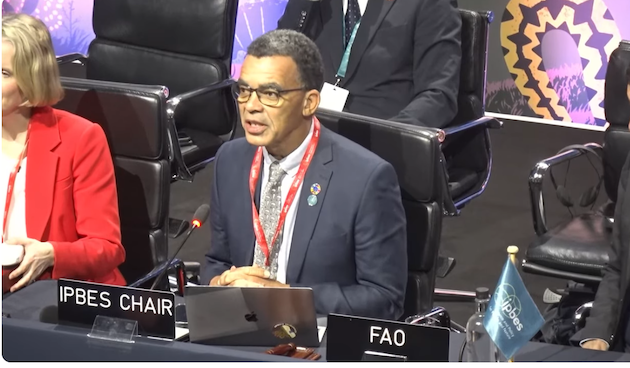
David Oburo, IPBES Chair. Credit: Busani Bafana/IPS

David Oburo, IPBES Chair. Credit: Busani Bafana/IPS

BULAWAYO, Feb 3 2026 (IPS) – British Monarch King Charles says science is the solution to protecting nature and halting global biodiversity loss, which is threatening humanity’s survival.


In a message to the 12th session of the Plenary of the Intergovernmental Science-Policy Platform on Biodiversity and Ecosystem Services (IPBES), which opened in Manchester, United Kingdom, this week, King Charles said nature is an important part of humanity but is under serious threat, which science can help tackle.

“We are witnessing an unprecedented, triple crisis of biodiversity loss, climate change, and pollution at a pace that far outstrips the planet’s ability to cope,” said King Charles in a message delivered by Emma Reynolds, United Kingdom Secretary of State for Environment, Food and Rural Affairs.

Science is the Solution

“The best available science can help inform decisions and actions to steward nature and, most importantly, to restore it for future generations, “ King Charles noted, pointing out that humanity has the knowledge to reverse the existential crisis and transition towards an economy that prospers in harmony with nature.

Delegates representing the more than 150 IPBES member governments, observers, Indigenous Peoples,  local communities and scientists are meeting for the  IPBES’ 12th Session, expected to approve a landmark new IPBES Business & Biodiversity Assessment. The report,  a 3-year scientific assessment involving 80 expert authors from every region of the world, will become the accepted state of science on the impacts and dependencies of business on biodiversity and nature’s contributions to people. It will provide decision-makers with evidence and options for action to measure and better manage business relationships with nature.

The King lauded IPBES for bringing together the world’s leading scientists, indigenous and local knowledge, citizen science and government to share valuable knowledge through the Business and Biodiversity Report—the first of its kind.

“I pray with all my heart that it will help shape concrete action for years to come, including leveraging public and private finance to close by 2030 the annual global biodiversity gap of approximately USD 700 billion,” said King Charles.

IPBES Chair, Dr. David Obura, highlighted that the approval of the IPBES Business and Biodiversity Assessment is important just days after the World Economic Forum’s 2026 Global Risks Report again spotlighted biodiversity loss as the second most urgent long-term risk to business around the world.

“In transitioning and transforming, businesses should all experience the rewards of being sustainable and vibrant, benefiting small and large,” Obura emphasized. “The Business Biodiversity assessment synthesizes the many tools and pathways available to do this and provides critical support for businesses across all countries to work with nature and people and not to work against either or both.”

Addressing the same delegates, Emma Reynolds,  UK Secretary of State for Environment, Food and Rural Affairs, highlighted the urgency of collective action, the critical role of science, and the opportunities for business in nature.

Reynolds noted there was momentum around the world as countries were restoring wetlands and forests, communities were reviving degraded landscapes and businesses were increasingly investing in nature after realizing that nature delivers real returns.

“The tide for nature is beginning to turn, but we cannot afford to slow down,” said Reynolds. “The window to halt diversity loss by 2030 is narrowing. We need to build on that momentum, and we need to do it now.”

Multilateralism, a must for protecting nature

Paying tribute to IPBES for supporting scientific research, Reynolds emphasized that the rest of the world must step forward when others are stepping back from international cooperation. This is to demonstrate that protecting and restoring nature was not just an environmental necessity but essential for global security and the economy.

“The UK’s commitment to multilateralism remains steadfast,” she said. “We believe that by working together, sharing knowledge, aligning policies, and holding one another accountable, we can halt and reverse the diversity loss by 2030,.“

In January 2026, the United States withdrew its participation in IPBES, alongside 65  international organizations and bodies, including the International Union for Conservation of Nature (IUCN), the UN Framework Convention on Climate Change (UNFCCC) and the Paris Agreement.

The United States was a founding member of IPBES, and since its establishment in 2012, scientists, policymakers, and stakeholders—including Indigenous Peoples and local communities—from the United States have been among the most engaged contributors to its work.

The approval of the Business and Biodiversity Assessment by IPBES government members this week will be multilateralism in action, she said, noting that the assessment would not be possible without the critical role of science.

Reynolds underscored the need to base sound policy on solid scientific evidence. Decisions made in negotiating rooms and capitals around the world must be guided by the best and most up-to-date science available. IPBES  exists to provide exactly that.

Noting that the business depends on nature for raw materials, clean water, a stable climate, and food, Reynolds said companies that recognize their dependency on nature are proving that nature-positive investment works.

“Business as well as the government must act now to protect and restore nature… we have the science. We have the frameworks… What we need now is action.”

“Nature loss is now a systemic economic risk. That’s precisely why the assessment on business impact and dependencies is both urgent and necessary,” said  Inger Andersen, executive director of the United Nations Environment Programme (UNEP).

“The first-ever business and diversity assessment will deliver authoritative evidence on how businesses depend on nature, how they impact it, and what that means for risk, for resilience, and for long-term value creation.”

Business and Biodiversity are linked

Underscoring that biodiversity loss is linked to the wider planetary crisis, Astrid Schomaker, executive secretary of the Convention on Biological Diversity, paid tribute to IPBES as a provider of science as a public good.

“IPBES has remained a  ‘beacon of knowledge at a time when science  and knowledge itself is under strain and when the voices of disinformation are sometimes louder than the facts,” said Schomaker, noting that ahead of the first global stocktake of progress in the implementation of the Kunming-Montreal Global Biodiversity Framework (KMGBF), the science provided by IPBES would be invaluable.

“The Business and Biodiversity assessment constitutes a win for everyone. Clarifying that biodiversity loss isn’t just an environmental issue; it’s a serious threat to economic systems, livelihoods, business profitability, and societal resilience. Biodiversity simply underpins and provides the stability we all need.”

Target 15 of the KMGBF, focuses on business reducing negative impacts on biodiversity and global businesses need to assess and disclose biodiversity-related impacts.

IPBES executive secretary, Dr. Luthando Dziba, said IPBES was on track to deliver, in the coming years, crucial knowledge and inspiration to support the implementation of current goals and targets of the KMGBF, and to provide the scientific foundation needed by the many processes now shaping the global agenda beyond 2030.

IPS UN Bureau Report


World Living Beyond Its Means: Warns UN’s Global Water Bankruptcy Report

Armed Conflicts, Climate Change, Combating Desertification and Drought, Conferences, Conservation, Editors’ Choice, Environment, Featured, Global, Headlines, Migration & Refugees, Natural Resources, Sustainable Development Goals, TerraViva United Nations

Water & Sanitation

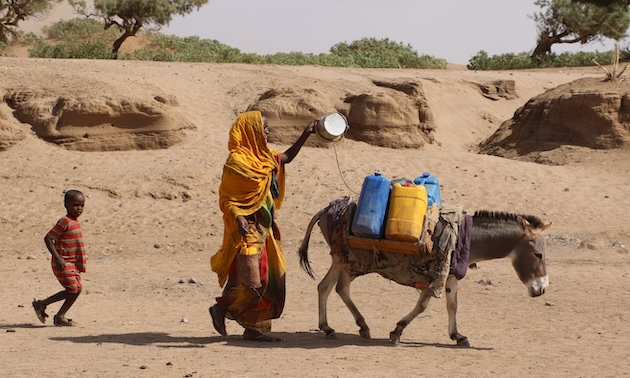
Collecting water in Ethiopia. A new report, ‘Global Water Bankruptcy: Living Beyond Our Hydrological Means in the Post Crisis Era’ warns that many of the earth’s water resources have been pushed to a point of permanent failure. Credit: EU/ECHO/Anouk Delafortrie/IPS

Collecting water in Ethiopia. A new report, ‘Global Water Bankruptcy: Living Beyond Our Hydrological Means in the Post Crisis Era’ warns that many of the earth’s water resources have been pushed to a point of permanent failure. Credit: EU/ECHO/Anouk Delafortrie/IPS

UNITED NATIONS & SRINAGAR, India, Jan 20 2026 (IPS) – The world has entered what United Nations researchers now describe as an era of Global Water Bankruptcy, a condition where humanity has irreversibly overspent the planet’s water resources, leaving ecosystems, economies, and communities unable to recover to previous levels.


The new report, released by the United Nations University Institute for Water, Environment and Health, titled Global Water Bankruptcy: Living Beyond Our Hydrological Means in the Post-Crisis Era. The report argues that decades of overextraction, pollution, land degradation, and climate stress have pushed large parts of the global water system into a permanent state of failure.

“The world has entered the era of Global Water Bankruptcy,” the report reads, adding that “in many regions, human water systems are already in a post-crisis state of failure.”

According to the report, the language of “water crisis” is no longer sufficient to explain what is happening. A crisis implies a shock followed by recovery. Water bankruptcy, by contrast, describes a condition where recovery is no longer realistically possible because natural water capital has been permanently damaged.

In an exclusive interview with Inter Press Service, former Deputy Head of Iran’s Department of Environment  Prof. Kaveh Madani, who currently is the Director at United Nations University, Institute for Water, Environment and Health, said that declaring that the planet has entered the era of water bankruptcy must not be interpreted as universal water bankruptcy, as not all basins, aquifers, and systems are water bankrupt.

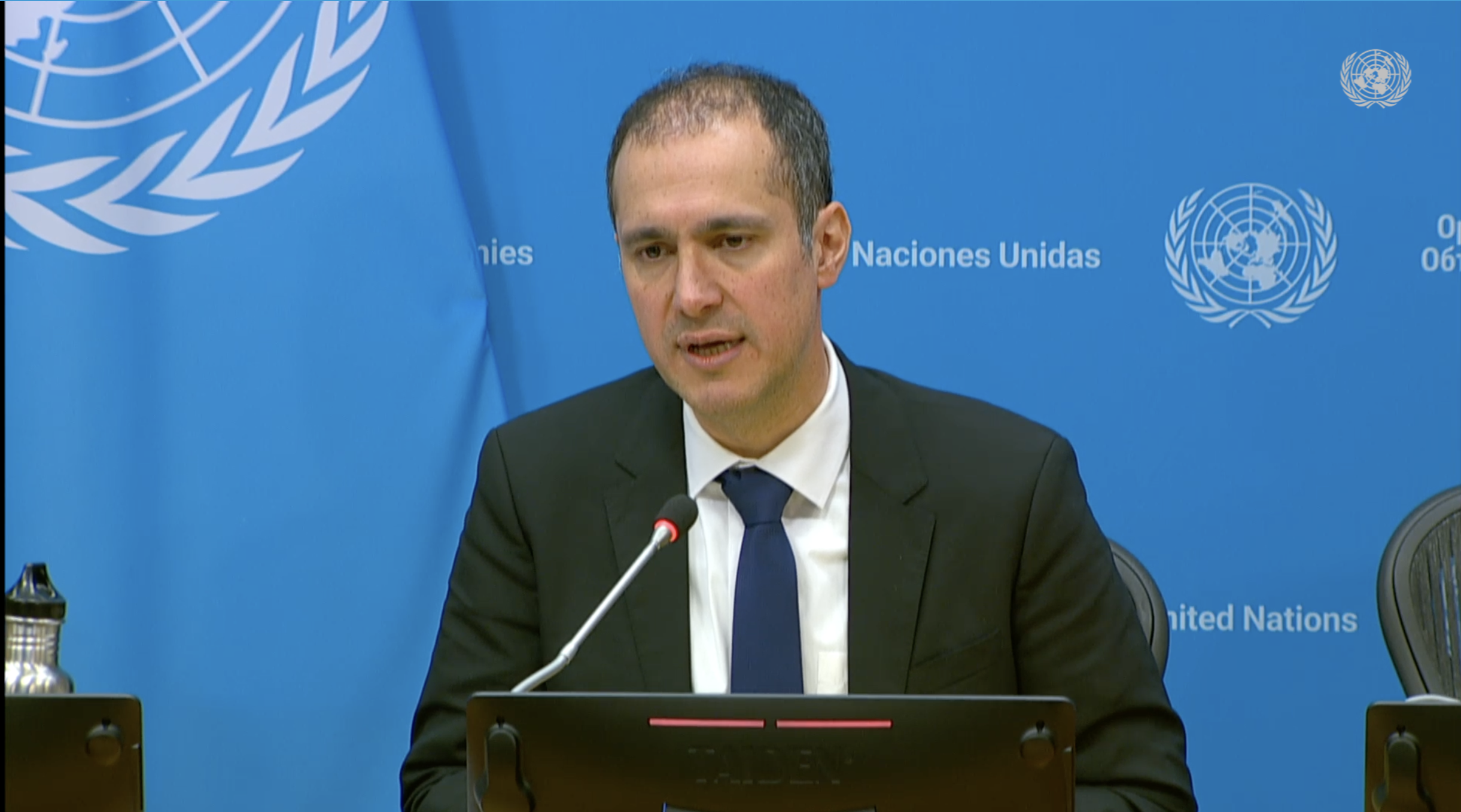
 Prof. Kaveh Madani, Director at the United Nations University, Institute for Water, Environment and Health, addresses the UN midday press briefing. Credit: IPS

Prof. Kaveh Madani, Director at the United Nations University, Institute for Water, Environment and Health, addresses the UN midday press briefing. Credit: IPS

“But we now have enough critical basins and aquifers in chronic decline and showing clear signs of irreversibility that the global risk landscape is already being reshaped. Scientifically, we know recovery is no longer realistic in many systems when we see persistent overshoot (using more than renewable supply) combined with clear markers of irreversibility—for example aquifer compaction and land subsidence that permanently reduce storage, wetland and lake loss, salinization and pollution that shrink usable water, and glacier retreat that removes a long-term seasonal buffer. When these signals persist over time, the old “bounce back” assumption stops being credible,” Madani said.

According to the report, over decades, societies have drawn down the renewable flow of rivers and rainfall besides long-term reserves stored in aquifers, glaciers, wetlands, and soils. At the same time, pollution and salinization have reduced the share of water that is safe or economically usable.

“Over decades, societies have withdrawn more water than climate and hydrology can reliably provide, drawing down not only the annual income of renewable flows but also the savings stored in aquifers, glaciers, soils, wetlands, and river ecosystems,” the report says.

The scale of the problem, as per the report, is global. Nearly three-quarters of the world’s population now lives in countries classified as water insecure or critically water insecure.

Around 2.2 billion people still lack safely managed drinking water, while 3.5 billion lack safely managed sanitation. About 4 billion people, as per the report findings, experience severe water scarcity for at least one month every year.

Madani said, adding that water bankruptcy is best assessed basin by basin and aquifer by aquifer, not by country.

“Please note that, based on the water security definition used by the UN system, water insecurity and water bankruptcy are not equivalent. Water bankruptcy can drive water insecurity, but water insecurity can also stem from limited financial and institutional capacity to build and operate infrastructure for safe water supply and sanitation, even where physical water is available,” he explained.

Madani added that the regions most consistently closest to irreversible decline cluster in the Middle East and North Africa, Central and South Asia, parts of northern China, the Mediterranean and southern Europe, the southwestern United States and northern Mexico (including the Colorado River system), parts of southern Africa, and parts of Australia.

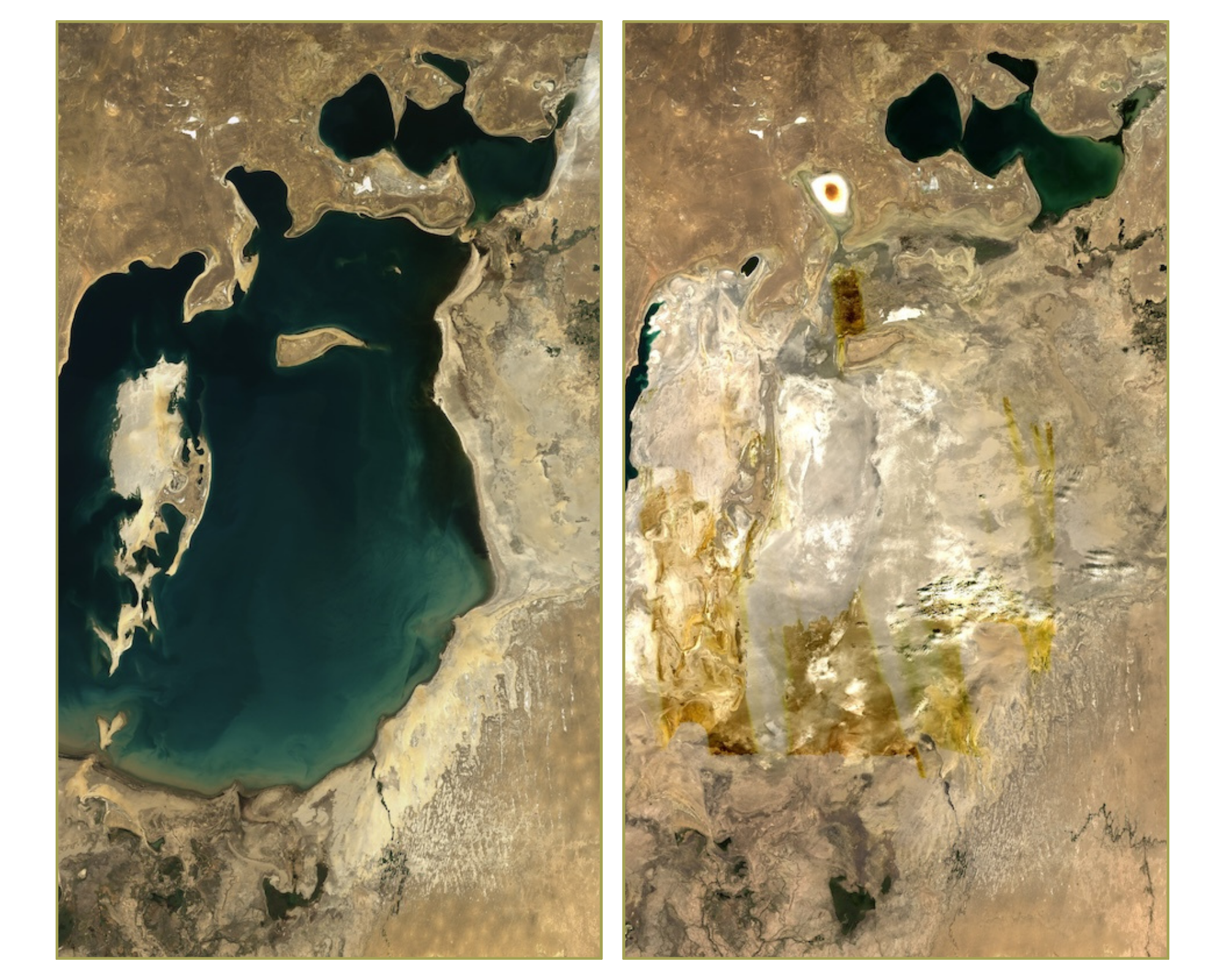
The Aral Sea, which lies between Kazakhstan and Uzbekistan shows dramatic water loss between 1989 and 2025. Credit: UNU-INWEH

The Aral Sea, which lies between Kazakhstan and Uzbekistan, shows dramatic water loss between 1989 and 2025. Credit: UNU-INWEH

Surface Water Systems Are Shrinking Rapidly

The report shows how more than half of the world’s large lakes have lost water since the early 1990s, affecting nearly one quarter of the global population that depends directly on them. Many major rivers now fail to reach the sea for parts of the year or fall below environmental flow needs.

Massive losses have occurred in wetlands, which serve as natural buffers against floods and droughts. Over the past five decades, the report claims that the world has lost roughly 410 million hectares of natural wetlands, almost the size of the European Union. The economic value of lost ecosystem services from these wetlands exceeds 5.1 trillion US dollars.

Groundwater depletion is one of the clearest signs of water bankruptcy. Groundwater, says the report, now supplies about 50 percent of global domestic water use and over 40 percent of irrigation water. Yet around 70 percent of the world’s major aquifers show long-term declining trends.

“Excessive groundwater extraction has already contributed to significant land subsidence over more than 6 million square kilometers,” the report says, warning that in some locations land is sinking by up to 25 centimeters per year, permanently reducing storage capacity and increasing flood risk.

In coastal areas, overpumping has allowed seawater to intrude into aquifers, rendering groundwater unusable for generations. In inland agricultural regions, falling water tables have triggered sinkholes, soil collapse, and the loss of fertile land.

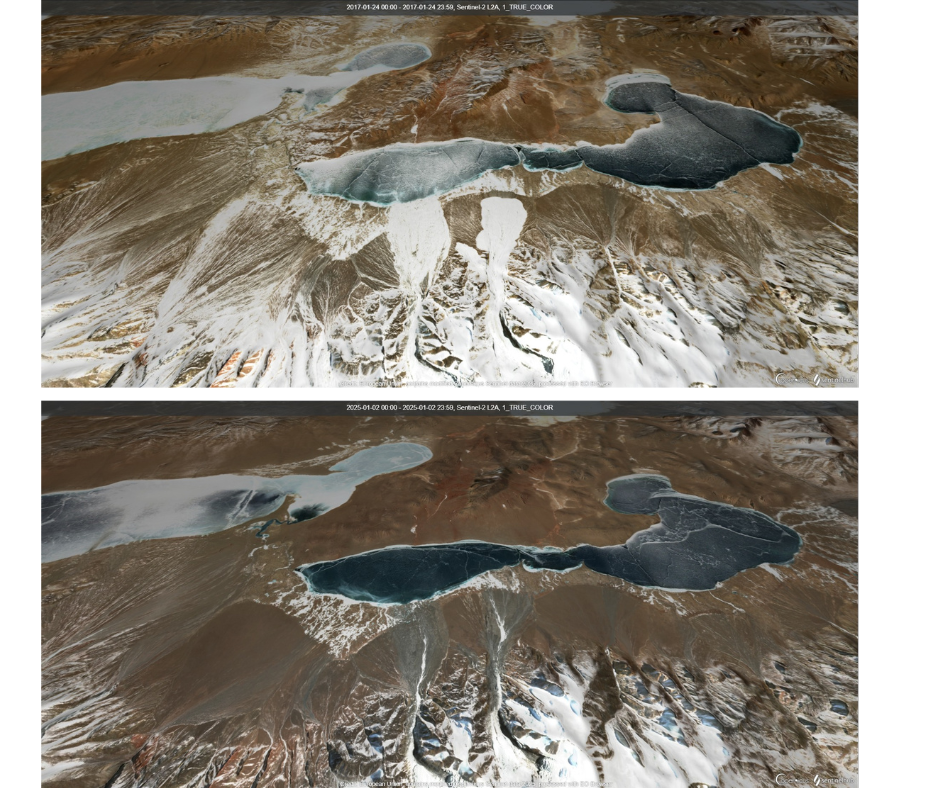
These satellite images show a dramatic impact of the Aru glacier collapses in western Tibet. First image was taken in 2017 and the second in 2025. Credit: UNU-INWEH

These satellite images show a dramatic impact of the Aru glacier collapses in western Tibet. First image was taken in 2017 and the second in 2025. Credit: UNU-INWEH

The cryosphere, glaciers and snowpacks that act as natural water storage systems are also being rapidly liquidated. The world has already lost more than 30 percent of its glacier mass since 1970. Several low- and mid-latitude mountain ranges could lose functional glaciers within decades.

“The liquidation of this frozen savings account interacts with groundwater depletion and surface water over-allocation to lock many basins into a permanent worsening water deficit state,” says the report.

This loss, as per the report, threatens the long-term water security of hundreds of millions of people who depend on glacier- and snowmelt-fed rivers for drinking water, irrigation, and hydropower, particularly in Asia and the Andes.

Madani said the biggest failure was treating groundwater as an unlimited safety net instead of a strategic reserve.

He says that when surface water tightened, many systems defaulted to “drill deeper” without enforceable caps.

“Authorities often recognize the consequences when it is already late, and meaningful action then faces major political barriers. For example, reducing groundwater use in farming can trigger unemployment, food insecurity, and even instability unless farmers are supported through short-term compensation and a longer-term transition to alternative livelihoods,” he added.

According to Madani, that kind of transition cannot be implemented overnight.

“So, business as usual continues. The result is predictable: groundwater gets “liquidated” to postpone hard choices, and by the time the damage is obvious, recovery is no longer realistic,” he told IPS news.

Agriculture Lies at the Heart of the Crisis

According to the report, farming accounts for approximately 70 percent of global freshwater withdrawals. About 3 billion people and more than half of the world’s food production are located in regions where total water storage is already declining or unstable.

The report states that more than 170 million hectares of irrigated cropland are under high or very high water stress. Land and soil degradation are making matters worse by reducing the ability of soils to retain moisture. The degradation of more than half of the global agricultural land is now moderate or severe.

Drought, once considered a natural hazard, is increasingly driven by human activity. Overallocation, groundwater depletion, deforestation, land degradation, and climate change have turned drought into a chronic condition in many regions.

“Drought-related damages, intensified by land degradation, groundwater depletion and climate change rather than rainfall deficits alone, already amount to about 307 billion US dollars per year worldwide,” the report states.

Water quality degradation further shrinks the usable resource base. Pollution from untreated wastewater, agricultural runoff, industrial effluents, and salinization means that even where water volumes appear stable, much of that water is unsafe or too costly to treat.

The report adds that the planetary freshwater boundary has already been crossed. Both blue water, surface and groundwater, and green water, soil moisture, have been pushed beyond a safe operating space.

Current governance systems, the authors argue, are not fit for this reality. Many legal water rights and development promises far exceed degraded hydrological capacity. Existing global agendas, focused largely on drinking water access, sanitation, and incremental efficiency gains, are inadequate for managing irreversible loss.

“Water bankruptcy must be recognized as a distinct post-crisis state, where accumulated damage and overshoot have undermined the system’s capacity to recover,” the report says.

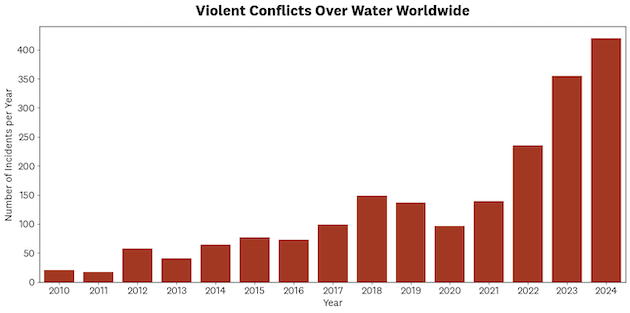
Water bankruptcy could result in an increase in conflicts. Credit: UNU-INWEH

Water bankruptcy could result in a further increase in conflicts. Credit: UNU-INWEH

It warns that the implications of water bankruptcy are dire.

UN Under-Secretary-General Tshilidzi Marwala, Rector of UNU explains,  “Water bankruptcy is becoming a driver of fragility, displacement, and conflict. Managing it fairly—ensuring that vulnerable communities are protected and that unavoidable losses are shared equitably—is now central to maintaining peace, stability, and social cohesion.”

Policy Implications

Instead of crisis management aimed at restoring the past, the report actually pitches for bankruptcy management. That means acknowledging insolvency, accepting irreversibility, and restructuring water use, rights, and institutions to prevent further damage.

The authors lay stress on the fact that water bankruptcy is also a justice and security issue. The costs of overshoot fall disproportionately on small farmers, rural communities, women, Indigenous peoples, and downstream users, while benefits have often accrued to more powerful actors.

“How societies manage water bankruptcy will shape social cohesion, political stability, and peace,” the report warns.

Furthermore, it urges governments and international institutions to use upcoming UN Water Conferences in 2026 and 2028 as milestones to reset the global water agenda, calling for water to be treated as an upstream sector central to climate action, biodiversity protection, food security, and peace.

“This is about a crisis that might arrive in the future. The world is already living beyond its hydrological means,” reads the report.

When asked why the report frames water bankruptcy as a justice and security issue and how governments can implement painful demand reductions without triggering social unrest or conflict, Madani said the demand reduction becomes dangerous when it is treated as a technical exercise instead of a political economy reform. In many water-bankrupt regions, according to him, water is effectively a jobs policy: it keeps low-productivity farming and local economies afloat.

“If you cut water without an economic transition, you create unemployment, food insecurity, and unrest. So the practical pathway is to decouple livelihoods and growth from water consumption. In many economies, water and other natural resources are used to keep low-efficiency systems alive. In most places, it is possible to produce more strategic food with less water and less land, and with fewer farmers—provided that farmers are supported through a transition and offered alternative livelihoods.”

According to Madani, governments should protect basic needs but target the big reductions where most water is used, especially agriculture and besides that, pair caps with a just transition package for farmers—compensation, insurance, buy-down or retirement of water entitlements where relevant, and real income alternatives.

He further suggests that the governments should invest in diversification, including services, industry, value-added agri-processing, and urban jobs, so communities can earn a living without expanding water withdrawals.

“In short, you avoid conflict by making demand reduction part of a broader economic transition, not a standalone water policy.”

IPS UN Bureau Report