Urgent Need to Replace Competition with Cooperation in the Aral Sea Basin

Asia-Pacific, Climate Change, Conferences, Development & Aid, Economy & Trade, Education, Environment, Featured, Global, Headlines, Humanitarian Emergencies, Poverty & SDGs, TerraViva United Nations, Water & Sanitation

Opinion

Stefanos Xenarios is a Professor at Nazarbaev University, Kazakhstan and co-editor-in-chief of the Central Asian Journal of Water Research; Iskandar Abdullaev is Deputy Director, CAREC Institute, China and Vladimir Smakhtin is Director, UN University Institute for Water, Environment and Health, Canada and series editor of the Routledge publishers’ Earthscan Series on Major River Basins of the World, in which the Aral Sea Basin Book is the latest addition.
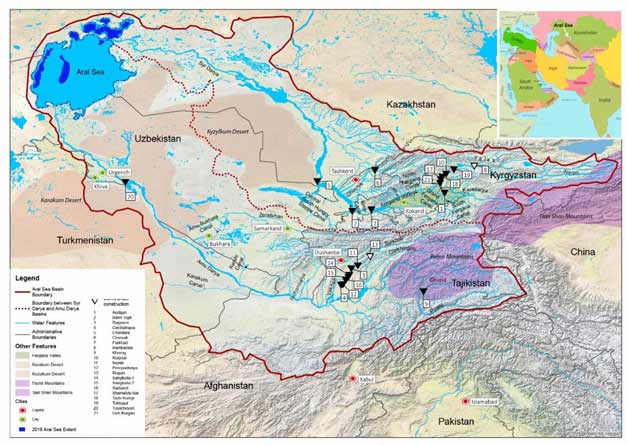
The Aral Sea Basin, defined in red, straddles six countries in Central Asia. See detailed map in full at http://bit.ly/2BQPpRm. Credit: UNU-INWEH

NUR-SULTAN CITY, Kazakhstan, Nov 7 2019 (IPS) – The water resources in Central Asia’s Aral Sea Basin support the lives and livelihoods of about 70 million people — a population greater than Thailand, France, or South Africa.


And unless well-funded and coordinated joint efforts are stepped up, with competition replaced by cooperation, ongoing over-withdrawals compounded by climate change will cause dangerous water shortages in this huge, highly complex watershed spanning six nations: Afghanistan, Kazakhstan, Kyrgyzstan, Tajikistan, Turkmenistan, and Uzbekistan.

That’s the key message of a new book co-authored by 57 regional and international experts from 14 countries and the United Nations, who spent years examining a suite of challenges in the Aral Sea Basin.

The new book assembles the views of nearly all major regional and international experts on the great challenges faced in the Aral Sea Basin. They include three co-authors from the UN University’s Institute for Water, Environment and Health, in Hamilton, Canada.

And almost half of the authors are based in Central Asia, creating a unique blend of regional and international voices and expertise on these critical issues.

The Basin’s two major rivers, the Amu Darya and Syr Darya, discharge now only about 10% of what flowed into the Aral Sea until the 1960s, shrinking the sea by more than 80 percent — “one of the world’s most severe and emblematic environmental disasters.”

Freshwater is key to food, energy, environmental security and social stability among the six Aral Basin countries. And given the countries’ prospective economic and population growth, reliance on water resources will increase, compelling cooperation in sharing benefits and reducing costs.

Intensive, wasteful irrigated farming when the nations were part of the Soviet Union was the main cause of the Aral Sea drying up and irrigation continues to consume about 90 percent of the total water withdrawal in the Basin, with agriculture contributing from 10 to 45 percent of GDP, and 20 to 50 percent of rural employment.

Most irrigation, hydropower and other water-related infrastructural systems and facilities are in transition, a blend today of past and present. Unfortunately, the existing observational meteorological and hydrological networks in the Basin, which declined in the 1990s when the Soviet period ended, are insufficient to support informed water management, and regional water data sharing is suboptimal.

Degradation of land and water are among the major hindrances to sustainable development in the region, with land degradation alone estimated to cost about US$3 billion of losses in ecosystem services annually.

There has been uneven progress across the countries on the Sustainable Development Goals (SDGs), and particularly Goal 6 (Clean Water and Sanitation), with contrasting progress also between urban and rural populations within each nation, most particularly Afghanistan.

The new book suggests a number of interventions and initiatives to end and reverse deterioration of the Aral Basin. For example, if existing large hydropower projects were managed in a collaborative manner, they can bring all countries multiple benefits, including improved reliability of supply and availability of water for agriculture, domestic use and electricity generation.

Monitoring of snow and glaciers in high altitude mountain areas, as well as permafrost, is essential for sound estimates of water availability and water-related hazards. Such systems need to be re-installed.

Also needed: institutions for decentralized management of natural resources, such as water user associations to promote cooperative, sustainable, intra-regional management between upstream and downstream countries and integrated rural development approaches.

Existing regional frameworks must either be reformed or replaced by new mechanisms of cooperation in order to successfully translate political will into highly effective, integrated regional water management.

Reforming the water sector, however, goes well beyond new policies and initiatives, updating the legislative framework, and building new institutions. A key challenge is to achieve continuous, strong, high-level political engagement throughout the Basin countries, the active participation of stakeholders, and technical and financial support.

The Aral Basin’s many water-related issues must be addressed jointly by all involved states within the concept that water, energy, and food issues represent a critical, interlinked nexus of needs.

Major geopolitical and economic development interests are placing increasing pressure on countries of the Basin to end resource competition and find a way to closer cooperation and effective pursuit of their shared interests.


 

Red Alert for Blue Planet and Small Island States

Asia-Pacific, Climate Change, Conferences, Development & Aid, Economy & Trade, Education, Environment, Featured, Global, Headlines, Humanitarian Emergencies, Poverty & SDGs, TerraViva United Nations, Water & Sanitation

Opinion

Farhana Haque Rahman is Senior Vice President of IPS Inter Press Service; a journalist and communications expert, she is a former senior official of the United Nations Food and Agriculture Organization and the International Fund for Agricultural Development.

The Pacific island is one of the countries worst affected by sea-level rise. Credit: UNICEF

ROME, Oct 31 2019 (IPS) – Barely a week passes without alarming news of the most recent scientific research into the global climate crisis compounding a growing sense of urgency, particularly the impact on small island states from rising sea levels and extreme weather.


Latest findings suggest that several hundred million more people than previously thought are at risk of coastal flooding due to climate change. Climate Central, a non-profit research and news organisation, found data used in past calculations overstated the elevation of many low-lying coastal communities.

And for the people of the Bahamas who had just endured Hurricane Dorian, the most intense tropical cyclone on record to hit their islands, it came as little surprise when the UN Intergovernmental Panel on Climate Change (IPCC) soon after released its landmark special report on the planet’s oceans and frozen regions, warning of “multiple climate-related hazards” for coastal regions.

“The ocean is warmer, more acidic and less productive,” the IPCC report stated.

The “Blue Pacific” concept sees the island states establishing themselves as “large ocean states” and guardians of the region rather than “small island states”

Oceans are absorbing heat twice as fast as just two decades ago, with hundreds of billions of tonnes of melting ice raising sea levels at an average rate of 3.6 millimetres a year, more than twice as fast as during the last century.

If greenhouse gas emissions “continue to increase strongly”, the IPCC report said, then levels could rise more than a metre by 2100.

Some island states in the Pacific face becoming uninhabitable. As UN Secretary-General Antonio Guterres noted while visiting Tuvalu, the sea level rise in some Pacific countries is four times greater than the world average, posing “an existential threat” to several island states.

Against this background the UN COP25 climate change summit scheduled to be held in Santiago in December had been dubbed the Blue COP, with expectations of a focus on the oceans and commitments of aid to poorer nations most at risk. So it comes as a serious blow that President Sebastian Pinera has just announced that Chile is calling off its hosting of COP25 because of mass anti-government protests rocking the country.

While the UN anxiously looks for an alternative venue (and Santiago had been the second choice after Brazil’s newly elected president, Jair Bolsonaro, pulled out of hosting it), the small island states of the Pacific will be making their voices heard as they seek to confirm themselves in the role of custodians of the world’s largest region.

It is an existential struggle but it is not a blame game however.

As Micronesia’s President David Panuelo declared last week in The Diplomat: “Rather than point fingers, we must all point the way toward solutions.”

“No single country created this problem, and certainly a small country like ours is bearing far greater responsibility for the solution than we ever contributed to the crisis in the first place. But we sit shoulder to shoulder in a coalition which has set a goal of growing economies while achieving 30 percent marine protection globally,” he wrote in a plea for action to save the oceans.

“Everyone must do more when garbage patches larger than entire countries float in the Pacific, and rising carbon dioxide levels increase ocean acidity and devastate coral reefs and marine life.”

The Pacific Community, the principal scientific and technical organisation in the region and founded as the SPC in 1947, counts 22 Pacific island countries and territories among its members who see themselves as the “tip of the spear” in terms of the impacts of climate change and their efforts to adapt.

SPC has recently established the Pacific Community Centre for Ocean Science (PCCOS) to provide the framework to “focus its scientific and technical assistance on providing solutions that will build, sustain, and drive blue economies in Pacific Island countries and territories” and support SDG 14 of conserving and sustainably using oceans and marine resources.

The SPC’s new and growing Pacific Data Hub is a public resource of data and publications on the Pacific across key sectors, from education and human rights to oceans and geoscience.

Such initiatives reflect how Pacific Island states have grown more assertive in their diplomacy, becoming more active in global multilateral forums and using their voices and votes for increased leverage rather than the old reliance on support from Australia and New Zealand.

The “Blue Pacific” concept sees the island states establishing themselves as “large ocean states” and guardians of the region rather than “small island states”. As stewards of the Pacific with their cultural identity shaped by the ocean, the Blue Pacific framework seeks to establish leadership on issues, with smart policies backed by scientific expertise and data.

As Micronesia’s president has reminded us, the climate crisis is neither abstract nor “tomorrow’s faraway challenge”. It is happening now and as the IPCC’s special report on the oceans and cryosphere warned in September the crisis is gathering speed, as seen in the recent acceleration of sea level rise.

In Antarctica the rate of ice loss tripled in the decade 2007-2016. May and August in 2019 were the warmest on record for the Arctic while this year saw the summer minimum extent of sea ice reaching a joint-second lowest in 40 years of satellite records.

As summarised by Carbon Brief, the IPCC warns that this accelerating ice loss, and the more rapid sea level rises it causes, will continue to gather pace over this century regardless of whether greenhouse gas emissions are reduced. The “likely” maximum rise of 1.1 metres by 2100 is some 10cm above the top-end estimate from its previous estimate, while a rise of 2 metres cannot be ruled out.

Such warnings were intended to provide input at COP25 for world leaders who face mounting calls to adopt more ambitious goals for carbon emission cuts. Those negotiations will not be happening in December in Santiago after all. An alternative must be found urgently.


Translating Ambition to Action: High Hopes for United Nations Action Week

Biodiversity, Climate Change, Combating Desertification and Drought, Conferences, Development & Aid, Environment, Featured, Global, Headlines, Health, Natural Resources, Poverty & SDGs, TerraViva United Nations

Opinion

Cameron Diver is Deputy Director-General, the Pacific Community (SPC)

New Caledonia, Sep 13 2019 (IPS) – In less than 10 days, countries from around the planet will come together in New York for the United Nations Secretary General’s Climate Action Summit. I look forward to representing the Pacific Community (SPC) at this important event, and throughout “Action Week” during the upcoming UN General Assembly.


Cameron Diver

The interconnections and synergies between major issues of global concern and the key role multilateralism and international cooperation can play in helping tackle these challenges are illustrated by the agenda of the week from 23 to 27 September. Underpinned by the Sustainable Development Goals, each of the high-level summits will focus on commitments to accelerate action across climate change, enhance efforts to secure healthy, peaceful and prosperous lives for all, mobilise sufficient financing to realise the 2030 Agenda and address the specific issues and vulnerabilities of small island developing states.

The week of summits kicks off with a focus on climate action. And this is, in my mind, highly appropriate. The multiplier effect of climate change undermines our efforts to achieve the sustainable development goals, it increases the challenges of biodiversity conservation and sustainable use, it intensifies competition and the potential for conflict around natural resources and it poses the single greatest existential threat to the lives and livelihoods of millions of people around the globe. From where I stand, the science on climate change is clear. To take only these examples, the IPCC Special Reports on the impacts of global warming of 1.5° above pre-industrial levels and climate change, desertification, land degradation, sustainable land management, food security and greenhouse gas fluxes in terrestrial ecosystems provide us with the most robust, high quality evidence base to understand the significant negative impact climate change is already having on our natural environment, on the wellbeing of people, ecosystems, flora and fauna and the massive and potentially irreversible consequences of inaction. As regards our ocean, the upcoming Special Report on the Ocean and Cryosphere in a Changing Climate is likely to confirm what the islands of the Blue Pacific continent, and others whose cultures, traditions and livelihoods are deeply attached to the ocean, have already sensed: the climate crisis is a real and present threat to ocean and coastal ecosystems and the human communities that depend on them.

The stakes are high, but where there is a threat there is also an opportunity. If we act now, there is still have time effectively to tackle the climate crisis! To put it simply: ambition without action is insufficient and simply not an option. SPC is committed to working with our Member States, international and regional partners to translate climate ambition into tangible climate action, for both mitigation and adaptation. The benefits could be huge, with the Global Commission on Adaptation estimating that investing $1.8 trillion in climate adaptation globally in just five areas from 2020 to 2030 could generate $7.1 trillion in total net benefits. We are also convinced that we must collectively harness the synergies between, for example, climate and the ocean, biodiversity, health, security, economic development, food systems, land use, gender and many other development areas to fully exploit the potential of the SDGs and ensure that future pathways to sustainable development are integrated, inclusive, nature-friendly, climate-informed and resilient. SPC is already implementing this approach with its Members and partners. One illustration is our EU funded PROTEGE project, whose intended outcomes include a transition to sustainable integrated agriculture and sound forestry resource management; sustainable fisheries and aquaculture management that is integrated in and adapted to island economies; sustainable integrated water resource management; and invasive alien species control, all against a backdrop of climate-change hazards that require ecosystem and biodiversity protection, resilience and restoration.

As was recently remarked to me at the Green Climate Fund Global Programming Conference in Korea: “we already know what we must do. We need to stop talking and start doing”. It is my sincere hope that “Action Week” in New York will indeed be a turning point for “doing”; a catalyst for firm, measurable commitments to tangible actions that match the level of ambition already expressed to address the climate crisis and the multiple development challenges that remain as we approach the final decade of the 2030 Agenda. If we do not translate ambition into action, we will fail ourselves, we will fail future generations and we will fail our planet. If, however, we take up the challenge and take sustained, coordinated and integrated action, we can win the battle against climate change, create new and innovative opportunities for development, deliver on the promise of the Global Goals and trace a positive pathway to new era of resilient and sustainable development. High hopes indeed…


Ministers Call for Coalition to scale up land restoration massively worldwide

Climate Change, Conferences, Environment

NEW DELHI, Sep 11 2019 – 1. On the road to the Climate Action Summit, the Minister of Environment, Forest and Climate Change of India and President of COP14, His Excellency Mr. Prakash Javedkar, and the United Nations Deputy Secretary-General, Her Excellency Ms. Amina J. Mohammed, hosted a high-level luncheon on land and climate on 9 September 2019, on the margins of the UNCCD Fourteenth Session of the Conference of the Parties (COP14). The event was co-facilitated by the United Nations Convention to Combat Desertification (UNCCD) and the United Nations Environment Programme (UNEP).

2. During the meeting, participants underscored that land resources are the basis for human health, livelihoods, food security, and for our economic, cultural and spiritual well-being. Some 25 per cent of the world’s land is degraded (IPCC, 2019), affecting the lives of 3.2 billion people, particularly smallholder farmers, those in rural communities and the world’s poorest populations (IPBES, 2018). Women in particular are on the daily frontline struggle to salvage the large area of agricultural land already affected by land degradation. And the stewardship of indigenous peoples is essential to safeguard the world’s remaining biodiversity. All vulnerable groups who depend on sustainable land management and who can contribute to land restoration need our support.

3. Participants welcomed the IPCC’s special report on Climate Change and Land which constitutes the first comprehensive study of the entire land-climate system. As such, they agreed that it is a fundamental contribution to global negotiations on climate change, biodiversity and sustainable land management, and calls for synergies between the Rio Conventions. The report provides a sound basis for ambitious actions contributing to climate change adaptation and mitigation, biodiversity conservation as well as to combat land degradation and enhance food security.

4. Participants stressed that restoring degraded lands and achieving land degradation neutrality (SDG 15.3) provided an integrated solution to increase ecosystems and populations resilience as well as to enhance the capacity of our land for carbon sequestration. Land use must therefore be an integral part of the climate solution, rather than a cause of GHG emissions. This will strengthen biodiversity conservation, increase livelihoods and human security. It will also curb emissions from degrading lands and help close the projected emissions gap between Nationally Determined Contributions (NDCs) and the Paris Agreement objectives. Most importantly, land degradation neutrality will improve the living conditions of affected populations and the health and productivity of their ecosystems.

5. Participants agreed that land restoration will deliver co-benefits to many Sustainable Development Goals and that the three Rio Conventions can actively work together to support restoration activities as an important contribution to the 2030 Agenda for Sustainable Development.

6. Participants agreed that the critical role of land restoration for climate mitigation and adaptation must be visible. The Climate Action Summit will send a strong political signal for more public funding and private investments to enable land restoration for impact at the scale needed, through gender-responsive, transformative projects and programmes that seek to generate and sustain fundamental and sustainable positive change. Every 1 USD invested in land restoration is expected to generate up to 10 USD in returns for society through more efficient agricultural practices, integrated water management, and vital ecosystem functions (GPFLR, 2018).

7. Participants indicated that time had come to turn the vicious circle between land and climate into a virtuous one by reinforcing the positive elements of the relationship, helping to manage emissions on the one hand and adapting to climate impacts on the other. Participants therefore called for more concerted policy action, more investments, and more capacity to scale up land restoration to achieve land degradation neutrality. They expect the Nature-Based Solutions Coalition to propose concrete and ambitious actions at the Summit.

8. Participants supported the global effort to achieve land degradation neutrality through ambitious initiatives such as the Bonn Challenge target of having at least 350 million hectares of degraded land under active restoration by 2030 and the Great Green Wall for the Sahara and Sahel Initiative. Participants also welcomed the UN Decade on Ecosystem Restoration 2021-2030 (UN General Assembly resolution 73/284) as a unique opportunity to galvanize political will, increased investments, and action on the ground for land restoration at massive scale across the world.

9. Participants called for the UN Climate Action Summit to be the starting point for the establishment of a coalition of countries, to accelerate massive scaling up of land restoration activities worldwide, and to act as the building block of the UN Decade of Ecosystem Restoration (2021–2030). A coalition of active countries could federate and accelerate the achievement of existing ecosystem restoration goals of all into the UN Decade – a decade of action and impact on the ground for the planet, for the people and for prosperity.

10. Participants included Armenia, Austria, Bolivia, Brazil, Burkina Faso, Chile, China, Colombia, Costa Rica, Fiji, Finland, France, Gambia, Germany, Haiti, Iceland, Italy, Japan, Morocco, Nicaragua, Niger, Nigeria, Norway, Peru, Republic of Korea, Saint Lucia, Saint Vincent and the Grenadines, Samoa, South Africa, Tajikistan, The United Kingdom, the European Union as well as CBD, GCF, GEF, FAO, IPBES, IPCC, UNCCD, UNDP, UNEP, UNFCCC, UNRC India and the World Bank.

For further information, please contact:

    • Ms. Wagaki Wischnewski, wwischnewski@unccd.int, Cell: +91 74284 94332/+49-173-268-7593
    • Mr. Tim Christophersen, tim.christophersen@un.org, Cell : +254706044045

  Source

India Promotes South-South Cooperation, but Key Questions Unaddressed

Biodiversity, Climate Change, Combating Desertification and Drought, Conferences, Development & Aid, Economy & Trade, Environment, Featured, Food & Agriculture

Opinion

Joydeep Gupta is the South Asia Director for the Third Pole.

Indian Prime Minister Narendra Modi advocated, “greater South-South cooperation in addressing climate change, biodiversity and land degradation.” Courtesy: GCIS

At his speech at the United Nations Convention to Combat Desertification (UNCCD) summit in Delhi, Prime Minister Narendra Modi emphasised South-South cooperation and technology solutions, but issues of land ownership dog the ongoing negotiations.

As the second week of the UNCCD Conference of Parties (COP) kicked off in Delhi, Indian Prime Minister Narendra Modi highlighted South-South cooperation and issues of land degradation.

Speaking at the opening ceremony of the high level segment, he said that it was increasingly accepted that climate change impacts were leading to a loss of land, plants and animal species, and that it was causing, “land degradation of various kinds (including) rise of sea levels, wave action, and erratic rainfall and storms”.

All of these issues have a significant impact on India, and other developing countries, and as such, the Prime Minister advocated, “greater South-South cooperation in addressing climate change, biodiversity and land degradation.”

He said India would act both internally and externally on this. Domestically, he said that India was increasing its commitment to restore 21 million hectares of land by 2030 to 26 million hectares, an increase of 5 million hectares. The co-benefit of this would be that it would help create a carbon sink for 2.5-3 billion tonnes of carbon through increased tree cover.

On external action, he said that India was, “happy to help other friendly countries cost-effective satellite and space technologies,” and that it would be creating a Centre for Excellence at the Indian Council for Forestry Research and Education in Dehradun to promote South-South cooperation, where other countries could access technology and training.

Hard questions

Nevertheless, this avoids some of the hard questions that have been dogging the UNCCD COP. Who owns the land? Who is responsible when the land is no longer able to support a livelihood, and a farmer is forced to migrate?

These are not questions anyone thought about when they launched the UNCCD 25 years ago. But since degradation of land due to a variety of reasons precedes desertification, these questions are increasingly worrying policymakers, especially from developing countries. At the ongoing New Delhi summit, the issues have come to the fore, and have divided governments along the lines of developed and developing nations, a process familiar to observers of UN climate negotiations.

Despite Narendra Modi’s speech at the high level segment, these issues remained unresolved, with bureaucrats awaiting instructions from the 100-odd ministers gathered at the Indian capital.

The NGOs who work on farming issues are clear that land degradation cannot be halted unless farmers around the world have guaranteed rights over the land on which they grow food for everyone. This may sound like a no-brainer, but estimates show that globally only around 12% of all farmers can claim legal rights over the land they till. To this, experts would like to add the land held in various forms of community ownership, sometimes by indigenous communities. But few countries have strong laws to protect such ownership.

In the first week of the New Delhi summit, developing country governments have wanted this issue of land tenure being discussed at the UNCCD forum, and developed countries – led by the US delegation – have opposed the inclusion. The industrialised countries say it is an issue of different laws in different countries, and discussing it in the UN is not going to help.

Land tenure

But, with land degradation being inextricably tied up with climate change and biodiversity, the urgency of the situation may force UNCCD to discuss land tenure in this and future meetings, and to come up with possible solutions.

The solutions are not always as straightforward as they may seem, warned UNCCD chief scientist Baron Orr in a conversation with thethirdpole.net. Think of what a farmer – especially a smallholder farmer – is likely to do if offered a high price for land. Most of them are likely to sell, as evidenced by the mushrooming malls, offices and homes all around the current summit venue, which was all farmland just about a decade ago. And what happens to our food supply if this replicated globally?

Land tenure is important to halt degradation because people naturally provide better protection to land they own. But it is not enough. A farmer faced with competitors using chemical fertilisers and pesticides is not going to move to organic farming just because that is better for the soil.

Most farmers cannot afford to do that. They need help, as was seen in India when the state of Sikkim pledged to do only organic farming. Sikkim is a relatively small state – replicating that kind of help on a global or even national scale may need far more money than is available for the purpose, as Orr pointed out.

Land tenure is also an area where women face discrimination in a big way. Data journalism site IndiaSpend reported that 73.2% of the country’s rural women workers are farmers, but have only 12.8% of India’s land holdings.

Migration: the hot potato

Farmers being forced to migrate because their farms can no longer support them due to land degradation and climate change is the hottest potato of them all. Developed countries are united in opposing this major “push” factor in migration, insisting that people migrate only due to “pull” factors such as better economic opportunities. Developing countries, especially those from the Sahel belt stretching from the western to the eastern coast of Africa, point to numerous instances where farmers are forced off land gone barren, and insist on this issue being discussed by UNCCD.

Former UNCCD chief Monique Barbut has said almost all Africans trying to move to Europe are doing so due to land degradation and drought. Without putting it in words that strong, current UNCCD chief Ibrahim Thiaw has backed the inclusion of migration in the conference agenda.

As host government and conference president, India may have to use all its diplomatic skills if this knot is to be untied during this summit – an especially tricky manoeuvre because India has consistently refused to accept that immigrants from Bangladesh are entering this country because their farms can no longer support them.

And it is not just migration across countries. At a meeting organised on the sidelines of the summit by local government organisation ICLEI, mayor after mayor got up to say farmers are coming into their cities in increasing numbers due to land degradation and climate change, but they have no budget to provide any housing, water, electricity, roads or any form of livelihood to these millions of immigrants.

Still, developed country delegations insist UNCCD is not the right forum to discuss migration. What all 196 governments and the European Union agree upon in the next day or two remains to be seen.

Human efforts

Prakash Javadekar, India’s Minister of Environment, Forests and Climate Change and the conference president, had said at the opening, “If human actions have created the problems of climate change, land degradation and biodiversity loss, it is the strong intent, technology and intellect that will make (the) difference. It is human efforts that will undo the damage and improve the habitats. We meet here now to ensure that this happens.” This foreshadowed what the Prime Minister said today.

He pointed out that 122 countries, among them Brazil, China, India, Nigeria, Russia and South Africa, which are among the largest and most populous nations on earth, “have agreed to make the Sustainable Development Goal of achieving land degradation neutrality a national target.”

Thiaw drew attention to the warnings sounded by recent scientific assessments and the growing public alarm at the frequency of weather-related disasters such as drought, forest fires, flash floods and soil loss. He urged delegates to be mindful of the opportunities for change that are opening up, and take action. The response of governments from developed countries will decide how useful the current summit will be.

The world is in trouble otherwise. The current pace of land transformation is putting a million species at risk of extinction. One in four hectares of this converted land is no longer usable due to unsustainable land management practices. These trends have put the well-being of 3.2 billion people around the world at risk. In tandem with climate change, this may force up to 700 million people to migrate by 2050.

This story was first published on thethirdpole.net and can be found here.


Achieving Global Consensus on How to Slow Down Loss of Land

Asia-Pacific, Climate Change, Combating Desertification and Drought, Conferences, Editors’ Choice, Environment, Featured, Food & Agriculture, Global, Headlines, IPS UN: Inside the Glasshouse, Regional Categories, Sustainability, TerraViva United Nations

Combating Desertification and Drought

India’s minister for environment, forests and climate change, Prakash Javadekar (left), said he would be happy if CoP 14 could achieve consensus on such difficult issues as drought management and land tenure. Courtesy: Ranjit Devraj

NEW DELHI, Sep 4 2019 (IPS) – Expectations are high, perhaps too high, as the 14th Conference of the Parties (CoP 14) of the United Nations Convention to Combat Desertification (UNCCD), now into the third day of its two-week session, is being held outside the smog-filled Indian capital of New Delhi.


At the inauguration on Monday, India’s minister for environment, forests and climate change, Prakash Javadekar, soon after ceremonies to mark his taking over as president of the Convention for the next two years, said he would be happy if CoP 14 could achieve consensus on such difficult issues as drought management and land tenure.

Other issues on the agenda of CoP14, themed ‘Restore land, Sustain future’ and located in Greater Noida, in northern Uttar Pradesh state, include negotiations over consumption and production flows that have a bearing on agriculture and urbanisation, restoration of ecosystems and dealing with climate change.

According to Ibrahim Thiaw, executive secretary of the Convention, CoP14 negotiations would be guided by, its own scientific papers as well as the Special Report on Climate Change and Land of the U.N. Intergovernmental Panel on Climate Change (IPCC), released in August.

The IPCC report covered interlinked, overlapping issues that are at the core of CoP14 deliberations — climate, change, desertification, and degradation, sustainable land management, food security and greenhouse gas fluxes in terrestrial ecosystems.

“Sustainable land management can contribute to reducing the negative impacts of multiple stressors, including climate change, on ecosystems and societies,” the IPCC report said. It also identified land use change as the largest driver of biodiversity loss and as having the greatest impact on the environment.

Javadekar said he saw hope in the fact that of the 196 parties to the Convention 122, including some of the most populous like Brazil, China, India, Nigeria, Russia and South Africa have agreed to make the U.N. Sustainable Development Goal of achieving land degradation neutrality (LDN) targets by 2030 as national objectives.

But the difficulty of seeing results on the ground can be gauged from India’s own difficult situation. Nearly 30 percent of India’s 328 million hectares, supporting 1.3 billion people, has become degraded through deforestation, over-cultivation, soil-erosion and wetland depletion, according to a satellite survey conducted in 2016 by the Indian Space Research Organisation.

A study, conducted last year by The Energy and Resource Institute (TERI), an independent think-tank based in New Delhi, estimates India’s losses from land degradation and change in land use to be worth 47 billion dollars in 2014—2015.

The question before CoP14 is how participating countries can slow down loss of land and along with it biodiversity threatening to impact 3.2 billion people across the world. “Three out of every four hectares have been altered from their natural states and the productivity of one every four hectares of land has been declining,” according to UNCCD.

Running in parallel to CoP14 is the 14th session of UNCCD’s committee on science and technology (CST14), a subsidiary body with stated objectives — estimating soil organic carbon lost as a result of land degradation, addressing the ‘land-drought nexus’ through land-based interventions and translating available science into policy options for participating countries.

On Tuesday, as CoP4 launched into substantive business, the participants at the CST and other subsidiary bodies began to voice real apprehensions and demands.

Bhutan representing the Asia Pacific group, highlighted the need for cooperation at all levels to disseminate and translate identified technologies and knowledge into direct benefits for local land users.

Bangladesh pointed out that LDN targets are sometimes linked to transboundary water resources and also called for mobilising additional resources for capacity building.

Colombia, speaking for the Latin America and Caribbean group, appreciated the value of research by the scientific panels, but urged introduction of improved technologies and mitigation strategies to reduce the direct impacts of drought on ecosystems, starting with soil  degradation.

Russia, on behalf of Central and Eastern Europe, mooted the establishment of technical centres in the region to support the generation of scientific evidence to prevent and manage droughts, sustainable use of forests and peatlands and monitoring of sand and dust storms.

Civil society organisations, led by the Cape Town-based Environmental Monitoring Group, were also critical of the UNCCD for putting too much emphasis on LDN and demanded optimisation of land use through practical solutions that would ensure that carbon is retained in the soil.

“Retaining carbon in the soil is of particular value to India and its neighbouring countries, which presently have the world’s greatest rainwater runoffs into the sea,” says Himanshu Thakkar, coordinator, South Asia Network on Dams, Rivers and People (SANDRP), a New Delhi based NGO, working on the water and environment sectors.

“What South Asian countries need to do urgently is to improve the rainwater harvesting so as to recharge groundwater aquifers and local water bodies in a given catchment so that water is available in the post-monsoon period that increasingly see severe droughts,” Thakkar tells IPS. “This is where governments can be supportive.”

Benefits such as preventing soil degradation and consequent landslides that have become a common feature in South India, Sri Lanka and Bangladesh.

A study published in May said half of the area around 16 of India’s 24 major river basins is facing  droughts due to lowered soil moisture levels while at least a third of its 18 river basins has become non-resilient to vegetation droughts.

Responding to the suggestions and demands the Secretariat highlighted  recommendations to ensure mainstreaming of LDN targets in national strategies and action programmes, partnerships on science-policy to increase awareness and understanding of LDN and collaborations to assess finance and capacity development needs.

In all, the delegates, who include 90 ministers and more than 7,000 participants drawn from among government officials, civil society and the scientific community from the 197 parties will thrash out 30  decision texts and draw up action plans to strengthen land-use policies and address emerging threats such as droughts, forest fires, dust storms and forced migration.

“The agenda shows that governments have come to CoP14 ready to find solutions to many difficult, knotty and emerging policy issues,” said Thiaw at the inaugural session. The conference ends with the parties signing a ‘New Delhi Declaration’ outlining actions to meet UNCCD goals for 2018-2030.

  Source