
Excluding Food Systems From Climate Deal Is a Recipe for Disaster

Africa, Climate Change, Climate Change Justice, Conferences, COP30, Development & Aid, Editors’ Choice, Featured, Food and Agriculture, Food Systems, Global, Headlines, Latin America & the Caribbean, Population, Sustainable Development Goals, TerraViva United Nations | Analysis

Food Systems


Food solutions were on display everywhere around COP30—from the 80 tonnes of local and agroecological meals served to concrete proposals for tackling hunger—but none of this made it into the negotiating rooms or the final agreement. —Elisabetta Recine, IPES-Food panel expert

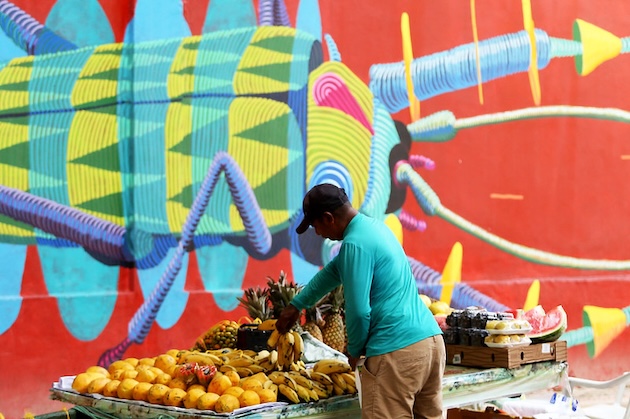
Agriculture is both a challenge and a solution for climate change. Busani Bafana/IPS

Agriculture is both a challenge and a solution for climate change. Busani Bafana/IPS

BULAWAYO, Jan 9 2026 (IPS) – As they ate catered meals, COP30 negotiators had no appetite for fixing broken food systems, a major source of climate pollution, experts warn.


Food systems are the complete journey food takes—from the farm to fork—which means its growing, processing, distribution, trade and consumption and even the waste.

The International Panel of Experts on Sustainable Food Systems (IPES-Food) warns that the final COP30 agreement risks deepening climate and hunger crises.  It failed  to address global warming emissions from food systems and the escalating damages caused by fossil-fuel-dependent industrial agriculture.

Food appears only once in the negotiated text, as a narrow indicator on ‘climate resilient food production’ under the Global Goal on Adaptation, IPES-Food pointed out.

“There is no mention of food systems, no roadmap to tackle deforestation, and no recognition that industrial agriculture drives nearly 90 percent of forest loss worldwide,” noted the think tank, emphasizing that negotiators also weakened language in the Mitigation Work Programme from addressing the ‘drivers’ of deforestation to vague ‘challenges.’

IPES-Food argued that the omission of food systems in the COP30 agreement was in stark contrast to the summit itself, which was held in the heart of the Amazon. Thirty percent of all food served during COP30 came from agroecological family farmers and traditional communities, and concrete public policy proposals for a just transition of food systems were on full display, IPES-Food said.

By not supporting a transition to environmentally friendly and low-emission agriculture, the agreement has left the global food system—and the billions who depend on it—highly vulnerable to the very climate shocks it helps cause, experts said.

“Food solutions were on display everywhere around COP30—from the 80 tonnes of local and agroecological meals served to concrete proposals for tackling hunger—but none of this made it into the negotiating rooms or the final agreement,” said Elisabetta Recine, IPES-Food panel expert and president of the Brazilian National Food and Nutrition Security Council (Consea), in a statement.

“Despite all the talk, negotiators failed to act, and the lived realities of people most affected by hunger, poverty, and climate shocks went unheard.”

Big Oil and Big Ag, Bigger voice

More than 300 industrial agriculture lobbyists were registered as delegates to COP30. They  are blamed for influencing discussions and promoting false solutions to climate change.

“COP30 was supposed to be the Implementation COP—where words turned into action,” Danielle Nierenberg, an expert on sustainable agriculture and food issues and President of Food Tank, told IPS. “But once again, corporate interests won over people, nature, and the future of our food and agriculture systems as part of the solution to the climate crisis.”

Raj Patel, IPES-Food panel expert and professor at the University of Texas, argues that agribusiness lobbyists captured COP30 to influence outcomes favoring industrial agriculture and big oil interests.

“Food systems are second only to oil and gas as a driver of the climate crisis, and unlike oil wells, they are also the first victim of the chaos they create, Patel noted.

Obstacles and Opportunities

Scientists have warned that carbon emissions, including those from agriculture, must be cut considerably if the world is to meet the goals of the Paris Agreement to limit global warming to 2°C or less.

Even if fossil fuel emissions were eliminated immediately, emissions from the global food system alone would make it impossible to limit warming to 1.5°C and difficult even to realize the 2°C target, scientists have said.

Selorm Kugbega, a Research Fellow at the Stockholm Environment Institute, agrees that despite many promises made to tackle agriculture-linked emissions, COP30 turned out to be a damp squib for agrifood systems.

Initiatives such as RAIZ to restore 500 million hectares of degraded agricultural land by 2030 and TERRA to scale out climate solutions for smallholder farmers through blended finance, which were launched at COP30 omitted to highlight the effects of industrial food systems. Over 300 industrial agriculture lobbyists participated in discussions at COP30, leading to accusations of swaying the outcomes.
Analysts warn the final agreement at COP30 in Belém, Brazil, risks deepening climate and hunger crises. Credit: Raimundo Pacco/COP30

Analysts warn the final agreement at COP30 in Belém, Brazil, risks deepening climate and hunger crises. Credit: Raimundo Pacco/COP30

Kugbega observed that after several years of slow progress and momentum in integrating food systems in climate negotiations, COP30 should have been the opportunity to seal agriculture’s centrality in future COPs. However, it ended with no clear agreements on grant-based public finance for adaptation in agriculture or redirection of public funds that subsidize industrial systems.

The climate negotiations demonstrated power inequality in climate negotiations with the implicit protection of industrial agriculture interests, which weakened the credibility of any global efforts at mitigating agriculture-based emissions, Kugbega observed, highlighting that smallholders bear a high burden of climate risks and have little adaptation financing.

Kugbega argued the most powerful countries, which are generally less dependent on agriculture, tend to prioritize sectors such as energy and transport in climate negotiations. However, many least developed countries, particularly in Africa, are highly dependent on agriculture for employment and economic stability and face urgent climate risks.

“Yet these countries often lack the political influence to elevate agriculture and food systems as central issues in COP negotiations,” he said. “COP30 in Brazil presented a major opportunity to shift this imbalance, making the failure to position food systems at the center of the climate agenda particularly troubling.”

Frugal Financing for Food and Farmers

According to the Climate Policy Initiative (CPI) and the UN’s Standing Committee on Finance, agriculture receives a small and insufficient share of total global climate finance.

Of the available approximate total global climate finance of USD 1.3 trillion per year on average, agriculture gets around USD 35 billion per year. This is a huge shortfall given that food systems are estimated to be responsible for roughly one-third of global greenhouse gas emissions and are one of the sectors most vulnerable to climate impacts, according to the CPI. Worse still, smallholder farmers, who produce up to 80 percent of food in developing countries, only receive 0.3 percent—a striking imbalance, yet they feed the world and are more exposed to climate impacts.

Will COP31 Deliver?

While COP30 highlighted the need to tackle climate change impacts through the transformation of food systems, such as highlighted in the Belém Declaration on Hunger, Poverty and Human-Centered Climate Action, it remains to be seen if COP31 will deliver a positive outcome on food systems.

Waiting for COP31 to save the world is surrendering because agribusiness lobbyists do not take holidays, argues IPES-Food panel’s Raj Patel.

“The test is not whether diplomats can craft better language in Antalya, but whether farmers’ movements, indigenous movements, and climate movements can generate enough political pressure to make governments fear inaction more than they fear confronting corporate power,” he said.

COP31, to be  hosted by Turkey with Australia as negotiations president in 2026 , is expected to prioritize an action agenda centered on adaptation finance, fossil fuel phase-out, adaptation in Small Island Developing States, and oceans.

While this agenda aligns with broader climate justice goals, it means food systems risk becoming indirectly addressed rather than explicitly championed, Kugbega said.

Given the stalled negotiations on financing sustainable agriculture transitions and the postponement of the Sharm el-Sheikh Joint Work on Agriculture, Kugbega said COP31 will likely focus more on developing new roadmaps and agreements than on full-scale implementation.

COP32 could be a greater opportunity for the implementation of the work program under Ethiopia’s COP32 presidency, given the country’s direct exposure to climate risks in agriculture, he noted.

“COP31 will likely shape whether the world arrives at COP32 ready to implement and operationalize sustainable food systems or once again be forced to renegotiate what is already known.”

This feature is published with the support of Open Society Foundations.

IPS UN Bureau Report


Fast-Acting Interventions Needed for Sudanese Refugee Children as Needs Outpace Response

Active Citizens, Africa, Aid, Armed Conflicts, Civil Society, Development & Aid, Editors’ Choice, Education, Education Cannot Wait. Future of Education is here, Featured, Headlines, Human Rights, Humanitarian Emergencies, Middle East & North Africa, Migration & Refugees, Population, Poverty & SDGs, Sustainable Development Goals, TerraViva United Nations, Youth

Education Cannot Wait. Future of Education is here

These Sudanese refugee children are among the 748,000 refugees and asylum-seekers who have sought refuge in Egypt. Credit: ECW

These Sudanese refugee children are among the 748,000 refugees and asylum-seekers who have sought refuge in Egypt. Credit: ECW

CAIRO & NAIROBI, Aug 26 2024 (IPS) – As peace eludes war-torn Sudan, thousands of displaced people fleeing the deadly battle between the Sudanese Armed Forces (SAF) and Rapid Support Forces (RSF) have found refuge in neighboring countries, including Egypt.


The Sudanese refugee population in Egypt has grown almost sevenfold in what is considered the worst displacement crisis in the world, impacting 10 million people, with at least 2 million having fled to neighboring countries, including Egypt. In Egypt, over 748,000 refugees and asylum-seekers are registered with the UNHCR, a majority of whom are women and children who have recently arrived from Sudan. This number is expected to continue to rise.

“When Sudan plunged into conflict, the international aid community, UN agencies, civil society and governments developed a response plan to meet the urgent needs of refugees fleeing Sudan to seek safety in five different countries, including Chad, Ethiopia, Egypt, South Sudan and the Central African Republic,” Yasmine Sherif, Executive Director of Education Cannot Wait (ECW), the global fund for education in emergencies and protracted crises within the United Nations, told IPS.

To put it into perspective, the 2024 Sudan Regional Refugee Response Plan calls for USD 109 million to respond to refugee education needs across the region. To date, only 20 percent of this amount has been mobilized, including USD 4.3 million—or 40 percent of the requirement for Egypt.

ECW was among the first to respond in the education sector, providing emergency grants to support partners in all five countries.

The government of Egypt has demonstrated great commitment to providing refugees with access to education services, but with 9,000 children arriving every month, the needs are overwhelming.

Consequently, nearly 54 percent of newly arrived children are currently out of school, per the most recent assessment.

Sherif says despite Egypt’s generous refugee policy, the needs are great, resources are running thin and additional funding is urgently needed to scale up access to safe, inclusive, and equitable quality education for refugee as well as vulnerable host community children.

“Families fleeing the brutal conflict in Sudan endured the most unspeakable violence and had their lives ripped apart. For girls and boys uprooted by the internal armed conflict, education is nothing less than a lifeline. It provides protection and a sense of normalcy amidst the chaos and gives them the resources they need to heal and thrive again,” she said.

Yasmine Sherif, Executive Director of Education Cannot Wait (ECW) interacts with Sudanese refugee children in Egypt. Credit: ECW

Yasmine Sherif, Executive Director of Education Cannot Wait (ECW), interacts with the Sudanese refugee community in Egypt. Credit: ECW

The government of Egypt has demonstrated great commitment to providing refugees with access to education services, but with 9,000 children arriving every month, the needs are overwhelming.

On a high-level stock-taking UN mission to Egypt in August 2024, ECW, UNHCR and UNICEF are urging donors, governments and individuals of good will to contribute to filling the remaining gap and scaling up the education response for refugee and host-community children.

“We have seen the important work that is being undertaken by UNHCR, the Catholic Relief Service and local organizations. But needs are fast outpacing the response, and Egypt now has a growing funding gap of USD 6.6 million. Classrooms are hosting as many as 60 children, most of whom are from host communities,” Sherif says.

Stressing that additional resources are urgently and desperately required to ensure that refugee and host community children in Egypt and other refugee-receiving countries in the region can attend school and continue learning. With the future of the entire region at stake, ECW’s call to action is for as many donors as possible to step in and help deliver the USD10 million required here and now to adequately support the refugee and host communities.

The ECW delegation in Egypt have assessed that at least USD 109 million is needed to assist with refugee education across the region. Credit: ECW

Education Cannot Wait Executive Director Yasmine Sherif, UNHCR, UNICEF, Catholic Relief Services (CRS) staff and Sudanese refugee girls and women at the CRS office in Cairo, Egypt.Credit: ECW

“We have seen the important work that is being undertaken by UNHCR, the Catholic Relief Service and local organizations, such as the Om Habibeh Foundation. But needs are fast outpacing the response,” Sherif says.

“In the spirit of responsibility sharing enshrined in the Global Compact on Refugees, I call on international donors to urgently step up their support. Available funding has come from ECW, ECHO, the EU, Vodafone, and a few other private sector partners. We should not abandon children in their darkest hour. This is a plea to the public and private sectors, and governments to step in and deliver for conflict-affected children,” she said.

Dr. Hanan Hamdan, UNHCR Representative to the Government of Egypt and to the League of Arab States, agreed.

“Forcibly displaced children should not be denied their fundamental right to pursue their education; their flight from conflict can no longer be an impediment to their rights. UNHCR, together with ECW and UNICEF, continue to ensure that children’s education, and therefore their future, are safeguarded,” she said.

“To this end, it is crucial to further support Egypt as a host country. It has shown remarkable resilience and generosity, but the increasing number of displaced individuals requires enhanced international assistance. By strengthening Egypt’s capacity to support refugees, we can ensure that more children have access to education and eventually a brighter future,” Hamdan added.

During the high-level ECW mission in Egypt, the ECW delegation met with key strategic partners—including donors, UN agencies, and local and international NGOs—and with Sudanese refugees to take stock of the scope of needs and the ongoing education response by aid partners.

Jeremy Hopkins, UNICEF Representative in Egypt, reiterated the agency’s commitment.

“UNICEF is steadfast in its commitment to ensure that conflict-affected Sudanese children have the opportunity to resume their education. In Egypt, through innovative learning spaces and the Comprehensive Inclusion Programme, UNICEF is working diligently, under the leadership of the Egyptian government, in cooperation with sister UN agencies and development partners, to create inclusive learning environments and strengthen resilient education systems and services,” Hopkins said.

“This not only benefits displaced Sudanese children but also supports host communities by ensuring that all children have access to quality education.”

In December 2023, ECW announced a USD 2 million First Emergency Response Grant in Egypt. The 12-month grant, implemented by UNHCR in partnership with UNICEF, is reaching over 20,000 Sudanese refugees in the Aswan, Cairo, Giza and Alexandria governorates.

Sudanese displaced children in Egypt are falling behind in their education. Education Cannot Wait has made a global appeal for funds to ensure they are able to continue with their education. Credit: ECW

Sudanese displaced children in Egypt are falling behind in their education. Education Cannot Wait has made a global appeal for funds to ensure they are able to continue with their education. Credit: ECW

The grant supports interventions such as non-formal education, cash grants, social cohesion with host communities, mental health and psychosocial support, and construction and refurbishment work in public schools hosting refugee children to benefit both refugee and host community children. As conflict escalates across the globe, ECW is committed to ensuring that all children have a chance at lifelong learning and earning opportunities.

Beyond Egypt, ECW has allocated USD 8 million in First Emergency Response grants in the Central African Republic, Chad, Ethiopia and South Sudan to address the urgent protection and education needs of children fleeing the armed conflict in Sudan. In Sudan, ECW has invested USD 28.7 million in multi-year and emergency grants, which have already reached more than 100,000 crisis-affected girls and boys.

During the mission, ECW called on leaders to increase funding for the regional refugee response and other forgotten crises worldwide. ECW urgently appeals to public and private donors to mobilize an additional US$600 million to reach 20 million crisis-impacted girls and boys with safe, quality education by the end of its 2023–2026 strategic plan.

IPS UN Bureau Report

  Source



