A Grim Year for Democracy and Civic Freedoms – but in Gen Z There Is Hope

Active Citizens, Armed Conflicts, Civil Society, Climate Change, Crime & Justice, Democracy, Economy & Trade, Environment, Featured, Gender, Global, Headlines, Human Rights, Inequality, LGBTQ, TerraViva United Nations

Opinion

People take part in an anti-corruption protest in Kathmandu, Nepal on 8 September 2025. Credit: Navesh Chitrakar/Reuters via Gallo Images

NEW YORK, Dec 24 2025 (IPS) – 2025 has been a terrible year for democracy. Just over 7 per cent of the world’s population now live in places where the rights to organise, protest and speak out are generally respected, according to the CIVICUS Monitor, a civil society research partnership that measures civic freedoms around the world. This is a sharp drop from over 14 per cent this time last year.


Civic freedoms underpin healthy democracies, and the consequences of this stifling of civil society are apparent. At the end of the first quarter of the 21st century, the world is experiencing 19th century levels of economic inequality. The wealth of the richest 1 per cent is surging while some 8 per cent of the world’s population – over 670 million people – suffer from chronic hunger. Weapons-producing firms, closely intertwined with political elites, are reaping windfall profits as death and destruction rains down in Gaza, Myanmar, Sudan, Ukraine and many other places. It should surprise no one that the political leaders fomenting these conflicts are also squashing civic freedoms to avert questions about their motivations.

From Lima to Los Angeles, Belgrade to Dar es Salaam and Jenin to Jakarta, far too many people are being denied the agency to shape the decisions that impact their lives. Yet these places have also been the site of significant protests against governments this year. Even as authoritarianism appears to be on the march, people are continuing to pour onto the streets to insist on their freedoms. As we speak people in Sofia in Bulgaria are demonstrating in large numbers against endemic corruption which recently forced the government to resign.

History shows that mass demonstrations can lead to major advances. In the 20th century, people’s mobilisations helped achieve women’s right to vote, liberation of colonised peoples and adoption of civil rights legislation to address race-based discrimination. In the 21st century, advances have been made in marriage equality and other LGBTQI+ rights, and in highlighting the climate crisis and economic inequality through protests. But in 2025, the right to protest, precisely because it can be effective, is under assault by authoritarian leaders. Around the world, the detention of protesters is the number one recorded violation of civic freedoms, closely followed by arbitrary detentions of journalists and human rights defenders who expose corruption and rights violations.

This backsliding is now happening in major established democracies. This year, the CIVICUS Monitor downgraded Argentina, France, Germany, Italy and the USA to an ‘obstructed’ civic space rating, meaning the authorities impose significant constraints on the full enjoyment of fundamental rights. This regression is being driven by anti-rights nationalist and populist forces determined to degrade constitutional checks and balances and advance ballot box majoritarianism that denies minorities a fair say in economic, political and social life.

The push to degrade democracy by anti-rights forces now coming to fruition has been many years in the making. It accelerated this year with the return of Donald Trump. His administration immediately withdrew support to international democracy support programmes and instead built links to politicians responsible for crushing civic freedoms and committing grotesque human rights violations. Trump has laid out of the red carpet to El-Salvador’s Nayib Bukele, Hungary’s Victor Orbán, Israel’s Benjamin Netanyahu, Russia’s Vladimir Putin and Saudi Arabia’s Mohammed bin Salman, ushering in a new era of values-free might-is-right diplomacy that threatens to undermine decades of painstaking progress achieved by civil society.

The fallout is clear. Many wealthy democratic governments that traditionally fund civil society activities have significantly reduced their contributions. At the same time, they have linked their remaining support for civil society to narrowly defined strategic military and economic interests. In doing so, they have played directly into the hands of powerful authoritarian states such as China, Egypt, Iran, Nicaragua and Venezuela that seek to discredit domestic calls for accountability. Countries including Ecuador and Zimbabwe have introduced laws to limit the ability of civil society organisations to receive international funding.

All these developments are negatively impacting on civil society efforts for equality, peace and social justice. Yet the story of 2025 is also one of persistent resistance, and some successes. The courage demonstrated by Generation Z protesters has inspired people around the world. In Nepal, protests triggered by a social media ban led to the fall of the government, offering hope for a much-needed political reset. In Kenya, young protesters continued to take to the streets to demand political reform despite state violence. In Moldova, a cash-rich disinformation campaign run by a fugitive oligarch failed to sway the course of the national election away from human rights values. In the USA, the number of people joining the No-Kings protests just keeps on growing.

With over 90 per cent of the world’s population living with the institutional denial of full civic freedoms, anti-rights forces must be feeling pretty smug right now. But democratic dissent is brewing, particularly among Generation Z, denied political and economic opportunities but understanding that another world – one more equal, just, peaceful and environmentally sustainable – is possible. It’s far from game over yet, and even in difficult times, people will demand freedoms – and breakthroughs may be just around the corner.

Mandeep S Tiwana is Secretary General of CIVICUS, the global civil society alliance.

  Source

Refugees Forced to Fill Gaps as Funding, Power and Legal Recognition Move Out of Reach

Active Citizens, Africa, Armed Conflicts, Asia-Pacific, Civil Society, Development & Aid, Disaster Management, Editors’ Choice, Featured, Global, Human Rights, Humanitarian Emergencies, Middle East & North Africa, Migration & Refugees, Sustainable Development Goals, TerraViva United Nations

Migration & Refugees

A new global synthesis report and refugee voices from East Africa and the Middle East warn that reductions in humanitarian footprints risks breaking the refugee protection system.

Sahrawi refugees walk near the Awserd Refugee Camp in the Tindouf Province of Algeria. Credit: UN Photo/Evan Schneider

Sahrawi refugees walk near the Awserd Refugee Camp in the Tindouf Province of Algeria. Credit: UN Photo/Evan Schneider

SRINAGAR, India, Dec 16 2025 (IPS) – The global refugee system is entering a period of deep strain. The delivery of protection and assistance is undergoing a transformation due to funding cuts, institutional reforms, and shifting donor priorities.


Against this backdrop, a new Global Synthesis Report titled From the Ground Up highlights the many issues faced by refugees in the Middle East and Africa.

Regional Perspectives on Advancing the Global Compact on Refugees has highlighted a rare, refugee-centered assessment of what is working, what is failing, and what must change. The report draws on regional roundtables held in East Africa and the Middle East and North Africa, followed by a global consultation in Geneva, to feed into the 2025 Global Refugee Forum progress review

According to the report, refugee-led and community-based organizations are increasingly taking on responsibilities, but they are not receiving power, funding, or legal recognition. As international agencies scale back under what is being called the Humanitarian Reset and UN80 reforms, refugees are expected to fill widening gaps without the authority or resources required to do so safely and sustainably.

The East Africa roundtables, held in Kampala with participation from refugee organizations in Uganda, Kenya, and Ethiopia, highlight a region often praised for progressive refugee policies. Countries here host millions displaced by conflict, hunger, and climate stress from South Sudan, Sudan, Somalia, and the Democratic Republic of the Congo.

Laws and regional frameworks promise freedom of movement, inclusion in national systems, and meaningful participation. The lived reality, however, remains uneven.

Education emerged as a central concern. Refugee children are enrolling in schools at higher rates, especially where they have been integrated into government-aided systems. Yet access remains unequal. Refugee students struggle to have prior qualifications recognized.

Many are treated as international students at universities and charged higher fees. Refugee teachers, often qualified and experienced, receive lower pay than nationals or are excluded from formal recognition. Language barriers and lack of psychosocial support further undermine learning outcomes. Refugee-led groups are already stepping in with mentorship, counseling, and bursary support, but they do so with fragile funding and limited reach.

Documentation and freedom of movement form another critical fault line. Uganda is widely cited for its rapid issuance of refugee IDs and settlement-based approach. Kenya and Ethiopia have made progress through new refugee laws and policy reforms. Still, gaps between policy and practice persist. Refugees in urban areas remain undocumented in large numbers. Identity documents often have short validity, forcing repeated renewals.

Travel documents are difficult to obtain, especially in Ethiopia, limiting cross-border movement, livelihoods, and participation in regional or global policy forums. Without documentation, refugees face arrest, harassment, and exclusion from services. For refugee organizations, lack of legal registration means operating in constant uncertainty.

Access to justice, described in the report as one of the least discussed yet most pivotal issues, cuts across all others. Refugees cannot claim rights or seek redress without functioning justice pathways. Language barriers in courts, xenophobic profiling, and lack of legal aid remain common.

Refugee-led organizations already provide mediation, paralegal support, and court accompaniment, often acting as the first point of contact between communities and authorities. Yet their work is rarely formalized or funded at scale.

These findings came alive during a webinar held at the launch of the report, where refugee leaders from different regions spoke directly about their experiences. One participant from East Africa reflected on repeated engagement in international forums. This event was his third such process, following meetings in Uganda and Gambia. He noted that participation was no longer symbolic. Governments and institutions were beginning to listen more closely.

He pointed to concrete differences across countries. In Kenya, refugees do not require exit visas. In Ethiopia, they do. Sharing such comparisons, he argued, helps governments rethink restrictive practices and adapt lessons from neighbors.

From the Middle East and North Africa, the discussion shifted to documentation and access to justice. A Jordan-based lawyer explained that civil documentation is not mere paperwork. It is the foundation of rights and accountability. Without birth registration, children cannot access education.

Without legally recognized marriages, women and children remain unprotected. Many Syrian refugees arrived in Jordan without documents, having lost them during flight or lacking legal awareness. Over time, Jordan introduced measures such as fee waivers, legal aid, and even Sharia courts inside camps like Zaatari to facilitate birth and marriage registration. Civil society groups have provided thousands of consultations and legal representations, bridging gaps between refugees and state systems.

The webinar also highlighted language as a structural barrier. In Jordan, Arabic serves as a common language for Syrians, easing communication. In East Africa, linguistic diversity complicates access to justice and services. Uganda hosts South Sudanese, Sudanese, and Congolese refugees, each with distinct languages, while official processes operate in English and Kiswahili. Governments have made efforts to provide interpretation, but gaps remain, particularly in courts and police interactions.

In Ethiopia, where Amharic dominates official institutions, refugee organizations often rely on founders or leaders who speak the language fluently, limiting broader participation.

As the conversation turned to the future of the humanitarian system, the tone grew more urgent. Participants acknowledged that funding cuts have already halted programs and exposed vulnerabilities. One speaker stressed that legal aid and documentation cannot be seen as optional sectors.

Without sustained support, entire protection systems risk collapse. Empowerment, he argued, goes beyond providing lawyers. It means building refugees’ confidence and capacity to navigate legal systems themselves.

Another participant addressed donors and UN agencies directly. Localization, he said, will fail if refugee organizations are treated only as implementers of predesigned projects. Power must shift alongside responsibility.

Refugee organizations should help design programs, raise resources, and make decisions based on community priorities. Otherwise, localization becomes another layer of outsourcing rather than a genuine transfer of agency.

The speaker’s final intervention starkly highlighted the stakes involved. With funding shrinking and uncertainty growing, refugees may soon have no option but to rely on themselves. Investing in refugee-led organizations, the speaker said, is not a luxury. This represents the final line of hope for refugees on the ground.

The MENA roundtables echo many of these concerns but in a more restrictive political context. Civic space is tighter. Legal recognition for refugee organizations is often impossible or risky. In Jordan, refugees cannot legally register organizations. In Egypt, civil society laws limit advocacy.

In Türkiye, registration is technically possible but bureaucratically daunting. Despite this, refugee-led initiatives have multiplied, filling gaps in education, protection, and livelihoods as international actors retreat.

The report warns of a dangerous paradox. Localization is advancing by necessity, not design. International agencies withdraw. Local actors step in. Yet funding, decision-making, and protection remain centralized. Refugee organizations absorb risk without safeguards. Participation is often tokenistic. Refugees are present in meetings but absent from real influence.

IPS UN Bureau Report

  Source

Funding for Human Rights Organizations – including at the Grassroots Level – have Been Slashed Worldwide

Civil Society, Global, Global Governance, Headlines, Human Rights, International Justice, IPS UN: Inside the Glasshouse, TerraViva United Nations

Opinion

Volker Türk is UN High Commissioner for Human Rights

Human rights are positive, essential and attainable.

Human rights are positive, essential and attainable.

 
Photo: from left to right: UN/Harandane Dicko, © NurPhoto, © Betul Simsek, OHCHR Moldova
Credit: United Nations

GENEVA, Dec 11 2025 (IPS) – Human rights are underfunded, undermined and under attack. And yet. Powerful. Undeterred. Mobilizing.

This year no doubt has been a difficult one. And one full of dangerous contradictions. Funding for human rights has been slashed, while anti-rights movements are increasingly well-funded.


Profits for the arms industry are soaring, while funding for humanitarian aid and grassroots civil society plummets. Those defending rights and justice are attacked, sanctioned and hauled before courts, even as those ordering the commission of atrocity crimes continue to enjoy impunity.

Diversity, equity and inclusion policies that were adopted to address historical and structural injustices are being vilified as unjust. The prognosis would be incredibly dire if these were the only trends. But the pushback on human rights is facing pushback from a groundswell of human rights activism.

In Nepal, Serbia, Madagascar, Kenya, Bangladesh, Ecuador, Paraguay, the Philippines, Indonesia, Tanzania, Morocco, Peru and beyond, mostly young people have taken to the streets and to social media against inequalities, against corruption or repression, in favour of freedom of expression, and for their everyday essential rights.

People across the world have also been protesting against war and injustice, and demanding climate action, in places far from home, expressing solidarity and pressuring their governments to take action.

I urge governments around the world to harness the energy of these social movements into opportunities for broader transformational reforms rather than rushing to suppress them or label them as extremist threats to national security. They are, in fact, the exact opposite of threats to national security.

On the challenges I had set out earlier, here is some data:

Funding: Our resources have been slashed, along with funding for human rights organisations – including at the grassroots level – around the world. We are in survival mode.

My Office has had about USD 90 million less than we needed this year, which means around 300 jobs have been lost, and essential work has had to be cut, including on Colombia, the Democratic Republic of the Congo, Myanmar, Tunisia and other countries at a time when the needs are rising.

Special Rapporteur country visits and investigative missions by fact-finding bodies have also been reduced, sometimes drastically. Crucial dialogues with States on their compliance with UN human rights treaties have had to be postponed – last year there were 145 State party reviews, we are down to 103 this year.

We see that all this has extensive ripple effects on international and national efforts to protect human rights.

Meanwhile, anti-rights and anti-gender movements are increasingly coordinated and well-funded, operating across borders. According to the European Parliamentary Forum for Sexual and Reproductive Rights, for example, almost USD 1.2 billion was mobilized by anti-rights groups in Europe between 2019 and 2023.

There is significant money flowing into the anti-rights agenda from funders based in Europe, Russia and the United States of America. Such massive funding, coupled with media capture and disinformation strategies have made the anti-rights agenda a powerful cross-regional force.

Another distressing dataset is that from the Stockholm International Peace Research Institute (SIPRI). It says that arms and military services revenues for the 100 largest arms companies reached a record USD 679 billion in 2024. SIPRI has said demand was boosted by wars in Ukraine and Gaza, by global and regional geopolitical tensions, and ever-higher military expenditure.

There have been efforts this year to secure ceasefires and peace deals, which are certainly welcome. However, for peace to be sustainable, human rights must play a central role. There From prevention to negotiating to monitoring to accountability, recovery and peacebuilding.

And we need to do a reality check.

As we have seen in Gaza and in the eastern Democratic Republic of the Congo, agreements have yet to translate into effective protection of civilians on the ground.

Gaza remains a place of unimaginable suffering, loss and fear. While the bloodshed has reduced, it has not stopped. Attacks by Israel continue, including on individuals approaching the so-called “yellow line”, residential buildings, and IDP tents and shelters as well as other civilian objects.

Access to essential services and goods remain severely inadequate. In the West Bank, we are seeing unprecedent levels of attacks by Israeli forces and settlers against Palestinians, forcing them from their land. This is a time to intensify pressure and advocacy – not to sink into complacency – for Palestinians across the occupied territory.

Clashes between the DRC armed forces and the Rwandan-backed M23 armed group continue, alongside serious human rights violations and abuses. Civilians, again, are bearing the brunt. Overnight, you’ll have seen, there have been reports of thousands fleeing the densely populated South Kivu city of Uvira amid escalating clashes between the M23 and DRC armed forces, backed by Wazalendo militia.

This comes just days after the DRC and Rwanda reaffirmed their commitment to implement the June 2025 Washington Peace Agreement. Over the years, we have documented outrageous violations against civilians in Uvira, including rape and sexual and gender-based violence. The risk of a broader regional confrontation appears to be increasing.

In Sudan, the brutal conflict between the army and the Rapid Support Forces continues unabated. From Darfur and the Kordofans to Khartoum and Omdurman and beyond, no Sudanese civilian has been left untouched by the cruel and senseless violence. I am extremely that we might see a repeat of the atrocities committed in El Fasher in Kordofan.

In Ukraine, civilian harm has risen sharply. Civilian casualties so far this year are 24 per cent higher than the same period last year, largely due to Russia’s increased use of powerful long-range weapons in large numbers and its continuing efforts across broad front to capture further Ukrainian territory by armed force.

Large-scale attacks on Ukraine’s energy system have caused emergency outages and prolonged daily electricity cuts, disruptions to water and heating services in many areas. Urgent steps need to be taken to alleviate suffering, including the return of transferred children, the exchange of all prisoners of war, and the unconditional release of civilian detainees held by Russian authorities.

For any sustainable peace to be negotiated, it is important that confidence-building measures are taken, grounded in human rights, including steps to alleviate civilian suffering, promote accountability and preserve a basis for future dialogue. And, importantly, women need to be a part of this process.

It is imperative that peace deals and ceasefires are secured and implemented in good faith. And with full respect for international law, which can never be set aside for political convenience.

It is also critical to counter the demonization of and hatemongering rhetoric against migrants and refugees. In various countries, worryingly, we are seeing violent pushbacks, large-scale raids, arrest and returns without due process, criminalization of migrants and refugees and those who support them, as well as the outsourcing of responsibilities under international law.

I urge States to embark on an evidence-based policy debate on migration and refugee issues, anchored in international human rights and refugee law.

In the course of many electoral campaigns this year, we have also seen a pattern of democratic backsliding, restrictive civic space and electoral violence.

Myanmar’s upcoming military-imposed “election”, is accompanied by new waves of acute insecurity and violence, continued arrests and detentions of opponents, voter coercion, the use of extensive electronic surveillance tools and systemic discrimination. I fear this process will only further deepen insecurity, fear and polarization throughout the country.

There is, unfortunately, never a shortage of human rights challenges to face, issues to resolve, and values to defend. What is heartening is that there are so many of us, around the world, attached to the same universal human rights values – no matter the noise, the gaslighting, and the persistent injustices.

I am energized by the social movements – particularly those led by young people. They are writing the latest chapters in the time-honoured struggle for our collective humanity and dignity. Journalists, activists, and human rights defenders have been at the forefront of the global movement for freedom, equality and justice.

Such perseverance has achieved landmark victories for the rights of women, migrants, people discriminated against on the basis of descent, minorities, our environment, and so much more.

And we will continue to persevere.

IPS UN Bureau

  Source

A New UN Secretary-General Needs the Blessings of the US–or Get Vetoed

Civil Society, Featured, Global, Global Governance, Headlines, IPS UN: Inside the Glasshouse, TerraViva United Nations

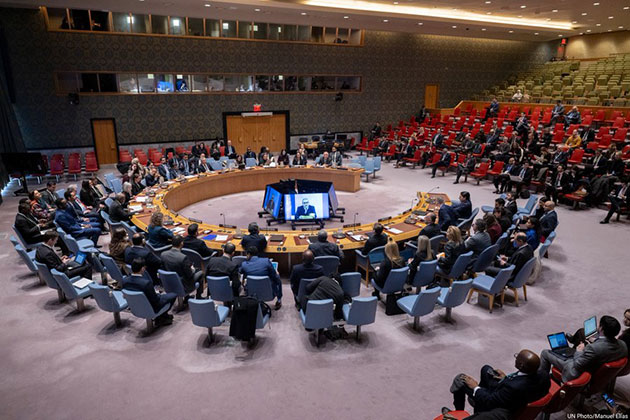
The Security Council in session. Credit: UN Photo/Evan Schneider

UNITED NATIONS, Dec 11 2025 (IPS) – When there was widespread speculation that a UN Under-Secretary-General (USG), a product of two prestigious universities—Oxford and Cambridge—was planning to run for the post of Secretary-General back in the 1980s, I pointedly asked him to confirm or deny the rumor during an interview in the UN delegate’s lounge.


“I don’t think”, he declared, “anyone in his right mind will ever want that job”.

Fast forward to 2026.

As a financially stricken UN is looking for a new Secretary-General, who will take office beginning January 2027, the USG’s remark in a bygone era was a reflection of a disaster waiting to happen.

The current Secretary-General is facing a daunting task battling for the very survival of the UN, with a hostile White House forcing the world body to sharply reduce its staff, slash funding and relocate several UN agencies, moving them out of New York.

The bottom line: the incoming Secretary-General will inherit a virtually devastated United Nations.

Addressing the General Assembly last September, President Trump remarked, “What is the purpose of the United Nations? It’s not even coming close to living up to [its] potential.”

Dismissing the U.N. as an outdated, ineffective organization, he boasted, “I ended seven wars, dealt with the leaders of each and every one of these countries, and never a phone call from the United Nations offering to help in finalizing the deal.”

Whoever is elected, the new UN chief will have to faithfully abide by the ground rules of the Trump administration virtually abandoning what the UN stands for, including racial equality and gender empowerment (DEI)

“Diversity, equity and inclusion (DEI) policies that were adopted to address historical and structural injustices are being vilified as unjust,” says Volker Turk, UN High Commissioner for Human Rights.

In his 345-page book titled “Unvanquished: A US-UN Saga,” released in 1999, Boutros Boutros-Ghali, a former Secretary-General, points out that although he was accused by Washington of being “too independent” of the US, he eventually did everything in his power to please the Americans.

But when he ran for a second term, the US, which preaches the Western concept of majority rule, exercised its veto even though Boutros-Ghali received 14 of the 15 votes in the Security Council, including the votes of the other four permanent members of the Council, namely the UK, France, Russia and China.

In such circumstances, tradition would demand the dissenting US abstain on the vote and respect the wishes of the overwhelming majority in the Security Council. But the US did not.

Unlike most of his predecessors and successors, Boutros-Ghali refused to blindly play ball with the US despite the fact that he occasionally caved into US pressure at a time when Washington had gained a notoriety for trying to manipulate the world body to protect its own national interests.

Jesselina Rana, UN Advisor at CIVICUS’ UN Hub in New York and the steering committee of the 1 for 8 Billion campaign, told IPS when key international norms are being openly flouted by certain member states and the veto is used to undermine the very principles the UN was built on, will structural reforms alone be enough to restore trust in the institution?”

Can the UN80 process genuinely rebuild trust in multilateralism, she asked, when the process itself has been opaque and has lacked meaningful civil society participation?

“An accountable and transparent Secretary-General selection process requires stronger and more explicit support from member states.”

A process that is open and inclusive of civil society and grounded in feminist leadership will strengthen the UN’s ability to navigate today’s difficult geopolitical conditions and help rebuild trust in multilateralism, she argued.

After 80 years of male leadership, the next Secretary-General should be a woman with a proven record on gender equality, human rights, peace, sustainable development, and multilateralism, declared Rana.

Felix Dodds, Adjunct Professor at the Water Institute, University of North Carolina and Associate Fellow, the Tellus Institute, Boston, who has written extensively on the UN, told IPS the UN is experiencing challenging times, living through what are probably the most difficult times since the Cold War.

It may not be a bad idea to move some UN bodies. UNDP did a lot of that under Helen Clarke—being closer to the people you are working to help, maybe it is a cost-cutting issue, but it may also be something that should have been considered before.

“The new SG will need to be someone Trump allows, as he has a veto,” he pointed out.

“Of the candidates we looked at before, the only one that is realistic is Rebeca Grynspan from UNCTAD. She has shown herself to be a good bureaucrat and has led UNCTAD well, as she did for Costa Rica when she was the Deputy President, said Dodds, City of Bonn International Ambassador.

“We may be looking at a man again,” he said.

Clearly, the new secretary-general taking over in 2027 has a daunting task ahead. Whoever it is will have had to make concessions to the P5 on the size and reach of the UN. The present cuts may be just the first set to come down.

“A UN with a clearer mandate on what it will do may be a result. Stakeholders need to, of course, defend the UN as a critical body for multilateral affairs BUT they must at the same time be putting forward reforms that are simple and strengthen the area they are working on.”

There is no way we can get security reform through—it doesn’t mean it shouldn’t be proposed, but what is realistic in the areas being reformed is that stakeholders and governments can work together on it.

Ultimately, the driving force should be a more effective UN delivering on the ground. Do reform proposals do that? he asked.

“The organization has always worked in a world of political pressures. I agree the body should be a place for dialogue and protection of the most vulnerable. UN80 offers an opportunity for dialogue on realistic proposals. The question is, what are they in the different areas?” he said.

Dr. Stephen Zunes, Professor of Politics and International Studies at the University of San Francisco, where he serves as coordinator of the program in Middle Eastern Studies, told IPS following the Napoleonic Wars, the Council of Europe largely kept the peace until the Central Powers decided it no longer worked for them. The result was World War I.

The League of Nations then set up a framework to keep the peace until the Axis powers decided it no longer worked for them. The result of World War II, he said.

“We are now at a similar crossroads, where the United Nations system is being challenged by both Russia and the United States which–as demonstrated through the invasions of Iraq and Ukraine—no longer feel constrained by the prohibition against aggressive war.”

“The more recent U.S. assaults on the UN are particularly damaging, given the importance of U.S. financial contributions to the UN’s functioning and Washington’s ability in recent weeks to push through resolutions in the UN Security Council seemingly legitimizing illegal Israeli and Moroccan military occupations of their neighbors.”

UN members must be willing to risk the wrath of the Trump administration by standing up for the UN Charter and basic principles of international law. Nothing less than the future of the world body and international peace and security is at stake, declared Dr Zunes.

IPS UN Bureau Report

  Source

The Daunting Tasks Ahead for the New UN Secretary-General

Civil Society, Featured, Global, Global Governance, Headlines, IPS UN: Inside the Glasshouse, TerraViva United Nations

Opinion

The United Nations Headquarters as seen from First Avenue in New York City. Credit: UN News/Vibhu Mishra

KATHMANDU, Nepal, Dec 10 2025 (IPS) – The election of the next Secretary-General of the United Nations comes at a highly inopportune moment in 2026, when the UN is being bypassed, and multilateralism—with the UN at its core—is under increasing challenge from some of the world’s most powerful states and leaders.


The new Secretary-General, taking office in 2027, will inherit an unprecedented financial crisis and a pressing need for major institutional reorganization simply to keep the UN afloat. At first glance, this hardly seems like the right moment for a new SG to advance a bold vision—one capable of winning over powerful leaders who appear lukewarm toward strengthening genuine multilateralism and instead prefer a multipolar order where each can guard its own sphere of influence.

Yet history reminds us that some of the boldest ideas have emerged during periods of great upheaval—wars, revolutions, and global crises. It is therefore conceivable that a visionary new UN leader could break new ground, introduce innovative ideas, and help plant the seeds for a rejuvenated, rules-based world order.

Kul Gautam

While many of today’s most powerful leaders may be ambivalent about multilateralism, the world’s general public—especially the digitally savvy younger generation—has a strong sense of global interdependence.

They increasingly identify as global citizens, eager to thrive in a borderless world, and are more likely to embrace visionary proposals for UN reform that meet the realities of the 21st century.

A promising starting point would be the election of the first-ever female Secretary-General of the UN. Another essential reform would be restructuring the UN’s financing system to make it more broad-based and less dependent on the whims of a few wealthy, powerful states.

Some consolidation of the UN’s sprawling architecture—much of it underfunded—is already underway through the current SG’s UN80 Initiative. A new SG could accelerate this effort, earning the support of both critics and cynics.

Still, even a dynamic and visionary new SG will require the backing of Member States. At present, leaders of the most powerful states, particularly the veto-wielding P5, seem disinclined to empower the world’s top diplomat as a true global leader.

While many enlightened global citizens—especially Gen Z—hope for a bold, inspiring figure at the helm, the major powers may prefer a more compliant “Secretary” rather than a strong, strategic “General.”

With the rise of the Global South and groupings such as BRICS+ and the G20, the balance of power—especially soft power—is shifting away from the states that founded the UN 80 years ago.

One hopes this evolving landscape will help strengthen the UN and reinvigorate multilateralism, which remains the only viable way to confront such transcendental issues as climate change, war and peace, pandemics, widening inequalities, and the profound opportunities and risks of the AI revolution.

The world urgently needs a more effective UN to address these pressing global challenges—none of which any nation, however rich or powerful, can tackle alone. It is to be hoped that world leaders, attuned to their peoples’ aspirations, will choose a highly capable new Secretary-General and empower her to help build a more peaceful and prosperous world for present and future generations.

Kul Gautam is a former UN Assistant Secretary-General, Deputy Executive Director of UNICEF and author of Global Citizen from Gulmi: My Journey from the Hills of Nepal to the Halls of the United Nations.

IPS UN Bureau

  Source

UN Pact for the Future Requires Global Solidarity and Localized Solutions

Civil Society, Development & Aid, Featured, Global, Headlines, Humanitarian Emergencies, Sustainable Development Goals, TerraViva United Nations

IPS UN: Inside the Glasshouse

H.E. Abdulla Shahid (left), former President of the UN General Assembly, and Collen Kelapile (center), former UN ambassador to Botswana and former vice-president of the UN Economic and Social Council, speak as panelists at the launch event of ICO's flagship report. Credit: John Okyo Nyaku/UN

H.E. Abdulla Shahid (left), former President of the UN General Assembly, and Collen Kelapile (center), former UN ambassador to Botswana and former vice-president of the UN Economic and Social Council, speak as panelists at the launch event of ICO’s flagship report. Credit: John Okyo Nyaku/UN

UNITED NATIONS, Dec 9 2025 (IPS) – More than one year since its adoption, the UN Pact for the Future is held up as a critical framework for countries to address today’s issues through global cooperation. Its agenda for global governance and sustainable development is ambitious, and it is for this reason the Pact poses implementation challenges when it comes to the direct impact on local communities. It will require the joint efforts of governments, civil society and international organizations to achieve the goals laid out in the Pact.


The efforts of the International Communities Organisation (ICO), a UK-based international NGO, demonstrate what implementing the Pact would look like. Since 2016, ICO has worked to empower minority communities in conflict-affected areas through education and capacity-building opportunities. ICO focuses on directly supporting efforts to build up underrepresented groups’ involvement in community initiatives and diplomatic dialogue and address systemic, societal inequalities.

On December 3, ICO launched its flagship report, For Our Future: Best Practice for the Implementation of the UN Pact for the Future, at the UN Headquarters in New York, presenting a practical framework to support UN member states in advancing the objectives outlined in the Pact for the Future. Several Permanent Missions to the UN, including Bahrain, Guyana, Hungary, Kuwait, Samoa, Singapore, Tajikistan, Tonga, and Uganda, co-sponsored the event.

The UN Pact for the Future represents a shared set of global commitments to sustainable development, peace and security, and redefining global governance for member states. While its adoption marks a decisive moment of global consensus, there remains the challenge of translating the Pact’s guiding principles into meaningful action at the national and regional levels.  Through its ‘Best Practices’ blueprint, the ICO report distills their findings into an adaptable methodology designed to equip policymakers with the tools they need to implement the Pact’s goals effectively.

James Holmes, ICO founder and Secretary General, said, “The Pact reminds us that the strength of nations is measured not only by the power of their armies or the size of their economies, but also by the inclusiveness of their societies and the recognition of all who live within.” “How we treat minority peoples, those who are few in number, vulnerable, or historically marginal, is the true test of our progress and the true test of whether the fact for the future is being successful.”

H.E. Abdulla Shahid, ICO International Ambassador and former President of the 76th United Nations General Assembly, said it was crucial for the world to unite.

“The UN Pact for the Future calls for renewed unity in tackling humanity’s greatest challenges. This report demonstrates that lasting peace is built not only at negotiation tables but also through empowering communities themselves, ensuring that no group is left behind.”

“As UN Secretary-General António Guterres noted at the opening of the ‘Summit of the Future’ in September 2024, ‘21st-century challenges require 21st-century solutions: frameworks that are networked and inclusive and that draw on the expertise of all humanity.’

He added that the ICO’s report embodies this principle, showing how global aspirations can intersect with local action.

Prominent UN diplomats and civil society members were present at the launch event, demonstrating and remarking on their commitment to the Pact for the Future, and specifically to ICO’s work on the ground. Current and former high-ranking UN officials were also in attendance.

“One year after the adoption of the Pact, this discussion is timely,” said Themba Kalua, the UN Director, Pact for the Future Implementation Kalua remarked during the event. “While the world has grown more complex since the adoption of the Pact for the Future, the Pact continues to be central in realizing multilateralism, navigating the current geopolitical complexities and shaping our collective action on the global agenda.”

Kalua noted the efforts made by the UN system towards the Pact, including global panels on the governance of artificial intelligence (AI) and the political declarations that emerged from UN conferences on social development in Qatar and financing for development in Spain. He expressed that the Pact was a “strategic priority” for the UN and its Secretary-General, António Guterres.

“From our side in the UN system and the Secretariat, we are committed to doing our part in supporting the implementation of the Pact,” Kalua told IPS.

Presenting the report, ICO’s UN Programme Manager Mia Sawjani broke down its findings and recommendations. She emphasized that countries would need to empower and promote the agency of local actors. This includes building up their capacity and skills to enact positive change in their communities. Countries must recognize adaptability in assessing situations on the ground, particularly in conflict settings that transform institutions and structures.

“The implementation of the Pact can be tangibly realized for all, but particularly to serve marginalized communities. It’s a transformative opportunity and it is our collective responsibility to follow through,” said Sawjani.

After the event, Holmes was heartened by the outpouring of support for ICO’s work, noting that many more countries had agreed to partner with them for future projects. By maintaining their focus on working with minority communities, ICO can “play a major global role” in implementing the Pact for Future.

“I have a big vision, and I have a lot of ambition for ICO,” Holmes told IPS. “We already have a global team, and I see that growing, and I see us having a bigger and bigger role in helping to implement the Pact.”

The launch event of ICO's flagship report on the UN Pact for the Future at UNHQ in New York. The event was attended by high-ranking UN diplomats. Credit: John Okyo Nyaku/UN

The launch event of ICO’s flagship report on the UN Pact for the Future at UNHQ in New York. The event was attended by high-ranking UN diplomats. Credit: John Okyo Nyaku/UN

Local actors and stakeholders, namely governments, academia, the private sector and civil society, would play a key role in implementing the Pact’s agenda. Organizations like ICO could serve as a bridge to translate the issues to the national context.

“The more we are able to bridge communities, the more successful it will be for states to deal with Track I diplomacy,” Shahid said to IPS, referencing the formal channel of diplomacy between governments on international issues.

Implementing the Pact for the Future must also mean recognizing the specific needs and challenges that these countries face. Island states like Samoa and Tonga, for example, are uniquely impacted by climate change, energy, and the global financial structures that need to better serve developing countries.

“For us in the Pacific, progress is measured not by rhetoric, but by real improvements that are felt in our villages, outer islands and vulnerable communities,” said Viliami Va’inga Tōnē, the Permanent Representative of Tonga.

Accountability and transparency will also be crucial to ensure countries follow through on the promises of the Pact. This must be present at all levels. Participants at the event emphasized the need for monitoring mechanisms that would measure progress.

The timing of the report coincides with the ongoing reform negotiations under the UN80 Initiative introduced this year. Discussions around the Pact went hand in hand with recognizing the critical step toward reforming the UN system that will optimize its ability to live up to its founding principles and the Pact’s promises.

If the Pact represents ‘what’ the UN and member states need to achieve in the global agenda, then UN80 represents ‘how’ the UN can implement the agenda.

“The UN80 initiative is really part of the UN response to how it can deliver on the ground,” said Fatumanava-o-Upolu III Dr. Pa’olelei Luteru, the Permanent Representative of Samoa. He said to IPS, “When you look at all the individual actions that need to be taken, these are at the global level, the UN [level], regional level, and national level. They’re all important, because we can’t continue to work in silence. Everything is interconnected now. So we need to make those connections and work together, and you don’t want duplication.”

While New York hosts reform discussions around the UN and its mandates, the organization’s impact will ultimately be felt by local communities across the world.

Dr. Agnes Mary Chimbiri-Molande, Permanent Representative of Malawi, told IPS that the people who serve in multilateral systems like the UN need to “renew or even rebuild trust” with local communities. At a time when people are questioning the UN’s relevance, she said, these discussions must be held and all perspectives need to be respected.

“We need to hear the voices of the local people. Because here we are working for them. We are not working for ourselves,” Chimbiri-Molande said. “So in fact, to be hearing the voices of those peoples, it’s very, very important to inform our work here, whether we are making an impact or we are making differences in the lives of the people in the community.”

Shahid reiterated that the decisions made in the halls of UN Headquarters will affect local communities, adding that the UN’s success is also contingent on its partnerships with civil society and how important it is for civil society to recognize the UN’s relevance.

During his time as President of the General Assembly from 2021-2022, the world was in the midst of the COVID-19 pandemic. His ‘presidency of hope’ championed the progress made by the international system despite the challenges brought on by the pandemic. He also made efforts to promote inclusivity by opening the General Assembly to more participants, including civil society groups.

Shahid invited young diplomats from underrepresented member states to the President’s office to witness international diplomacy firsthand.

Even after his presidency ended, he told IPS, he wanted to continue to deliver on the ideals that defined his tenure.

“I thought that there’s no need to end the presidency of hope after one year. Let us keep delivering the message of hope through other platforms. And ICO provides me the platform, because it is a platform through which I can actually reach out to communities at [the] household level and inspire them not to give up. Keep working, keep aiming to change the status.”

IPS UN Bureau Report

  Source