IPCI 2024: Oslo Commitment Protects Sexual and Reproductive Rights Across All Contexts

Civil Society, Development & Aid, Editors’ Choice, Featured, Gender, Gender Identity, Gender Violence, Global, Headlines, Human Rights, Humanitarian Emergencies, Population, Poverty & SDGs, Sustainable Development Goals, TerraViva United Nations, Women in Politics

Population

Ase Kristin Ask Bakke, MP and Chair of APPG Norway, reads the Oslo Statement of Commitment. Alando Terrelonge, MP, Jamaica, chair of the IPCI Drafting Committee, sits second from left. Credit: Naureen Hossain/IPS

Ase Kristin Ask Bakke, MP and Chair of APPG Norway, reads the Oslo Statement of Commitment. Alando Terrelonge, MP, Jamaica, chair of the IPCI Drafting Committee, sits second from left. Credit: Naureen Hossain/IPS

OSLO, Apr 12 2024 (IPS) – Parliamentarians from 112 countries have adopted the IPCI statement of commitment to protect and promote sexual and reproductive health rights, committing to the principle that “life or death is a political statement.”

As IPCI Oslo drew to a close on Friday, April 12, 2024, parliamentarians adopted a new Statement of Commitment that was “the collective effort of every single delegate,” said Alando Terrelonge, MP from Jamaica and chair of the drafting committee.


Remarking on the drafting process, he remarked, “We have definitely placed people’s rights and their dignity, the whole essence of human rights, at the forefront of our discussion.”

“Human rights really are at the heart of human civilization and sustainable development.”

Terrelonge, along with Ase Kristin Ask Bakke, MP and chair of APPG Norway, presented the statement before the conference in its penultimate session.

In brief, the Oslo Statement calls for parliamentarians to advocate for and promote SRHR across the life course, from birth to old age. It addresses the “rising polarization, conflicts, and fragile environments” that threaten the achievements made in the realization of IPCD’s Programme of Action by mobilizing their efforts and cooperating with relevant stakeholders.

It calls for increased accountability towards governments, the tech and healthcare sectors, and other relevant stakeholders, to respect human rights law. The statement makes a specific note to protect women, adolescents, and other vulnerable, marginalized groups who suffer disproportionately in conflicts and crises.

This statement seems pertinent in the wake of prolonged conflicts in Gaza, South Sudan, and Ukraine. In this light and in a broader context, the statement reaffirms a commitment to uphold international human rights law and humanitarian law in all contexts.

The statement reaffirms and expands on the core issues of the conference: policy and megatrends in demography, technology, and financing.

Technology’s impact on SRHR and political practices was officially codified in the statement, as it calls for governments to recognize the impact of digital technology on people’s lives, and the “immense potential” for the “full realization of the ICPD [Programme of Action].”

It also cautions that governments promote the safe and meaningful participation of women and girls in the digital space.

Financing SRHR programs has also been recognized as a priority, along with urging governments to allocate 10 percent of national development budgets towards the implementation of the Cairo program of action (POA). Furthermore, the statement advocates for following another UN-codified program, the Addis Ababa Action Agenda on Financing for Development, for its framework on long-term investments in development projects.

The participants had also agreed to increase political commitment to the continued implementation of the IPCD POA on parliamentary action for accountability and political commitment. The parliamentarians present pledged to accelerate developments and promote laws that respect international human rights obligations.

All those present enthusiastically applauded the statement’s adoption by consensus. As the conference reached its end and the statement was formally pledged, attendees expressed their support and its relevance to their states.

A delegate from Guatemala noted that while there were several pieces of legislation aimed at SRHR, they were not implemented clearly enough for civilians to know that these laws existed. She added that it was important to bridge the gap between governments and civilians in their understanding and implementation of SRHR policies.

The MP from Peru said parliamentarians needed to return to hold their governments accountable for the setbacks in the SRHR. She added that there needed to be investigations into the factors driving conservative groups to push back against the expansion of SRHR.

A MP from the Mauritiana delegation noted the progress that is achieved through pursuing gender equality: “Any society that does not give a space for women is a society that will suffer, socially and politically.”

  Source

IPCI 2024: Technology as a Tool to Advance and Threaten Sexual and Reproductive Health Rights

Civil Society, Development & Aid, Editors’ Choice, Featured, Gender, Gender Violence, Global, Headlines, Health, Human Rights, Humanitarian Emergencies, Population, Sustainability, Sustainable Development Goals, TerraViva United Nations, Women’s Health

Population

The benefits and challenges of technology in SRHR were a key topics at the International Parliamentarians' Conference on Implementation of the ICPD Programme of Action 2024, in Oslo, Norway. Credit: Petter Berntsen / NTB Kommunikasjon

The benefits and challenges of technology in SRHR were a key topics at the International Parliamentarians’ Conference on Implementation of the ICPD Programme of Action 2024, in Oslo, Norway. Credit: Petter Berntsen / NTB Kommunikasjon

OSLO, Apr 12 2024 (IPS) – Technology emerged as a core theme of IPCI Oslo for its relevance in advancing the objectives of the Cairo Programme of Action.

When channeled for good, it is an effective tool that can fill accessibility gaps in the health sector and spread awareness of sexual and reproductive health rights. Yet, the way in which digital technology has been weaponized against SRHR is of great concern for parliamentarians, especially for women.


In a plenary meeting on Thursday, April 11, 2024, parliamentarians shared their countries’ experiences of employing technology to enhance sexual and reproductive health practices (SRHR), while also cautioning its misuse as a tool to propagate misinformation and disinformation about SRHR and to enact online harassment, among other offenses. Information and communications technology was seen to be used often to raise awareness of reproductive and sexual health or to facilitate access to services.

Telemedicine is one example of the way that technology is used to enhance access to reproductive health services. Countries like Tanzania and Ireland saw an increased reliance on telemedicine and digital technology during the COVID-19 pandemic, when in-person appointments were not an option, along with an increased use of digital family planning apps that have allowed young women to make informed decisions.

It was acknowledged that uneven access to technology is a sign of and can result in inequalities in this sector, which can, as Fox Odoi-Oywelowo, a member of parliament from Uganda, remarked, hinder progress in the ICPD. Within the healthcare sector, this is evident in the skills and training of healthcare workers in urban areas versus rural areas. Rural areas already face the issue of fewer options for sexual and reproductive health services and fewer opportunities to develop digital skills, so this digital divide is further indicative of inequality.

Parliamentarians may find it challenging to uphold SRHR in the first place when vocal opponents of these rights are driving online discourse. Women in politics who advocate for these rights are often targets of harassment. Annie Hoey of Ireland’s Seanad Eirann Party recounted her own experience of harassment. She noted in such cases that not only was the politician attacked on an individual level, but the social issue would be attacked as well, and any person involved by association would face harassment online.

The impact of this on SRHR is that women in politics are threatened or prevented from doing their job. Developments in SRHR policies are drafted by women parliamentarians, often based on lived experiences, and women in politics have a public platform through which they can raise awareness on the issues. But if they are driven away from public life out of fear for their safety, the issues may not get picked up again. At the parliamentarian level, there would be no one to advocate for these rights to be enshrined.

Neema Lugangira, MP, Tanzania, said that this form of technology-facilitated gender-based violence on women in politics can cause them to retreat from online spaces, a form of “self-censorship,” which can “shrink democracy.”

“To get more women in politics, we need to be online,” she said. “If we want to truly take advantage of the paths to technology, which will impact more young women and girls who are mostly marginalized, we have to make these online spaces safe. Because how are we going to access the information if the online space is not safe?”

This also ties back to the concept of bodily autonomy and the right to live safely in one’s body. “If there are threats of violence online that can then become in-person, that is, I think, an impact on our sexual and reproductive health because we can’t live as fully,” Hoey told IPS.

She explained that she knew of women politicians who got abortions and had to be private about this in fear of facing judgement and scrutiny from critics online.

“All of this online discourse of demonizing women, demonizing women in politics… means that other elements of our lives are under threat. People should be able to access abortions whether they want to or not, whether they are women parliamentarians or not. This online discourse creates a lack of safety for women to do that.”

This is just one example of technology-facilitated gender-based violence (TF-GBV), where online harassment leads to a fear of safety for one’s life and even risks reducing women’s public presence.

UNFPA defines this as an act of violence committed using digital media and communications technologies against a person on the basis of their gender. Other examples also fall into the category of cybercrimes, such as cyberstalking, doxxing, and revenge porn.

What the discussions revealed was that there remained gaps at the legislative level to address violence against women in online spaces, especially for women in politics. Gender inequality in politics persisted within communities that perpetuated gender inequality on a societal level. When it came to how technology factored into this, it was identified that this would develop at a faster rate than legislation could keep up to address it. Nevertheless, it was important to revisit the legislation and ensure that it could protect all vulnerable communities.

“As parliamentarians, we are perfectly poised, perfectly placed, to ensure this legislation is in place,” Alando Terrelonge, MP, Jamaica, said as the session reached its conclusion. “We have a duty of care to ourselves, as well as a duty of care to women, children, and other vulnerable groups, to ensure that appropriate legislation is in place all over the world and is enacted.”

IPS UN Bureau Report

  Source

WHO Calls for More Data on Violence Against Older Women and Women With Disabilities

Civil Society, Development & Aid, Featured, Gender, Gender Violence, Global, Headlines, Health, Human Rights, Inequality, Population, Sustainable Development Goals, TerraViva United Nations, Women’s Health

Gender Violence

Older women and women with disabilities are underrepresented in global data on violence against women. Credit: WHO/Kiana Hayeri

Older women and women with disabilities are underrepresented in global data on violence against women. Credit: WHO/Kiana Hayeri

UNITED NATIONS, Mar 29 2024 (IPS) – Older women and women with disabilities experience abuse that is unique to their demographics, yet they are underrepresented in national and global databases, according to findings shared by the World Health Organization (WHO).


On Wednesday, WHO and UN-Women released two new briefs, the first in a series that will discuss neglected forms of violence, including gender-based violence. The two briefs, titled Measuring violence against older women and Measuring violence against women with disability, investigate the types of violence that these groups face through the data available. Through reviewing existing studies into violence against women, the research team was able to synthesize the information available on this topic and its scope across different countries.

As was noted by Dr. Lynnmarie Sardinha, Technical Officer at WHO and the UN Special Programme on Human Reproduction (HRP) for Violence against Women Data and Measurement, and author of the briefs. The limited data on older women and women with disabilities undermines the ability of programmes to meet their needs. “Understanding how diverse women and girls are differently affected, and if and how they are accessing services, is critical to ending violence in all its forms.”

One in three women is affected by gender-based violence in these forms. For older women—aged 60 years and over—and women with disabilities, they are also subjected to other forms of abuse and neglect, usually at the hands of caregivers, family members, or healthcare institutions such as nursing homes. Examples of this include controlling behaviors such as withholding medicine and assistive devices, and financial abuse. Though these forms of neglect and abuse have been observed, the studies that the briefs reviewed seemed to focus more on intimate partner violence through physical and sexual abuse. The briefs acknowledge, however, that violence against women should not only be exemplified by intimate partner violence. The prevalence of this example hints at further nuances that are not sufficiently captured in the studies due to their limitations.

Violence against older women can manifest in other ways as they and their partners/perpetrators age. Although women aged 15–49 are at higher risk of intimate partner and sexual violence, older women are still likely to experience it, and this can shift towards other forms of abuse, such as neglect, economic abuse, and psychological abuse. The brief on older women reveals, however, that there is limited data to definitively state its prevalence. This is particularly the case for low- and middle-income countries; the data that was compiled for this brief comes largely from high-income countries, a gap that the reports are aware of. Older women are represented in only ten percent of the data on violence against women.

Only 6 percent of the studies reviewed for women with disabilities included measures of violence specific to this group. The lack of questions specific to this demographic indicates that they are, perhaps unconsciously, unaccounted for when measuring the scale of violence against women. Data collection procedures may not be designed to accommodate women with disabilities or prevent them from self-reporting, such as deaf or hard-of-hearing women who are unable to participate in surveys conducted through the telephone.

The briefs also suggest that women who live with lifelong disrespect and neglect may not recognize the specific forms of violence, which could account for fewer instances being reported. This could also apply to older women, where surveying and reporting mechanisms are geared towards women of reproductive age, especially in low- and middle-income countries.

This may also speak of socio-cultural attitudes towards violence against older women that are steeped in ageism, harmful stereotypes, and discriminatory cultural norms that prevent them from sharing their experiences.

The WHO briefs make several recommendations to address the evidence gaps. Among them are extending the age limit for survey participation and incorporating questions that relate to different types of violence. Data collection should also account for cultural-specific contexts of violence and abuse across different countries. Women with disabilities should be consulted in research at every stage when designing surveys targeted at them, which will allow for a broader spectrum of disabilities to be accounted for.

Read the briefs on women with disability and older women.

IPS UN Bureau Report

  Source

Parents Harness Pedal and Wind Power To Demand Climate Action

Civil Society, Environment, Global, Headlines, TerraViva United Nations

Environment

Yamandú Pagliano plans to cross Praia do Cassino, the world's longest beach, stretching 250 kilometers along Brazil's southern coast from Uruguay, in his homemade wheeled wind buggy, , to highlight the need to address global heating. Credit: Yamandú Pagliano

Yamandú Pagliano plans to cross Praia do Cassino, the world’s longest beach, stretching 250 kilometers along Brazil’s southern coast from Uruguay, in his homemade wheeled wind buggy, to highlight the need to address global heating. Credit: Yamandú Pagliano

ROME, Mar 26 2024 (IPS) – Extreme sports are not just for young people. Climate activism isn’t either. Yamandù Pagliano is proof.


The 59-year-old father of two is gearing up for an epic feat. He plans to cross the longest beach on Earth, the Praia do Cassino, stretching from the border of Uruguay 250 kilometres up Brazil’s southern coastline, on his home-made wheeled wind buggy.

It’s a massive challenge both in physical and mental terms and one that brings multiple risks with it, including the danger of getting lost, crashing, or being swept out into the sea if the weather turns nasty.

But the Montevideo native has a special motive for taking it on.

Organizers want to highlight the “institutional indifference” to the climate crisis at all levels of government, promote sustainable transport and tourism, draw attention to the need for more cycle paths, especially in southern Italy, and make a loud appeal for peace around the world

Pagliano is a member of Parents for Future (PFF), a global network of citizens concerned about the climate crisis set up to support and echo the calls made by the young people of the Fridays for Future (FFF) movement.

When he takes on the Praia do Cassino challenge, he’ll be flying the Parents for Future flag on the mast of his wind buggy to highlight the need to address global heating.

“It’s going to be a PFF challenge,” Pagliano told IPS.

“My involvement in PFF started after my daughter joined FFF. Soon I was in Parents for Future Latin America (PFF LATAM) and then I helped to set up PFF Uruguay.

“I hope all the detailed stories of the crossing will help people become aware of the climate crisis, biodiversity loss and pollution. I’ll probably find dead animals and plastic garbage on the beach and face extreme weather events”.

Pagliano knows that the climate crisis is no longer a distant problem for future generations as people in Uruguay have been faced with the consequences first hand, as seen with last year’s severe drought that caused dramatic water shortages.

“In Uruguay the winters are not as cold as they used to be, and summers are a lot hotter,” he said.

“We have had big floods, with houses carried down the coast, and recently we had the biggest drought in our history, with almost no water coming out of the tap”.

Fittingly for an initiative that seeks to show the need for sustainability, Pagliano made his windcar out of reused material, welding together pipes he picked up from a scrap yard, while the sail is second-hand.

“There’ll be no phone signal in the middle section of the beach and I’ll be on my own for quite some time,” said Pagliano, who works in construction.

“I will be completely isolated. You have to be ready for every eventuality.

“Depending on the wind, it could take two or three days.

“It could take just one day with an early departure in good conditions, with the wind blowing in the perfect direction and at the perfect strength.

“It gets tiring physically after a while, but the adrenalin keeps you pumped up.

“It’s a good way to highlight the need to be sustainable.

“It’s a natural sport. There’s no contamination. No carbon footprint.

“I’ll do the crossing first and then go public if I’m successful, like Gagarin,” he quipped.

He is not the only parent harnessing renewable energy to draw attention to the need for climate action.

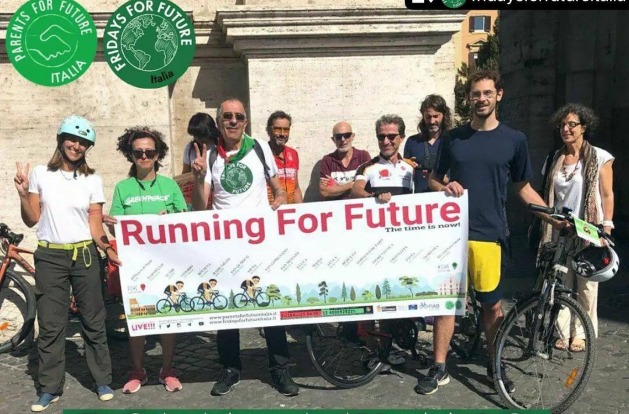
On the other side of the world, the Italian section of PFF is getting ready for the Running For Future, Cycling For Peace – a bike event which, fittingly for the land of the Giro d’Italia, is split into stages.

The ‘race’ starts in Rome’s Piazza del Popolo on May 10 and features 16 stages over nine days, roughly following the Via Francigena pilgrimage route southwards to end in Lecce on May 19.

Each stage will be used to focus on a specific aspect of the ecological crisis, such as air pollution, urban sprawl and the problems created by intensive livestock farming, while at the same time showing how they are all interconnected.

Organized with Fridays for Future Italia, the aims are multiple.

Among other things, organizers want to highlight the “institutional indifference” to the climate crisis at all levels of government, promote sustainable transport and tourism, draw attention to the need for more cycle paths, especially in southern Italy, and make a loud appeal for peace around the world.

The Italian section of Parents for Future gears up for "Running For Future, Cycling For Peace" — a multi-stage cycling event starting in Rome's Piazza del Popolo on May 10th and ending in Lecce on May 19th, following the Via Francigena route. Credit: Paul Virgo

The Italian section of Parents for Future gears up for “Running For Future, Cycling For Peace” — a multi-stage cycling event starting in Rome’s Piazza del Popolo on May 10th and ending in Lecce on May 19th, following the Via Francigena route. Credit: Paul Virgo

“We chose a cycling initiative because the bicycle has become a symbol of ecology,” said Maria Santarossa of Parents for Future Italia.
“It is a clean means of transport, which enables you to stay fit and be in direct contact with nature.

“We chose a pilgrims’ path because we can consider it an emblem of the beauty of nature and it’s a way to remind ourselves that we must take care of beauty.

“We have involved many other movements, associations, committees, and networks because we want people to know that many of us have the same objectives regarding the very serious climate and environmental crisis that is present in everyone’s lives”.

It is free to take part in the event, although participants have to cover their own accommodation and food expenses.

It is the second such event. The first took place in 2021, going from Rome northwards along the Via Francigena to Milan for the PreCOP26 conference that was held there.

That was such a success that it inspired the Polish section of Parents for Future to stage a climate grand tour of its own.

Each national PFF group is autonomous and does its own thing, campaigning on the issues that are most appropriate given the local situation.

PFF Italia, for example, is currently engaged in a major campaign to convince consumers to switch to utility companies whose electricity comes only from renewable sources.

There is also an umbrella group, Parents for Future Global (PFFG), which, among other things, is campaigning to support the drive for a Fossil Fuel Non-Proliferation Treaty.

  Source

New Report Examines Progress on Global Sustainable Development Goals

Civil Society, Climate Action, Climate Change, Environment, Global, Headlines, Human Rights, Natural Resources, Sustainable Development Goals, TerraViva United Nations

Opinion

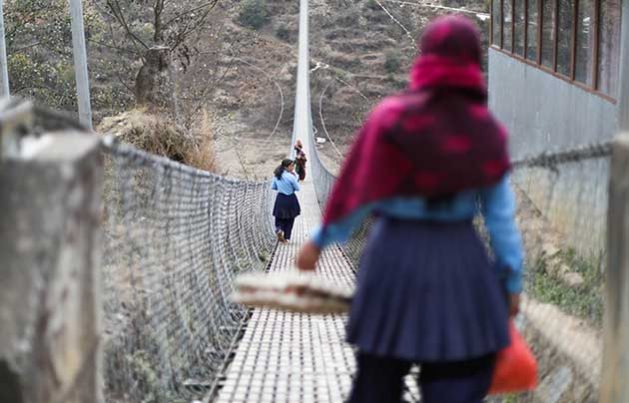
Credit: Students in Nepal’s Chitlang. Both Nomads/Forus

NEW YORK, Mar 21 2024 (IPS) – At the half-way point of the 2030 Agenda, the Sustainable Development Goals (SDGs) “are in deep trouble.” The need to accelerate progress towards the Sustainable Development Goals has never been more urgent as only approximately 12% of targets are currently on track. “Planet” is equally at risk as “people”.


As civil society leader Mavalow Christelle Kalhoule, Forus Chair and President of SPONG, the Burkina Faso NGO network, puts it, “What unfolds in the Sahel and in so many other forgotten communities ripples across the globe, impacting us all even if we choose to look away. Implementing the Sustainable Development Goals is vital to unlock a different future.”

The new “Progressing National SDGs Implementation” report looks at how countries around the world are advancing in their efforts towards sustainable development. The 2023 edition of the report is particularly significant as it marks the midpoint towards the 2030 Agenda’s goals, and the “world is not delivering”.

The report, which has been published since 2017, looks at crucial aspects such as governance, civil society involvement and space, localization, the importance of policy coherence, and the principle of Leaving No One Behind.

To compile the analysis, the report combines official Voluntary National Reviews (VNRs) submitted by member states with spotlight and alternative assessments, which aim to offer a more complete picture of national progress, particularly with respect to the fundamental 2030 Agenda principle to leave no one behind.

The report highlights that while more countries are engaging in ‘whole of government’ planning to implement the SDGs, at the same time many of the same countries do not ensure a wider ‘whole of society’ approach that involves civil society partners in delivery of the 2030 Agenda.

The report calls for a renewed global commitment to the SDGs, with a focus on:

    • Increased ambition: Countries need to adopt more ambitious plans to achieve the SDGs and ensure policy coherence.
    • Leaving no one behind: Data collection and policy focus must ensure that everyone benefits from SDG progress pacitularly by considering the extra challenges faced in reaching historically marginalized groups.
    • Stronger partnerships: Governments, civil society, and the private sector need to work together more effectively.
    • Improved monitoring: More robust data, national statistical and monitoring systems are needed to track progress and identify areas lagging behind.

Oli Henman from Action for Sustainable Development said: “We need to ensure that SDG reviews are genuinely inclusive of all parts of society and that national plans are backed up with real steps towards financing implementation at the community level. This to the only way that the world can get back on track to deliver the transformative change that was promised in 2015.”

Wangu Mwangi, a seasoned environmental journalist and expert in sustainable development, has authored the Progressing National SDG Implementation Report 2023, drawing on her extensive experience in sustainable development, land governance, natural resources management, climate change adaptation, and African development.

This report was coordinated by A4SD, in collaboration with ANND, BOND, Cooperation Canada, CPDE, Forus, IISD, Save The Children UK, and Sightsavers.

IPS UN Bureau

  Source

Democracy’s Contested Territory

Armed Conflicts, Civil Society, Crime & Justice, Democracy, Featured, Global, Headlines, Human Rights, Press Freedom, TerraViva United Nations

Opinion

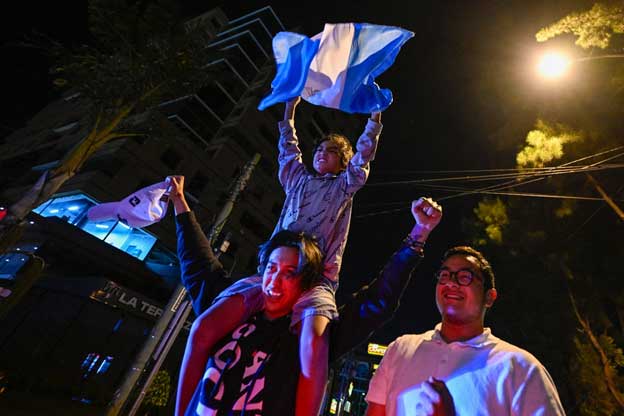
Credit: Luis Acosta/AFP via Getty Images

MONTEVIDEO, Uruguay, Mar 19 2024 (IPS) – This year more than half the world’s population has the chance to go to the polls. That might make it look like the most democratic year ever, but the reality is more troubling. Too many of those elections won’t give people a real say and won’t offer any opportunity for change.


2024’s bumper election year comes as a record number of countries are sliding towards authoritarianism, and global advances in democratisation achieved over more than three decades have been all but wiped out. In 2023, no authoritarian state became a democracy, and while some countries made marginal improvements in the quality of their democracies – by improving civic space, making inroads on corruption or strengthening institutions – many more experienced often serious declines.

Nearly three quarters of humanity now live under authoritarian regimes. Defending democracy and holding political leaders to account is becoming harder as civic space is shutting down. The proportion of people living in countries with closed civic space, 30.6 per cent, is the highest in years.

The latest State of Civil Society Report, from global civil society alliance CIVICUS, shows how conflict is exacerbating this regressive trend. In war-torn Sudan, hopes for democracy, repeatedly denied since the 2019 overthrow of dictator Omar al-Bashir, receded further as elections were made impossible by the civil war between the military and militia that erupted last April. Russia’s sustained assault on Ukraine brought intensified repression of domestic dissent, and there were no surprises in the recent non-competitive vote that maintained Vladimir Putin’s grip on power.

The ineffectiveness of civilian governments in dealing with jihadist insurgencies has also been the justification used by military leaders to take or retain power in Central and West Africa. As a result, rule by junta is in danger of becoming normalised after decades in which it appeared on the verge of extinction. A ‘coup belt’ now stretches coast to coast across Africa. None of the states that fell victim to military rule in recent years have returned to civilian government, and two more – Gabon and Niger –joined their ranks last year.

Authoritarian regimes that experienced mass protest movements in recent years, including Iran, Nicaragua and Venezuela, have regained their footing and hardened their grip. In states long characterised by autocratic rule, many civil society activists, journalists and political dissidents have sought safety in exile to continue their work. But they often didn’t find it, with repressive states – China, Turkey, Tajikistan, Egypt and Russia are the worst five abusers –increasingly using transnational repression against them.

Many elections are held with no competition. Last year several non-democratic states of various kinds – including Cambodia, the Central African Republic, Cuba, Eswatini, Uzbekistan and Zimbabwe – held votes in which autocratic power was never in question. Voting was ceremonial, its purpose to add a veneer of legitimacy to domination.

Many more regimes that combine democratic and authoritarian traits have been home to recent elections with less predetermined results, where there was at least some chance of the ruling party being defeated. But incumbent advantage was reflected in the fact that change rarely materialised, as seen in Nigeria, Paraguay, Sierra Leone and Turkey. The outlier was Maldives, where voters have a history of rejecting sitting presidents.

Some hybrid regimes, notably El Salvador, experienced further democratic backsliding through the erosion of freedoms and institutional checks and balances – a road typically travelled by populist authoritarians who claim to speak in the name of the people and insist they need to concentrate power to deal with crises.

When voters do have a genuine say, in free and fair elections, they’re increasingly rejecting mainstream parties and politicians. In a time of economic uncertainty and insecurity, many express disappointment with what democracy is offering them. Anti-rights political entrepreneurs are successfully exploiting their anxieties by scapegoating migrants and attacking women’s and LGBTQI+ people’s rights. Right-wing populists using such tactics recently took control of Argentina, came first in elections in the Netherlands and Switzerland and entered government in Finland. Even where they don’t take office, far-right forces often succeed in shifting the political centre by forcing others to compete on their terms. They’re expected to make big gains in the European Parliament elections in June 2024.

Polarisation is on the rise, fuelled by disinformation, conspiracy theories and hate speech. These are made so much easier by AI-powered technologies that are spreading and evolving faster than they can be regulated. The first elections of 2024, including those in Bangladesh and Indonesia, offered cautionary tales of the unprecedented levels of manipulation that AI can enable. We’re likely to see a lot more of this in 2024.

But our research findings support our hope, because they show movement isn’t all in one direction. In Guatemala, a new party born from mass anti-corruption protests was the unlikely 2023 election winner, and people mobilised in numbers to defend the result in the face of powerful political and economic elites. Despite China’s concerted attempts to derail Taiwan’s election, including through cyberattacks, people vindicated their right to have a say in their own future. In Poland, a unity government pledging to restore civic freedoms came to power after eight years of right-wing nationalist rule, offering new potential for civil society to partner in retrieving democratic values and respecting human rights. In Mexico, which is among the many countries going to the polls in 2024, people mobilised in numbers against the threat posed by a democratically elected leader seeking to override checks and balances. Given the dangers it may entail, civil society is pushing for transnational regulation of AI.

Things would be much worse were it not for civil society, which continues to mobilise against restrictions on freedoms, counter divisive rhetoric and strive for the integrity of electoral processes. Throughout 2024, civil society will keep pushing for elections to take place in free and fair conditions, for people to have the information they need, for votes to be properly counted, for losers to accept defeat and for winners to govern in the common good.

Inés M. Pousadela is CIVICUS Senior Research Specialist, co-director and writer for CIVICUS Lens and co-author of the State of Civil Society Report.

  Source