Statement on the G7 Hiroshima Summit, the Ukraine Crisis and “No First Use” of Nuclear Weapons

Dr. Daisaku Ikeda. Credit: Seikyo Shimbun

By Daisaku Ikeda
TOKYO, Japan, May 8 2023 (IPS)

The Ukraine crisis, which in addition to bringing devastation to the people of that country has had severe impacts on a global scale—even giving rise to the specter of nuclear weapons use—has entered its second year. Against this backdrop and amid urgent calls for its resolution, the G7 Summit of leading industrial nations will be held in Hiroshima, Japan, from May 19 to 21.


In February of this year, an emergency special session of the UN General Assembly was held, where a resolution calling for the early realization of peace in Ukraine was adopted. Among the operative paragraphs of the resolution was one that urged the “immediate cessation of the attacks on the critical infrastructure of Ukraine and any deliberate attacks on civilian objects, including those that are residences, schools and hospitals.”

With that as a first essential step, all concerned parties must come together to create a space for deliberations toward a complete cessation of hostilities. Here I would like to propose that, as negotiations advance through the cooperative efforts of the concerned countries, they be joined by representatives of civil society, such as the physicians and educators who work in schools and hospitals to protect and nurture people’s lives and futures, participating as observers.

In March, the leaders of Russia and China issued a joint statement following their summit meeting which reads in part: “The two sides call for stopping all moves that lead to tensions and the protraction of fighting to prevent the crisis from getting worse or even out of control.” This is aligned with the resolution adopted by the emergency special session of the UN General Assembly.

The G7 Hiroshima Summit should develop concrete plans for negotiations that will lead to a cessation of hostilities.

I also urge the G7 to commit at the Hiroshima Summit to taking the lead in discussions on pledges of No First Use of nuclear weapons. The current crisis is without parallel in the length of time that the threat of use and the fear of actual use of nuclear weapons have persisted without cease.

Since the bombings of Hiroshima and Nagasaki, the hibakusha of those cities, in coordination with the larger civil society movement, have stressed the inhumane nature of nuclear weapons; non-nuclear-weapon states have engaged in continuous diplomatic efforts; and the states possessing nuclear weapons have exercised self-restraint. As a result, the world has somehow managed to maintain a seventy-seven-year record of non-use of nuclear weapons.

If international public opinion and the taboo against the use of nuclear weapons were to fail to provide their braking function, nuclear deterrence policy will compel humankind to stand on a precipitous ledge, never knowing when it might give way.

Since the start of the Ukraine crisis, I have written two public statements. In both, I referenced the joint statement by the five nuclear-weapon states (United States, Russia, United Kingdom, France and China) made in January 2022, which reiterated the principle that “a nuclear war cannot be won and must never be fought,” and called for it to serve as the basis for reducing the risk of nuclear weapons use.

Also of important note is the declaration issued by the G20 group in Indonesia last November, which stated: “The use or threat of use of nuclear weapons is inadmissible.”

The G20 member countries include nuclear-weapon states as well as nuclear-dependent states. It is deeply significant that these countries have officially expressed their shared recognition that the use or threat of use of nuclear weapons is “inadmissible”—the animating spirit of the Treaty on the Prohibition of Nuclear Weapons (TPNW).

It is vital that this message be communicated powerfully to the world from Hiroshima.

As the G7 leaders revisit the actual consequences of a nuclear weapon detonation and the bitter lessons of the nuclear era, I urge that they initiate earnest deliberations on making pledges of No First Use so that their shared recognition of the inadmissible nature of nuclear weapons can find expression in changed policies.

If agreement could be reached on the principle of No First Use, which was at one point included in drafts of the final statement for last year’s NPT Review Conference, this would establish the basis on which states could together transform the challenging security environments in which they find themselves. I believe it is vital to make the shift to a “common security” paradigm.

Commitment to policies of No First Use is indeed a “prescription for hope.” It can serve as the axle connecting the twin wheels of the NPT and TPNW, speeding realization of a world free from nuclear weapons.

For our part, the SGI has continued to work with the world’s hibakusha, the International Campaign to Abolish Nuclear Weapons (ICAN)—which arose from its parent body IPPNW—and other organizations first for the adoption and now the universalization of the TPNW. As members of civil society, we are committed to promoting the prompt adoption of policies of No First Use of nuclear weapons, generating momentum to transform our age.

The author is Peace builder and Buddhist leader Daisaku Ikeda, who is President of the Soka Gakkai International (SGI). https://www.daisakuikeda.org/ Read full statement here full statement.

IPS UN Bureau


!function(d,s,id){var js,fjs=d.getElementsByTagName(s)[0],p=/^http:/.test(d.location)?’http’:’https’;if(!d.getElementById(id)){js=d.createElement(s);js.id=id;js.src=p+’://platform.twitter.com/widgets.js’;fjs.parentNode.insertBefore(js,fjs);}}(document, ‘script’, ‘twitter-wjs’);  

Source

UN Plan of Action on Safety of Journalists

Credit: Shutterstock
 
On World Press Freedom Day 2023, UNESCO will organize a special anniversary event at UN headquarters in New York, marking the 30 years since the UN General Assembly’s decision proclaiming an international day for press freedom.

This anniversary edition of World Press Freedom Day will include a full day of activities at the UN Headquarters on 2nd May. Partners from the media, academia, and civil society are invited to organize events in New York and around the world centered on this year’s theme.

By Audrey Azoulay
PARIS, May 1 2023 (IPS)

Freedom of the press is the cornerstone of democratic society. Without a debate of ideas, without verified facts, without diversity of perspectives, democracy is a shadow of itself; and World Press Freedom Day was established to remind us of this.


For the international community, it is first and foremost a question of combating the impunity that still surrounds crimes of which journalists are victims, with nearly nine out of ten murders of journalists going unpunished.

This, for instance, is the objective of the United Nations Plan of Action on the Safety of Journalists and the issue of Impunity, which UNESCO has been leading for ten years. It is also about ensuring that independent media can continue to exist.

With the digital revolution, the information landscape and its modes of production and distribution have been radically disrupted, jeopardizing the viability of independent professional media.

To ensure that information remains a common good in the digital age, our Member States, through the Windhoek +30 Declaration of 2021, have undertaken to support independent journalism, ensure greater transparency of online platforms, and develop media and information literacy.

We will not be able to do this without the actors who now have significant control over access to information: the digital platforms. This is why UNESCO held the “Internet for Trust” conference in February, as an essential step towards the development of principles to regulate digital platforms.

This is a fundamental issue, because it involves both protecting freedom of expression and fighting disinformation and hate speech. Thirty years after the first World Press Freedom Day, we can see how far we have come and how far we still have to go.

So, let this Day be an opportunity to renew our commitment, within international organizations, to defending journalists and, through them, press freedom.

Footnote: As the UN Organization responsible for defending and promoting freedom of expression, media independence and pluralism, UNESCO leads the organization of World Press Freedom Day each year.

This year’s celebration will be particularly special: the international community will mark the 30th anniversary of the proclamation of the Day by the United Nations General Assembly.

It will serve as an occasion to take stock of the global gains for press freedom secured by UNESCO and its partners in the past decades, as well as underline the new risks faced in the digital age.

IPS UN Bureau


!function(d,s,id){var js,fjs=d.getElementsByTagName(s)[0],p=/^http:/.test(d.location)?’http’:’https’;if(!d.getElementById(id)){js=d.createElement(s);js.id=id;js.src=p+’://platform.twitter.com/widgets.js’;fjs.parentNode.insertBefore(js,fjs);}}(document, ‘script’, ‘twitter-wjs’);  

Excerpt:

Audrey Azoulay is Director-General of UNESCO Source

A Proposal for a UN Freedom of Information Act Never Got Off the Ground

Credit: UNESCO Attribution 3.0 IGO
 
Celebrated every 3rd of May, this year’s theme for World Press Freedom Day will be “Shaping a Future of Rights: Freedom of Expression as a Driver for all other Human Rights.”  

By Thalif Deen
UNITED NATIONS, May 1 2023 (IPS)

The United Nations has consistently been a vociferous advocate of freedom of the press – and, most importantly, the right of journalists to report without fear of reprisals.

But regrettably, the UN is also one of most opaque institutions where transparency is never the norm.


Journalists, rarely if ever, were able to get any on-the-record comments or reactions from ambassadors, diplomats and senior UN officials because most of them follow the advice given to Brits during war-time censorship in the UK: “Be like Dad, Keep Mum”.

As Winston Churchill once remarked: “Diplomacy is the art of telling people ‘to go to hell’ in such a way that they ask for directions.”

But as a general rule, most ambassadors and diplomats did not tell us either to go to hell or heaven– but avoided all comments on politically-sensitive issues with the standard non-excuse: ”Sorry, we have to get clearance from our capital”.

But that “clearance” from their respective foreign ministries never came. Still, it was hard to beat a response from a tight-lipped Asian diplomat who told me: “No comment” – and as an after-thought, added: “And Don’t Quote Me on That”.

And most senior UN officials, on the other hand, never had even the basic courtesy or etiquette to respond to phone calls or email messages even with an acknowledgment. The lines of communications were mostly dead.

When I complained to the media-savvy Shashi Tharoor, a former UN Under-Secretary-General, head of the one-time Department of Public Information (DPI) and a prolific author, he was explicit in his response when he said that every UN official – “from an Under-Secretary-General to a window-washer”—has the right to express an opinion in his or her area of expertise.

The US Freedom of Information Act (FOIA), which dates back to 1967, has provided the public and mostly the press in the United States the right to request access to records from any federal agency—and has been described as “the law that keeps citizens in the know about their government”.

As a result, some of the newspaper scoops and insider information in the US mainstream media have come following requests from American journalists under the FOIA.

But a longstanding proposal for a FOIA at the United Nations has failed to get off the ground due largely to the inaction by the 193-member General Assembly, the UN’s highest policy making body, resulting in the lack of transparency in the inner workings of the UN and its Secretariat.

So has the proposal for a UN Special Envoy to deal with safety of journalists—dead on arrival (DOA).

Andreas Bummel, Executive Director, Democracy Without Borders, told IPS: the UN is an institution that exercises public authority directly and indirectly with over 30,000 working in the Secretariat (plus the UN system worldwide).

“As such, it needs to be accountable not only to its member states but to citizens and the public at large.

Establishing a proper freedom of information procedure at the UN will be an important tool to enhance this, declared Bummel, co-author of “A World Parliament: Governance and Democracy in the 21st Century.”

Martin S. Edwards, Professor and Chair, School of Diplomacy and International Relations at Seton Hall University in the US, told IPS: “I must admit I don’t know the legal angles here. This having been said, it’s pretty clear to me that the only way forward for the UN in an era of political division is greater transparency”

Greater efforts to “tell your story better” are not enough. You can’t advocate for “effective, accountable, and inclusive” institutions at the national level without it, within the UN system too. Things like access to information are an essential step in that direction, he added.

In the US, federal agencies are required to disclose any information requested under the FOIA unless it falls under one of nine exemptions which protect interests such as personal privacy, national security, and law enforcement.

In Australia, the legislation is known as Right2Know; in Bangladesh, the Right to Information (RTI) provides resources for those seeking to file a request with government agencies; in Japan, the Citizens’ Centre for Information Disclosure offers help to those interested in filing requests; in India, the Right to Information: a Citizen Gateway is the portal for RTI; Canada’s Access to Information Act came into force in 1983 and Kenya’s Access to Information Act was adopted in August 2016, according to the Centre for Law and Democracy (CLD).

And Sweden’s Freedom of the Press Act of 1766 has been described as the “oldest in the world.”

While FOIA covers access to federal government agency records, the Freedom of Information Law (FOIL) guarantees access to state and local government records. All 50 states in the US also have freedom of information laws that govern access to these documents, though the provisions of the state laws vary considerably.

The Paris-based UN Educational, Scientific and Cultural Organization (UNESCO), which is mandated to oversee press freedom, defines Freedom of Information (FOI) as the right to access information held by public bodies.

According to UNESCO, the FOI is an integral part of the fundamental right of freedom of expression, as recognized by Resolution 59 of the UN General Assembly adopted in 1946, as well as by Article 19 of the Universal Declaration of Human Rights (1948), which states that the fundamental right of freedom of expression encompasses the freedom to “to seek, receive and impart information and ideas through any media and regardless of frontiers”.

FOI has also been enshrined as a “freedom of expression” in other major international instruments, including the International Covenant on Civil and Political Rights (1966) and the American Convention on Human Rights (1969).

In an interview with IPS back in 2017, Samir Sanbar, a former UN Assistant Secretary-General who headed the one-time Department of Public Information (DPI), said the right to information is an integral part of U.N. principles.

But providing that right—even the basic information available in the public domain– has been stymied both by member states and the UN bureaucracy, he added.

He pointed out that the need to “inform the peoples” is implicitly indicated in the UN Charter.

But implementing it was “a basic issue I had experienced throughout my work, with both certain government officials– including those publicly claiming open channels– and many senior U.N. Secretariat colleagues”.

Those who believed “Information is Power” were very hesitant, to what they perceived was sharing their authority with a wider public, said Sanbar who served under five different UN Secretaries-General.

“It was most evident that when I launched the now uncontested website www.un.org, a number of powerful Under-Secretaries-General (USGs) and Permanent Representatives cautioned me against “telling everyone what was happening” (in the UN system) and refused to authorize any funds.”

“I had to raise a team of DPI volunteers in my office, operating from within the existing budget, to go ahead and eventually offer computers loaned from an outside source, to certain delegations to realize it was more convenient for them to access news releases than having to send one of their staffers daily to the building to collect material from the third floor.“

Eventually, everyone joined in, and the site became one of the ten best official sites worldwide.

“We had a similar difficulty in prodding for International World Press Freedom Day through the General Assembly. It seems that even those with the best of intentions– since delegates represent official governments that view free press with cautious monitoring– are usually weary of opening a potentially vulnerable issue,” said Sanbar, author of the book “Inside the U.N. in a Leaderless World’.

This article contains excerpts from a 2021 book on the United Nations—largely a collection of political anecdotes– titled “No Comment – and Don’t Quote Me on That,” available on Amazon. The link to Amazon via the author’s website follows: https://www.rodericgrigson.com/no-comment-by-thalif-deen/

IPS UN Bureau Report


!function(d,s,id){var js,fjs=d.getElementsByTagName(s)[0],p=/^http:/.test(d.location)?’http’:’https’;if(!d.getElementById(id)){js=d.createElement(s);js.id=id;js.src=p+’://platform.twitter.com/widgets.js’;fjs.parentNode.insertBefore(js,fjs);}}(document, ‘script’, ‘twitter-wjs’);  

Source

“Defending Human Rights Is a Crime in Some Countries and a Deadly Activity in Others”

An activist in Colombia, the deadliest country in the world for human rights defenders in 2022, accounting for 186 killings – or 46% – of the global total registered last year. Credit: Sebastian Barros

By Bibbi Abruzzini and Clarisse Sih, Forus
BRUSSELS, Apr 27 2023 (IPS)

In today’s world, human rights defenders face immense challenges, with threats, attacks, and repression being rampant in many countries. According to the latest report by Front Line Defenders, killings of rights defenders increased in 2022, with a total of 401 deaths across 26 different countries. Despite the adoption of the UN Declaration on Human Rights Defenders 25 years ago, the threats faced by defenders persist globally.


One striking example of the dire situation is in Bolivia, where violations of freedoms of expression, association, peaceful assembly, and the right to defend rights have been recorded by the Observatory of Rights Defenders of UNITAS, with the Permanent Assembly of Human Rights of Bolivia (APDHB) being a longstanding victim of attacks and delegitimization. A total of 725 violations of the freedoms of expression, association and peaceful assembly, democratic institutions and the right to defend rights have been recorded by the Observatory of Rights Defenders.

Gladys Sandova, a human rights and environmental defender in the Tariquía Flora and Fauna National Reserve in Bolivia, reveals how the state often aligns with oil businesses instead of protecting communities. “Tariquía is the lung of Tarija,” Gladys explains, yet this vital source of water for southern Bolivia and home to over 3,000 people, is at risk due to the state-owned Yacimientos Petrolíferos Fiscales Bolivianos (YPFB) seeking to revive oil exploration in the reserve.

“Oil companies are here, we are going to lose our natural richness, they are going to affect the lives of families, and contaminate our water and our air,” says Gladys, reflecting the urgent need to defend human rights and the environment.

Her story is similar to that of several other human rights defenders across the globe : they are victims of hostilities, interference, threats, and harassment. The campaign, ReImagina La Defensa de Derechos, by UNITAS collects the testimonies of human rights defenders and indigenous leaders across Bolivia raising awareness about the challenges they face.

Stories from human rights defenders from across the globe are also featured in the #AlternativeNarratives campaign, which seeks to amplify the voices of civil society organizations and grassroots movements that work towards social justice, human rights, and sustainable development. The campaign encourages the use of storytelling, multimedia tools, and creative expression to highlight alternative perspectives, challenge stereotypes, and advocate for positive chang while fostering a more inclusive and equitable narrative space that reflects the diversity of human experiences and promotes solidarity, empathy, and mutual understanding.

Human rights defenders, including women defenders, continue to mobilize against repressive regimes and occupying forces in countries like Afghanistan, the DRC, El Salvador, Iran, Myanmar, Sudan, and Ukraine. Mary Lawlor, UN Special Rapporteur on the situation of human rights defenders, highlights the underreporting of human rights violations against defenders, particularly women, and outlines “disturbing trends” in relation to civic space worldwide.

Repongac, representing over 1,200 NGOs in Central Africa, states that “human rights in Central Africa are no longer guaranteed,” with civil society actors, journalists, and defenders facing repression, prosecution, and arrests. Recent campaigns organized by Repongac in Central Africa and Repaoc in West Africa, supported by Forus and the French Development Agency, brought together diverse stakeholders, including human rights defenders, political parties, parliamentarians, journalists, and security personnel, to initiate a dialogue and protect civic space amnd fundametnal freedoms in the region.

To support activists and defenders globally, the Danish Institute for Human Rights has launched a monitoring tool that assesses whether an enabling environment for human rights defenders exists across five critical areas. Developed in collaboration with 24 institutions and organizations, including the United Nations and civil society networks, the tool not only tracks the number of killings of human rights defenders but also analyzes the presence of appropriate legislation and practices to protect defenders.

As Carol Rask, a representative of the Danish Institute for Human Rights, explains, defending human rights is a crime in some countries and a deadly activity in others. It is a call to action for change, urging individuals, organizations, and governments to prioritize and protect the crucial work of human rights defenders worldwide.

Griselda Sillerico, human rights defender in Bolivia for over 30 years, quotes Ana María Romero and says “human rights are seeds that we continue to plant and that over the years we harvest.” Griselda Sillerico’s quote echoes the enduring spirit of human rights advocacy, where the work of human rights defenders like her is a constant effort to sow the seeds of justice, equality, and dignity for all. Despite the challenges and setbacks, human rights defenders across the world continue to plant these seeds, often at great personal risk, with the hope of reaping a future where human rights are universally respected and protected.

IPS UN Bureau


!function(d,s,id){var js,fjs=d.getElementsByTagName(s)[0],p=/^http:/.test(d.location)?’http’:’https’;if(!d.getElementById(id)){js=d.createElement(s);js.id=id;js.src=p+’://platform.twitter.com/widgets.js’;fjs.parentNode.insertBefore(js,fjs);}}(document, ‘script’, ‘twitter-wjs’);  

Source

CIVICUS Report Exposes a Civil Society Under Attack

The State of Civil Society report from CIVICUS, the global civil society alliance which was officially launched on March 30, 2023, exposes the gross violations of civic space. Credit CIVICUS

The State of Civil Society report from CIVICUS, the global civil society alliance which was officially launched on March 30, 2023, exposes the gross violations of civic space. Credit CIVICUS

By Joyce Chimbi
NAIROBI, Mar 31 2023 (IPS)

As conflict and crises escalate to create human emergencies that have displaced over 100 million people worldwide, civil society’s vital role of advocating for victims and monitoring human rights cannot be over-emphasised.


The 2022 Nobel Peace Prize award to activists and organisations in Belarus, Russia and Ukraine for working to uphold human rights in the thick of conflict underpins this role.

Yet this has not stopped gross violations of civic space as exposed by the State of Civil Society report from CIVICUS, the global civil society alliance, which was officially launched on March 30, 2023.

“This year’s report is the 12th in its annual published series, and it is a critical look back on 2022. Exploring trends in civil society action, at every level and in every arena, from struggles for democracy, inclusion, and climate justice to demands for global governance reform,” said Ines Pousadela from CIVICUS.

The report particularly highlights the many ways civil society comes under attack, caught in the crossfire and or deliberately targeted. For instance, the Russian award winner, the human rights organisation Memorial, was ordered to close in the run-up to the war. The laureate from Belarus, Ales Bialiatski, received a 10-year jail sentence.

Mandeep Tiwana stressed that the repression of civic voices and actions is far from unique. In Ethiopia, “activists have been detained by the state. In Mali, the ruling military junta has banned activities of CSOs that receive funding from France, hampering humanitarian support to those affected by conflict. In Italy, civil society groups face trial for rescuing migrants at sea.”

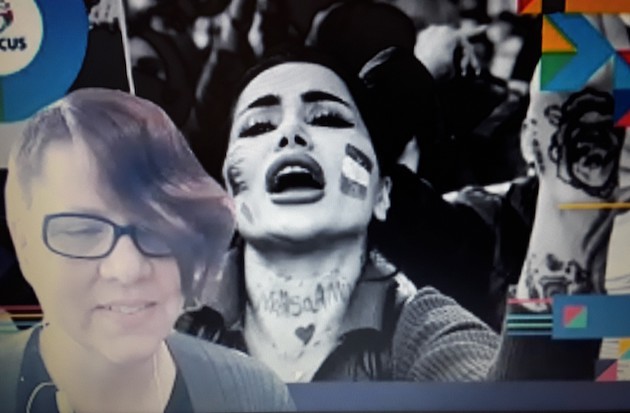
Ines Pousadela at the launch of the CIVICUS State of Civil Society Report. Credit: Joyce Chimbi/IPS

Ines Pousadela at the launch of the CIVICUS State of Civil Society Report. Credit: Joyce Chimbi/IPS

Spanning over six chapters titled responding to conflict and crisis, mobilising for economic justice, defending democracy, advancing women’s and LGBTQI+ rights, sounding the alarm on the climate emergency and urging global governance reform, the analysis presented by the report draws from an ongoing analysis initiative, CIVICUS Lens.

On responding to conflict and crisis, Oleksandra Matviichuk from the Center for Civil Liberties in Ukraine spoke about the Russian invasion and the subsequent “unprecedented levels of war crimes against civilians such as torture and rape. And, a lack of accountability despite documented evidence of crimes against civilians.”

Bhavani Fonseka, from the Centre for Policy Alternatives, Sri Lanka, addressed the issue of mobilising for economic justice and how Sri Lanka captured the world’s attention one year ago through protests that start small in neighbourhoods and ultimately led to the President fleeing the country.

Launched in January 2022, CIVICUS Lens is directly informed by the voices of civil society affected by and responding to the major issues and challenges of the day.

Through this lens, a civil society perspective of the world as it stands in early 2023 has emerged: one plagued by conflict and crises, including democratic values and institutions, but in which civil society continues to strive to make a crucial difference in people’s lives.

On defending democracy, Amine Ghali of the Al Kawakibi Democracy Transition Center in Tunisia spoke about the challenge of removing authoritarian regimes, making significant progress in levels of democracy only for the country to regress to authoritarianism.

“It starts with the narrative that democracy is not delivering; let me have all the power so that I can deliver for you. But they do not deliver. All they do is consolidate power. A government with democratic legitimacy demolishing democracy is where we are in Tunisia,” he said.

Erika Venadero from the National Network of Diverse Youth, Mexico, spoke about the country’s journey that started in the 1960s towards egalitarian marriages. Today, same-sex marriages are provided for in the law.

On global governance reforms, Ben Donaldson from UNA-UK spoke about global governance institutional failure and the need to improve what is working and reform what is not, with a special focus on the UN Security Council.

“It is useful to talk about Ukraine and the shortcomings of the UN Security Council. A member of the UN State Council is unable to hold one of its members accountable. There are, therefore, tensions at the heart of the UN. The President of Ukraine and many others ask, what is the UN for if it cannot stop the Ukraine invasion?”

Baraka, a youthful climate activist and sustainability consultant in Uganda, spoke about ongoing efforts to stop a planned major pipeline project which will exacerbate the ongoing climate crisis, affecting lives and livelihoods.

His concerns and actions are in line with the report findings that “civil society continues to be the force sounding the alarm on the triple threat of climate change, pollution and biodiversity loss. Urging action using every tactic available, from street protest and direct action to litigation and advocacy in national and global arenas.”

But in the context of pressures on civic space and huge challenges, the report further finds that “civil society is growing, diversifying and widening its repertoire of tactics.”

Moving forward, the report highlights 10 ideas, including an urgent need for a broad-based campaign to win recognition of civil society’s vital role in conflict and crisis response as well as greater emphasis by civil society and supportive states on protecting freedom of peaceful assembly.

Additionally, the need for civil society to work with supportive states to take forward plans for UN Security Council reform and proposals to open up the UN and other international institutions to much greater public participation and scrutiny.

In all, strengthening and enhancing the membership and reach of transnational civil society networks to enable the rapid deployment of solidarity and support when rights come under attack was also strongly encouraged.

IPS UN Bureau Report


!function(d,s,id){var js,fjs=d.getElementsByTagName(s)[0],p=/^http:/.test(d.location)?’http’:’https’;if(!d.getElementById(id)){js=d.createElement(s);js.id=id;js.src=p+’://platform.twitter.com/widgets.js’;fjs.parentNode.insertBefore(js,fjs);}}(document, ‘script’, ‘twitter-wjs’);  

Source

The Need for a Strong Legal Treaty on Business & Human Rights

The open-ended intergovernmental working group on transnational corporations and other business enterprises with respect to human rights was established in 2014 in response to Human Rights Council resolution 26/9 with a mandate to elaborate an international legally binding instrument to regulate, in international human rights law, the activities of transnational corporations and other business enterprises.

By Simone Galimberti
KATHMANDU, Nepal, Mar 31 2023 (IPS)

The ongoing discussions on an internationally treaty, described as a “legally binding instrument” on business and human rights, remains one of the most neglected issues that should instead command the attention of the public.


Such a legal tool would bind companies to uphold high standards and most importantly, it would entail mandatory guarantees for accessible and inclusive remedy and therefore, clear liabilities for victims of alleged abuses perpetrated by companies.

It all started in 2014 when two nations of the South, Ecuador and South Africa successfully pushed for a resolution at the UN Human Rights Council on the establishment of a so called “international legally binding instrument on transnational corporations and other business enterprises with respect to human rights”.

By reading the title of the resolution you can immediately realize that one of the conundrums being discussed is the overarching scope of such treaty especially in the reference of the nature of the companies being subject to it.

In practice, would only multinational or also national private corporations come under its jurisdiction?

Interestingly, at the Intergovernmental Working Group (IGWG) created to draft the text of the treaty, many developing nations, for example, like Indonesia, were strongly advocating for only multinationals to be included.

This is a position of convenience that would exclude local major operators involved in the plantations business from coming under scrutiny of the treaty.

Other complex issues are centered on the liability especially in relation to instances where a corporation is “only” directly linked to the harm rather than cause.

As explained by Tara Van Ho, a lecturer at the University of Essex School of Law and Human Rights Centre, if “a business is only “directly linked to” the harm, it does not need to provide remedies but can instead use its “leverage” to affect change in its business partners.”

The difference between causing or contributing to harm and instead being only liked to it can be subtle and remain an exclusive debate among scholars, but its repercussions could or could not ensure justice to millions of people victims of corporate abuses.

Another point of attrition is the complex issue of the statutes of limitations and the role of domestic jurisdiction over the future treaty.

With all these challenges, after 8 years of negotiations, the drafting is moving in slow motion amid a general disinterest among state parties, as explained by Elodie Aba for Business & Human Rights Resource Centre

An issue that should capture global attention has instead become a realm of technical discussions among governments, academicians and civil society members without generating mass awareness about it.

The need for a treaty related to abuses of corporations is almost self-evident, considering the gigantic proofs that have been emerging both in the North and South.

Despite nice words and token initiatives, the private sector has been more than often keen to close its eyes before abuses occurring through its direct actions or throughout its supply chains.

Amid weak legislations, especially in developing countries, the hard job of trying to keep companies accountable, until now, has depended on a set of non-binding, voluntary procedures formally known as the Guiding Principles on Business and Human Rights.

The Principles, prepared by late Harvard Professor John G. Ruggie in his capacity as UN Special Representative on Business and Human Rights, proved to be a useful but at the same time inadequate tool.

It has been useful because it was instrumental in raising the issue of human rights within the corporate sector, something that was for too long and till recently, a taboo.

In order to further mainstream it, for example, a UN Working Group on Business and Human Rights has been established as a special procedure within UN Human Rights.

Along the years, this independent group, composed by pro bono academicians, has carried out considerable work to strengthen both the understanding of and the adherence to the Principles.

There is no doubt that there have been attempts at going deeper, especially from the legal point of view on the Principles, especially on their articles related to right to remedy, the thorniest issue.

In this regard, the Accountability and Remedy Project have been providing a whole set of insights through multiple consultations and discussions, a process that still ongoing with the overall purpose of making a stronger cases on “the right to remedy, a core tenet of the international human rights system”.

Yet principles, UN Global Compact, are toothless tool and showed considerable limitations, starting from the most obvious element, the fact that they are not binding.

In the meantime, in 2021 the UN Working Group on Business and Human Rights, on occasion of their 10th anniversary of the Principles, launched road map for the next 10 years.

It is actions, despite their intrinsic limitations due to the nature of the Principles, should be supported but more financial resources are indispensable. Yet finding the financial resources or better the political will to do so remains an issue.

A recommendation from late Prof. Ruggie to create a Voluntary Fund for Business and Human Rights did not go anywhere.

“The Fund would provide a mechanism for supporting projects developed at local and national levels that would increase the capacity of governments to fulfill their obligations in this area as well as strengthen efforts by business enterprises and associations, trade unions, non-governmental organizations and others seeking to advance implementation of the Guiding Principles”.

Even more worrisome is the fact that till now a new Special Representative for Business and Human Rights has not been appointed yet.

Having an authoritative figure, especially a former head of state rather than an academician, could help bring more visibility to the ongoing “behind the curtain” discussions related to the need for a strong Treaty.

Such a political figure could not only command a stronger attention on the issue but also provide “cover” to the delicate work of the UN Working Group on Business and Human Rights, complementing and strengthening its mandate.

Engagement with the education sector, law and business schools, as advocated by a report published by Business and Human Rights Asia, a UNDP Program, can be essential.

Together with a stronger media coverage, students and academicians can help elevate the issue of human rights and its linkages with the private sector.

We could imagine competitions among students at national and international levels on how the principles can be better implemented as a “bridge” tool towards a binding legal mechanism.

Students could also have a major say on the opaque drafting process of this treaty.

At the end of the day, there will be compromises and shortcomings, but with a bigger bottom-up approach, a strong Treaty could become a “global” Escazu’, the first ever binding environment agreement in Latin America and the Caribbean.

UNDP with its Business and Human Rights Asia unit that recently organized in Kathmandu an excellent 4th UN South Asia Forum on Business and Human Rights. But it could also be bolder.

The forum did a great job at giving voice to indigenous people, one of the key stakeholders in the global negotiations for the treaty.

A lot of discussions were rightly held on the impact of issues like climate change and migration and their links with businesses’ attitudes and behaviors towards local populations.

Yet, there was no conversation nor on the treaty nor on the future evolution of the principles. It might certainly be an issue of a limited “mandate” but UNDP could, together with UN Human Rights, be a neutral enabler on a global discussion on the treaty and on how the Principles can further evolve while we wait for such a legal tool.

The Principles should also be better linked with the UN Compact, creating more synergies and coordination between the two.

The fact that nations like France, Germany and the Netherlands have been stepping up with new vigorous legislations in the field of business and human rights is extremely positive.

Equally important is the commitment of the EU to come up with Corporate Sustainability Due Diligence Directive (CSDDD) or the OECD to revise its Guidelines on Responsible Business Conduct but the nations behind these initiatives must commit to the drafting process of the Treaty.

Otherwise, we run the risk that discussions will continue without anyone caring about them. Such an unfortunate situation must truly be “remedied’ with the right smart mix, political will, starting from the Secretary General and a powerful alliance of progressive nations in the both South and North driving the process and involving other peer nations.

Ultimately civil society must also step up beyond their technical and legal recommendations and truly engage the people.

Simone Galimberti is the co-founder of ENGAGE and of the Good Leadership, Good for You & Good for the Society.

Opinions expressed are personal.

IPS UN Bureau


!function(d,s,id){var js,fjs=d.getElementsByTagName(s)[0],p=/^http:/.test(d.location)?’http’:’https’;if(!d.getElementById(id)){js=d.createElement(s);js.id=id;js.src=p+’://platform.twitter.com/widgets.js’;fjs.parentNode.insertBefore(js,fjs);}}(document, ‘script’, ‘twitter-wjs’);  

Source