Collaboration Can Help Eradicate COVID-19

Civil Society, Development & Aid, Education, Featured, Global, Headlines, Health, Humanitarian Emergencies, TerraViva United Nations

Opinion

Rev Liberato C. Bautista is assistant general secretary for United Nations and International Affairs of the United Methodist Board of Church and Society. He also serves as president of the Conference of Non-Governmental Organizations in Consultative Relationship with the United Nations.
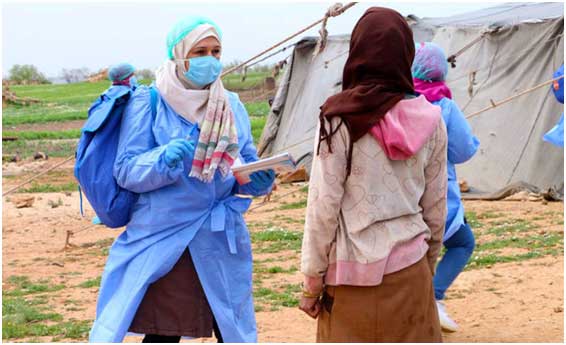
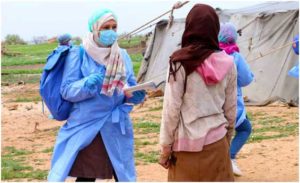
Coronavirus pandemic threatens crises-ravaged communities, UN appeals for global support. Credit: United Nations

NEW YORK, Apr 23 2020 (IPS) – Since the founding of the United Nations in 1945, space for multilateral policy development and commitment has grown. Its growth in the global health field augurs well as we find ways to mitigate the spread of the novel coronavirus.


Multilateralism is a difficult word, often misconstrued to be about the global and not the local and daily life. Perception plays a major role in how the public perceives multilateralism. This is in part due to the complexity of modern global challenges, which are well beyond the capacity of any one state or even a small group of states to resolve by themselves.

The novel coronavirus pandemic may yet change this perception.

As the saying goes, all politics is local. My rejoinder to this is that one’s local is another’s global. The local and the global are simultaneous realities. United Methodist connectionalism is akin to multilateralism.

As a church, we address social issues central to the multilateral agenda, including health, migration, peace, climate, and concerns about global poverty, trading and commerce, sustainable development, social justice, women, children and gender justice, human rights, indigenous peoples, and more.

Holistic health, healing and wholeness are intrinsic to Methodism and its Wesleyan roots. John Wesley attended to both the care for the soul and for the biological body with his abundant tips and remedies for ailments during his time.

Throughout the United Methodist connection, we are doing advocacy on public health policies at national legislatures and multilateral settings. We are in global mission together for sustainable development and humanitarian assistance, building capacity for peoples and communities to manage their healthcare needs.

Our numerous United Methodist-affiliated clinics, hospitals, colleges and universities around the world are training medical, health, social work and pastoral care professionals.
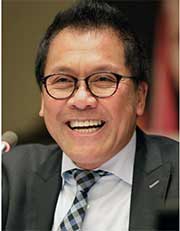
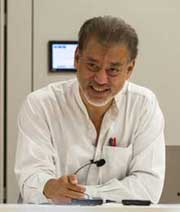
The Rev. Liberato Bautista. Credit: Marcelo Schneider, World Council of Churches

Human rights intrinsic to health, healing and wholeness

Global pandemics such as the novel coronavirus respect no sovereign boundaries or national allegiances. The coronavirus ravages all peoples across races and social classes, but its effects are more devastating on vulnerable populations everywhere and on struggling low- and middle-income economies around the world.

To mitigate the virulent spread of COVID-19, we are called by national authorities to stay at home, wash our hands, stay in place and practice physical distancing. These public health directives imply that we have houses to stay in, water to wash our hands, and some space where we can move around and still maintain six feet distance from each other.

When Philippine government officials issued the directive for Filipinos to stay at home, Norma Dollaga, a United Methodist deaconess and justice advocate from the Philippines, reacted through her Facebook page: “Stay at home. That’s for those who have homes. How about the homeless?”

The reality is that the human rights to health, housing and water, along with human mobility, have long been imperiled in many places around the world prior to COVID-19’s onslaught. Moreover, the health crisis has been used as an excuse in other parts of the world to grab power or tighten national security laws that are assaulting civil liberties and violating democratic rights.

Neither pandemic nor political or economic exigency can derogate from the enjoyment of fundamental human rights.

That the outbreak of COVID-19 started in Wuhan City in China has resulted in undue rise in racist and xenophobic acts especially against people of Chinese origin, or Asians in general. This is on top of an ongoing surge of populism and xenophobic nationalism around the world.

Health is wealth, fund it robustly

If health is wealth, it behooves peoples and their governments to protect it. Health care workers who are on the front line against this pandemic should have all the resources they need without begging for them.

A war may have been declared in the eradication of the novel coronavirus pandemic. But it is looking more like the deployment of war rhetoric and not the funding that real wars have received.

National budgets are moral documents. Health is the true common wealth that we must invest human and budgetary resources to. Yet we know that defense spending today far outweighs the puny investments from national coffers that health care urgently needs and strategically deserves.

Global collaboration is indispensable

The role of the U.N. in forging global cooperation is crucial, in times of crisis or calm. Global cooperation in the surveillance of emerging viruses and bacteria is necessary if pandemics are to be mitigated and diseases eradicated.

Coordinating this global collaboration and leading the development of a vaccine to treat the COVID-19 disease gives the public good reason to trust global institutions like World Health Organization. Think of the eradication of smallpox — and the ongoing programs to eventually eradicate polio and malaria — as examples of how global cooperation benefits us in our local daily lives.

To triumph over COVID-19, comprehensive cooperation is needed on many fronts — medical, pharmaceutical, healthcare workers, mental health providers, healthcare facilities. Public and private coordination is necessary in ensuring that the supply chain for much needed testing kits, ventilators, as well as personal protective equipment like N95 face masks, gloves, gowns, aprons, face shields and respirators remain unbroken.

A successful multilateral response requires a “whole-of-government,” “whole-of-society” and evidence-based public health approach. Mitigation works best when countries share expertise and scientific knowledge about threats to health, to climate, to populations and to peace and security.

Social inequalities imperil public health

The Commission on the Social Determinants of Health established by WHO in 2005 elaborated on the disastrous effects of social inequalities on people’s health. The intersections of physical, mental and social health, healing and wholeness are abundantly clear.

The commission’s 2008 final report stated: “The social determinants of health are the conditions in which people are born, grow, live, work and age. These circumstances are shaped by the distribution of money, power and resources at global, national and local levels.

The social determinants of health are mostly responsible for health inequities — the unfair and avoidable differences in health status seen within and between countries.”

The U.N. commemorates its 75th anniversary this year. It is an auspicious time to reaffirm support for its mandates, especially the securing of health for all peoples and the planet. A healthy population makes for a healthy planet.

Nongovernmental organizations, including faith-based organizations like our United Methodist representations at the U.N., are in a kairos moment to help achieve the U.N.’s mandates.

COVID-19 may have been virulent and will forever change the rules of social etiquette and socialization. But the novel coronavirus has done what multilateral negotiations have not done — pause globalization and its unbridled pursuit of profit and capital.

When the world reopens from the ravages of the virus, we have a momentous task not to return to, but to transform, global and local arrangements to protect humanity and the planet, at least from the ravages of pandemics and social inequalities.

It comforts me that not all contagions are deadly. Some are beneficial. Love and kindness are. So are hospitality, mercy and justice.

*This article 0riginally appeared in UM News”. The link follows: https://www.umnews.org/en/news/collaboration-can-help-eradicate-covid-19
  Source

Citizen Action is Central to the Global Response to COVID-19

Active Citizens, Development & Aid, Economy & Trade, Global, Headlines, Health, Humanitarian Emergencies, Labour, TerraViva United Nations

Opinion

NEW YORK and MANILA, Apr 22 2020 (IPS) – The coronavirus (COVID-19) pandemic has created an unprecedented human and economic crisis. Governments are taking strong actions, enforcing quarantines to reduce contagion, testing populations, building emergency intensive care units. Governments have also launched large fiscal stimulus plans to protect jobs and the economy, as well as temporary social protection programs such as income/food support, subsidies to utilities and care services.


Isabel Ortiz

But in many countries, even stronger actions are needed if we are to protect lives and jobs. States must respond adequately to this public emergency. Citizens must question if the measures implemented by their governments are sufficient and adequate.

The following are important issues for citizens and civil society organizations (CSOs) to watch out at the country level:

    1. It is time to invest in universal public health, not only emergency support. Given COVID-19, governments are advised to ramp up public health expenditures. Indeed, respirators, tests and masks are necessary, but countries need more than just emergency support. There is a risk that, as governments will become indebted, they continue with austerity cuts and privatizations that have been eroding public health systems in recent years, returning to a situation where millions are excluded from healthcare.
    2. Stimulating the economy and employment. This is much necessary to support job-generating enterprises during the COVID-19 lockdown. However, citizens need to be vigilant that fiscal stimulus do not go to the wrong hands, to large corporations avoiding taxes, to cronies, to the untaxed financial sector. If public funds are given to companies, it should be with strict conditions to stop tax evasion and share buybacks, undergo adequate regulation, cut obnoxious management bonusses, pay living wages and preserve employment.
    3. Providing social protection, income and food support to people. These measures are extremely urgent if people are to be quarantined and are unable to telework. In developing countries, most work precariously in the informal economy and isolation is not possible, households will suffer hunger with no income. Given the low living conditions in most developing countries, policymakers should consider the need for universal social protection floors.
    4. Governments need more executive powers to implement these measures. States and public policies have been weakened over the last decades by deregulations, privatizations and budget cuts. Better planning, better resources and better public policies for all citizens are needed, but it is important to ensure that far right and authoritarian leaders do not use the need for decisive executive action to grab more power for their own ends (eg. Brazil, Hungary, India, Philippines, US).

Additionally, it is important for citizens and CSOs to push for the following measures at the global level:

Walden Bello

    5. Support for global public health, at stake is the survival of the planet. The coronavirus pandemic has revealed the weak state of global public health systems – generally overburdened, underfunded and understaffed because of earlier austerity policies and privatizations. There is urgent need to improve the global governance of health, including the strengthening the WHO and UN agencies that support the extension of public health systems, as well as CSOs monitoring progress.
    6. Put pressure on the international financial institutions such as the IMF and the development banks, so their policies support universal public health systems, jobs and social protection floors at present as well as after the COVID-19 emergency, including resources and fiscal space to finance them.
    7. Given high sovereign debt levels, continue lobbying for debt forgiveness or radical debt relief to ensure that countries get the needed financing; or at least a debt moratoria, and later debt restructuring/relief.
    8. Watch out that new debt and fiscal deficits created to respond to COVID-19 do not result in a new round of austerity cuts with negative social impacts that will undermine public health systems, jobs and social protection.
    9. Ensure capital controls. Capital is flying North to safety, to the US, to Europe. Developing countries are going to be hard hit, not only because of the capital drain but also from the fall of commodity prices and others. Capital controls are easy to implement, with immediate results.
    10. A Global Marshall Plan, or a Global Green New Deal. Global problems require global solutions; after the WW2, the US implemented a Marshall Plan to rebuild Europe. This time, no country alone can or should finance a global plan, it can be built as part of a progressive multilateralism. There are many ways to finance it, solidarity taxes to wealth may well be a best way to reduce inequalities and even up world’s development. It can be complemented by other measures such as issuing more Special Drawing Rights (SDRs) at the international organizations.

The coronavirus pandemic has provided stark evidence of the weaknesses and extreme injustices of our world. We must not return to “normality”, a world where half of its population is living below the poverty line of $5.50 a day. We must move away from an inequitable model based on unregulated finance and corporate power, blind to harmful social and environmental impacts. We must back away from a system that disregards the work of health staff, cleaners, garbage collectors, farmers, and instead reward with huge salaries corporate managers, football players, and others who do not perform any essential activity. Now citizens have the opportunity to move forward.

As countries and enterprises recuperate from the crisis, they will have to rethink their economic model, including fewer links with global supply chains, and more links closer to home. It will be an important time for citizens and CSOs to press for “deglobalization”, making the domestic market again the center of gravity of the economy by preserving local production with decent jobs and green investments, and question global supply chains based on taking advantage of cheaper wages, lesser taxes and environmental regulations elsewhere.

Now is the time for citizens to ensure that world leaders forcefully respond to the COVID-19 crisis, in accordance with human rights. This time it cannot be like many earlier crisis experiences, where insufficient support was provided, or ended in the wrong hands, bailing out banks not the population. Citizens and CSOs have a very important role to play to ensure that governments respond to people.

Isabel Ortiz is Director of the Global Social Justice Program at the Initiative for Policy Dialogue, Columbia University, and former director of the International Labour Organization (ILO) and UNICEF.

Walden Bello is senior analyst at the Bangkok-based Focus on the Global South and the International Adjunct Professor of Sociology at the State University of New York at Binghamton.

  Source

A Global Crisis Like No Other Needs a Global Response Like No Other

Civil Society, Development & Aid, Featured, Global, Headlines, Health, Human Rights, Humanitarian Emergencies, Inequity, TerraViva United Nations

Opinion

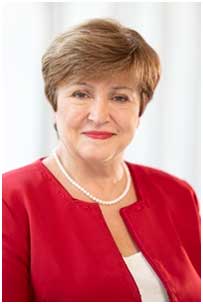
Kristalina Georgieva is the Managing Director of the International Monetary Fund (IMF)

WASHINGTON DC, Apr 22 2020 (IPS) – I have been saying for a while that this is a ‘crisis like no other.’ It is:

    • • More complex, with interlinked shocks to our health and our economies that have brought our way of life to an-almost complete stop;
    • • More uncertain, as we are learning only gradually how to treat the novel virus, make containment most effective, and restart our economies; and
    • Truly global. Pandemics don’t respect borders, neither do the economic shocks they cause.

Credit: IMF

The outlook is dire. We expect global economic activity to decline on a scale we have not seen since the Great Depression.

This year 170 countries will see income per capita go down – only months ago we were projecting 160 economies to register positive per capita income growth.

Actions taken

Exceptional times call for exceptional action. In many ways, there has been a ‘response like no other’ from the IMF’s membership.

Governments all over the world have taken unprecedented action to fight the pandemic—to save lives, to protect their societies and economies. Fiscal measures so far have amounted to about $8 trillion and central banks have undertaken massive (in some cases, unlimited) liquidity injections.

For our part, the IMF has $1 trillion lending capacity – 4 times more than at the outset of the Global Financial Crisis—at the service of its 189 member countries. Recognizing the characteristics of this crisis—global and fast-moving such that early action is far more valuable and impactful—we have sought to maximize our capacity to provide financial resources quickly, especially for low-income members.

In this regard, we have strengthened our arsenal and taken exceptional measures in just these two months.

These actions include:
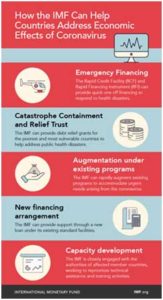
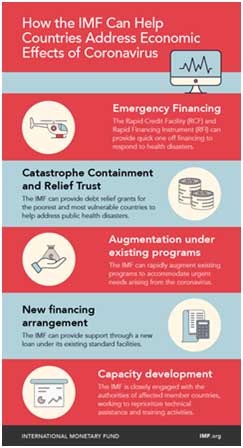
Doubling the IMF’s emergency, rapid-disbursing capacity to meet expected demand of about $100 billion. 103 countries have approached us for emergency financing, and our Executive Board will have considered about half of these requests by the end of the month.
• Reforming our Catastrophe Containment and Relief Trust, to help 29 of our poorest and most vulnerable members—of which 23 are in Africa—through rapid debt service relief, and we are working with donors to increase our debt relief resources by $1.4 billion. Thanks to the generosity of the UK, Japan, Germany, the Netherlands, Singapore, and China, we are able to provide immediate relief to our poorest members.
• Aiming to triple our concessional funding via our Poverty Reduction and Growth Trust for the most vulnerable countries. We are seeking $17 billion in new loan resources and, in this respect, I am heartened by pledges from Japan, France, UK, Canada, and Australia promising commitments totaling $11.7 billion, taking us to about 70 percent of the resources needed towards this goal.
• Supporting a suspension of official bilateral debt repayments for the poorest countries through end 2020—a ground-breaking accord among G20 countries. This is worth about $12 billion to nations most in need. And calling for private sector creditors to participate on comparable terms—which could add a further $8 billion of relief.
• Establishing a new short-term liquidity line that can help countries strengthen economic stability and confidence.

Kristalina Georgieva

This is the package of actions that the International Monetary and Financial Committee endorsed last week at our virtual Spring Meetings.

It represents a powerful policy response. Above all, it enables the IMF to get immediate, ‘here and now’ support to countries and people in desperate need. Today.

Preventing a protracted recession

But there is much more to be done and now is the time to look ahead. To quote a great Canadian, Wayne Gretzky: “Skate to where the puck is going, not where it has been.”

We need to think hard about where this crisis is headed and how we can be ready to help our member countries, being mindful of both risks and opportunities. Just as we responded strongly in the initial phase of the crisis to avoid lasting scars for the global economy, we will be relentless in our efforts to avoid a painful, protracted recession.

I am particularly concerned about emerging markets and developing countries.

They have experienced the sharpest portfolio flow reversal on record, of about $100 billion. Those dependent on commodities have been further shocked by plummeting export prices. Tourism-dependent countries are experiencing a collapse of revenues, as are those relying on remittances for income support.

For emerging economies, the IMF can engage through our regular lending instruments, including those of a precautionary nature. This may require considerable resources if further market pressures arise.

To prevent them from spreading, we stand ready to deploy our full lending capacity and to mobilize all layers of the global financial safety net, including whether the use of SDRs could be more helpful.

For our poorest members, we need much more concessional financing. With the peak of the outbreak still ahead, many economies will require significant fiscal outlays to tackle the health crisis and minimize bankruptcies and job losses, while facing mounting external financing needs.

But more lending may not always be the best solution for every country. The crisis is adding to high debt burdens and many could find themselves on an unsustainable path.

We therefore need to contemplate new approaches, working closely with other international institutions, as well as the private sector, to help countries steer through this crisis and emerge more resilient.

And the IMF, like our member countries, may need to venture even further outside our comfort zone to consider whether exceptional measures might be needed in this exceptional crisis.

Preparing for recovery

To help lay the foundations for a strong recovery, our policy advice will need to adapt to evolving realities. We need to have a better understanding of the specific challenges, risks and tradeoffs facing every country as they gradually restart their economies.

Key questions include how long to maintain the extraordinary stimulus and unconventional policy measures, and how to unwind them; dealing with high unemployment and ‘lower-for-longer’ interest rates; preserving financial stability; and, where needed, facilitating sectoral adjustment and private sector debt workouts.

We also must not forget about long-standing challenges that require a collective response, such as reigniting trade as an engine for growth; sharing the benefits of fintech and digital transformation which have demonstrated their usefulness during this crisis; and combating climate change—where stimulus to reinforce the recovery could also be guided to advance a green and climate resilient economy.

Finally, in the new post-COVID-19 world, we simply cannot take social cohesion for granted. So, we must support countries’ efforts in calibrating their social policies to reduce inequality, protect vulnerable people, and promote access to opportunities for all.

This is a moment that tests our humanity. It must be met with solidarity.

There is much uncertainty about the shape of our future. But we can also embrace this crisis as an opportunity—to craft a different and better future together.

  Source

Kerala Covid-19 Response Model for Emulation

Asia-Pacific, Civil Society, Development & Aid, Economy & Trade, Featured, Global, Headlines, Health, Humanitarian Emergencies, TerraViva United Nations

Opinion

SYDNEY and KUALA LUMPUR, Apr 9 2020 (IPS) – Within weeks, the Covid-19 epidemic was classified by the World Health Organization (WHO) as an epidemic of international significance, triggering a pre-agreed WHO response. By the end of the first week of April, more than 1.3 million people had been confirmed as infected, with over 65,000 deaths across the world.


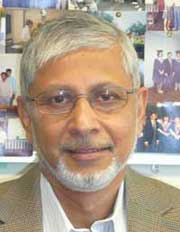
Anis Chowdhury

Many governments of developing, especially poor countries are unsure what to do, fearing the likely economic consequences of the ‘lockdowns’ increasingly adopted by Western economies. Indeed, lockdowns may shut down businesses relying on daily turnover and eliminate incomes for daily rated workers.

Meanwhile, most East Asian and some other governments have acted early to trace, test, isolate and treat the infected without lockdowns. Yet, most measures recommended have been criticized as beyond the means of the most vulnerable societies and populations.

Early action crucial
Early measures have required ‘physical distancing’ and other precautionary measures — at work, at home and in the community, at relatively low cost. People also need to be prepared to live differently for a long time to come as part of a ‘new normal’, at least until everyone can be effectively vaccinated.

‘All of government’ approaches are urgently needed everywhere to provide effective leadership to ‘whole of society’ efforts to contain the spread of viral infections. While this is no conventional war, only whole of society mobilization efforts can help mitigate major economic disruption and damage.

This should not only involve public health and police authorities, typically those empowered by draconian lockdowns. But repressive measures are unlikely to secure needed public support for effective enforcement and implementation, and adoption of needed behavioural and cultural changes.

Health authorities must provide publics with much better understanding of the threats faced and the rationale for policy responses to secure compliance. Public appreciation of the challenges involved is crucial for policy compliance and effective implementation.

Physical distancing, social solidarity
Kerala state in southwestern India, with a population of 35 million, has become “a model state in the fight against Covid-19”. Its Left Front-led government was among the first to introduce precautionary state-wide measures against the novel coronavirus threat.

Through appropriate and effective early actions, it has successfully slowed the spread of infection in the state, largely by promoting physical distancing and mainly sanitary precautionary, measures, and providing better protection for health staff well before the hugely disruptive and draconian lockdown imposed in India in late March.

Jomo Kwame Sundaram

The Kerala state government invited religious leaders, local bodies and civil society organizations to participate in policy design and implementation, considering its specific socio-economic conditions, including urban slum environments.

It has communicated effectively in different languages to educate all, including migrants, and to prevent stigmatization of those infected, even opposing the term ‘social distancing’, which has caste connotations, with ‘physical distancing and social solidarity’.

Returning migrants
Despite Kerala’s long-standing achievements in education, health and science, highly educated Keralans tend to migrate to work out of state, if not abroad, seeking more lucrative employment. The state was still recovering from the devastating floods and nipah virus epidemic of 2018 when tens of thousands began returning after losing jobs in the Middle East.

Kerala is also the destination for a large number of Indian internal migrants. With the nationwide lockdown, non-residents, equivalent to almost 5% of Kerala’s population, have returned, causing a surge of new infections.

Such unusually high movements of people have made the state more vulnerable. Despite some controversy, the state appears to have handled the migrant issue very well, especially compared to other state governments and the central government.

There has also been a close connection between Kerala and Wuhan, a popular educational hub offering affordable quality medical and other courses; the first three positive Covid-19 cases detected in India involved returned university students in Wuhan.

The state health department promptly went into action, setting up a coordination centre on 26 January. Recognizing there was no time to be lost, the Kerala state government set up mechanisms to identify, test, isolate and treat those infected, quickly earning an excellent reputation.

Less disruptive, less costly, more effective
Some key features of Kerala’s response, undertaken by a government with very limited fiscal resources, are hence instructive.

*All-of-government approach: involving a range of relevant state government ministries and agencies to design measures to improve consistency, coordination and communication, and to avoid confusion.

*Whole-of-society approach: wide community consultations, including experts, to find the most locally appropriate modes of limiting infections, along with means to monitor and enforce them.

*Social mobilization: communities were provided essential epidemiological information to understand the threat and related issues, ensure compliance with prescribed precautionary measures, and avoid panic.

*No one left behind: adequate supply of essential commodities, particularly food and medicines, has been ensured, especially to protect the most vulnerable sections of society.

To make things worse, Kerala has been discriminated against by the central government’s disaster relief fund on specious grounds. The largely agricultural state has modest fiscal resources of its own as state governments in India have limited fiscal rights and resources.

Credible leadership
The Kerala government has set up 18 committees and holds daily evening meetings to evaluate the situation, issuing media updates about those quarantined, tested and hospitalized .

At these meetings, the state Health Minister and Chief Minister calmly explain what is going on, including what the government is doing. They thus provide credible leadership on the difficult issues involved, securing strong public participation for its mass campaign of containment.

Kerala’s approach has proven less disruptive, less costly and more effective than most others. After recording its first COVID-19 case on January 30, its infection and death rates have been kept relatively low despite much more tracing and testing.

  Source

Martin Khor, Third Worldist

Civil Society, Climate Change, Economy & Trade, Global, Headlines, Poverty & SDGs

Opinion

PENANG, Apr 3 2020 (IPS) – Martin Khor Kok Peng passed away just after the end of the first quarter of 2020. He leaves behind an unusually rich legacy. Atypically for people mainly working in the worldideas, he was also a very practical and pragmatic activist who successfully built and sustained several important initiatives which will live on after him.


Martin Khor

Martin was widely well known,both in Malaysia and internationally,and will be remembered for his commitment to a variety of causes perhaps best summed up by the concept of sustainable development, adopted by world leadersat Rio in 1992, and reaffirmed in Johannesburg in 2002, Rio again in 2012 and, most recently, through the Sustainable Development Goals declared in 2015.

Born in 1951, Martin’s passing,less than a year after the demise of his mentor and close collaborator, the nonagenarian Mahathir contemporary, S M Mohammed Idris, suggests the end of an era, not only in Malaysia, but also beyond.

Already there are many pronouncements about the end of the Third World, of the solidarity of the global South, and most recently, about the related demise of multilateralism, especially as it was transformed in the 1970s when the United Nations committed to a New International Economic Order, thanks to the G77 caucus of developing countries at the UN.

Paths not taken
Reflecting on Martin’s career path, one cannot but be struck by the choices he made, and by paths not taken. Leaving his hometown of Penang, Martin wasa pre-university classmate of current Prime Minister Lee Hsien Loong in Singapore, before going to Cambridge together.

Later, after a few months in Singapore’s civil service during 1974-1975, which almost surely would have led him to a cabinet position in Lee’s cabinet, Martin ‘broke his bond’ to return to Malaysia to start teaching for a pittance at the Science University of Malaysia (USM).

From there, he began his lifelong engagement with the Consumers Association of Penang (CAP) and Friends of the Earth, Malaysia (SAM), collaborating closely with Haji Idris, to wage efforts to protect Penang, and later the countryagainst ecological and other disasters in the name of development.

From local to global
Followingan international civil society solidarity conference in 1984,Third World Network (TWN) was born and rapidly developed by Martin to promote collective solidarity to protectdeveloping countries’ national interests as the global South came under siege with the neoliberal ascendance of the 1980s.

The South Summit in Kuala Lumpur in 1986 established the South Commission worked under former Indian Prime Minister Manmohan Singh which recommended establishing the South Centre as an intergovernmental policy research and analysis institution for developing countries headquartered in Geneva and chaired by Tanzanian President Julius Nyerere. Years later, Martin took over the South Centre in 2009, strengthening its finances, capacities and impact, by creatively mobilizing resources.

The personal is political
Martin’s widow, Meenakshi Raman was a victim of Malaysian political repression in 1987. But without personal rancour, Martin worked closely with the Mahathir and subsequent Malaysian administrations, especially on internationalcauses, includingtrade, intellectual property, biopiracy and climate change.

Martin touched many, inspiring all by his tireless commitment. He was often more than happy for others to getcredit for his discreet efforts behind the scenes with relevant research and skilled drafting. His persistence was legendary, but everyone knew his efforts were not for personal gain.

Martin waswell known for his indefatigable energy and meticulousness in preparing policy and advocacy briefs on many key matters of concern to developing countries, often working late into the night as necessary. This reputation gained him access to many government and other leaders.

  Source

In memoriam ‒ Martin Khor

Civil Society, Climate Change, Featured, Global, Headlines, Poverty & SDGs

Opinion

GENEVA, Apr 3 2020 (IPS) We are greatly saddened by the passing of Martin Khor, a long-time friend and colleague, an undaunted fighter for the poor and underprivileged, a passionate believer in a more balanced and inclusive multilateralism, a rare intellectual and eloquent orator, an icon of the Global South worthy of veneration, greatly respected for his struggle for justice and fairness against the dominance and double-standards of big economic powers.   


Martin was born in 1951 in colonial Malaysia, still under British rule, to a family of journalists. After his primary and secondary education in Malaysia, he left for the UK in 1971 to study at the University of Cambridge, where he obtained his B.A Hons and M.A. in economics, before completing his second Masters in Social Sciences at the University of Science, Malaysia in 1978. 

There are increasing warnings of an imminent new financial crisis, not only from the billionaire investor George Soros, but also from eminent economists associated with the Bank of International Settlements, the bank of central banks.

Martin Khor

In his Master’s thesis, he grappled with the changing nature of external dependence and surplus extraction in Malaysia as it moved from colonial to post-colonial status, with a view to its implications for the scope and limits of industrialization and development; a study which left an indelible mark on his subsequent engagement and activities in a world characterised by increasingly asymmetric power relations.  

He started his professional career as an Administrative Officer at the Ministry of Finance, Singapore before joining the University of Science, Malaysia as lecturer in Economics in 1975.   

He became the Research Director of The Consumers’ Association of Penang in 1978, an independent non-profit international research and advocacy organization on issues related to development.

The Third World Network (TWN) was created in 1984 at an international Conference on “The Third World: Development and Crisis” organized by the Consumers’ Association of Penang.   In 1990, Martin became the Director of the TWN, perhaps the most important NGO from the developing world with operations globally, both in the North and the South, through offices, secretariats and researchers, including in Penang, Kuala Lumpur, Geneva, Beijing, Delhi, Jakarta, Manila, New York, Montevideo and Accra.  

Martin’s approach to advancing progressive solutions on all these fronts was always one of quiet determination driven by a passionate commitment to strengthening the voice of developing countries.

He had an envious ability to synthesise and explain complex negotiating issues to a broad audience and in a way that could bring on board activists and policy makers alike

Martin held both positions at the Consumers’ Association of Penang and the TWN until 2009 when he became the Executive Director of the South Centre in Geneva, an intergovernmental organization of developing countries established in 1995 to undertake research in various national and international development policy areas and provide advice and support to developing countries in a variety of international negotiating fora. 

Under his leadership, the South Centre became an important voice in discussions on international trade and investment, intellectual property, health, global macroeconomics, finance, sustainable development, and climate change.

During his tenure, the Centre extended significantly the scope and quality of its policy research and advice, building an enhanced reputation and level of trust among developing countries in the struggles to protect and promote their interests.   After leaving the South Centre in 2018, Martin returned to Penang, already suffering from cancer, and acted as Chairman of the Board of TWN until his death on April 1, 2020.

Martin was a staunch multilateralist but not an advocate of globalization, at least in the neo-liberal guise it acquired from the early 1980s.   On the one hand, he was well aware that individually developing countries could not obtain fair deals with major (and minor) developed countries in the international economic system. 

On the other hand, he knew that multilateral rules and practices were unbalanced, designed to subject developing countries to the discipline of unfettered international markets shaped by transnational corporations and self-seeking policies of dominant powers in the North, denying them the kind of policy space they themselves had enjoyed in the course of their industrialization.  His efforts focussed on reshaping multilateral rules and practices as a way to bring about systemic changes in the service of development.     

Martin did this on three frontsFrom the mid-1980s he focussed mainly on international trade issues, particularly those raised by negotiations during the Uruguay Round, and subsequently in the WTO and the proliferating free trade agreements and bilateral investment treaties that accompanied the shift to a neo-liberal international economic order.

Martin was instrumental in bringing the attention of policy makers and activists to the implications of new trade rules for the industrialization and development of the Global South arising from more demanding obligations on tariff and non-tariff measures, industrial subsidies, investment and intellectual property rights. 

He made several proposals for reform in these areas to remove imbalances and constraints over industrialization, and economic diversification more generally, in the Global South. He opposed free trade agreements with developed countries on the grounds that, by simultaneously curtailing the policy space available to governments while expanding the space for abusive practices by the large international firms that dominate international trade, they posed an even greater threat to development than the earlier generation of trade rules under the GATT.

In the aftermath of the Marrakech agreement, Martin was a prominent figure blocking efforts by OECD countries to push for a multilateral investment agreement, to extend the neo-liberal agenda at the first WTO ministerial in Singapore and subsequently at the third meeting in Seattle and to water down the Doha Development Agenda at the Cancun Ministerial in 2003.

The second front concerned the issues around the operations of the Bretton Woods Institutions, notably debt and development finance.  Martin had been a long-time critic of the Washington Consensus, and in particular, the use of policy conditionalities attached to lending by the IFIs which sought to push a series of damaging measures on developing countries in the name of efficiency, competitiveness and attracting foreign investors.

But he started to pay greater attention to these after the 1997 Asian financial crisis, arguing against austerity, advocating capital controls, orderly debt work-out mechanisms, multilateral discipline over exchange rates and financial policies of major advanced economies and global regulation and supervision of systemically important international financial firms.

He was a particularly strong advocate of these positions in his role as a member of the Helsinki Group on Globalisation and Democracy.  Martin took the helm of the South Centre just before the 2009 Global Financial Crisis hit and was quick to provide substantive assistance to developing countries during the 2009 UN Conference on the World Financial and Economic Crisis and its Impact on Development, identifying the key issues for them and working to ensure their insertion in the Outcome Document.

He continued to push hard on these issues through the research output from the Centre while adding the related areas of illicit financial flows and international tax issues to its workload as developing countries sought support on these matters.

The third, and increasingly prominent, front was climate change and sustainable development which gained added importance in international discussions in the new millennium. Environmental issues had always been part of Martin’s work as head of TWN and as a member of the Commission on Developing Countries and Global Change. 

But this widened significantly after the UN Conference on the Environment and Development in 1992 in Rio de Janeiro. Subsequently, Martin became a member of the Consultative Group on Sustainable Development and a regular attendee at the UN Climate Change Conferences that began in 1995 playing a particularly important role in the Copenhagen COP in 2009 where the neglect of the development dimension by advanced economies, their reluctance to acknowledge common but differentiated responsibilities and their naïve belief in market-friendly solutions to the climate challenge led to acrimonious discussions and the eventual collapse of the conference.

While he clearly recognized the need to reduce the pace of emissions and protect the environment, Martin was wary that the measures promoted by industrial countries could become instruments to stem development in the Global South.  Under his leadership an important part of the work in the South Centre focussed on this issue.

During this time Martin was a strong critic of tighter intellectual property rights, particularly through trade agreements, that restricted the transfer of the technologies developing countries needed to help in the fight against rising global temperatures and to mitigate the climate damage they were already experiencing.

This work had a parallel in Martin’s fight to ease the burden of TRIPs on developing countries in dealing with public health emergencies which, thanks to a successful civil society coalition where Martin was a pivotal figure, eventually succeeded in a permanent amendment to the TRIPs agreement in 2017.

Martin’s support to developing countries in the climate change negotiations, carried out through the South Centre and TWN, fostered greater coordination among developing countries in protecting and promoting their development policy space in the climate negotiations, highlighting equity, and stressing the international obligation of advanced economies to provide support to developing countries.

Martin’s approach to advancing progressive solutions on all these fronts was always one of quiet determination driven by a passionate commitment to strengthening the voice of developing countries.

He had an envious ability to synthesise and explain complex negotiating issues to a broad audience and in a way that could bring on board activists and policy makers alike. He became a trusted advisor to policy makers and diplomats across the developing world.

But Martin was equally comfortable engaging in a productive debate with policy makers from advanced countries and in mainstream institutions.   His was a uniquely calming but authoritative voice for increasingly anxious times, one that has been silenced too soon and at a moment when his commitment to building a fairer and more resilient world was needed more than ever.

Yilmaz Akyüz, Former Director, Globalization and Development Strategies Division, UNCTAD; and Former Chief Economist, South Centre, Geneva.

Richard Kozul-Wright, Director, Globalization and Development Strategies Division, UNCTAD, Geneva. 

  Source