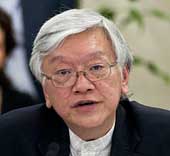
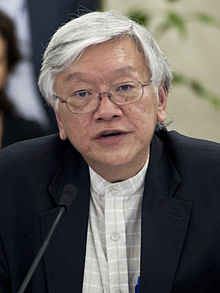
PENANG, Apr 3 2020 (IPS) – Martin Khor Kok Peng passed away just after the end of the first quarter of 2020. He leaves behind an unusually rich legacy. Atypically for people mainly working in the worldideas, he was also a very practical and pragmatic activist who successfully built and sustained several important initiatives which will live on after him.
Martin Khor
Martin was widely well known,both in Malaysia and internationally,and will be remembered for his commitment to a variety of causes perhaps best summed up by the concept of sustainable development, adopted by world leadersat Rio in 1992, and reaffirmed in Johannesburg in 2002, Rio again in 2012 and, most recently, through the Sustainable Development Goals declared in 2015.
Born in 1951, Martin’s passing,less than a year after the demise of his mentor and close collaborator, the nonagenarian Mahathir contemporary, S M Mohammed Idris, suggests the end of an era, not only in Malaysia, but also beyond.
Already there are many pronouncements about the end of the Third World, of the solidarity of the global South, and most recently, about the related demise of multilateralism, especially as it was transformed in the 1970s when the United Nations committed to a New International Economic Order, thanks to the G77 caucus of developing countries at the UN.
Paths not taken Reflecting on Martin’s career path, one cannot but be struck by the choices he made, and by paths not taken. Leaving his hometown of Penang, Martin wasa pre-university classmate of current Prime Minister Lee Hsien Loong in Singapore, before going to Cambridge together.
Later, after a few months in Singapore’s civil service during 1974-1975, which almost surely would have led him to a cabinet position in Lee’s cabinet, Martin ‘broke his bond’ to return to Malaysia to start teaching for a pittance at the Science University of Malaysia (USM).
From there, he began his lifelong engagement with the Consumers Association of Penang (CAP) and Friends of the Earth, Malaysia (SAM), collaborating closely with Haji Idris, to wage efforts to protect Penang, and later the countryagainst ecological and other disasters in the name of development.
From local to global Followingan international civil society solidarity conference in 1984,Third World Network (TWN) was born and rapidly developed by Martin to promote collective solidarity to protectdeveloping countries’ national interests as the global South came under siege with the neoliberal ascendance of the 1980s.
The South Summit in Kuala Lumpur in 1986 established the South Commission worked under former Indian Prime Minister Manmohan Singh which recommended establishing the South Centre as an intergovernmental policy research and analysis institution for developing countries headquartered in Geneva and chaired by Tanzanian President Julius Nyerere. Years later, Martin took over the South Centre in 2009, strengthening its finances, capacities and impact, by creatively mobilizing resources.
The personal is political Martin’s widow, Meenakshi Raman was a victim of Malaysian political repression in 1987. But without personal rancour, Martin worked closely with the Mahathir and subsequent Malaysian administrations, especially on internationalcauses, includingtrade, intellectual property, biopiracy and climate change.
Martin touched many, inspiring all by his tireless commitment. He was often more than happy for others to getcredit for his discreet efforts behind the scenes with relevant research and skilled drafting. His persistence was legendary, but everyone knew his efforts were not for personal gain.
Martin waswell known for his indefatigable energy and meticulousness in preparing policy and advocacy briefs on many key matters of concern to developing countries, often working late into the night as necessary. This reputation gained him access to many government and other leaders.
GENEVA, Apr 3 2020 (IPS) – We are greatly saddened by the passing of Martin Khor, a long-time friend and colleague, an undaunted fighter for the poor and underprivileged, a passionate believer in a more balanced and inclusive multilateralism, a rare intellectual and eloquent orator, an icon of the Global South worthy of veneration, greatly respected for his struggle for justice and fairness against the dominance and double-standards of big economic powers.
Martin was born in 1951 in colonial Malaysia, still under British rule, to a family of journalists. After his primary and secondary education in Malaysia, he left for the UK in 1971 to study at the University of Cambridge, where he obtained his B.A Hons and M.A. in economics, before completing his second Masters in Social Sciences at the University of Science, Malaysia in 1978.
Martin Khor
In his Master’s thesis, he grappled with the changing nature of external dependence and surplus extraction in Malaysia as it moved from colonial to post-colonial status, with a view to its implications for the scope and limits of industrialization and development; a study which left an indelible mark on his subsequent engagement and activities in a world characterised by increasingly asymmetric power relations.
He started his professional career as an Administrative Officer at the Ministry of Finance, Singapore before joining the University of Science, Malaysia as lecturer in Economics in 1975.
He became the Research Director of The Consumers’ Association of Penang in 1978, an independent non-profit international research and advocacy organization on issues related to development.
The Third World Network (TWN) was created in 1984 at an international Conference on “The Third World: Development and Crisis” organized by the Consumers’ Association of Penang. In 1990, Martin became the Director of the TWN, perhaps the most important NGO from the developing world with operations globally, both in the North and the South, through offices, secretariats and researchers, including in Penang, Kuala Lumpur, Geneva, Beijing, Delhi, Jakarta, Manila, New York, Montevideo and Accra.
Martin’s approach to advancing progressive solutions on all these fronts was always one of quiet determination driven by a passionate commitment to strengthening the voice of developing countries.
He had an envious ability to synthesise and explain complex negotiating issues to a broad audience and in a way that could bring on board activists and policy makers alike
Martin held both positions at the Consumers’ Association of Penang and the TWN until 2009 when he became the Executive Director of the South Centre in Geneva, an intergovernmental organization of developing countries established in 1995 to undertake research in various national and international development policy areas and provide advice and support to developing countries in a variety of international negotiating fora.
Under his leadership, the South Centre became an important voice in discussions on international trade and investment, intellectual property, health, global macroeconomics, finance, sustainable development, and climate change.
During his tenure, the Centre extended significantly the scope and quality of its policy research and advice, building an enhanced reputation and level of trust among developing countries in the struggles to protect and promote their interests. After leaving the South Centre in 2018, Martin returned to Penang, already suffering from cancer, and acted as Chairman of the Board of TWN until his death on April 1, 2020.
Martin was a staunch multilateralist but not an advocate of globalization, at least in the neo-liberal guise it acquired from the early 1980s. On the one hand, he was well aware that individually developing countries could not obtain fair deals with major (and minor) developed countries in the international economic system.
On the other hand, he knew that multilateral rules and practices were unbalanced, designed to subject developing countries to the discipline of unfettered international markets shaped by transnational corporations and self-seeking policies of dominant powers in the North, denying them the kind of policy space they themselves had enjoyed in the course of their industrialization. His efforts focussed on reshaping multilateral rules and practices as a way to bring about systemic changes in the service of development.
Martin did this on three fronts. From the mid-1980s he focussed mainly on international trade issues, particularly those raised by negotiations during the Uruguay Round, and subsequently in the WTO and the proliferating free trade agreements and bilateral investment treaties that accompanied the shift to a neo-liberal international economic order.
Martin was instrumental in bringing the attention of policy makers and activists to the implications of new trade rules for the industrialization and development of the Global South arising from more demanding obligations on tariff and non-tariff measures, industrial subsidies, investment and intellectual property rights.
He made several proposals for reform in these areas to remove imbalances and constraints over industrialization, and economic diversification more generally, in the Global South. He opposed free trade agreements with developed countries on the grounds that, by simultaneously curtailing the policy space available to governments while expanding the space for abusive practices by the large international firms that dominate international trade, they posed an even greater threat to development than the earlier generation of trade rules under the GATT.
In the aftermath of the Marrakech agreement, Martin was a prominent figure blocking efforts by OECD countries to push for a multilateral investment agreement, to extend the neo-liberal agenda at the first WTO ministerial in Singapore and subsequently at the third meeting in Seattle and to water down the Doha Development Agenda at the Cancun Ministerial in 2003.
The second front concerned the issues around the operations of the Bretton Woods Institutions, notably debt and development finance. Martin had been a long-time critic of the Washington Consensus, and in particular, the use of policy conditionalities attached to lending by the IFIs which sought to push a series of damaging measures on developing countries in the name of efficiency, competitiveness and attracting foreign investors.
But he started to pay greater attention to these after the 1997 Asian financial crisis, arguing against austerity, advocating capital controls, orderly debt work-out mechanisms, multilateral discipline over exchange rates and financial policies of major advanced economies and global regulation and supervision of systemically important international financial firms.
He was a particularly strong advocate of these positions in his role as a member of the Helsinki Group on Globalisation and Democracy. Martin took the helm of the South Centre just before the 2009 Global Financial Crisis hit and was quick to provide substantive assistance to developing countries during the 2009 UN Conference on the World Financial and Economic Crisis and its Impact on Development, identifying the key issues for them and working to ensure their insertion in the Outcome Document.
He continued to push hard on these issues through the research output from the Centre while adding the related areas of illicit financial flows and international tax issues to its workload as developing countries sought support on these matters.
The third, and increasingly prominent, front was climate change and sustainable development which gained added importance in international discussions in the new millennium. Environmental issues had always been part of Martin’s work as head of TWN and as a member of the Commission on Developing Countries and Global Change.
But this widened significantly after the UN Conference on the Environment and Development in 1992 in Rio de Janeiro. Subsequently, Martin became a member of the Consultative Group on Sustainable Development and a regular attendee at the UN Climate Change Conferences that began in 1995 playing a particularly important role in the Copenhagen COP in 2009 where the neglect of the development dimension by advanced economies, their reluctance to acknowledge common but differentiated responsibilities and their naïve belief in market-friendly solutions to the climate challenge led to acrimonious discussions and the eventual collapse of the conference.
While he clearly recognized the need to reduce the pace of emissions and protect the environment, Martin was wary that the measures promoted by industrial countries could become instruments to stem development in the Global South. Under his leadership an important part of the work in the South Centre focussed on this issue.
During this time Martin was a strong critic of tighter intellectual property rights, particularly through trade agreements, that restricted the transfer of the technologies developing countries needed to help in the fight against rising global temperatures and to mitigate the climate damage they were already experiencing.
This work had a parallel in Martin’s fight to ease the burden of TRIPs on developing countries in dealing with public health emergencies which, thanks to a successful civil society coalition where Martin was a pivotal figure, eventually succeeded in a permanent amendment to the TRIPs agreement in 2017.
Martin’s support to developing countries in the climate change negotiations, carried out through the South Centre and TWN, fostered greater coordination among developing countries in protecting and promoting their development policy space in the climate negotiations, highlighting equity, and stressing the international obligation of advanced economies to provide support to developing countries.
Martin’s approach to advancing progressive solutions on all these fronts was always one of quiet determination driven by a passionate commitment to strengthening the voice of developing countries.
He had an envious ability to synthesise and explain complex negotiating issues to a broad audience and in a way that could bring on board activists and policy makers alike. He became a trusted advisor to policy makers and diplomats across the developing world.
But Martin was equally comfortable engaging in a productive debate with policy makers from advanced countries and in mainstream institutions. His was a uniquely calming but authoritative voice for increasingly anxious times, one that has been silenced too soon and at a moment when his commitment to building a fairer and more resilient world was needed more than ever.
Yilmaz Akyüz, Former Director, Globalization and Development Strategies Division, UNCTAD; and Former Chief Economist, South Centre, Geneva.
Richard Kozul-Wright, Director, Globalization and Development Strategies Division, UNCTAD, Geneva.
Women bear the brunt of climate change disasters. Credit: Women Deliver
NEW YORK, Mar 31 2020 (IPS) – Vanessa Nakate of Uganda may have been cropped out of a photograph taken at the World Economic Forum, but she along with Swedish activist Greta Thunberg have made the climate crisis centre stage.
Women Deliver Young Leader Jyotir Nisha discusses with Costa Rican President Carlos Alvarado Quesada on how to harness young people to overcome gender inequality and address climate change in a recent wide-ranging interview.
Quesada says key strategies to designing policy to fight climate change require unconventional decision-making to address challenges like climate change, biodiversity loss, the fourth industrial revolution, and inequality.
“These are intertwined factors that can hinder development if unattended but, if tackled, they could potentially accelerate progress and wellbeing for all,” he says.
“And, of course, this is a task that young leaders are able to handle and produce the timely answers that are necessary.”
Bringing in her experience in the non-profit sector, Nisha says training girls and women in up-cycling plastic waste to produce handmade goods has assisted them to contribute to their family income and their empowerment in the community. The question is, how can this be broadened.
Quesada says women, in particular young women, are leading the way.
Costa Rican President Carlos Alvarado Quesada. Credit: Women Deliver
“From cooperative seed banks, to early warning networks, from solar engineers to women politicians carving a path of sustainable policymaking. They are at the forefront of forest conservation, sustainable use of resources, and community enhancement, and restoration of landscapes and forest ecosystems,” he says.
However, women’s roles are often underestimated, unrecognised, and unpaid.
“Women and girls with access to technology have already begun developing innovative tools to reduce emissions by targeting sustainable consumption and production practices, including food waste, community waste management, energy efficiency, and sustainable fashion.”
The solutions exist, but much more is needed.
“It takes a whole-of-society approach for collaboration and cooperation on a bigger and enhanced scale.”
The President suggests that the way investments are made could be fundamental to ensure a flow of finance to the communities, including women, and youth. This will, he believes, provide “a stable source of funding for businesses and services that contribute to the solution of social or environmental challenges.”
The impact of this will be partnerships between traditional sources of finance, like international cooperation and development banks, and new partners, like philanthropy, hedge funds, or pension funds.
“And what better than young people giving the thrust that all this requires?”
Nisha says she was pleased to see the massive mobilisation of young people at the inaugural Climate Action Summit last year. The summit had little good news for climate change with concerns raised that the accelerating rise in sea level, melting ice would have on socio-economic development, health, displacement, food security and ecosystems. However, beyond taking to the streets, they also need to hold decision-makers accountable.
“In the last months we have witnessed the irruption of massive mobilisations in different parts of the world, lead mostly by young people. This would seem surprising for a generation that has been accused several times of passivity, indifference, and individualism,” Quesada says. “I truly believe that, as long as these demands are channelled through democratic and pacifist means, they are extremely important to set a bar and a standard of responsibility for us, decision-makers — who are, by the way, more and more often, young people.”
He adds that world leaders owe them explanations of the decisions made.
“We must also have the wisdom to pay attention to these demands and take into account their opinions and proposals to reach agreements that have the legitimacy of consensus-building.”
However, Nisha notes, while campaigns like the Deliver for Good campaign is working across sectors reports at COP25, and the recent World Economic Forum (Davos), “climate change continues to threaten progress made toward gender equality across every measure of development.”
At WEF Global Gender Gap Report 2020 showed that it would take more than a lifetime, 99.5 years in 2019 for gender parity across health, education, work and politics to be achieved.
Quesada says the climate catastrophe “demands that policymakers and practitioners renew commitments to sustainable development — at the heart of which is, and must continue to be, advancing gender equality and women’s empowerment, and realising women’s rights as a pre-requisite for sustainable development.”
Costa Rica, he says, has been recognised internationally on two significant areas: the respect of human rights and environmental protection.
“The present Administration has taken these objectives a step further by paying particular attention to women’s rights, inclusion, and diversity, and including them as part of our core policy principles and our everyday practices,” he says. “We expect to increase women’s integration into productive processes and achieve women’s economic empowerment through specific policies linked to our long-term development strategy — the Decarbonization Plan — allowing the transformational changes our society needs.
However, the critical question, Nisha says, is: “What can world leaders and governments do today to ensure young people have a seat at the decision-making table?”
Quesada is confident that young people will be part of the solution.
“The challenges we are facing today are unprecedented precisely because previous generations did not have to face situations such as biodiversity loss, global warming, or the emergence of artificial intelligence and technology. Thus, we need new answers and solutions from Twenty-First Century people, and those should and will be put forward by the youth,” he says.
The importance of youth involvement was recently highlighted too at the meeting of African Leaders for Nutrition in Addis Ababa. African Development Bank (AfDB) President Akinwumi Adesina said Africa should invest in skills development for the youth so the continent’s entrepreneurs can leverage emerging technologies to transform Africa’s food system to generate new jobs. This is especially urgent as the population on the continent is expected to double to 2.5 billion people in 40 years putting pressure on governments to deliver more food and jobs in addition to better livelihoods.
In a recent interview with IPS International Institute for Tropical Agriculture (IITA) Director General, Nteranya Sanginga, explained that this change is neither easy or necessarily something all leadership has taken on board.
“Our legacy is starting a programme to change the mindset of the youth in agriculture. Unfortunately (with) our governments that is where you have to go and change mindsets completely. Most probably 90 per cent of our leaders consider agriculture as a social activity basically for them its (seen as a) pain, penury. They proclaim that agriculture is a priority in resolving our problems, but we are not investing in it. We need that mindset completely changed.”
Quesada is unequivocal that this attitude needs to change.
“My advice to world leaders is to have the humility to listen to the people and to allow more inclusive and participatory decision-making. And to the young people, I can only encourage them to own their future, and to act accordingly, with vision, courage, and determination.”
Abdul Mohammed is a humanitarian worker for Oxfam Yemen
Credit: United Nations
SANA’A, Yemen, Mar 26 2020 (IPS) – In every room in Yemen’s Al-Saba’een hospital, patients in critical condition waited on chairs, and still others laid on the bare ground. I saw women and girls sharing beds in pairs, and children laying close together being treated.
This is Sana’a, Yemen’s best-supplied and capital city, on what has become an ordinary day. Coronavirus hasn’t arrived in Yemen yet.
As I watch the destruction that the novel coronavirus is wreaking on wealthy and peaceful countries with developed health systems, I fear for Yemen. If cholera, diphtheria, and malnutrition can overwhelm our war-stricken health system, I can only imagine the devastation that this fast-spreading, uncurable virus could unleash.
The impact of COVID-19 would mirror the impact of the war to date: no one would be safe, but the most vulnerable would bear a disproportionate share of the burden.
Credit: UNOCHA
The world is now getting a glimpse of the reality we have faced in Yemen for the past five years since war here escalated: life-threatening illness, deepening economic pressure, fewer and worse options for parents and caregivers, and a dizzyingly constant change in routine.
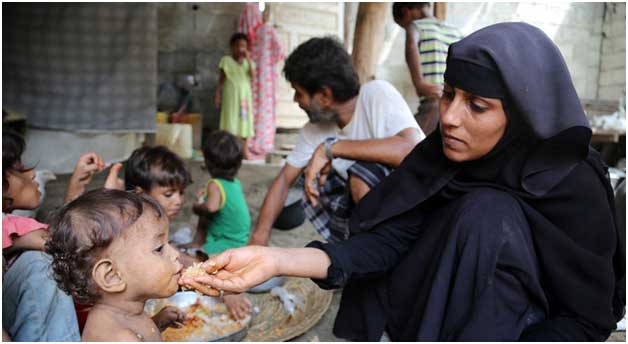
Millions now live in overcrowded shelters, without safe water, proper nutrition or proper health care. The basic steps others are taking to curtail the spread of COVID-19 are virtually impossible here. Should it take hold, the results would be unthinkable.
Public health crises don’t just threaten the well-being of the afflicted; their impacts ripple widely across families and societies. I think about Ahmed, a young man from Ibb, who lost his father to cholera, and then was suddenly thrust into the role of sole provider and caregiver for his entire family.
“I am not ready for this,” he shared in desperation. Feeling ill-equipped but required to take on extraordinary responsibilities – and with little time for grief or sentiment – is one that most Yemenis can identify with.
As we mark five years since a US-backed, Saudi-led coalition intervened and escalated the war in our country, we find ourselves defenseless against even basic maladies like diphtheria and cholera. These stone-age pathogens are held at bay in most societies by taking basic public health measures, drinking safe water, and eating nutritious food.
But parties to this on-going fighting since 2015 – have damaged or destroyed more than half of Yemen’s hospitals and other health facilities through bombing and shelling. The fighting has destroyed water and sanitation infrastructure in an already water-poor country, leaving more than two-thirds of the country with only unsafe water to drink.
As a result, Yemen now has the unenviable distinction of having experienced the world’s worst diphtheria outbreak in 30 years and the largest cholera outbreak ever recorded.
Even when it comes to critical patients who can be saved, this protracting war shown no mercy. Tens of thousands of Yemenis with life-threatening but manageable conditions have sought medical treatment abroad.
But the Saudi-led coalition, which has controlled Yemeni airspace on behalf of Yemen’s recognized government, has shut down commercial air traffic in and out of Sana’a. Only this year did the government and coalition consent to allow a long-promised medical air bridge to Cairo. 24 patients have been transported thus far. Tens of thousands have died waiting.
Credit: United Nations
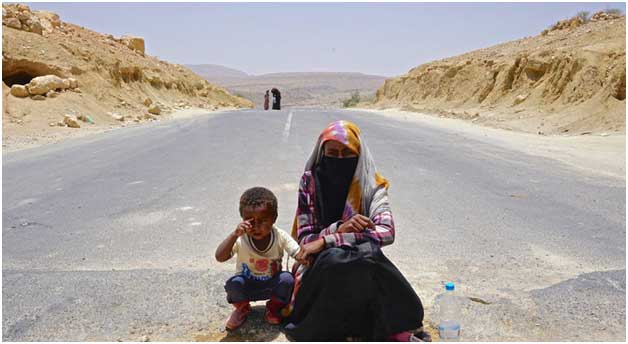
Millions of Yemenis have already been forced from their homes, some of them multiple times to escape violence or pursue scarce opportunities for work. But even basic sanitation and health care in camps for displaced people are often unavailable.
Even with a massive aid response, as the conflict continues, we are fighting a rising tide. It goes without saying that in these cramped quarters, where social distancing is a fanciful notion and suppressed immunity the norm, a single infection would lead to countless deaths. The coronavirus epidemic would write new stories of suffering in Yemen’s already long tale of woe.
The conflict in Yemen must end before it claims any more lives. Yemen’s military and political leaders have shown too often these past five years that they are not willing to make even small compromises for the sake of their country and its people.
And the international community, so far, has failed to muster the resolve to demand the ceasefire and political settlement that can bring the life-saving peace that Yemen’s people demand.
With coronavirus knocking on Yemen’s door, we need humanitarian aid to restore our health systems, tackle the diseases currently ravaging our people, and prevent a new catastrophe. We cannot afford to wait for the next crisis to hits.
AMMAN, Jordan, Mar 26 2020 (IPS) – Humankind has outlived multiple pandemics in the course of world history. The kingdoms and states of Central and Western Europe abolished the institution of serfdom once it had become clear that medieval rule in the aftermath of devastating pestilence would founder without ending the dependency and servitude that characterized the Dark Ages. The vulnerability of entire nations to the risk of total collapse in the absence of widespread access to the most basic healthcare in the Spanish Flu spurred governments to build the public health systems that have made the progress and development of the last hundred years possible. If the past is prologue, then continuity and survival command that we change.
We have more often than not banded together in the face of all kinds of threats. In all its ramifications, COVID-19 threatens to push our social, political and economic structures to the brink. Disease, recession and fright can rapidly overwhelm states and societies. Each coming day will bring increasing challenges that can only be met by caring for the sick, minimizing the impact of shutdowns on lives and livelihoods, securing the delivery of adequate water, food and energy supplies, and racing for a cure. Success – as in an asymmetric conflict – rests on resilience. To contain the socio-political and socio-economic fallout from the crisis, policymaking efforts should center on human dignity and welfare as the bedrock of national and international security.
The most vulnerable members of society in some parts of our world are those on the front lines of the crisis: the doctors, nurses, care-givers, pharmacists, sanitation workers, farmers, supermarket cashiers and truck drivers whose courage, sacrifice and dedication will see us through the next 12 to 18 months of expected lockdowns. In the absence of state support, what will happen to the hundreds of thousands of people who have already been laid off, while millions more face looming hardship as the numbers of layoffs grow? Some will continue to ignore the vulnerable and marginalized, those who have least access to humanitarian assistance, while others will continue to exploit them. The calls for social distancing have grown louder and more frequent over the last couple of days, and as we begin to separate from one other we must remember our humanitarian duty to each another.
Security, far from being individual, is collective and global. The current crisis calls for transcendent thinking between politicians on both sides of the aisle. Grey areas in politics in which zero-sum games and the perverse logic of mutually assured destruction proliferate will not protect and promote human dignity and welfare. Conservatives and reformers must now move beyond the tournaments and arm-twisting of politics. The logic of mutually assured survival cannot accept grey areas. If conflict resolution transcends political beliefs, nationality, ethnicity, gender, and religion, then human dignity and welfare is the benchmark of the humanitarian commitment to life.
Reliable brokers in the management of this crisis and other crises do exist as in the International Committee of the Red Cross and Médecins Sans Frontières. Corporate social responsibility requires developing a public platform of health facts so that people-to-people conversations and consultations can be promoted through civil society, the media and educational institutions. We cannot cherry-pick energy and climate change without talking about health or education and human dignity. Migrants and refugees must be an integral part of the national response for halting the spread of the novel coronavirus. The United Nations Economic and Social Commission for West Asia reports that 55 million people, in West Asia region, require some sort of humanitarian assistance and that the vulnerability of displaced women and girls is especially heightened in a pandemic. Post-conflict insecurity – whether in countries ravaged by war or across the urban centers and countrysides of advanced economies overwhelmed by disease – can only be addressed in the careful terrain mapping of humanitarian access. Yemen, Syria, Gaza and Libya are frighteningly vulnerable to the onslaught of epidemics – what will peace uncover there when the wars end?
Regional insecurity is heightened in the absence of cooperation, but the multilateral system is not at a loss in facing an existential crisis. European solidarity has been sharply damaged by the onset of widespread disease although China is performing through the swift and effective action that has come to the aid of the people and government of Italy. Multilateralism today can only be revisited with a focus on the interdisciplinary priorities of the twenty-first century that include addressing the need for a Law of Peace. We draw humanitarian concessions from the law of war in times of conflict, but have no recourse to legal instruments that can secure the dignity and welfare of all in times of peace.
The current crisis is as much a global health crisis as it is a crisis of the globalization that has come to undermine the foundations of modern society with its rampant inequality and rising injustice and which threatens the very survival of our species with climate change. The planet that we share with other organisms is fragile and prone to crises. A resolution to our predicament will take nothing short of extending the ethic of human solidarity beyond the contours of our immediate response to the outbreak of COVID-19. Real success lies not in the taming of a pathogen or in re-discovering the value of compassion, respect and generosity, but in institutionalizing these values in the days, weeks and months ahead.
Claudia Ituarte-Lima, Stockholm University, Sweden and University of British Columbia, Canada
Claudia Ituarte-Lima is researcher on international environmental law at the Stockholm Resilience Centre, and affiliated senior researcher at the Raoul Wallenberg Institute of Human Rights and Humanitarian Law. She is currently a visiting researcher at the Institute for Resources, Environment and Sustainability, University of British Columbia. She holds a PhD from the University College London and a MPhil from the University of Cambridge.
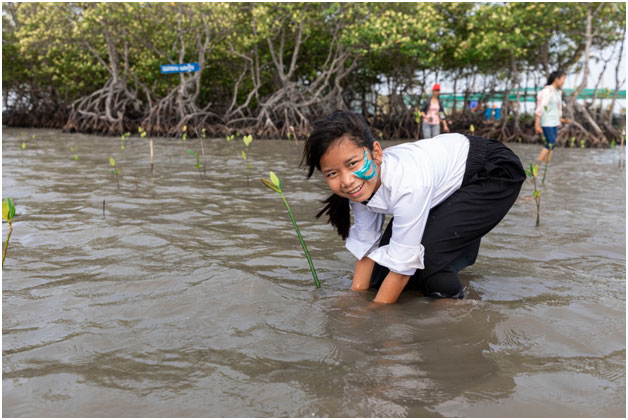
On March 2020, over 330 students, women champions, government officials, NGO members and community members from around Kampot and Kep gathered in an effort to plant 3,000 mangroves and conserve Cambodia’s coastline. The local activity took place as part of a larger mangrove planting and marine exhibition under Action Aid’s 100,000 Mangroves campaign, supported by the United Nations Development Programme (UNDP) under the project ‘Strengthening Climate Information and Early Warning Systems in Cambodia’. The campaign aims to plan 100,000 mangroves in eight community fisheries by May 2020, and raise awareness of the importance of marine ecosystems. Credit: ManuthButh/UNDP Cambodia
VANCOUVER, British Columbia, Canada, Mar 24 2020 (IPS) – We are living in a critical time. As we face existential environmental challenges from climate crises to the mass extinction of species, it is difficult sometimes to see solutions and new ideas. This is why we all need to celebrate and give visibility to creative and courageous efforts of people and organizations striving towards a healthy planet for all.
I write today about the key role played by National Human Rights Institutions (NHRIs) in the Global South in our collective fight against climate change. The time has come to empower NHRIs.
Their unique position mandated by law yet independent from the government can make an urgent needed bridge between legal and policy advances, and ground-up efforts such as youth and women movements, thereby contributing to the enjoyment of the right to a healthy environment.
I have recently had the chance of learning real-world success stories by brave NHRIs working in some of the most challenging contexts. While being a member of the facilitators’ team of a series of webinars* for technical staff and decision-makers working in NHRIs and prior face-to-face interaction with them, it became crystal clear that strengthening the skills and capacities of NHRIs can contribute positive outcomes for both human rights and the environment.
In Mongolia, for instance, the NHRI with the support of civil society organizations and environmental researchers has recently developed a draft law for safeguarding the rights of environmental defenders.
The NHRIs have also intervened in a variety of sectoral issues from pesticides and agriculture in Costa Rica, to mining in South Africa and the connections between coal mining and transportation in Mongolia. The Morocco NHRI has prompted other African NHRIs and civil society organizations to actively participate in international climate negotiations.
Business and human rights was a key issue raised by our NHRIs colleagues.
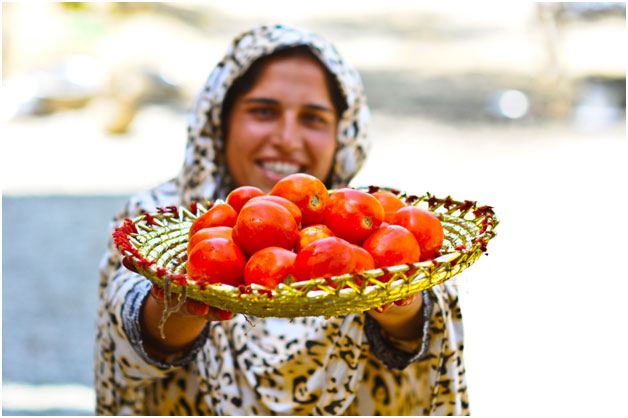
Nazia, 38, proudly shows off her home-grown tomatoes in Nadirabad village, Pakistan. She participated in kitchen gardening training offered under the joint UNDP-EU Refugee Affected and Host Areas (RAHA) Programme in Pakistan. Credit: UNDP Pakistan
The significant legal, institutional and financial obstacles that national duty bearers face to investigate transnational corporations and their responsibilities concerning their impacts to a safe climate has not proved insurmountable for NHRIs.
The Philippine’s NHRI has a mandate to promote human rights which, creatively interpreted, allowed it to investigate the climate change and human rights nexus beyond its national borders.
The systemic nature of climate change justified a national inquiry rather than a field visit. Because climate change is an existential issue not only to Filipino people but globally, the Philippines national inquiry on climate change turned into an inquiry with strong global dimensions.
It included public hearings in the Philippines, New York and London, virtual hearings and expert advice from the former UN Special Rapporteur on human rights and environment, academics from different parts of the world and the Asia-Pacific regional network of NHRIs.
A major comparative advantage presented by the NHRIs is their unique position in working hand in hand with right holders in addressing environmental – human rights gaps facing the most vulnerable populations.
Costa Rica NHRI has found, for instance, that women, girls, men and boys and elder living in coastal areas become especially vulnerable to climate change because their access to clean drinking water and fish become scarce.
The South African NHRI together with food sovereignty civil society organizations has developed a draft climate charter, to be presented to the parliament, with a more holistic approach to the current climate policy.
In recent years, the awareness of the linkages between human rights and climate change has greatly increased. The legal recognition of the right to a healthy environment in more than 150 countries, together with judicial decisions, and academic studies on the safe climate dimension of this right has grown rapidly. NHRIs can be instrumental in translating them into results and action, including under difficult circumstances.
Their role in advising duty bearers, working together with right-holders helps to understand and act upon systemic environmental challenges. Their synergies with environmental human rights defenders can also contribute to more effective investigation and advocacy, not least in the context of informal and unregulated business activities where it is especially difficult to collect data and hold businesses accountable.
Time has come for the international community to do more to support NHRIs in the Global South, a key player often overlooked in climate and biodiversity talks, debates and funding. Due to the intrinsic connections between human rights and environment, the NHRIs need to be further supported to perform their innovative roles in safeguarding life-support systems at various jurisdictional scales, including advocating for the global recognition of the right to a healthy environment by the United Nations.
* The series was organized by the Global Alliance for National Human Rights Institutions (GANHRI), UNDP, the UN Special Rapporteur on Human Rights and the Environment, the Swedish Environmental Protection Agency and UN Environment. A final report with key messages from the webinar series is available on the UNDP website.