Dangers and Questions of the Zuckerberg Era

Civil Society, Democracy, Global, Headlines, Human Rights, Press Freedom

Opinion

Will the Internet become a tool for participation? How will this be done? These are questions that political institutions, if they really care for democracy, must address as soon as possible. The Zuckerberg era must make this choice now, in a few years time it will already be too late…

ROME, Nov 15 2019 (IPS) – This year the Worldwide Web is thirty years old. For the first time since 1435, a citizen from Brazil could exchange their views and information with another in Finland.


The Internet, the communications infrastructure for the Web is a little older. It was developed from the ARPANET, a US Defense Department project under the Advanced Research Projects Agency; the military designing it to decentralize communications in the case of a military attack.

That network enabled scientists to communicate over email in universities. Then in 1989 Tim Berners-Lee at CERN in Switzerland invented the Hyperlink and the Worldwide Web (the Web) rapidly moved from scientists automating information sharing between universities and research institutions to the first Websites now available to the general public.

In 2002 the first social media sites began as specialised websites. LinkedIn launched in 2003 then FaceBook in 2004, Twitter in 2006, Instagram in 2010 and so on…

Will the Internet become a tool for participation? How will this be done? These are questions that political institutions, if they really care for democracy, must address as soon as possible. The Zuckerberg era must make this choice now, in a few years time it will already be too late…

My generation regarded the arrival of the Web as a great prospect for democracy. We come from the Gutenberg era, an era that in 1435 changed the world. From manuscripts drafted by monks to be read by a few people in monasteries, the invention of reusable movable type meant that in just 20 years already eight million copies of printed books went all across Europe.

Among many other things it also meant the creation of information. People who heretofore had merely a scant horizon beyond their immediate surroundings, could suddenly access information about their country, and even the entire world. The first newspaper was printed in Strasbourg in 1605. From then until 1989, the world was filled with information.

Information had a very serious limit. It was a vertical structure. Just a few people sent news to a large number of recipients; there was little feedback. It wasn’t participatory, it required large startup investments, it was easily used by economic and political powers.

In the Third World, the media system was part of the State. In 1976, 88% of World news flows emanated from just three countries: the US, the UK and France. International news agencies based in these three countries included Associated Press (AP), United Press International (UPI), Reuters and Agence France Press (AFP).

The world’s media were dependent on their news services. Some alternative news agencies, like Inter Press Services, were able to put a dent in their monopoly. But what this Western media published, by and large was a biased window on the world.

Then came the Internet, and with it, came horizontal communication. Every receiver was also a sender. For the first time since 1435, media were no longer the only window on the world. Like-minded people could take part in social, cultural and economic interactions.

This change was evident in the United Nations Woman’s World Conference in Beijing, 1995. Women created networks prior to the conference, and came with a common plan of action. Governments were not so prepared, so the Declaration of Beijing was a turning point, one which was entirely unlike the bland declarations from the previous four World Conferences.

Another good example is the campaign to eliminate anti-personnel landmines, started by the Canadian activist Jody Williams in 1992. This soon blossomed into a large coalition of Non-Governmental Organizations from more than 100 countries.

Under mounting pressure Norway decided to introduce the issue to the UN, where the US, China, and other manufacturers of landmines like the USSR, tried to block the debate, declaring that they would vote against it.

Roberto Savio

The activists did not care, and 128 countries adopted the Mine Ban Treaty in 1997 with the US, China and the USSR voting against. A vast global movement was more powerful than the traditional role of the Security Council. The Internet had become the tool to create world coalitions.

Those are just two examples of how far the Internet could change the traditional system of Westphalian state sovereignty as defined at the Conference of Westphalia in 1648. The Internet spanned national frontiers to bring on a new era.

Let’s say, for the sake of symbolism, that the Internet brought us from the Gutenberg Era, to the Zuckerberg Era, to cite the inventor of Facebook and a leading instance of what went wrong with this medium.

The Internet came upon us with an unprecedented force. It took 38 years for the radio to reach 50 million people: television took 13 years; and the Web just four years. It had a billion users in 2005, two billion in 2011, and it now has three and a half billion users, three billion of those using social media.

So the two traditional pillars of power, the political system and the economic system, also had to learn how to use the Internet. The US provides a good example. All of American media (national and regional publications) involves printing 50 million copies daily.

Quality newspapers — both the conservative broadsheets like the Wall Street Journal, and progressive ones like the Washington Post or the New York Times — together print ten million copies a day. Trump has sixty three million followers on Twitter; they read Trump’s tweets but don’t buy newspapers.

The Web has had two unforeseen developments. One was the dramatic reinforcement of the consumer society. Today advertising budgets are ten times larger than budgets for education, and education only lasts a few years compared with a lifetime of advertisement.

With the development of social networks, people — now more consumers than citizens — have become objects for marketing goods and services, and recently also for political campaigns. All systems of information and communications extract our personal data, selling us on as consumers.

Now the TV can see us while we watch it. Smartphones have become microphones that listen in on our conversations. The notion of privacy is gone. If we could access our data, we would find out that we are followed every minute of the day, even into our bedrooms.

Secret algorithms form profiles of each and every one of us. Based on these profiles platforms provide us with the news, the products, and the people that these algorithms believe we will like, thus insulating us in our own bubbles.

Artificial intelligence learns from the data that it accumulates. China, with 1.35 billion people, will provide its researchers with more data than Europe and United States together. The Internet has given birth to a digital extractive economy, where the raw material is no longer minerals, but we humans.

The other development that went awry is that the digital extractive economy has created unprecedented wealth.

Amazon CEO Jeff Bezos was recently divorced from his wife. In the settlement she received 36 billion dollars yet Bezos remains among the 10 richest people in the world. This is just one story from an increasingly sad reality of social injustice, where 80 of the world’s richest persons hold the same wealth as nearly three billion poor people.

A new sector is evolving, the “surveillance capitalism” sector, where money is made not from the production of good and services, but from data extracted from people.

This new system exploits humans to give to the owners of this technology, a concentration of wealth, knowledge and power without precedent in history. The ability to develop facial recognition and other surveillance instruments no longer lies in the realms of science fiction.

The Chinese government has already given every citizen a digital number, where all their ‘good’ and ‘bad’ behaviours converge. If a citizen goes below a level, their children will not be allowed to go to a good school, and the citizen themselves, though they may still be able to travel by train, won’t have access to planes.

These technologies will soon be in use all over the planet. London town now has 627,000 surveillance cameras, one for every fourteen citizens; in Beijing it’s one for every seven.  A study conducted by The Rand Corporation estimates that by 2050, Europe too would also have one camera for every seven citizens.

The interrelationship between democracy and the Internet is now creating a belated awareness in the political system. The European Parliament has just released a study, about the negative impact of the Internet. These impacts are:

  1.        Internet Addiction
    There is unanimity among doctors and sociologists that a new generation is coming, one which is very different from the previous one. Over 90% of those aged 15-24 uses the Internet, as against 11% for those over 55. Young people spend 21 hours per week on the PC, and 18 hours on a smart phone. This leaves little time for social and cultural interaction. 4.4% of European adolescents now show pathological Internet use “that affects their lives and health”. The American Academy of Psychology has officially included Internet Addiction as a new ailment. Magnetic resonance studies of those with Internet Addiction Disorder (IAD) show that they exhibit the same brain structure alterations as those who suffer from drug or alcohol addiction.
  2.        Harming cognitive development
    A particular warning is given about children under two years of age. More than 20 minutes a day of screen use reduces some of their neural development. People pushed to isolation tend to develop symptoms of distress, anger, loss of control, social withdrawal, familial conflicts, and an inability to act in real life. Internet users in tests were faster than non-users at finding data, but they were less able to retain data.
  3.        Information Overload
    The condition of having too much information hampers the ability to understand an issue, or to make effective decisions, an important issue for managers, consumers, and social media users. According to Microsoft, attention span for a title has gone from 12 seconds in 2000 down to 8 seconds in 2016. The attention span for reading has gone from 12 minutes to 8 minutes. Two new terms can be used: one, the ‘popping brain’, describes a brain less adept to adapt to a slower pace of real life and then there is ‘Neuroplasticity’; i.e. the ability to alter one’s behaviour after a new experience. Frequent immersion in virtual worlds can reduce neuroplasticity and also make it more difficult to adapt to the slower pace of real life. The need to compete in speed between social media channels is well known. For example Amazon estimates that one second of performance delay would cost 1.16 billion losses per year in sales.
  4.        Harmful effects in knowledge and belief
    The fact that social media deliberately tends to gather together users with similar views, tastes and habits, is fragmenting society in a negative way for democracy, resulting in closed systems that don’t allow for alternative viewpoints. Adolescents no longer discuss significant subjects. They go to their virtual world, and if they come across somebody from another group, they tend to insult each other. The Internet is full of fake news and misleading information, and users have great difficulty distinguishing accurate from inaccurate information. Echo chambers appear to be far more pervasive, and may unite those with more extreme and partisan political and ideological positions, therefore undermining possibilities for civil discourse and tolerance, supporting radicalization.
  5.        Harming public/private boundaries.
    The Internet blurs the distinction between the private and the public. Private life becomes public. This is especially negative for teenagers who lose the concept of privacy, for example by sending private photos across the Internet. One important observation is that teenagers now get their sexual education from pornography, where women are always an object to satisfy men’s sexual phantasies. This is in turn creating a lack of respect for women, and a new generation that risk, for new reasons, returning to a patriarchal society. Group violations of teenage girls are clearly a result of this trend.
  6.        Harming social relationships
    The Internet is clearly a powerful instrument to create new communities. However, when used negatively, it can also damage communities, because of the migration to Internet of many human activities such as shopping, commerce, socialising, leisure, professional activities and personal interaction. That migration creates impoverished communication, incivility and a lack of trust and commitment.
  7.        Harming democracy
    The Internet has been a powerful tool for participation, and therefore for democracy. However the study notes with concern that a growing number of activities are also harmful to democracy. These include: a) The incivility of many online political discourses, b) Political and ideological polarisation, uniquely possible using the Internet. c) Misinformation, and, in particular, fake news, d) Voter manipulations through profiling based on harvested social media information. We all know what happened in the US elections with Cambridge Analytica data, gathered by Facebook, and how thousands of false web users and bots now heavily interfere in elections.

We should add to this study some other considerations. The first is that finance now is now also run by algorithms. The algorithms do not only decide when to sell or buy shares, but now also decide where to invest.

The Exchange-Traded Funds (ETFs) last month reached 14,400 billion dollars in trades, more than that traded by humans. This trend will continue with the development of artificial intelligence and soon finance will become even more dehumanized.  Even when Internet users invest themselves they too will be directed by machines and algorithms.

A second consideration is that young people read less and less. Reading a book is very different to scrolling a screen. We are experiencing a progressive reduction in levels of culture. It’s not uncommon to have university students that make grammar and spelling mistakes.

Let us remember that when the Internet was still new, its proponents told us: it is not important to know, rather it is important to know how to find. We are more and more dependent on search engines, learning less and less, and we are unable to connect that data in a personal holistic logical system.

There is clearly a need for regulation to reduce the negative aspects of the Internet and to reinforce positive values. The owners of social media platforms are now under increased scrutiny so they have taken the road of self-regulation.

Twitter, for instance, has decided that it cannot be used for political purposes. Zuckerberg is an exponent of market myths telling us that good news will automatically prevail over fake news. Except that platforms help users to read and find only what they like, to maintain our attention, providing us what is striking, unusual and provocative. This is not a free market.

The Zuckerberg era is clearly creating an entirely different generation, very different from the generations of the Gutenberg era. This raises many questions, from privacy to freedom of expression (now in private hands), from who will regulate, what to regulate and how.

A five year-old child is now very different from a Gutenberg five year-old. We are in a period of transition. The meaning of democracy is changing. International relations are moving away from the search for common values via multilateralism, to a tide of nationalist, xenophobic and selfish views of the world.

Terms like peace, cooperation, accountability, participation and transparency are becoming outdated. What is clear is that the present system is no longer sustainable. Policies disappear from debate, now referred to only as ‘politics’. Vision and paradigms are getting scarce.

Over and above all of this the threat of climate change is looming; yet last year toxic emissions from the five largest countries increased by 5%. Young people are largely absent from political institutions as is shown by the vote on Brexit where only 23% of the 18-25 age group participated.

At this very moment we have large demonstrations in thirteen countries all over the world. In those streets young people do participate, frequently demonstrating rage, frustration and violence. If we cannot bring back horizontal communication to the Internet and we do not free it from the commercial fracturing of young people, the future is hardly rosy.

Yet as the marches against Climate Change clearly demonstrate, if young people want to change the world, values and vision will return. It is evident that the Internet can be a very powerful tool. But who will redress these failings? Will the Internet become a tool for participation? How will this be done?

These are questions that political institutions, if they really care for democracy, must address as soon as possible. The Zuckerberg era must make this choice now, in a few years time it will already be too late…

Publisher of OtherNews, Italian-Argentine Roberto Savio is an economist, journalist, communication expert, political commentator, activist for social and climate justice and advocate of an anti neoliberal global governance. Director for international relations of the European Center for Peace and Development.. He is co-founder of Inter Press Service (IPS) news agency and its President Emeritus.
  Source

Empower Young People to Sustain Our Planet, and Let Peace and Prosperity Thrive

Africa, Conferences, Development & Aid, Education, Featured, Gender, Gender Violence, Global, Headlines, Health, Human Rights, Labour, TerraViva United Nations, Women’s Health

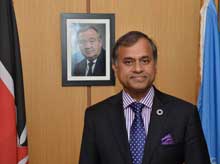
We need to empower young people to sustain our planet, and let peace and prosperity thrive says UN’s Resident Co-ordinator in Kenya, Siddharth Chatterjee speaks to IPS on reflections on the ICPD25 Summit.

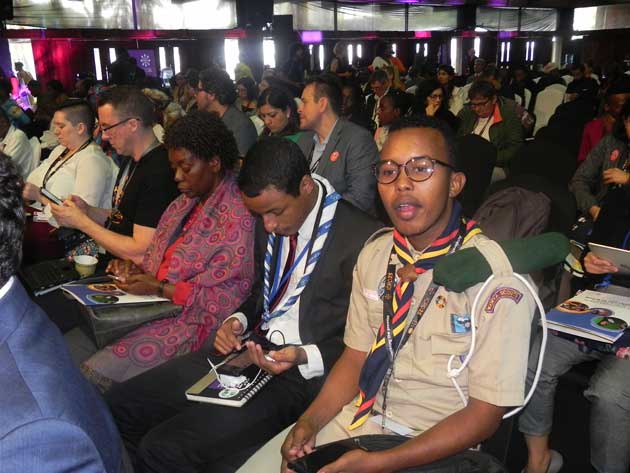
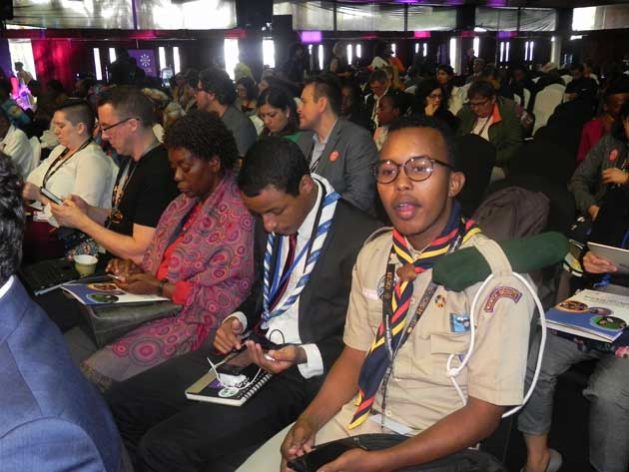
Young people at ICPD25 youth session. Credit: Mantoe Phakathi / IPS

NAIROBI, Kenya, Nov 15 2019 (IPS) Q: At ICPD25 we heard that women and girls are still waiting for the unmet promises to be met? DO you think this time around there is a commitment to ensure that these promises are met?

The Nairobi Summit is about the Future of Humanity and Human Prosperity.


We all have an opportunity to repeat the message that women’s empowerment will move at snail-pace unless we bolster reproductive health and rights across the world. This is no longer a fleeting concern, but a 21st century socio-economic reality.

We can choose to take a range of actions, such as empowering women and girls by providing access to good health, education and job training. Or we can choose paths such as domestic abuse, female genital mutilation and child marriages, which, according to a 2016 Africa Human Development Report by UNDP, costs sub-Saharan Africa $95 billion per year on average due to gender inequality and lack of women’s empowerment.

Fortunately, the world has made real progress in the fight to take the right path. There is no lack of women trailblazers in all aspects of human endeavour. It has taken courage to make those choices, with current milestones being the result of decades of often frustrating work by unheralded people, politics and agencies.

Leaders like the indefatigable Dr. Natalia Kanem the Executive Director of UNFPA and her predecessors, are pushing the global change of paradigm to ensure we demolish the silo of “women’s issues” and begin to see the linkages between reproductive rights and human prosperity.

Siddharth Chatterjee

Numerous studies have shown the multi-generation impact of the formative years of women. A woman’s reproductive years directly overlap with her time in school and the workforce, she must be able to prevent unintended pregnancy in order to complete her education, maintain employment, and achieve economic security.

Denial of reproductive health information and services places a women at risk of an unintended pregnancy, which in turn is one of the most likely routes for upending the financial security of a woman and her family.

As the UN Resident Coordinator to Kenya, I am privileged to serve in a country, which has shown leadership to advance the cause of women’s right-from criminalizing female genital mutilation to stepping up the fight to end child marriage and pushing hard on improving reproductive, maternal and child health.

Q: At ICPD25 we heard that innovative partnerships are needed to ensure commitments to women and girls. 25 years on do you think this will happen? Can you site an example in Kenya or Africa on this?

Achieving the SDGs will be as much about the effectiveness of development cooperation as it will be about the scale and form that such co-operation takes. There is a lot of talk about partnership, but not enough practical, on-the-ground support to make partnerships effective in practice, especially not at scale.

Under the leadership of the Government of Kenya therefore, the UN System in Kenya in 2017 helped to spearhead the SDG Partnership Platform in collaboration with development partners, private sector, philanthropy, academia and civil society including faith-based stakeholders.

The Platform was formally launched by the Government of Kenya at the UN General Assembly in 2017 and has become a flagship initiative under Kenya’s new UN Development Assistance Framework 2018-2022 (UNDAF). As the entire UNDAF, the Platform is geared to contribute to the implementation of Kenya’s Big Four agenda in order to accelerate the attainment of the Country’s Vision2030.

In 2018, the Platform has received global recognition from UNDCO and the Dag Hammarskjold Foundation as a best practice to accelerate SDG financing. This clearly implies that we are on the right track, and as you can read in this report are developing a blueprint for how 21st Century SDG Partnerships can be forged and made impactful, but much more needs to be done.

Primary Healthcare (PHC) – in the SDG 3 cluster – has been the first SDG Partnership Platform window contributing to the attainment of the Universal Health Coverage as a key pillar of the Big Four agenda. We are living in a day and age where we have the expertise, technology and means to advance everyone’s health and wellbeing. It is our moral obligation to support Kenya in forging partnerships, find the right modalities to harness the potential out there and make it work for everyone, everywhere.

With leadership as from my co-chairs, Hon. Sicily Kariuki, Cabinet Secretary for Health in Kenya, and H.E Kuti, Chair of the Council of Governors Health Committee and Governor of Isiolo, and the strong political commitment, policy environment, and support of our partners we have in Kenya, I am convinced that Kenya can lead the way in attaining UHC in Africa, and accelerate the implementation of the ICPD25 agenda.

Q: Funding remains a crucial challenge- do you think there is a commitment to fund the initiatives?

Yes, there is a clear commitment to fund the ICPD Plan of Action.

I applaud partners whom have been doing so for long as the governments of Denmark, Netherlands, Sweden, Finland, Norway, and UK, and Foundations as the Bill and Melinda Gates Foundation.

But increasingly there is also the recognition that we cannot reach our ambitions through aid and grants.

At the global scale we need to let better regulation evolve for advancing greater equality and support to those furthest left behind.

Especially within middle-income-countries / emerging economies, our ICPD25 funding models need to be underpinned by shared-value approaches, and financed through domestic and blended financing.

I feel encouraged therefore by the Private Sector committing eight (8) billion fresh support to the acceleration of the ICPD Plan of Action.

Considering the trillions of dollars being transacted however by the private sector, this should be only the start and we should continue to advocate for bigger and better partnership between public and private sector targeting the communities furthest left behind to realize ICPD25.

Q: What do you think should be done to ensure young people’s participation?

Africa’s youth population is growing rapidly and is expected to reach over 830 million by 2050. Whether this spells promise or peril depends on how the continent manages its “youth bulge”.

Many of Africa’s young people remain trapped in poverty that is reflected in multiple dimensions, blighted by poor education, access to quality health care, malnutrition and lack of job opportunities.

For many young people–and especially girls– the lack of access to sexual and reproductive health services is depriving them of their rights and the ability to make decisions about their bodies and plan their families. This is adversely affecting their education and employment opportunities.

According to UNDP’s Africa Human Development Report for 2016, gender inequalities cost sub-Saharan Africa US$ 95 billion annually in lost revenue. Women’s empowerment and gender equality needs to be at the top of national development plans.

Between 10 and 12 million people join the African labour force each year, yet the continent creates only 3.7 million jobs annually. Without urgent and sustained action, the spectre of a migration crisis looms that no wall, navy or coastguard can hope to stop.

Africa’s population is expected to reach around 2.3 billion by 2050. The accompanying increase in its working age population creates a window of opportunity, which if properly harnessed, can translate into higher growth and yield a demographic dividend.

In the wake of the Second World War, the Marshall Plan helped to rebuild shattered European economies in the interests of growth and stability. We need a plan of similar ambition that places youth employment in Africa at the centre of development.

In the meantime, the aging demographic in many Western and Asian Tiger economies means increasing demand for skilled labour from regions with younger populations. It also means larger markets for economies seeking to benefit from the growth of a rapidly expanding African middle class.

Whether the future of Africa is promising or perilous will depend on how the continent and the international community moves from stated intent to urgent action and must give special priority to those SDGs that will give the continent a competitive edge through its youth.

The core SDGs of ending poverty, ensuring healthy lives and ensuring inclusive and equitable quality education all have particular resonance with the challenge of empowering youth and making them effective economic citizens.

Many young people in Africa are taking charge of their futures. There is a rising tide of entrepreneurship sweeping across Africa spanning technology, IT, innovation, small and medium enterprises.

They are creating jobs for themselves and their communities.

We need to empower young people to sustain our planet, and let peace and prosperity thrive.

Q: Lastly, we heard strong commitments from President Uhuru Kenyatta on the issue of FGM- do you think it will really happen by 2022?

President Uhuru Kenyatta needs to be lauded for his strong commitment to ending FGM.

Despite being internationally recognized as a human rights violation, some 200 million girls and women alive today have undergone FGM, and if current rates persist, an estimated 68 million more will be cut between 2015 and 2030.

We cannot accept this any longer and should step up for this cause.

Without leaders as H.E Kenyatta championing the fight to address cultural harmful practices as FGM – rapid strides will never be made.


Art Helping Women to Highlight Gender-based Violence at ICPD25

Africa, Arts, Conferences, Education, Featured, Gender, Gender Violence, Headlines, Health, Human Rights, TerraViva United Nations, Women’s Health

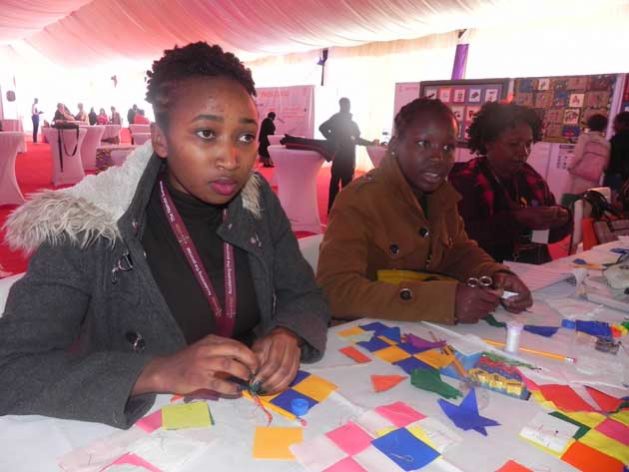
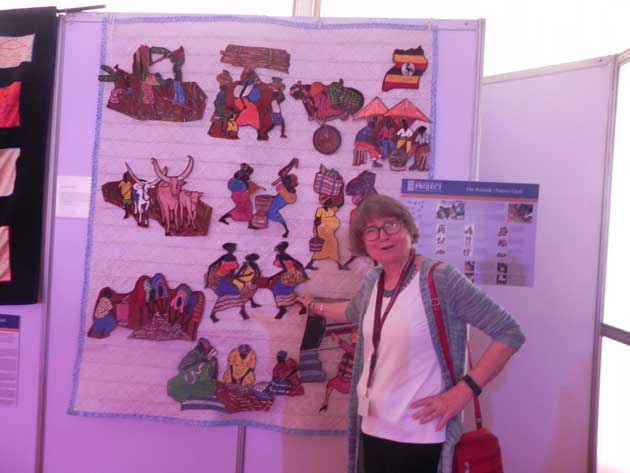
Ann Kihii (25) spends time with other young women from poor communities in Nairobi and use embroidery to create images that tell a story about the daily challenges they face. They also get a chance to discuss the issues among themselves in a safe space. Credit: Mantoe Phakathi / IPS

NAIROBI, Kenya, Nov 14 2019 (IPS) – While women find it hard to talk about their painful experiences, some have found a way of expressing themselves through art. Women, trained as artists, from Nairobi’s informal settlements Kibera and Kangemi, have produced a beautiful quilt that tells stories about their daily challenges.


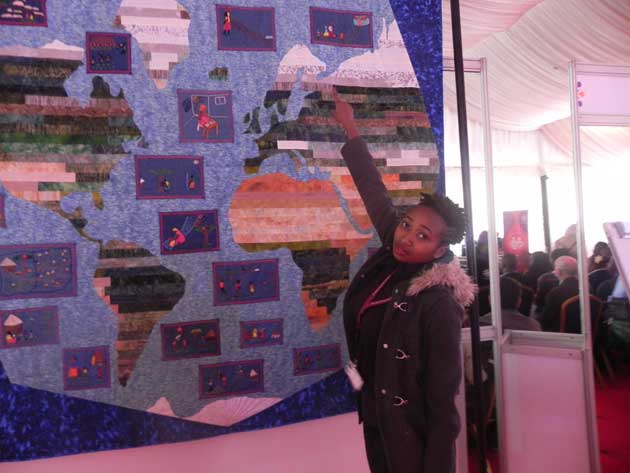
Displayed at the Pamoja Zone of ICPD25, the quilt is used to lobby delegates to rally behind girls and women by ensuring that they enjoy sexual reproductive rights and end gender-based violence.

Being able to express yourself through art

While the embroidered quilt is a beautiful piece of work, each square that forms part of it it is sewn by different women who are expressing their sad experiences.

“I live in a community where violence against women is the order of the day,” she told IPS. “Unfortunately, women find it hard to talk about it.” Ann Kihiis (25) is one of the young women who have turned out to be a fine quilt maker. Using small square pieces of fabric, she sewed an image of a woman who was experiencing violence in her marriage.

In the same image, there is a shadow which she says symbolises the anger and hurt that an abused woman carries with her all the time unless she is able to talk about it and heal from the experience. Although she has never been in an abusive relationship, she said observing it from a young age in her family and community has traumatised her.

Ann Kihii showcases the quilt that she contributed in making where she designed an image of a woman in an abusive relationship who always carries the anger and hurt. Credit: Mantoe Phakathi / IPS

“I love art and this is a way of creating awareness about gender-based violence and letting people know that it’s okay to talk about it,” said Kihiis.

She said she is aware that women who are abused end up believing that they do not deserve to be loved, something that is not true.

Art brings women together

On the same quilt, other artists made images depicting crime, drugs and teenage pregnancy. For example, there is an image of a young girl who is sitting on a desk with a baby on her back. This, according to Bobbi Fitzsimmons, a quilter from the Advocacy Project is the story of a young girl who was abandoned by her father after falling pregnant. When she fell pregnant for the second time, she decided to take control of her life and returned to school even if it meant studying with much younger learners.

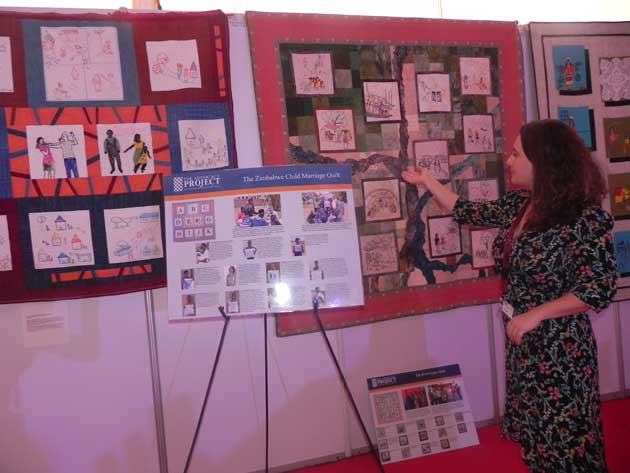
Bobbi Fitzsimmons, a quilter from The Advocacy Project, trains women groups across the world to express the challenges they face by using embroidery, painting and applique to raising awareness so as to get support in addressing gender-based violence and sexual reproductive health rights. Credit: Mantoe Phakathi / IPS

“Art is a very effective way of expressing oneself,” she said. “What’s more, the women came together while working on the quilt and discussed their issues, in what was a safe space for them to talk.”

The Kenyan women artists are trained by the Kenya Quilt Guild under Fitzsimmons’ directorship.

The United National Population Fund (UNFPA) funded The Advocacy Project to train the women. They also funded the exhibition of quilts from women in other parts of the world. For example, there is a quilt from Nepal on display with squares of paintings through which a group of women from the Eastern part of the country expresses themselves after they were treated for uterine prolapse, a painful condition affecting 600 000 women in Nepal. Another quilt donning the walls of the Pamoja Zone is one from survivors of sexual violence from the Democratic Republic of Congo, while another depicts child marriages in Zimbabwe.

In total, 18 quilts are on display at the exhibition, where delegates are fascinated by the stories.

Karen Delaney, the deputy director of The Advocacy Project believes that through this initiative, women do not only come together to talk about their issues but they also get a lifetime skill for income generation. Credit: Mantoe Phakathi / IPS

In making the quilts the artists are trained to use the following skills: beadwork, painting and applique.

“Apart from the opportunity of bringing together the women, they gain skills that they can use to generate income for the rest of their lives,” said Karen Delaney, the deputy director at The Advocacy Project.


Young People at ICPD25: ‘ We Have the Right to Sexual and Reproductive Rights’

Africa, Conferences, Education, Featured, Gender, Gender Violence, Global, Headlines, Health, Human Rights, TerraViva United Nations, Women’s Health

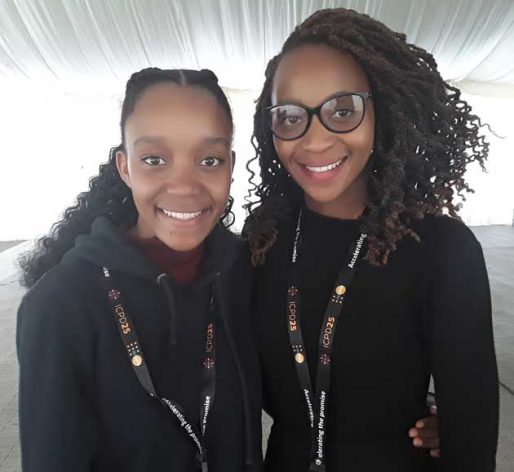
ICPD25 Youth delegates: Michele Simon (left) and Botho Mahlunge. Credit: Joyce Chimbi / IPS

NAIROBI, Kenya, Nov 14 2019 (IPS) – Every day in developing countries it is estimated that 20,000 girls under the age of 18 give birth. This amounts to 7.3 million births a year.


Complications from pregnancy and childbirth are still the leading cause of death among adolescent girls, according to the United Nations Population Fund (UNFPA) statistics.

Let us be heard

Born long after the Cairo Promise, the 18-year-old Michelle Simon and the 19-year-old Botho Mahlunge both youth representatives from Botswana, lament that years later a world where girls can enrol and stay in school is far from the lived reality for millions of adolescents across the globe.

“When I was 13 years old I started to see the connection between girls getting pregnant and dropping out of school. “These girls were very bright but when they left school they never returned.

I started to talk about preventing these pregnancies at that young age,” Simon tells IPS.

Simon says that 25 years after the promise, “it is very sad because those who should be protecting us have failed us. Parents cannot even close the gap between them and their adolescent”.

She argues that parents have abdicated their responsibility to the education system and the entire society. “But where is the parent’s responsibility towards adolescent health?” she asks.

Simon says that in this era of technology and information, adolescent health should not be the problem area that it is. “We cannot hide behind culture and say that ours is a conservative society.

Culture should reflect problems

“Culture evolves and it must so that it can reflect the problems we are facing,” she says.

Mahlunge says that failure to educate our young people on sexuality “is the reason so many girls are getting pregnant and infected with HIV.”

She says the continued exclusion of young people in rural areas from sexual and reproductive health and rights discussion is also to blame for the prevailing state of affairs.

“Young people in rural areas are completely vulnerable. They are so far removed from the little information and services available to young people in urban areas,” Mahlunge observes.

We need sexual health education

Denis Otundo from the Network for Adolescent and Youth of Africa says that the ICPD25 conference has a lot in store to offer adolescents.

He notes that the stigma attached to providing adolescents with comprehensive sexuality education in many African countries is unfounded.

“This Summit is very clear on what needs to be done. As early as at the age of 15 years, adolescents should start receiving information on sexuality. The focus is to provide the right information, at the right time so that adolescents can make the right decisions,” he says.

Otundo says that this information includes life skills “on how to say no to sex because this is part of promoting adolescent health. It is also about training them on identifying all forms of violence, teaching them about available channels to report violence, and how to report”.

Experts at UNFPA argue that if laws support access to adolescent sexual and reproductive health rights, this could delay early sexual debut because such rights encourage and enable young people to make sound decisions.

He says that when young people lack access to proper information, they turn to fellow adolescents for information.

Invest in young people says the Asian Population and Development Association

Dr Osamu Kusumoto from the Asian Population and Development Association (APDA) says that the capacity of countries to accelerate and achieve ICPD25 commitments is dependent on the extent to which countries invest in their young people.

“Unplanned pregnancies are a big problem in developing countries. When you have a large population of young people pregnant while they should be in school, this is a problem for the economy too,” he says.

In Kenya alone, UNFPA statistics show that many young girls are likely to have repeated pregnancies.

As many as one in five girls give birth before the age of 18 years, even worse, as a majority of then will get married. Girls between 15 to 19 years are particularly at risk of acquiring HIV.

Kusumoto says that interventions must address young people’s most pressing problems. In this way, they can stay in school and acquire the skills needed to participate in the economy.

Young people are the heart of this Summit

“Adolescents are at the heart of the Summit. All the commitments that have been made, in one way or another, touch on adolescents,” says Otundo.

He says that adolescents are the most affected by sexual and gender-based violence, and harmful practices including female genital mutilation and child marriages.

Among the private sector partners who have committed funds to deliver the Cairo promise include Plan International who will allocate $500 million to improve the sexual and reproductive health and rights of girls and adolescents by 2025.

“I speak out about unwanted pregnancies and violence against young people. I also speak out about the need to stay in school because I believe this is what we need to accelerate the promise made to us even before we were born,” Simon says.

Botho encourages young people wherever they may be “to engage and to dialogue. If you see an opportunity to hold government accountable, do not hold back.”


World Youth Call to Governments to Ban All Hin Drances to LGBTQI Communities

Africa, Conferences, Crime & Justice, Development & Aid, Economy & Trade, Education, Featured, Gender, Gender Violence, Global, Headlines, Health, Human Rights, LGBTQ, TerraViva United Nations

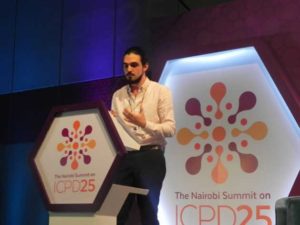
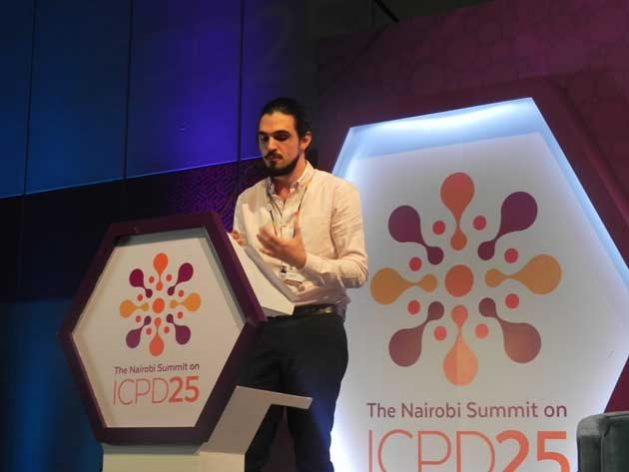
MARTIN KARADZHOV, Global Youth Commitee speaking at ICPD25. Credit: Mantoe Phakathi / IPS

NAIROBI, Kenya, Nov 13 2019 (IPS) – Governments across the world must ban all state-implemented harmful practices against the Lesbian, Gay, Bisexual, Transgender, Queer and Intersex (LGBTQI) community delegates at the ICPD25 tells IPS.


Adding his voice in bridging the gap of Sexual Reproductive Health Rights (SRHR) among the youth, Martin Karadzhov, chair for Global Youth Steering Committee, told delegates at a youth event themed “our bodies, our lives, our world”, at the 25thInternational Conference on Population Development (ICDP25).

LGBTQI young people remain voiceless

Although there are 1.8 billion youths between the ages of 10 and 24 years, they continue to be marginalised when it comes to SRHR issues. Karadzhov said LGBTQI youth in many countries were subjected to harmful practices including pressure on them to convert, a practice with no scientific basis which is also unethical and, in most instances, a torture. “Justice for one is justice for all,” he said.

He urged governments to repeal discriminatory laws against the LGBTQI community, adding that they were denied access to Sexual Reproductive Health (SRH) services on the basis of their sexuality. “Our human rights are not controversial,” said Karadzhov.

Young people often only a statistic

Echoing his sentiments was Mavis Naa Korley Aryee, a youth programme national radio host at Curious Minds. She said although there are 1. 8 billion reasons why young people should be involved in decision-making process, they are only mentioned as statistics.“Being part of a minority should not be a reason for discrimination,” said Aryee.

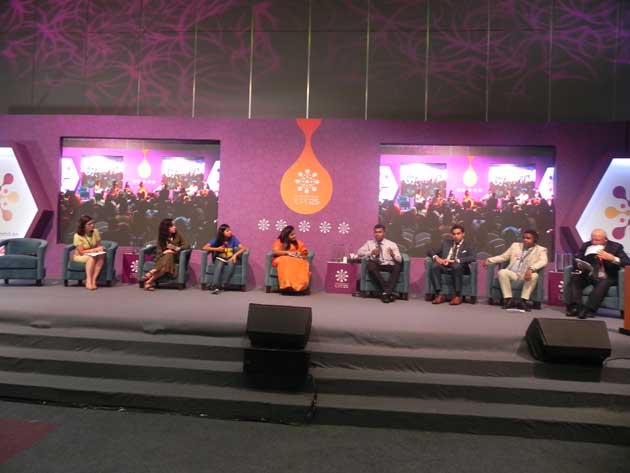
Young people speak out at Nairobi Summit. Credit: Mantoe Phakathi / IPS

She advocated for access to SRH services to be made available to all young people, adding that they have a right to make choices about their bodies. She was, however, encouraged by the way the global youth had stood up to be counted despite the challenges they face. Aryeenoted that the youth contributed to the development agenda leading to ICPD25, adding that the UN Sustainable Development Goals (SDGs) are also about them.

“We have then numbers. No one will ignore 1.8 billion reasons. The more we collaborate, the more we advance our agenda,” she said.

Fighting for a seat a the table

The global youth is fighting for a seat on the decision-making table where Marco Tsaradia, a Member of Parliament from Madagascar, said young people are told: “things have always been done like this”. He said the youth are keen to bring about new ideas because they are talented and innovative. However, he complained that the existing decision-making structure prevented them from achieving this objective.

It gets worse if young persons with disabilities want to enter the table because, said Leslie Tikolitikoca from the Fiji Disabled Peoples Federation, they tend to be “judged on their disabilities rather than their abilities”. For example, he said, instead of providing services to those who are unable to hear or see, those in power would rather make decisions on their behalf instead of helping them to contribute to the discussion.

“How are we going to ensure that we leave no one behind if we don’t involve all young people?” he wondered.

EU commits funding

Following the youth’s proposed solutions to their SRHR, Henriette Geiger, from the directorate of people and peace at the European Union Commission, said it was time to act. She said the EU has proposed that governments should consider reducing the voting age to 16 years.

Young people at ICPD25 youth session. Credit: Mantoe Phakathi / IPS

“That would make a huge impact in decision-making on youth policy,” she said, adding that the EU was funding key initiatives to change public perceptions about the LGBTQI community by using film.

Although she said the EU was involved in many SRHR programmes in Africa, she further pledged €29 million towards SRHR programmes for the youth, urging organisations to take advantage of this initiative.

Not all doom and gloom

During the opening address of the ICPD25, the United Nations Population Fund (UNFPA) executive director, Natalia Kanem, told delegates “good progress is not good enough”, insisting that the promises made to girls, women and everyone should be kept.

Kanem paid special tribute to the youth, for bringing new ideas and resources to make rights and choices a reality.

“To the youth, you’re inspiring in pushing us to go further Thank you,” said Kanem.

It is not all sad and gloomy for the youth, said Ahmed Alhendawi, the secretary-general of the World Organisation of the Scouts Movement. The fact that the youth have formed themselves into a global youth movement should be celebrated because that is how they are going to win the fight to be part of decision-making processes.


Cairo Dream Requires $264 Billion to Deliver Women’s Call for Justice and Bold Leadership

Africa, Conferences, Development & Aid, Economy & Trade, Education, Featured, Gender, Gender Violence, Global, Headlines, Health, Human Rights, TerraViva United Nations, Women’s Health

NAIROBI, Kenya, Nov 12 2019 (IPS) – For each of the 830 women dying each day from pregnancy complications and childbirth, an estimated 20 others suffer serious injuries, infections or disabilities.

This is the reality that millions of women face, and informs the Nairobi Summit’s three critical commitments which are to bring preventable maternal deaths, gender-based violence and harmful practices, as well as unmet need for family planning, to zero. To achieve this objective money is needed.


Joyce Chimbi

Finding the money for commitments

Private sector organisations including the Ford Foundation, Johnson & Johnson, Philips and World Vision, announced that the world as envisioned in Cairo in 1994 will cost $264 billion to deliver.

“Building financial momentum and bridging existing resource gaps around these commitments will not be easy. While most countries have constitutionalised reproductive health and rights, mobilising domestic resources has not automatically followed,” says Nerima Were, programme manager of the Kenya Legal and Ethical Issues told IPS.

How much will it really cost to deal with family planning?

To bring maternal mortality to zero in the 120 countries that account for over 95 percent of maternal mortality will cost $115.5 billion in key maternal health interventions.

Ending the unmet need for family planning in the same number of priority countries will cost $68.5 billion. Ending gender-based violence will require investing 42 billion dollars in 132 priority countries.

Currently, only $42 billion in development assistance is expected to be spent on advancing these goals. It, therefore, means that an additional $222 billion in investments will be required over the next decade.

Who will really fund commitments?

Were says that envisioning and articulating what form and shape these investments will take, is critical. She argues that at the moment it is not clear whether these additional costs will be raised in foreign investments, domestic allocation or private spending.

“This discussion is not just about dollars and cents but values and choices. It is also about translating choices into practical ways of making decisions,” says Achim Steiner, of the United Nations Development Programme, UNDP.

Steiner says that financial decisions can be framed in different ways, and that analysing the cost and gaps in delivering the three commitments, is a way to advise the world on how to invest.

Making informed decisions

“It is about helping societies to be better informed and to make better choices. The issue is not what it will cost to bring them to zero, but the cost of not bringing them to zero,” he argues.

World Bank data has shown that family planning is the “best buy” for governments. For each additional dollar spent on contraceptive services in developing countries, the cost of maternal and newborn healthcare could be reduced by two dollars and twenty cents. Importantly, estimates also show that every dollar invested in family planning pays itself back $120 in saved costs.

Africa must and can find the money

Researchers at the African Population and Health Research Centre indicate that African countries will need to dig deeper.

Budget underspending in the health sector prevails across the continent. “Africa has the resources to achieve these three critical goals. The exponential growth of economies across the country is reflective of the continents financial muscle,” says Jackson Chekweko, executive director for Reproductive Health Uganda, the member association for International Planned Parenthood Federation (IPPF).

Chekweko argues that political will and commitments are more important, and that “there will always be resources for what the government, especially presidents, say is a priority. African presidents wield a lot of influence on resource allocation.”

He argues, for instance, that Uganda made a commitment at the recent London Summit “to allocate $5 million to family planning annually. This has been done because the president said so.”

Bold leadership from Kenya’s Uhuru Kenyatta

Chekweko adds that there’s also a new generation of leaders such as President Uhuru Kenyatta of Kenya who will not shy away from making ambitious commitments.

“President Kenyatta made several bold statements at the ICPD25 Summit. He has declared that East African countries will reduce FGM to zero by 2022 and confirmed gender-based violence will, without a doubt, be reduced to zero,” he says.

Chekweko says that a demonstrable political commitment will encourage partnerships to help meet existing resource gaps. “Once we agree that issues of sexual and reproductive health and rights are a priority, the money will follow this purpose. Even if it means raising taxes such as VAT(value-added taxes) and PAYE (pay as you earn) by just one percent, it will be done,” Chekweko says.

Were adds that within the context of limited domestic funding, a scale back by external donors, and ambitious health and health coverage targets and domestic resource mobilisation, has never been more critical.

“To reach zero in all three areas, governments will need to carefully decide what their priorities are, anything that falls within that priority framework must be achieved,” she says.