Cambodia’s Young Environmental Activists Pay a Heavy Price

Armed Conflicts, Asia-Pacific, Civil Society, Economy & Trade, Environment, Featured, Headlines, Indigenous Rights, Labour, Natural Resources, Press Freedom, TerraViva United Nations

Opinion

Credit: Tang Chhin Sothy/AFP via Getty Images

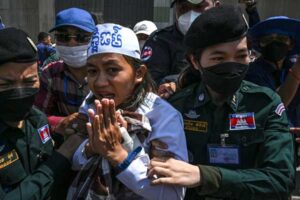
LONDON, Aug 1 2024 (IPS) – It’s risky to try to protect the environment in authoritarian Cambodia. Ten young activists from the Mother Nature environmental group have recently been given long jail sentences. Two were sentenced to eight years on charges of plotting and insulting the king. Another seven were sentenced to six years for plotting, while one, a Spanish national banned from entering Cambodia, was sentenced in absentia.


Four of the activists were then violently dragged away from a peaceful sit-in they’d joined outside the court building. The five who’ve so far been jailed have been split up and sent to separate prisons, some far away from their families.

This is the latest in a long line of attacks on Mother Nature activists. The group is being punished for its work to try to protect natural resources, prevent water pollution and stop illegal logging and sand mining.

An autocratic regime

Cambodia’s de facto one-party regime tolerates little criticism. Its former prime minister, Hun Sen, ruled the country from 1985 until 2023, when he handed over to his son. This came shortly after a non-competitive election where the only credible opposition party was banned. It was the same story with the election in 2018. This suppression of democracy required a crackdown on dissenting voices, targeting civil society as well as the political opposition.

The authorities have weaponised the legal system. They use highly politicised courts to detain civil society activists and opposition politicians for long spells before subjecting them to grossly unfair trials. Campaigners for environmental rights, labour rights and social justice are frequently charged with vaguely defined offences under the Criminal Coder such as plotting and incitement. Last year, nine trade unionists were convicted of incitement after going on strike to demand better pay and conditions for casino workers.

In 2015 the government introduced the restrictive Law on Associations and Non-Governmental Organisations (LANGO), which requires civil society organisations to submit financial records and annual reports, giving the state broad powers to refuse registration or deregister organisations. In 2023, Hun Sen threatened to dissolve organisations if they failed to submit documents.

The state also closely controls the media. People close to the ruling family run the four main media groups and so they mostly follow the government line. Independent media outlets are severely restricted. Last year the authorities shut down one of the last remaining independent platforms, Voice of Democracy. Self-censorship means topics such as corruption and environmental concerns remain largely uncovered.

This extensive political control is closely entwined with economic power. The ruling family and its inner circle are connected to an array of economic projects. Landgrabs by state officials are common. These means land and Indigenous people’s rights activists are among those targeted.

In 2023, courts sentenced 10 land activists to a year in jail in response to their activism against land grabbing for a sugar plantation. That same year, three people from the Coalition of Cambodian Farmer Community, a farmers’ rights group, were charged with incitement and plotting. The LANGO has also been used to prevent unregistered community groups taking part in anti-logging patrols.

The activity that saw the Mother Nature activists charged with plotting involved documenting the flow of waste into a river close to the royal palace in the capital, Phnom Pen. It’s far from the first time the group’s environmental action has earned the state’s ire. The government feels threatened by the fact that Mother Nature’s activism resonates with many young people.

Three of the group’s activists were convicted on incitement charges in 2022 after organising a protest march to the prime minister’s residence to protest against the filling in of a lake for construction. In 2023, Mother Nature delivered a petition urging the government to stop granting land to private companies in Kirirom National Park; there’s evidence of licences going to people connected to ruling party politicians. In response, the Ministry of Environment said Mother Nature was an illegal organisation and that its actions were ‘against the interests of Cambodian civil society’.

Media also get in trouble if they report on the sensitive issue of land exploitation. In 2023, the authorities revoked the licences of three media companies for publishing reports on a senior official’s involvement in land fraud. In 2022, two teams of reporters covering a deforestation operation were violently arrested.

Regional challenges

Repression of environmental activism isn’t limited to Cambodia. In neighbouring Vietnam, the one-party communist state is also cracking down on climate and environmental activists. In part this is because, as in Cambodia, climate and environmental activism is increasingly shining a light on the environmentally destructive economic practices of authoritarian leaders.

Cambodia’s creeping use of the charge of insulting the king to stifle legitimate dissent also echoes a tactic frequently used in Thailand, where the authorities have jailed young democracy campaigners for violating an archaic lèse majesté law that criminalises criticism of the king. Other repressive states are following its lead – including Cambodia, where the law on insulting the king was introduced when the crackdown was well underway in 2018.

Cambodia provides ample evidence of how the denial of democracy and the repression that comes with it enable environmentally destructive policies that further affect people’s lives and rights. The solution to protect the environment and prevent runaway climate change is less repression, more democracy and a more enabled civil society.

Cambodia’s international partners should emphasise this in their dealings with the state. They should press the authorities to release the jailed Mother Nature activists, who deserve to spend the coming years helping make their country a better place, not rotting in prison.

Andrew Firmin is CIVICUS Editor-in-Chief, co-director and writer for CIVICUS Lens and co-author of the State of Civil Society Report.

  Source

Paraguay: ‘Bureaucratic Criminalisation’, New Legislation Threatens NGOs and Democracy

Civil Society, Crime & Justice, Democracy, Headlines, Human Rights, Latin America & the Caribbean, Press Freedom, TerraViva United Nations

Opinion

March for rights in Asunción, capital of Paraguay. Credit Patricia López

ASUNCIÓN, Paraguay, Jul 29 2024 (IPS) – In a move that has aroused national and international concern, the Paraguayan Senate has given preliminary approval to a controversial bill that imposes strict controls on NGOs in a case of ‘bureaucratic criminalisation’.


The landscape has become increasingly hostile to the activities of civil society organisations, with several laws representing a rollback of historically defended fundamental rights.

‘Additional bureaucratic hurdles”: the effects of new legislation

Non-profit organisations in the country have to deal with a variety of formalities and ongoing procedures before various public bodies. The proposed legislation, promoted by the ruling Colorado Party, now introduces additional registrations for all NGOs and strict reporting requirements. Under the pretext of improving transparency and accountability, the legislation represents a significant threat to democracy and the operational freedom of civil society in Paraguay.

Controversial elements of the bill include a new mandatory registration with the Ministry of Economy and Finance – which would be the law’s implementing authority – for all organisations receiving public or private funds of national or international origin, detailed reporting of all activities, detailed semi-annual financial reports, and severe penalties for non-compliance, including heavy fines and the possibility of dissolution of NGOs. Critics argue that these ‘legal-political arrangements’ are disproportionate and serve more to intimidate and control NGOs than to promote real accountability.

March for rights in Asunción, capital of Paraguay. Credit Patricia López

What civil society says

The passage of this bill comes in a broader context of growing authoritarianism in Paraguay. Since the 2023 elections, there have been several concerns about the ruling party’s consolidation of power and its impact on democratic institutions. The media, opposition parties and civil society organisations have faced increasing pressures, raising fears of a regression to the authoritarian practices of the past.

Monica Centron, Executive Coordinator of the national NGO platform, POJOAJU, emphasises the broader implications of such legislation for democracy: ‘This law threatens the fundamental rights enshrined in our constitution. It undermines the role of civil society in holding government accountable and promoting social justice. NGOs promote transparency and accountability, we have legislation that obliges us to account for our actions such as the Civil Code, reports to Seprelad (Secretariat for the Prevention of Money or Asset Laundering), the Treasury Attorney’s Office, banks, the National Directorate of Tax Revenue, among others’.

Raúl Monte Domecq, from POJOAJU’s coordination team, highlighted the possible adverse effects for smaller NGOs: ‘The administrative burdens and the threat of severe sanctions could lead many smaller organisations to close down. This will have a devastating impact on the communities they serve, particularly the most vulnerable’.

‘It must be understood that we have adopted for our Republic a Social State of Law and as a form of government representative, participatory and pluralist democracy, as enshrined in the National Constitution. The paths of dialogue and consultation, and not the opposite, are necessary requirements for the strengthening of our still incipient process of democratisation,’ says Gladys Casaccia, also a member of the POJOAJU Coordination team.

A threat to democratic principles

The bill has faced strong opposition from various sectors, including religious leaders, civil society organisations and international human rights bodies.

Marta Hurtado, spokesperson for the UN Human Rights Office, said the bill would ‘impose substantial restrictions on NGO funding’ and ‘obstruct the exercise of freedoms of association and expression’.

Ana Piquer, Amnesty International’s Americas director, said that ‘this bill subjects civil society organisations to arbitrary and abusive state control, without giving them the opportunity to defend themselves. It puts human rights defenders and the communities they serve at significant risk’.

Just a few days ago, several UN Special Rapporteurs have joined forces to communicate to the government of Paraguay their concern about the possible approval of the Draft Law on the Control of Non-Profit Organisations.

Cardinal Adalberto Martinez, has urged the Senate to delay the bill, which will be discussed in less than 2 weeks from now, and initiate a dialogue with the affected sectors. ‘This bill could have serious consequences for our representative, participatory and pluralistic democratic system,’ he warned, emphasising the need for inclusive discussions.

This legislative measure also follows a worrying trend observed in other countries where governments have introduced restrictive laws to curb the influence and operations of civil society. By limiting access to international funding and imposing strict oversight, these laws effectively weaken civil society’s ability to operate independently and advocate for human rights and democratic governance.

Call for action

In light of these developments, POJOAJU and other civil society organisations call for urgent action:

    • Postponement and dialogue: they urge the government to halt the legislative process and engage in meaningful consultations with civil society to review the draft law.
    • Protection of rights: They demand that any new regulatory framework respect constitutional rights and international human rights standards, ensuring that it promotes genuine transparency without undermining the independence of civil society.
    • International solidarity: Civil society and governments are also being urged to call for dialogue with the Paraguayan government to reconsider this draft law in law. The stakes are high, not only for Paraguay, but also for the precedent it could set in the region.

Mónica Centrón, POJOAJU, Isabella Camargo and Bibbi Abruzzini, Forus

This article is written by the Forus network in partnership with POJOAJU. For more on the “bureocratic criminalisation” of civil society, consult Abong’s report detailing the context in Brazil under Bolsanaro’s presidency here.

IPS UN Bureau

  Source

Rights Groups Demand Governments Protect Exiled Journalists, Dissidents

Civil Society, Democracy, Editors’ Choice, Featured, Freedom of Expression, Global, Headlines, Human Rights, Press Freedom, Sustainable Development Goals, TerraViva United Nations

Freedom of Expression

Irene Khan, Special Rapporteur for freedom of expression and opinion, briefs reporters at UN Headquarters. Credit: Manuel Elías/UN

Irene Khan, Special Rapporteur for freedom of expression and opinion, briefs reporters at UN Headquarters. Credit: Manuel Elías/UN

BRATISLAVA, Jul 19 2024 (IPS) – Rights groups have called for governments to do more to combat transnational repression as a series of recent reports show growing numbers of exiled journalists, political dissidents and rights defenders are being targeted by autocratic regimes in an attempt to silence them.


They say governments must do more to deal with the repression, which takes the form of online harassment, surveillance, enforced disappearances, physical attacks and sometimes even killings, to protect the safety of these people.

“We have seen an increase in transnational repression, tied into the rise in authoritarianism around the world in general. Generally, there is a growing awareness of this complex problem among host countries and a willingness to do something about it.

“But more work needs to be done in some areas and governments need to support exiled journalists and understand the vital importance of the work they do,” Fiona O’Brien, UK Bureau Director at Reporters Without Borders (RSF), told IPS.

The scale of the problem has been laid bare in a number of reports in recent months.

In February, rights group Freedom House released a report documenting scores of attacks, including assassinations, abductions and assaults, carried out by governments against people outside their borders in 2023.

Naming Russia, Cambodia, Myanmar, Turkmenistan and China as the biggest perpetrators, it also reported on the first known cases of transitional repression sanctioned by a number of governments, including the regimes of Cuba, the Democratic Republic of the Congo, El Salvador, Myanmar, Sierra Leone and Yemen.

The group said that 44 countries—more than a fifth of the world’s national governments—have attempted to silence dissidents, activists, political opponents and members of ethnic or religious minorities beyond their own borders in the last ten years, with 1,034 recorded direct, physical incidents of transnational repression.

Meanwhile, at the end of June, while presenting a report on transnational repression, the United Nations special rapporteur on freedom of opinion and expression, Irene Khan, raised concerns not just about increasing incidents of transnational repression, but host countries’ responses to it.

“Too often, states are either unwilling for political reasons or unable for lack of capacity or resources to protect and support journalists in exile. Journalists should not be treated as political pawns but as human beings in distress who, at great cost to themselves, are contributing to the realization of our human right to information,” Khan said.

Following the report, scores of governments issued a joint statement condemning the repression and committing to coordinated action to help people being targeted and to hold accountable those behind any attacks. But it did not spell out any specific measures that should be implemented to do this.

Rights groups say that concrete steps must be taken by host governments to address the problem both in their own countries, and to confront those regimes perpetrating such acts.

Phil Lynch, Executive Director at the non-profit organisation International Service for Human Rights, said such action should involve host states not only providing comprehensive protection and support to those at risk of acts of transnational repression, but also measures, to undermine the capabilities of regimes to target people abroad.

He said host states must ensure they do not support or acquiesce in acts of transnational repression, such as through extradition or refoulement to states engaged in the persecution of human rights defenders; do not provide or export the tools or technologies of transnational repression, such as spyware and arms, to repressive states; must build awareness and law enforcement capabilities to respond to acts of transnational repression; and publicly denounce, investigate and pursue accountability for acts of transnational repression, including through sanctions and diplomatic repercussions.

“They should also prioritise human rights in foreign policy and relations both at bilateral and multilateral levels, adopting a principled and consistent approach to human rights in all situations, without selectivity and without discrimination,” he told IPS.

The lack of any serious consequences for regimes using transnational repression is helping perpetuate its widescale use, experts say.

“Governments don’t seem to be shying away from using transnational repression. This is likely because there has been very little accountability even in the most well-publicized cases, like the assassination of [Saudi dissident writer] Jamal Khashoggi. Since governments aren’t paying a price for targeting dissidents abroad, there’s little reason for them not to attempt it,” Yana Gorokhovskaia, Research Director, Strategy and Design, at Freedom House, told IPS.

But it is not just host country governments that could do more, experts say.

“Most of the harassment and attacks are online. Big tech have been totally absent from [efforts to fight transnational repression]. Governments have to hold big tech to account on this,” said O’Brien.

“Increasingly, acts of transnational repression occur online or are technology-facilitated. Technology providers have a duty to conduct due diligence to ensure their technologies and tools are not used, directly or indirectly, to restrict or violate human rights, including through acts of transnational repression. Governments should also legislate to mandate that human rights due diligence is undertaken by companies,” added Lynch.

It appears that some countries are becoming increasingly aware of the issue and willing to improve how they tackle it.

O’Brien said this following an RSF report on harassment of Iranian journalists in the UK released earlier this year. British authorities have “shown a lot of interest in how to tackle this problem better,”  while Freedom House has highlighted how President Joe Biden’s administration has made addressing the issue a priority across law enforcement and security agencies.

Gorokhovskaia also pointed out that over the last four years various countries have adopted policies to mitigate the threat posed by transnational repression, including improved training for police and security agencies and more outreach to communities that can be targeted.

“Countries have also become more aware of how international organizations, like Interpol, can be misused for transnational repression and taken steps to address this (by examining Interpol notices from certain perpetrator countries),” she said.

But research from other groups shows a much less reassuring picture.

A report from Human Rights Watch (HRW) said some host country governments were not only failing to ensure adequate protective measures for those at risk but were even actively facilitating transnational repression.

UN special rapporteur Khan also warned of host states becoming enablers “of transnational repression, for instance, by colluding in abductions instigated by the home state.”

Some alleged cases of such facilitation involve ostensibly stable, democratic, western states.

Abdulrahman Al-Khalidi, a political activist and a known dissident, arrived in Bulgaria in October 2021.

A campaigner for human rights and advocate for democratic reforms, he had fled his home country in the wake of mass arrests following the Arab Spring.

But since crossing into Bulgaria and claiming asylum, he has faced a complicated and, he says, at times incomprehensible legal battle over authorities’ continued refusal to grant him asylum and release him from detention at the migration centre despite court rulings in his favour.

He is facing deportation to Saudi Arabia, where, he told IPS, he will almost certainly be killed.

Al-Khalidi believes the Saudi secret service is behind the Bulgarian authorities’ blocking of his asylum. He says that during questioning by agency officials, he was told they were working with Saudi authorities on his case and that Saudi officials wanted him returned to Saudi Arabia. The Bulgarian state security agency has repeatedly said Al-Khalidi is a threat to national security, thereby blocking his asylum and release from detention.

Speaking to IPS in early July as he began a hunger strike while at a migrant detention centre near the Bulgarian capital, Sofia, where he has been held for the last three years, Al-Khalidi had a warning for governments hosting exiled dissidents and journalists.

“We live in a time full of international turmoil in which younger generations believe in anarchism more than they believe in democratic principles. This is very dangerous. The blame for this is fully borne by politicians who benefit from this and whose actions contradict the principles of the state, subsequently raising generations who lose their faith in both,” he said.

IPS UN Bureau Report

  Source

Venezuela’s Opportunity for Democracy

Civil Society, Crime & Justice, Democracy, Featured, Headlines, Human Rights, Latin America & the Caribbean, Press Freedom, TerraViva United Nations

Opinion

Credit: Jimmy Villalta/VW Pics/Universal Images Group via Getty Images

MONTEVIDEO, Uruguay, Jun 10 2024 (IPS) – Venezuela’s 28 July presidential election could offer a genuine chance of democratic transition. Despite an array of challenges, the opposition is coming into the campaign unified behind a single candidate. Many Venezuelans seem prepared to believe that voting could deliver change.

But the authoritarian government is digging in its heels. The opposition reasonably fears the election could be suspended or the government could suppress the opposition vote. Large-scale fraud can’t be ruled out.


All credible opinion polls show that authoritarian president Nicolás Maduro, in power since the death of Hugo Chávez in 2013 and seeking a third term in office, is highly unpopular. But his United Socialist Party of Venezuela (PSUV) extensively controls the state apparatus. Electoral authorities aren’t neutral and the election system is riddled with irregularities. A recent decision by the government-controlled National Electoral Council (CNE) excluded from voting over five million Venezuelans who’ve emigrated.

If the opposition defeats the PSUV at the polls, the government will only accept the results if the costs of repression outweigh the costs of withdrawal. This means some form of exit guarantees will need to be agreed. An agreement to coexist would also be needed for a transition period that could last several years, during which PSUV supporters would continue to hold important positions and the party would need to be given the chance to reinvent itself as a participant in democratic processes.

Civil society in resistance mode

Venezuelan civil society has long played a key role in promoting democracy and defending human rights. But civic space has increasingly been shut down, with activists and journalists routinely subjected to threats, harassment, intimidation, raids, arrests, detention and prosecution by courts lacking any independence.

Many civil society organisations (CSOs) and media outlets have closed and others self-censor or have changed their focus to avoid reprisals. Numerous journalists, academics and activists have joined the exodus to other countries.

The government give repression legal cover through a barrage of laws and regulations, supposedly on grounds such as the defence of sovereignty and the fight against terrorism. Many of these, starting with the 2010 National Sovereignty and Self-Determination Law, sought to restrict access to funding to financially suffocate civil society.

In 2017, the state introduced the Constitutional Law Against Hatred, for Tolerance and Peaceful Coexistence, known as the Anti-Hate Law, imposing heavy punishments, including lengthy jail sentences, for inciting hatred or violence through electronic means, including social media. The law leaves the definition of what constitutes hate speech to the government-aligned courts.

In 2021, the government passed an International Cooperation Act that includes a mandatory register of CSOs and an obligation to provide sensitive information.

The government has doubled down ahead of the election. In January, the National Assembly approved the first reading of a draft law known as the Anti-NGO Law, which would prohibit CSOs from engaging in vaguely defined ‘political activities’. The National Assembly is also currently discussing a law against fascism, aimed at banning and criminalising ideas, expressions and activities it deems to be ‘fascist’.

A united opposition

Over the years, the opposition has found it hard to present a unified front and a credible alternative. But this has changed in the run-up to the 2024 election, with the opposition agreeing to select a single presidential candidate.

María Corina Machado emerged as a consensus candidate with over 90 per cent of the vote at the October 2023 primary election. More than two million people were said to have taken part, defying threats from the authorities, censorship and physical attacks on candidates.

In an attempt to regain the initiative, the government sought to stir up nationalist sentiment by activating its dispute over Essequibo Guiana, a large territory in Guyana claimed by Venezuela. In December 2023 it held and predictably won a consultative referendum on the issue.

A week after the opposition primary, the Supreme Court suspended the process and results. In December, Machado filed a Supreme Court writ, but instead the court ratified her disqualification. So on 22 March, three days before the deadline for candidate registration, she announced 80-year-old academic Corina Yoris-Villasana as her replacement.

The government couldn’t find any excuse to disqualify Yoris, so instead it blocked the registration website. Right up to the deadline, the automated system had selective technical issues that affected opposition candidates.

Following an international press conference in which Machado denounced the manoeuvre, support came from two unlikely allies, the leftist governments of Brazil and Colombia. The CNE eventually authorised a 12-hour extension to register its candidates.

As a result of further negotiations in April, all registered opposition candidates withdrew apart from one. The compromise candidate was former diplomat Edmundo González Urrutia, a moderate few could object to.

International community’s role

Some countries, notably European Union (EU) members and the USA, have supported the Venezuelan opposition and urged the government to respect human rights and hold free and fair elections.

Anything the USA does is open to the accusation of imperialist interference, but the EU has been able to supply a credible set of proposals on how to hold fair elections. Recommendations of its report following 2021 regional and municipal elections included strengthening the separation of powers, abolishing disqualifications, holding a public voter education campaign, allowing balanced media coverage, repealing the Anti-Hate Law and ensuring enough properly trained and accredited polling station officials are available on election day.

However, the EU’s role in the upcoming election remains in doubt. After the European Parliament passed a resolution condemning Machado’s disqualification, the National Assembly leader said the EU wouldn’t be allowed to do election observation.

A key step in the right direction was taken in October 2023, just ahead of the primary, when government and opposition representatives met in Barbados and signed an agreement on the right of political organisations to choose their presidential candidates, an electoral timetable and a set of procedural guarantees.

The day after the signing of the Barbados Agreement, the US government eased its oil and gas sanctions but warned it would reinstate them if the government didn’t honour its commitments; in April 2023, it brought them back. The Venezuelan government immediately breached the agreement’s first point, as it initiated legal proceedings against the opposition primary.

Upon the signing of the agreement, the US Secretary of State also said that political prisoners were expected to be released by November. Five were immediately freed, but many more remain behind bars. Their release is a key opposition demand ahead of the election.

Two months before the big day, everything hangs in the balance. The unofficial campaign is well underway. Machado and González are touring the country, promising orderly and peaceful change. The government has launched an aggressive smear and disinformation campaign against González. Relentless harassment follows Machado wherever she goes. Local activists are routinely arrested following opposition rallies in their area.

There are surely many more twists and turns ahead. The Venezuelan government is used to ignoring international criticism, but it’s harder when calls to respect the democratic process come from leftist Latin American leaders. They can play a key role in urging Venezuela to let genuine elections happen and accept the results. The logic of democracy is that sooner or later Maduro will have to go. It would be wise for him to start negotiating the how.

Inés M. Pousadela is CIVICUS Senior Research Specialist, co-director and writer for CIVICUS Lens and co-author of the State of Civil Society Report.

  Source

India’s Election: Cracks Start to Show in Authoritarian Rule

Asia-Pacific, Civil Society, Crime & Justice, Featured, Headlines, Human Rights, Press Freedom, Religion, TerraViva United Nations

Opinion

Credit: Himanshu Sharma/picture alliance via Getty Images

LONDON, Jun 7 2024 (IPS) – India’s Hindu nationalist strongman Narendra Modi has won his third prime ministerial term. But the result of the country’s April-to-June election fell short of the sweeping triumph that seemed within his grasp.

Modi’s Bharatiya Janata Party (BJP) has shed seats compared to the 2019 election, losing its parliamentary majority. Modi remains prime minister thanks to coalition partners. It’s a long way from the 400-seat supermajority Modi proclaimed he wanted – which would have given him power to rewrite the constitution.


The outcome may be that Modi faces more checks on his power. If so, that can only be good news for those he’s consistently attacked – including civil society and India’s Muslim minority.

Modi’s crackdown

Under Modi, in power since 2014, civic space conditions have deteriorated. India’s election was accompanied by the usual headlines about the country being the world’s largest democracy. But India’s democracy has long been underpinned by an active, vibrant and diverse civil society. Modi has sought to constrain this civic energy, seeing it as a hindrance to his highly centralised and personalised rule.

Modi’s government has repeatedly used repressive laws, including the draconian Unlawful Activities Prevention Act, to harass, intimidate and detain activists and journalists on fabricated charges. Law enforcement agencies have raided numerous civil society organisations and media companies. In October 2023, for example, police raided the homes of around 40 staff members of the NewsClick portal and detained its editor.

This was one of many attacks on media freedoms. Independent journalists routinely face harassment, intimidation, threats, violence, arrests and prosecution. Last year, the government banned a BBC documentary on Modi, followed by tax investigation raids on the corporation’s Indian offices.

The authorities have also used the Foreign Contribution Regulation Act to block access to international funding for civil society organisations, targeting those critical of their attacks on human rights. In 2020, the government amended the law to make it even stricter, extending powers to freeze bank accounts. Since the start of 2022, the authorities have cancelled registrations of almost 6,000 organisations.

The authorities have also unleashed violence against protesters. In 2019, citizenship legislation created a way for undocumented migrants to become Indian citizens – but only if they weren’t Muslim. Despite India’s secular constitution, the law introduced religious criteria into the determination of citizenship. The passage of this discriminatory law brought tens of thousands to the streets. Security forces responded with beatings, teargas and arrests, accompanied by internet shutdowns.

It was the same when farmers protested in 2020 and 2021, believing new farming laws would undermine their ability to make a living. The farmers ultimately triumphed, with Modi repealing the unpopular laws. But several farmers died as a result of the authorities’ heavy-handed response, including when a minister’s car ploughed into a crowd of protesters. Once again, the authorities shut down internet and mobile services, and police used batons and teargas and arrested many protesters.

As the new citizenship law made clear, those who have least access to rights are the ones most under attack. Muslims are the BJP’s favourite target, since it seeks to recast the country as an explicitly Hindu nation. The party’s politicians have consistently stoked anti-Muslim hatred, including over the wearing of hijabs, interfaith marriage and the protection of cows – a revered animal in Hinduism.

Modi has been accused of spreading anti-Muslim hate speech and conspiracy theories, including on the campaign trail. During the election, he called Muslims ‘infiltrators’ and alluded to India’s version of a narrative often advanced by far-right parties – that a minority population is out to replace the majority through a higher birthrate and the conversion of partners.

The BJP’s populist rhetoric has encouraged hatred and violence. In 2020, Delhi saw its worst riots in decades, sparked by violence at a protest against the citizenship law. Groups of Hindus and Muslims fought each other and 53 people were killed, most of them Muslims.

Top-down institutional violence followed the unilateral revocation of Jammu and Kashmir’s special autonomous status in 2019. The removal of constitutional protections for this Muslim-majority region was accompanied by a military occupation, curfew, public meeting ban, movement restrictions and one of the world’s longest-ever internet shutdowns. Indian government authorities have detained thousands of Kashmiri activists and criminalised countless journalists.

Disinformation thrives

Ahead of the election, the state detained key opposition politicians such as Delhi’s Chief Minister Arvind Kejriwal and froze opposition bank accounts, including of the main opposition party, Congress. Almost all politicians investigated by the government’s Enforcement Directorate are from the opposition.

Indian elections always take several weeks, given the huge logistical challenge of allowing up to 969 million people to vote. But this one, spread over 82 days, was unusually long. This allowed Modi to travel the country and make as many appearances as possible, representing a campaign that put his personality front and centre.

Disinformation was rife in the campaign. BJP politicians spread claims that Muslims were engaged in what they called a ‘vote jihad’ against Hindus, accompanied by accusations that the opposition would favour Muslims. Congress leader Rahul Gandhi was a particular target, with false allegations of links to China and Pakistan and doctored videos in circulation.

But despite the many challenges, the opposition coalition performed better than expected. The result suggests at least some are tired of the Modi personality cult and politics of polarisation. And for all the BJP’s attempts to emphasise economic success, many voters don’t feel better off. What matters to them are rising prices and unemployment, and they judged the incumbent accordingly.

It’s to be hoped the result leads to a change in style, with less divisive rhetoric and more emphasis on compromise and consensus building. That may be a tall order, but the opposition might now be better able to play its proper accountability role. Modi has lost his sheen of invincibility. For civil society, this could open up opportunities to push back and urge the government to stop its onslaught.

Andrew Firmin is CIVICUS Editor-in-Chief, co-director and writer for CIVICUS Lens and co-author of the State of Civil Society Report.

  Source

Slovakia PM Assassination Attempt Sparks Journalists’ Safety Fears

Editors’ Choice, Europe, Featured, Freedom of Expression, Headlines, Human Rights, Press Freedom, TerraViva United Nations

Freedom of Expression

Camera crews wait outside the Slovak parliament building in Bratislava days after the attempted assassination of PM Robert Fico. Credit: Ed Holt/IPS

Camera crews wait outside the Slovak parliament building in Bratislava days after the attempted assassination of PM Robert Fico. Credit: Ed Holt/IPS

BRATISLAVA, May 24 2024 (IPS) – Fears for the safety of journalists in Slovakia are growing in the wake of an assassination attempt on the country’s prime minister, which some politicians are blaming in part on local independent media.

Relations between some media and members of the governing coalition, led by Prime Minister Robert Fico’s Smer party, have become increasingly tense since the government came to power in October last year.


And immediately after Fico was shot and seriously injured on May 15, as he greeted members of the public after a government meeting, senior members of coalition parties linked the attack to critical coverage of Fico and accused outlets of spreading hate against him.

The 71-year-old man who shot the prime minister is thought to have had a political motive for his attack.

Since then, there have been calls from some other politicians and heads of media organizations to stop trying to apportion blame for the attack on any group so as to defuse tensions in society.

But senior figures from governing coalition parties have continued to attack the media for what they see as their role in fomenting anger towards the government and provoking the tragedy.

Journalists in Slovakia, and press freedom watchdogs, worry this is increasing the risk reporters could also become targets of a violent attack.

“Journalists are in no way responsible for this, and blaming them is only fueling the fires and increasing the likelihood of another violent incident,” Oliver Money-Kyrle, Head of European Advocacy and Programmes at the International Press Institute (IPI), told IPS.

For many years, Fico and his Smer party, who have been in power for much of the last 18 years in Slovakia, have publicly attacked individual media, and specific journalists in some cases, for their critical reporting of the various governments he has led.

When Jan Kuciak, a reporter investigating alleged corruption by people close to Fico’s government, and his fiancée, Martina Kusnirova, were murdered in 2018, critics said Fico’s rhetoric towards journalists had contributed to creating an atmosphere in society in which those behind the killings believed they could act with impunity.

Fico was forced to step down as PM not long after the murders, following massive public protests against his government.

But since returning to power, he and other members of the ruling coalition have repeatedly attacked journalists they see as critical of the government and his party has refused to communicate with certain newspapers and broadcasters.

The government has also pushed through legislation that media freedom organizations and members of the European Commission have warned could severely restrict independent media and press freedom.

Some journalists at major news outlets have been regularly receiving death threats and facing horrific online harassment for years, but others have said they have become increasingly worried for their safety in recent months, and that those concerns have been exacerbated now in the wake of Fico’s shooting.

Many believe that years of aggressive, derogatory rhetoric against them has made them a target for hate among some parts of a society with widespread distrust of media—a recent survey showed only 37 percent of Slovaks trust the media.

Since the assassination attempt, some newsrooms have taken extra security measures and the government has said it will also be providing extra protection for groups which could be facing an elevated safety risk, including media.

While this has been welcomed by media rights organizations, they have said politicians must take the lead in reducing tensions in society and lessening immediate safety risks for journalists.

“The way to de-escalate the situation is that political hate speech against media must stop,” Pavol Szalai, head of the EU/Balkans desk at RSF at Reporters Without Borders (RSF), told IPS.

In the immediate hours after the shooting, some ministers appeared to be pushing to calm the situation.  At a press conference, Interior Minister Matus Sutaj Estok appealed “to the public, to journalists, and to all politicians to stop spreading hatred”.

Meanwhile, dozens of editors from print and broadcast media issued a joint statement publicly condemning the attack on the prime minister and calling for politicians and media to come together to calm tensions.

However, even days after the shooting, senior government figures continued to attack specific media or play down the seriousness  of comments made by colleagues just after the shooting, including  labelling media as “disgusting pigs”.

The Slovak government did not respond to questions on journalists’ safety from IPS.

But beyond putting journalists at increased risk, it is feared that the assassination attempt may also worsen what research has shown is significantly worsening media freedom in the country.

The government recently approved legislation – which is expected to be passed in parliament within weeks that will see the country’s public broadcaster, RTVS, completely overhauled and, critics say, effectively under control of the government.

Ominously, the leader of the governing coalition Slovak National Party (SNS), Andrej Danko, warned after Fico was shot that there would “be changes to the media” now.

And on May 19, speaking on the TA3 private news channel, he said he was planning to propose legislation that would set new regulations governing journalistic ethics, relations between journalists and politicians, and what politicians would be obliged to “put up with” from journalists.

Beata Balogova, Editor in Chief of the Sme daily newspaper, one of the news outlets in the country regularly criticized by government politicians, told international media that the government could now introduce “brutal measures against the media.”

Local journalists say any repressive measures would make an already difficult job even harder.

“I haven’t thought about how things could get more difficult for us to do our work in the future because it’s already very hard. It’s so difficult to gather news with political parties refusing to speak to us. [More restrictions] certainly wouldn’t make things easier,” Michaela Terenzani, an editor at Sme, told IPS.

She added, though, that it was difficult to predict what would happen in the coming days and weeks.

“At the moment, we are all just getting over the shock and trying to get on with our work as best we can. This is a major moment in Slovakia’s history and we will have to see what happens with relations between the media and politicians. Everyone is calling for calm, and I hope that is what we get,” she said.

IPS UN Bureau Report

  Source