BLANTYRE-(MaraviPost)-In a lackluster display, FCB Nyasa Big Bullets failed to capitalize on the opportunity to gain ground in the TNM Super League title race, drawing 0-0 with Blue Eagles at Nankhaka Stadium in Lilongwe.
The People’s Team, under the stewardship of coach Peter Mponda, looked far from their best as they struggled to break down the Eagles’ defense.
This latest result is the third consecutive setback for Bullets, who suffered a 3-0 thrashing at the hands of Mighty Wanderers in a TNM Super League match two weeks ago at Kamuzu Stadium.
The team followed that disappointment with a 1-0 loss to the same opponents in the FDH Bank Cup semifinals last week.
The stalemate against Blue Eagles has raised questions about Mponda’s tactical acumen and the team’s overall form.
Bullets, who are currently second in the league standings, will have to regroup quickly and reassess their strategy if they hope to regain their title aspirations. With key players seemingly off the pace, Mponda faces a daunting task in getting his team back on track.
The match itself was a cagey affair, with neither side able to create a plethora of scoring opportunities.
Blue Eagles, ranked seventh in the league, showed greater resolve in defense, nullifying Bullets’ attacking threats and earning a hard-fought point.
As the league enters its final stretch, Bullets will need to rediscover the form that saw them dominate the competition in recent seasons.
With their title hopes hanging in the balance, Mponda’s coaching skills are under increasing scrutiny.
The 0-0 draw at Nankhaka Stadium will do little to alleviate the pressure on the coach, who will come under intense scrutiny from fans and pundits alike.
Bullets’ next assignment will be a crucial test of their resolve, as they look to bounce back from this disappointing result and keep their title dreams alive.
However, with their current form, it seems like a tall order for the People’s Team.
The draw has seen Bullets drop further behind league leaders Mighty Wanderers, who seem to be pulling away at the top of the table. Unless Bullets can quickly turn their fortunes around, they risk losing out on the title they have dominated for so long.
For now, Bullets fans can only hope that Mponda and his team regroup and come up with a winning strategy to take on the challenges ahead.
One thing is certain – the People’s Team cannot afford to continue in this manner if they hope to emerge as champions.
Share this:
Like this:
LikeLoading…
Discover more from The Maravi Post
Subscribe to get the latest posts sent to your email.
Dive into your backend of the week with this sexy star who posted up poolside in her animal-print bikini … You think you know who it is? Let’s test your skills! She recently celebrated her friend’s bday bash, and her Instagram posts rake in a…
Share this:
Like this:
LikeLoading…
Discover more from The Maravi Post
Subscribe to get the latest posts sent to your email.
A dog on a routine morning walk through Los Angeles accidentally ingested meth … and it created a nightmare situation for him and his owners. The pooch, a 4-year-old German Shepherd Husky mix named Atreyu, was out on a walk in North Hollywood…
Share this:
Like this:
LikeLoading…
Discover more from The Maravi Post
Subscribe to get the latest posts sent to your email.
LILONGWE-(MaraviPost)-The Centre for Democracy and Economic Development Initiatives (CDEDI) has renewed its call for a comprehensive review of all mining-related agreements and licences linked to Portland Cement Malawi Limited, citing alleged injustices, irregularities and possible corruption in the company’s operations at Chinkhumbe Hill in Balaka District.
Addressing the news conference on Thursday, November 6, 2025 in the capital Lilongwe Executive CDEDI Executive Director Sylvester Namiwa applauded President Peter Mutharika for the decision to ban the export of raw minerals, but stressed that the move should be followed by a review of all Minerals Development Agreements (MDAs) signed under previous administrations.
According to CDEDI, many of these agreements were questionable and not aligned with the best interests of Malawians.
The organisation claims the former administration was known for entering deals with “conmen and dubious investors,” resulting in communities suffering serious injustices.
The Chinese owned Portland Cement Malawi Limited, which bought shares in LaFarge Cement Company, is currently mining limestone at Chinkhumbe Hill in Senior Chief Nsamala’s area.
CDEDI says it began investigating the company after receiving complaints of unfair compensation, intimidation and lack of transparency from affected villagers.
A stakeholders’ meeting held on January 21, 2025 revealed that land compensation was not only meagre but had also been unlawfully reduced by 30 percent, allegedly due to the Ministry of Lands using Blantyre valuation rates instead of Balaka’s.
Balaka District Commissioner Tamanya Harawa later apologised for the misconduct.
Following demonstrations, Portland refunded the deducted 30 percent and added a 10 percent increase for the second phase.
CDEDI, however, noted that the Ministry of Lands, the Malawi Local Government Association and the Mining and Minerals Regulatory Authority initially defended the unfair compensation.
CDEDI further claims to have uncovered fraudulent compensation payments, including MK16 million allegedly paid to individuals who were not affected by the project, facilitated by Group Village Head Mchenga, who was later arrested by citizens for his role in the scheme.
Meanwhile, Village Head Ng’onga is said to have reported receiving death threats linked to the compensation controversy.
The organisation expressed concern that senior officials at Balaka District Council and some bureaucrats at Capital Hill appeared to shield Portland from accountability, prompting CDEDI to use the Access to Information (ATI) Act to demand documents.
Requests submitted to the Mining and Minerals Regulatory Authority on January 23, 2025 remain unanswered 10 months later.
CDEDI further alleges that Portland Cement is operating without conducting a mandatory Environmental and Social Impact Assessment (ESIA) as required under the Environmental Management Act of 2017.
Balaka District Council reportedly approved the company’s project after Portland submitted an outdated Environmental Impact Assessment report belonging to LaFarge and conducted in 2011. No committee member objected to the anomaly.
The organisation has since urged the newly-appointed Minister of Natural Resources, Energy and Mining, Jean Mathanga, to urgently visit the affected villages and ensure justice is served.
Share this:
Like this:
LikeLoading…
Discover more from The Maravi Post
Subscribe to get the latest posts sent to your email.
The human right to health is not a privilege, tt is a legal obligation – rooted in international human rights law – and must form the foundation of all efforts toward universal access, equity, and justice. Protecting, implementing, and enforcing this right is essential for the wellbeing of women, girls, and all gender-diverse peoples.
Yet, across the world, sexual and reproductive health, rights and justice (SRHRJ) are increasingly under threat. Regressive policies, shrinking civic space, and a weakening of global solidarity are rolling back hard-won gains, particularly for those already on the margins.
According to UN Women, nearly one-in-four countries experienced a backlash against women’s rights in 2024 alone. From abortion restrictions and defunding of SRHRJ programmes to rising attacks on gender-diverse peoples, the erosion of rights has become systemic. The urgency to act – and to act together – has never been greater.
Translate rights into access and principles into practice
“Operationalising the demands of the right to health requires more than commitments on paper,” said Alison Drayton, Assistant Secretary General, CARICOM, Guyana, stressing the need for systems, partnerships, and accountability mechanisms. CARICOM refers to the Caribbean Community, a grouping of 21 countries (15 member countries and 6 associate members) in the Americas and the Caribbean.
“Through our multilateral cooperation on universal health coverage, gender equality, and reproductive and sexual health, we must collectively translate rights into access and principles into practice. We are investing in integrated primary healthcare, gender-responsive budgeting, and data systems that make inequities visible and actionable. But this journey is not easy,” she said.
For Alison, the core challenge is ensuring that people remain at the centre of health systems. “Health is not a privilege – it is the foundation of humanity and sustainability. Every woman should be able to give birth safely, every adolescent should have access to accurate information, and every person – regardless of gender, income, or geography – should be able to lead a healthy life. Let us be bold in our vision and reaffirm that health, equity, and rights are indispensable – and that our collective responsibility is to make them real for every community we serve.”
What does the right to health mean?
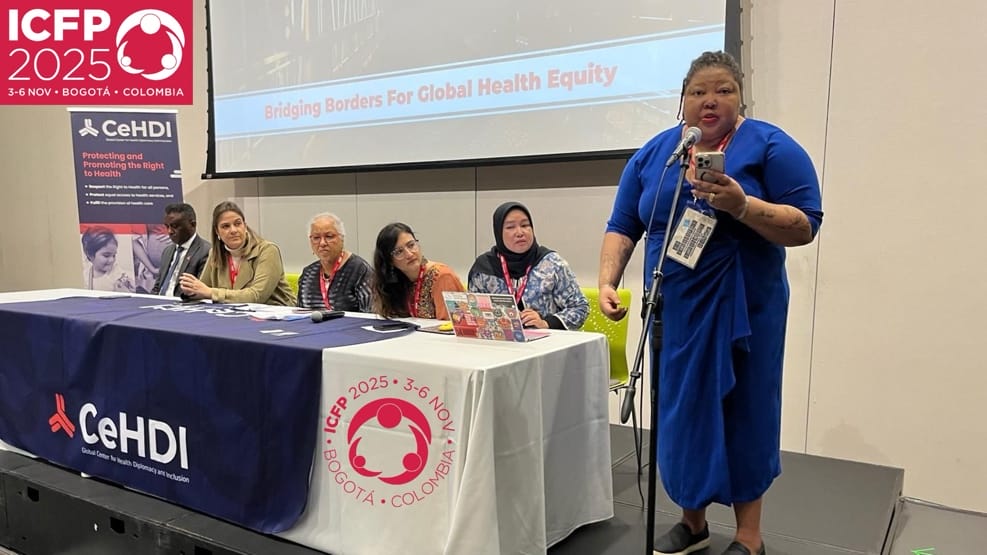
“The right to health is not simply an obligation – it is a deep commitment,” explained Dr Haileyesus Getahun, founder and Chief Executive Officer of the Global Center for Health Diplomacy and Inclusion (CeHDI). Dr Getahun also leads HeDPAC (Health Development Platform for Africa and the Caribbean) that works with like-minded governments, particularly in Africa and the Caribbean regions, to forge South-South partnerships that address pressing health challenges and achieve universal health coverage. He earlier served the UN health agency, the World Health Organization (WHO) for over two decades, and was the founding Director of Quadripartite Joint Secretariat on Antimicrobial Resistance (AMR). AMR is among the top 10 global health threats.
Dr Getahun underscored that the right to health has been enshrined in several international treaties, including the International Covenant on Economic, Social and Cultural Rights, ratified by 174 countries.
“It entails three key obligations for governments,” he said. “First, they must respect by not interfering with citizens’ enjoyment of their health and wellbeing. Second, they must protect by ensuring that no harm is brought to this enjoyment. And third, they must fulfill these obligations by establishing administrative systems that ensure every person in their country can realise this right.”
Dr Getahun describes the right to health as the gateway to universal health coverage, encompassing all services for all people without discrimination. “Sexual and reproductive health is an integral part of that right,” he said.
International instruments like the legally-binding treaty adopted in 1979 – the United Nations Convention on the Elimination of All Forms of Discrimination Against Women (CEDAW), further reinforce these commitments.
“We need to remind our governments that they have signed these international obligations,” he said. “Countries like Brazil, Canada, Cuba, Mexico, and El Salvador have shown how partnerships and learnings can lead to real progress. We can do more, we can do better, if we work together.”
Brazil’s rights-based model
One of the countries that has made notable progress in advancing the right to health through rights-based approaches is Brazil. Dr Ana Luiza Caldas, Brazil’s Vice Minister of Health shared how her country’s community-based primary healthcare approach has strengthened universal health coverage. “For the past 35 years, we have focused on connecting with the people we serve. Listening to communities and understanding what people actually need helps us design responsive SRH programmes – like providing free condoms in schools and health units.”
She stressed that access to quality healthcare is a human right, not a privilege. “Policies must be shaped by people’s needs. When we listen, we build trust and inclusion.”
“Access to quality healthcare should never be a privilege – it is a human right,” she re-emphasised. “By working in partnerships and staying close to the people, we can make that right real.”
Long walk to gender justice
For Aysha Amin, Founder of Baithak (Challenging Taboo) Pakistan, the right to health remains a distant dream for women and girls in marginalised communities. “Despite SRHRJ being so crucial for everyone, especially young girls and women, it is still not a priority. This is not just a health issue – it is a gender justice issue,” she said.
She highlighted how gender inequality and climate change intersect to compound vulnerability. “In communities most affected by climate disasters, health systems collapse. Floods wash away medical facilities. Women give birth in unsafe, makeshift conditions. Adolescent girls manage menstruation without facilities for water, sanitation and hygiene – often under open skies, risking infections and gender-based violence. This is a serious violation of dignity and safety.”
For Amin, the path forward requires centring the lived experiences of women and girls. “We need to create safe spaces where young women not only receive information but also reflect, question, and demand their rights. Building leadership among women and girls is essential so they can hold local governments accountable – especially in times of disaster.”
She also called for a shift in male engagement strategies, which often remain superficial. “In countries like Pakistan, decisions about women’s bodies are still made by men. We need to engage men as allies – challenging patriarchal norms and rethinking masculinity – thus helping to create space for women in decision-making, not take those spaces away. Male engagement must move beyond tokenism to transformative change.”
Amin also underscored the need for qualitative data to complement statistics. “Numbers alone cannot show what it means when an unmarried woman is denied care, or when a transgender person is refused access, or when a woman with disability is unable to access healthcare. Their stories reveal the intersectional inequalities that health systems must address.”
Countering media silence and anti-rights narratives
In many societies, SRHRJ remains taboo – not because people do not experience these issues, but because they are deemed unfit for public discourse.
“In my country, Indonesia, we cannot talk openly about comprehensive sexuality education,” said Betty Herlina, an Indonesian journalist and Founder Editor of Bincang Perempuan (Bahasa-language media focussed on gender justice). She is also a noted SRHRJ advocate. “If I distribute a condom in public, people would say that I am ‘promoting free sex.’ That is the bias we must break.”
Herlina urged media professionals to frame SRHRJ as a public health and human rights issue, not a moral or political one.
Patriarchy and harmful gender biases within and through media
Herlina noted that media indifference is part of the problem. “Not all media houses want to cover SRHRJ – it is not seen as an ‘attractive’ topic.” She urged media professionals to frame SRHRJ as a public health and human rights issue, and not as a moral or political one.
“While reporting on unplanned pregnancies or abortion, journalists must remember that women still have the right to medical care. It is our duty to verify government claims and bring evidence-based narratives to the public,” said Herlina.
She added that data-driven journalism can counter misinformation around SRHRJ and push for policy change. “We need to document stories of people affected by restrictive policies to humanise these issues.”
We need to counter harmful gender biases, norms and stereotypes and challenge patriarchy within and through media.
Betty Herlina was also conferred upon the 1st Prize in Asia Pacific Region: SHE & Rights Media Awards 2025 at the International Conference on Family Planning (ICFP 2025) in Bogota, Colombia. SHE & Rights is together hosed by CeHDI, ICFP 2025, IPPF, ARROW, WGNRR, CNS and partners. Sai Jyothirmai Racherla, Deputy Executive Director of Asian-Pacific Resource and Research Centre for Women (ARROW) conferred the award citation to Betty Herlina at ICFP Live Stage in presence of Dr Haileyesus Getahun and others.
Reclaiming health as a human right
For Dr Tlaleng Mofokeng, UN Special Rapporteur on the Right to Health, this right is far from abstract – it is a living testimony to justice, autonomy, and equity.
“Our health systems must be inclusive, gender-responsive, and grounded in human rights. But around the world, access to SRH services is being restricted, healthcare workers are being silenced, and ideology is replacing evidence,” she said.
She cautioned that conditional funding – where financial aid depends on limiting support for certain groups – undermines human rights. “Funding cannot be conditional. Maternal health, SRH, and universal health coverage must not be seen as competing agendas. They are interconnected and part of the same promise of human dignity,” she asserted.
Dr Mofokeng urged governments and global institutions to invest in equity and intersectionality. “We must ensure that adolescents, LGBTIQ+ persons, people with disabilities, migrants, and others at the margins are not left behind. Health diplomacy must serve justice, not conditionality. Our movements need comprehensive, unrestricted resources to continue their work.”
The way forward
The Right to Health provides a moral and legal compass for achieving gender equality. But realising it requires political will, inclusive governance, collective action and sustained investment. As the world grapples with climate crises, rising inequalities, and anti-rights movements, reaffirming health as a human right becomes a powerful act of resistance and hope.
Ensuring that no one is left behind means building systems that listen to communities, amplify marginalised voices, and turn commitments into action. The right to health is not merely about survival – it is about freedom, justice, and the promise of a fairer world.
Shobha Shukla – CNS (Citizen News Service)
(Shobha Shukla is a feminist, health and development justice advocate, and an award-winning founding Managing Editor and Executive Director of CNS (Citizen News Service). She was also the Lead Discussant for SDG-3 at United Nations inter-governmental High Level Political Forum (HLPF 2025). She is a former senior Physics faculty of prestigious Loreto Convent College; current President of Asia Pacific Regional Media Alliance for Health, Gender and Development Justice (APCAT Media); Chairperson of Global AMR Media Alliance (GAMA received AMR One Health Emerging Leaders and Outstanding Talents Award 2024); and Host of SHE & Rights (Sexual Health with Equity & Rights). Follow her on Twitter/X @shobha1shukla or read her writings here www.bit.ly/ShobhaShukla)
– Shared under Creative Commons (CC)
Share this:
Like this:
LikeLoading…
Discover more from The Maravi Post
Subscribe to get the latest posts sent to your email.
BLANTYRE-(MaraviPost)-James Brown Mpinganjira, a seasoned politician and former MCP stalwart, has defected to the ruling Democratic Progressive Party (DPP), citing the party’s commitment to the welfare of Malawians.
However, not everyone is welcoming Mpinganjira’s move, with political commentator Mathews Namukhoyo urging the DPP to exercise caution.
According to Mpinganjira, his decision to leave the MCP was motivated by the party’s failure to deliver on its promises to Malawians.
“It was just a waste of time to be in MCP as it failed Malawians,” Mpinganjira said, adding that, “But DPP is the only party that has the heart of Malawians, and I’m excited to be part of a team that is working tirelessly to improve the lives of our people.”
However, Mpinganjira’s track record has raised eyebrows, with many questioning his motives for joining the DPP.
Mpinganjira previously defected from the DPP to the MCP, where he campaigned vigorously for the party and disparaged the DPP, claiming it would not win. Now, he’s singing a different tune, sparking accusations of opportunism.
Namukhoyo, a vocal political commentator, has cautioned the DPP against welcoming Mpinganjira, describing him as a “greedy and prostitute politician.” “DPP should not allow any greedy politicians who just want to harvest when they didn’t sow,” Namukhoyo warned , adding that, “The party should work only with those who risked their lives and refused monetary incentives from MCP.”
Namukhoyo’s sentiments are echoed by many who feel that Mpinganjira’s defection is a blatant attempt to jump on the DPP bandwagon.
“These are people who were eating well in MCP, and now they’re coming to DPP just because they smell food,” said one MCP supporter, adding that, ”We shouldn’t forget that Mpinganjira was one of the most vocal MCP supporters when it suited him. Why should we trust him now?”
The DPP has yet to comment on Mpinganjira’s defection, but the party’s leadership will likely face pressure to clarify its stance on the matter.
As the party considers Mpinganjira’s application, it remains to be seen whether it will heed Namukhoyo’s warning or give Mpinganjira a chance to prove himself.
One thing is certain, however: Mpinganjira’s defection has sparked controversy, and only time will tell if it’s a wise move or a misstep.
Share this:
Like this:
LikeLoading…
Discover more from The Maravi Post
Subscribe to get the latest posts sent to your email.