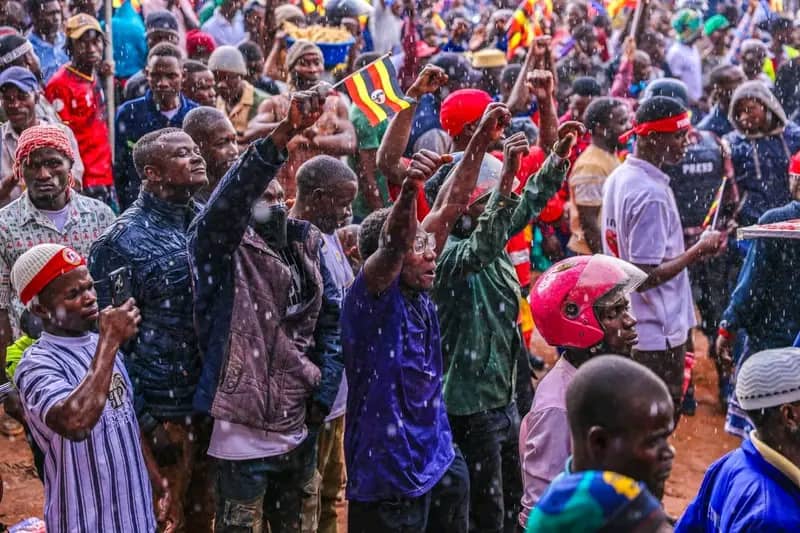
KAMPALA-(MaraviPost)-National Unity Platform (NUP) supporters showed their unwavering dedication to their leader, Kyagulanyi Ssentamu, alias Bobi Wine, by braving the afternoon rains at the NUP’s Kampala Central rally.
The event marked a crucial moment in the presidential campaigns, which will conclude on Tuesday, 13 January.
The rally, held in the heart of Kampala, demonstrated the strong support base of Bobi Wine, who is challenging incumbent President Yoweri Museveni in the upcoming elections.
Despite the inclement weather, supporters gathered in large numbers, waving national flags and chanting slogans in support of their candidate.
Bobi Wine’s campaign has been marked by a strong emphasis on protest and resistance, with his supporters using the national flag as a symbol of their movement.
This has led to tensions with security forces, who have been accused of targeting flag-carrying supporters at rallies.
The election is seen as a crucial moment for Uganda, with many young people looking for change and an end to Museveni’s long-standing rule.
Bobi Wine, 43, has positioned himself as a champion of the youth and a voice for those seeking reform ¹ ².
As the campaigns draw to a close, the stage is set for a highly contested election.
With voting scheduled to take place on Thursday, 15 January, Ugandans will head to the polls to decide their future.
3:21 PM PT — The TRO was denied by the court clerk because it’s not an emergency order … the judge will rule January 23 on the issue at the hearing. Brittany Furlan says Ronnie Radke just won’t leave her alone — blasting him as “unhinged and…
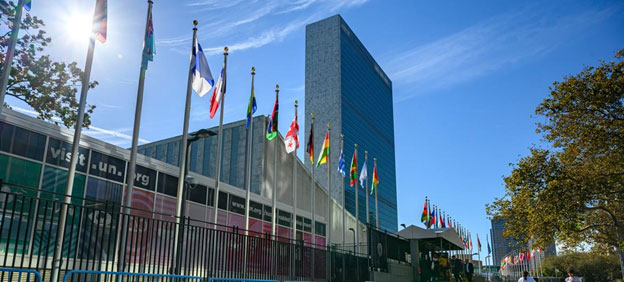
UN’s ‘responsibility to deliver’ will not waver, after US announces withdrawal from dozens of international organizations. Credit: UN Photo/Loey Felipe
“Take up the White Man’s burden — Send forth the best ye breed… By all ye cry or whisper, by all ye leave or do, [T]he silent, sullen peoples shall weigh your gods – and you…” — Rudyard Kipling, The White Man’s Burden: The United States and the Philippine Islands (1899)
NEW YORK, Jan 12 2026 (IPS) – We’re living in an age where the world is loudly proclaiming the death of empire, yet reproducing its structures. This is not nostalgia for colonial postcards — it’s a reinvention of foreign policy, international governance and global economic power that resembles colonial logic far more than it does meaningful cooperation.
The term “New Colonialism” feels extreme until you look not at poetry, but at power in motion — from military takeovers and genocides, to diplomatic withdrawal, to institutions that still perpetuate inequality and human rights’ abuses under the guise of neutrality.
I – Where Are We Today
“Imperialism after all is an act of geographical violence through which virtually every space in the world is explored, charted, and finally brought under control.” — Edward Said, Culture and Imperialism (1993)
In January 2026, the United States executed what amounts to the most dramatic foreign intervention in Latin America in decades: a military incursion into Venezuela resulting in the abduction of President Nicolás Maduro. President Donald Trump openly declared that the U.S. would “run the country until such time as we can do a safe, proper and judicious transition.” This is not coded language — it is overt control.
Critics and allies alike see the move not as a limited counternarcotics or law enforcement operation (as the Administration frames it), but as a return to the old playbook of hemispheric domination. Latin American governments from Mexico to Brazil condemned it as a violation of sovereignty — a modern mirror to the regime-change interventions of the 20th century.
Analysts at Foreign Policy have highlighted precisely how this intervention fits into a larger pattern of U.S. foreign policy ambition. Rishi Iyengar and John Haltiwanger note that under the banner of battling “narcoterrorism,” the United States has expanded the role of its military into actions that blur the distinction between security and political control — “adding bombing alleged drug traffickers to its ever-growing list of duties.”
Such actions reflect a foreign policy that is increasingly militarized and deeply unilateral in its execution.
This intervention was not an isolated blip. It fits into a broader dynamic which suggests Washington’s moves in Venezuela are less about drug interdiction and more about strategic positioning and resource control — especially Venezuela’s vast oil reserves.
In the context of a “World-Minus-One” global order where U.S. power is contested by China and Russia, interventionist impulses have resurfaced not as humanitarian projects but as geopolitical gambits.
Viewed through the lens of colonial critique, the language of “rescuing” Venezuelans from an accused dictator echoes Kipling’s exhortation to take up the supposed moral burden. But those centuries-old justifications masked violence and labour exploitation; today’s rhetoric masks geopolitical self-interest.
The U.S. claims to be liberating Venezuelans from authoritarianism, yet asserts control over governance and economic infrastructure — a 21st-century version of telling another nation it cannot govern itself without direction from Washington. The result is not liberation, but dependency — a hallmark of colonial relationships.
II. The U.S. Withdrawal from Multilateral Institutions
“The White Man’s Burden, which puts the blame of the new subjects upon themselves without acknowledging the real burden — the systematic, structural and often violent exploitation — is the oldest myth of empire.”
Kumari Jayawardena, The White Woman’s Other Burden: Western Women and South Asia During British Colonial Rule, (1995)
If the takeover of Venezuela reads like old-fashioned empire building, the withdrawal from multilateral institutions is a disengagement from the very forums meant to prevent that kind of unilateralism.
In early 2026, the United States signed a presidential memorandum seeking to withdraw support and participation from 66 international organizations — including numerous United Nations agencies and treaty frameworks seen as “contrary to U.S. interests.” This list contains both U.N. bodies and other treaty mechanisms, extending a pattern of U.S. disengagement from global governance structures.
Among the organizations targeted are the U.N.’s population agency and the framework treaty for international climate negotiations. Already, U.S. participation in historic climate agreements like the Paris Agreement has been rolled back, and the World Health Organization was officially exited — marking a return to a transactional, bilateral focus rather than deep multilateral cooperation.
U.N. Secretary-General António Guterres responded to the announcement with regret and a reminder of legal obligations: assessed contributions to the regular and peacekeeping budgets are binding under the U.N. Charter for all member states, including the United States. He also underscored that despite U.S. withdrawal, the agencies will continue their work for the communities that depend on them.
This move comes against a backdrop in which the U.N. and other institutions are already grappling with serious internal challenges — problems that critics argue undermine their legitimacy and point to deeper governance failures. For instance, allegations of sexual exploitation and abuse by U.N. peacekeepers and staff have repeatedly surfaced, with hundreds of cases documented and concerns raised about the trustworthiness of leadership responses.
In 2024 alone, peacekeeping and political missions reported over 100 allegations, and internal surveys showed troubling attitudes among staff toward misconduct.
Such abuses are not random flukes; scholars and advocates have documented persistent organizational cultures where power imbalances enable exploitation and harassment, and where transparency and accountability often lag.
These structural issues do not delegitimize the idea of multilateral cooperation — but they certainly challenge claims that these institutions function as equitable and effective global governance mechanisms.
International non-governmental organizations (INGOs) are likewise under scrutiny. Critics point to cases where aid workers have perpetrated sexual abuse and exploitation or where organizational priorities have at times aligned more with donor interests than with local needs.
A 2024 study on sexual exploitation and harassment in humanitarian work highlights how power imbalances and weak enforcement mechanisms within the sector contribute to ongoing abuses that remain under-reported and inadequately addressed.
These issues — within the U.N. and the humanitarian sector — fuel frustration that multilateralism too often protects institutional reputation at the expense of victims and local communities. That frustration helps explain why some U.S. policymakers see these organizations as outdated or corrupt.
But the response of walking away rather than strengthening accountability mechanisms plays directly into the hands of those who would hollow out global governance altogether.
III. It Takes Two to Tango
So, is the United States the villain in this unfolding story of fractured cooperation and revived colonial impulses? Yes — but only partially.
There is no denying that recent U.S. foreign policy has made unilateral moves that harm global norms: military intervention in sovereign states, withdrawal from key treaties and organizations, and politicized rejection of multinational cooperation reflect a retreat from shared leadership. Yet, the belief that multilateral institutions are inherently effective, just and beyond reproach is equally misplaced.
Structural weaknesses in international governance — from slow, opaque accountability mechanisms to insufficient representation of Global South voices — have long been recognized by scholars and practitioners. These deficiencies leave global organizations vulnerable to political capture, ineffectiveness in crisis response and the perpetuation of inequalities they are meant to dismantle.
The failures inside the U.N. and the aid sector are not the sole fault of the United States, but of a global system that institutionalized power hierarchies sustained by western donors, from the beginning.
The New Colonialism era does not show up as 19th-century conquest; it’s woven into the language of “interest,” “security,” and “institutional reform.” Whether it is a powerful state flexing military might under humanitarian pretences or “self defence”, or powerful states walking away from agreements that protect smaller nations’ interests, the pattern is the same: power asserts itself where it can, and multilateral norms are treated as optional.
If this moment teaches us anything, it’s that saving multilateralism requires both accountability and renewal — not abandonment. Countries that champion global cooperation must address colonial legacies in governance, ensure institutions are transparent and accountable, and democratize decision-making.
Likewise, powerful states must recognize that withdrawing from shared systems or using them to further their own limited interests, does not reset power imbalances — it entrenches them.
In the end, meaningful global cooperation cannot be the project of a single nation or a network of powerful elites. It must be rooted in shared accountability and genuine equity — a coalition of efforts for the common good, prepared not only to compromise, but to sacrifice.
Azza Karam is President of Lead Integrity and Director of Occidental College’s Kahane UN Program.
Dressing for winter doesn’t have to mean hiding behind oversized layers or settling for shapeless silhouettes. With the right design details, a dress can instantly create a sleeker, more balanced look while still feeling cozy and wearable. These winter styles are proof that built-in flattery makes all the difference.
Each option below features thoughtful elements that help smooth the belly and define your shape naturally. Think effortless wrap dresses you can reach for on busy mornings and still feel confident walking out the door. Best of all, these flattering finds start at just $24, making them easy to add to your winter rotation.
17 Belly-Hiding Winter Dresses With Built-in Flattery
Brunch-Ready Beauties
1. Our Favorite: Not only does this belted knit maxi slim the waist, its vertical stripe details visually slim as well.
2. Curve-Accentuating: A belted wrap dress like this one highlights the waist while softly skimming the midsection.
3. Waist-Slimming: Thanks to its cinched waist, this flowy maxi dress offers shape without clinging.
4. Mocha Moment: Not only does this stunning eyelet dress have a pretty design, but it also has built-in pockets.
5. Belted Beauty: With smartly placed pleats, this belted knit midi avoids clinging and stays flattering.
LILONGWE-(MaraviPost)-Human rights activist Chimwemwe Mbeya Mhango Ntchindi has slammed Malawi Congress Party (MCP) zealot Dala Kadula for threatening to deal with Frank Chiwanda over MCP Secretary General Richard Chimwendo Banda detention.
Mhango, the former Malawi Defence Force (MDF) officer is reacting to social media audio circulation which Kadula is heard threatening Chiwanda for initiating Chimwendo’s arrest in attempted murder case.
In an audio which The Maravi Post Post posted a day ago, Kadula who is also answering assault charges in court questioned Chiwanda as to why he initiated Chimwendo’s arrest.
Kadula further threatened to deal with Chiwanda if Chimwendo remains in cell.
But reacting to the audio, Mhango expressed worrisome over Kadula’s unpalatable behaviour of threatening others despite being in court on similar charges.
“Is Kadula really normal? Why he continues to pose threats to others despite being dragged to court on similar charges?
“What if MCP was still in power, what could be the fate of us whom he also threatened to kill?”, he queries.
The activist adds, “This behaviour is a threat to our society that is aimed at violating people’s rights.
“It’s my appeal to authorities to put this to stop. Let the law take its course on this uncalled for inhumane characters.
According to court documents, Kadula is Chimwendo Banda’s accomplices in attempted to Frank Chiwanda in 2022 in Dowa.
However, the court stopped Kadula’s arrest as he is also answering others assault charges.
But with this behaviour, the court might revoke the bail as he posses threat to society.
MCP Secretary General Chimwendo has been on detention for a month now as the court is yet to grant him bail.
But Chimwendo has not been fully charged in the court.