Linking the Malawian Diaspora to the Development of Malawi”
Malawi
Malawi (/məˈlɔːwi,məˈlɑːwi/; Chichewa pronunciation:[maláβi]; Tumbuka: Malaŵi), officially the Republic of Malawi and formerly known as Nyasaland, is a landlocked country in Southeastern Africa. It is bordered by Zambia to the west, Tanzania to the north and northeast, and Mozambique to the east, south and southwest. Malawi spans over 118,484 km2 (45,747 sq mi) and has an estimated population of 19,431,566 (as of January 2021). Malawi’s capital and largest city is Lilongwe. Its second-largest is Blantyre, its third-largest is Mzuzu and its fourth-largest is its former capital, Zomba.
In my 40 years on earth I would have never imagined seeing one of my black brothers or sisters place a noose around their own neck. Yesterday my Instagram was ringing with comments on a Meek Mill post from the Ellen Show, which glorified a black elementary school boy as he rapped a song from newly appointed criminal justice reform champion Meek Mill. The 8 year old sang versus about cooking crack in the kitchen as the Ellen crowd erupted in cheers and praise. Seeing an 8 year old black child being used to promote the same acts that are responsible for the mass incarceration of our young black generation was very disheartening. The new culture lead by the most influential black Americans has embraced a message that normalizes self degradation.
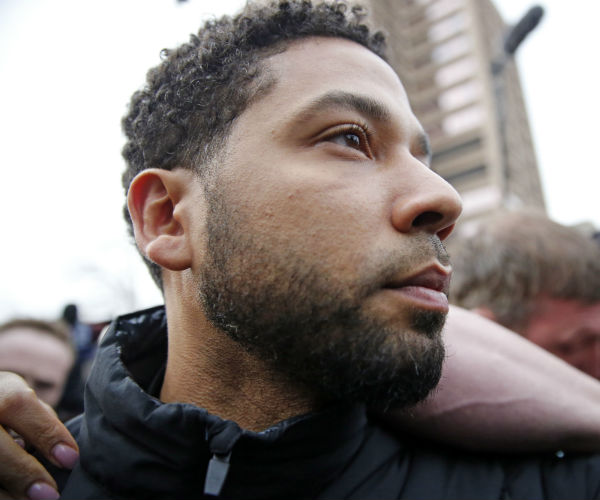
The recent allegedly staged hate crime by “Empire” actor Jussie Smollett is a dark symbol of how liberalism, victimization and entitlement have metastasized throughout American Black culture.
When I originally heard this story, it brought back some vivid memories of my teenage years dealing with skin heads, the KKK, and other white supremacist groups in Texas. During my senior year of high school, while playing football under the Friday night lights, I had to deal with nooses being dangled in the stands. In 1996, we were the number one rated team in the state. Our rivals would do anything to get the betters of us. Fans from one opposing team decided to “string up” black dolls with my jersey number on them. Specifically, these fans from Southlake Carroll High School even developed a theme for our highly anticipated rivalry game; “TANHO,” which stood for “tear a n-word’s head off.” Instead of playing victim, I used the other team’s racist antics to motivate me. Needless to say we beat the Southlake Carroll Dragons that night on the way to an undefeated season, and a Texas State title.
My experiences growing up black in the deep-south, combined with my extensive global travel have helped shape my perspective on race and equality in America. And I’ve vowed to always try to inspire others to transcend those who use nooses to intimidate and impede our race, including other black Americans.
No Self Accountability
Our outward cry for sympathy can’t be as strong as our inward pursuit of accountability and prosperity. Too often we rise up and protest harder against other races’ acts of oppression, than we do when we terrorize ourselves. Jussie Smollett’s alleged Chicago hate crime skit got more attention from America’s most powerful black leaders than the dozens of murders committed by black kids in any given weekend in the Windy City.
I was never satisfied with President Obama’s efforts to curb black-on-black violence, especially in Chicago — his home town. Now, we are witnessing Senators Kamala Harris and Cory Booker call Smollett’s skit — “a modern day lynching.” Prior to their comments on Smollett, neither had done enough to stand-up for the thousands of black kids murdered and their mothers who are burying their babies every week in inner cities across America. Most of these cities are run by Democrats, who base their agenda and talking points on what their constituents want to hear, not what they need to hear. This is how elected officials put a figurative “noose” around our necks.
Criminal JusticeHypocrisy
After Bill Clinton’s 1994 Crime Bill was passed, the number of black men locked up for non-violent crimes soared to the millions. Several black Democrats supported this bill then. Ironically 25 years later, many black Democrats were opposed to rolling back this toxic legislation simply because the First Step Act was backed by the Trump Administration.
Despite their tough talk against the broken criminal justice system, black leaders like Sens. Harris and Booker and Reps. Sheila Jackson Lee and John Lewis all put their liberal agenda ahead of bringing freedom and reform to thousands of black men locked up for non-violent crimes. It’s unimaginable to think that the most prominent black leaders in America are using their voting power to keep “nooses” on the necks of our underserved prison population.
Money, Fame, Likes, and Followers
Money, and fame, along with likes and followers on social media, have too often replaced spirituality, love, and community service in the black community. This is caused by our disconnect with our roots and a mentality that has lead us to value money and fame more than helping our own people who are living without access to life’s basic needs. Blacks in America and abroad continue to be the sickest, the poorest, and the most under-educated. Living in America puts us in the upper echelon of the world, no matter your race. Most of my brothers and sisters tend to forget that a black person on welfare in America is wealthy compared to nearly a billion Africans.
Lebron James has recently chosen to compare NFL players to “slaves” and the owners their “slave masters.” Well Mr. James, I played 5 years in the NFL, had my masters degree before I got there, then went on to pursue another degree which was all paid for by the National Football League. As a matter of fact, the NFL gives former players up to $40,000 a year post-retirement to pursue continued education. To make ignorant statements like this about men who make an average of $2.1 million a year, while there are still up to 40 million people actually living in slavery around the world is toxic rhetoric for our young black kids to hear from the most popular black athlete on the planet. Lebron received overwhelming support for this idiocy, further proving that many blacks have completely lost the reality that hundreds of millions of our ancestors live without access to clean water and basic food and medicine, many still in slavery. Like the great Marcus Garvey said, “A people without the knowledge of their past history, origin and culture is like a tree without roots” and that tree cannot grow.
The Hip Hop Effect
What about the self-proclaimed “leaders” — many of whom, unfortunately, have made their fortunes from promoting and marketing destructive behavior to the black community. I grew up on Hop Hip music and though I was sickened by Meek Mill’s support of an 8 year promoting cooking up crack and hustling, I like his music. I still love listening to the latest Jay Z or DJ Khaled track. As a 40 year old man who grew up with both parents, going to great public schools, I can keep music in perspective. We cannot expect a young black kid, with no positive father or mentor to fully understand why they can’t afford to imitate the lifestyle they hear in the lyrics of artists like Future, Jay Z and Beyoncé. Take for example, their recent hit song with DJ Khaled called “Top Off.” In it, the 49-year-old Jay Z repeats “I got the police behind me, ain’t gone stop” then “take the top of the Maybach, f*** these cops.”
In the midst of a national crisis of police shooting unarmed black men, we have our most respected African American entertainer and businessman spreading a message that could easily encourage black youth to hate and disrespect all law enforcement. This is like putting a “noose” around necks of these young black kids.
When I grew up, the Hip Hop culture definitely helped give me the courage to carry my first gun and to sell my first bag of weed. Fortunately, I had parents whom I feared and respected, so I never pushed my flirtation with the criminal lifestyle to the point where I faced serious consequences like jail time. I was blessed. Millions of other black men and women from my generation were not as lucky. They succumbed to the crack epidemic. Now crack baby boomers fill our prisons. Ironically, prison reform is now being cheered on by many of the same rappers who promoted a lifestyle which helped lead these people to prison. Now they are promoting 8 year olds to perform these songs.
I recently heard my 6-year-old son repeating the lyrics of a song called “Mask Off” — by the rapper Future. It was a platinum hit five times over. It promotes drug culture and the casual use of opioids like Percocet and “Molly” — a slang term used for the drug MDMA. This is just one of many hit Hip Hop songs glorifying drug use while we are in the middle of a nationwide opioid epidemic that is killing over 150 people a day. The same vicious cycle that I lived through in the 1980’s and 90’s is happening right before our eyes. Is anyone surprised to see a new generation of young black boys who kill each other by the thousands every year, don’t respect law enforcement and have embraced a Hip Hop culture that promotes the use of lethal drugs?
Today, about 50 percent of black boys drop out of school. Many of them go on to use or sell drugs. It’s the saddest form of life imitating art. The lessons are learned from the rappers they idolize. Where are the songs promoting education? Or calling out their peers who are polluting the minds of our kids? How about songs praising good police officers. This would give more credibility to the black community’s attempts to hold the bad ones accountable? It’s time to stand up and demand that these proclaimed leaders of the Hip Hop world stop putting nooses around our kids necks.
Jack Brewer possesses a unique combination of expertise in the fields of global economic development, sports, and finance through his roles as a successful entrepreneur, executive producer, news contributor, and humanitarian. Currently serving as the CEO and Portfolio Manager of The Brewer Group, Inc. as well as the Founder and Executive Director of The Jack Brewer Foundation (JBF Worldwide), active Shriner and Ambassador and National Spokesperson for the National Association of Police Athletic/ Activities Leagues, Inc. Other key roles include regular contributor to CNBC, Fox Business, and The American City Business Journals, Ambassador for Peace and Sport for the International Federation for Peace and Sustainable Development at the United Nations, Senior Advisor to former H.E. President Joyce Banda of the Republic of Malawi, and three time National Football League (NFL) Team Captain for the Minnesota Vikings, Philadelphia Eagles, and New York Giants. To read more of his reports — Click Here Now.
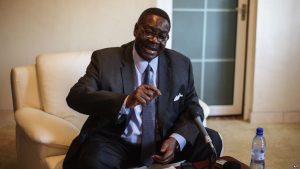
Malawi President Peter Mutharika assents to Malawi dual citizenship law
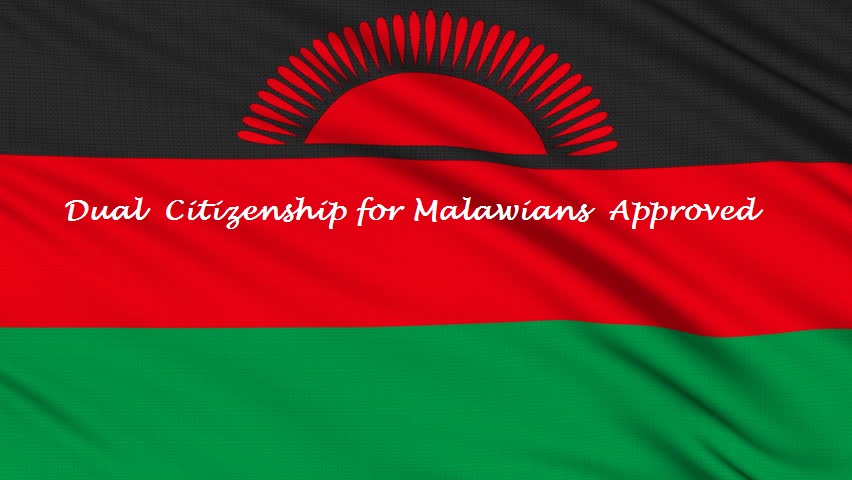
Malawi President Peter Mutharika has assented to the amendment to the Citizenship Act which now provides for dual citizenship law in the country.Speaker of Malawi Parliament Richard Msowoya disclosed the development on Tuesday during announcements to the House at the start of the Mid-year Budget Review Meeting in Lilongwe.
Malawi President Peter Mutharika
Msowoya told the house that among the Bills that were sent to the President to assent, the Dual Citizenship has been given the nod.The new law repeals Sections 8 to 11 of the Citizenship Act which dealt with citizenship of children born outside Malawi, loss of citizenship if a person acquires another citizenship other than by marriage and loss of citizenship by a Malawian woman who marries a foreigner unless she denounces her other citizenship.
It allows for dual citizenship for Malawians with government’s hope of improving socio-economic activity among Malawians.
For children born in the diaspora, the repeal of Section 7, which obligated them to denounce their country of birth upon reaching 21 years, would enable them to reconnect with Malawi better as opposed to being treated as foreigners and applying for visa’s in a country of their parents’ birth.Leader of House Kondwani Nankhumwa disclosed that Minister of Finance, Economic Planning and Development Goodall Gondwe will make his statement on Friday, March 8.It is anticipated that the budget could be cut by as much as MK32 billion from the recurrent expenditure and about MK28 billion from the development budget to make up for the MK60 billion that the World Bank has not disbursed but was factored into the budget.
Nankhumwa said the programme for the budget meeting would remain traditional with Tuesday and Thursday mornings catering for questions to ministers for oral replies and Wednesdays for committee reports.The two-week meeting is the final for the current cohort of Parliament ahead of the May 21 Tripartite Elections.
The budget review meeting runs from March 5 to 18.
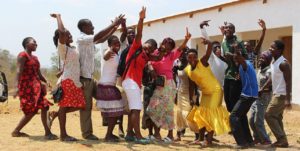
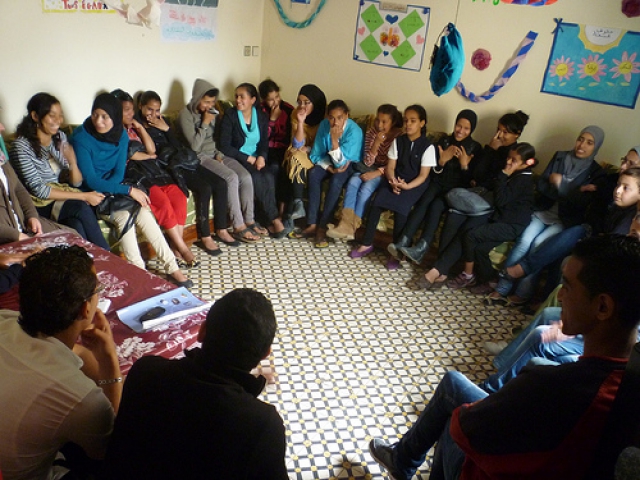
Work-study students, interns, and volunteers of the High Atlas Foundation have opportunities to analyze development as it is experienced in rural and urban communities, by farmers, women, youth, and people of all backgrounds. We also give the students and volunteers the encouragement and support that they need in order to write their observations, improve upon their writing, and to share their work with the public.
This Newsletter is composed of the published articles by HAF’s work-study students, volunteers, and interns. We hope that you find them informative and inspiring. We also hope that you visit HAF and take this opportunity to assist people’s development, research and analyze their situations and how conditions at national and international levels impact people’s lives, and write about it for a global audience. You can now do this and more and receive college credit through the University of Virginia.
These articles that are published in outlets around the world are important not only in regards to the professional growth of the young writers, but because they share the perspectives of the people about whom they are writing, and advocate positions and policies that advance sustainable growth in Morocco and beyond.
We hope to see you in Marrakech as a visiting (and writing) member of HAF’s team.
Yossef Ben-Meir, Ph.D. President High Atlas Foundation yossef@highatlasfoundation.org
Jelani Cobb: “Chadwick Boseman’s T’Challa, the Black Panther and the King of Wakanda, confronts Erik Killmonger, a black American mercenary, played by Michael B. Jordan, as a rival, but the two characters are essentially duelling responses to five centuries of African exploitation at the hands of the West. The villain, to the extent that the term applies, is history itself.” Karen Attiah: “Indeed, ´Black Panther´ offers a radical vision of what black national power and internationalism could look like, if we trusted, respected, and elevated black women … In ´Black Panther,´ as in real life, black women be saving ev-ery-body, white or black.”
Although it did not win the best picture award*, “Black Panther” won three Academy Awards this year, for costume design, production design and musical score. Its cultural as well as commercial success is undeniable. In addition, if there were a ´most thoughtprovoking ´ film award, it would have clearly been the top contender. A superhero film is not intended to be a portrayal of reality. But the film offered, and still offers, multiple opportunities to explore deep historical questions.
* Despite an inspired nomination speech by Trevor Noah, which included a joke only understandable to speakers of Xhosa! https://twitter.com/i/status/1099885201788948481 For more explanation visit http://tinyurl.com/y2y5mmzr
This AfricaFocus Bulletin contains excerpts from seven commentaries from a year ago, particularly noteworthy for their focus on the implications for understanding the history of Africa and the African diaspora. Karen Attiah is a Nigerian-Ghanaian-American, Boima Tucker a Sierra-Leonean-American, Jelani Cobb, Christopher Lebron, and Robyn Spencer are African-American, Thandika Mkandawire and Paul Tiyambe Zeleza are both from Malawi, and live in Sweden and Kenya respectively.
A related AfricaFocus Bulletin also sent out today and available on the web at http://www.africafocus.org/docs19/usa1902b.php, introduces a selection of books and articles exploring in greater depth the wider historical context to which the discussions about ´Black Panther´ point. These include slavery and the Atlantic slave trade, the genocidal conquest of the Americas, and the complex issue or reparations or redress for historical crimes the impact of which still shapes our world today.
For previous AfricaFocus Bulletins on the USA and Africa,visit http://www.africafocus.org/country/usa-africa.php
—Editor’s Note-
Selected Reflections on “Black Panther”
Karen Attiah, “Forget Killmonger — Wakanda’s women are ‘Black Panther’s’ true revolutionaries,” Washington Post, March 1, 2018
http://tinyurl.com/yxgxp7wh
Most of the intellectually interesting — and heated — discussions about “Black Panther” have been about whether the film’s representations of black liberation, internationalism, and imperialism are empowering, or regressive.
As a black woman and the daughter of West African immigrants, the most tragic and scary part about Killmonger and his imperialist vision is that he does not hesitate to sacrifice black women in pursuit of it.
In his blood-soaked quest to seize Wakanda, he leaves behind a trail of dead and injured black women, both American and Wakandan. He kills his African-American girlfriend and partner in crime. He chokes the female priestess of the purple heart-shaped herbs that give Wakanda’s rulers spiritual access to the ancestors. Later in the film, he slices the throat of a member of the all-female royal guards, the Dora Milaje. And, if it wasn’t for T’Challa’s intervention in the grand battle scene, he might have killed T’Challa’s younger sister Shuri, the genius responsible for Wakanda’s technological achievements, including the same vibranium-powered weapons that Killmonger wants to ship to oppressed black peoples around the world. …
And this is the true tragedy of Killmonger — in his trauma-fueled quest for dominance, he does not represent black liberation — rather, he symbolizes the internalization of white patriarchy — which manifests in his external violence against black women.
Indeed, “Black Panther” offers a radical vision of what black national power and internationalism could look like, if we trusted, respected, and elevated black women — especially in maledominated fields such as the military and international diplomacy.
In “Black Panther,” as in real life, black women be saving ev-ery-body, white or black.
3-minute interview with Letitia Wright, Angela Bassett, and Lupita Nyong’o – http://tinyurl.com/y36vl86m
Boima Tucker, “African America’s Wakanda,” Africa is a Country, Feb. 23, 2018.
It’s too soon to tell if this specific cultural moment has done anything to bring African Americans closer to Africans on the continent and its many other diasporas. It doesn’t help that Black Panther’s depiction of the actual African continent is not any more complex than any other in the history of Hollywood. True, in the film African cultures are represented and depicted positively. We have come a long way from Birth of a Nation. However, those cultures are also used piecemeal, cut-and-paste and without context. The only time we see the Wakandans visit another African country it is of course to fight militant Islamists who are kidnapping children. The Africa of Wakanda resembles more an undifferentiated African stew, its parts floating in the red, black and green universe somewhere between Kwanza and Kente.
…
The arrival of Black Panther arrives at a time when black America is diversifying. But it also happens to be a time where the US itself is becoming more isolationist. I know from personal experience that it is not beyond many in the African American community to reflect nativist tendencies. In private conversations, I have heard African Americans say things like “The Muslim-ban protest isn’t my fight” or “What does DACA have to do with me?”
In a perfect world, Black Panther fever would lead more African Americans down a path of knowledge that would inform them that African migrants are crossing oceans, deserts and jungles on foot to get in to the US. That Haitians and African migrants are flooding the Canadian border out of fear of being deported by a xenophobic Trump administration. That Black Lives Matter applies to a mudslide in Sierra Leone or miners killed by police in South Africa. That there is a real life ethno-nationalist, technologically advanced isolationist dictatorship, in Paul Kagame’s Rwanda. That their tax dollars are going to build a giant drone base in Niger. That this knowledge would help open them to a Pan-African political project.
Jelani Cobb, “‘Black Panther’ and the Invention of ‘Africa'” The New Yorker, Feb. 18, 2018
http://tinyurl.com/ydb82dcs
There is a fundamental dissonance in the term “African-American,” two feuding ancestries conjoined by a hyphen. That dissonance—a hyphen standing in for the brutal history that intervened between Africa and America—is the subject of “Black Panther,” Ryan Coogler’s brilliant first installment of the story of Marvel Comics’ landmark black character. “I have a lot of pain inside me,” Coogler told an audience at the Brooklyn Academy of Music, on Wednesday night. “We were taught that we lost the things that made us African. We lost our culture, and now we have to make do with scraps.” Black America is constituted overwhelmingly by the descendants of people who were not only brought to the country against their will but were later inducted into an ambivalent form of citizenship without their input. The Fourteenth Amendment, which granted citizenship to all those born here, supposedly resolved the question of the status of ex-slaves, though those four million individuals were not consulted in its ratification. The unspoken yield of this history is the possibility that the words “African” and “American” should not be joined by a hyphen but separated by an ellipsis.
…
Chadwick Boseman’s T’Challa, the Black Panther and the King of Wakanda, confronts Erik Killmonger, a black American mercenary, played by Michael B. Jordan, as a rival, but the two characters are essentially duelling responses to five centuries of African exploitation at the hands of the West. The villain, to the extent that the term applies, is history itself.
…
it is all but impossible not to notice that Coogler has cast a black American, a Zimbabwean-American, and a Kenyan as a commando team in a film about African redemption. The cast also includes Winston Duke, who is West Indian; Daniel Kaluuya, a black Brit; and Florence Kasumba, a Ugandan-born German woman. The implicit statement in both the film’s themes and its casting is that there is a connection, however vexed, tenuous, and complicated, among the continent’s scattered descendants. Coogler said as much in Brooklyn, when he talked about a trip that he took to South Africa, as research for the film: after discovering cultural elements that reminded him of black communities in the United States, he concluded, “There’s no way they could wipe out what we were for thousands of years. We’re African.”
Christopher Lebron, “‘Black Panther’ Is Not the Movie We Deserve,” Boston Review, Feb. 18, 2018
http://tinyurl.com/y8rvz4vx
Black Panther presents itself as the most radical black experience of the year. We are meant to feel emboldened by the images of T’Challa, a black man clad in a powerful combat suit tearing up the bad guys that threaten good people. But the lessons I learned were these: the bad guy is the black American who has rightly identified white supremacy as the reigning threat to black wellbeing; the bad guy is the one who thinks Wakanda is being selfish in its secret liberation; the bad guy is the one who will no longer stand for patience and moderation—he thinks liberation is many, many decades overdue. And the black hero snuffs him out.
When T’Challa makes his way to Oakland at the movie’s end, he gestures at all the buildings he has bought and promises to bring to the distressed youths the preferred solution of mega-rich neoliberals: educational programming. Don’t get me wrong, education is a powerful and liberating tool, as Paulo Freire taught us, but is that the best we can do? Why not take the case to the United Nations and charge the United States with crimes against humanity, as some nations tried to do in the early moments of the Movement for Black Lives?
Robyn C. Spencer, “Black Feminist Meditations on the Women of Wakanda,” Medium, Feb. 21, 2018
http://tinyurl.com/yy4cg56l
Killmonger is a monarch seeking a throne, a familiar figure in the history of Black protest. Despite his flawed ideas and violent actions as a CIA operative, he is presented as having a redeemable vision of Black futurity. The struggle between T’Challa’s way and Killmonger’s alternative have fueled some of the most provocative think pieces about the meaning of the movie to Black history and politics. However, it is the women of Wakanda who have offered the most justice centered view of what Wakanda can mean in the world. Black Panther” reflects a deep, global and collective hunger for cultural products that represent people of African descent with dignity and power, but that doesn’t mean that one has to swallow everything uncritically. There is potential in this moment. Activists have raised awareness about the 1960s Black Panther Party, rallied for support for political prisoners and held voter registration drives at movie screenings. Fewer have asked why the African future—as imagined in “Black Panther”—and the African past—as sold by ancestry.com—is so much more appealing to some Americans than the African present. There is no better time to launch critical conversations about what liberation could look like; connect new people to pre-existing organizations and political networks; re-center aesthetics in freedom making projects and have some frank transnational diasporic dialogue.
Perhaps the best thing about “Black Panther” is that it grounds these conversations in intergenerational soil. The day after the film, I will ask my daughter to use the tools of Black feminism to re-imagine Wakanda. How should it be organized, run and led? Could she think beyond monarchy and create an alternative system of governance based on values like egalitarianism and collectivity? How might she redistribute, rather than hoard, the wealth of Wakanda for the greater good? What would she do with Killmonger, who at the end finally grasps the splendor of Wakanda yet is incapable of imagining that it had evolved beyond imprisoning vanquished enemies. (A burning question in a country where 2.3 million people are incarcerated.) Most of all, I will ask her about her favorite thinkers and suggest that the women of Wakanda might be the leaders that we have been calling for.
Thandika Mkandawire, Facebook post, March 14, 2018
http://tinyurl.com/y66oqr35
When Africa’s sagging pan-Africanist spirits are their nadir, its Diaspora has stood up to remind us of the dream – from William Blyden, Marcus Garvey, George Padmore, Malcolm X, Bob Marley, W.E.B Dubois, and, of course, Bob Marley “Africa’s Must Unite”.
The history of pan-Africanism is characterized by seesaw-like shifts in emphasis as continental or Diasporic issues have become dominant. In Africa, as elsewhere, Diasporas have played an important role in the reinvention and revitalisation of the “homeland” identity and sense of itself. And today, with the increased capacity to participate in the political life of their homelands, there can be no doubt that the Diaspora will be even more immediate to the rethinking of a new Africa.
…
The sheer size of the continent and the dispersion of peoples of African descent has meant that the pan-Africanist project has had to come to terms with a wide range of identities, interests and concerns which include gender, ethnicity, nationality, religion, race and geographical allocation, to only name some major one. However, as I have said on several occasions, I do not believe that the failure of pan-Africanism can be attributed to lack of identification with Africa by Africans chauvinistically mired in their diverse identities, as it is often stated. Nor is it because individual countries have firmly established successful national identities that somehow militate against the pan-African ideal.
“Africa” is probably the most emotionally evoked name of any continent. Its people sing about it, paint it, and wear it more than any continent. Its artists produce hundreds of icons of this much “beloved continent”. Every major African singer has at least sang one song about Africa. Even national anthems often evoke Africa much more than individual country names.
This said we need all the cultural reinforcement to the panAfrican project. Black Panther has contributed in a spectacular way to the cultural underpinnings and imaginary of pan-Africanism.
Paul Tiyambe Zeleza, “Black Panther and the Persistence of the Colonial Gaze,” Pulse, March 31, 2018
http://tinyurl.com/y2fscfvq
Thus the film bears the great weight of racial representation, of the brilliant possibilities of the past, present and future for African peoples on the continent and in the Diaspora. This is a burden it carries because of the paucity of Black films in Hollywood and one that it ultimately fails to uphold because it’s too much for one film to bear.
While I found the film interesting even engrossing in parts I was underwhelmed. In fact, I left the theater quite troubled by the pervasive tropes of colonial discourse that frame the film despite its eagerness to invoke a progressive Pan-African aesthetic.
The tropes of the colonial gaze are signaled at the outset. We are told Wakanda is a ‘tribal’ nation-state. None of Africa’s major precolonial states—from the ancient Nile valley civilizations to the great empires of Western Africa, not to mention others elsewhere on the continent—were ‘tribal’ states; they were multiethnic or to use contemporary terms multi-cultural and multinational states and societies. And contemporary African states, formed out of the historical geography of European colonialism, are almost invariably multi-ethnic, multicultural, and multireligious.
The term ‘tribe’ is the ‘N’ word of colonial denigration for African societies. There is nothing authentic or liberating about referring to African communities as ‘tribal,’ a term that evokes atavistic identities and primordial politics.
The representations of Wakanda reek with other Eurocentric stereotypes. The accession to and defense of the throne are marked by ferocious and bloody fights. The contestation between the king of Wakanda, T’Challa, the Black Panther, and his estranged African American cousin and interloper, Erik Kilmonger, degenerates into the ‘inter-tribal’ warfare of colonial folklore, together with the Tarzanian animalistic chants by the neighboring kingdom that comes to intervene. There are also the shields and spears and gyrations of old Hollywood films about ‘tribal’ African warfare.
…
In other words, despite all its best counter-hegemonic efforts, Wakanda’s Africa is quintessentially sub-Saharan Africa, the truncated Africa of Eurocentric cartography, of Europe’s ultimate other. Black Panther offers us an Afrocentric projection of an Africa invented by the racialized and racist realities and rhetoric of American history and society. It is not a reflection of the bewildering complexities, contradictions, and diversities of Africa itself.
AfricaFocus Bulletin is an independent electronic publication providing reposted commentary and analysis on African issues, with a particular focus on U.S. and international policies. AfricaFocus Bulletin is edited by William Minter.
AfricaFocus Bulletin can be reached at africafocus@igc.org. Please write to this address to suggest material for inclusion. For more information about reposted material, please contact directly the original source mentioned. For a full archive and other resources, see http://www.africafocus.org
It’s still winter in America, with downtown Milwaukee lined by banks of dirty snow, but there is sunshine in this room. Donald Trump remains in office, as anger and disillusion festers, but Malcolm Brogdon defies these downbeat days. Fiery eloquence and hope pour out of the NBA’s 2017 Rookie of the Year who plays for the most exciting basketball team in America. The Milwaukee Bucks lead the Eastern Conference and have the best record in the league.
Giannis Antetokounmpo, a 6ft 11in Greek immigrant of Nigerian descent, is the Bucks’ exhilarating star who now bears comparison with LeBron James and Steph Curry. But Brogdon is the steady heart of this young team. Antetokounmpo is called the Greek Freak while Brogdon’s stately nickname is The President. Having come late to the pro ranks after completing his post-graduate degree, the 26-year-old talks with the resolve of a man destined for more important matters than his current drive to help the Bucks become NBA champions for only the second time in their five-decade history – and the first since a young Kareem Abdul-Jabbar was in their fold.
“It speaks to America as a whole,” Brogdon says as he considers the perennial question of race in a country where Trump sits in the White House. “We’ve elected someone who allows hatred and racism to continue and, in some way, supports it. It was shocking when we put him in office but having him there has allowed everyone to see what people in the country really feel. Now we can rebuild the country properly. It’s about electing someone that unites people and supports progressive ideas. We no longer need a president who tries to destroy people.”
Brogdon, a quietly impassioned orator, pauses. “It’s ironic because, while Trump tries to break people down and tear them apart, he’s brought so many of us together. This is especially true for the black community. One of our main problems is that, after the Civil Rights movement, black people did not look after each other. But having Trump in office has brought us together.”
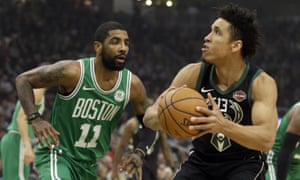
Malcolm Brogdon’s Bucks have the best record in the NBA this season, outperforming the likes of Kyrie Irving’s Boston Celtics in the Eastern Conference. Photograph: Aaron Gash/AP
An hour-long conversation with Brogdon is very different to a routine sports interview. I am struck by the cool intelligence and defiant optimism that surges through him and can understand why a superstar like Antetokounmpo has stressed his teammate’s nickname is not a joke – but echoes a belief among the Bucks that they could have a giant of a man in their midst.
Brogdon takes a difficult subject such as racism and turns it over to find something new to say. “It builds mental toughness. It builds character. It builds identity. From a young age you figure out I can be a smart, articulate, educated black man and still identify as an African American. I’m named after Malcolm X and Malcolm always said: ‘If you don’t have education then you have no future.’ My parents are huge Malcolm X fans and raised me according to his guidelines.
“But I went to a school [in Atlanta] where many racist situations occurred. The basketball was pretty racist; the classroom was very racist. The teachers were so blatant in their targeting based on colour. I went to a private school and I only had one or two black friends. We were always the ones in detention. My mom knew to get me out of there. But I’d go to basketball practice with my black friends, in my neighbourhood, and me and my brothers were called white because we went to private school and were articulate.”
His father, Mitchell, is a lawyer, while Brogdon’s mother, Jann Adams, is the former chair of the psychology department at Atlanta’s Morehouse College, among the most famous of America’s historically black colleges and universities. She is now the associate dean of the science and maths department. “I was lucky I had a mom who had seen it all. From seeing my grandfather march in the Civil Rights era, she understood the depth, character and stability you need to go through racism. She taught me not to accept it to but deal with it, and be better than it. My mom grew up in Waco, Texas, when the KKK was still prominent. She remembers them burning crosses in the front yard. The racism was palpable every day.”
Brogdon tells me the remarkable story of how his parents made the decision, when he and his two brothers were still young, to move the family out of a middle-class neighbourhood. “We moved into inner-city Atlanta. It was a developing neighbourhood but it was lower income. It was one of the best moves my parents ever made. It was a conscious decision on their part to make sure we grew up with an understanding of what other people had to go through.”
His parents also took their boys to Africa, on a three-week trip to Ghana where, instead of a vacation, they worked in day-care and maternity centres. While playing soccer with barefoot local kids, Brogdon realised how fortunate his family were in comparison to most people. “I have great memories from childhood. Of course the divorce, when I was 11, was tough. But my mom, especially, did a great job in raising us. She rooted us in black environments while situating us in private school. We tasted both sides.”
There was a basketball court just behind Brogdon’s backyard in Atlanta and his face lights up at a surreal memory. “We had crackheads, all types of users, coming by the court. We befriended all of them. They would come play with us. My mom saw no danger. She thought it was a great environment for us to learn how to be with different people. They knew our names, we knew their names. We had fun every day.
The Bucks’ new practice facility is adjacent to their stadium in downtown Milwaukee. Photograph: Adam Jason Cohen/The Guardian
“I learnt that drug users could be good people too. They had just gone down a wrong path. It’s easy to dismiss people but my grandfather taught us to think differently. He marched with Dr Martin Luther King and to this day my grandmother is great friends with Andrew Young [a King confidant who became the US Ambassador to the United Nations]. It was a blessing and a privilege to have my grandfather – a giant among men.”
As a kid did Brogdon believe a career in the NBA was impossible? “My parents never planted the seed that anything was impossible. They planted the seed that things were doubly hard for a black man. My brothers and I made sure we outworked people and were better than everyone we were around.”
Brogdon smiles. “Anyway, I really wanted to play professional soccer. I loved Arsenal and Thierry Henry. Soccer is still my favourite sport. I was a striker – like Henry. But things changed when I got to the ninth grade. My brother was always playing basketball and I wanted to be more like him. I wanted to be around more black people.”
We discuss my interview last year with Jaylen Brown, of the Boston Celtics, another impressive young NBA player. It was rumoured that an unnamed executive said Brown was “too smart” – a euphemism for being too educated and political. “Absolutely. Me and Jaylen went through the same [2016] draft. I went into draft interviews and they would say: ‘You went to college for four years, and got your master’s in your fifth year. Are you sure you want to be an NBA player? Don’t you want to go into politics?’ It seems as if you’re black you can’t be both educated and a sportsman. I’d rather they said: ‘You showed so much dedication and perseverance in your studies we know you will show it on the court.’”
It does not sound like an isolated incident. “There were multiple teams. But it’s not disheartening. It’s empowering and a chance for me to break the mould for younger black athletes get their degree, their master’s, and come into the NBA and shock the world.”
Malcolm Brogdon is full of praise for his All-Star teammate Giannis Antetokounmpo. Photograph: Jeffrey Phelps/AP
Brogdon still believes that “the NBA is the most progressive league out there. I’ve been a bit surprised, and encouraged, by the NBA’s support for athletes that speak out. Compared to the NFL it’s night and day. Look at the NFL’s treatment of Colin Kaepernick [who was shut out of football after he refused to stand for the national anthem]. Kaepernick is a hero. When you talk about Malcolm X and Dr King the word that comes to mind is sacrifice. Colin Kaepernick is the epitome of that sacrifice in our generation. I love it that black athletes are now willing to speak out. It’s inspiring.”
The Bucks have been inspiring on court. At their new arena, the stunning Fiserv Forum in Milwaukee, I saw them demolish the Dallas Mavericks. With Antetokounmpo and Brogdon in full flow, it’s easy to imagine the Bucks facing the Golden State Warriors, the imperious champions, in June’s NBA finals.
“Absolutely,” Brogdon says. “We have a phenomenal coach [Mike Budenholzer] and a phenomenal system. We have guys with little ego and a superstar, Giannis, who is top five in the league. We have great role players behind him. You can’t get a better recipe than that – unless you’re Golden State. But we’ve already beaten them this season [the Bucks won easily in Oakland, in November, with Brogdon scoring 20 points]. I’m living my dream and playing in the NBA. But the next level of the dream is to win a championship. It’s something very few NBA guys do – so it would be amazing.”
The Bucks new state of the art practice facitilty is adjacent to their brand new stadium in downtown Milwaukee. Photograph: Adam Jason Cohen/The Guardian
He laughs when asked what it’s like to play with Antetokounmpo. “Giannis does so many amazing things on the floor. A lot of time you just watch him play – like the fans. Sometimes you just have to get out of the way, and let him do his thing. For six or seven minutes, long stretches, he dominates. There are times when he needs support but Giannis attracts so much attention that often all you have to do is stand on the perimeter and shoot at the ring – or cut to the basket and score a lay off. He makes the game easy for us.”
Peter Feigin, the Bucks’ charismatic president, is a New Yorker who offended many locals in 2016 when he said Milwaukee is “the most segregated and racist place” he had known. Was Brogdon surprised? “Not at all. Before I came to Milwaukee I’d heard the city was the most segregated in the country. I’d heard it was racist. When I got here it was extremely segregated. I’ve never lived in a city this segregated. Milwaukee’s very behind in terms of being progressive. There are things that need to change rapidly.”
Is this an opportunity to change Milwaukee? “Absolutely. Leadership and change starts from the top down – with our owners being progressive. They encourage players that also want to be forward thinking. For them to support Peter Feigin is a big sign and encourages us to do the same. To speak out for what is good and right.”
Is Milwaukee, agog with the brilliance of the Greek Freak and teammates like Brogdon, already changing? “It’s amazing how sports is a way to control the masses. But it also unites people. When you have a team on the rise, with a player like Giannis, it brings the city together. The owners, and Peter Feigin, have trademarked the team as something the city can really get behind as a progressive unit.”
Before he won Rookie of the Year, Brogdon persuaded the Bucks to divert all the money they had earmarked for his campaign to charity. “I thought my play would speak for itself and all the money put into that should go to something more important. The award is superficial. It’s more important to give back when you can.”
Brodgon’s master’s thesis was on the necessity for clean water in rural South Africa. “When I first went to Africa, aged 11, it was the trip of a lifetime. It ignited a fire in me. I saw people less privileged than me. But they were still happy – even if they didn’t have clean water. They didn’t have food to eat. They were starving to death. From then on I wanted to make a change.
“I went on a mission trip with my grandparents – to Malawi – when I was 14. Malawi was far worse off than Ghana. It was mind-boggling that people don’t have clean water. And then an opportunity arose. During my thesis I was looking for an organisation I could work with. And there happened to be one based in Charlottesville. I worked with them on my thesis, went out [to South Africa] for nine days and it was the best trip I’ve ever taken.”
[embedded content]
Brogdon is the founder of Hoop2o which, last October, he and four other NBA players launched to help people benefit from clean water in Tanzania. By late January they had raised $125,000 and built two wells which now provide water to 11,000 people. Brogdon also works with the NFL player Chris Long, who started Waterboys – an initiative that funds 55 wells and provides clean water to 210,000 people in Africa. Their aim is for their wells to reach a million people – as a child in Africa dies every 90 seconds from a water-related disease.
“Clean water allows little girls traveling miles to school to get an education,” he adds. “It allows them not to be eaten by animals when they’re trying to get water.”
Did he know Long, one of the most politically conscious white sportsmen in America, when they both went to the University of Virginia? “I didn’t as he’s about [seven] years older than me. I just heard great things about him. Chris is totally aware of what’s happening in America and the world and he’s amazing.”
“That’s not my experience of Charlottesville,” Brogdon says, “but it was a powerful reminder of racism and prejudice. I see the news, I read, and there’s so much hatred and violence.”
Trump initially refused to comment on Charlottesville – and when he did speak the President praised the “many fine people on both sides”. Despite the constant accusations swirling around Trump, many Americans believe he will be re-elected. “It’s very realistic,” Brogdon says of that bleak possibility. “It’s very discouraging. But the focus has to be on getting the minorities, especially African Americans, voting. We have a history of not voting. But people died for our right to vote. We must get out and vote and change the outcome of these future elections.”
What will Brodgon be doing in 10 years? “I’ll be finding something that will impact people’s lives. I’d like to stay in the non-profit sector whether it’s clean water or fighting poverty. I have a passion for Africa and I would love to continue to use my resources to help others.”
Is politics too dirty a business? “No, it’s not too dirty. There are good people in politics that are doing great work. But is a business where there is dirt. If I want to get into that I have to be ready to take on every aspect – including politicking. It’s similar to the NBA. You have to fight for what you want. I need to decide if I want another career like that because, by that time, I’ll have kids. But it’s possible.”
How did his presidential nickname arise? “That came up when President Obama was in office. People said I spoke like him and looked like him. I was articulate and had my master’s degree. People started to call me The President.”
Brogdon, who will surely do even more in life than chase down an NBA championship in Milwaukee, smiles when asked if he likes his nickname. “I love it – as long as you know the context. We need context for everything.”
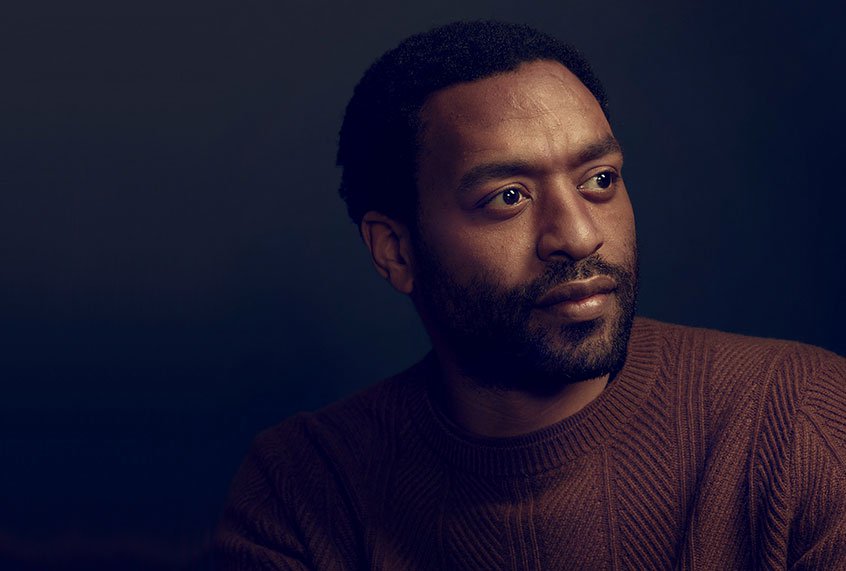
Academy Award-nominated actor Chiwetel Ejiofor joined me on “Salon Talks” to discuss the nearly 10-year process of directing his first feature film, “The Boy Who Harnessed the Wind,” streaming on Netflix and showing in select theaters on March 1. Ejiofor also wrote the screenplay and stars in the film, which is set in Malawi and based on a true story.
Advertisement:
Adapted from the bestselling memoir by William Kamkwamba and Bryan Mealer, “The Boy Who Harnessed the Wind” tells the story of Kamkwamba at 13, forced to drop out of secondary school in Malawi because of his family’s financial struggles. He ends up inventing an unconventional way to save his family and village from famine by building a wind turbine that creates electricity.
Ejiofor traveled to Malawi to shoot the film, and once mixed in with the people, he absorbed the culture and learned to speak Chichewa. His film represents Malawi in an authentic, beautiful way by honing in intimately on one family’s story. It will probably make the people of Malawi proud, which was very important to Ejiofor. To me, his careful approach is the optimal way to portray and showcase cultures that are not our own.
Advertisement:
When he sat down with me at Salon this week to about the film, Ejiofor sparked a much-needed conversation about how society is quick to box people in by the culture they belong to. There’s only one Malawi in Africa, and it’s not the same as Nigeria, or Egypt — each is equally unique and special in its own right and deserves to respected as such. Generalizations about Africa are disrespectful and do nothing but promote false and dangerous stereotypes.
My friends and I never heard anything positive about Africa growing up. I remember seeing racist cartoons of tribal men, or what looked like sharecroppers on Looney Toons, back in the day. We learned nothing about the continent in school. Meanwhile, the older beer drinking dudes who hung by the lobby in my aunt’s projects, mainly Boof, would say things like, “Dem Africans hate us and they stink just like their jungle country!” I know he’s a fool now, but as kids, we were just listening to the adults.
We didn’t have rebuttals. There weren’t any people from any part of Africa living in my neighborhood. Collectively we weren’t exposed to positive representations of Africa or any of its beautiful countries. It wasn’t until high school that I met a friend, Jol, who taught me differently.
Advertisement:
She was Nigerian — Yoruba to be exact — and moved to Baltimore from West Virginia as a tenth grader. One day we were all hanging by the same lobby where the older drunks had boozed, and the conversation about Africa surfaced. I started with joking about 7′-7″ former NBA player Manute Bol, who’s from Sudan. We all dived into our bag of stereotypes until Jol was like, “You guys do know I’m from Nigeria.”
At first, I thought she was joking. We all did. No one believed her. She dipped off and stopped coming around us, so I knocked on her door one day and asked, “What’s up?” and she told me how she’s sick of everybody hating on Africa. So I started hanging with her without the rest of my crew and we became close. I learned about her family, their culture, history and how narrow our view of Africa was.
She introduced me to more Nigerians and I developed immense respect for them when I observed their honest work ethic. Nigerians are hustlers. The more time I spent with them, I learned that I was more African than American. I started going to Jol’s family functions and never missed the feasts her mom put on. My time with Jol forced me to quickly correct people like Boof who spread false ideas about Africa, treating the continent like it’s not the mother civilization but one monolithic place full of disease, famine and ignorance.
Stereotypes around Africa persist today, and I’m even witnessing it in the classroom.
Advertisement:
“African Americans are lazy,” a young Nigerian student with a strong accent said during a communication class I taught a few years back at Coppin State University in Baltimore. “They have all the opportunities in the world, but they just want sell drugs and go to jail.”
All the African-American students attacked her with the same stereotypes I grew up with, while some of the students from the islands agreed.
“My family came here with nothing!” she countered. “And now my dad has two cabs, my mom is a nurse and I’m in college!”
Advertisement:
“That’s actually not that impressive,” an African-American student replied. “My mom is a doctor, so what are you saying?”
I calmed down the group, and we moved into a more important conversation about putting people or groups of people into boxes. Ethnicity doesn’t determine destruction, failure or guaranteed success.
My Nigerian friends never boxed me in, but some of the students explained that this has been a very common experience they have had when dealing with immigrants. African Americans can be victims of the same kind of false stigmas that disrespect African and other immigrant POC cultures.
Advertisement:
The fact is that people make these bad assumptions because they have no connection or exposures to cultures outside of their own. When you are fortunate enough to interact with another culture, the goal should be to learn all you can and absorb.
Ejiofor, a proud son of Nigerian immigrants who was born and raised in the UK and acts in American films, taught me that Malawi was beautiful because through “The Boy Who Harnessed the Wind,” he used his art to take me to place I have never traveled to. That one film doesn’t make me an expert on Malawi culture; however, it’s given a better understanding of that part of the world and I’m more complete for it.
Read our full “Salon Talks” conversation below, or watch it here.
Explain the title of the film for people who aren’t familiar with William’s story.
Advertisement:
“Boy Who Harnessed the Wind” is a film that’s based on the memoir of William Kamkwamba, of the same title, and it tells his story of when he was 13 years old in Malawi in 2001 to 2002, and the circumstances of his life there in his very rural community. There was an impending famine situation based on a flooding that had happened, and then a drought — a kind of double whammy.
His community was sort of bracing for the impact of this as the prices of grain raised through the roof and they had a terrible harvest. He was taken out of secondary school, because secondary school isn’t free in Malawi, and they waited for this impending doom, essentially.
He started sneaking into the school, and started sneaking into the library, and trying to get into the library because he was very keen in science and technology and wanted to continue his studies. On one occasion, he went into the library and he found a book titled “Using Energy,” an American textbook. And on the front of it was a picture of a windmill, and so that’s what inspired him to start trying to pull together whatever scraps he could find and see if in these very challenging circumstances, he could build a wind turbine to help his community.
It’s such an inspiring story and it gives the viewer such energy: you feel like you can do anything if you put your mind to it, if you put in the actual work. Talk about Malawi. What was your experience like filming there?
Advertisement:
I first went to Malawi in about 2009, 2010, just after the book came out. I’d written a first draft of the screenplay, and started to develop the film and I went out to do some research before continuing.
Your first trip was actually because of the book?
Yes, exactly. I was inspired to write the draft and then go out and meet William Kamkwamba. He took me around to Kasungu, which is the region that he’s from. He took me into Wimbe, which is the very specific village that he’s from. I met his family, his community, just a whole host of people. He was very generous with his time and that community was very welcoming.
Then I just started to travel the country. I wanted just to get a real sense of Malawi and so we went to the car and a couple of us—I had somebody had to help me with translation, if I needed it—and somebody else who was just helping me with logistics, and we just traveled around the country and got a feel for it really.
Advertisement:
As an actor, you have an amazing, extremely diverse body of work. You’ve done everything from “Melinda and Melinda” to playing Frank Lucas’ little brother in “American Gangster.” How did you end up choosing this film to be your directorial debut?
Well, it was really just the book, just reading the book and understanding its layers and its complexity. On the surface of it, there’s a kind of beautiful simplicity to the story and to what William Kamkwamba did in that time, but as you sort of start to kind of peel the onion you realize just how complex this journey is and how it involves so many other, sort of, wider themes and ideas.
There are social ideas, there are geopolitical ideas, the relationship and the dynamics that we have to other countries in the world and economics and so on, and of course to the changing climate, and the environmental damage of deforestation and things like this. There just seemed to be a very wide platform to discuss a lot of different things within the context of talking about this very detailed, personal, interpersonal family dynamic centering largely on this father and son, and this sort of intergenerational discussion
You learned the language and everything too. You put some serious prep work in.
Advertisement:
I wanted to create an environment where an audience is really invited into a kind of private space and to a very authentic world. Part of that for me was to learn Chichewa, which is one of the languages of Malawi that’s spoken in this region. Quite early in the process I knew that that’s what I wanted to do.
When I started to get the script translated, which I did with Samson Kambalu , who is a Malawian who lives in the UK and is a writer and is an artist, I was able to sort of get a groundwork in basic Chichewa and then to start to sort of learn the lines in the script.
Then when I was casting, we cast in Malawi as well as in Kenya and we cast Aïssa Maïga out of Paris, so those who didn’t speak Chichewa and those who did speak Chichewa would work together and we’d start to, sort of, work together as a little community.
As an artist you’ve had to learn how to perform within so many different cultures—the African culture in “The Boy Who Harnessed the Wind,” the culture of “American Gangster,” for example. There are so many different complexities inside the Black experience in general because if we’re keeping it all the way honest, race is a thing — people, they look at it and they talk about it. A lot of times, if you’re Black you’re put in a box. If you’re from some country in Africa, you’re just from Africa, as if Africa is just one place; as if it’s not so many different tribes and experiences. Is that something that you keep in mind for every role and every project?
Yeah, 100 percent, 100 percent. I am engaged and I love to be engaged and work and think about things that work in terms of the African diaspora, and the specifics of that. That is always something that I have gravitated to in my work.
I think that it’s such a rich template, and so many extraordinary stories and avenues and ways of telling stories, and epic stories, big stories, emotional stories, stories that really move and stories, such as this one that, I think, not only move, but inspire. And I think you’re absolutely right, that there’s so many specific details and cultural details that are rich and rewarding.
You know when I was looking at this film, and when I was trying to make this film, it was to me a deep dive into Malawian culture and the spirit of Malawi, and then the rural communities, understanding that I, as a young man and as I grew older I traveled back and forth to Nigeria very often, and to the rural communities in Nigeria at times. I had a sense of that kind of dynamic, and realizing that obviously Malawian rural community is very different, but there are some similarities.
And as you say, there is no generic Africa. There are some similarities, but there are also these distinctions; these differences, these kind of individual traits. So it was really [about] exploring those; finding what was specific about Malawi, what you fall in love with about this country and how this country in many ways creates this solution, that it’s the whole package. It’s not what people are, but who they are.
I feel like your film is going to help some of the big social generalizations, which is a problem because when they exist it prohibits social relations. It can be disrespectful and it can be harmful. What were the challenges of being a director? Instead of just having to worry about yourself as an actor, you now have to worry about all these different moving parts on set.
It’s a very steep learning curve and really understanding how much there is to take on board was pretty interesting. And then, on top of that we had the straight forward logistics. I’d made certain decisions very early in the process that had serious implications. I wanted to shoot in Malawi.
There haven’t been a lot of films made in Malawi and there certainly not been film of this scale made in Malawi. So there was no real infrastructure to make films in the country. That meant that we had to really bring in a lot of things. And so the kind of logistical concerns of getting staff and equipment from Kenya and getting equipment from South Africa was a big part of that process.
But that was offset, of course, because the passion and the energy and the depth of feeling from the people in Malawi was so strong that it really felt kind of empowering to all of us making the film. Obviously they were aware of William’s story and they were excited for us to be there. Like it’s a crazy circus just comes to town when you’ve got a film unit that is descending on a small village in Malawi, but it was really important that they got behind this.
While you’re acting in a scene, you have to be the director too and yell cut in the middle of a scene, right?
That is also really weird. That was actually, in a strange way, the most weirdly awkward part of the whole process because I felt like I still needed to keep the cut. I didn’t need to call action because the first AD calls action. The director can call action but doesn’t need to. But calling cut is quite important for the director to do and to kind of hold the right to do that in case you want to linger a shot, whether you want roll again, whether whatever. That means kind of coming out of character slightly. I think there’s kind of an awkward b-roll that is going to be cut together of me just coming out of character to say cut.
Now that you’ve directed a film, do you ever think about any of your films from the past and think I wish I would have directed that film or made it differently?
I actually didn’t think of it like that. I mean I definitely felt when I was going into the process that there were films that I had felt had really worked in certain ways because of decisions that had been made. Just understanding that is very useful going into the process of directing. Also, and equally useful, if not more useful, is the times when there are decisions that you didn’t think were great. And trying to sort of avoid making those kind of choices. Having had a lot of experience in film, that kind of vocational quality to approaching directing was really useful.
Education was an important theme in the film. I think that a lot of people are going to see it and feel the power—the power of reading, the power of thinking, the power of just being able to imagine a reality that you don’t live in. Was that one of your main goals?
Absolutely, 100 percent. The critical power of education can’t be underestimated. It is the difference between here and there if somebody wants it to be. I feel that it is a question of empowering young people to sort of, as William Kamkwamba did, identify the problems that he faces and identify the solutions to those problems and to live in the solution to the problems.
That’s one of the things that I thought was just so incredibly remarkable about him doing that and feeling that and working within that at the age of 13. I think it’s inspiring not only to people who of that similar sort of age group. I think it’s inspiring to everybody, to everybody that faces challenges, to nations that face challenges.
You have some people who will always say they like the book more than the movie or vice versa. How do you approach that as an artist? Because the book itself is amazing and did really well, but the film is special in a different way.
I think you need to take a bit of time to sort of analyze and really find what it exactly is that you like about the book. Of course you might like the story and that is great and broadly speaking you can relay the story in the film, but I think you’ve gotta kind of break it down thematically.
You’ve got to find out sort of very honestly for yourself, what is it about the book, what is it that it represents for you, and how do you then go about structuring that into a screenplay that is personal to you. You got to sort of take the book apart in a way and rebuild it as a sort of combination of you and it, as honestly as you can.
I think it would be great if schools gave the book to kids so they that could read it and be inspired by the story, but then actually be rewarded by seeing the film, so it’s like it’s two whole different things.
Yeah and they’d see what was similar and what were the differences. And it’d actually open up a little bit more of the conversation of how you go about structuring a screenplay as well.
Are you directing again? Is there something in your future?
Yeah, I certainly hope so. It’s been a very exciting process for me. And I was incredibly fortunate to find something that I was so excited by, that I stuck with for 10 years more or less you know, through the kind of peaks and troughs of that experience. And I think that’s what it needs really. I don’t need to spend that long, but it needs something that you really feel as passionate about.
Something in Nigeria, or something in the UK, what do you think?
Maybe. We’ll see. I think there is a lot of opportunities, basically. And I’m excited about pursuing them.
I was reading an interview that you did a while back, and you were talking about playing Othello as a young person and then revisiting the role as an adult. Do you feel like you’re able to convey certain emotions in a reverse way? Like, of course when you are young you don’t really understand jealousy and things like that the way you do when you get older. Are there certain things that you played as a young person that you feel like you couldn’t really do or redo, or certain energy that you couldn’t visit, or do all those life lessons add up and you get better with age?
That’s a great question. You know there’s a Bob Dylan line, I was much older then and I’m younger than that now. And I feel like sometimes that’s true for me as well that there are certain things that I did and I can look at and I can see that I did when I was younger that I don’t know what would be.
There would be something interrupting me now. There would be a neurosis that’s built in. There would be something a bit more kind of mannered or slightly harder to find. I would get in my way a little bit more. And I do see that with certain things.
I think, gosh, back then I was fearless and now, not so much. Other things you kind of grow with, you understand life more in a sort of more linear way and so you can get better.
Certainly, with Othello that was true that I felt that when I didn’t understand any of those emotions I couldn’t really be inside of the project. But then years later, I understood all those things.
You’ve accomplished so much. Do you care about awards and stuff like that or do they become just like whatever, afterthoughts?
I mean it’s never been comparable to the doing of it, to the actual engaging in the work and trying to push myself to just as far as I can go with the work, and how much I can get out of the work. I have found, and it might be a slightly a cliché, but I do find that it’s true nonetheless that the work is its own reward if it really sings, if it clicks with you, if you feel that it’s been accomplished well.
Don’t get me wrong, it’s fantastic to get awards as well but it’s not the kind of primary purpose.
Spike Lee got his first competitive Oscar this year, and a lot of us were extremely happy because we feel like he’s been snubbed for a very long time. But sometimes when I look at someone as accomplished as you, or as accomplished as Spike, I wonder does it really matter, do awards matter? You’re already recognized by your peers at such a high level and people are always flocking to the work. Then when you see Spike run on stage and jump on Samuel Jackson, it’s like yeah, it’s the thing!
Yeah, I mean I loved that. I loved that he was so happy. And it did make me reflect. I was like, I hope that if that ever happened to me I would be as happy as Spike because it made me happy that it meant so much to him. And I think that’s great. I think that’s positive that he cared.
You also have “The Lion King” coming out this year. Are you excited about that part?
Very excited. I mean, it’s amazing. As soon as I was asked, I was just kind of thrilled. It was an amazing original, and I think this is going to be incredible. I’m sort of first in line. I’m waiting like everybody else. I’m just really excited by it.



 Work-study students, interns, and volunteers of the