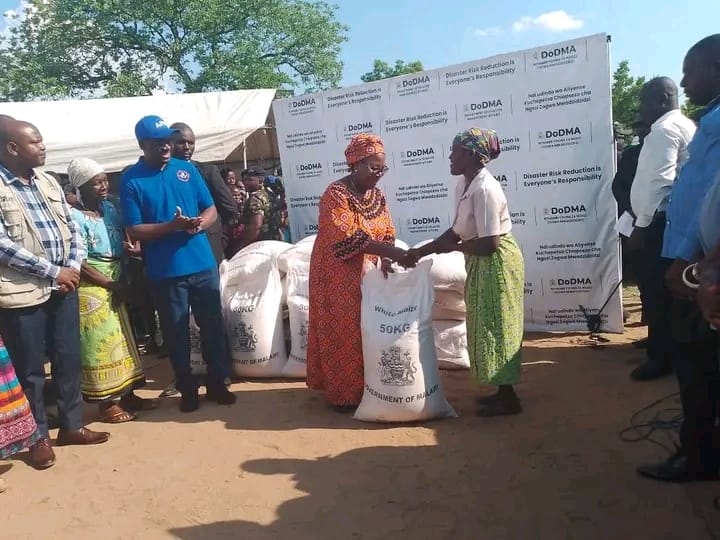
BLANTYRE-(MaraviPost)-Vice President Dr Jane Ansah spearheaded the Lean Season Response Programme in Chikwawa, urging unity and collective commitment in the fight against hunger.
Addressing the gathering, Dr Ansah described the food distribution initiative as a critical intervention designed to support households grappling with severe food shortages during the lean period.
She emphasized that sustainable development at family, community, or national level is impossible without sufficient food.
Dr Ansah explained that the 2024/2025 farming season was severely affected by the La Niña weather pattern, which delayed rainfall, caused erratic showers, and left some areas parched, leading to widespread crop failure.
She added that crop-destroying pests, economic hardships, and rising commodity prices further aggravated food insecurity for many Malawians.
Citing the latest Malawi Vulnerability Assessment Committee report, Dr Ansah noted that over four million people are at risk of food insecurity between October 2025 and March 2026.
Highlighting government interventions, she said that President Professor Arthur Peter Mutharika declared food insecurity across all districts, necessitating food assistance throughout the country.
She thanked development partners and supporting nations for enabling the timely rollout of the programme and praised district councils for ensuring smooth distribution.
Dr Ansah encouraged communities to adopt modern, climate-smart agricultural practices that reduce reliance on rainfall to secure long-term food stability.
In closing, she urged beneficiaries to use the maize responsibly and report any misuse or fraud, assuring them that legal action would be taken against all acts of corruption.
Share this:
Like this:
LikeLoading…
Discover more from The Maravi Post
Subscribe to get the latest posts sent to your email.
LILONGWE-(MaraviPost)-Vice PresidentJane Ansah welcomed government officials, development partners, and distinguished guests to a special networking dinner held ahead of the 2025 Cabinet Retreat.
She began by expressing sincere gratitude to President Arthur Peter Mutharika for entrusting her with the responsibility to preside over the gathering, highlighting the significance of the evening as a platform for dialogue and partnership.
The Vice President noted that the dinner was designed to foster connections among leaders and stakeholders, providing an opportunity to exchange ideas, share experiences, and strengthen collaborative efforts aimed at advancing Malawi’s national development agenda.
She extended warm appreciation to Ahunna Eziakonwa, United Nations Assistant Secretary-General and UNDP Assistant Administrator, who also serves as Director of the Regional Bureau for Africa, for her insightful address that emphasised the critical role of partnerships in achieving sustainable development.
Frost happy with new leadership
Acknowledging the United Nations Development Programme (UNDP) for its continuous support, the Vice President remarked that the evening represented more than a ceremonial gathering, serving instead as a forum to prepare for the discussions and strategic planning that would take place during the Cabinet Retreat.
Attendees were encouraged to reflect on the challenges facing Malawi, as well as the opportunities that can drive the nation’s economic growth and social transformation.
She emphasised that the path ahead requires coordinated efforts and collective responsibility from all stakeholders, including those who could not be present, reiterating that meaningful progress cannot be achieved through government action alone.
Robust and strategic partnerships, she said, are essential for ensuring accountability, resilience, and long-term development, highlighting the invaluable contribution of development partners in supporting Malawi’s journey toward national transformation.
The Vice President expressed heartfelt gratitude on behalf of the President and herself to all those who contributed to making the dinner a success, recognising both government organisers and UNDP officials for their meticulous planning and dedication.
Sunbird Nkopola Lodge was commended for providing a gracious and conducive environment, while the teams behind the scenes were praised for creating a warm, elegant, and welcoming setting.
Guests were encouraged to enjoy their meal while engaging in meaningful conversations aimed at enhancing national development and promoting collaborative action.
In her closing remarks, Vice President Ansah prayed for God’s blessings upon everyone present, the President, and the nation of Malawi, before concluding by wishing all attendees an enjoyable evening and thanking them once again for their participation.
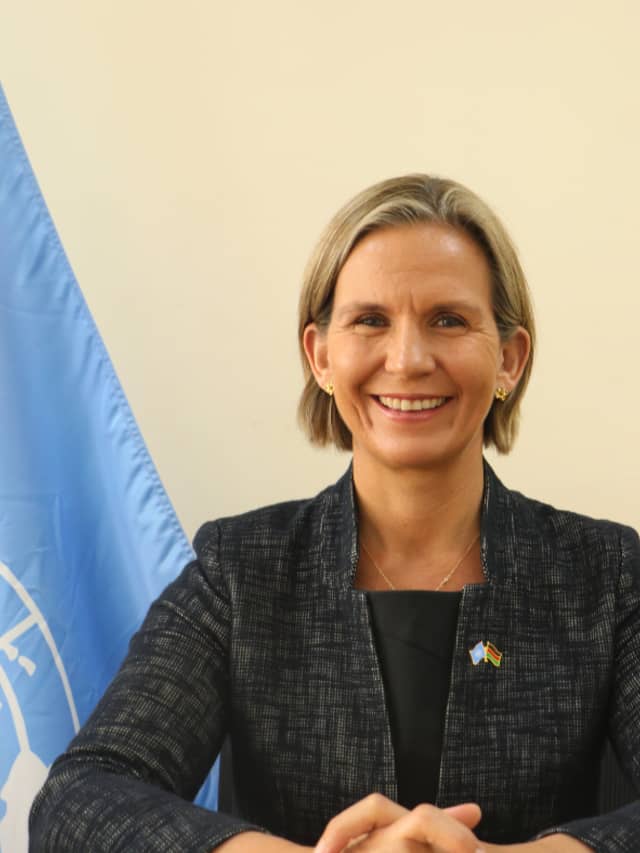
Speaking at the event, Fenella Frost, UNDP Resident Representative in Malawi, described it as a privilege to attend the gathering, highlighting it as an opportunity to celebrate Malawi and the remarkable spirit of its people.
She expressed deep appreciation on behalf of UNDP to the Government of Malawi, the Vice President, and all partners for their continued collaboration and commitment to advancing national development.
Frost described the dinner as inspiring, noting that it reflected both shared achievements and Malawi’s immense potential, while reaffirming UNDP’s dedication to supporting the country’s development aspirations, strengthening institutions, and building a more inclusive and resilient future for all Malawians.
Share this:
Like this:
LikeLoading…
Discover more from The Maravi Post
Subscribe to get the latest posts sent to your email.
BLANTYRE-(MaraviPost)-Malawi on Tuesday received a multimillion-kwacha consignment of solar-powered cold chain equipment, a development expected to significantly reinforce the country’s vaccine delivery and overall public-health systems.
The equipment valued at US$776,000 was provided through a partnership involving Africa CDC, UNICEF and the Mastercard Foundation.
Officials say the new units will help maintain vaccine potency and expand access in communities that continue to face unreliable electricity.
Speaking to journalists,Africa CDC Regional Director Lul Riek described the handover as a milestone for Malawi, emphasizing that the advanced storage technology will ensure life-saving vaccines reach even the most remote parts of the country.
On his part, Secretary for Health Dan Namarika said the new capacity will address long-standing challenges linked to power outages and limited refrigeration, allowing Malawi to reach tens of thousands of children who previously missed routine immunisation.
Government and development partners have since hailed the donation as a major step toward building a stronger and more resilient national immunisation system capable of protecting Malawians of all ages.
Share this:
Like this:
LikeLoading…
Discover more from The Maravi Post
Subscribe to get the latest posts sent to your email.
BLANTYRE-(MaraviPost)-The Malawi government has recalled all Public Relations Officers (PROs) with immediate effect, as confirmed by the Minister of Information, Shadreck Namalomba
The investigation has also revealed that, some of the PROs recalled including Grace Kapatuka, Principal Communications Officer for the Presidential Taskforce on Covid-19 and Cholera; Mphatso Nkuonera from the Ministry of Lands; Pauline Kaude from the Ministry of Gender; Nellie Kapatuka from the Ministry of Labour; Tionge Kampondeni from the Ministry of Mining, Watson Maingo from the Ministry of Transport; and Gift Chiponde from Ministry of Education.
However, investigations by Maravi Post reveal that some PRO officers have not met their fate, including; Adrian Chikumbe and Loness Gwazanga both in the Ministry of Health, and Christopher Kapachika Banda from the Ministry of Education.
Chikumbe and Kapachika were not assigned by the Ministry of Information which is the policy holder, but were just handpicked by some political cadres, allegedly due to their loyalty to the Malawi Congress Party (MCP).
Mphatso Nkuonera, former PRO in the Ministry of Lands, expressed his gratitude in a farewell message that he dropped on Monday, on a WhatsApp forum, stating, “It’s time to say goodbye… You were available 24/7, and I am very grateful, kindly support the incoming.”
When contacted, Minister of Information and Government Chief Spokesperson, Hon. Namalomba confirmed the recall, saying, “The government has indeed recalled all PROs.”
The recall comes amid concerns about the role of PROs in government and their potential influence on public opinion.
The development has sparked speculation about the government’s intentions and the future of the PROs.
The Malawi government has been under pressure to ensure transparency and accountability in its operations.
The recall of PROs may be seen as a step towards achieving this goal.
Further details are awaited on the implications of this move and the government’s plans for the PROs.
Share this:
Like this:
LikeLoading…
Discover more from The Maravi Post
Subscribe to get the latest posts sent to your email.
MANGOCHI-(MaraviPost)-Humanitarian assistance in Mangochi has reignited discussions on long-term food security, as communities in Makawa under Senior Chief Mponda continue to grapple with hunger.
This follows the latest intervention by the Faizan Global Relief Foundation (FGRF), which reached 1,500 people with maize flour.
During the handover ceremony, Agriculture Minister Roza Fatch Mbilizi said the donation reflects the urgent need for stronger partnerships to address the country’s worsening food crisis.
She stressed that Malawi cannot rely on relief distribution alone and must invest in systems that help communities withstand recurring droughts.
Mbilizi noted that with over four million Malawians facing hunger, government efforts through the Department of Disaster Management Affairs (DoDMA) remain critical.
However, she called on development partners to complement these efforts with programmes that also empower farmers with modern farming tools and technologies.
The minister emphasised that repeated food shortages highlight deeper structural challenges in the agricultural sector.
She urged organisations working in disaster response to integrate resilience building initiatives such as irrigation support, seed distribution and climate smart agriculture.
FGRF spokesperson Ibrahim Omar Mataya said the foundation understands these long-term needs and is exploring ways to expand its support beyond emergency food distribution.
The current maize flour donation, worth K20 million, is expected to be followed by six months of additional assistance.
Mataya revealed that FGRF is considering incorporating soy flour and cooking oil to improve nutrition, especially among children and elderly people who are most affected during periods of scarcity.
Community members, while appreciative, echoed concerns about their inability to produce enough food due to last year’s crop failure. Many farms yielded almost nothing after prolonged dry spells destroyed maize fields before harvesting time.
For elderly beneficiaries like 65-year-old Jafali Naphwata, the relief brings temporary comfort, but his fears linger as the next farming season approaches without adequate seed or fertilizer.
He appealed to government and well wishers to support farmers with inputs to avoid another cycle of hunger.
Traditional leaders in the area also expressed the need for coordinated interventions that go beyond short-term handouts.
They believe empowering communities with farming resources would reduce dependency on emergency aid over time.
The donation has therefore sparked broader conversations about how Mangochi and the country at large can shift from crisis-driven responses to sustainable food systems that can withstand climate shocks.
Share this:
Like this:
LikeLoading…
Discover more from The Maravi Post
Subscribe to get the latest posts sent to your email.
Schooling ourselves to protect our present and secure our future
SHOBHA SHUKLA – CNS
Let us go back in time 97 years ago and dare to imagine the plight of those who suffered with bacterial infections before the discovery of world’s first antibiotic in 1928 (penicillin). Without lifesaving medicines, curable or treatable infections could become deadly – once again. Today, a lot of medicines are failing to treat infections because disease-causing bacteria, virus, fungi and/or parasites are becoming drug-resistant – largely because of human-made misuse and overuse of medicines. Choice is ours: Do we want to slip back in time when there were not enough medicines around, or would we stop misuse and overuse of medicines and use them responsibly?
Recent data released by the WHO last month sets the alarm bells ringing on drug-resistance (or antimicrobial resistance or AMR). “Latest AMR surveillance report paints a sobering picture. AMR remains firmly among the top global health threats undermining the foundation of modern medicine. First, the scale of resistance is growing. Roughly one in six bacterial infections worldwide is caused by pathogens resistant to antibiotics. Second, the threat to critical care is real and resistance is particularly severe in gram-negative bacteria – the very pathogens most associated with hospital-acquired infections and high fatality rates. And third, AMR burden is profoundly inequitable. So low- and middle-income countries where health systems are often weaker face the highest resistance levels,” said Dr Tim France, molecular biologist turned global health thought leader.
Silver lining: Data is used as a policy compass
“AMR surveillance coverage and data quality have expanded dramatically. The GLASS (Global AMR and use Surveillance System of the WHO) network now includes 104 countries covering more than 70% of the global population compared to 2016 – a four-fold increase. Political commitment is stronger than ever. AMR global surveillance data is itself now being used as a policy compass, not just as a warning system,” added Dr France, who founded and leads Inis Communication. “MRSA rates have declined steadily in several regions by over 7% annually in Europe, and 6% in Southeast Asia. So focused interventions really do work.” Tim was speaking at the 5th Annual Global Media Forum on Antimicrobial Resistance (ahead of World AMR Awareness Week or WAAW 2025).
Inappropriate use of medicines is not just in human health but also in animal health, food and agriculture
The misuse and overuse of antimicrobial drugs in human health, animal health and livestock, food and agriculture are fuelling AMR. Additionally, environmental pollution – such as untreated hospital and community wastewater, pharmaceutical effluents, and agricultural run-off – plays a growing role in enabling resistant pathogens to emerge and persist across sectors. The consequences of AMR are far-reaching, affecting human and animal health, food safety and security, and placing additional strains on healthcare systems and economies.
Addressing AMR requires urgent, coordinated action and sustained commitment from governments and diverse sectors across the One Health spectrum, said Dr Jean-Pierre Nyemazi, Director of the Quadripartite Joint Secretariat on AMR. The Quadripartite Joint Secretariat has brought 4 global agencies on human health (WHO), food and agriculture (FAO), environment (UNEP) and animal health (WOAH) together to address AMR using the One Health approach.
“Today, 1 out of every 6 bacterial infections confirmed in the laboratory is resistant to antibiotics,” said Dr Javier Yugueros-Marcos, Head of the Antimicrobial Resistance & Veterinary Products Department, World Organization for Animal Health (WOAH).
AMR is already linked to nearly 5 million deaths each year, including 1.14 million deaths directly caused by bacterial AMR. “That is 2 lives lost every minute. Since 2016, countries have worked hard to prevent AMR. Over 90% of the countries (178 countries) have national AMR action plans. But only 22% are fully implementing the national AMR action plans with monitoring and financing in place. So, that is why world leaders stepped up last year in 2024 with another bold commitment enshrined in the Political Declaration adopted in the UNGA 2024 High Level Meeting: 60% of countries must have fully funded national AMR action plans and implement them,” said Dr Nyemazi.
“For us to reach that goal, governments also committed to mobilise at least US$ 100 million by 2030, including through AMR Multi-Partner Trust Fund (AMR MPTF) and other mechanisms. This is a powerful signal that the world understands the urgency and shared responsibility. However, technical solutions alone won’t win this fight. We need a shared responsibility,” said Dr Nyemazi.
“AMR is invisible but I am not”
“AMR is invisible, but the WHO was smart enough to recognise the value of stories of those with lived experiences of AMR,” said Rob Purdie, AMR survivor and Member of WHO Task Force of AMR Survivors.
Around the time of new year 2012, Rob started having a headache and a terrible pain. Rob made several trips to healthcare facilities in the USA and was attended by several doctors and treated for a range of conditions (which later were found to be incorrectly diagnosed). He wrongly got treated for them- from sinus infections to cluster headaches etc.
Right diagnosis was Coccidioidomycosis – a form of meningitis caused by Valley fever, a disease caused by a fungus endemic in the soil of south-west USA.
“My fungal disease of meningitis, primarily presents as a pneumonia – and because of that it is one of the reasons that multiple prescriptions of antibiotics on an average are prescribed to patients of Coccidioidomycosis,” said Rob.
Rob had to endure years of struggle and battle AMR.
“Fungal AMR is very intertwined with agricultural use of pesticides. So rather than emerging out of overprescription of antibiotics – which happens obviously on the bacterial side, it has more to do with the use of pesticides to control fungus in agriculture. That is an important example why One Health approach is so critical to address AMR,” said Rob.
It is high time we stop misuse and overuse of antimicrobial medicines in all sectors – be it human health, animal health and livestock, or food and agriculture, and stop polluting our environment. Let us hope this year’s WAAW 2025 serves as another wake up call to accelerate science-based approaches to prevent AMR with One Health approach.
Shobha Shukla – CNS (Citizen News Service)
(Shobha Shukla is a feminist, health and development justice advocate, and an award-winning founding Managing Editor and Executive Director of CNS (Citizen News Service). She was also the Lead Discussant for SDG-3 at United Nations inter-governmental High Level Political Forum (HLPF 2025). She is a former senior Physics faculty of prestigious Loreto Convent College; current President of Asia Pacific Regional Media Alliance for Health, Gender and Development Justice (APCAT Media); Chairperson of Global AMR Media Alliance (GAMA received AMR One Health Emerging Leaders and Outstanding Talents Award 2024); and Host of SHE & Rights (Sexual Health with Equity & Rights). Follow her on Twitter/X @shobha1shukla or read her writings here www.bit.ly/ShobhaShukla)
– Shared under Creative Commons (CC)
Share this:
Like this:
LikeLoading…
Discover more from The Maravi Post
Subscribe to get the latest posts sent to your email.