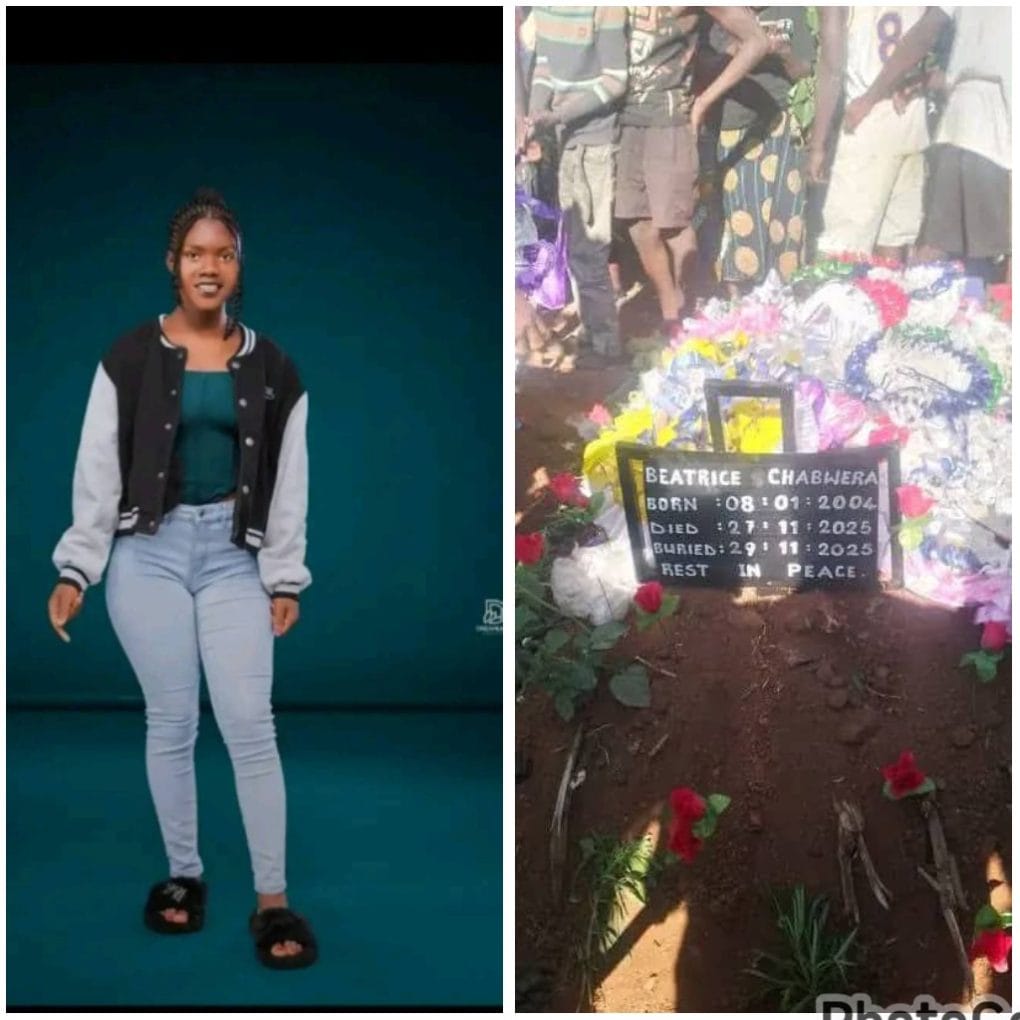

Lilongwe young-lady Beatrice Chabwera laid to rest as her assailants still at large

By Arkangel Tembo

LILONGWE-(MaraviPost)-Dark clouds engulfed the capital city of Malawi on Saturday afternoon, when exactly at 2:03pm, the coffin of a twenty-one year-old girl Beatrice Chabwera was lowered into the grave.

There were tears, and sound of birds singing, “Tukruku tuktuku” inside the cemetery as slowly the innocent girl was on her way to her final resting place.

The choir members were singing,”Amayi tsalani ngakhale mundikonda,Ambuye tsogoleleni ndili ndekha.”

Friends to Beatrice were waving at the coffin as slowly it descended into the grave.

One relative shouted on top of her voice,”Yenda bwino mwanawanga Mulungu akutsogolele,”as adzukulu were instructing each other …lafika bwelesani makasu pafupi.

It was a sad moment, as women shed tears while most of the men hold their hands at their back. Adzukulu started burying the body of Beatrice ,who was sent to an early grave by some evil people.

After she was laid to rest,one by one starting with women left the cemetery leaving behind some relative to Beatrice who kneel down on the tombstone of their lovely Queen.They bowed down and shed tears.

As l write, Beatrice is all alone 6 ft under the ground not that she was sick or had an accident,but some unknown assailants,who stabbed her on the back and neck.

These people are enjoying in their homes,while Beatrice is down on the ground in a tinny coffin.

May Beatrice soul rest in peace


Discover more from The Maravi Post

Subscribe to get the latest posts sent to your email.

The Maravi Post

Chawama legislator Tasila Lungu faces possible loss of seat as absence from Parliament persists

LUSAKA–(MaraviPost)-Edgar Lungu — former Zambian president — died in South Africa on June 5, 2025, prompting his daughter, Tasila Lungu, Member of Parliament for Chawama Constituency, to travel abroad for funeral and related proceedings.

Her prolonged absence from parliamentary sittings has triggered a formal challenge over whether she should retain her seat.

During a parliamentary session on July 15, 2025, an MP raised a point of order questioning whether it was proper to continue recognising her as an MP, given reports that the family might not return to Zambia.

The Speaker of the National Assembly, Nelly Mutti, reserved her ruling at the time but later stipulated that Tasila Lungu must present herself either at the parliamentary offices or the House within 14 days after her father’s burial — or within 14 days of the opening of the Fifth Session of the 13th Assembly.

As at now, no public announcement has been made by the Speaker or the official parliamentary records indicating that her seat has been declared vacant.

Because her burial has been delayed due to ongoing legal disputes in South Africa over repatriation of the body, the deadline for her return has continued to be subject to postponement — complicating the process of deciding the fate of the Chawama seat.

Despite growing demands from constituents and local governance experts calling for her replacement — arguing that Chawama has effectively been without active representation — the matter remains unresolved until the Speaker’s formal ruling.

In summary: while Tasila Lungu’s seat is under serious threat due to prolonged absence, she has not officially lost it yet. The final outcome depends on whether she returns to the House within the timeframe mandated by the Speaker or whether the Speaker rules to declare the seat vacant.


Discover more from The Maravi Post

Subscribe to get the latest posts sent to your email.

The Maravi Post

Malawi’s Veteran broadcaster Gerald Nyamatcherenga dies

BLANTYRE-(MaraviPost)-Malawi’s media fraternity is mourning the loss of veteran broadcaster Gerald Nyamatcherenga, who died on Tuesday, November 25, 2025, at the age of 67.

Nyamatcherenga, a former employee of the Malawi Broadcasting Corporation (MBC), had a distinguished career spanning over three decades.

Born on September 10, 1958, Nyamatcherenga joined MBC on February 2, 1983, and served for 17 years before leaving in July 2000.

During his tenure, he made significant contributions to the development of broadcasting in Malawi.

After leaving MBC, Nyamatcherenga worked as a communications consultant in several countries, including Swaziland and Rwanda.

He was a seasoned professional with expertise in communication strategy development and implementation, having worked on various donor-funded projects in Africa and Asia.

Nyamatcherenga’s death has been met with an outpouring of tributes from colleagues and friends, who remember him as a dedicated and passionate broadcaster.

His legacy will continue to inspire future generations of broadcasters in Malawi and beyond.


Discover more from The Maravi Post

Subscribe to get the latest posts sent to your email.

The Maravi Post

Reggae legend Jimmy Cliff dies at 81

International reggae icon Jimmy Cliff has passed away at the age of 81, his family announced on Monday.

Cliff, whose birth name was James Chambers, died after a battle with pneumonia following a seizure, his wife Latifa Chambers said in a statement.

Cliff was instrumental in introducing reggae to a global audience, particularly through his performance in the landmark film The Harder They Come.

Born in rural Jamaica, Cliff began recording music in Kingston and made several singles before topping the Jamaican charts with his song Hurricane Hattie.

He broadened his musical approach to incorporate soul and Rhythm and Blues after relocating to London in 1965, and his album Wonderful World, Beautiful People became an international hit.

Cliff’s contributions to the soundtrack of The Harder They Come, including Many Rivers to Cross and Sitting in Limbo, cemented his status as reggae’s biggest star.

Cliff’s legacy extends beyond his music, as he paved the way for future generations of reggae artists.

He won a prize at a festival in Brazil with his song Waterfall and inspired artists like Paul Simon to explore reggae.

His music and impact will be remembered and celebrated by fans worldwide.


Discover more from The Maravi Post

Subscribe to get the latest posts sent to your email.

The Maravi Post

Former information Minister Kunkuyu calls for Dr Bobe’s burial suspension

LILONGWE-(MaraviPost)-The former information minister and legislator for Dedza Moses Kunkuyu has urged President Peter Mutharika’s government to halt the burial of Dr. Victoria Bobe until all investigations into her death are thoroughly completed.

Kunkuyu expressed concern in Parliament that scheduling the burial for tomorrow may compromise crucial forensic processes needed to establish the truth behind her killing.

Responding to the concerns, Minister of Homeland Security Peter Mkhitho said he is expecting an update on Tuesday evening from both the police and medical teams handling the case.

The discussion was initiated by Blantyre Soche MP Fredo Kalua, who pressed the minister to act swiftly and ensure full transparency in the ongoing inquiry.

Dr Bobe, who worked for Queens Elizabeth Central Hospital in Blantyre was brutally murdered in her house on Monday night by unknown assailants.


Discover more from The Maravi Post

Subscribe to get the latest posts sent to your email.

The Maravi Post

Why Zambian Govt must step back from Edgar Lungu’s burial

……When compassion fails

The death of a former president is ordinarily a moment of national reflection, unity, and respect.

It is a time when a country collectively honors the contributions and sacrifices of its past leaders, setting aside political differences in acknowledgment of shared history.

However, the case of Edgar Lungu, Zambia’s late president, presents a starkly different scenario—one that demands critical examination of the government’s role during his final days and the ethical implications of its involvement in his state funeral.

Edgar Lungu’s passing in June 2025 has been met with an unusual and uncomfortable silence from many quarters, not least from the current government under President Hakainde Hichilema.

This silence is not only about the delay in his burial, which remains unresolved months after his death, but also about the profound dissonance between how Lungu was treated during his illness and how the state now seeks to honor him in death.

To understand why it is imperative for President Hichilema’s government to abstain from participating in the burial of Edgar Lungu, one must look closely at the treatment Lungu received while bedridden.

It is well documented that the government stripped him of all privileges ordinarily accorded to former heads of state.

This was not a mere political distancing or symbolic rebuke; it was a tangible withdrawal of support and dignity.

The government denied him his medical entitlements, forcing his family to shoulder the burden of hospital bills and healthcare costs.

This abandonment was not only a breach of protocol but also a profound moral failure.

The legal arguments presented in court by Lungu’s family highlight this glaring contradiction.

They pointed out the glaring hypocrisy in seeking to accord Lungu a state funeral—a mark of honor and respect—when, during his lifetime, the very government now orchestrating this honor denied him the rights and privileges that justified such a send-off.

The family’s lawyer posed a powerful question: How could a government that deliberately withdrew medical support and stripped entitlements from a former president suddenly claim to mourn his death with a state funeral? This question strikes at the heart of the issue and demands a response grounded in sincerity rather than political expediency.

The optics of the government’s involvement in the funeral are troubling.

Rather than being seen as a gesture of respect or remorse, it risks being interpreted as an opportunistic celebration of Lungu’s demise—an event that some might view as a political victory for President Hichilema.

This perception is fueled by the government’s previous actions, which appeared to have been aimed at hastening Lungu’s exit by denying him the care he was entitled to.

Such an interpretation casts a long shadow over the funeral proceedings, robbing them of the solemnity and dignity they should command.

Moreover, the government’s insistence on taking part in the burial could be deeply hurtful to Lungu’s family and supporters.

The family, who bore the financial and emotional burden of his final days, deserve the space and respect to mourn their loved one without the political overtones that the government’s presence inevitably brings.

The burial should be a private, dignified affair led by those who cared for Lungu most intimately—not a stage for political grandstanding.

The courts have a critical role to play in this delicate matter.

They must weigh the arguments of the Lungu family with empathy and fairness, recognizing that despite Lungu’s status as a former president, the government’s treatment of him was far from that of a respected statesman.

The legal system should safeguard the rights of the deceased’s family to conduct the burial according to their wishes, free from unnecessary state interference that could compound their grief.

This situation also raises broader questions about how societies treat their former leaders and the ethical responsibilities of governments beyond political cycles.

Stripping a former president of privileges and denying medical care is not just an administrative decision—it is a reflection of a deeper erosion of respect for the office and the individual who once held it.

Such actions risk setting dangerous precedents for future leadership transitions, undermining national unity and the very fabric of democratic governance.

The Zambian government’s conduct during Edgar Lungu’s illness and subsequent death reveals a troubling disregard for human dignity and respect. By denying him the medical care he was entitled to, the government effectively contributed to his demise.

This reality cannot be ignored or whitewashed by a state funeral that lacks genuine remorse or compassion.

The government should honor the memory of Edgar Lungu by stepping back and allowing his family to mourn and bury him with the dignity they deserve, free from political interference.

True respect for a former leader is shown not only in death but in the compassion extended during their final days—a lesson that Zambia’s current government must seriously reflect upon.

Edgar Lungu died in June 2025, but his burial remains unresolved.

The time has come for the government to recognize the pain it has caused and to act with humility by letting the family lead the way in honoring their lost loved one.

Only then can Zambia begin to heal from this painful chapter in its history.


Discover more from The Maravi Post

Subscribe to get the latest posts sent to your email.
The Maravi Post