Has the United Nations Outlived its Usefulness?

Armed Conflicts, Civil Society, Global Governance, Headlines, Human Rights, IPS UN: Inside the Glasshouse, Middle East & North Africa, TerraViva United Nations

Opinion

Credit: United Nations

 
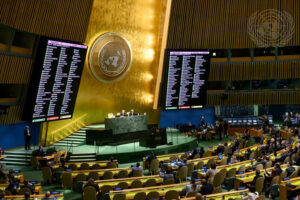
The UN, which was established to foster global peace and stability, has now become a paralyzed institution that inadvertently contributes to raging conflicts because it is constrained by an archaic structure that no longer meets the dramatically changed world order.

NEW YORK, Nov 1 2024 (IPS) – The United Nations, established in 1945 at the end of World War II, has sadly virtually outlived its usefulness as it commemorated its 79th anniversary due to its failure to reform itself and adjust to the new world order following the collapse of the Soviet Union, which is significantly different from when the UN was established.


The UN’s mission, which is to promote peace and stability, has failed time and again, as many of the current violent conflicts, especially the Ukraine War and the Israeli-Palestinian conflict, glaringly demonstrate.

As Ukrainian President Volodymyr Zelenskyy aptly put it when he asked during his address to the Security Council in 2022: “Where is the security that the Security Council needs to guarantee? … Where is the peace?”

Over the years, scholars and think tanks have offered reformist ideas to make the UN more adaptable and responsive to the changing world order. They have failed primarily because of how the UN was structured and the opposition of the five permanent members of the United Nations Security Council (UNSC) – the US, Russia, China, Britain, and France – to any significant reforms that could diminish their power.

Offering any comprehensive reforms to the UN is certainly beyond the scope of this column. However, there are some limited reforms that the UNSC can take, without a fundamental change in its structure, to enhance its effectiveness in maintaining global peace.

Before that, it is essential to point out some of the UN’s shortcomings to put into context the limited reforms that can be taken.

The UN Security Council’s structure
The UN Security Council’s structure, particularly the veto power held by its five permanent members, often leads to inaction. This power allows any one of these countries to block resolutions, even if there is broad international support. This has resulted in deadlocks on critical issues such as the Syrian Civil War, the Ukraine War, and the Israeli-Palestinian conflict.

The killings of civilians and the destruction of cities and towns, particularly by Israel and Russia, are devastating and continue unabated even through the UN and its humanitarian agencies. The International Criminal Court and UN human rights experts have repeatedly called on the Security Council to act. In these cases, the US and Russia’s adversarial relations prevented them from reaching solutions to mitigate these conflicts.

The composition of the Security Council does not reflect current global dynamics, leading to questions about its legitimacy and effectiveness. Calls for reform have been persistent but largely unaddressed due to the reluctance of current permanent members to alter a system that benefits them.

Only one-quarter of the global population is represented by the Security Council. Blocks of countries, including Muslim states, African nations, South American countries, and India, with over 1.3 billion people, are not represented in the SC.

Peacekeeping Constraints
The UN peacekeeping missions are often criticized for their limited mandates and resources. Peacekeepers are usually deployed in areas where there is no peace to keep, like Cyprus, Kosovo, and Western Sahara. They are generally not adequately equipped or have the authority to engage in violent operations.

This limitation is starkly evident in regions plagued by terrorism and violent extremism, including the Sahel region in Africa, the Democratic Republic of Congo, and the Central African Republic, where peacekeepers struggle to stabilize situations without adequate support from powerful nations. In addition, there is often a disconnect between UN mandates and local realities, which complicates peacekeeping efforts.

Peacekeepers may not be adequately trained or prepared to handle complex regional dynamics, leading to ineffective interventions.

Lack of Enforcement Mechanisms
The UN often lacks effective enforcement mechanisms for its resolutions. While the Security Council can theoretically impose sanctions or authorize military action, veto power and political considerations frequently prevent decisive actions. This allows countries that are committing crimes against humanity or engaged in war crimes to escape any punitive measures with impunity, even when imposed by the UNSC.

National Interests Over Global Peace
The interests of powerful member states often precede collective global security objectives. The major arms-exporting nations are also permanent members of the Security Council, creating conflicts of interest that undermine efforts to resolve disputes where these nations have strategic interests.

This is highly evident in the Israel-Hamas war and Russia-Ukraine wars, where the US, in particular, is providing massive military support. In this context, geopolitical rivalries among major powers hinder consensus on critical issues. For example, China and Russia often align against Western countries on various international matters, leading to a stalemate in effectively addressing conflicts.

Bureaucratic Inefficiencies
Slow bureaucratic processes and mismanagement frequently hamper the UN’s operations. These inefficiencies can delay critical humanitarian aid and other interventions necessary for maintaining peace. Addressing these issues would require substantial reforms, particularly within the Security Council, alongside a commitment from member states to prioritize global peace over national interests.

Reforms that Can Enhance Effectiveness of UN Operations
Given, however, the insurmountable difficulties in undertaking comprehensive reforms of the UN, it is still possible to reform the UNSC to enhance its effectiveness in maintaining global peace, which involves addressing several key issues. Here are several doable reforms that could rectify some of the problems.

Reform proposals include limiting the use of vetoes, particularly in cases involving mass atrocities or violations of international law. This could include requiring a supermajority for vetoes to be effective or mandating discussions in the General Assembly following a veto.

Regional Representation
Ensuring geographic balance and representation of diverse cultures and civilizations is crucial. This could involve creating regional seats that rotate among countries within a region, thereby enhancing representation without significantly increasing the number of permanent seats.

Strengthening the Role of the General Assembly
Enhancing the General Assembly’s role in peace and security matters could counterbalance Security Council paralysis. Initiatives like the “Uniting for Peace” resolution allow the General Assembly to act when the Security Council is deadlocked. Given the differing national interests and geopolitical considerations, consensus-building can still be achieved without necessarily compromising national interests.

Non-amendment Reforms
Reinterpreting existing UN Charter provisions may allow for more flexible responses to global crises without formal amendments. Such reforms could empower other UN bodies to act when the Security Council cannot.

Balancing Power Dynamics
Expanding membership while managing veto power requires careful negotiation to ensure new members do not exacerbate gridlock. There is also concern about maintaining the council’s effectiveness with an increased number of members.

Expansion of Membership
Increasing permanent and non-permanent members is a widely discussed reform. This expansion could include adding new permanent members without veto power, such as countries from underrepresented regions like Africa, Latin America, and Asia. The G4 nations (Brazil, Germany, India, and Japan) and African countries have been prominent candidates for permanent seats.

Although there is broad agreement on the need to reform the UNSC, achieving that involves piloting multifaceted geopolitical landscapes and balancing various national interests. That said, incremental changes, especially those not requiring formal amendments to the UN charter, may offer a feasible path forward.

If the UNSC does not adopt some of these reforms, the UN will virtually outlive its usefulness, especially in the area of conflict resolution, where the daily horrific death and destruction around the world attests to its dismal failures.

Dr. Alon Ben-Meir is a retired professor of international relations, most recently at the Center for Global Affairs at New York University (NYU). He taught courses on international negotiation and Middle Eastern studies.

IPS UN Bureau
  Source

UN Remains Paralyzed as “Rogue Nations” Violate Charter & Escalate War Crimes

Armed Conflicts, Civil Society, Featured, Global Governance, Headlines, Human Rights, IPS UN: Inside the Glasshouse, Middle East & North Africa, TerraViva United Nations

Credit: UN Photo/Manuel Elías

UNITED NATIONS, Nov 1 2024 (IPS) – The United Nations continues to be virtually paralyzed – and remains politically impotent amidst two raging conflicts—as Russia and Israel keep defying the world body.

The killings of civilians and the destruction of cities, particularly by Israel, are devastating and continue despite repeated warnings from the UN, its humanitarian agencies, the International Criminal Court (ICC), UN human right experts and the Security Council.


Which prompts the question: has the UN outlived its usefulness –even as it commemorated its 79th anniversary on the annual UN Day on October 24?

The United Nations, which has failed to help resolve some of the world’s ongoing and longstanding civil wars and military conflicts—including Palestine, Afghanistan, Yemen, Western Sahara, Myanmar, Syria, and most recently, Ukraine—was challenged by Ukrainian President Volodymyr Zelenskyy during his address to the Security Council last April.

And he rightly asked: “Where is the peace that the United Nations was created to guarantee? And where is the security that the Security Council was supposed to guarantee?

The repeated US calls for a ceasefire by Israel have fallen on deaf ears—even as violations of the UN Charter continue with accusations of war crimes and genocide in Gaza since October 7 last year.

Speaking on condition of anonymity, an Asian diplomat, was right on target, when he told IPS the countries that violate the UN charter and commit war crimes are “rogue nations” and should be driven out of the world body.

But that will never happen with a Security Council empowered with vetoes.

Sarah Leah Whitson, Executive Director, Democracy for the Arab World Now (DAWN) told IPS the UN Security Council has served as the principal obstacle to global peace and security, hindering rather than helping efforts to end conflicts around the world.

Both the United States and Russia have used their veto power to ensure the wars they support, whether Russia’s conflicts in Ukraine and Syria, or the US supported wars in Gaza, Lebanon and Yemen, continue.

Without ending the veto power of these two global powers that are fomenting the worst conflicts in the world, the UN will continue to be a toothless and discredited institution, Whitson declared.

Dr Ramzy Baroud, a journalist and Editor of The Palestine Chronicle, told IPS the question of whether the United Nations has outlived its usefulness or not, depends on how we choose to comprehend the initial formation and the original purpose of the organization.

“If we believe, and many rightly do, that the UN was formed to protect the interests of those who emerged victorious following the devastation of WWII, then, largely it has succeeded in its mission.”

Indeed, the UN, especially its executive branch, the Security Council, has mainly reflected the balances of global power, which, until recently, was mostly titled in favor of the US and its western allies, he said.

Though this is somewhat changing, he pointed out, the US continues to prove that it is still capable of being a major obstacle before allowing the institution to serve even a nominal role in imposing international and humanitarian laws on guilty parties, the likes of Israel.

“However, if we subscribe to the misconception that the UN existed as a global guarantor of peace through the generation and implementation of international laws, then there is no question it has miserably failed”, he declared.

Responding to a question at a press briefing early October, UN Spokesperson Stephane Dujarric said: “Well, when people talk about the failures of the UN, my question back to you is, which UN are you speaking about?”

“Are you speaking about the inability of the Security Council to come together on critical issues? Are you speaking about Member States not respecting and not implementing resolutions? Are you speaking about Member States not upholding the rulings of the International Court of Justice, which every Member State has signed up to?”

And are you speaking about the Secretary-General feeling that you think he’s not doing enough or his humanitarians are not doing enough? So, I think those types of questions are extremely valid, but I think one has to examine which part of the organization you’re speaking about,” said Dujarric.

On the margins of the BRICS Summit in Kazan on October 24, Secretary-General Antonio Guterres met with Vladimir Putin, President of the Russian Federation and reiterated his position that the Russian invasion of Ukraine was “in violation of the United Nations Charter and international law.”

But Russia’s response went unannounced—even as violations continue.

Responding to a question at a press conference in Colombia on October 29, Guterres said: “We need peace among ourselves. That is the reason I’ve been asking, in line with the Charter, in line with international law, and in line with the General Assembly resolutions.”

“That is why we have been asking for an immediate ceasefire in Gaza, releasing all hostages and massive humanitarian aid to Gaza. That is why we have been asking for peace in Lebanon and peace that respects Lebanese sovereignty and Lebanese territorial integrity and paves the way for a political solution”.

“That is why we have been asking for peace in Sudan, where an enormous tragedy exists,” Guterres said.

Perhaps these are appeals that will continue to remain unanswered.

Elaborating further, Dr Baroud told IPS what is particularly exasperating is that despite its obvious failures, the UN continues to carry on as if it served any other purpose aside from mirroring the existing imbalances of power around the world, and as a publicity platform for the US, Israel and others, who violate international law with complete impunity.

The UN was formed following the atrocities of WWII. Now, it stands completely useless in its inability to stop similar atrocities in Gaza, the West Bank and Lebanon. There is no moral, let alone rational justification of why the UN in its current form should continue to exist, he argued.

Now that the Global South is finally rising with its own political, economic and legal initiatives, it is time for these new bodies to either offer a complete alternative to the UN or push for serious and irreversible reforms at the currently ineffectual organization, said Dr. Baroud, a Non-resident Senior Research Fellow at the Center for Islam and Global Affairs (CIGA). www.ramzybaroud.net

In an oped piece for IPS Dr. Alon Ben-Meir, a retired professor of international relations, most recently at the Center for Global Affairs at New York University (NYU), pointed out that the UN Security Council’s structure, particularly the veto power held by its five permanent members, often leads to inaction.

This power allows any one of these countries to block resolutions, even if there is broad international support. This has resulted in deadlocks on critical issues such as the Syrian Civil War, the Ukraine War, and the Israeli-Palestinian conflict, he said.

“The killings of civilians and the destruction of cities and towns, particularly by Israel and Russia, are devastating and continue unabated even through the UN and its humanitarian agencies.”

The International Criminal Court and UN human rights experts have repeatedly called on the Security Council to act. In these cases, the US and Russia’s adversarial relations prevented them from reaching solutions to mitigate these conflicts, he pointed out.

Although there is broad agreement on the need to reform the UNSC, achieving that involves piloting multifaceted geopolitical landscapes and balancing various national interests.

That said, incremental changes, especially those not requiring formal amendments to the UN charter, may offer a feasible path forward, said Dr Ben-Meir, who has taught courses on international negotiation and Middle Eastern studies.

“If the UNSC does not adopt some of these reforms, the UN will virtually outlive its usefulness, especially in the area of conflict resolution, where the daily horrific death and destruction around the world attests to its dismal failures,” he declared.

Meanwhile, the UN’s declining role in geo-politics, however, has been compensated for, by its increasingly robust performance as a massive humanitarian relief organization.

These efforts are led by multiple UN agencies such as the World Food Program (WFP), the World Health Organization (WHO), the UN children’s fund UNICEF, the Office of the UN High Commissioner for Refugees (UNHCR) , the UN Population Fund (UNFPA), the Food and Agriculture Organization (FAO), the International Organization for Migration (IOM) and the UN Office for the Coordination of Humanitarian Affairs (OCHA), among others.

These agencies, which have saved millions of lives, continue to provide food, medical care and shelter, to those trapped in war-ravaged countries, mostly in Asia, Africa and the Middle East, while following closely in the footsteps of international relief organizations, including Doctors Without Borders, Save the Children, international Committee of the Red Cross (ICRC), CARE International, Action Against Hunger, World Vision and Relief Without Borders, among others.

https://www.ipsnews.net/2024/11/united-nations-outlived-usefulness/

IPS UN Bureau Report

  Source

Hope Springs Eternal—Dashed it’s Deadly

Armed Conflicts, Civil Society, Democracy, Global Governance, Headlines, Human Rights, IPS UN: Inside the Glasshouse, Middle East & North Africa, TerraViva United Nations

Opinion

The UN Relief and Works Agency (UNRWA) is the largest aid agency in the Gaza Strip where it provides emergency and other assistance to vulnerable Palestinians. Credit: UNRWA

ATLANTA, USA, Oct 31 2024 (IPS) – The most solemn and terrifying words ever uttered are those inscribed over the gateway to Hell in Dante’s Inferno: “Abandon all hope, ye who enter here!” Hope is essential for human survival both as individuals and as nations.


Surveying the history of the seemingly endless series of wars and counter-wars between Israel and its foes in Gaza and Lebanon from 1948 until now—a period of 76 years—it seems that all hope for peace has been lost. Palestinians, Lebanese, the people of Gaza—and yes, the Israelis too—are all residents of this inferno, the endless Hell of war.

If you pay close attention to the weak, mealy-mouthed utterances of US Secretary of State Anthony Blinken—the emissary of the equally weak President Joe Biden—you’ll understand that the Middle East region and therefore the world is rapidly approaching the Ninth Circle of Hell.

Both of them utter meaningless phrases that reveal their lack of understanding at best, or at worst their vicious, inhumane complicity.

Now, the latest, and possibly most obscene, third act in this modern Greek tragedy was played out October 28 in Israel’s Knesset. Nearly 100 of the 120 members of that wise and honorable body voted to cut the lifeline for millions of Palestinians who depend on the UN’s Relief and Works Agency (UNRWA) for health care and education.

Credit: UNRWA

Besides irrationally imposing new cruelties—rubbing salt in the wounds of an entire population of innocent people—the Knesset’s decision constitutes cultural genocide, an essential factor underlying the supreme international crime of Genocide as defined by the United Nations.

UNRWA’s registry constitutes the primary link millions of 1948 War refugees and their descendants have to their lost properties. Destroying that link erases an entire people from history. It obliterates Israel’s “Crime of the Century,” which is the theft of the nation of Palestine.

Is this the hand of friendship, the “Light to the Nations” Israel’s founder Ben Gurion promised in 1948? Review the numbers: there are still 1.2 million registered Palestinian refugees dependent on food aid in 68 camps in Lebanon, Syria, Jordan, the West Bank, and Gaza. UNRWA services in Gaza alone include 140 health care centers and 700 schools educating 300,000 students.

Is there hope in this darkened scenario? Actually, there is. Sun Tzu’s long-ago Chinese classic, The Art of War, records the following sardonic, understated observation: “There is no example of a long war benefitting anybody.”

Which means that at some point people will have to come to their senses, or else generations will pass away before their descendants, with new issues to deal with, will wonder what the fuss was all about.

But that’s in the future—perhaps the distant future. What about now? Is there any hope? Surprisingly, yes, there is.

In an interview on al-Jazeera television on October 25, 2024, after more than a year of the most devastating and genocidal war on Palestine’s civilian population, leading Palestinian politician and spokesman Mustafa Barghouti, expressed optimism.

He said that the single positive development during the longest and most destructive war against Palestine in its history is the continuing determination of the Palestinian people to remain on their land and to resist efforts to expunge their national identity, as is their right.

In Arabic it is called Sumud, “steadfastness,” loosely translated as “Staying power.” Hope survives. Where there’s life, there’s hope.

James E. Jennings is President of Conscience International, an international aid organization that has responded to wars in Lebanon, Syria, Iraq, Palestine, and Gaza since 1991.

IPS UN Bureau

  Source

Over 150 NGOs Urge World Governments to Help End War Crimes in Gaza

Armed Conflicts, Civil Society, Featured, Global Governance, Headlines, Human Rights, IPS UN: Inside the Glasshouse, Middle East & North Africa, TerraViva United Nations

Credit: UNRWA

UNITED NATIONS, Oct 28 2024 (IPS) – As it continues to leave a mounting trail of death and destruction in Gaza, Israel has come under severe attack from the international community, including the United Nations and its humanitarian agencies, Western allies, the International Criminal Court (ICC) and scores of human rights experts.


During a conference in Paris, focusing on the new crisis unfolding in Lebanon, President Emmanuel Macron of France, a longtime Western ally and one of the five veto-wielding permanent members of the UN Security Council, had “sharp words for Israel reflecting the view, even among Israel’s allies, that it has used excessive force against its enemies, resulting in disproportionate casualties and destruction,” according to the New York Times October 25.

“I am not sure you can defend a civilization by sowing barbarism yourself,” Macron declared.

Meanwhile, the rising death toll in Gaza has topped over 43,000 Palestinians, mostly women and children, in retaliation for the 1,200 killed by Hamas inside Israel on October 7

And last week, over 150 civil society and non-governmental organizations (CSOs/NGOs) made a joint appeal to world governments to do “everything in their power to end this growing catastrophe and cycle of impunity. It is not only a moral imperative but a legal obligation.”

The CSOs urged all 193 UN Member States to “prevent further atrocities and ensure that those responsible for any violations of international law, including war crimes and crimes against humanity, are held accountable.”

Failure to act now risks further eroding international norms and emboldening perpetrators. The cycle of violence against civilians needs to stop, the CSOs declare.

The signatories include CIVICUS, Oxfam, United Nations Association — UK, Norwegian Refugee Council, International Civil Society Action Network (ICAN), Saferworld, and the Jewish Network for Palestine, among others.

https://www.civicus.org/index.php/media-resources/news/7372-open-call-for-a-ceasefire-in-gaza-lebanon-and-israel-and-end-to-impunity-amid-a-spiralling-humanitarian-catastrophe-and-escalating-regional-conflict

Mandeep S. Tiwana, Interim Co-Secretary General, CIVICUS, told IPS “it’s deeply unfortunate that the United States government for all its talk of human rights continues to engage in moral dualism by providing diplomatic cover to the Israeli government.”

This is happening, he pointed out, despite overwhelming evidence of the commission of war crimes, crimes against humanity and genocide by Israeli forces. “It’s fair to conclude that there’s an element of inherent racism in how the Biden administration has approached the situation in Palestine.”

In the face of a relentless assault by an occupying force, the plight of the Palestinian people matters less to America’s top diplomats than the plight of the Ukrainian people to whom the same administration has extended all sorts of moral and material support, he added

“Until Israel’s politicians and military brass are brought before an international tribunal to face justice the cycle of violence in the Middle-East will continue to repeat itself,” warned Tiwana.

Even the US, one of Israel’s closest allies, couldn’t restraint itself.

Addressing a UN Security Council meeting on October 16, Linda Thomas-Greenfield, US Ambassador to the UN, said she “watched in horror as images from central Gaza poured across my screen.”

“There were no words, simply no words, to describe what we saw. Israel has a responsibility to do everything possible to avoid civilian casualties, even if Hamas was operating near the hospital in an attempt to use civilians as human shields. We have made this clear to Israel,” she said.

“Just as we have made clear to the Israeli government at the highest levels, that it must do more to address the intolerable and catastrophic humanitarian crisis in Gaza,” the US ambassador said.

Dr. James Jennings, President of Conscience International, told IPS that “Gaza’s horror defies description”.

For Israel to bomb the enclave day and night for a full year is certainly criminal, he argued, but to impose an embargo on vital medicine and food needed by millions for survival is the absolute depth of inhumanity.

Lately it has been almost impossible to get volunteer teams of doctors and life-saving medical supplies into the enclave. Shipments of food aid are now embargoed with no explanation or reason. Besides being inhumane, it makes no military sense, unless the objective is to punish the entire population, which is a war crime, he said.

International outrage is needed to force the gates of Gaza open again, declared Dr. Jennings.

The NGO letter says: Israel’s war in Gaza, following the deadly attacks by Palestinian armed groups on 7 October 2023, is the latest and most horrific onslaught of violence in the decades-long Israeli occupation of Palestinian territory.

After a year of unfathomable killing and destruction, patterns of civilian harm by Israeli forces are spreading and escalating from Gaza to Lebanon, while rocket attacks by armed groups in Lebanon continue. We are now on the precipice of even greater devastation across the region.

Failure to act now is a choice – a choice that will fail to stop and prevent future atrocities. The UN Commission of Inquiry concluded last week that Israel has committed war crimes and the crime against humanity of extermination with relentless and deliberate attacks on medical personnel and facilities in Gaza, and called on member states to “cease aiding or assisting in the commission of violations.”

Over the last 12 months, the UN Security Council has passed four resolutions on Gaza, including one calling for a ceasefire, and the International Court of Justice (ICJ) has ordered Israel to take all measures within its power to prevent the commission of all acts within the scope of Article II of the Genocide Convention.

The ICJ also issued an Advisory Opinion that found that Israel’s occupation1 and annexation of Palestinian territory is illegal, and the UN General Assembly passed a resolution demanding that Israel end its unlawful presence in the occupied Palestinian territory (oPt) within 12 months. Despite this, none of these measures have been implemented or adhered to.

“The international community’s egregious disregard for international law and the government of Israel’s unchecked impunity in Gaza, the West Bank and now Lebanon, has set dangerous new precedents for the conduct of war,” says the letter.

For civilians in the occupied Palestinian territory and Lebanon, this has resulted in:

Many among us, says the letter, have repeatedly called for a permanent and unconditional ceasefire, hostage release, a halt to arms transfers, and de-escalation of tensions in the region, and yet the violence only appears to be intensifying.

Again, we call on all Heads of State and Governments, the UN Security Council, and actors on the ground to prioritise the preservation of human life above all else by:

    • Securing an immediate ceasefire by all parties to the conflict and an end to the indiscriminate attacks that kill civilians and
    destroy civilian infrastructure;
    • Halting the transfer of weapons, parts, and ammunition to parties to the conflict that may be used to commit violations of international humanitarian law (IHL);
    • Enabling unhindered humanitarian access for the delivery of lifesaving assistance, including food, medical supplies and fuel, and the safe movements of civilians and aid workers.
    • Ensuring the protection of civilians from further forced displacement, and the right to return for those forcibly displaced. Civilians who choose to stay or are unable to leave remain protected under international law.
    • Securing the release of all hostages and
    • Immediately activating independent international investigations into all apparent violations of international humanitarian law and war crimes committed by all parties.

Governments must do everything in their power to end this growing catastrophe and cycle of impunity. It is not only a moral imperative but a legal obligation.

All Member States must prevent further atrocities and ensure that those responsible for any violations of international law, including war crimes and crimes against humanity, are held accountable. Failure to act now risks further eroding international norms and emboldening perpetrators. The cycle of violence against civilians needs to stop.

For more on what international humanitarian law says about occupation, please see commentary by ICRC.

IPS UN Bureau Report

  Source

Civil Society Fights Against Budget Cuts Amid Calls for “Aid” Reform

Armed Conflicts, Civil Society, Climate Change, Conferences, Development & Aid, Economy & Trade, Financial Crisis, Global, Headlines, TerraViva United Nations

Opinion

Sarah Strack is Forus Director

“Woman crosses a local business in the streets of Kathmandu, Nepal” (Both Nomads)

NEW YORK, Oct 16 2024 (IPS) – Multiple conflicts, the climate emergency and other crises are destabilising many parts of the world and intensifying the strain on the resources needed to finance the global sustainable development agenda. Amid these challenges, data from 2023, shows that Official Development Assistance (ODA) reached a record-breaking US$223.7 billion, up from US$211 billion the previous year, according to Eurodad.


However, if one looks beyond the mere figures, worrying trends are emerging. Major donors like Germany and France are reducing their development budget and several countries are already announcing cuts for 2025.

This trend has prompted debate over the direction and quality of global aid, especially at a time when ODA is more crucial than ever in addressing global crises.

In France, with the campaign #StopàlabaisseAPD (#StoptheODACuts), NGOs are mobilising against further reductions in the 2025 budget, warning that such cuts could undermine international solidarity efforts and hit hardest those who are already left behind.

Coordination SUD, a coalition of 180 French NGOs, is raising the alarm over the potential impact of these cuts, which follow a 13% reduction in 2024, and which is seeing ODA funds slashed again by over 20% in 2025, as per the finance bill presented this Thursday

The first victims of this measure will be the most vulnerable populations. “ODA enables local and international NGOs to work daily with and alongside the most fragile communities,” reminds Olivier Bruyeron, President of Coordination SUD.

“Official development assistance has been used as a political football over recent years,” says Bond, the national platform of NGOs in the UK.

As a national civil society platform, they work to ensure UK aid reaches the communities “that need it most”.

“ODA is being used as a geopolitical tool with national interests in focus, when it should be a mechanism for redistributive justice,” said Alex Farley of Bond in a recent global event during the Summit of the Future hosted by the global civil society network Forus.

This debate is part of a larger global conversation on the future of ODA.

While the traditional 0.7% Gross National Income (GNI) target remains a key benchmark for donor countries, experts argue that ODA must evolve to better address the real needs of recipient communities, particularly in the Global South. As Oyebisi Oluseyi of the Nigerian Network of NGOs (NNNGO) points out, “While this target remains important, it’s no longer enough.”

Critics are calling for a redefinition of ODA that shifts powers toward recipient countries and communities. Zia ur Rehman, Coordinator of the Asia Development Alliance – a regional platform of NGOs, emphasizes the need for local actors to have more say in how funds are used.

Providing a perspective from the Pacific Islands, Emeline Siale from the civil society regional coalition PIANGO, echoes the need for local actors to play a leading role in ODA decision-making, “not merely as participants but as leaders”.

“Community participation itself is a healing process, and it’s become a central topic in many civil society discussions,” Siale explains.

As key international summits on development financing approach, the future of ODA—and its ability to meet the needs of the most vulnerable—hangs in the balance.

“The upcoming Fourth United Nations International Conference on Financing for Development presents a key opportunity for the development community to align with development effectiveness principles, rather than allowing them to be further diluted. Now, more than ever, civil society must play its role, shifting power and pushing for a new global governance of international aid that is more representative, democratic, inclusive, and transparent,” says civil society leader in Burkina Faso Mavalow Christelle Kalhoule and President of Forus, a global civil society network representing over 24,000 NGOs across the globe.

IPS UN Bureau


World Told Act Now or Face 136 Years of Hunger, Report Warns

Active Citizens, Aid, Armed Conflicts, Civil Society, Climate Change, Development & Aid, Featured, Food and Agriculture, Food Security and Nutrition, Food Sustainability, Global, Headlines, Human Rights, Sustainable Development Goals, TerraViva United Nations

Food Security and Nutrition

World Food Day 2024


The world must take action to improve food security, which is at risk due to conflict and climate change. Credit, Busani Bafana/IPS

The world must take action to improve food security, which is at risk due to conflict and climate change. Credit, Busani Bafana/IPS

BULAWAYO, Zimbabwe, Oct 15 2024 (IPS) – High levels of hunger will continue for another 136 years in many developing countries, according to a new report assessing global hunger.


The report, the 2024 Global Hunger Index (GHI), paints a grim picture, predicting that global hunger levels will remain high for another century. If more progress is not made to end hunger, it will continue to reverse many development gains. The report blames the combined crises of conflict, climate change, high food prices and mounting debt, all of which are denying billions of people the right to adequate food. 

Hunger Here To Stay

Published by Concern Worldwide and Welthungerhilfe, on October 10, 2024, the GHI reveals that at least 64 countries are unlikely to reach low hunger levels until 2160 if the current pace of change continues.

Hunger is at serious or alarming levels in 42 countries, with conflicts exacerbating food crises in places like Gaza and Sudan, where famine is already present in North Darfur, the report found.

Now in its 19th year, the GHI ranks countries based on recorded levels of undernourishment, child stunting, child wasting and child mortality. Of the 136 countries examined, 36 face serious hunger levels, while six at the bottom of the index—Somalia, Yemen, Chad, Madagascar, Burundi, and South Sudan—have alarming hunger levels. In 2023 alone, 281.6 million people in 59 countries and territories faced crisis-level or acute food insecurity, including Gaza, Sudan, Haiti and Burkina Faso.

The report warns that the chances of meeting the UN’s goal of zero hunger by 2030 are grim.

Concern Worldwide’s Chief Executive, David Regan, described the situation as disappointing that the 2030 goal was now out of reach.

“Our response should be to redouble our efforts to regain momentum,” Regan told IPS. “We need global action to tackle hunger.”

Sub-Saharan Africa and South Asia are the regions most affected by hunger. According to the GHI, about 22 countries in Africa are facing serious hunger levels.  Of the top ten countries cited for having serious to alarming hunger levels, five are in Africa.

David Regan, Chief Executive, Concern Worldwide. Credit: Concern worldwide

David Regan, Chief Executive, Concern Worldwide. Credit: Concern worldwide

Conflict, Climate Change and High Debt Fuel Hunger

Large-scale armed conflicts, climate change, high food prices, market disruptions, economic downturns, and debt crises in many low- and middle-income countries have combined to complicate efforts to reduce hunger, the report found.

“Conflict can only be resolved where the external stakeholders that are typically fueling the conflict, step away from using conflict to acquire the resources or to increase the instability of the most fragile states,” Regan told IPS. “Climate change will not stop until those responsible for the largest emissions reduce them. It is not possible to say that the human right to food is being respected globally when powerful nations are clearly not playing their role in addressing its causes.”

Regan criticized wealthy nations for not playing their part in addressing global hunger, stating that while they have not turned their backs on the issue, political  interest in solving hunger has waned in recent years.

The report further notes that more than 115 million people globally are internally displaced—some have been forced to migrate as a result of persecution, conflict violence and many more displaced by weather-related disasters.

The wars in Gaza and Sudan have led to exceptional food crises, the report stated, flagging rising inequality between and within countries.  Although extreme poverty in middle-income countries has decreased, income inequality remains persistently high, and poverty in the poorest countries is worse than before the COVID-19 pandemic.

Gender Equality, Key to Food Security

The report also draws attention to the link between gender inequality, food insecurity, and climate change, noting that these factors combined have put communities and countries under extreme stress.

FAO Director-General QU Dongyu delivers his speech during the opening session of 29th Session of the Committee on Agriculture. Credit: FAO/Cristiano Minichiello

FAO Director-General QU Dongyu delivers his speech during the opening session of 29th Session of the Committee on Agriculture. Credit: FAO/Cristiano Minichiello

“Governments must invest in and promote gender equality and climate change and recognize and deliver on the right to food so that all people are assured the right to food,” Regan said.

Ahead of World Food Day, the United Nations Food and Agriculture Organization (FAO) has echoed the call for swift action to eliminate hunger and ensure everyone has access to safe, nutritious food.

The World Food Day is being marked under the theme Right to food for a better life and a better future, which underscores the urgency to provide varied and healthy food to all.

FAO Director General Qu Dongyu noted that 730 million people are facing hunger due to the global challenges caused by man-made and natural disasters. Besides, more than 2.8 billion people in the world cannot afford a healthy diet.

“There is no time to lose, we must take immediate action, we must act together,” Dongyu urged, reiterating that the right to food is a basic human right.

IPS UN Bureau Report

  Source



