Cambodia’s Young Environmental Activists Pay a Heavy Price

Armed Conflicts, Asia-Pacific, Civil Society, Economy & Trade, Environment, Featured, Headlines, Indigenous Rights, Labour, Natural Resources, Press Freedom, TerraViva United Nations

Opinion

Credit: Tang Chhin Sothy/AFP via Getty Images

LONDON, Aug 1 2024 (IPS) – It’s risky to try to protect the environment in authoritarian Cambodia. Ten young activists from the Mother Nature environmental group have recently been given long jail sentences. Two were sentenced to eight years on charges of plotting and insulting the king. Another seven were sentenced to six years for plotting, while one, a Spanish national banned from entering Cambodia, was sentenced in absentia.


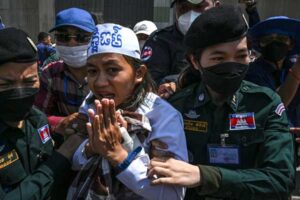
Four of the activists were then violently dragged away from a peaceful sit-in they’d joined outside the court building. The five who’ve so far been jailed have been split up and sent to separate prisons, some far away from their families.

This is the latest in a long line of attacks on Mother Nature activists. The group is being punished for its work to try to protect natural resources, prevent water pollution and stop illegal logging and sand mining.

An autocratic regime

Cambodia’s de facto one-party regime tolerates little criticism. Its former prime minister, Hun Sen, ruled the country from 1985 until 2023, when he handed over to his son. This came shortly after a non-competitive election where the only credible opposition party was banned. It was the same story with the election in 2018. This suppression of democracy required a crackdown on dissenting voices, targeting civil society as well as the political opposition.

The authorities have weaponised the legal system. They use highly politicised courts to detain civil society activists and opposition politicians for long spells before subjecting them to grossly unfair trials. Campaigners for environmental rights, labour rights and social justice are frequently charged with vaguely defined offences under the Criminal Coder such as plotting and incitement. Last year, nine trade unionists were convicted of incitement after going on strike to demand better pay and conditions for casino workers.

In 2015 the government introduced the restrictive Law on Associations and Non-Governmental Organisations (LANGO), which requires civil society organisations to submit financial records and annual reports, giving the state broad powers to refuse registration or deregister organisations. In 2023, Hun Sen threatened to dissolve organisations if they failed to submit documents.

The state also closely controls the media. People close to the ruling family run the four main media groups and so they mostly follow the government line. Independent media outlets are severely restricted. Last year the authorities shut down one of the last remaining independent platforms, Voice of Democracy. Self-censorship means topics such as corruption and environmental concerns remain largely uncovered.

This extensive political control is closely entwined with economic power. The ruling family and its inner circle are connected to an array of economic projects. Landgrabs by state officials are common. These means land and Indigenous people’s rights activists are among those targeted.

In 2023, courts sentenced 10 land activists to a year in jail in response to their activism against land grabbing for a sugar plantation. That same year, three people from the Coalition of Cambodian Farmer Community, a farmers’ rights group, were charged with incitement and plotting. The LANGO has also been used to prevent unregistered community groups taking part in anti-logging patrols.

The activity that saw the Mother Nature activists charged with plotting involved documenting the flow of waste into a river close to the royal palace in the capital, Phnom Pen. It’s far from the first time the group’s environmental action has earned the state’s ire. The government feels threatened by the fact that Mother Nature’s activism resonates with many young people.

Three of the group’s activists were convicted on incitement charges in 2022 after organising a protest march to the prime minister’s residence to protest against the filling in of a lake for construction. In 2023, Mother Nature delivered a petition urging the government to stop granting land to private companies in Kirirom National Park; there’s evidence of licences going to people connected to ruling party politicians. In response, the Ministry of Environment said Mother Nature was an illegal organisation and that its actions were ‘against the interests of Cambodian civil society’.

Media also get in trouble if they report on the sensitive issue of land exploitation. In 2023, the authorities revoked the licences of three media companies for publishing reports on a senior official’s involvement in land fraud. In 2022, two teams of reporters covering a deforestation operation were violently arrested.

Regional challenges

Repression of environmental activism isn’t limited to Cambodia. In neighbouring Vietnam, the one-party communist state is also cracking down on climate and environmental activists. In part this is because, as in Cambodia, climate and environmental activism is increasingly shining a light on the environmentally destructive economic practices of authoritarian leaders.

Cambodia’s creeping use of the charge of insulting the king to stifle legitimate dissent also echoes a tactic frequently used in Thailand, where the authorities have jailed young democracy campaigners for violating an archaic lèse majesté law that criminalises criticism of the king. Other repressive states are following its lead – including Cambodia, where the law on insulting the king was introduced when the crackdown was well underway in 2018.

Cambodia provides ample evidence of how the denial of democracy and the repression that comes with it enable environmentally destructive policies that further affect people’s lives and rights. The solution to protect the environment and prevent runaway climate change is less repression, more democracy and a more enabled civil society.

Cambodia’s international partners should emphasise this in their dealings with the state. They should press the authorities to release the jailed Mother Nature activists, who deserve to spend the coming years helping make their country a better place, not rotting in prison.

Andrew Firmin is CIVICUS Editor-in-Chief, co-director and writer for CIVICUS Lens and co-author of the State of Civil Society Report.

  Source

Silenced: Women’s Many Layered Struggles for Climate Justice in Nepal

Active Citizens, Asia-Pacific, Civil Society, Climate Change, Climate Change Justice, Editors’ Choice, Featured, Gender, Headlines, Human Rights, Sustainable Development Goals, TerraViva United Nations, Women & Climate Change, Women in Politics

Women & Climate Change

Silenced and sidelined, women politicians in Nepal fight for their voices to be heard, especially as they represent a population most impacted by climate change.

Women farmers in Helambu, Sindhupalchwok. Women, who are the primary growers, have to deal with changing patterns of snowfall and rain, which is affecting their agricultural activities. However, they feel like no one is listening to their concerns. Credit: Tanka Dhakal/IPS

Women farmers in Helambu, Sindhupalchwok. Women, who are the primary growers, have to deal with changing patterns of snowfall and rain, which is affecting their agricultural activities. However, they feel like no one is listening to their concerns. Credit: Tanka Dhakal/IPS

KATHMANDU, Jul 18 2024 (IPS) – A group aligned with the mayor of Chhayanath Rara Municipality in the Mugu district of Nepal’s Karnali Province physically attacked Aishwarya Malla for simply asking for a budgetary review of the local government.


“As a deputy mayor, I have the right to know where the budget is allocated, but the mayor’s team attacked me,” Malla said. “They did it only because I’m a woman, but they forget I’m also an elected representative with a responsibility to serve people, especially women and marginalized sections of our society.”

Malla has had an upward battle trying to get her voice heard.

Earlier in May, she requested just a few minutes to lay out her area’s issues related to climate change. She was in the nation’s capital, Kathmandu, where the International Dialogue on Climate Change was happening.

“If you want to know the ground reality, you have to give time to speak,” she said in her loud, passionate voice, but she didn’t get the chance. “We represent the women and lower sections of society, and nobody listens or wants to give us space.”

Aishwarya Malla (left), Deputy Mayor of Chhayanath Rara Municipality, and Shanti Malla Bhandari (right), Vice President of Guthichaur Rural Municipality. Credit: Tanka Dhakal/IPS

Aishwarya Malla (left), Deputy Mayor of Chhayanath Rara Municipality, and Shanti Malla Bhandari (right), Vice President of Guthichaur Rural Municipality. Credit: Tanka Dhakal/IPS

In Nepal, local governments have the responsibility to be the first and most accessible authority to serve people, and elected representatives run their constituencies.

In leadership positions (mayor and their deputies or presidents and their vice presidents), women’s representation as candidates is mandatory for political parties. However, only 25 local governments have women serving as either mayors or presidents. Out of 753 local governments, 557 have women as deputy mayors or vice presidents.

Largely, women leaders are forced to remain second in line of power. But as Malla says, women leaders are the ones whom people in need reach out to, but they struggle to find their space within the male-dominant local political sphere.

“This is affecting our efforts to find solutions and adaptive measures to the climate change impact in our community and the same is true of other issues too,” Malla said, expressing her frustrations.

Local Struggle on National Platform

During the International Expert Dialogue on Mountains, People, and Climate, organized by the government of Nepal on May 22–23, experts discussed the importance of locally led adaptation to tackle the impacts of climate change in the community. However, there was no representation from the local community.

Apsara Lamsal Lamichhane, vice president of Helambu Rural Municipality, Sindhupalchowk district, stood up and expressed her frustrations when the floor was opened for questions.

“We are the ones who are suffering from the dire impacts of climate change, and we are trying to find a way to adapt,” Lamichhane angrily said as her microphone was about to be cut off. “But the central government doesn’t even listen to us, and we don’t get a chance to present our ground reality on platforms like this.”

Apsara Lamsal Lamichhane, Vice President of Helambu Rural Municipality, Sindhupalchowk, during the International Expert Dialogue on Mountains, People, and Climate. Credit: Tanka Dhakal/IPS

Apsara Lamsal Lamichhane, Vice President of Helambu Rural Municipality, Sindhupalchowk, during the International Expert Dialogue on Mountains, People, and Climate. Credit: Tanka Dhakal/IPS

She comes from one of the most vulnerable areas, where locals are facing the direct impacts of disasters exacerbated by climate change.

Lamichhane, Malla and other women in deputy mayor or vice president posts share the same complaint: that the provincial and central governments don’t listen to their concerns, including the losses caused by climate change.

“At the local level, the Mayor or President tries to silence us. In national discussions like this, we are invited but not allowed to speak. It’s our reality,” says Shanti Kumari Malla Bhandari, vice president of Guthicahur Rural Municipality in Jumla.

The Same Story on the International Stage

Just as there are internal obstacles to getting even a few minutes to present the issues local communities on the frontlines are dealing with, experts and leaders at the national level complain that in international climate forums, their voices are suppressed, and they don’t get enough space to present the reality of the climate plight.

Former Foreign Minister Dr. Bimala Rai Paudyal acknowledges that there is much to do to foster smooth discussion internally and to create a listening environment.

“We are working in isolation; there is an inter-ministerial communication gap, and yes, local representatives have to struggle much to make their voices heard,” Paudyal, who advocates for women’s representation in climate change discussions, says.

“Women are not only frontline victims of the climate crisis but also the first responders. We need to give them space, and then we can make our case in international forums. But there is a long way to go.”

To have better negotiation power in global forums, internal discussions need to prioritize local voices, she says. If we listen to each other here, then we can raise our collective voice with much conviction in international forums like the Conference of the Parties (COP) and climate finance committees.

According to Raju Pandit Chhetri, who works on climate finance negotiation, for countries like Nepal that are dependent on donor countries and agencies, negotiating on the global stage is not easy.

“There is already a giver-receiver relationship, and our psyche may be hesitant to negotiate strongly on climate finance issues. I think that kind of mentality may also exist at the national level too,” climate finance expert Chhetri said. “We have to break that wall of hesitation both internally and on the global stage.”

Note: This feature is published with the support of Open Society Foundations.

IPS UN Bureau Report

  Source

Kanak Ambition for Independence Is Defiant Following Political Turmoil in New Caledonia

Asia-Pacific, Civil Society, Democracy, Editors’ Choice, Global Governance, Headlines, Human Rights, Indigenous Rights, Sustainable Development Goals, TerraViva United Nations

Indigenous Rights

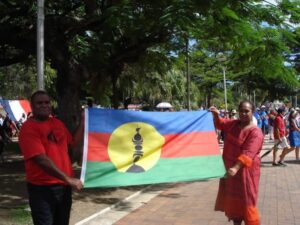
Kanak Pro-Independence supporters display the Kanak flag during a rally in the streets of Noumea prior to New Caledonia's first referendum on Independence in 2018. Credit: Catherine Wilson/IPS

Kanak Pro-Independence supporters display the Kanak flag during a rally in the streets of Noumea prior to New Caledonia’s first referendum on Independence in 2018. Credit: Catherine Wilson/IPS

NOUMEA, New Caledonia , Jul 17 2024 (IPS) – It’s been 26 years since a peace agreement, the Noumea Accord, was signed following an outbreak of conflict in the 1980s between Kanak islanders and French armed forces in the French overseas territory of New Caledonia.


But the eruption of turbulent protests and unrest again two months ago has shown that the cleavage of indigenous political grievances with the French state remains deep in this group of islands located east of Australia in the southwest Pacific.

The centre of New Caledonia’s capital, Noumea, a popular holiday destination in the Pacific Islands, is usually abuzz with tourists patronizing sidewalk cafes. But many of the streets, now patrolled by French police, are deserted and eerily quiet.

The protests, which began in mid-May, escalated to armed clashes between activists and French security forces, resulting in ten deaths. And the destruction of homes, public buildings and looting of shops and businesses has had a devastating impact on the small island society. The cost of the damage is estimated to be more than USD 1 billion; at least 7,000 people have lost jobs and incomes, and the territory’s economy has suffered a major downturn.

Barricades were erected in the streets of Noumea when confrontations escalated between Pro-Independence activists and French police in May following the French Parliament's adoption of electoral reforms in New Caledonia. Credit: Catherine Wilson/IPS

Barricades were erected in the streets of Noumea when confrontations escalated between Pro-Independence activists and French police in May following the French Parliament’s adoption of electoral reforms in New Caledonia. Credit: Catherine Wilson/IPS

The unrest has revealed the gaping fracture between France’s determination to retain control of the territory and the indigenous Kanak islanders, who are riled at lack of progress toward their call for self-determination.

“We protested in the streets. We wanted to say to the French state, you must respect the Kanaks because France voted for the reforms without consent from us,” Jacques (his name has been changed), a Kanak activist in Noumea, told IPS.

He was speaking of the adoption of electoral changes in New Caledonia by the French Parliament, which would have opened the electoral roll to tens of thousands of recent migrant settlers, the majority from Europe.

About 41 percent of New Caledonia’s population is indigenous and many believe it would have led to the declining influence of their vote against rising numbers of Loyalists in future elections and referendums. The changing demographic balance between Kanaks and non-Kanaks is a longstanding grievance.

The uprising in the 1980s was driven by grievances about land dispossession, poverty, inequality, the absence of civil and political rights, and France’s policy of promoting migration from France to New Caledonia.

While French President Emmanuel Macron suspended the electoral reforms in mid-June, many Pro-Independence supporters are unappeased.

Jacques is among a group of Kanak activists who have set up a campaign site next to a main road on the outskirts of the capital. They are sitting around a table under a marquee, surrounded by flags and banners.

“We want our country to be decolonized, as it is written in the Noumea agreement. The French state is only interested in dominating the population here. If the French state stays here, we will have more violence,” Jacques claims.

The French government agreed in the 1998 Noumea Accord to grant New Caledonia more governing powers, recognition of Kanak culture and right to consultation, restrictions on the local electoral roll allowing only Kanaks and long-term residents to vote and the holding of referendums on its future political status.

But by 2021, three referendums had been held, all with majority outcomes, to remain part of France. There was a 43.33 percent vote for Independence in the first referendum in 2018, which increased to 46.74 percent in the second in 2020. But Kanaks, severely affected by the COVID-19 pandemic, boycotted the third referendum in 2021. The overwhelming Loyalist vote of 96.5 percent has never been accepted by Pro-Independence political parties, such as the Kanak and Socialist National Liberation Front (FLNKS).

“We firmly support the call by FLNKS for the UN to declare the result of the third referendum null and void due to the non-participation of the people of Kanaky. Voter turnout was below 50 percent of registered voters; hence, it cannot be taken as the legitimate wish of the silent majority,” the sub-regional inter-governmental organization, the Melanesian Spearhead Group, stated in 2021.

Kanak separatists’ determination to keep their aspirations alive, even though options for changing the political status quo through referendums have been exhausted, has led to an increasingly polarized political landscape. Some entrenched Loyalists believe that the French state should “take over the New Caledonian government because of all the political problems that we have,” Catherine Ris, President of the University of New Caledonia in Noumea, told IPS. And, “on the Pro-Independence side, we do not hear the moderate people anymore.”

The recent mobilization of the Field Action Coordinating Cell (CCAT) by the Pro-Independence Caledonian Union party was a sign of some Kanaks’ belief that their demands are not being met through the political process. The core group of activists were a major force behind the recent protests and the Cell’s leader, Christian Tein, is currently being held in a jail in France on charges related to the unrest. Similarly, the major presence of youths on the streets in May is evidence that a new generation has lost faith in the pace of social and political change.

“The younger people want the change now because in their lives they have experienced and seen a lot of hardship—the persecution of the Kanak people, the difficulties of getting a job,” Jacques emphasized. An estimated 45 percent of people in New Caledonia who don’t have a high school certificate are indigenous, and the Kanak unemployment rate is reported to be as high as 38 percent.

Yet the representation of Kanaks in the territory’s government and politics has steadily increased over the past two decades. The number of seats held by Pro-Independence politicians in New Caledonia’s 54 seat Congress rose from 18 to 25 between 2004 and 2014, while Loyalists witnessed a decrease from 36 to 29 seats, reports Australia’s Lowy Institute for International Policy.

In 2021, Louis Mapou, the first Kanak Pro-Independence President of the government, was elected. And, following the French national election this month, Emmanuel Tjibaou, a Kanak leader from the rural North Province, was voted in as one of New Caledonia’s two members of the National Assembly in Paris.

In the wider region, New Caledonia’s self-determination movement has the international support of other Pacific Island countries, especially those that have indigenous Melanesian populations, such as Papua New Guinea and Fiji, as well as Azerbaijan and Russia. And the French overseas territory has been on the United Nations’ Decolonization List since 1986.

Yet there are New Caledonians who are concerned about the viability of a New Caledonian state. The territory relies heavily on France’s fiscal support, which amounts to 20 percent of the local gross domestic product (GDP) and pays for public services, local economic development programs and civil service salaries.

“We have a good economy here,” Marcieux, a Frenchman who has lived in New Caledonia for 30 years, told IPS in Noumea. “It is easy to speak of independence, but, in reality, it is very difficult. You need a way to make independence.”

But, until the yawning political divisions laid bare by the events of May are addressed, it will be difficult for New Caledonia’s leaders to present a united will to President Macron and the French Parliament located more than 16,000 kilometres away.

However, Tjibaou, the new member of the French National Assembly, is the focus of hope that meaningful dialogue can emerge from the recent conflict. He told local media soon after his election this month that “we all have to offer a framework for discussions to resume between the three partners, which are France, the FLNKS and the Loyalists… we have to capitalize on this.”

IPS UN Bureau Report

  Source

How Vote Reflects Farmers’ View on India’s BJP’s Agrarian Policy Amid Climate Change

Active Citizens, Asia-Pacific, Civil Society, Climate Change, Climate Change Justice, Food and Agriculture, Headlines, Humanitarian Emergencies, Sustainable Development Goals, TerraViva United Nations | Analysis

Democracy

Political parties often play lip service to climate change, but farmers in India, faced with unpopular policies and uncertainty in their livelihoods due to climate change, ensured their views were heard during the recent general elections.

Farmers in Kashmir sow rice crops. Farmers voted against the ruling BJP because of its unpopular policies and lack of support, as uncertain weather conditions impact their livelihoods. Credit: Umer Asif/IPS

Farmers in Kashmir sow rice crops. Farmers voted against the ruling BJP because of its unpopular policies and lack of support, as uncertain weather conditions impact their livelihoods. Credit: Umer Asif/IPS

SRINAGAR, Jul 15 2024 (IPS) – On June 4, Ram Das, a 65-year-old farmer from India’s northern state of Haryana, was anxiously waiting for the results of the country’s general elections. It was early morning when he left his home and, along with his fellow villagers, congregated near a tea stall that had a transistor set playing the election results.


By 11 in the morning, Das had already sipped three cups of tea and smoked a few cigarettes. His anxiety was plummeting as the results hinted at a decreasing number of seats for India’s ruling Bharatiya Janata Party (BJP). He, along with the entire hamlet, had voted against the Narendra Modi government. “The farmers are not happy at all. We wanted to teach this government a lesson, and that is what we did,” Das told Inter Press Service. 

Despite securing a third term in government, the BJP’s overall election performance was described as a “shock” to Prime Minister Narendra Modi by several media sources. The party fell short of its goal of winning 400 out of 543 seats, managing to secure only 240 seats compared to 303 in the last elections that were held in the year 2019. Opposition parties saw significant success in states with large farming populations, such as Uttar Pradesh, Haryana, Maharashtra, Punjab, and West Bengal. Consequently, the BJP had to rely on the 28 cumulative seats from its allies to form the government.

An infographic of the number of seats won by India's ruling Bharatiya Janata Party (BJP) in the 2019 and 2024 elections for Rajasthan, Uttar Pradesh, Haryana, and Punjab have the largest farming populations. The blue bars represent the 2019 elections, and the red bars represent the 2024 elections. The numbers on top of the bars indicate the number of seats won by the BJP out of the total seats available in each state. Credit: Umar Manzoor Shah/IPS

An infographic of the number of seats won by India’s ruling Bharatiya Janata Party (BJP) in the 2019 and 2024 elections for Rajasthan, Uttar Pradesh, Haryana, and Punjab have the largest farming populations. The blue bars represent the 2019 elections, and the red bars represent the 2024 elections. The numbers on top of the bars indicate the number of seats won by the BJP out of the total seats available in each state. Credit: Umar Manzoor Shah/IPS

What went wrong and where?

When Narendra Modi first took office in 2014, he promised to reform the agriculture sector and double farmers’ incomes. However, government data from 2022 shows that farmers still live in squalid conditions, earning just Rs 28 ($0.34) per day.

Government data reveals that between 2018 and 2022, a staggering 53,478 farmers took their own lives, overwhelmed by mounting debt, inadequate compensation for their produce, and unpredictable weather conditions. This means 36 farmers were killing themselves every day during this period. “The numbers could be much higher than what is being projected in the government data. This could be the tip of an ice-berg. Many farmer suicides go unreported and never find place in government files,” says Abinav Sinha, a civil society activist based in Indian state of Uttar Pradesh.

In 2020, Modi’s government enacted three controversial agricultural laws without consulting farmers’ groups. This move sparked a massive year-long protest, as farmers feared the laws would lead to increased corporatization of agriculture and the elimination of state-backed protections, such as the minimum support price and the procurement of farm produce by state agencies.

The government ultimately repealed the controversial agricultural laws, but not before enforcing a severe crackdown on the protests. Authorities arrested farmers, barricaded highways to prevent them from reaching New Delhi, and deployed shotguns, pellets, and drones to disperse tear gas on unarmed protesters. As per the various farmers’ associations, over 570 farmers were killed during the protest.

In February of this year, farmers once again took to the streets, this time demanding legal guarantees for a minimum support price (MSP) for crops, among other issues. However, negotiations with government officials failed to yield any conclusive results.

This was the reason that the farmers associations across the country galvanized their efforts into political action and unanimously resolved to vote against the ruling Bharatiya Janata Party (BJP).

June 4: The D-Day

Farmers like Das from Haryana were one amongst the thousands of other farmers who didn’t allow the BJP candidates to even enter their villages for the campaigning. “They were ruthless for us when we sought the rollback of the draconian farm laws. How on earth should we vote for them? We will not even allow them to campaign here,” Das said.

On June 4, this year, election results were announced, and the country was shocked to find the states with a considerable amount of agrarian population voting against the BJP.

In Rajasthan, where the BJP had secured a victory in the state government last December, it won 14 out of 25 seats in the recent elections, a significant drop from winning all 25 seats in 2019.

In Uttar Pradesh, a state where 65 percent of the population relies on agriculture, the BJP managed to win just 33 out of 80 seats, a sharp decline from the 62 seats it secured in 2019 and 71 in 2014.

In Haryana, known as India’s breadbasket, the BJP’s count dropped to five seats out of the 10 available, compared to winning all 10 seats in 2019. The opposition Congress claimed the remaining five seats.

In Punjab, a leading producer of rice and wheat, the BJP failed to win any seats, drawing a blank in the state.

Government Cannot Ignore Climate Change Now

Pranav Shankar, a climate change activist based in New Delhi, told IPS that the general elections in India this year have shown a considerable trend that cannot be ignored, downplayed or undermined. “The farmers have spoken out.  This is the reality. To date, the government has ignored the importance of the farming community. From now on, the government has to remain assiduous towards the farmers’ needs and take measures to tackle climate change that is wreaking havoc in the country and putting the farmers in distress,” Shankar said.

He added that more than 33 electoral officers were killed due to heat stroke during the national elections in India this year. “No one talked about them. Even the government itself seems to have forgotten about those poor souls. This is all very unprecedented,” Shankar said.

Note: This feature is published with the support of Open Society Foundations.

IPS UN Bureau Report

  Source

AFGHANISTAN: ‘The Doha Meeting Has Raised Concerns the UN Is Indirectly Legitimising the Taliban’

Asia-Pacific, Civil Society, Education, Featured, Gender, Headlines, Human Rights, Labour, Religion, TerraViva United Nations

Jul 10 2024 (IPS) –  
CIVICUS discusses the exclusion of women from international talks on Afghanistan currently being held in Qatar with Sima Samar, former chairperson of the Afghan Independent Human Rights Commission (AIHRC). The AIHRC is the Afghan national institution devoted to the promotion, protection and monitoring of human rights. Its status is now a matter of contention: on returning to power, the Taliban decreed its dissolution, but the AIHRC refuses to abide by the decision due to the illegitimate nature of the Taliban regime.


Sima Samar

The meeting between the Taliban, envoys from up to 25 countries and other stakeholders being hosted by the United Nations (UN) in Doha, Qatar, has sparked an international outcry because Afghan women haven’t been invited. This is the third such meeting but the first to include the Taliban, who aren’t internationally recognised as Afghanistan’s rulers. Rights activists have criticised the UN’s approach, saying it gives legitimacy to the Taliban and betrays its commitment to women’s rights. They are calling for gender apartheid to be recognised as an international crime and for sanctions to be imposed on those responsible.

What’s the purpose and relevance of the third Doha meeting on Afghanistan?

The third Doha meeting was convened following a UN Security Council resolution that mandated an independent assessment of the situation in Afghanistan, with the aim of facilitating Afghanistan’s reintegration into the international community and the UN. The appointed independent expert, a former Turkish diplomat, conducted a comprehensive assessment. While it acknowledged the Taliban’s human rights violations, particularly against women, it did not sufficiently address issues such as the persecution of minorities and the erosion of democratic processes.

The UN sees these meetings as part of a plan for a peaceful Afghanistan that respects human rights, particularly for women and girls, and is integrated into the global community. But the decision to exclude women from these critical discussions is deeply contradictory. By accepting the Taliban’s conditions for participation in the talks, the UN is undermining its commitment to promoting inclusivity and gender equality.

Why are rights groups criticising the meeting and what are their demands?

Rights groups have been highly critical of the UN’s approach to the meeting for a number of reasons. First, they have condemned the exclusion of women from the main discussions. This exclusion directly contradicted the UN’s commitment to gender mainstreaming and its resolutions advocating women’s participation in peace processes. Second, there was a significant lack of transparency about the agenda and proceedings of the meetings, particularly the separate women’s session that followed the main discussions. This opacity fuelled concerns about the effectiveness and sincerity of the engagement.

Critics say the meeting focused mainly on economic issues, ignoring important discussions on human rights and women’s rights. This has raised concerns the UN is indirectly legitimising the Taliban’s harsh policies. Rights groups want future meetings to be inclusive and transparent and ensure women’s voices are heard. They want the UN to stick to its rules and not agree to demands that violate human rights.

What’s the situation of Afghan women under the Taliban?

Since the Taliban came back to power, the situation for women in Afghanistan has deteriorated dramatically. Women have been almost completely removed from public life, allowed to work only in very limited fields such as health and primary education, and then only under strict conditions.

Afghanistan is the only country in the world that prohibits girls beyond 11 to 12 years old from receiving education. Even below that level, there are severe restrictions, including the imposition of the hijab on young girls and a curriculum increasingly focused on religious instruction, which threatens to radicalise the next generation.

Women working in any capacity face severe economic discrimination. Their salaries are capped at unsustainable levels, making it impossible for them to live independently. When female health workers went on strike over these unfair conditions, the Ministry of Public Health refused to engage in dialogue.

The Taliban’s systematic discrimination places women in an inferior position in all aspects of life, from education to employment, perpetuating a cycle of oppression and marginalisation. There is an obvious gap between the goals of the Doha meeting, which aim to achieve a peaceful Afghanistan with human rights for women and girls, and the harsh realities faced by Afghan women under Taliban rule.

What should the international community do to support Afghan women?

To support women’s rights in Afghanistan, the international community must take a firm stand against the Taliban’s policies.

First, the Taliban should not be recognised as a legitimate government until they comply with international human rights standards, including those relating to women’s rights. Second, existing sanctions against the Taliban should be strengthened to pressure them to comply with human rights norms. Third, the international community should hold the Taliban accountable for their crimes, including rights violations against women, through legal mechanisms and continuous advocacy.

The plight of Afghan women is not just a national issue, but a global one that affects the stability and peace of the entire region. Ignoring women’s suffering will only perpetuate conflict and undermine efforts to achieve sustainable peace and development. The international community has a moral obligation to ensure the protection of Afghan women’s rights and uphold the principles of justice and equality in any engagement with the Taliban.

What should be done to ensure women are included in future talks on Afghanistan?

To ensure the inclusion of women in future international talks, it is essential that their participation is mandated at every stage of the dialogue process. Women must be at the table for all discussions, as their exclusion fundamentally undermines the legitimacy and effectiveness of the talks.

The international community should strongly reject any conditions set by the Taliban that violate human rights principles, particularly those that exclude women. Transparency is also crucial. Agendas and outcomes of meetings should be openly shared to ensure inclusiveness and accountability.

Civic space in Afghanistan is rated ‘closed’ by the CIVICUS Monitor.

Get in touch with the Afghan Independent Human Rights Commission through its website or Facebook page, and follow @AfghanistanIHRC and @DrSimasamar on Twitter.

  Source

As Heat Soars in India, so Does Domestic Violence

Asia-Pacific, Civil Society, Crime & Justice, Featured, Gender, Gender Violence, Global, Headlines, IPS UN: Inside the Glasshouse, TerraViva United Nations

Opinion

Members of a “Jugnu” club get trained by UN Women to support women who experience gender-based violence. Credit: UN Women

NEW DELHI, India, Jul 4 2024 (IPS) – As the temperature soars to new heights in India, so does domestic violence. It’s a well-established correlation that is largely left out of the climate change discussion, but the gap is glaring and needs to be bridged.


For the third summer in a row, temperatures in India are breaking historical records. The recent record high of 52.9° C (127.22° F), has resulted in loss of livelihood, water rationing, health impacts, and even death. The heat affects some more than others. As people are advised to shelter at home, those in lower economic strata contend with cramped living situations, lack of air conditioning, and power cuts.

Women bear the worst impacts. New Delhi’s Heat Action Plan (HAP) registers their greater vulnerability – noting, for example, that they’re more susceptible to falling sick from the heat compared to men, the heightened risks for pregnant people, and greater expectations of women to be caretakers. But it fails to note the increased threat of violence.¬¬¬¬¬

It is well-documented that temperature extremes lead to an increase in domestic violence cases, with low-income women bearing the brunt. In South Asia, for every degree that the temperature rises, domestic violence increases about 6%.

As India grapples with its large carbon footprint, rising temperatures, and growing population, intimate partner violence can be expected to increase drastically. P¬¬ar¬¬¬ticularly if greenhouse gas emissions aren’t regulated effectively, India could see a spike in domestic violence of more than 20% by the end of the century.

Extreme temperatures are associated with frustration, aggression, and disruptions in people’s daily routines. Researchers theorize this is the reason why heat has a such a strong influence on rates of intimate partner violence.

For low-income daily wage laborers in India, heat may result in loss of livelihood and income. Economic stress and resultant anxiety can significantly increase domestic violence risk.

In addition, women are expected to be caretakers for the family, which gives them little chance of escape from abusers and increases their vulnerability under extreme conditions. This phenomenon was prevalent during Covid-19 pandemic, when the “shadow pandemic” of domestic violence affected women across India.

The pandemic also revealed strong patterns of economic abuse of women due to unequal power dynamics within the family.

Despite research demonstrating this, the spike in domestic violence during heat waves remains hush-hush. New Delhi’s Heat Action Plan (HAP) does not mention gender-based violence even once across its 66 pages.

While it acknowledges women as a vulnerable group and deals with increased risk during pregnancy, other risks to women remain shrouded in the vagueness of “social norms” and “gender discrimination.” Failing to address the threat of intimate partner violence explicitly leaves out a key piece of the puzzle.

The omission has manifold impacts. It lets policymakers shy away from confronting the issue, creating a gap in policy at the highest level. It sets up government workers tasked with implementing the plans such as New Delhi’s HAP on the ground for failure.

With no guidance on how to deal with the predictable increase in domestic violence during extreme heat, government can offer little support for women who need it. Mahila Panchayats (“women’s councils”) and grassroots non-profits often help rural and low-income women find support and community, but extreme weather can cut them off from these resources.

Forced to stay indoors and unable to access help, women have little recourse or respite. In theory, India’s laws protect them. But in practice, implementation is spotty, and they remain vulnerable.

India’s climate policy must not leave women out in the cold. New Delhi’s Heat Action Plan and other policy initiatives must protect women and offer them accessible support. First responders and government workers must be given the tools they need to help support those at risk for domestic violence, not only during heat waves but year-round.

Finally, India’s problem with domestic violence might be exacerbated during the summers but is not unique to them. India needs a suite of policies and concrete actions to contend with rising intimate partner violence, starting at the grassroots level and prioritizing education, employment, economic stability, and family planning for all.

Heat waves and the stressors they bring might be unforeseeable in a sense, but rising temperatures and rising domestic violence are completely predictable effects of climate change. There’s no excuse for failing to redress them.

By leaving women vulnerable year after year, we are doing a disservice, both to women who need help and to the institutions that they place their trust in.

Umang Dhingra is a Duke University undergraduate and a Stanback Fellow at the Population Institute, a Washington D.C.-based nonprofit that supports reproductive health and rights.

IPS UN Bureau

  Source