Transgender People Face Growing Violence, Discrimination in Pakistan

Transgender people often entertain at weddings and other events, but they increasingly face violent acts, especially since part of an Act ensuring their rights was recently struck down. Credit: Ashfaq Yusufzai/IPS

Transgender people often entertain at weddings and other events, but they increasingly face violent acts, especially since part of an Act ensuring their rights was recently struck down. Credit: Ashfaq Yusufzai/IPS

By Ashfaq Yusufzai
PESHAWAR, Jul 24 2023 (IPS)

“The problems transgender people face start from their homes as their parents, especially fathers and brothers, look them down upon and disrespect them,” says 20-year-old Pari Gul.


Gul, a resident of Charsadda district in Khyber Pakhtunkhwa (KP), left her house at 16 when her mother asked her to or face being killed by her father.

“I was born as a boy, and my name was Abdul Wahid, but when I came to Peshawar and joined a transgender group, I got a female name, Pari Gul. Since then, I have been going to weddings and other festive ceremonies to dance,” she says. “Dance is my passion.”

However, she has often been the brunt of discrimination and violence.

“During my five-year career, people have beaten me more than 20 times. Each time the perpetrators went unpunished,” she told IPS in an interview.

Trans people are often targeted in KP, one of Pakistan’s four provinces.

On March 28, a man shot dead a transgender person in Peshawar. It was the third incident targeting transgender persons in the province in less than a week. Despite the violence, violent attacks on transgender people aren’t considered a major crime.

Khushi Khan, a senior transgender person, says lack of protection is the main problem.

“People have developed a disdain for us. They consider us non-Muslims because we dance at marriages and other ceremonies,” she says.

“We had lodged at least a dozen complaints with police in the past three months when our colleagues were robbed of money, molested and raped but to no avail,” Khan, 30, says.

Last month, clerics in the Khyber district decided they wouldn’t offer funerals to transgender persons and asked people to boycott them.

Rafiq Shah, a social worker, says that people attack the houses of transgender, kill, injure and rob them, but the police remain silent “spectators”.

“We have been protesting against violence frequently, but the situation remains unchanged,” Shah said.

Qamar Naseem, head of Blue Veins, a national NGO working to promote and protect transgender people, isn’t happy over the treatment meted out to the group.

“Security is the main issue of transgender persons. About 84 transgender persons have been killed in Pakistan since 2015 while another 2,000 have faced violence, but no one has been punished so far,” Naseem says.

The lack of action by the police has emboldened the people.

“Health, transportation, livelihoods and employment issues have hit the transgender (community) hard. Most of the time, they remained confined to their homes, located inside the city,” he says.

There are no data regarding the number of transgender in the country because the government doesn’t take them seriously, he says.

In May 2023, the Federal Shariat Court (FSC) dealt a severe blow when it suspended the implementation rules of the Protection of Transgender Persons Protection of Rights Act.

Farzana Jan, president of TransAction Alliance, says that FSC’s declaration that individuals cannot alter their gender at their own discretion, asserting that specific clauses within the Transgender Persons (Protection of Rights) Act, 2018 contradict Islamic law, has disappointed us.

The FSC declared un-Islamic sections 3 and 7 and two sub-sections of Section 2 of the Transgender Persons (Protection of Rights) Act, 2018, five years after the law was passed, the FSC rolled back key provisions granting rights to Pakistan’s transgender community.

Some right-wing political parties had previously voiced concerns over the bill as a promoter of “homosexuality,” leading to “new social problems”.

The Transgender Persons (Protection of Rights) Act, 2018, is against the injunctions of Islam as laid down in the Holy Quran and Sunnah of the Holy Prophet (PBUH) and will cease to have any legal effect immediately, the verdict stated.

Amnesty International said the verdict was a blow to the rights of the already beleaguered group of transgender and gender-diverse people in Pakistan. It said some of the FSC’s observations were based on presumptive scenarios rather than empirical evidence. The denial of essential rights of transgender and gender-diverse persons should not be guided by assumptions rooted in prejudice, fear and discrimination, AI said.

“Any steps taken by the government of Pakistan to deny transgender and gender-diverse people the right to gender identity is in contravention of their obligations under international human rights law, namely the International Covenant on Civil and Political Rights (ICCPR) and the Convention on the Elimination of All Forms of Discrimination against Women (CEDAW) to which they are a state party,” it said.

The government should take immediate steps to stop the reversal of essential protections, without which transgender and gender-diverse people will be even more at risk of harassment, discrimination and violence, AI added.

On July 12, 2023, transgender representatives from all provinces held a press conference at Lahore Press Club, where they vehemently condemned the recent decision by the FSC against the Transgender Persons (Protection of Rights) Act, 2018.

Arzoo Bibi, who was at a press conference, said it was time to stand united for justice and equality.

“Militants don’t threaten us, but our biggest concern is the attitude of the society and police,” said Arzoo.
IPS UN Bureau Report


!function(d,s,id){var js,fjs=d.getElementsByTagName(s)[0],p=/^http:/.test(d.location)?’http’:’https’;if(!d.getElementById(id)){js=d.createElement(s);js.id=id;js.src=p+’://platform.twitter.com/widgets.js’;fjs.parentNode.insertBefore(js,fjs);}}(document, ‘script’, ‘twitter-wjs’);  

Source

Quest for Safe Water in One of India’s Most Isolated Villages

Simita Devi, whose daughter spent days in hospital recently suffering from typhoid caused by contaminated water, collects clean water brought to the surface by a solar pump. Credit: Umar Manzoor Shah/IPS

Simita Devi, whose daughter spent days in hospital recently suffering from typhoid caused by contaminated water, collects clean water brought to the surface by a solar pump. Credit: Umar Manzoor Shah/IPS

By Umar Manzoor Shah
Champad, India, Jul 4 2023 (IPS)

Simita Devi spent over ten days in a government-run hospital a year ago anxiously watching her critically ill nine-year-old daughter, Gudiya, who was diagnosed with typhoid.

Gudiya was so sick she even went into a coma for a day. Medical staff attending to the child said she contracted the disease from drinking contaminated water.


After being discharged, Devi’s main worry was to get safe drinking water for her ailing daughter.

She was advised not to consume water from village wells or untested sources like river streams or springs.

Hailing from Champad, a tribal village in India’s Jharkhand state, Devi works as a daily wage labourer alongside her husband. With a limited income, Devi couldn’t afford packaged drinking water for her daughter.

She then decided to boil the water using firewood to make it safe to drink. But to get the firewood, she had to trek the treacherous terrains of the nearby forests – a long, difficult work and the fear of wild animals loomed.

It was not Devi alone impacted by contaminated water, it was making many people in her village ill, and there was nothing the inhabitants could do about it.

According to government records, 80% of India’s rural drinking water comes from underground sources. One-third of India’s 600 districts do not have safe drinking water because fluoride, iron, salinity, and arsenic concentrations exceed tolerance levels. India’s water quality is poor, ranking at 120 of 122 nations.

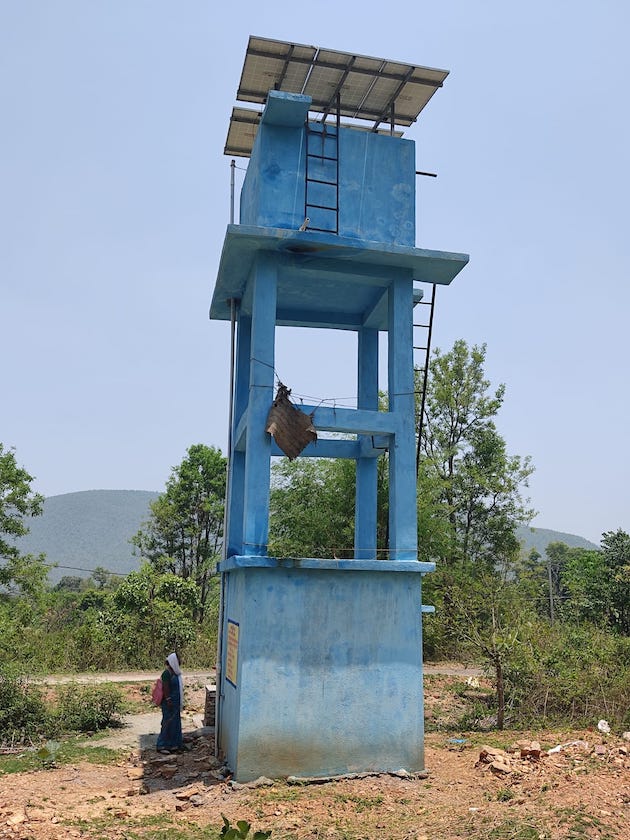
The solar panels on the water tower have meant clean waters for the villagers of Champad, a tribal village in India’s Jharkhand. Credit: Umar Manzoor Shah/IPS

The solar panels on the water tower have meant clean waters for the villagers of Champad, a tribal village in India’s Jharkhand. Credit: Umar Manzoor Shah/IPS

Experts believe that the source of these heavy metals is industrial waste being dumped untreated into water systems and nitrates which surface due to excessive and prolonged use of fertilizers. The government estimates that every year, over one lakh (100,000) people die of waterborne diseases in the country.

Champad, a village inhabited by a tribal community, has 105 households per the 2011 census. Until 2022, the community depended on only two tube wells as their source of drinking water. However, these tube wells often experienced malfunctions, leaving the villagers with no choice but to fetch water from a nearby river or pond. Consequently, there has been a rise in waterborne diseases, particularly affecting the health of women and children. The need to travel long distances for safe drinking water has increased women’s workload, increasing their workload.

Perturbed by the threat of waterborne diseases, the village locals congregated earlier this year to try to find a solution. They at first visited the local politicians for help. Then they headed towards government offices. “Nothing happened—absolutely nothing. We were virtually left high and dry. Except for God, no one is there to help us. At times, we were told to wait, and at times, we were told that government funding wasn’t available. But we were slowly dying. Our children are suffering in front of our own eyes,” Ram Singh, a local villager at Champad, told IPS.

Earlier this year, a team from a non-governmental agency working to uplift rural areas in India visited the village to assess the villagers’ hardships.

The agency then mooted the idea of a solar water tower in the village. The villagers were made aware of the process involved in the tower’s construction and that government approval for the facility was needed.

The village representatives were taken on board, and a proposal was submitted to the water department of the district.

“Government liked the idea, and it was readily approved. The entire village worked together to make the project a success story,” says a member of the humanitarian agency who wished to remain anonymous.

The towers were equipped with solar panels, enabling them to operate sustainably and with minimal environmental impact. The selection of sites for the towers was a collaborative effort involving the village communities. The first solar water tower was constructed in February 2023, while work on the other two towers is still ongoing. As a result, 45 families now directly benefit from the convenience of having clean drinking water channelled to their homes through pipelines. The water provided is of good quality and considered safe, in contrast to the open well water that was previously relied upon. This development has significantly alleviated the burden on women, who no longer have to travel long distances to fetch water from various sources.

The impact of this intervention was significant. The community’s health improved, and they were no longer at risk of waterborne illnesses. The women and children, who were often responsible for collecting water from distant sources, could now spend their time on other activities. The community’s overall quality of life improved, and they could focus on their livelihoods and education.

For Simita Devi, the facility is no less than a major solace in her life. She excitedly uses this water for drinking and thanks God for such an endeavour.

“Safe water means life for us. The solar tower has become a messiah for poor villagers like us. We will cherish the moments for life when we find its water coming to our homes,” Devi told IPS.

IPS UN Bureau Report


!function(d,s,id){var js,fjs=d.getElementsByTagName(s)[0],p=/^http:/.test(d.location)?’http’:’https’;if(!d.getElementById(id)){js=d.createElement(s);js.id=id;js.src=p+’://platform.twitter.com/widgets.js’;fjs.parentNode.insertBefore(js,fjs);}}(document, ‘script’, ‘twitter-wjs’);  

Source

Myanmar: Military Junta Gets a Free Pass

Cover photo by Reuters/Stringer via Gallo Images

By Andrew Firmin
LONDON, Jun 23 2023 (IPS)

The violence keeps coming in Myanmar, under military rule since February 2021. The junta stands accused of war crimes and crimes against humanity, with evidence of systematic use of killings, rape, torture and other gross human rights violations in its attempt to suppress forces demanding a return to democracy.


Even humanitarian aid is restricted. Recently the junta refused to allow in aid organisations trying to provide food, water and medicines to people left in desperate need by a devastating cyclone. It’s far from the first time it’s blocked aid.

Crises like this demand an international response. But largely standing on the sidelines while this happens is the regional intergovernmental body, the Association of Southeast Asian Nations (ASEAN). Its recent summit, held in Indonesia in May, failed to produce any progress.

ASEAN’s inaction

ASEAN’s response to the coup was to issue a text, the Five-Point Consensus (5PC), in April 2021. This called for the immediate cessation of violence and constructive dialogue between all parties. ASEAN agreed to provide humanitarian help, appoint a special envoy and visit Myanmar to meet with all parties.

Civil society criticised this agreement because it recognised the role of the junta and failed to make any mention of the need to restore democracy. And the unmitigated violence and human rights violations are the clearest possible sign that the 5PC isn’t working – but ASEAN sticks to it. At its May summit, ASEAN states reiterated their support for the plan.

A major challenge is that most ASEAN states have no interest in democracy. All 10 have heavily restricted civic space. As well as Myanmar, civic space is closed in Cambodia, Laos and Vietnam.

It wouldn’t suit such states to have a thriving democracy on their doorstep, which could only bring greater domestic and international pressure to follow suit. States that repress human rights at home typically carry the same approach into international organisations, working to limit their ability to uphold human rights commitments and scrutinise violations.

Continuing emphasis on the 5PC hasn’t masked divisions among ASEAN states. Some appear to think they can engage with the junta and at least persuade it to moderate its violence – although reality makes this increasingly untenable. But others, particularly Cambodia – a one-party state led by the same prime minister since 1998 – seem intent on legitimising the junta.

Variable pressure has come from ASEAN’s chair, which rotates annually and appoints the special envoy. Under the last two, Brunei Darussalam – a sultanate that last held an election in 1965 – and Cambodia, little happened. Brunei never visited the country after being refused permission to meet with democratic leaders, while Cambodia’s prime minister, Hun Sen, visited Myanmar last year. The first post-coup visit to Myanmar by a head of government, this could only be construed as conferring legitimacy.

Indonesia, the current chair, hasn’t appointed a special envoy, instead setting up an office headed by the foreign minister. So far it appears to be taking a soft approach of quiet diplomacy rather than public action.

Thailand, currently led by a pro-military government, is also evidently happy to engage with the junta. While junta representatives remain banned from ASEAN summits, Thailand has broken ranks and invited ASEAN foreign ministers, including from Myanmar, to hold talks about reintegrating the junta’s leaders. A government that itself came to power through a coup but should now step aside after an election where it was thoroughly defeated looks to be attempting to bolster the legitimacy of military rule.

ASEAN states seem unable to move beyond the 5PC even as they undermine it. But the fact that they’re formally sticking with it enables the wider international community to stand back, on the basis of respecting regional leadership and the 5PC.

The UN Security Council finally adopted a resolution on Myanmar in December 2022. This called for an immediate end to the violence, the release of all political prisoners and unhindered humanitarian access. But its language didn’t go far enough in condemning systematic human rights violations and continued to emphasise the 5PC. It failed to impose sanctions such as an arms embargo or to refer Myanmar to the International Criminal Court (ICC).

Civil society in Myanmar and the region is urging ASEAN to go further. Many have joined together to develop a five-point agenda that goes beyond the 5PC. It calls for a strategy to end military violence through sanctions, an arms embargo and a referral of Myanmar to the ICC. It demands ASEAN engages beyond the junta, and particularly with democratic forces including the National Unity Government – the democratic government in exile. It urges a strengthening of the special envoy role and a pivoting of humanitarian aid to local responders rather than the junta. ASEAN needs to take this on board.

A fork in the road

ASEAN’s current plan is a recipe for continuing military violence, increasingly legitimised by its neighbours’ acceptance. Ceremonial elections could offer further fuel for this.

The junta once promised to hold elections by August, but in February, on the coup’s second anniversary, it extended the state of emergency for another six months. If and when those elections finally happen, there’s no hope of them being free or fair. In March, the junta dissolved some 40 political parties, including the ousted ruling party, the National League for Democracy.

The only purpose of any eventual fake election will be to give the junta a legitimising veneer to present as a sign of progress – and some ASEAN states may be prepared to buy this. This shouldn’t be allowed. ASEAN needs to listen to the voices of civil society calling for it to get its act together – and stick together – in holding the junta to account. If it doesn’t, it will keep failing not only Myanmar’s people, but all in the region who reasonably expect that fundamental human rights should be respected and those who kill, rape and torture should face justice.

Andrew Firmin is CIVICUS Editor-in-Chief, co-director and writer for CIVICUS Lens and co-author of the State of Civil Society Report.


!function(d,s,id){var js,fjs=d.getElementsByTagName(s)[0],p=/^http:/.test(d.location)?’http’:’https’;if(!d.getElementById(id)){js=d.createElement(s);js.id=id;js.src=p+’://platform.twitter.com/widgets.js’;fjs.parentNode.insertBefore(js,fjs);}}(document, ‘script’, ‘twitter-wjs’);  
Source

Hong Kong’s Lights of Freedom Extinguished

Asia-Pacific, Civil Society, Crime & Justice, Democracy, Education, Featured, Headlines, Press Freedom, TerraViva United Nations

Opinion

Credit: Yan Zhao/AFP via Getty Images

LONDON, Jun 9 2023 (IPS) – Nothing was more predictable than repression. Merely for holding candles and flowers, people were taken away by Hong Kong’s police.

The occasion was the anniversary of the Tiananmen Square Massacre, 4 June 1989. Hong Kong was until recently home to mass annual vigils where thousands gathered to keep alive the memory of that day. But that’s all gone now in the crackdown that followed large-scale protests for democracy that erupted in 2019.


Hong Kong’s authorities are evidently determined to erase any form of acknowledgement that the massacre ever happened. Memorials and artworks commemorating it have been removed. Books that mention the tragedy have disappeared from libraries. Shops selling the LED candles commonly used to mark the occasion were visited by the authorities in the run up to this year’s anniversary.

The organisation behind the vigil, the Hong Kong Alliance in Support of Patriotic Movements in China, closed itself down in 2021 following a police investigation. Several of its leaders were jailed in March.

Instead of hosting the usual vigil, this year Hong Kong’s Victoria Park was home to a carnival celebrating Chinese rule. People wanting to mark the occasion had to do so in private.

This is only the tip of the iceberg. People are mourning not only the many who died on 4 June 1989 but also the Hong Kong vanishing before their eyes.

Further than ever away from democracy

When Hong Kong was handed over to China by the UK in 1997, China agreed to maintain the country’s distinct political and economic structures for the next 50 years, under the banner of ‘one country, two systems’.

Hong Kong’s Basic Law guaranteed civic rights, including freedoms of association, peaceful assembly and expression. China committed to move towards universal suffrage for the election of Hong Kong’s Chief Executive, the head of government.

But following the democracy protests that burst out in 2019, China has unilaterally torn up that agreement. Three years ago, the government passed the National Security Law, a sweeping piece of legislation that criminalises criticism of the authorities. It’s been used alongside existing laws, such as the law on sedition, to jail leaders of the democracy movement.

China never made good on its promise of universal suffrage. It’s gone in the opposite direction. Current Chief Executive John Lee – who as security chief led the violent crackdown on democracy protests – was chosen last year by a hand-picked 1,500-member Election Committee, which duly endorsed him as the sole candidate.

The Legislative Council, Hong Kong’s parliament, had already been neutered. The number of directly elected seats has been slashed and people are disqualified from standing if they question China’s sovereignty over Hong Kong.

Now the District Councils are in the firing line. When the last elections for the municipal bodies were held, in the thick of democracy protests in November 2019, pro-democracy parties triumphed.

Such a result is now impossible. In 2021, a law was passed requiring all district councillors to swear an oath of allegiance affirming their ‘patriotism’ for China. Most of the pro-democracy candidates elected in 2019 were disqualified or resigned.

Now when new district councillors are chosen in November, only 20 per cent of seats will be directly elected. The authorities will fill the rest with their supporters, all vetted to ensure their ‘patriotism’. Little wonder that the Civic Party, one of Hong Kong’s leading pro-democracy parties, recently announced it was closing down.

A hollowed-out Hong Kong

Hong Kong was once a country where people felt safe to protest. It had a flourishing media and publishing industry. Now journalists are criminalised and key independent media have shut down.

Civil society organisations and trade unions have done the same. The remaining organisations are scattered, practising self-censorship. Protests continue to be heavily restricted: this year a planned International Women’s Day march was cancelled after police threats.

People continue to try to find ways to express dissent, but any small gesture can attract the state’s ire. The death of Queen Elizabeth II gave people an opportunity to use public mourning to express at with the regression since handover. But when a vigil was held during the Queen’s funeral, a harmonica player was arrested for daring to play the tune Glory to Hong Kong, associated with the democracy protests.

Last year five speech therapists were convicted of producing ‘seditious publications’. Their crime was to produce children’s books in which sheep defend their villages from wolves. This was taken to be an allegory of China’s control of Hong Kong.

Everyday repression is making Hong Kong a hollowed-out country, its population falling. Some schools face closure due to falling student numbers. Many have fled, not wanting their children to grow up in a country where education is indoctrination. The curriculum has been reworked to teach students loyalty rather than independent thought. Many teachers are leaving the country or taking early retirement.

With the legal system facing increasing interference and political pressure, lawyers are also among those fleeing.

A key test will be the trial of Jimmy Lai, former media owner and democracy campaigner. He’s already been found guilty on numerous counts. His newspaper, Apple Daily, once Hong Kong’s most widely read pro-democracy paper, shut down in 2021. He faces trial under the National Security Law, which could mean a life sentence.

The judges who will try Lai have been handpicked by John Lee. Meanwhile the authorities have tried to prevent Lai’s defence lawyer, UK barrister Tim Owen, representing him in court. In March they passed a law giving Lee the power to ban foreign lawyers working on national security cases. It isn’t looking promising.

Lai is one of Hong Kong’s 1,508 political prisoners. Even as the population shrinks, the imprisoned population just keeps getting bigger. The candles that commemorate the Tiananmen Square Massacre and the yearning for democracy will continue to flare around the world in exile – but those lights are being extinguished in Hong Kong.

Andrew Firmin is CIVICUS Editor-in-Chief, co-director and writer for CIVICUS Lens and co-author of the State of Civil Society Report.

  Source

Climate Change Gets Its Day in Court

Asia-Pacific, Civil Society, Climate Action, Climate Change, Development & Aid, Environment, Featured, Global, Headlines, Human Rights, TerraViva United Nations

Opinion

Credit: Save the Children Vanuatu/Facebook

MONTEVIDEO, Uruguay, May 25 2023 (IPS) – As a matter of global justice, the climate crisis has rightfully made its way to the world’s highest court.

On 29 March 2023, the United Nations General Assembly (UNGA) unanimously adopted a resolution asking the International Court of Justice (ICJ) to issue an advisory opinion on the obligations of states on climate change. The initiative was led by the Pacific Island state of Vanuatu, one of several at risk of disappearing under rising sea levels. It was co-sponsored by 132 states and actively supported by networks of grassroots youth groups from the Pacific and around the world.


Civil society’s campaign

In 2019, a group of law students from the University of the South Pacific formed Pacific Islands Students Fighting Climate Change (PISFCC), a regional organisation with national chapters in Fiji, the Solomon Islands, Tonga and Vanuatu. PISFCC advocated with the Pacific Island Forum – the key regional body – to put the call for an ICJ opinion on its agenda. The government of Vanuatu announced it would seek this in September 2021, and Pacific civil society organisations (CSOs) formed an alliance – the Alliance for a Climate Justice Advisory Opinion – that has since grown to include CSOs and many others from around the world, including UN Special Rapporteurs and global experts.

The campaign made heavy use of social media, with people sharing their stories on the impacts of climate change and emphasising the importance of an ICJ opinion to help support calls for climate action, including climate litigation. It organised globally, sharing a toolkit used by activists around the world, and took to the streets locally. In Vanuatu, where it all started, children demonstrated in September 2022 to call attention to the impacts of climate change as their country’s single greatest development threat and express support for the call for an ICJ opinion.

In the run-up to the UNGA session that adopted the historic resolution, thousands of CSOs from around the world supported a letter calling for governments to back the vote.

[embedded content]

The ICJ’s role

The ICJ is made up of 15 judges elected by the UNGA and UN Security Council. It settles legal disputes between states and provides advisory opinions on legal questions referred to it by other parts of the UN system.

The questions posed to the ICJ aim to clarify the obligations of states under international law to protect the climate system and environment from human-induced greenhouse gas emissions. They also ask about the legal responsibilities of states that have caused significant environmental harm towards other states, particularly small islands, and towards current and future generations.

To provide its advisory opinion, the ICJ will have to interpret states’ obligations as outlined in the 1992 UN Framework Convention on Climate Change and the 2015 Paris Agreement as well as the Universal Declaration of Human Rights and a variety of international covenants and treaties. It may consider previous UNGA resolutions on climate change, such as the recent one recognising access to a clean, healthy and sustainable environment as a universal human right, and other resolutions by the UN Human Rights Council and reports by the Office of the UN High Commissioner of Human Rights and its independent human rights experts. It may also take into account decisions by UN treaty bodies and its own jurisprudence on climate and environmental matters.

Next steps

According to its statute, the ICJ can seek written statements from states or international organisations likely to have relevant information on the issue at hand. On 20 April, it communicated its decision to treat the UN and all its member states as ‘likely to be able to furnish information on the questions submitted to the Court’ and gave them six months to submit written statements, after which they will have three months to make written comments on statements made by other states or organisations.

Civil society doesn’t have any right to submit formal statements, so climate activists are urging as many people as possible to advocate towards their governments to make strong submissions that will lead to a progressive ICJ opinion. After submissions close, the ICJ is likely to take several months to deliberate, so its opinion may be expected at some point in 2024, likely towards the end of the year.

Advisory opinions aren’t binding. They don’t impose obligations on states. But they shape the global understanding of states’ obligations under international law and can motivate states to show their compliance with rising standards. An ICJ opinion could positively influence climate negotiations, pushing forward long-delayed initiatives on funding for loss and damage. It could encourage states to make more ambitious pledges to cut greenhouse gas emissions. It might also help raise awareness of the particular risks faced by small island states and provide arguments in favour of stronger climate action, helping climate advocates gain ground within governments.

A progressive advisory opinion could also help support domestic climate litigation: research shows that domestic courts are increasingly inclined to cite ICJ opinions and other sources of international law, including when it comes to determining climate issues.

The risk can’t be ruled out of a disappointing ICJ opinion merely reiterating the content of existing climate treaties without making any progress on states’ obligations. But climate activists find reasons to expect much more: many see this as a unique opportunity, brought about by their own persistent efforts, to advance climate justice and push for action that meets the scale of the crisis.

Inés M. Pousadela is CIVICUS Senior Research Specialist, co-director and writer for CIVICUS Lens and co-author of the State of Civil Society Report.

  Source

Uzbekistan: A President for Life?

Credit: Victor Drachev/AFP via Getty Images

By Andrew Firmin
LONDON, May 5 2023 (IPS)

Where will you be in 2040? For Uzbekistan’s President Shavkat Mirziyoyev, the answer is: in the Kuksaroy Presidential Palace. That’s the chief consequence of the referendum held in the Central Asian country on 30 April.

With dissent tightly controlled in conditions of closed civic space, there was no prospect of genuine debate, a campaign against, or a no vote.


Repression betrays image of reform

Mirziyoyev took over the presidency in 2016 following the death of Islam Karimov, president for 26 years. Karimov ruled with an iron fist; Mirziyoyev has tried to position himself as a reformer by comparison.

The government rightly won international recognition when Uzbekistan was declared free of the systemic child labour and forced labour that once plagued its cotton industry. The move came after extensive international civil society campaigning, with global action compensating for the inability of domestic civil society to mobilise, given severe civic space restrictions.

While that systemic problem has been addressed, undoubtedly abuses of labour rights remain. And these are far from the only human rights violations. When one of the proposed constitutional changes announced last July sparked furious protests, the repression that followed belied Mirziyoyev’s reformist image.

Among the proposed changes was a plan to amend the status of Uzbekistan’s Karakalpakstan region. Formally, it’s an autonomous republic with the right to secede. The surprise announcement that this special status would end brought rare mass protests in the regional capital, Nukus. When local police refused to intervene, central government flew over riot police, inflaming tensions and resulting in violent clashes.

A state of emergency was imposed, tightly restricting the circulation of information. Because of this, details are scarce, but it seems some protesters started fires and tried to occupy government buildings, and riot police reportedly responded with live ammunition and an array of other forms of violence. Several people were killed and over 500 were reported to have been detained. Many received long jail sentences.

The government quickly dropped its intended change, but otherwise took a hard line, claiming the protesters were foreign-backed provocateurs trying to destabilise the country. But what happened was down to the absence of democracy. The government announced the proposed change with no consultation. All other channels for expressing dissent being blocked, the only way people could communicate their disapproval was to take to the streets.

Civic space still closed

It remains the reality that very little independent media is tolerated and journalists and bloggers experience harassment and intimidation. Vague and broad laws against the spreading of ‘false information’ and defamation give the state ample powers to block websites, a regular occurrence.

Virtually no independent civil society is allowed; most organisations that present themselves as part of civil society are government entities. Independent organisations struggle to register, particularly when they have a human rights focus. New regulations passed in June 2022 give the state oversight of activities supported by foreign donors, further restricting the space for human rights work.

It’s been a long time since Uzbekistan held any kind of recognisably democratic vote. The only presidential election with a genuine opposition candidate was held in 1991. Mirziyoyev certainly hasn’t risked a competitive election: when he last stood for office, to win his second term in 2021, he faced four pro-government candidates.

A flawed vote and a self-serving outcome

The referendum’s reported turnout and voting totals were at around the same levels as for the non-competitive presidential elections: official figures stated that 90-plus per cent endorsed the changes on a turnout of almost 85 per cent.

Given the state’s total control, voting figures are hard to trust. Even if the numbers are taken at face value, election observers from the Organization for Security and Co-operation in Europe pointed out that the referendum was held ‘in an environment that fell short of political pluralism and competition’. There was a lack of genuine debate, with very little opportunity for people to put any case against approving the changes.

State officials and resources were mobilised to encourage a yes vote and local celebrities were deployed in rallies and concerts. State media played its usual role as a presidential mouthpiece, promoting the referendum as an exercise in enhancing rights and freedoms. Anonymous journalists reported that censorship had increased ahead of the vote and they’d been ordered to cover the referendum positively.

Mirziyoyev is clearly the one who benefits. The key change is the extension of presidential terms from five to seven years. Mirziyoyev’s existing two five-year terms are wiped from the count, leaving him eligible to serve two more. Mirziyoyev has taken the same approach as authoritarian leaders the world over of reworking constitutions to stay in power. It’s hardly the act of a reformer.

The president remains all-powerful, appointing all government and security force officials. Meanwhile there’s some new language about rights and a welcome abolition of the death penalty – but no hint of changes that will allow movement towards free and fair elections, real opposition parties, independent human rights organisations and free media.

The constitution’s new language about rights will mean nothing if democratic reform doesn’t follow. But change of this kind was always possible under the old constitution – it’s always been lack of political will at the top standing in the way, and that hasn’t changed.

Democratic nations, seeking to build bridges in Central Asia to offer a counter to the region’s historical connections with Russia, may well welcome the superficial signs of reform. A UK-based public relations firm was hired to help persuade them. But they should urge the president to go much further, follow up with genuine reforms, and allow for real political competition when he inevitably stands for his third term.

Andrew Firmin is CIVICUS Editor-in-Chief, co-director and writer for CIVICUS Lens and co-author of the State of Civil Society Report.


!function(d,s,id){var js,fjs=d.getElementsByTagName(s)[0],p=/^http:/.test(d.location)?’http’:’https’;if(!d.getElementById(id)){js=d.createElement(s);js.id=id;js.src=p+’://platform.twitter.com/widgets.js’;fjs.parentNode.insertBefore(js,fjs);}}(document, ‘script’, ‘twitter-wjs’);  

Source