World’s Largest Religious Gathering Becomes Trans-Inclusive Despite Controversies

Arts, Asia-Pacific, Civil Society, Editors’ Choice, Featured, Gender, Gender Identity, Headlines, Human Rights, LGBTQ, Religion, TerraViva United Nations

Religion

Pavitra Nandagiri—one of the highest-ranking transgender spiritual leaders at Maha Kumbh, the largest religious gathering on earth in Prayagraj, India. Credit: Stella Paul/IPS

Pavitra Nandagiri—one of the highest-ranking transgender spiritual leaders at Maha Kumbh, the largest religious gathering on earth in Prayagraj, India. Credit: Stella Paul/IPS

PRAYAGRAJ, India, Feb 18 2025 (IPS) – Despite a blazing sun and growing heat, Pavitra Nandagiri sits on a cot smiling. Clad in a saffron robe and headgear with her forehead painted with turmeric and vermillion, Nandagiri is a Mahamandaleshwar—one of the highest-ranking monks of the Kinnar Akhada (Transgender Arena) at the Maha Kumbh, the world’s largest religious gathering currently underway in northern India.


As a steady stream of visitors pours in to touch her feet, Nandagiri raises her right hand and touches their heads in a gesture of accepting their respect and blesses them.

Just a few hours ago, she had taken part in the special, ceremonial snan (bathing) in the Sangam—a place with mythological significance where three holy rivers—Ganga, Jamuna and Saraswati—are believed to have met. Taking a dip in the confluence of these rivers is considered by Hindus as the most sacred act of one’s lifetime.

The ceremonial bathing is led by the most important of the living Hindu saints and godmen who follow a strict order of hierarchy. On Wednesday morning (February 12), the fourth ceremonial bathing of the 45-day Maha Kumbh was held. Fifteen transgender spiritual leaders, including Nandagiri, marched along with the Naga Sadhus and Aghoris—the legendary saints with ash-covered bodies, matted hair, and minimalistic clothing. Together, they bathed in the river with the holy chant of “Har har Mahadev” (Hail Shiva) while saints of other sects waited for their turn.

A devotee prays at the Maha Kumbh Sangam, where three rivers are believed to have converged. While two of the rivers—Ganges and Yamuna—are visible, the third river, Saraswati, is said to be hidden underneath. Credit: Stella Paul/IPS

A devotee prays at the Maha Kumbh Sangam, where three rivers are believed to have converged. While two of the rivers—Ganges and Yamuna—are visible, the third river, Saraswati, is said to be hidden underneath. Credit: Stella Paul/IPS

Later, inside the Kinnar Akhada, trans gurus receive visitors while some are seen performing some rituals and meditating along with Aghori ascetics. Asked how the partnership between the third highest order of the religious saints and the trans leaders came to be, Nandagiri says that it had been in the making since 2015 and culminated in a functioning collaboration during this year’s Maha Kumbh, which happens once every 12 years. She, however, does not share other details except that perhaps what brought together the two sects is their shared denouncement of worldly pleasure and embracing of a life free from its wealth and other complexities.

Transgender-Inclusive Kumbh: Conditions Apply

At the Kumbh, Akharas are organized into various sects, primarily categorized based on their philosophical orientation and the deity they worship. The two main sects are Shaiva Akharas, dedicated to Lord Shiva, and Vaishnava Akharas, devoted to Lord Vishnu. Each Akhara operates under a hierarchical structure, typically led by a Mahant (chief) or Acharya (spiritual leader) who oversees the spiritual and administrative functions.

The inclusion of the transgender Acharyas in the Kumbh, especially as a part of the highly revered Juna Akhada of the group of the Naga Sadhus, however, has not been completely free of controversies. Some have disputed their claim of embracing a minimalistic life and accused them of indulging in a game of power and authority considered unbefitting for true sainthood.

On January 24, the community ushered in a former film actress called Mamta Kulkarni as one of its top leaders, which led to protests by many both from within the trans community and leaders of other Hindu sects, who described it as a public relations stunt. Baba Ramdev—a well-known yoga guru—called it a violation of the Hindu religious ethos. Some gurus went as far as threatening to boycott the next Kumbh—to be held in 2037—if the Kinnar Akhada is not excluded from the ritual bathing.

Kalyani Nandagiri—another top-ranking trans guru who opposed the actress’s inclusion—was physically attacked by unidentified assailants on February 12.

A monk at the Transgender Arena within the Maha Kumbh. Credit: Stella Paul/IPS

A monk at the Transgender Arena within the Maha Kumbh. Credit: Stella Paul/IPS

Despite these deep divisions and acts of violence, Pavitra Nanndgiri remains hopeful of the community’s future.

“People say a lot of things; some wrongs also happen. But such small issues should not be highlighted much. We are here today, and we will be here then (in the next Kumbh),” she says, sounding more like a peace advocate.

A Different Picture

While inside the Kinnar Akhada, trans gurus are busy receiving and blessing visitors; outside, on the street, a small crowd of men is seen surrounding a young trans man dancing to the fast beats of music.

“This is Launda Naach,” says Ajeet Bahadur—a local theater artist. “It’s a common form of rural entertainment here, performed typically by cross-dressing trans men.”

The audience of Launda Naach is typically male. It is said to have started at a time when women were not allowed to dance in public because of orthodox social norms. However, today the moves of a Launda Naach performer are often sleazy and according to Ajeet Bahadur, the dancers are often sexually exploited, and their performance is rarely seen as art.

“Their lives are unbelievably miserable; there is little respect for their art, all eyes are on their bodies and exploitation and poverty are a constant part of their lives,” says Bahadur, who has studied the lives of Launda Naach performers for some time.

Aside from Launda Naach performers, thousands of other trans men and women in India struggle to earn a living. They are usually seen begging on the street and inside public transport, while many are also often accused of extorting money from small businesses such as shopkeepers in local markets. Not surprisingly, the presence of a trans person in India usually evokes a mix of fear and contempt instead of the deep respect that is on display in the Kinnar Akhada of the Kumbh. Will the elevated status of the gurus here lead to any change in the social status of the common trans people?

Priyanka Nandagiri, a transgender monk, says that it cannot be guaranteed. “Broadly, the transgender community in India is divided into two groups: the Sanatani and the Deredaar. We are the members of the Sanatani group who have always been immersed in religious activities, while the Deredaar are the ones who have chosen a different lifestyle, such as performing dances on the street and at social events like weddings, etc. So, we have always been following separate paths,” she explains.

Dwita Acharya and Mohini Acharya—two other trans monks—nod in agreement: “It will depend on what life they choose,” they say in unison.

”If they want to follow our path (the Sanatani), they will get that recognition but if they want to continue with their usual Deredaar lifestyle, then people will continue to view them accordingly.”

[embedded content]

IPS UN Bureau Report

  Source

Afghan Refugees, Among Others, Feel the Impact of USAID Funding Freeze

Aid, Asia-Pacific, Civil Society, Democracy, Development & Aid, Featured, Headlines, Human Rights, Humanitarian Emergencies, Migration & Refugees, Sustainable Development Goals, TerraViva United Nations, Women’s Health

Aid

Flashback to the opening of a USAID project. Credit: Ashfaq Yusufzai/IPS

PESHAWAR, Pakistan, Feb 16 2025 (IPS) – “I was shocked when told by a security guard that the clinic has been closed down. I, along with my relatives, used to visit the clinic for free checkups,” Jamila Begum, 22, an Afghan woman, told IPS.


The clinic has been established by an NGO with the financial assistance of the USAID to reduce maternal complications on the outskirts of Peshawar, the capital of Khyber Pakhtunkhwa, one of Pakistan’s four provinces. Begum, who is near to delivering a baby, says she couldn’t afford the high fee of blood tests and ultrasound examinations in private hospitals and is concerned about her delivery. Fareeda Bibi, an Afghan refugee, is concerned too.

“We have been receiving more than a dozen Afghan women for pre- and post-natal checkups through a clinic funded by the U.S., which has now been shut down,” Bibi, a female health worker, said at a clinic on the outskirts of Peshawar.

Pakistan is home to 1.9 million Afghan refugees and most of the women seek health services in NGO-run health facilities funded by the United States.

“The Afghan women cannot visit remote hospitals and came here conveniently because we have all female staff but all of a sudden, the small clinics have been closed, leaving the population high and dry,” Bibi says. “In the past year, we have received 700 women for free check-ups and medicines, due to which they were able to stay safe from delivery-related complications.”

Jamila Khan, who runs an NGO helping women in rural settings of the Khyber Pakhtunkhwa, one of Pakistan’s four provinces, is also upset by the funding freeze.

“Most of the USAID’s funds were used by NGOs, who will now either be completely closed down or will look for new sources of funds. For the time being, they are struggling to continue operations after the withdrawal of promised funds,” she says.

The suspension of funds by the USAID has hit all sectors in Pakistan, a former employee of USAID, Akram Shah, told IPS.

“The 39 projects funded by the United States included energy, economic development, agriculture, democracy, human rights and governance, education, health, and humanitarian assistance. The suspension order has impacted all,” he says.

President Donald Trump’s directives of suspending USAID funding worldwide after assuming his office also brought to a standstill several projects worth over USD 845 million in Pakistan.

Shah says the abrupt funding cut will badly harm the small landowners who looked towards the USAID but now we are immensely concerned about how to go ahead with our annual plan of going crops without financial assistance.

Our farming has been worst hit as farmers banked on the financial and technical assistance provided by the U.S. to enhance agricultural productivity.

“Most farmers in rural areas have been benefitting from the USAID for a long time, as we got high-quality seeds, tools, fertilizers, etc., which helped us to grow more crops and earn for our sustenance,” Muhammad Shah, a farmer, says.

The health sector is also badly hit, as USAID’s money kept running the Integrated Health Systems Strengthening and Service Delivery Integrated Health System Program, says Dr. Raees Ahmed at the Ministry of National Health Services Regulations and Coordination.

The promised funds of USD 86 million aimed at strengthening Pakistan’s healthcare infrastructure would leave the program half finished, he says. Additionally, Pakistan was supposed to receive USD 52 million under the Global Health Supply Chain Program to ensure the availability of essential medical supplies, but it will be closed down for want of funds.

Education officer Akbar Ali says they had pinned hopes on USAID’s assistance of USD 30.7 million for the Merit and Needs-Based Scholarship Program for the poor students to continue their studies but it has become a dream now.

Ali says the inclusive democratic processes and governance projects, of which USD 15 million was promised, have been halted. The program, in which teachers were also included, was intended to enhance democratic governance and transparency.

Funds for improving governance and the administrative system in the violence-stricken tribal areas along Afghanistan’s border will also stop. The USAID had pledged USD 40.7 million.

Muhammad Wakil, a social activist, says his organization, which is working for a U.S.-funded Building Peace in Pakistan, is also suffering. The program, worth USD 9 million, aimed at fostering religious, ethnic, and political harmony, has had to close.

“We have asked our workers to stay home and have suspended at least 20 workshops scheduled this year,” Wakil says.

He wondered why the United States, a staunch supporter of peace and religious harmony, has stopped funds.

The Mangla Dam Rehabilitation Project, a USD 150 million initiative essential for Pakistan’s energy and water security, has also suffered.

The decision to suspend these aid programs comes as part of a broader restructuring of US foreign assistance under Trump’s “America First” policy.

USAID, established in 1961 under President John F. Kennedy, has long been a cornerstone of US foreign policy, administering approximately 60 percent of the country’s aid budget. In the 2023 fiscal year alone, USAID disbursed USD 43.79 billion in global assistance, supporting development efforts in over 130 countries, media reported.

IPS UN Bureau Report

  Source

Pakistan: Freedom of Expression at Stake With New Cybercrime Law

Asia-Pacific, Civil Society, Democracy, Editors’ Choice, Featured, Freedom of Expression, Headlines, Human Rights, Sustainable Development Goals, TerraViva United Nations

Freedom of Expression

Pakistani journalists speak out about cybercrimes law from left to right Hamid Mir, Munazza Siddiqui and Umar Cheema. Credits: Jang News, and TikTok

Pakistani journalists speak out about cybercrimes law from left to right Hamid Mir, Munazza Siddiqui and Umar Cheema. Credits: Jang News, and TikTok

KARACHI, Feb 5 2025 (IPS) – “I may not be able to continue hosting my show because the content I put up will most certainly land me in prison,” said senior correspondent Azaz Syed who works for a private TV channel, but who also has his own private online digital channel. He was referring to the recent amendment in the already existing cybercrime law, terming it a “wild” law which has been instituted to grapple with fake news among other online harms.


The new version—Prevention of Electronic Crimes (Amendment) Act, 2025—passed hurriedly, within a week, in both the houses without debate, and signed into a law by President Asif Ali Zardari on January 29, has triggered nationwide protests by the country’s media personnel.

“They have taken away my right to freedom of expression,” Syed told IPS.

“I fail to understand the uproar among journalists working in electronic media. They already have PEMRA, [the Pakistan Electronic Media Regulatory Authority] which is responsible for facilitating and regulating private electronic media,” said Minister for Information and Broadcasting Atta­ullah Tarar. “This law is to regulate the social media and countries across the world have some codes or standards under which social media operate; but there was none in our country.”

He said the existing authority, which is the Federal Investigation Authority, that looked into cybercrimes seemed ill-equipped to handle the expanding nature of online crimes taking place—harassment, pornography, national security threats, spreading economic uncertainty; just look at the conviction rate, which is dismal,” he defended the amendment.

Tarar’s reference to the “uproar” stems from TV journalists, like Syed, who have gigs on online platforms and fear the restrictions on content imposed by PECA.

For the past two years, Syed has been hosting a popular show on YouTube called Talk Shock, focusing on sensitive topics like the Pakistan army, intelligence agencies, blasphemy laws, persecution of Ahmadis, and forced conversions of Hindu girls. He described it as a passion project addressing issues close to his heart, despite potential disapproval from authorities. His show has gained over eight million viewers and 174,000 followers, also providing him with extra income.

Hamid Mir, host of Capital Talk, one of the oldest and highest-rated political talk shows, launched his digital TV channel on YouTube after being banned from TV in 2021 (he had already been banned twice, in 2007 by military dictator Pervez Musharraf  and in 2008 by the ruling Pakistan People’s Party) for  speaking against the country’s powerful military for persecuting journalists. “I share my opinions there when I am unable to on the channel that I’m employed in. Having your own platform is liberating,” he told IPS. He has 263,000 viewers.

Azaz Syed, who has his digital TV programme on YouTube called Talk Shock. Credit: Azaz Syed

Azaz Syed, who has his digital TV programme on YouTube called Talk Shock. Credit: Azaz Syed

Mir’s greater worry though is the possibility of losing his voice on X, where he connects with over eight million followers. “If I can’t speak my mind, it will have a profound impact on me,” he said.

But even those journalists who otherwise feel social media is being misused find the law distasteful.

“I have zero tolerance for fake news, and am all for regulating the beast that social media has become, but not this way, certainly” said senior investigative journalist, Umar Cheema, terming it a “third class” law.

The law was originally passed in 2016, by the same ruling party that has brought the current amendments – the Pakistan Muslim League-N. It had been met with much criticism even then.

“The reason for the need for the law given back in 2016 was to counter hate speech, terrorist content and harassment of women—this time the ruse is fake news,” said Farieha Aziz’s co-founder of Bolo Bhi, an advocacy forum for digital rights. The suspicion and criticism against the law now and then is the same—the government is using this law to “stifle political dissent and rein in freedom of expression” she said.

The amendment to the law, criminalises fake news and its dissemination with a prison term of up to three years and a fine of up to Rs 2 million (about USD 7,200).

But, pointed out Aziz, the concern went beyond just the penalties associated with the amendment to the law—it is the “potential for misuse” in the process of determining what constitutes fake news. “People will be reluctant to share or even discuss information out of fear that it might be deemed false or harmful, leading to criminal charges,” she explained, adding the definition of fake news was vague and broad. “They have created a vagueness through the use of language taken from the anti-terrorism act, around the offence,” she pointed out.

“The government operates in grey areas and likes to keep people in a state of confusion,” agreed Cheema.

Moreover, pointed out, Munazza Siddiqui, senior producer on a private TV channel: “The law is unconstitutional as it violates the fundamental right to freedom, a core principle enshrined in our Constitution.” She uses TikTok, a platform predominantly used for putting up entertaining content, for disseminating news and opinions. “It’s popular with young people but works superbly for me as they are my audience. The millennials and Gen Z want to stay informed about the world around them, but they lack the patience to sit through long articles or watch lengthy news segments on TV. I provide them with both in just a minute or so!”

However, Siddiqui acknowledged that her vlogging might be impacted. With the sword of Damocles hanging over her, in the form of the newly revised cyber law, she said, “We already navigate a space of self-censorship, and now there’s an added layer of fear.”

The law establishes four bodies—the Social Media Protection and Regulatory Authority, the Social Media Complaints Council, the Social Media Protection Tribunal, and the National Cyber Crime Investigation Agency—concentrating significant power. Aziz warned that these bodies, appointed by the federal government, could lack independence, creating potential conflicts of interest and undermining fairness and accountability.

“And the window of appeal has also been closed as I can only go to the Supreme Court of Pakistan,” said Azaz, which was an expensive route to prove your innocence.

Although the 2016 cybercrime law was already considered draconian by experts, the reason to tweak it further, explained Cheema, was that “the nature and use of social media has changed and become more sophisticated since then, adding that the media needed to share the blame for the recent shape the law has taken.

Cheema said the media did not establish a code of conduct for responsible social media use which led the government to step in, using the fake news excuse to silence dissenting voices. He emphasized that while media can express opinions, facts must be solid, and journalists should hold each other accountable. “Yet, we don’t even call out our colleagues for lying.”

Finding the nationwide protest hypocritical, he questioned, “The bill wasn’t a surprise—everyone knew it was being revised. Why didn’t anyone speak up then? Where were the protests and revisions when it was in the National Assembly and Senate? There was silence, and now, after it’s law, they’re out on the streets.”

“The law is in place,” Tarrar said with finality. However, he added: “The rules are still being worked out, and we’re open to media input to refine them.”

“Recalling the law may be tough,” agreed Cheema, but if the media is concerned, “They can come up with their own system; no one is stopping them; but that’s the real test for our community.”

IPS UN Bureau Report

  Source

Malala: ‘Honest Conversations on Girls’ Education Start by Exposing the Worst Violations’

Asia-Pacific, Civil Society, Conferences, Development & Aid, Editors’ Choice, Education, Featured, Gender, Headlines, Human Rights, Humanitarian Emergencies, Sustainable Development Goals, TerraViva United Nations

Education

Pop singer and education activist Shehzad Roy plays chess with Malala Yousafzai. Courtesy: Shehzad Roy

Pop singer and education activist Shehzad Roy plays chess with Malala Yousafzai. Courtesy: Shehzad Roy

KARACHI, Pakistan, Jan 13 2025 (IPS) – “She was at her brilliant best, speaking fearlessly and boldly about the treatment of women by the Afghan Taliban, robbing an entire generation of girls their future, and how they want to erase them from society,” said educationist and one of the speakers, Baela Raza Jamil, referring to the speech by Nobel Laureate and education activist Malala Yousafzai.


Jamil heads Idara-e-Taleem-o-Aagahi, an organization promoting progressive education.

Malala addressed the second day of a two-day international conference organized by the Pakistan Ministry of Federal Education and Professional Training (MoFE&PT) on January 11 and 12, to discuss the challenges and opportunities for girls’ education in Muslim communities.

“They are violators of human rights, and no cultural or religious excuse can justify them,” said Malala. “Let’s not legitimize them.”

Pop singer and education activist Shehzad Roy was equally impressed.

Roy said, “When she speaks, she speaks from the heart.”

It has been a little over three years since the Taliban banned secondary education for girls in Afghanistan on September 17, shortly after their return to power in August 2021. In 2022, the Taliban put a ban on women studying in colleges, and then in December 2024, this was extended to include women studying nursing, midwifery and dentistry.

In October 2012, at 15, Malala survived a Taliban assassination attempt for advocating girls’ education in Mingora, Pakistan. She was flown to England for treatment and has since settled there with her family while facing continued Taliban threats.

Dr. Pervez Hoodbhoy, a university professor and columnist, acknowledged that the treatment of girls and women in Afghanistan was essentially “primitive and barbaric,” but emphasized that “before the Pakistani government takes on the mantle of being their [Afghan women’s] liberator, there are laws relating to women (in Pakistan) that need to be changed and anti-women practices that need to be dismantled.”

Syani Saheliyan project which helped nearly 50,000 adolescent girls by providing academic, life skills, vocational training, and technology-driven support to reintegrate Courtesy: Idara-e-Taleem-o-Aagahi

Syani Saheliyan project, which helped nearly 50,000 adolescent girls by providing academic, life skills, vocational training, and technology-driven support to reintegrate Courtesy: Idara-e-Taleem-o-Aagahi

Dismantling many of the colonial laws and legal systems that perpetuate gender inequality at both personal and societal levels was also pointed out by Jamil, who spoke about the important role women can play in peacebuilding. But that was only possible, she said, when society can promote education and lifelong learning without discrimination.

“In Malala, we have a living example of a contemporary young student’s lived experience of responding to deadly violence by becoming a unique peacebuilder,” said Jamil in her speech to the conference.

This high-profile conference deliberately kept low-key till the last minute for “security reasons gathered 150 delegates, including ministers, ambassadors, scholars, and representatives from 44 Muslim and allied countries, as well as international organizations like UNESCO, UNICEF, the World Bank, and the Saudi-funded Muslim World League.

[embedded content]

Hoodbhoy, however, said the summit was “solely purposed to break Pakistan’s isolation with the rest of the world and shore up a wobbly government desperate for legitimacy.”

While some Indian organizations were represented, Afghanistan, despite being invited, was conspicuously absent.

This did not go unnoticed.

“The silence of the Taliban, the world’s worst offender when it comes to girls’ education, was deafening,” pointed out Michael Kugelman, director of the Washington D.C.-based Wilson Center’s South Asia Institute. Given the strained relationship between Pakistan and Afghanistan, he said the former may have wanted this conference to bring attention to the Taliban’s horrific record on girls’ education.

“And it has succeeded, to a degree, especially with an iconic figure like Malala using the conference as a platform to condemn gender apartheid in Afghanistan under the Taliban.”

[embedded content]

Yusafzai was glad that the conference was taking place in Pakistan. “Because there is still a tremendous amount of work that is ahead of us, so that every Pakistani girl can have access to her education,” she said, referring to the 12 million out-of-school girls.

Kugelman credited Pakistan as the host for not trying “to hide its own failures” on the education front. “It was important that Prime Minister Sharif acknowledged the abysmal state of girls’ education in Pakistan in his conference speech,” he said.

With 26 million out-of-school children in Pakistan, 53 percent of whom are girls, the summit seemed to be in line with Prime Minister Shehbaz Sharif’s declaration of an education emergency in Pakistan last year, vowing to “bring them [unschooled children] back to school.”

“The PM is rightly worried about out-of-school kids, but I’m more worried about those who complete ten years of education and fail to develop critical thinking,” said Roy, commenting on the summit. The pop singer has been a very vocal education activist for over two decades.

Hoodbhoy had similar thoughts. “Had there been serious intent to educate girl children, the more effective and far cheaper strategies would be to make coeducation compulsory at the primary and early secondary levels to increase school availability and design curriculum to educate and inform girls (and boys) rather than simply brainwash,” he said.

Pop singer and education activist Shehzad Roy is concerned with the quality of education. Courtesy: Shehzad Roy

Pop singer and education activist Shehzad Roy is concerned with the quality of education. Courtesy: Shehzad Roy

Roy stated that Yousafzai has consistently emphasized the importance of quality education. With just 150 government training institutions in Pakistan, he said there was an urgent need for reform through public-private partnerships. He also noted that many private schools hire unqualified teachers and advocated for a teaching license, like medical licenses.

Since forming the Zindagi Trust in 2003, Roy has been advocating for better quality education in public schools. He has also adopted two government girl’s schools in Karachi and turned them around, providing meals to nursery children and teaching chess and musical instruments, both unheard of in public schools, especially for girls.

The Prime Minister acknowledged that enrolling 26 million students in school was a challenging task, with “inadequate infrastructure, safety concerns, as well as deeply entrenched societal norms” acting as barriers, and stated that the real challenge was the “will” to do it.

For 34 years, Jamil has raised questions about the design and process of education in Pakistan through annual reports. She believes that bringing 26 million children back to school is less challenging than ensuring “foundational learning” for those already enrolled. “Forty-five percent of children aged 5-16 fail in reading, comprehension, and arithmetic,” she told IPS. Along with improved funding and well-equipped school infrastructure, Jamil was also concerned about what she termed a runaway population.

Lamenting on a “lack of imagination to solve the education crisis” within the government, she said there was potential to achieve so much more. Jamil’s own organisation’s 2018 Syani Saheliyan project helped nearly 50,000 adolescent girls (ages 9-19) in South Punjab who had dropped out of school. It provided academics, life skills, vocational training, and technology-driven support to reintegrate them into education. The project was recognized by HundrEd Innovation in 2023.

Even Dr. Fozia Parveen, assistant professor at Aga Khan University’s Institute for Educational Development, would like the government to think outside the box and find a “middle ground” by including local wisdom in modern education.

“Instead of western-led education in an already colonial education system, perhaps a more grassroots approach using local methods of education can be looked into,” she suggested, adding: “There is so much local wisdom and knowledge that we will lose if we continue to be inspired by and adopt foreign systems. An education that is localized with all modern forms and technologies is necessary for keeping up with the world,” she said.

Further, Parveen, who looks at environmental and climate education, said “more skill-based learning would be needed in the times to come, which would require updated curriculum and teachers that are capacitated to foster those skills.”

The two-day International Conference on Girls’ Education in Muslim Communities ended with the signing of the Islamabad Declaration, recognizing education as a fundamental right protected by divine laws, Islamic teachings, international charters, and national constitutions. Muslim leaders pledged to ensure girls’ right to education, “without limitations” and “free from restrictive conditions,” in line with Sharia. The declaration highlighted girls’ education as a religious and societal necessity, key to empowerment, stable families, and global peace, while addressing extremism and violence.

It condemned extremist ideologies, fatwas, and cultural norms hindering girls’ education and perpetuating societal biases. Leaders committed to offering scholarships for girls affected by poverty and conflict and developing programs for those with special needs to ensure inclusivity.

The declaration concluded by affirming “it will not be a temporary appeal, an empty declaration, or simply a symbolic stance. Rather, it will represent a qualitative transformation in advocating for girls’ education—bringing prosperity to every deprived girl and to every community in dire need of the contributions of both
its sons and daughters equally”.

A permanent committee was urged to oversee the implementation of these outcomes.

IPS UN Bureau Report


Erratic Sales and Government Apathy Hurt Telangana Weavers

Arts, Asia-Pacific, Civil Society, Development & Aid, Editors’ Choice, Featured, Headlines, Labour, Sustainable Development Goals, TerraViva United Nations, Trade & Investment

Arts

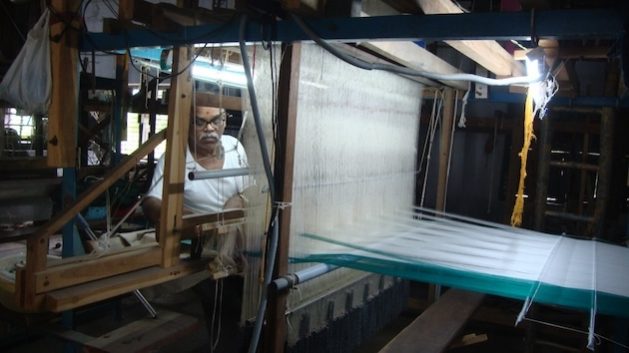
Siddipet cotton fabric being woven. Credit: Rina Mukherji/IPS

Siddipet cotton fabric being woven. Credit: Rina Mukherji/IPS

SIDDIPET, POCHAMPALLY & KOYALAGUDDEM, India, Jan 8 2025 (IPS) – The southern Indian state of Telangana has always been home to exquisite cotton and silk weaves. But in recent years, lack of market access, expensive inputs, and government apathy have taken their toll on the weaving community. As a result, the younger generation is refraining from pursuing this traditional occupation and opting for more lucrative pursuits.


This is evident when one visits the weaving towns of the state. Take Siddipet, which is about 100 km from the metropolitan city of Hyderabad. Siddipet has always been known for its exquisite cotton saris and stoles. But today, only about a hundred wizened individuals, spread over seven handloom cooperatives, still weave.

Srivikailasam is a renowned middle-aged weaver who was honoured by the Chief Minister with the Konda Laxman Bapuji Award. His saris, dupattas and stoles are prized items in the export market. Yet none of his children—a son and two daughters—want to inherit his craft.

Another weaver, known as Ilaiyah, has been weaving for the past 60 years, since he turned 15. Yet his children have turned their backs to weaving.

Yadagiri has also been weaving for the past 60 years, like his fellow weavers. But neither his son nor daughter are interested in learning to weave.

Master weaver Mallikarjun Siddi, who also owns a marketing outlet in Siddipet, followed his father, renowned weaver Buchaiah Siddi, into the profession. But his children have opted out of this traditional occupation.

However, Siddi defends the youngsters.

“Why would youngsters want to adopt a profession that pays so little? A weaver earns Rs 1000 (USD 11.82) a day here, and it takes three full days to weave a sari. A job in the IT hub of HiTech City in Hyderabad fetches a lot more.”

Worse, the Telangana government does not subsidize electricity; this has resulted in the Siddipet weavers continuing to use handlooms instead of switching to powerlooms, making their work even more tedious and hard. Electricity is Rs 10 (USD 0.12) a unit. If subsidized, the cost comes down to Rs 1 (US$ 0.012) per unit. Power loom machinery is expensive, ranging from Rs 1.5 lakh to 6 lakh (USD 1773.5 to USD 7101). With electricity subsidy, a weaver can bear the burden. Otherwise, it is not possible. Hence, even today, you see only handlooms here,” explains Siddi.

Master weaver Laxman Tadaka prepares his materials. Credit: Rina Mukherji/IPS

Master weaver Laxman Tadaka prepares his materials. Credit: Rina Mukherji/IPS

Marketing the product is also tough. The government buys the product at higher rates but does so lackadaisically. “Their representatives come only once a year, and although the payment is higher, it is not immediate. Private parties come regularly, and often, pay immediately,” say weavers.

The story is hardly any different in Pochampally, world-renowned for its ikat silk weaves. Ikat here can be either single ikat or double ikat, with the second being even more expensive. The yarn has to be initially soaked and then dyed before weaving. Since ikat weaves require every thread of the yarn to be dyed separately, a power loom can never be used. Thus, ikat weaves, whether cotton or silk, must be woven on a handloom, as master weaver Laxman Tadaka points out. The silk yarn comes from Bengaluru and is priced at Rs 4500 (USD 53.20) per kilogram. A weaver needs an average of 6 kg of yarn to weave seven saris a month. To bear the cost of inputs and the effort, a weaver must make enough sales. “The 15 percent subsidy extended by the government can hardly suffice,” Tadaka points out.

Rudra Anjanelu, manager of the Pochampally Handloom Weavers Cooperative Society, says they are dependent on subsidies.

“Our silk saris are expensive. But we cannot afford to give discounts unless the government supports us. A major problem is the 5 percent Goods and Services Tax (GST) that has now been imposed by the central government. It makes saris and other silk products even more expensive.”

In the past, the state government used to render marketing support through its outlets, offering the products to customers at discounted prices, especially during the festive season, while subsidizing weavers. This is not forthcoming anymore, making it tough for weavers.

Most weavers have to rely on the Telangana State Handloom Weavers Cooperative Society Limited (TSCO), their apex cooperative, to sell their product.

“We had suggested a method to jack up our sales. The Telangana government has a Kalyanalakshmi scheme, wherein parents of girls are given Rs 1 lakh (USD 1182.32) for their daughter’s wedding. Along with the money, the government could easily provide a sari worth Rs 10,000 (USD 118.23) for the bride. This will help us weavers too, while helping the parents with the bridal trousseau,” Anjanelu says.

Besides, most weavers are not happy with the quality of the subsidized yarn provided by the government through the National Handloom Development Corporation.

Muralikrishnan, a weaver from Koyalaguddem, a village renowned for its cotton ikat, laments, “The yarn provided by the government is of inferior quality and this, in turn, can affect the quality of our end product. It is unlike what we get from private traders.”

Moreover, as Anjanelu points out, “Yarn has to be paid for. When sales are down, how can weavers buy any yarn?”

A big challenge for handloom weavers remains the flooding of markets by printed duplicates, which sell at a fraction of the price of handloom fabric.

On hindsight, though, it is not as if nothing was done for weavers by the Telangana government. However, if weavers have not experienced long-term benefits, could this be attributed to the outcome of the ballot?

The previous Chandrashekhar Reddy (state) government, for instance, introduced a 36-month savings-cum-insurance scheme for weavers termed the Thrift Scheme, wherein the government contributed an amount matching the investment made by an individual.

In Pochampally, land was also sanctioned for a handloom institute, and a handloom park was set up on the outskirts of the town. However, with a new Chief Minister getting elected, the plans came to naught. The Handloom Park too suffered from bad planning. Weavers who had set up shop at the park now have to market their products from their homes.

It is ironical that the weavers of Pochampally, Koyalaguddem and Siddipet find it tough to sell their exquisite weaves, despite being located in the vicinity of metropolitan Hyderabad, which boasts of an upwardly mobile population with high disposable income.

Notwithstanding the problems faced, there are a few who have found a solution. Dudyala Shankar and Muralikrishnan of Koyalaguddem have diversified their range of products to include ikat fabric and bedsheets, alongside traditional saris, dupattas, and stoles. Muralikrishnan has been accessing markets all over India through the internet, from his dusty little village.

“It is the only way out,” he tells me.

Indeed, the World Wide Web can certainly fill in where humans cannot. Product diversification and market access translating into sales may ultimately wean back the younger generation to keep the weaving tradition alive in Telangana and prevent it from dying out.

IPS UN Bureau Report

  Source

Targeting Transformative Disaster Risk Reduction in Asia-Pacific Subregions

Asia-Pacific, Civil Society, Climate Change, Development & Aid, Environment, Featured, Headlines, Natural Resources, Small Island Developing States, Sustainable Development Goals, TerraViva United Nations

Opinion

A volcano in Vanuatu was active in 2023. The county was affected by a 6.6 M earthquake in March 2023 and 7.4 M earthquake in December 2024. Credit: Unsplash/Sebastian Lio

BANGKOK, Thailand, Dec 23 2024 (IPS) – In December 2024, Vanuatu experienced yet another harrowing reminder of its vulnerability to disasters—a powerful 7.4 magnitude earthquake struck the Pacific nation’s capital, Port Vila, leaving 14 dead, over 200 injured, and thousands more affected.


The devastating earthquake, compounded by overnight aftershocks and disrupted essential services, highlights the precarious situation faced by countries already grappling with the impacts of climate change and natural disasters.

Vanuatu is emblematic of the cascading disasters that Pacific Island nations increasingly endure, where frequent earthquakes intersect with the escalating impacts of climate-induced hazards such as cyclones, rising sea levels, and coastal erosion accompanied by staggering loss and damage experienced by vulnerable populations and ecosystems.

With every fraction of a degree of warming, the region’s diverse subregions—from the icy peaks of the Third Pole to the low-lying islands of the Pacific—are encountering unparalleled climate risks.

Recognizing these unique challenges, ESCAP launched the 2024 Asia-Pacific Subregional Disaster Reports to customize the insights and recommendations from the flagship Asia-Pacific Disaster Report 2023 to the distinct vulnerabilities and opportunities within each subregion.

Transformative insights: Shaping climate resilient futures

The 2024 subregional reports reveal escalating disaster risks across Asia and the Pacific, stressing that incremental actions are insufficient against intensifying climate impacts. East and North-East Asia has faced $2 trillion in economic losses and nearly half a million fatalities over five decades, with 2°C warming expected to exacerbate droughts, heatwaves, and floods in China, Mongolia and Korea, threatening urban centers and critical systems.

North and Central Asia faces growing multi-hazard risks in the Aral Sea Basin, where droughts, heatwaves, and floods will endanger agriculture and energy systems. In South-East Asia, nearly 100 per cent of the population is at risk of floods under 2°C warming, with the Mekong River Basin emerging as a persistent multi-hazard hotspot.

Pacific island nations face rising seas and stronger cyclones that erode coastlines, threaten biodiversity, and force communities to relocate, while South and South-West Asia grapples with glacial melt from the Third Pole, jeopardizing water security for 1.3 billion people.

Economic and social costs are mounting, with average annual losses (AAL) projected to rise under warming scenarios. East and North-East Asia’s AAL of $510 billion could increase further under 2°C warming, while the Pacific’s AAL exceeds $20 billion, with small island developing states like Vanuatu and Tonga suffering losses of over 21 per cent of GDP.

Despite these dire projections, the reports emphasize that investments in transformative adaptation—such as early warning systems, resilient infrastructure, and integrated climate policies—can mitigate risks and protect livelihoods across the region.

Early warning systems: A lifeline for resilience

A critical takeaway from the subregional reports is the transformative role of early warning systems (EWS) in disaster risk reduction. By providing timely and actionable information, these systems save lives and reduce economic losses. In South-East Asia, effective EWS could prevent $8.7 billion to $13.1 billion annually, while in the Pacific, they could avert $4 billion to $6 billion in damages each year.

EWS are especially vital in regions with complex multi-hazard risks, such as the Pacific small island developing States, where cyclones, floods, and sea-level rise intersect, and in South-East Asia, where urban flood risks are rapidly escalating.

For EWS to be fully effective, they must encompass four key pillars: risk knowledge, detection and monitoring, dissemination of warnings, and preparedness. Investments in these areas, combined with robust regional cooperation, can ensure that warnings reach the most vulnerable populations in time to act.

The reports highlight examples like impact-based forecasting in South and Southwest Asia and AI-powered risk assessments in China and Japan as transformative advancements in EWS implementation. These systems not only save lives but also help governments and communities reduce disaster recovery costs and safeguard economic stability.

Transboundary solutions: Collaborative action for shared risks

Transboundary risks like ocean-based hazards, inland water stress, and desertification demand collaborative solutions across regions.

1. Ocean-Based Climate Action:

Rising sea levels, intensified cyclones, and coastal erosion require collective efforts such as mangrove restoration and integrated coastal management. In the Pacific SIDS, ASEAN, and South-West Asia, platforms like the Pacific Resilience Partnership and Mekong Basin initiatives foster nature-based solutions to protect ecosystems and livelihoods.

2. Inland Water Systems:

The drying of the Aral Sea Basin in North and Central Asia highlights the importance of transboundary water-sharing agreements to combat drought and degradation. For Third Pole glacial melt, collaboration through the Third Pole Climate Forum is vital to safeguard water security for 1.3 billion people in South, South-West, and East Asia.

3. Desertification and Sand and Dust Storms:

Desertification and sand and dust storms (SDS) are accelerating across Asia. Countries like China, Mongolia, and Iran are advancing afforestation and land restoration, while regional frameworks promote sustainable land management to mitigate downstream impacts.

By prioritizing transboundary cooperation, countries can tackle shared risks, protect vulnerable communities, and build scalable solutions for resilience.

A call for transformative change

The 2024 subregional reports make it unequivocally clear: transformative, not incremental, adaptation is needed to combat the growing threats of climate change and disasters. This means embedding climate resilience in every sector—agriculture, energy, urban planning, and biodiversity conservation—while fostering regional cooperation to address transboundary risks.

By aligning local action with global frameworks like the Sendai Framework for Disaster Risk Reduction and the Paris Agreement, the Asia-Pacific region has an opportunity to lead the way in building a sustainable and resilient future. As ESCAP’s subregional reports demonstrate, the tools and knowledge are at hand. The time to act is now—before the risks become irreversible and the costs unmanageable.

Madhurima Sarkar-Swaisgood is Economic Affairs Officer, ESCAP & Sanjay Srivastava is Chief of Disaster Risk Reduction Section, ESCAP. Other co-authors include Leila Salarpour Goodarzi, Associate Economic Affairs Officer, ESCAP, Rusali Agrawal, Consultant, ESCAP, Naina Tanwar, Consultant, ESCAP, Madhurima Sarkar-Swaisgood, Economic Affairs Officer, ESCAP and Sanjay Srivastava, Chief of Disaster Risk Reduction Section, ESCAP.

IPS UN Bureau

  Source