Tracking Global Development in Child Benefits Through New Monitoring and Information Platform

Active Citizens, Child Labour, Civil Society, Development & Aid, Editors’ Choice, Education Cannot Wait. Future of Education is here, Gender, Global, Headlines, Health, Human Rights, Humanitarian Emergencies, Population, Sustainable Development Goals, TerraViva United Nations, Youth

Sustainable Development Goals

Students attending at the Souza Gare school in the Littoral region, Cameroon. The school hosts displaced children who have fled the violence in the North-West and South-West regions. Photo credits: ECW/Daniel Beloumou

Students attending class at the Souza Gare school in the Littoral region, Cameroon. The school hosts displaced children who have fled the violence in the North-West and South-West regions.
Credits: ECW/Daniel Beloumou

UNITED NATIONS, Feb 15 2024 (IPS) – Inclusive social protections for children would be a positive signifier of social development in a time where 1.4 billion children globally are denied them. A step towards realizing this has been taken through a new monitoring tool on current social protection and child poverty statistics.


The International Labour Organization (ILO), UNICEF, and Save the Children have partnered together to create the Global Child Benefits Tracker. This online platform will globally monitor children’s access to social protection and identify gaps in existing social protections systems in over 180 countries.

On Wednesday, this tool was launched at a side event on universal child benefits (UCBs) during the 62nd Commission for Social Development (CSoCD62) hosted in New York. One of the prevailing themes for this year was the use of digital transformation to promote inclusive growth and development. In the context of the Sustainable Development Goals, the tracker would go forward to monitoring growth in poverty eradication by calling on governments to implement responsible and appropriate social protection systems for all by 2030.

The platform includes a breakdown of child poverty statistics by country, region, and income bracket. Notably, the percentage of children that currently have access to social protections is higher when compared to the percentage of the country’s population that is covered by benefits and the expenditures on these social protections. The platform also provides data on the percentage of children at risk of or experiencing monetary or multidimensional poverty. The purpose of this platform will be to serve as a knowledge tool for use in designing evidence-based child-sensitive social protections, intended for use by policymakers in government and international development programmes, social protection programmes, and civil society organizations. The tool would facilitate the exchange of best practices and inspire greater investment in child-sensitive social protection.

The platform also includes a community tab, where supplemental material can be shared as designed by experts and practitioners, such as blog posts, podcasts, videos, and links to resources. David Lambert Tumwesigye, the Global Policy & Advocacy Lead, Child Poverty, of Save the Children International, has urged members of government, academia, development partners, and practitioners to contribute to the community tab and expand the broader understanding of child poverty. “We aim to highlight the scale of global child poverty,”  he said.

Disruptions in the global economy, increased costs of living, and the COVID-19 pandemic are cited as some of the factors that have underlined the need for resilient and comprehensive social protections, especially for children at high risk of experiencing poverty. Yet, as was pointed out by speakers at the event, there have been limited investments in social protections for children, despite the general sentiment that these would be imperative. This was described as a “moral, social, and economic catastrophe,” by ILO Director in New York, Cynthia Samuel-Olonjuwon.
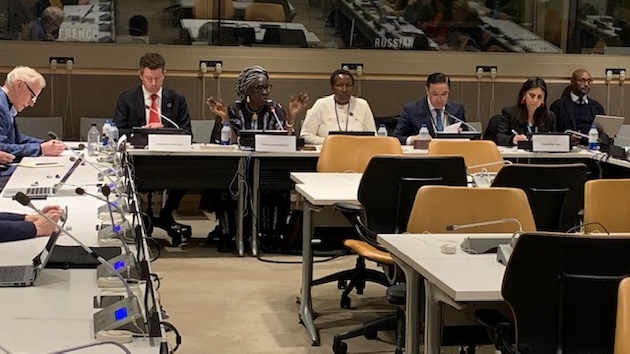
At the launch of the International Labour Organization (ILO), UNICEF, and Save the Children's Global Child Benefits Tracker. Credit: Naureen Hossain/IPS

At the launch of the International Labour Organization (ILO), UNICEF, and Save the Children’s Global Child Benefits Tracker. Credit: Naureen Hossain/IPS

“Life without social protection inflicts enormous social costs, and they result in squandered and prematurely shortened lives,” she said. “For children, social protection can literally be a lifesaver. It can make the difference between a healthy, happy, and long life or one that is punctuated by ill health, stress, and unrealized potential.”

The data on countries’ current social protections has been compiled through public studies and those conducted by the ILO and UNICEF. It reveals that social protection programmes in low-income countries reach less than 10 percent of their child population, in contrast to high-income countries, where their programmes reach more than 80 percent of their child population. Yet, the global average of children covered by social protection or benefits caps out at 28.1 percent. Although the evidence suggests that low-income countries struggle to provide universal child benefits, child poverty is still a global issue that affects all countries, regardless of their income group.

ILO, UNICEF, and Save the Children have urged policymakers and leaders to take the necessary measures to implement universal child benefits, or at least more inclusive, child-sensitive social protections. This includes building a social protection system that provides benefits to its citizens across the life cycle, from birth to old age, and securing financing for these programmes through increased public investments and mobilizing domestic resources.
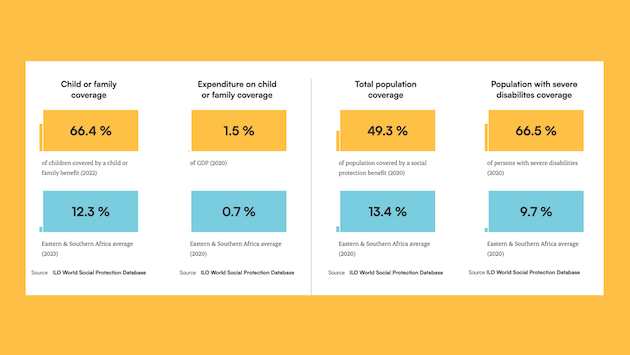
A comparison of child benefits in South Africa compared to the region. Credit: Child Benefits Tracker

A comparison of child benefits in South Africa compared to the region. Credit: Child Benefits Tracker

The Global Child Benefits Tracker may be a step forward in monitoring progress towards social development when considering the progress that remains in achieving the SDGs. While it is still in its early days, the tool may benefit from expanding its coverage to include contributions from actors on the ground. Philip Alston, the former UN Special Rapporteur on Extreme Poverty and Human Rights, suggested that the platform should include qualitative evidence through testimonies to get a clearer sense of the challenges that hinder social protections and how governments have chosen to act.

There will remain challenges to implanting the sort of social protections and benefits that are being called for. There are still gaps in information, as not all countries are featured. At present, there is limited investment in child benefits. It was acknowledged that the fiscal space is a determining factor, and for the low- and middle-income countries in the Global South, this can be even more challenging due to the limitations in their financial state. It is here that solidarity from the international community and support from financing institutions would serve these countries.

Child benefits can be part of the wider social protection systems, and it has been proven that they can positively contribute towards food security and improved access to basic social services, according to UNICEF’s Global Director of Social Policy and Social Protection, Natalia Winder Rossi. Not only can they directly benefit children and their families, but they can also contribute to their communities and local economies.

“The investment is clear, the evidence is clear, but we continue to face challenges in convincing our own policymakers that this is a wide choice,” she said. “I think the Tracker provides some of that progress, to track some of those results… At UNICEF, this is part of our very strong commitment to closing the coverage gap for children. To make sure that we have systems that are strong and inclusive, we must make sure that every child is part of them and receives adequate benefits. But also that systems are adequately responding to crises.”

Visit the Global Child Benefits Tracker here.

IPS UN Bureau Report

  Source

Last Chance Saloon? Myanmar Junta Imposes Military Conscription

Armed Conflicts, Asia-Pacific, Civil Society, Editors’ Choice, Featured, Headlines, Human Rights, Humanitarian Emergencies, Migration & Refugees, TerraViva United Nations

Armed Conflicts

A Buddhist pagoda towers above a teeming thoroughfare in Mae Sot, a Thai town dense with tens of thousands of people fleeing conflict in nearby Myanmar. Credit: William Webb/IPS

A Buddhist pagoda towers above a teeming thoroughfare in Mae Sot, a Thai town dense with tens of thousands of people fleeing conflict in nearby Myanmar. Credit: William Webb/IPS

MAE SOT, Thailand, Feb 15 2024 (IPS) – The news travelled like wildfire. In the teashops, bars, and market stalls that make Thailand’s border town of Mae Sot feel far more Burmese than Thai, the feared rumours circulating at the weekend were suddenly confirmed.

Military conscription would be imposed on young men and women for two to five years, regime-controlled broadcasters in Myanmar announced on the Saturday night airwaves. Details were sparse.


Panic scrolling through social media suddenly replaced conversation in one popular Mae Sot hangout run by a Burmese activist-entrepreneur for his clientele of exiles, fugitives, and migrants. Pool players stopped mid-break. “What the ***!” exclaimed the member of a rock band. 

Myanmar’s junta has been at war with much of the country since staging a coup three years ago, but still, it has come as a serious shock that for the first time in modern history, the military will impose on young people the choice of two uniforms—army or prison.

Analysts—Burmese and foreign—interpreted the developments in various ways. For some, it was a clear sign that the military was losing this patchwork civil war and could not sustain itself. For decades, it had thrived on recruiting youngsters from poor areas of the Bamar-majority heartlands of Sagaing and Magwe. But now those same arid regions are hotbeds of resistance against the regime, its forces stretched across the length and breadth of almost the entire country, depending mostly on air power to bomb civilian areas into submission.

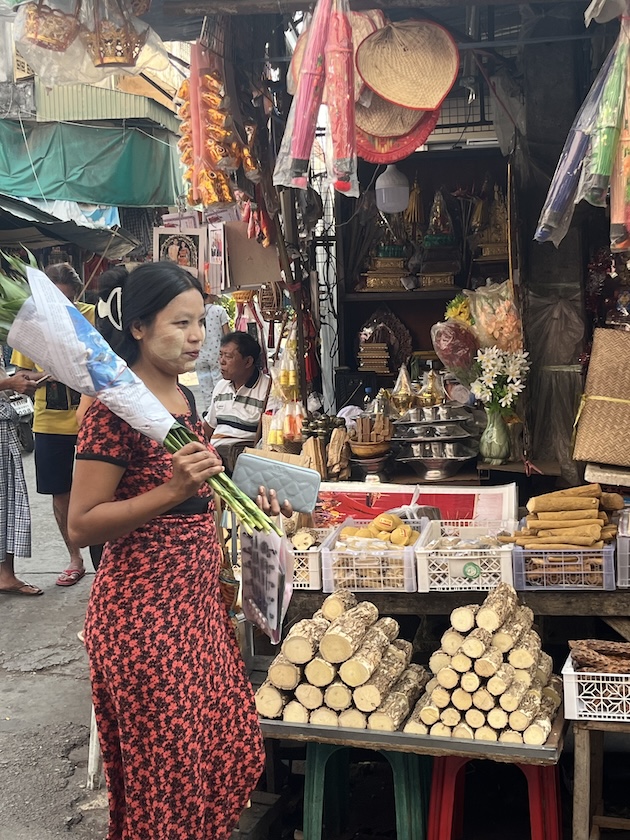
A Burmese woman wearing thanaka to protect her face from the sun walks through a market in the Thai border town of Mae Sot. The stall is selling the wood bark that is ground into the cosmetic paste so popular in Myanmar. Credit: William Webb/IPS

A Burmese woman wearing thanaka to protect her face from the sun walks through a market in the Thai border town of Mae Sot. The stall is selling the wood bark that is ground into the cosmetic paste so popular in Myanmar. Credit: William Webb/IPS

“An act of desperation,” Igor Blazevic said of the junta’s move, which follows sizeable territorial losses and a meltdown of its forces in northern Shan State late last year. Blazevic, a Myanmar expert at the Prague Civil Society Centre, predicted on Facebook that the measure would backfire because the regime was too “weakened and broken” to be able to administer recruitment on a large scale.

But on Monday night, more news was breaking that indicated the junta had got its ducks in a row—airports were suddenly requiring military authorisation stamped on tickets for even internal domestic flights. According to unconfirmed reports, some junta-controlled border posts were closing or imposing similar restrictions, and young men had been picked up on the streets of the commercial capital Yangon.

“It’s another way of terrorising the population,” was the view of one young Burmese who did not want to be named for obvious reasons.

In the Myanmar capital, Nay Pyi Taw, junta spokesperson Zaw Min Tun simply said conscription was essential because of the “situation”.

“The duty to safeguard and defend the nation extends beyond just the soldiers but to all citizens. So I want to tell everyone to proudly follow this people’s military service law,” he intoned.

No way, retorted May, a young refugee whose dream of becoming a doctor was shattered by the 2021 coup and the arrest of her father.

She said compulsory military service would simply drive more young people to join the People’s Defence Forces of the resistance— despite the heavy losses they are incurring and the military’s barbaric treatment of prisoners subjected to torture, summary executions, and, most recently, strung up and torched.

May slipped across the nearby border into Mae Sot with her family after spending two years as a refugee in a camp run by a section of the Karen National Liberation Army fighting what is known as the world’s longest-running civil war dating back to 1949.

“I cannot go back to Myanmar,” she said. At 19 years old, she fits the age range of 18 to 27 for single women to be conscripted. For men, it is 18 to 35 years, rising to 45 for specialists like doctors and IT workers who quit their state sector posts in droves after the coup, joining the Civil Disobedience Movement (CDM) of non-violent resistance.

On Sunday night in Mae Sot, large crowds of this latest wave of the Myanmar diaspora gathered for an outdoor CDM fund-raising concert, featuring dancing and music performed by several of the country’s ethnic minorities, including Karen and Chin. The concert was sponsored by an online bank set up by the resistance. Stalls sold knick-knacks and garments, and beer and hot food were swiftly ferried about by teams of neatly dressed waiters.

May and her entrepreneurial family had their properties and businesses seized and sealed by the military near Mandalay and are now rebuilding their lives, running a small restaurant among the estimated 100,000 to 200,000 Burmese living in and around Mae Sot, setting up businesses, social services, and accommodation safe from predatory Thai officials and regime spies.

May remains determined to study medicine somewhere somehow, representative of a young, capable, and innovative generation of Burmese plugged into a digital world while moving in and out of the shadows of war.

Bo Kyi, a veteran activist and former prisoner who co-founded the Assistance Association of Political Prisoners in Mae Sot 24 years ago, saw the military’s conscription order as a “huge challenge” for young people, especially those who had tried to keep out of politics and war. It would become very hard to leave the country legally now, he said.

“Millions will suffer and Burma will lose its human resources,” he said.

[embedded content]

William Webb is a travel writer who started out in Asia nearly 50 years ago

IPS UN Bureau Report

  Source

Moimuna Nursing Institute Ushers Hope for Vulnerable Rural Girls in Bangladesh

Aid, Asia-Pacific, Civil Society, Development & Aid, Editors’ Choice, Featured, Gender, Headlines, Health, Human Rights, Inequality, Sustainable Development Goals, TerraViva United Nations, Youth

Active Citizens

Dr MA Sayed conducts a practical with his students at the Moimuna Nursing Institute. Credit: Rafiqul Islam/IPS

Dr MA Sayed conducts a practical class with his students at the
Moimuna Nursing Institute. Credit: Rafiqul Islam/IPS

THAKURGAON, Bangladesh, Feb 6 2024 (IPS) – After passing her secondary school certificate (SCC) in 2019, Sweety Akter went door-to-door to collect money to enroll in a college, but she wasn’t successful.

Born to an extremely poor family in Fultala village under Baliadangi upazila in Thakurgaon district, Akter saw her dream of studying fading as she was unable to enroll in a college because of a lack of funding, despite her good results at school.


“I went to many places but did not get the opportunity for admission. I did not have the financial support to study at a private college or an educational institute.”

Then Sweety’s fortune changed.

“I luckily got a chance to study for a nursing diploma free of charge at Moimuna Nursing Institute (MNI),” she told IPS.

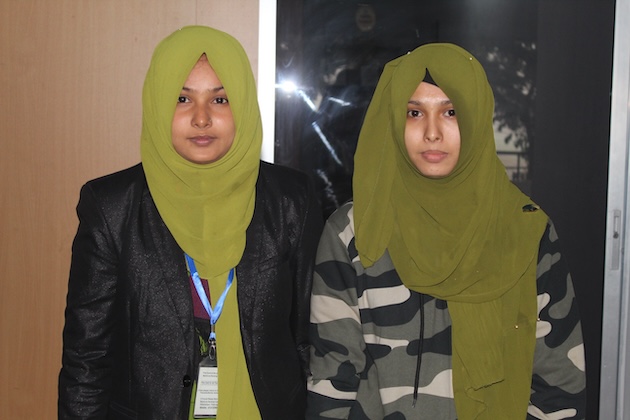
Two sisters, Sweety Akter (left) and Shikha Akter (right) enrolled in Moimuna Nursing Institute, Sweety has already completed a nursing diploma with financial support from the institute and Shikha is now a second-year student. Credit: Rafiqul Islam/IPS

Two sisters, Sweety Akter (left) and Shikha Akter (right), are enrolled in Moimuna Nursing Institute. Sweety has already completed a nursing diploma with financial support from the institute, and Shikha is now a second-year student. Credit: Rafiqul Islam/IPS

Explaining her financial hardships, the 22-year-old Akter said her father is a gambler who had sold all the family’s assets to gamble, and he had even sold their lone homestead, where they are currently living.

“My father does not give me and my younger sister any money for education. My mother works as domestic help at the houses of people and is bearing the costs for our four-member family,” she said.

Sweety said that if she had not had the opportunity to enroll at MNI, it would have been impossible for her to pursue tertiary education, and she would have been forced to marry.

Overcoming all the odds and passing the nursing diploma, she is now pursuing an internship at Rangpur Medical College and Hospital (RMCH) with financial support from the institute, which paves the way for former students to get jobs at hospitals.

Shikha Akhter (19) enrolled in Moimuna Nursing Institute in Thakurgaon, northwest Bangladesh, to pursue a diploma in nursing science and midwifery with the encouragement of her sister, Sweety.

Shikha said she enrolled in the institute at a minimum fee, and now she is enjoying more facilities than other students as her elder sister also studied there.

“I am studying the nursing diploma and staying at the MNI’s hostel, which makes my life easy. I want to be a good nurse and serve people,” she added.

Joya Rani, a 20-year-old girl from poverty-stricken Kaliganj village under Deviganj upazila, also studied the nursing diploma with financial support from the institute.

“My father is physically challenged, so he cannot work. My mother is the only breadwinner for our family, and she supports the family by rearing cattle. That’s why she cannot give me any money (for study),” she told IPS.

Joya, who is currently doing an internship at RMCH, said she received a stipend of Taka 2,000 (USD 19) from the institute over the past two years, and if she had not received the stipend, it would not have been possible for her to continue studying.

Moimuna Nursing Institute, located 460 kilometers away from the capital Dhaka, is a non-profit approved by the Bangladesh Council of Nursing and Midwifery and offers a three-year diploma in nursing for about USD 1,500, which includes tuition fees, accommodation, uniforms, and books.

Thakurgaon is a poor district in Bangladesh, with a poverty rate of 36.7 percent against 18.7 percent at the national level. Of them, about 19.7 percent of people in the district live in extreme poverty, which prevents many from continuing their education, particularly the girls.

Since the start of its journey in 2019–20, the MNI has been providing financial support, including stipends and need-based scholarships, for students coming from underprivileged families.

MNI’s managing director, Dr. MA Sayed, said the institute authorities are providing a handful of scholarships, with three poor students receiving stipends in each batch so that they can continue their nursing education.

In distributing scholarships and stipends, a committee of the institute inspects the houses of their students. If the committee finds evidence of acute financial hardship, the MNI provides support.

Even after completing the nursing diploma, the institute’s support continues, and it facilitates sending the former students to public hospitals to do internships.

“During their internship, we are providing financial support for some selected poor students so that they can accomplish their goals,” Sayed said.

He said the MNI provides a residential facility for its students to ensure a smooth environment for education, resulting in a 100 percent pass rate, which makes it the first in Thakurgaon district.

“We also carry out career counseling for students to encourage them to consider a higher education in nursing,” he added.

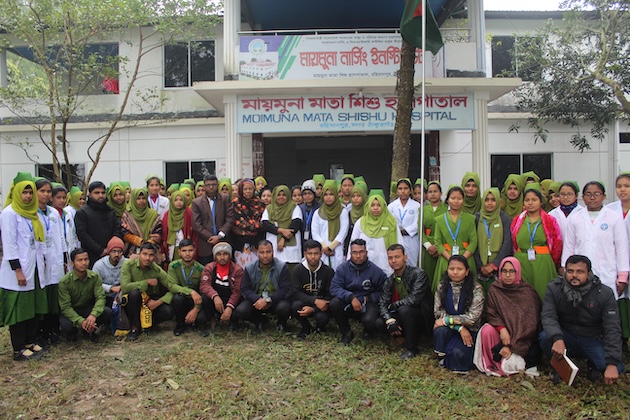
Teachers, students and staff of Moimuna Nursing Institute pose for a photo in front of its main building on the campus. Credit: Rafiqul Islam/IPS

Teachers, students, and staff of Moimuna Nursing Institute pose for a photo in front of its main building on the campus. Credit: Rafiqul Islam/IPS

Nirmola Toppa, mother of Nila Kispotta, who recently completed a nursing diploma from the MNI, said after her daughter passed the SSC examination, she tried to marry her off because she could not afford to pay for her daughter’s educational expenses.

But a scholarship meant Nila could complete her diploma, and she is now getting a stipend of Taka 2,000 (USD19) per month from MNI to complete her six-month internship at RMCH.

Nirmala said Nila received Taka 6,000 (USD 57) to enroll in the internship too.

Founder of Moimuna Nursing Institute, Dr. Saifullah Syed, said in Thakurgaon, many rural underprivileged girls and those coming from minority and ethnic communities pass the entrance exam (SSC) to enroll in nursing institutes but do not enroll due to financial constraints.

Also, there are many who could qualify but do not take the entrance exam, thinking that they may not be able to afford the educational expenses to become nurses and midwives, he said.

“That’s why I founded Moimuna Nursing Institute to ensure that qualified poor rural girls, particularly those coming from minority and ethnic communities, get the opportunity to become nurses and midwives,” Syed told IPS.

He asserted that his institute has established an endowment fund under the control of a Board of Trustees, provides need-based scholarships, and arranges sponsors.

The MNI welcomes donations as it means more students may be assisted.

IPS UN Bureau Report

  Source

The West’s Addiction to War Must End in Gaza

Armed Conflicts, Civil Society, Crime & Justice, Headlines, Human Rights, Middle East & North Africa, Migration & Refugees, TerraViva United Nations

Opinion

Sa’ada, Yemen. Aftermath of a Saudi airstrikes. Credit: Ghaith Abdul-Ahad

KABUL, Afghanistan, Feb 2 2024 (IPS) – Two months ago, an opinion piece I wrote, “The Cries of Gaza Reach Afghanistan,” was published with the hope of reminding American and other Western leaders of how quickly wars ON terror descend into wars OF terror because of their disproportionate impact on civilians and the unpredictability once unleashed.


The United States and its Western alliance of ‘forever wars’ since 9/11 were all entered under the pretext of defeating terrorism. Instead, they strengthened the political and military standing of those they aimed to destroy while simultaneously causing unimaginable suffering for millions of civilians, including their own citizens.

According to Brown University’s Cost of War Project and various other independent research groups, a catastrophic 4.5 million direct and indirect deaths are attributed to Western efforts to “defeat terrorism” since 9/11.

If Afghanistan, Iraq, Yemen, Syria, and Libya have taught us anything, it should be this. Today, the Taliban once again rules Afghanistan, and Iraq, after years of sectarian violence resulting from the U.S. invasion has moved closer to the political influence of Iran. In Syria, Bashar al-Assad’s autocratic rule remains firmly in place. The U.S./European NATO-led air war to rid Libya of Muammar Qaddafi and usher in democracy in 2011 was so naively executed that no consideration was paid to how such a reckless, violent endeavor would ultimately trigger a civil war, terrorism, and mass migration. In Yemen, U.S. support for Saudi Arabia’s war against Houthi rebels has led to the deaths of more than 200,000 Yemenis and strengthened the Houthis to the point where, for the “first time in history, a naval blockade is being successfully enacted” by a non-state actor with “no navy and cheap, low-grade technology.”

The same hubris that has blinded the West’s addiction to answering terrorism with war since 9/11 is the same hubris and hypocrisy that fuels its unconditional support for Israel’s war against Hamas today. To be clear, the attacks of Hamas on October 7, like the attacks of Al Qaeda on 9/11, deserve the harshest global condemnation and a proportional, strategic response that respects international law. It does not justify the unconditional support and shielding of Israel’s punitive war on Gaza’s unarmed civilian population, its civilian infrastructure, and its cultural and religious heritage while further risking the lives of the remaining Israeli hostages held by Hamas. Moreover, this war serves no military objective for Israel and offers no strategic benefit for those aiding and abetting Israel’s war from Washington, London, and various EU capitals.

In seeking to wipe out Hamas, all that Israel and its supporters led by the United States are doing is wiping out Gaza. In 100 days, Israel has succeeded in decimating 4 percent of Gaza’s population. Ninety thousand men, women, and children in the Gaza Strip have been killed, seriously injured, or disappeared. 75% of those killed are women and children (Source: Euro-Med Monitor), not Hamas fighters.

If Gaza was called an open-air prison before this war, now it’s an open-air graveyard. A closer look at the 4 percent shows an even bigger tragedy unfolding by the minute. Unchallenged by those who are supplying it with arms and political cover, Israel is targetting Palestinian healthcare workers, humanitarian relief specialists, journalists, artists, poets, civil society activists, and educators, along with their families. As if the killing of Gaza’s children and its brightest wasn’t enough, Israel, through the collaboration of its Western allies, is also obliterating Gaza’s residential and public service infrastructure.

According to a Wall Street Journal satellite imagery survey, “Israel has bombarded and destroyed 70 percent of homes in Gaza.” According to the W.H.O., “none of Gaza’s 36 hospitals are functioning,” and universities, including its primary medical teaching college, have been blown up by the I.D.F. Even places of worship, mosques, and churches, historically places of refuge during times of war, haven’t been spared the wrath of the Israeli-Western assault on Gaza.

Investigations conducted by The Washington Post and Truthout state, “Israel has deployed over 22,000 U.S. produced bombs on Gaza including 2,000-pound ‘bunker bombs’ which experts warn are not meant for densely populated areas as well as white phosphorus produced by munitions manufacturer, the Pine Bluff Arsenal, in the U.S. state of Arkansas (source: Arkansas Times) and supplied to Israel by the U.S. government over the years. Despite massive protests in major U.S. cities calling for a cease-fire, President Biden has bypassed Congress on two occasions to get even more weapons to Israel. The U.K. and Europe, for their part, have also continued to supply key weapons to Israel since the start of the war (Stockholm International Peace Research Institute) despite loud calls from their citizens for an immediate cease-fire.

When asked about these atrocities, the only reply from Israeli, American, British, and European officials is, “Do you condemn Hamas?” The answer should always be yes, but Hamas’s crimes against Israeli citizens on October 7 are not a license for Israel and the West to kill, maim, and displace the entire unarmed civilian population of Gaza. Furthermore, Israel’s reasoning that Hamas is using the civilians of Gaza as human shields and, therefore, justified in deploying any form of military action it deems necessary is not war but a crime against humanity. It’s also a disingenuous argument meant to create a fog of war repeated with criminal negligence by countless U.S., U.K., and European leaders and government officials.

It’s hard to imagine today, but the suffering being inflicted upon two million Palestinians and the remaining 132 Israeli hostages in Gaza, fatefully connected by history, geography, and the tragic events of October 7, will eventually come to an end. Perhaps the historic ruling by the International Criminal Court of Justice (I.C.J.) will prevail, but this could take months. In the meantime, the atrocities being committed on Gazans will intensify, and the plight of the Israeli hostages will enter an even darker, more desperate stage.

The recent ruling of the world’s highest court, while legally binding, doesn’t have the power of enforcement. Furthermore, the court’s order to Israel to “take measures which prevent further harm on Palestinians” without actually ordering a cease-fire fails to take into consideration the entrenched and sick appetite for war that exists between the world’s political elites are not only providing unconditional support for Israel’s war on the civilian population of Gaza, but participating and profiting from it.

According to EuroMed Monitoring, “Since the I.C.J.’s ruling, Israel has maintained its rate of killing in Gaza” with either no or muted reactions from Western leaders. The fury but also the inertia of powerful states, regardless of political governance and persuasion, is virtually impossible to stop once their war machines are set in motion. It’s no different for Israel.

It took the United States twenty years to end its war in Afghanistan and almost ten years in Iraq. It still maintains counter-terrorism operations with Saudi Arabia in Yemen despite the deadly impact on Yemeni civilians. Europe continues its unwavering support for continued war in Ukraine for no reason other than political arrogance. Russia, for its part, despite its upper hand in Ukraine, continues to fight with devastating consequences for both Russians and Ukrainians. So, why should Netanyahu and his war cabinet be counted on to rein in their war in Gaza? Like their militarily powerful peers, Israel’s warmongering has no bounds.

The entire population of Northern Gaza is now internally displaced, forced by Israel to move south towards Rafah on the Egyptian border. Despite the I.C.J.’s ruling, Israel has intensified its ground operation towards Rafah, where hundreds of thousands from the North of Gaza are already taking refuge on the outskirts of the city, living for weeks in a harsh desert landscape. If Israel continues its violent push into Rafah as it has warned Egypt it plans to do, the entire population of Gaza will be trapped in a tiny corner of the desert with no protection and no safe passage out.

Those who survive the daily air strikes are now dying of hunger, disease, and injuries left untreated because of the destruction of Gaza’s health care system. Two million people are now also forced to endure the extreme traumas of trying to survive without any viable shelter, food, clean water and sanitation, electricity, and safe passage while surrounded by constant air and ground bombardment, snipers, drone attacks, the cold and rain of winter and perhaps worse of all the inaction of world leaders who have it in their power to end Israel’s genocidal campaign in Gaza and, now it’s frightening assault on the civilian population of the West Bank, where Hamas isn’t even in power.

Only the United States, specifically President Biden, is uniquely positioned to pressure Israel to respect each of the I.C.J’s rulings. Perhaps, given its reliance on war as an answer to every foreign policy challenge since 9/11, the United States has forgotten it also has something called soft power- something it has sorely neglected the past twenty years.

The easiest way for President Biden to prove that he and the United States are still committed to international law is by announcing his personal support for an immediate cease-fire and showing proof that he’s pressuring Israel to do the same. He will also need to push for a robust and independent humanitarian assistance effort without any interference from Israel at either border crossing into Gaza.

Of course, all of this assumes that President Biden is willing to stop listening to the impenetrable wall of aides and advisors he’s created around himself and start seeing with his own eyes the scale of the suffering and the dire risks of a wider, regional war that is already endangering American lives.

According to a confidential source with extensive U.S. foreign policy experience, the deadly attack on U.S. troops on the border between Jordan and Syria this past week “exhibits how even the projection of U.S. military power serves to fuel conflict rather than mitigate it.” For totally preventable reasons, now the families of these American soldiers can join all the Palestinian and Israeli lives torn apart by the sheer insanity of this preventable war and unfolding humanitarian disaster.

Above all, President Biden needs to start hearing the calls of his fellow citizens, including the many thousands of Jewish Americans, who are demanding that their taxes and their nation not be used to wage yet another senseless war in their names. A failure to do so will have unimaginable consequences not just for Israelis and Palestinians but for the world.

IPS UN Bureau

  Source

Solar Energy Gives Important Boost to Small-scale Farmers in Chile

Active Citizens, Civil Society, Climate Action, Climate Change, Development & Aid, Economy & Trade, Editors’ Choice, Energy, Environment, Featured, Food and Agriculture, Headlines, Integration and Development Brazilian-style, Latin America & the Caribbean, Population, Projects, Regional Categories, Water & Sanitation

Energy

Myriam Miller and Freddy Vargas stand next to one of the three greenhouses on their farm, where tomatoes are growing, anticipating an optimal harvest this year. The couple uses no chemical fertilizers to ensure the healthy development of thousands of plants on their farm in Mostazal, a municipality in central Chile. CREDIT: Orlando Milesi / IPS

Myriam Miller and Freddy Vargas stand next to one of the three greenhouses on their farm, where tomatoes are growing, anticipating an optimal harvest this year. The couple uses no chemical fertilizers to ensure the healthy development of thousands of plants on their farm in Mostazal, a municipality in central Chile. CREDIT: Orlando Milesi / IPS

MOSTAZAL, Chile , Feb 2 2024 (IPS) – The installation of photovoltaic panels to use solar energy to irrigate small farms is expanding quickly in Chile because it lowers costs and optimizes the use of scarce water resources.


This long, narrow South American country that stretches from the northern Atacama Desert to the southern Patagonia region and from the Andes Mountains to the Pacific Ocean is extremely rich in renewable energies, especially solar and wind power.

“Solar panels have made an immensely important contribution to our energy expenditure. Without them we would consume a lot of electricity.” — Myriam Miller

Last year, 36.6 percent of Chile’s electricity mix was made up of Non-Conventional Renewable Energies (NCREs), whose generation in May 2023 totaled 2392 gigawatt hours (GWh), including 1190 GWh of solar power.

This boom in the development of alternative energies has been mainly led by large companies that have installed solar panels throughout the country, including the desert. The phenomenon has also reached small farmers throughout this South American country who use solar energy.

In family farming, solar energy converted into electricity is installed with the help of resources from the government’s Agricultural Development Institute (Indap), which promotes sustainable production of healthy food among small farmers, incorporating new irrigation techniques.

In 2020 alone, the last year for which the institute provides data, Indap promoted 206 new irrigation projects that incorporated NCREs with an investment of more than 2.1 million dollars.

That year, of the projects financed and implemented, 182 formed part of the Intra-predial Irrigation Program, 17 of the Minor Works Irrigation Program and seven of the Associative Irrigation Program. The investment includes solar panels for irrigation systems.

Within this framework, 2025 photovoltaic panels with an installed capacity of 668 kilowatts were installed, producing 1002 megawatt hours and preventing the emission of 234 tons of carbon dioxide.

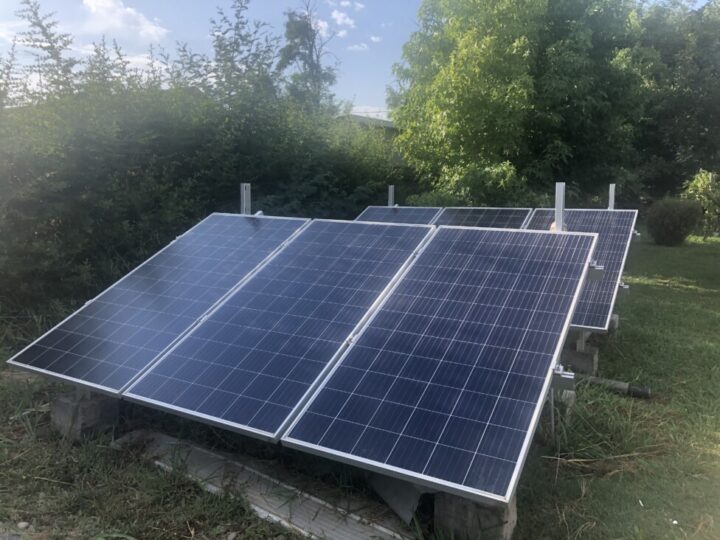
The six solar panels installed on the small farm of Myriam Miller and Freddy Vargas, in the municipality of Mostazal, south of Santiago, Chile, allow them to pump water to their three greenhouses with thousands of tomato plants and to their vegetable garden. They also drastically reduced their electric energy expenditure. CREDIT: Orlando Milesi / IPS

The six solar panels installed on the small farm of Myriam Miller and Freddy Vargas, in the municipality of Mostazal, south of Santiago, Chile, allow them to pump water to their three greenhouses with thousands of tomato plants and to their vegetable garden. They also drastically reduced their electric energy expenditure. CREDIT: Orlando Milesi / IPS

An experience in Mostazal

“Solar panels have made an immensely important contribution to our energy expenditure. Without them we would consume a lot of electricity,” 50-year-old farmer Myriam Miller told IPS at her farm in the municipality of Mostazal, 66 km south of Santiago, where some 54,000 people live in different communities.

Miller has half a hectare of land, with a small portion set aside for three greenhouses with nearly 1,500 tomato plants. Other tomato plants grow in rows outdoors, including heirloom varieties whose seeds she works to preserve, such as oxheart and pink tomatoes.

Indap provided 7780 dollars in financing to install the solar panels on her land. Meanwhile, she and her husband, Freddy Vargas, 51, who run their farm together, contributed 10 percent of the total cost.

In 2023, Miller and Vargas built a third greenhouse to increase their production, which they sell on their own land.

“We’re producing around 8,000 kilos of tomatoes per season. This year we will exceed that goal. We’re happy because we’re moving ahead little by little and improving our production year,” Miller said as she picked tomatoes.

On the land next to the tomato plants, the couple grows vegetables, mainly lettuce, some 7,000 heads a year. They also have fruit trees.

Vargas told IPS that they needed electricity to irrigate the greenhouses because “it’s not easy to do it by hand.”

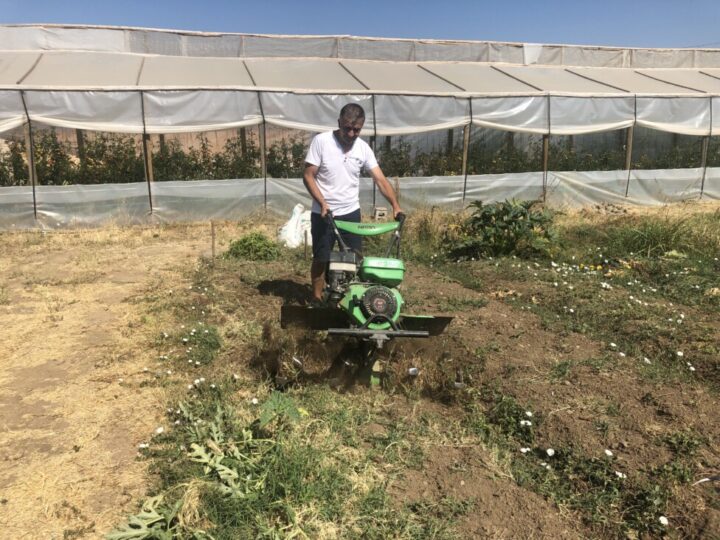
Freddy Vargas turns the soil on his farm in the municipality of Mostazal, south of Santiago, Chile. Lettuce is his star vegetable, with thousands of heads sold on the farm. The farmer plans to buy a mini-tractor to alleviate the work of plowing the land. CREDIT: Orlando Milesi / IPS

Freddy Vargas turns the soil on his farm in the municipality of Mostazal, south of Santiago, Chile. Lettuce is his star vegetable, with thousands of heads sold on the farm. The farmer plans to buy a mini-tractor to alleviate the work of plowing the land. CREDIT: Orlando Milesi / IPS

The farm has two wells that hold about 30,000 liters of water that arrives once a week from a dam located two kilometers away. This is the water they use to power the pumps to irrigate the greenhouses.

“We have water rights and Indap provided us with solar panels and tools to automate irrigation. They gave us four panels and we made an additional investment, with our own funds, and installed six,” Vargas explained.

The couple consumes between 250 and 300 kilowatts per month and the surplus energy they generate is injected into the household grid.

“We don’t have storage batteries, which are more expensive. Every month the electric company sends us a bill detailing the total we have injected into the grid and what we have consumed. They calculate it and we pay the difference,” Vargas said.

The average savings in the cost of consumption is 80 percent.

“I haven’t paid anything in the (southern hemisphere) summer for years. In the winter I spend 30,000 to 40,000 pesos (between 33 and 44 dollars) but I only pay between 5,000 and 10,000 pesos a month (5.5 to 11 dollars) thanks to the energy I generate,” the farmer said.

Above and beyond the savings, Miller stressed the “personal growth and social contribution we make with our products that go to households that need healthier food. We feel good about contributing to the environment.”

“We have a network, still small, of agroecological producers. There is a lack of information among the public about what people eat,” she added.

Their tomatoes are highly prized. “People come to buy them because of their flavor and because they are very juicy. Once people taste them, they come back and recommend them by word of mouth,” Miller said.

She is optimistic and believes that in the municipalities of Mostazal and nearby Codegua, young people are more and more interested in contributing to the planet, producing their own food and selling the surplus.

“We just need a little support and more interest in youth projects in agriculture to raise awareness that just as we take care of the land, it also gives to us,” she said.

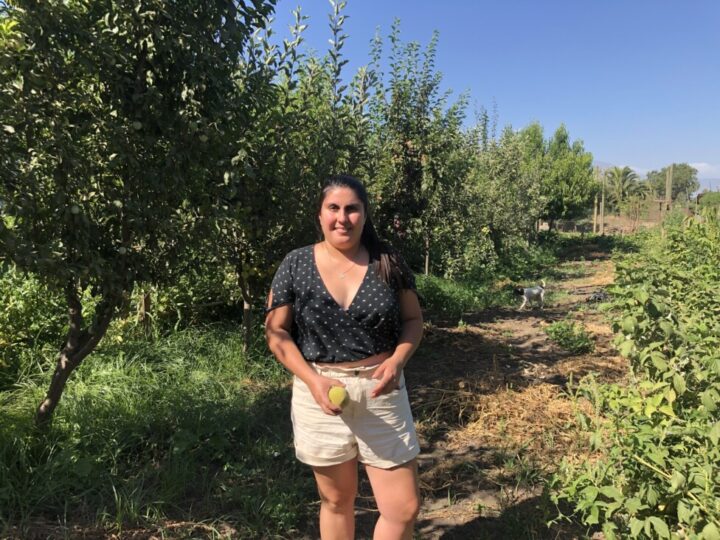
Valentina Martínez stands on her father's small plot of land in the municipality of María Pinto, north of Santiago, Chile. The fruit trees provide the shade needed to keep the planted vegetables from being scorched by the strong southern hemisphere summer sun in central Chile. CREDIT: Orlando Milesi / IPS

Valentina Martínez stands on her father’s small plot of land in the municipality of María Pinto, north of Santiago, Chile. The fruit trees provide the shade needed to keep the planted vegetables from being scorched by the strong southern hemisphere summer sun in central Chile. CREDIT: Orlando Milesi / IPS

A pesticide-free new generation

Valentina Martínez, 32, is an environmental engineer. Together with her father, Simón, 75, they work as small farmers in the municipality of María Pinto, 60 kilometers north of Santiago. She has a 0.45 hectare plot and her father has a 0.35 hectare plot.

Both have just obtained funding from the Transition to Sustainable Agriculture (TAS) project, which operates within Indap, and they are excited about production without chemical fertilizers and are trying to meet the goal of securing another larger loan that would enable them to build a greenhouse and expand fruit and vegetable production on the two farms.

“It’s a two-year program. In the first year you apply and they give you an incentive of 450,000 pesos (500 dollars) focused on buying technology. I’ve invested in plants, fruit trees, worms, and containers for making preserves,” Valentina told IPS.

In the second year, depending on the results of the first year, they will apply for a fund of 3900 dollars for each plot, to invest in their production.

“This year my father and I will apply for solar panels to improve irrigation,” said Valentina, who is currently dedicated to producing seedlings.

“My father liked the idea of producing without agrochemicals to combat pests,” she said about Simón, who has a fruit tree orchard and also grows vegetables.

In María Pinto there are 380 small farmers on the census, but the real number is estimated at about 500. Another 300 are medium-sized farmers.

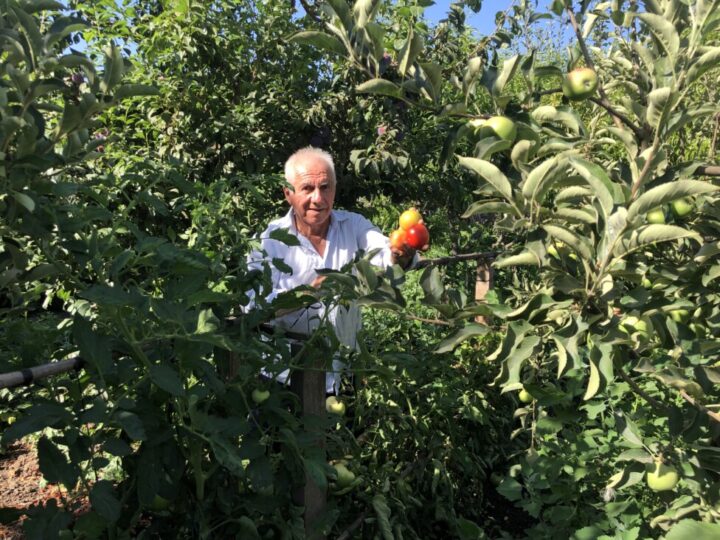
Simón Martínez, 75, proudly shows some of the citrus fruits harvested on his farm where he practices agroecology and does not use agrochemicals. He and his daughter Valentina won a contest to continue improving the sustainability of their farming practices on their adjoining plots, located outside the Chilean town of María Pinto. CREDIT: Orlando Milesi / IPS

Simón Martínez, 75, proudly shows some of the citrus fruits harvested on his farm where he practices agroecology and does not use agrochemicals. He and his daughter Valentina won a contest to continue improving the sustainability of their farming practices on their adjoining plots, located outside the Chilean town of María Pinto. CREDIT: Orlando Milesi / IPS

The rest of the area is monopolized by large agricultural companies dedicated to monocultures for export. Most of them have citrus, avocado, cherry and peach trees, as well as some walnut trees, and they all make intensive use of chemical fertilizers.

Chile exports mainly copper, followed by iron. But it also stands out for its sales of fish, cellulose pulp and fruit. In 2023, it exported 2.3 million tons of fruit, produced by large farms and bringing in 5.04 billion dollars. Agriculture represents 4.3 percent of the country’s GDP.

Family farming consists of some 260,000 small farms, which account for 98 percent of the country’s farms, according to the government’s Office of Agrarian Studies and Policies (Odepa).

Family farms produce 40 percent of annual crops and 22 percent of total agricultural production, which is key to feeding the country’s 19.7 million people.

Valentina is excited about TAS and the meetings she has had with other young farmers.

“It’s fun. We’re all on the same page and interested in what each other is doing. We start in December and January and it lasts all year. The young people are learning about sustainable agriculture and that there are more projects to apply for,” she explained.

She said that 15 young people in María Pinto have projects with pistachio trees, fruit trees, greenhouse gardens, outdoor gardens, animal husbandry and orchards. They are all different and receive group and individual training.

The training is provided by Indap and the Local Development Program (Prodesal), its regional representatives and the Foundation for the Promotion and Development of Women (Prodemu).

“The idea is that more people can learn about and realize the benefits of sustainable agriculture for their own health and for their land, which in a few years will be impossible due to the spraying of monocultures,” Valentina said.

It targets large entrepreneurs who produce avocado and broccoli in up to four harvests a year, both water-intensive crops, even on high hillsides.

“We need to come together, do things properly and recruit more people to create a legal group to reach other places and be able to organize projects. When you exist as an organization, you can also reach other places and say I am no longer one person, we are 15, we are 20, 100 and we need this,” she said.

  Source

Myanmar’s Military Catastrophe: Three Years and Counting

Asia-Pacific, Civil Society, Crime & Justice, Democracy, Featured, Gender Violence, Headlines, Human Rights, Migration & Refugees, TerraViva United Nations

Opinion

Credit: Sirachai Arunrugstichai/Getty Images

LONDON, Feb 1 2024 (IPS) – The military must have expected an easier ride. Three years ago, it ousted Myanmar’s democratically elected government. But the coup has been met with fierce resistance, unleashing a bloody conflict with no end in sight.


Civil society has scrambled to respond to humanitarian needs, defend human rights and seek a path to peace. Last year, civil society organisations in Myanmar and the region developed and endorsed a five-point agenda that calls for an international response to end military violence, including through sanctions, an arms embargo and a referral of Myanmar to the International Criminal Court – a call the UN Security Council hasn’t so far heeded.

Civil society is also demanding that the key regional body, the Association of Southeast Asian Nations (ASEAN), takes the conflict more seriously and engages beyond the junta, particularly with democratic forces and civil society.

So far civil society’s calls haven’t been heard. But intensifying violence proves that the approaches tried to far have failed. Staying on the same path is a recipe for further carnage.

Violence and repression

Three years on from the coup, the military doesn’t control significant sections of the ethnically diverse country. People’s defence forces are fighting an armed campaign in support of the ousted National Unity Government, often in alliance with long-established ethnic militia groups.

In October 2023, three armed groups in Myanmar’s north joined the conflict against the junta, forming the Brotherhood Alliance. The resulting offensive in Shan state saw the rebels capture the border town of Laukkai and cut off key trading routes with China. The UN stated that this was the biggest escalation in fighting since the coup. A ceasefire in the region was supposedly agreed in January following China-brokered talks, but fighting resumed.

It seems clear the junta won’t win this conflict any time soon. Morale among armed forces is collapsing and soldiers defecting, deserting or surrendering in growing numbers. Even pro-junta voices on social media have begun to criticise military leaders.

Pushed into a corner, the military is lashing out, committing mass killings, burning villages and unleashing indiscriminate airstrikes to compensate for its struggles on the ground. The deadliest strike so far came in April 2023, when 168 people, including 40 children, were reported killed in the village of Pa Zi Gyi.

This was no one-off. The UN Special Rapporteur on the situation of human rights in Myanmar has reported that the junta continues to bomb hospitals, schools, villages and camps for displaced people. Attacks on civilians include mass killings, torture, sexual violence and forced labour, and the junta also obstructs essential humanitarian aid supplies.

In September 2023, the UN High Commissioner for Human Rights, Volker Türk, condemned this violence as ‘inhumanity in its vilest form’. Research suggests that most of the military’s senior commanders are responsible for war crimes.

The humanitarian impacts are deep. By the end of 2023, over 2.6 million people had been displaced, 628,000 of them since the Brotherhood Alliance launched its campaign. The UN assesses that 18.6 million need humanitarian help and 5.3 million need it urgently. But aid workers are being targeted: at least 142 were arrested or detained last year.

The restriction of humanitarian work is part of wider repression. Assistance Association for Political Prisoners, a human rights organisation, reports that since the coup 4,468 people have been killed by the junta and pro-military groups. Almost 20,000 people are in detention, among them many activists and protesters charged with offences such as treason and sedition. Torture in prison is widespread, and 34 political prisoners died in detention in 2023.

The junta is doing everything it can to try to control the narrative. It’s believed that 64 journalists are currently detained. Internet shutdowns, website blocking and arrests for social media comments are routine occurrences. Last November, the junta took control of the Broadcasting Council, which oversees TV and radio outlets.

In August 2023, the junta extended the state of emergency, in effect since the coup, for a further six months. The elections that it promised on seizing power are nowhere in sight, and even if they eventually come, they won’t serve any purpose other than trying to legitimise military power.

International action needed

The junta faces strong domestic opposition and has no real international legitimacy but crucially, pressure from the regional body is weak.

ASEAN claims to be following a long-discredited plan, the Five-Point Consensus, which dates back to April 2021. The violence unleashed by the junta against civilians shows it can’t be trusted to act in good faith, but ASEAN still claims to believe it’s possible to involve it in an ‘inclusive dialogue’. At its annual summit in May 2023, ASEAN members reiterated their support for the failed plan, despite civil society’s calls.

ASEAN members are mostly repressive states, and some, including Cambodia and Thailand, have shown signs of seeking to normalise relations with the junta. ASEAN continues to allow junta representatives to attend some of its meetings. This year’s chair, Laos, is an authoritarian state that will have no interest in restoring democracy in Myanmar.

Elsewhere, however, the junta may be running out of friends. China was untroubled by military rule, but it doesn’t want unrest on its border. A potential breakthrough came from the US government in October 2023, when it imposed sanctions on the previously untouchable Myanma Oil and Gas Enterprise (MOGE), the state-owned corporation that’s the regime’s main source of foreign income. The European Union also stepped up its sanctions in December 2023, including against two companies providing arms and generating income for the junta.

It remains essential to keep the junta diplomatically isolated and to cut economic relations with the many companies it depends on, including MOGE. It’s vital to stop supplying arms to the junta and, above all, to stop selling it the jet fuel it needs to carry out airstrikes.

A UN Human Rights Council resolution adopted in April 2023 condemned the junta’s violence but failed to call for responses such as bans on the sale of weapons or aviation fuel. Events since then have made it sadly clear that decisive action can no longer wait.

Andrew Firmin is CIVICUS Editor-in-Chief, co-director and writer for CIVICUS Lens and co-author of the State of Civil Society Report.

  Source