Halfway to 2030: Our 5 Asks at the SDG Summit

Civil Society, Crime & Justice, Development & Aid, Environment, Global, Headlines, Human Rights, Inequality, Poverty & SDGs, Press Freedom, Sustainable Development Goals, TerraViva United Nations

Opinion

A protest for women’s rights in Puebla, Mexico. Credit: Melania Torres/Forus

NEW YORK, Sep 15 2023 (IPS) – At the UN SDG Summit in New York, the Forus global civil society network is calling for decisive action on SDG implementation. Clearly, as we hit the midpoint towards the “finish line” of the Agenda 2030, progress is stagnating.


The 2023 Special Edition of the SDG Progress Report emphasized that we’re falling short in implementing the SDGs. In April this year, UN Secretary General Antonio Guterres deplored that “Progress on more than 50 per cent of targets of the SDGs is weak and insufficient; on 30 per cent, it has stalled or gone into reverse,” disproportionately impacting the world’s poorest and most vulnerable.

As we approach the halfway mark of the 2030 Agenda, we urge world leaders at the UN General Assembly to address the precarious state of SDG implementation. Here’s our 5 asks.

Walk the talk with clear implementation plans and benchmarks for the realization of the Sustainable Development Goals.

“In Guatemala, there are two worlds, one for a small group that benefits from this macroeconomic stability, this weakness of democracy, this co-optation of state institutions, and a large majority of the population that faces poverty and inequality,” says Alejandro Aguirre Batres, Executive Director of CONGCOOP, the national platform of NGOs in Guatemala that recently published an alternative report on the implementation of the SDGs in the country.
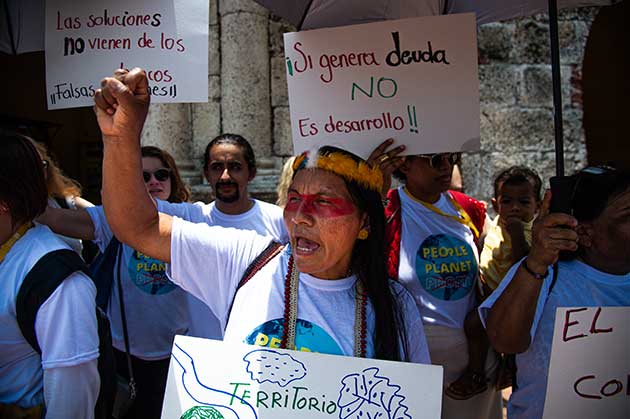
Human rights activists in Cartagena, Colombia from the Coalition of Human Rights in Development at the Finance in Common Summit. Credit: Sebastian Barros/Forus

Governments must make specific national implementation plans to advance the Sustainable Development Goals, with clear benchmarks on when to achieve the targets set in 2015. Following the SDG Summit, we call on the United Nations and its partners to ensure that the “National Commitments to SDG Transformation” called for by the Secretary-General are adequately compiled and tracked, including by providing a transparent and inclusive platform for showcasing these commitments, helping to ensure adequate implementation, follow-up and accountability. All efforts and commitments must focus on breaching the increassing gap in inequalities, healing polarisation and restoring socio-environmental rights at the core of Agenda 2030 implementation as no form of development should come at the cost of environmental degradation and injustice.

Presenting a viewpoint from Asia, Jyotsna Mohan Singh, representing the Asia Development Alliance, emphasizes that while the SDGs look good on paper, their real-world implementation remains far from satisfactory. She explains, “Governments should develop a policy coherence for sustainable development roadmap with timebound targets,” adding that it’s all about creating spaces grounded in equity where civil society and other stakeholders can join discussions and connect with local communities.

In regions like the Sahel, stretching 5,000 kilometers below the Sahara Desert from the Atlantic to the Red Sea, challenges like conflict, political instability, extreme poverty, and food insecurity affect nearly 26 million people. Yet, this region is teeming with opportunities, boasting abundant resources and a young population, including 50% young women and girls. As civil society leader Mavalow Christelle Kalhoule, Forus Chair and President of SPONG, the Burkina Faso NGO network, puts it, “What unfolds in the Sahel and in so many other forgotten communities ripples across the globe, impacting us all even if we choose to look away. Implementing the Sustainable Development Goals is vital to unlock a different future. But for global change to truly happen, we need countries to come together, we need solidarity, horizontal spaces, and for world leaders to start listening and acting accordingly.”

Commit to the protection of civic space and human rights.

“Although the state of Pakistan has ratified many global instruments, including the International Covenant on Civil and Political Rights and the SDGs, the irony is that none of them have been transformed into local policies and regulatory frameworks. Unfortunately, civil rights advocates and organizations have either transformed themselves into humanitarian organizations or practiced self-censorship to avoid state atrocities. Pakistan is failing to achieve SDGs due to disengagement with civil society and other stakeholders. Ironically, the government is unable to provide reliable data on any of their own priority indicators to measure progress towards the implementation of SDGs, particularly on rights-based indicators,” says Zia ur Rehman, National Convener of the Pakistan Development Alliance. Their newly published Pakistan Civic Space Monitor reveals a generally restricted civic space, including restraints on freedom of speech, assembly, information, rule of law, governance, and public participation, with further deterioration. This rings true for 92% of Forus members – comprising national and regional civil society networks in over 124 countries – who consider the protection of civic space and human rights a top priority.
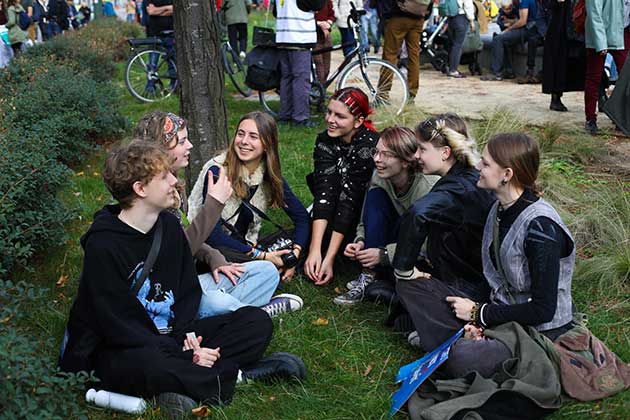
Fridays for Future activists during a Climate March in Brussels, Belgium. Credit: Both Nomads/Forus

Indeed, over the past decade, thousands of civil society organizations have faced increasing challenges due to restrictions on their formation and activities. Nine out of 10 people now live in countries where civil liberties are severely restricted, including freedoms of association, peaceful assembly, and expression, according to the CIVICUS Monitor. Forus reports confirm that civil society deals with increasing restrictions, involving extra-legal actions, misinformation and disinformation about their work both online and offline. Research also highlights the insufficiency of current institutional mechanisms to ensure an enabling environment for civil society, including addressing impunity for attacks on civil society and human right defenders, implementing supportive laws and regulations, and facilitating effective and inclusive policy dialogue. A recent ARTICLE 19 report highlights the inadequate integration of crucial elements like freedom of expression and access to information into SDGs, hampering progress. Journalist killings increased in 2022. Additionally, monitoring access to information mainly focuses on having a legal framework, ignoring its quality and adoption. Strengthening these rights is vital for advancing all SDGs. The growing number of human rights defenders being killed every year – at least 401 in 26 countries were murdered for their peaceful work in 2022 – is another worrying trend that needs to be reversed as the protection and promotion of human rights is the cornerstone of achieving sustainable development. Without human rights we will just move backwards.

Strengthen and Catalyze Robust Financing for the SDGs.

From the recent Summit for a new global financing pact to the Finance in Common initiative, it’s clear that the focus this year has been on increasing investment. But we need quality not just quantity, as expressed in a join civil society declaration aimed at public development banks signed by over 100 civil society organisations from 50+ countries. While we welcome UN Secretary General Antonio Guterres’s call for a SDG Stimulus, we remind Governments, International Financial Institutions, public development banks and donors that more efforts must be done to scale up investments for the realization of the SDGs at all levels, including through additional support for civil society and by involving communities in all “development talks”. The role of the private sector and financial institutions in the implementation of the 2030 Agenda must be talked about openly. It is important to include in all development projects being carried out specific budgets for actions linked to the implementation of the 2030 Agenda. Discussions about financial reforms that are being repeatedly undertaken by several countries cannot happen behind close doors and in non-inclusive forums such as the G7 and G20. Instead, they should be open, inclusive, and transparent, involving a broader spectrum of protagonists, including civil society, to ensure fairness and sustainability in shaping global financial policies.

“The SDGs are severely off track as we reach the critical half-way point of Agenda 2030. We need a renewed global ambition on financial commitments to make progress on the SDGs. Reforms of global financial architecture are a crucial part of this to ensure we have a fairer, more effective, inclusive and transparent system supporting lower-income countries that are at the forefront of the global climate, debt, poverty, food, and humanitarian crises. It’s not about a lack of finance, it is about political will and getting our priorities right,” says Sandra Martinsone, Policy Manager – Sustainable Economic Development at Bond UK.

Mobilize Transformative Commitments for SDG16+.

Recognizing the vital role of SDG16+ as a critical enabler for the entire 2030 Agenda, governments should come to the SDG Summit with targeted, integrated, focused and transformative commitments to accelerate action on SDG16+. As developed in the #SDG16Now collective campaign, this includes domestic policies and resources, legal reforms and initiatives to advance SDG16+ at the international, national and local levels, as well as ambitious global commitments to strengthen multilateralism and international resolve to promote peace, justice, the rule of law, inclusion and institution-building. Additionally, governments must use key moments – such as the 2024 High-Level Political Forum and the Summit of the Future – to advance implementation and delivery of the SDGs through similar commitments to action, and ensure adequate follow-up to these commitments going forward.

Ensure civil society participation and listen to communities, reinvigorate commitments to SDG17.

The 2030 Agenda overall cannot be achieved without building on the role of civil society and fostering a true global partnership. Every year at the fringes of the UN General Assembly, initiatives such as the Global People’s Assembly bring to the ears of world leaders the voices of communities historically marginalised. Governments need to reinvigorate engagement towards SDG17 to trengthen the means of implementing sustainable development goals and revitalising global partnerships for sustainable development. It’s high time we move away from conducting discussions about the future of development in closed-door settings. Tokenistic participation of civil society, where their involvement is merely symbolic or superficial, undermines the core principles of nclusivity, hurting genuine progress and meaningful collaboration. A more inclusive approach must be embraced that actively involves civil society and communities. Let’s #UNmute their voices and perspectives by bringing about reforms to current participation mechanisms, and giving them a real platform to be heard.

In 2015 every government in the world agreed as a global community on what we want for our comon future for people and planet. So many efforts and work went on to reach such an agreement. Now is the time for governments and world leaders to walk the walk and prioritize people and the planet, delivering the 2030 Agenda, essential to secure our shared future. It is time for world leaders to act decisively and uphold their commitments to the SDGs.

IPS UN Bureau

  Source

The UN’s Own Relevance Is at Stake at This Year’s General Assembly

Armed Conflicts, Civil Society, Climate Change, Crime & Justice, Development & Aid, Featured, Global, Headlines, Health, Human Rights, Inequality, Peace, Sustainable Development Goals, TerraViva United Nations

Opinion

United Nations Secretary General Antonio Guterres addresses the 22nd session of the Permanent Forum on Indigenous Issues at the General Assembly Hall of the United Nations headquarters in New York City on 17 April 17 2023. Credit: Ed Jones/AFP via Getty Images

NEW YORK, Sep 7 2023 (IPS) – This September, world leaders and public policy advocates from around the world will descend on New York for the UN General Assembly. Alongside conversations on peace and security, global development and climate change, progress – or the lack of it – on the Sustainable Development Goals (SDGs) is expected to take centre-stage. A major SDG Summit will be held on 18 and 19 September. The UN hopes that it will serve as a ‘rallying cry to recharge momentum for world leaders to come together to reflect on where we stand and resolve to do more’. But are the world’s leaders in a mood to uphold the UN’s purpose, and can the UN’s leadership rise to the occasion by resolutely addressing destructive behaviours?


Sadly, the world is facing an acute crisis of leadership. In far too many countries authoritarian leaders have seized power through a combination of populist political discourse, outright repression and military coups. Our findings on the CIVICUS Monitor – a participatory research platform that measures civic freedoms in every country – show that 85% of the world’s population live in places where serious attacks on basic fundamental freedoms to organise, speak out and protest are taking place. Respect for these freedoms is essential so that people and civil society organisations can have a say in inclusive decision making.

UN undermined

The UN Charter begins with the words, ‘We the Peoples’ and a resolve to save future generations from the scourge of war. Its ideals, such as respect for human rights and the dignity of every person, are being eroded by powerful states that have introduced slippery concepts such as ‘cultural relativism’ and ‘development with national characteristics’. The consensus to seek solutions to global challenges through the UN appears to be at breaking point. As we speak hostilities are raging in Ukraine, Sudan, the Occupied Palestinian Territories and the Sahel region even as millions of people reel from the negative consequences of protracted conflicts and oppression in Afghanistan, Ethiopia, Myanmar, Syria and Yemen, to name a few.

Article 1 of the UN Charter underscores the UN’s role in harmonising the actions of nations towards the attainment of common ends, including in relation to solving international problems of an economic, social, cultural or humanitarian character, and to promote respect for human rights and fundamental freedoms for all. But in a time of eye-watering inequality within and between countries, big economic decisions affecting people and the planet are not being made collectively at the UN but by the G20 group of the world’s biggest economies, whose leaders are meeting prior to the UN General Assembly to make economic decisions with ramifications for all countries.

Economic and development cooperation policies for a large chunk of the globe are also determined through the Organisation for Economic Cooperation and Development (OECD). Established in 1961, the OECD comprises 38 countries with a stated commitment to democratic values and market-based economics. Civil society has worked hard to get the OECD to take action on issues such as fair taxation, social protection and civic space.

More recently, the BRICS – Brazil, Russia, India, China and South Africa – grouping of countries that together account for 40 per cent of the world’s population and a quarter of the globe’s GDP are seeking to emerge as a counterweight to the OECD. However, concerns remain about the values that bind this alliance. At its recent summit in South Africa six new members were admitted, four of which – Egypt, Iran, Saudi Arabia and the United Arab Emirates – are ruled by totalitarian governments with a history of repressing civil society voices. This comes on top of concerns that China and Russia are driving the BRICS agenda despite credible allegations that their governments have committed crimes against humanity.

The challenge before the UN’s leadership this September is to find ways to bring coherence and harmony to decisions being taken at the G20, OECD, BRICS and elsewhere to serve the best interests of excluded people around the globe. A focus on the SDGs by emphasising their universality and indivisibility can provide some hope.

SDGs off-track

The adoption of the SDGs in 2015 was a groundbreaking moment. The 17 ambitious SDGs and their 169 targets have been called the greatest ever human endeavour to create peaceful, just, equal and sustainable societies. The SDGs include promises to tackle inequality and corruption, promote women’s equality and empowerment, support inclusive and participatory governance, ensure sustainable consumption and production, usher in rule of law and catalyse effective partnerships for development.

But seven years on the SDGs are seriously off-track. The UN Secretary-General’s SDG progress report released this July laments that the promise to ‘leave no one behind’ is in peril. As many as 30 per cent of the targets are reported to have seen no progress or worse to have regressed below their 2015 baseline. The climate crisis, war in Ukraine, a weak global economy and the COVID-19 pandemic are cited as some of the reasons why progress is lacking.

UN Secretary-General Antonio Guterres is pushing for an SDG stimulus plan to scale up financing to the tune of US$500 billion. It remains to be seen how successful this would be given the self-interest being pursued by major powers that have the financial resources to contribute. Moreover, without civic participation and guarantees for enabled civil societies, there is a high probability that SDG stimulus funds could be misused by authoritarian governments to reinforce networks of patronage and to shore up repressive state apparatuses.

Also up for discussion at the UN General Assembly will be plans for a major Summit for the Future in 2024 to deliver the UN Secretary-General’s Our Common Agenda report, released in 2021. This proposes among other things the appointment of a UN Envoy for Future Generations, an upgrade of key UN institutions, digital cooperation across the board and boosting partnerships to drive access and inclusion at the UN. But with multilateralism stymied by hostility and divisions among big powers on the implementation of internationally agreed norms, achieving progress on this agenda implies a huge responsibility on the UN’s leadership to forge consensus while speaking truth to power and challenging damaging behaviours by states and their leaders.

The UN’s leadership have found its voice on the issue of climate change. Secretary-General Guterres has been remarkably candid about the negative impacts of the fossil fuel industry and its supporters. This July, he warned that ‘The era of global warming has ended; the era of global boiling has arrived’. Similar candour is required to call out the twin plagues of authoritarianism and populism which are causing immense suffering to people around the world while exacerbating conflict, inequality and climate change.

The formation of the UN as the conscience of the world in 1945 was an exercise in optimism and altruism. This September that spirit will be needed more than ever to start creating a better world for all, and to prove the UN’s value.

Mandeep S. Tiwana is chief officer for evidence and engagement + representative to the UN headquarters at CIVICUS, the global civil society alliance.

  Source

Civil Society Organizations Unite to Urge Public Development Banks to Change the Way Development Is Done

Biodiversity, Civil Society, Climate Change, Development & Aid, Economy & Trade, Energy, Environment, Green Economy, Headlines, Human Rights, Latin America & the Caribbean, TerraViva United Nations

Opinion

CARTAGENA, Colombia, Sep 4 2023 (IPS) – In the midst of a complex web of crises, spanning climate change, biodiversity depletion, constraints on civic space and mounting debt burdens, civil society organizations and human rights defenders from over 50 countries have united their voices to call for immediate and impactful action from Public Development Banks (PDBs).


The global coalition’s message is clear: when it comes to financing for development, principles of rights, justice, sustainability, transparency, accountability and dignity for all cannot remain mere slogans. They must form the core of all projects undertaken by all Public Development Banks.

The Finance in Common Summit has become a pivotal platform for Public Development Banks from around the world. The fact that this year’s summit is taking place in Cartagena, Colombia, the deadliest country in the world in 2022 for human rights, envrionmental and indigenous activists, development banks must acknowledge and integrate the protection of human rights into their projects.

“Development banks are advocating to play an even bigger role in the global economy. But are they truly fit for this purpose? Unfortunately, the stories of communities around the world show us that development banks are failing to address the root causes of the very problems they claim to solve. We need to hold them accountable for this,” says Ivahanna Larrosa, Regional Coordinator for Latin America at the Coalition for Human Rights in Development.

“When PDB projects cause harm to people and the environment, PDBs must remedy these harms. All PDBs should implement an effective accountability mechanism to address concerns with projects and should commit to preventing and fully remediating any harm to communities,” adds Stephanie Amoako, Senior Policy Associate at Accountability Counsel.

The ongoing crises demand a transformation in the quality of financing and a power shift to include the voices of communities. The existing financial architecture not only impedes governments’ ability to safeguard both their citizens and the environment but also contributes to the escalating issue of chronic indebtedness. Policy-based lending and conditionalities enforced by International Financial Institutions have steered countries toward privatization of essential services, reduced social spending and preferential treatment for the private sector. This burdens the population with higher taxes, inflation, and weakened social safety nets.

“The same multinational companies that have polluted and violated human rights in Latin America are now obtaining financing from development banks for energy transition projects. Another example is the development of the green hydrogen industry in Chile, which carries a very high environmental and social risk,” says Maia Seeger, director of the Chilean civil society organization Sustentarse.

Addressing these issues requires a comprehensive and sustainable transformation of the financial architecture as well as holistic reforms and synergies with civil society and communities. Environmental and neo-colonial debts need to be a thing of the past and equitable reforms the thing of the present.

Global civil society, in response to these challenges, demands bold and decisive actions in a collective declaration signed by over 100 organisations. The demands are the result of a 4-year process in which a coalition of civil society organisations has come together to call on all PDBs at the Finance in Common Summit to embrace tangible actions that genuinely prioritize and protect people.

Just last month we have seen that change is possible when communities are involved, as the people of Ecuador voted to ban oil drilling in one of the most biodiverse places on the planet, the Yasuní National Park in the Amazon rainforest.

“The global financial system needs not just a rethink but a surgical operation, and that requires bold action. Governments and institutions such as the Public Development Banks must cancel the debt of the countries that require it and put in place concrete and immediate measures to put an end to public financing of fossil fuels, to have financing based on subsidies so as not to fall into the debt trap once again. It is time for the rich countries, the biggest polluters and creditors, to offer real solutions to the multiple crises we are currently experiencing,” says Gaïa Febvre, International Policy Coordinator at Réseau Action climat France.

“Public and Multilateral Development Banks must divest from funding false climate solutions and projects that harm forests, biodiversity and communities. Instead, they should redirect finance to support gender just, rights based and ecosystems approaches that contribute to transformative changes leading to real solutions that address climate change, loss of biodiversity and create sustainable livelihoods for Indigenous Peoples, women in all their diversities and local communities. Public funds must support community governed agroecological practices, small scale farming and traditional animal rearing practices instead of large scale agri-business which perpetuates highly polluting and emitting industrial agriculture and unsustainable livestock production, the root cause for deforestation and food insecurity,” adds Souparna Lahiri, Senior Climate and Biodiversity Policy Advisor at the Global Forest Coalition (GFC).

The call to action emphasizes that achieving the Sustainable Development Goals (SDGs), effective climate action aligned with the Paris Agreement and successful implementation of the Kunming-Montreal Global Biodiversity Framework require Public Development Banks to pivot from a top-down profit-driven approach to one that prioritizes community-led involvement and human rights-based approaches.

“It is important that civil society participation be strengthened at the Finance in Common Summit (FICS). In previous years, civil society has been sidelined. Clearly, there is still some room for improvement for civil society participation to become truly meaningful. The lack of civil society representative on the opening panel this year is just one example of that. PDBs should promote and support an enabling environment for civil society and systematically incorporate civic space, human rights and gender analysis. This year, we are working towards ensuring that civil society voices, including those from communities are heard at the FICS. In collaboration with the FICS Secretariat, Forus seeks to establish a formal mechanism between civil society and PDBs and to ensure that civil society is recognised as an official engagement group,” says Marianne Buenaventura Goldman, Project Coordinator, Finance for Development at the global civil society network Forus.

IPS UN Bureau

  Source

Alleviating Urban Poverty Through Livelihood Generation

Aid, Asia-Pacific, Civil Society, Development & Aid, Featured, Headlines, Humanitarian Emergencies, Poverty & SDGs, Sustainable Development Goals, TerraViva United Nations

Poverty & SDGs

BRAC International recently signed a memorandum of understanding with the Bihar Government’s Rural Livelihoods Promotion Society to launch Satat Jeevikoparjan Yojana Shahari, the first government-led urban Graduation programme in Asia. Credit: BRAC

BRAC International recently signed a memorandum of understanding with the Bihar Government’s Rural Livelihoods Promotion Society to launch Satat Jeevikoparjan Yojana Shahari, the first government-led urban Graduation programme in Asia. Credit: BRAC

PUNE, INDIA, Aug 30 2023 (IPS) – In a bid to tackle the complexities of urban poverty, the Government of Bihar’s Rural Livelihoods Promotion Society (BRLPS) has launched Satat Jeevikoparjan Yojana Shahari (SJY Urban). The program will include a time-bound series of multifaceted interventions addressing food security, social inclusion, and sustainable economic livelihoods to enable participating households to achieve a better standard of living.


As part of this program, BRLPS has signed a Memorandum of Understanding (MoU) with BRAC International, which will serve as a thought partner to the Government of Bihar for the project development and also is building a consortium of partners to support the government in its implementation. Project Concern International (PCI), for example, is taking on management responsibilities and will also host thematic workshops across departments and with civil society experts to support inclusive learning and dialogue.

Mobile Creches will create a community cadre of childcare providers who will support maternal and child health. They have a 50-year-old history of providing childcare support, maternal and nutritional health, and WASH training to urban women in the slums of Delhi, Mumbai, and Pune. Quicksand will support the learning process to consolidate the design through ethnographic methods, prototyping, and other design elements. These learnings will help inform the project about the fabric of each respective urban community and provide a feedback loop once the rollout starts.

SJY Urban was inspired by the existing rural programme, Satat Jeevikoparjan Yojana (SJY), locally known as JEEVIKA, the largest government-led Graduation programme in the world, which has reached over 150,000 households as of early 2023 and is still expanding. SJY Urban is modelled on the rural programme’s six basic modules: 1) Building up the aspirations and confidence of households; 2) Financial Inclusion; 3) Improvement of Health, Nutrition, and Sanitation; 4) Social Development; 5) Livelihood generation; and 6) Government Convergence.

While taking inspiration from JEEVIKA, the Urban Programme will be adapted to respond to the unique challenges people in poverty face within the urban context.

“Urban poverty is complex and inadequately addressed,” said Shweta S Banerjee, Country Lead – India, BRAC International. “SJY Shahari is a unique project in the many challenges it has accepted, including supporting project participants during extreme heat waves. BRAC is excited and committed to serving as a thought partner to the Government of Bihar as we take the time to test, learn, relearn, and deploy the project design.”

Applying Learnings from the Rural Programme to the Urban

The 36-month SJY Urban Programme will be launched in five wards in Patna and five wards in Gaya for now and will be scaled up in a year’s time. Given the unique challenges in urban settings, where research and solutions are more limited in comparison to rural settings, the programme will incorporate learnings from the SJY programme.

“In keeping with the requirements in an urban setting, we intend to provide improved skill sets in carpentry, plumbing, welding, and the like that can help workers access better employment opportunities both within and outside Bihar. For instance, there are around 50,000 to 100,000 Bihar workers in the Tiruppur hosiery industry. We intend to provide them with the necessary skill certification through the National Skill Development Council,” Jeevika CEO Rahul Kumar told IPS.

Designed with a focus on women’s empowerment, SJY has made a pronounced difference for people living in extreme poverty in Bihar, particularly through inclusive livelihood development and access to financial security through self-help groups (SHGs). The urban programme will also utilise SHGs to improve financial opportunities along with sustainable livelihood options.

While the livelihood options are different, there is still a great opportunity for skill development for people living in urban poverty. JEEVIKA plans to pursue livelihoods for participants through conventional entrepreneurship, building up specific skills for trades, and partnerships with public utilities. The existing bank sakhi programme, a program that has trained rural women to assist customers in opening accounts and other administrative bank-related services, as part of JEEVIKA, saw 2,500 bank sakhis leverage Rs 10,000 crore in business for various banks.

According to Rahul Kumar, the bank sakhi programme could be introduced in across Bihar and offer additional financial products such as insurance and mutual funds.

There are also climate-responsive livelihoods that have been utilised in the rural programme that can work for an urban setting as well, such as waste management, recycling of waste, and the use of e-rickshaws. With climate change contributing to rapid urbanisation across Asia and driving millions more into poverty, affecting those furthest behind first, sustainable, resilient livelihood development will be a critical component of SJY Urban. The programme will work to further enhance resilience among participants by providing them with resources and training to develop food security and social inclusion.

Creating a Stronger Ecosystem Through Convergence

Similar to the rural programme, SJY Urban will bring together different existing government schemes and agencies to best serve those living in extreme poverty. The programme will also leverage the existing enterprises within the rural programme and promote them in the urban programme as well, such as market poultry and dairy products.

There are existing livelihood initiatives that rural participants are driving forward, such as running nurseries across the state, which have provided saplings to the Environment, Forest, and Climate Change Department for planting. These saplings can be used by urban plantations and gardens that are also under the department. Similarly, there are kiosk carts that sell Neera or palm nectar that are processed and made by JEEVIKA participants. There is an opportunity to expand this enterprise to the urban setting as well.

JEEVIKA will also engage other government agencies to support the design and implementation of the urban programme. Most recently, JEEVIKA and BRAC convened an inaugural workshop in preparation for launching the Urban Poor Graduation Project, in collaboration with the Departments of Urban Development and Housing, Labour Resources, Social Welfare, Women and Child Development Corporation. The workshop brought together government representatives and experts with diverse sectoral expertise to reflect on existing solutions for urban poverty and share key insights that could help inform the design and delivery of the Urban Poor Graduation Project. The workshop also brought together practitioners and leveraged knowledge from Graduation-based programmes outside Bihar and India.

The shared expertise and convergence in existing government schemes and partnerships will allow the programme to address unique challenges facing the urban environment and enhance coordination, which will ultimately improve overall impact.

Challenges and Learning Opportunities in an Urban Environment

This will be one of the first urban Graduation programmes at scale that combine skills development and livelihood support to alleviate urban poverty.

The unique constraints presented by the urban environment in Bihar, such as limited land availability, the migratory nature of the population in urban poor neighbourhoods, and heatwaves impacting the ability to work, present an opportunity to learn and adapt programming further to test what works.

“The kind of social cohesion prevalent in rural areas is lacking in urban centres. This makes social mobilisation, on which the programme rests, a difficult task,” Kumar said.

The first phase in designing the programme, along with the learnings from the first cohort of participants, will offer valuable insights on how to combat the challenges of those living in urban poverty face. Such learnings can then be shared across the Global South to support broader efforts to respond to rapid urbanisation and an increase in urban poverty.

SJY Urban is poised to move head-on, with its consultants scheduled to hammer out a clear strategy in the coming months. In a year’s time, Kumar says the programme aims to cover all 240 urban local bodies in the state.
IPS UN Bureau Report

  Source

Guatemala: Change Within Reach

Civil Society, Crime & Justice, Democracy, Featured, Headlines, Latin America & the Caribbean, Press Freedom, TerraViva United Nations

Opinion

Credit: Luis Acosta/AFP via Getty Images

MONTEVIDEO, Uruguay, Aug 29 2023 (IPS) – On 20 August, Guatemala witnessed a rare event: despite numerous attempts to stop it, the will of the majority prevailed. Democracy was at a dramatic crossroads, but voters got their say, and said it clearly: the country needs dramatic change and needs it now.


Bernardo Arévalo, leader of the progressive Movimiento Semilla (Seed Movement), born out of 2015 anti-corruption protests, is now Guatemala’s president-elect. All-night street celebrations erupted as early results were announced. It was a once-in-a-lifetime occurrence: politics bringing joy rather than disappointment to Guatemalans.

But renewed attempts to prevent change can be expected. What Guatemalans expect from Arévalo is a morally competent government that will bring about genuine democracy – a government looking out for the public rather than self-serving elites. The unprecedented seriousness of Arévalo’s promise is reflected in the fear his rise has fuelled among the beneficiaries of the current authoritarian kleptocracy.

A blatant manipulation of judicial institutions after the first round of voting on 25 June failed to prevent Arévalo competing in the runoff – but now the attempt is to stop his inauguration. Following the runoff, the Public Prosecutor made yet another attempt to have Semilla suspended.

The stakes are so high that an attempt to stop change by force can’t ruled out. An assassination plot involving state and non-state forces came to light days before the runoff.

For security reasons, Arévalo couldn’t address the crowds celebrating on election night. On 24 August, the Inter-American Commission on Human Rights granted precautionary measures to Arévalo and vice-president-elect Karin Herrera, giving the state 15 days to report back on the adoption of additional measures – both already have state-issued security – to protect their physical integrity.

Guatemalans are counting the days to the inauguration of their new government, scheduled for 14 January 2024. But their hope is mingled with uncertainty and fear.

An election surprise and its aftermath

The collective mood on 20 August couldn’t have been more different from that on 25 June, when first place in the first round went to invalid votes.

The run-up to the June vote had been marked by further deterioration of civic space and the restriction of the choice on offer through the disqualification of several contenders, including the candidate first in the polls, conservative business leader Carlos Pineda Soa. But Arévalo wasn’t on the radar of opinion polls and no one saw him coming. In a very fragmented vote, his 12 per cent put him in the runoff. The frontrunner, with 16 per cent, was a political insider, former first lady Sandra Torres of the National Unity of Hope (UNE).

The establishment rightfully feared Arévalo because he didn’t seem the kind they could easily bring into the fold. A progressive academic and a member of Congress since 2020, he promised to bring back the numerous justice officials in exile and resume the fight against corruption ended by his predecessors.

The fact that he could become Guatemala’s next president made the 25 June election results an instant object of contention. Nine parties, including UNE, submitted complaints about supposed ‘irregularities’ that had gone undetected by all international observers. Their supporters converged outside the Supreme Electoral Tribunal (TSE).

In what was denounced as an attempted ‘electoral coup’, the Constitutional Court ordered a recount and instructed the TSE to suspend certification of results. The TSE eventually endorsed the results two weeks later, on 12 July.

But in the meantime, the Attorney General, an official under US corruption sanctions, spearheaded an onslaught of judicial harassment against Arévalo. She launched an investigation of Semilla for alleged registration irregularities and had its offices raided. She twice ordered raids on TSE offices too. And just as the TSE announced Torres and Arévalo as the runoff competitors, she ordered Semilla’s suspension. The Constitutional Court however blocked this order.

Citizens defend democracy

The European Union and the Organization of American States, both of which had observation missions, took a strong stance. Domestic condemnation of the attempt to twist the results was also voiced by groups ranging from leading business associations to Indigenous authorities. But the starring role was played by citizens who spent weeks on the alert to ensure that Arévalo wasn’t kicked out of the runoff.

Large-scale peaceful demonstrations were repeatedly held in Guatemala City and departmental capitals, overwhelmingly led by young people. They were vocally nonpartisan, making clear that they were marching not for Arévalo or Semilla, but for the future of democracy.

On election day, this translated into a clear victory for the change candidate: Arévalo took 58 per cent of the vote, compared to Torres’s 37.2 per cent. The election saw strong participation by young, educated, urban voters, many voting for the first time.

An uncertain future

Once he takes office Arévalo will face a tough time fulfilling his promises, not least because the June election produced a highly fragmented Congress in which Semilla will have only 23 of 160 seats.

But the urgent question now is what lengths deeply entrenched elites will go to to try and stop Arévalo taking office. Torres hasn’t conceded defeat. Instead, she’s cried foul and accused the five TSE magistrates of ‘breach of duties and abuse of authority’.

Meanwhile the Attorney General and her right-hand man, a prosecutor who has made a career of protecting the powerful and persecuting the press, continue the ‘investigation’ through which they seek to shut Semilla down. People have responded by continuing to demonstrate outside the Attorney General’s office demanding her resignation.

Guatemala is living a unique moment, an opportunity that many didn’t think they’d ever see. But it’s also an uncertain time. Guatemala must walk carefully into the future, one step at a time, resisting the onslaught, judicial or otherwise, to get the president-elect to Inauguration Day.

People have made it clear they’re ready to take to the streets in numbers to defend what they’ve achieved. And they’ll need to both support and hold to account the new government for the mission it’s been entrusted with: that of restoring the substance of democracy.

Inés M. Pousadela is CIVICUS Senior Research Specialist, co-director and writer for CIVICUS Lens and co-author of the State of Civil Society Report.

  Source

Two Years after the Taliban Took over, More Should Be Done to Rescue Afghanistan

Asia-Pacific, Civil Society, Crime & Justice, Education, Education Cannot Wait. Future of Education is here, Gender, Gender Violence, Headlines, Human Rights, Press Freedom, TerraViva United Nations

Opinion

A young girl in school uniform and covered in veil walks alone in the empty corridor of Tajrobawai girls primary and secondary school seen on September 16, 2021 in Herat, Afghanistan. The Taliban has forbidden girls at high school level to attend schools throughout Afghanistan. Credit: Kaveh Kazemi/Getty Images

KUALA LUMPUR / JOHANNESBURG, Aug 28 2023 (IPS) – His name is Matiullah Wesa, a girls education campaigner who now symbolises the “war” waged by the Taliban against the education and empowerment of women and girls. Exactly two years since the Taliban took over, Afghanistan is on a downward trajectory and unfortunately, global attention that was drawn by families chasing planes to flee a few days after the Taliban assumed control of the government has waned over the last two years.


Any improvements made in advancing human rights, especially the rights of women and access to education have been quickly reversed and replaced with severe restrictions that have almost completely wiped away the rights of women in almost all sectors and spheres of life. In a brazen move that provided a clear indication to the international community that the Taliban had an anti-human rights agenda, human rights defenders and members of their families have been harassed, detained and attacked in their homes while Afghanistan’s independent human rights commission was dissolved and its premises confiscated. In the absence of any internal human rights mechanism, the Taliban are only accountable to themselves and act with utmost impunity.

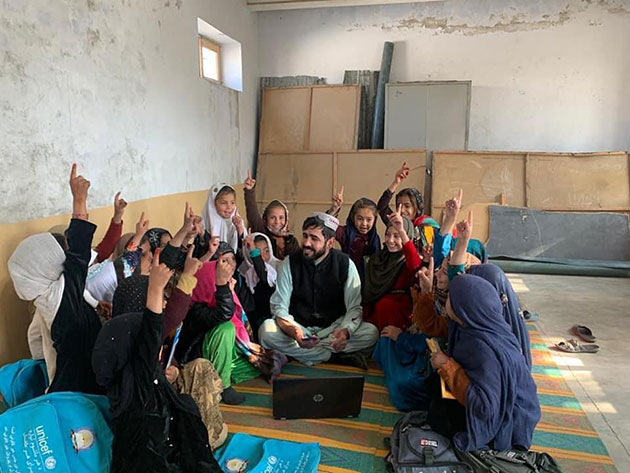
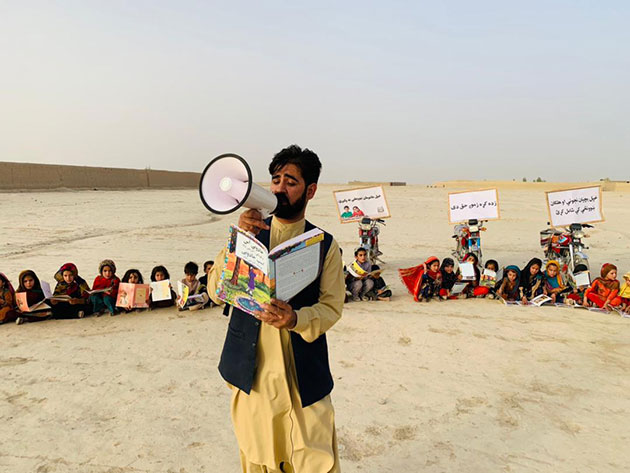
Matiullah was arrested in March 2023 for his dedication to provide education to girls particularly in rural areas. Through his organisation – PenPath which he founded in 2009, he campaigned for the right to education for girls, working with tribal leaders to provide mobile libraries to ensure girls have access to education. Penpath has successfully reopened 100 schools (including those closed for more than a decade due to war and the Taliban’s restrictions on education) in 16 provinces.

Matiullah Wesa, Afghan educational activist, reads to students in Afghanistan. Photo courtesy of Matiullah Wesa/PenPath

In an interview with CIVICUS, a year before he was arbitrarily arrested, Matiullah pointed out that they had provided education facilities for about 110000 children, about 60% were girls and distributed 1.5 million stationary and collected 34000 books through its book donation campaigns. His continued detention means, at best this much needed support provided to communities has been scaled back substantively and at worse has almost completely stopped. Yet, Matiullah is just one among hundreds who have worked tirelessly to improve the lives of Afghans over the years and are unable to do so either because they are in detention, have fled the country to avoid reprisals or have been forced to self censor.

The de facto Taliban regime has over the last two years institutionalised restrictions against women, dismissed women in public service, prevented girls from attending school and university and in December 2022, banned women from working with NGOs and aid agencies. It followed this decision exactly four months later by banning women from working for the UN in Afghanistan – as they had been exempted from the previous ban.

Through the Directorate for Intelligence, the regime monitors and targets women activists on social media and those identified as protest leaders. Others who participate in protests are identified through pictures posted on social media and through interrogations and arrested. On 11 February 2023, women’s rights activist and founder of the social movement – the Takhar Women’s Protest Movement – Parisa Mobarez, was arrested together with her brother in Takhar province and physically assaulted before they were released.

Matiullah Wesa, Afghan educational activist, reads to students in Afghanistan. Photo courtesy of Matiullah Wesa/PenPath

A day after, activist Nargis Sadat was arrested for protesting against the restrictions on women’s right to work and education and released after two months. In response to an announcement by the Taliban regime that it would close beauty salons, women protesters converged at the Shar-e Naw district in Kabul on 19 July, displaying protest signs with calls for ‘bread,’ ‘work’ and ‘justice.’ The women protesters were rounded up as security forces fired shots into the air and physically assaulted some of the women using electric stun guns.

The above restrictions are happening in a context of an ever increasing humanitarian crises exacerbated by growing social and economic challenges. Human rights groups report that the number of people living in poverty has increased to 97%, an increase of about 47% over the last three years and that more than half of the population – about 28 million people urgently need humanitarian assistance. The restrictions placed on women in government ministries and the ban on women from working for NGOs have a devastating impact on the families of these women and communities including women and children who have benefited from services provided. In addition, most women have literally been confined to their homes as they are banned from gyms, swimming pools and public parks.

Afghan women are fighting back

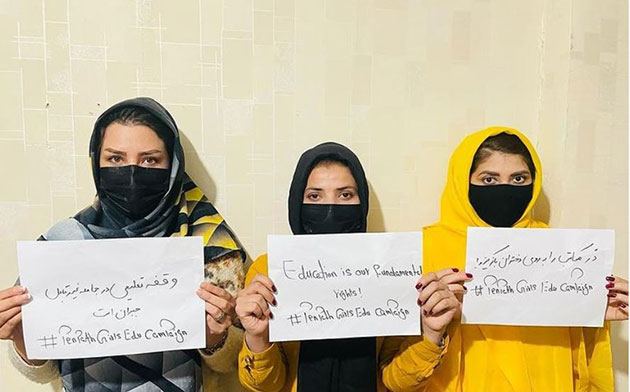
Despite the reprisals from the Taliban and threats of violence and arrests, Afghan women continue to mobilise to keep the face they face on the agenda of the international community. The resilience of these brave Afghan women and their sustained protests continue to shed light on the state of human rights in Afghanistan, especially at a time when the international community seems to have moved on to other crises. As women protesters, journalists and human rights defenders and families face increased attacks, protests have been moved indoors and online. Some of the protesters continue to cover their faces to avoid reprisals while others remain unveiled to encourage others.

Photo courtesy of PenPath

What can be done?

The current situation is especially tricky for many international actors and though the Taliban craves for international recognition to boast its legitimacy, members of the international community including the European Union, United Kingdom and India who engage with the Taliban as well as humanitarian organisations and civil society groups should respect the wishes of Afghans and not provide any form of formal recognition to the de facto regime. They should also support Afghan women rights activists in exile.

Millions of Afghans will continue to need humanitarian assistance for the foreseeable future and ongoing and future dialogues to negotiate for space and access through humanitarian corridors should be premised on respect for human rights and lifting of current restrictions on women and girls.

At the level of the United Nations, the UN Security Council Resolution on Afghanistan which accused the Taliban of violating human rights and the appointment of a Special Rapporteur on the situation of human rights in Afghanistan are important steps in the right direction but nearly not enough. The Security Council should continue to prioritise Afghanistan and push for accountability mechanisms inside of Afghanistan which would serve as some kind of a deterrent and a check on impunity. Lastly, there is a need for an intra-Afghan dialogue that is inclusive and should be led by a neutral party.

Josef Benedict is a researcher covering the Asia Pacific region for the CIVICUS Monitor. Malaysia. David Kode is the advocacy and campaigns lead for CIVICUS. South Africa

IPS UN Bureau

  Source