Brazil Back on the Green Track

Credit: Mauro Pimentel/AFP via Getty Images

By Inés M. Pousadela
MONTEVIDEO, Uruguay, Jul 24 2023 (IPS)

At a meeting with European and Latin American leaders in Brussels this July, Brazil’s President Lula da Silva reiterated the bold commitment he had made in his first international speech as president-elect, when he attended the COP27 climate summit in November 2022: bringing Amazon deforestation down to zero by 2030.


Lula’s presence at COP27 was a signal to the world that Brazil was willing to become the climate champion it needs to be. Following a request by the Brazilian Forum of NGOs and Social Movements for Environment and Development, Lula offered to host the 2025 climate summit in Brazil; it has now been confirmed that COP30 will be held in Belém, gateway to the Amazon River.

At COP27 Lula also said he intended to revive and modernise the 45-year old Amazon Cooperation Treaty Organisation, a body bringing together the eight Amazonian countries – Bolivia, Brazil, Colombia, Ecuador, Guyana, Peru, Suriname and Venezuela – to take concerted steps to protect the Amazon rainforest.

Four years of regression

In his four years in office, Lula’s far-right climate-denier predecessor Jair Bolsonaro dismantled environmental protections and paralysed key environmental agencies by cutting their funding and staff. He vilified civil society, criminalised activists and discredited the media. He allowed deforestation to proceed at an astonishing pace and emboldened businesses to grab land, clear it for agriculture by starting fires and carry out illegal logging and mining.

Under Bolsonaro, already embattled Indigenous communities and activists became even more vulnerable to attacks. By encouraging environmental plunder, including on protected and Indigenous land, the government enabled violence against environmental and Indigenous peoples’ rights defenders. A blatant example was the murder of Brazilian Indigenous expert Bruno Pereira and British journalist Dom Phillips in June 2022. The two were ambushed and killed on the orders of the head of an illegal transnational fishing network. Both the material and intellectual authors of the crimes have now been charged and await trial.

Reversing the regression

Having being elected on a promise to reverse environmental destruction, the new administration has sought to restructure and resource monitoring and enforcement institutions. It strengthened the Brazilian Institute for the Environment and Renewable Natural Resources (IBAMA), the federal agency in charge of enforcing environmental policy, and the National Foundation of Indigenous Peoples (FUNAI), which for the first time is now headed by an Indigenous person, Joenia Wapichana.

Bolsonaro had transferred FUNAI to the Ministry of Agriculture, run by a leader of the congressional agribusiness caucus. Instead of protecting Indigenous land, it enabled deforestation and the expansion of agribusiness.

In contrast, Lula’s first political gestures were to create a new ministry for Indigenous peoples’ affairs, appointing Indigenous leader Sonia Guajajara to lead it, and to make Marina Silva, a leader of the environmentalist party Rede Sustentabilidade, Minister for the Environment, a position she had held between 2003 and 2008.

Lula also restored the Action Plan for the Prevention and Control of Deforestation in the Amazon, launched in 2004 and implemented until Bolsonaro took over. In February, the government set up a Permanent Inter-Ministerial Commission for the Prevention and Control of Deforestation and Fires in Brazil to coordinate actions across 19 ministries and develop zero deforestation policies.

The strategy establishes a permanent federal government presence in vulnerable areas with the aim of eliminating illegal activities, setting up bases and using intelligence and satellite imagery to track criminal activity.

The newly appointed Federal Police’s Director for the Amazon and the Environment, Humberto Freire, launched a campaign to rid protected Indigenous land of illegal miners. It appears to be paying off: in July he announced that around 90 per cent of miners operating in Yanomami territory, Brazil’s largest protected Indigenous land, had been expelled. According to police sources, there were 19 mine-related deforestation alerts in April 2023 – compared to 444 in April 2022.

But the fight isn’t over. There are still a couple of thousand miners active and the criminal enterprises employing them remain very much alive. The key task of recovering damaged land and rivers can only begin once they’re all driven away for good. And an issue that cries out for international cooperation remains unresolved: violence and environmental degradation continue unabated in Yanomami communities across the border in Venezuela, and will only increase as illegal miners jump jurisdictions.

Achieving the ambitious zero-deforestation goal will require efforts on a much bigger scale than those of the past. And such efforts will further antagonise very powerful people.

Obstacles ahead

With the environmental agenda back on track, the pace of Amazon deforestation slowed down in the first six months of 2023, falling by 34 per cent compared to the same period in 2022. However, numbers still remain high and reductions are uneven, with two states – Roraima and Tocantins – showing increases. Deforestation is also still rising in another important part of Brazil’s environment, the Cerrado, where preservation areas are few and most deforestation happens on private properties.

For the Amazon, a crucial test will come in the second half of the year, when temperatures are higher. A stronger El Niño phase, with warming waters in the Pacific Ocean, will make the weather even drier and hotter than usual, helping fires spread fast. Anticipating this, IBAMA has scaled up its recruitment of firefighters to expand brigades in Indigenous and Black communities and conduct inspections and impose fines and embargoes. To discourage people from starting fires to clear land for agriculture, the agency prevents them putting that land to agricultural use.

But in the meantime, Brazil’s Congress has gone on the offensive. In June, the Senate made radical amendments to the bill on ministries sent by Lula, diluting the powers of the Ministries of Indigenous Peoples and Environment and limiting demarcation of Indigenous lands to those already occupied by communities by 1998, when the current constitution was enacted.

Indigenous leaders have complained that many communities weren’t on their land in 1998 because they’d been expelled over the course of centuries, and particularly during the 1964-1985 military dictatorship. They denounced the new law as ‘legal genocide’ and urged the president to veto it. Civil society has taken to the streets and social media to support the government’s environmental policies.

They face a formidable enemy. A recent report by the Brazilian Intelligence Agency exposed the political connections of illegal mining companies. Two business leaders directly associated with this criminal activity are active congressional lobbyists and maintain strong links with local politicians. They also stand accused of financing an attempted insurrection on 8 January.

Against these shady elites, civil society wields the most effective weapon at its disposal, shining a light on their dealings and letting them know that Brazil and the world are watching, and will remain vigilant for as long as it takes. The stakes are too high to drop the guard.

Inés M. Pousadela is CIVICUS Senior Research Specialist, co-director and writer for CIVICUS Lens and co-author of the State of Civil Society Report.


!function(d,s,id){var js,fjs=d.getElementsByTagName(s)[0],p=/^http:/.test(d.location)?’http’:’https’;if(!d.getElementById(id)){js=d.createElement(s);js.id=id;js.src=p+’://platform.twitter.com/widgets.js’;fjs.parentNode.insertBefore(js,fjs);}}(document, ‘script’, ‘twitter-wjs’);  

Source

Transgender People Face Growing Violence, Discrimination in Pakistan

Transgender people often entertain at weddings and other events, but they increasingly face violent acts, especially since part of an Act ensuring their rights was recently struck down. Credit: Ashfaq Yusufzai/IPS

Transgender people often entertain at weddings and other events, but they increasingly face violent acts, especially since part of an Act ensuring their rights was recently struck down. Credit: Ashfaq Yusufzai/IPS

By Ashfaq Yusufzai
PESHAWAR, Jul 24 2023 (IPS)

“The problems transgender people face start from their homes as their parents, especially fathers and brothers, look them down upon and disrespect them,” says 20-year-old Pari Gul.


Gul, a resident of Charsadda district in Khyber Pakhtunkhwa (KP), left her house at 16 when her mother asked her to or face being killed by her father.

“I was born as a boy, and my name was Abdul Wahid, but when I came to Peshawar and joined a transgender group, I got a female name, Pari Gul. Since then, I have been going to weddings and other festive ceremonies to dance,” she says. “Dance is my passion.”

However, she has often been the brunt of discrimination and violence.

“During my five-year career, people have beaten me more than 20 times. Each time the perpetrators went unpunished,” she told IPS in an interview.

Trans people are often targeted in KP, one of Pakistan’s four provinces.

On March 28, a man shot dead a transgender person in Peshawar. It was the third incident targeting transgender persons in the province in less than a week. Despite the violence, violent attacks on transgender people aren’t considered a major crime.

Khushi Khan, a senior transgender person, says lack of protection is the main problem.

“People have developed a disdain for us. They consider us non-Muslims because we dance at marriages and other ceremonies,” she says.

“We had lodged at least a dozen complaints with police in the past three months when our colleagues were robbed of money, molested and raped but to no avail,” Khan, 30, says.

Last month, clerics in the Khyber district decided they wouldn’t offer funerals to transgender persons and asked people to boycott them.

Rafiq Shah, a social worker, says that people attack the houses of transgender, kill, injure and rob them, but the police remain silent “spectators”.

“We have been protesting against violence frequently, but the situation remains unchanged,” Shah said.

Qamar Naseem, head of Blue Veins, a national NGO working to promote and protect transgender people, isn’t happy over the treatment meted out to the group.

“Security is the main issue of transgender persons. About 84 transgender persons have been killed in Pakistan since 2015 while another 2,000 have faced violence, but no one has been punished so far,” Naseem says.

The lack of action by the police has emboldened the people.

“Health, transportation, livelihoods and employment issues have hit the transgender (community) hard. Most of the time, they remained confined to their homes, located inside the city,” he says.

There are no data regarding the number of transgender in the country because the government doesn’t take them seriously, he says.

In May 2023, the Federal Shariat Court (FSC) dealt a severe blow when it suspended the implementation rules of the Protection of Transgender Persons Protection of Rights Act.

Farzana Jan, president of TransAction Alliance, says that FSC’s declaration that individuals cannot alter their gender at their own discretion, asserting that specific clauses within the Transgender Persons (Protection of Rights) Act, 2018 contradict Islamic law, has disappointed us.

The FSC declared un-Islamic sections 3 and 7 and two sub-sections of Section 2 of the Transgender Persons (Protection of Rights) Act, 2018, five years after the law was passed, the FSC rolled back key provisions granting rights to Pakistan’s transgender community.

Some right-wing political parties had previously voiced concerns over the bill as a promoter of “homosexuality,” leading to “new social problems”.

The Transgender Persons (Protection of Rights) Act, 2018, is against the injunctions of Islam as laid down in the Holy Quran and Sunnah of the Holy Prophet (PBUH) and will cease to have any legal effect immediately, the verdict stated.

Amnesty International said the verdict was a blow to the rights of the already beleaguered group of transgender and gender-diverse people in Pakistan. It said some of the FSC’s observations were based on presumptive scenarios rather than empirical evidence. The denial of essential rights of transgender and gender-diverse persons should not be guided by assumptions rooted in prejudice, fear and discrimination, AI said.

“Any steps taken by the government of Pakistan to deny transgender and gender-diverse people the right to gender identity is in contravention of their obligations under international human rights law, namely the International Covenant on Civil and Political Rights (ICCPR) and the Convention on the Elimination of All Forms of Discrimination against Women (CEDAW) to which they are a state party,” it said.

The government should take immediate steps to stop the reversal of essential protections, without which transgender and gender-diverse people will be even more at risk of harassment, discrimination and violence, AI added.

On July 12, 2023, transgender representatives from all provinces held a press conference at Lahore Press Club, where they vehemently condemned the recent decision by the FSC against the Transgender Persons (Protection of Rights) Act, 2018.

Arzoo Bibi, who was at a press conference, said it was time to stand united for justice and equality.

“Militants don’t threaten us, but our biggest concern is the attitude of the society and police,” said Arzoo.
IPS UN Bureau Report


!function(d,s,id){var js,fjs=d.getElementsByTagName(s)[0],p=/^http:/.test(d.location)?’http’:’https’;if(!d.getElementById(id)){js=d.createElement(s);js.id=id;js.src=p+’://platform.twitter.com/widgets.js’;fjs.parentNode.insertBefore(js,fjs);}}(document, ‘script’, ‘twitter-wjs’);  

Source

‘It’s Time UN Turned Ideas to ‘UNMute’ Civil Society into Action’

Activists, CSOs and faith-based leaders this week pondered how you get a seat at the table when they couldn't even get access to the UN building.

Activists, CSOs and faith-based leaders this week pondered how you get a seat at the table when they couldn’t even get access to the UN building.

By Abigail Van Neely
NEW YORK , Jul 21 2023 (IPS)

How do you get a seat at the table when you can’t even access the building? This question loomed as activists, faith-based leaders, and NGO representatives gathered at the NY Ford Foundation. They discussed how to amplify the voice of civil society organizations at the UN Headquarters across the street.


“How to UNMute” was hosted on July 20, 2023, as a side event during the ongoing 2023 High-Level Political Forum (HLPF). The event kicked off the creation of a manual to break down barriers to civil society engagement as the first step towards turning ideas into action.

Maithili Pai, the UN advocate for the International Service for Human Rights, illustrated the divide between the UN’s verbal commitments and its actual practices. Sometimes, Pai said, civil society representatives could not enter UN meeting rooms or waited years for UN accreditation. According to Pai, some representatives even faced retaliation for trying to interact with UN bodies.

“We understand very well that civil society is under attack and that there are people pushing you back,” Costa Rica’s Ambassador to the UN, Maritza Chan, told the audience.

Chan stressed that meeting the UN’s 17 sustainable development goals (SDGs) required empowering civil society organizations that provide critical insight.

“We need civil society in the room at all times, providing advice, supporting states, and also calling us when we are not doing things right,” Chan said.

Recommendations for the manual on ‘unmuting’ civil society were developed at a recent workshop. They include better-resourced UN NGO support offices, increased financing for participation in UN events, and more supportive visa processes, especially for delegates from the global south who have been historically excluded. Advocates also called for more systematic flows of information, methods of participation, and pathways into the UN.

Arelys Bellorini, the senior UN representative from World Vision, said she has to go to friendly missions to facilitate youth access to the UN.

Nelya Rakhimova, a sustainable development specialist, said she was asked to pay $1,500 to be at the UN.

Carmen Capriles, an environmental policy expert at the United Nations Environment Program, said she could not attend meetings on climate change because they were closed.

The Ambassador to the UN from Denmark, Martin Bille Hermann, pushed these advocates to present specific action items. “You’re not giving me easy avenues to deliver,” Hermann said. “Develop a toolbox that would allow us to continue to live in an old house.”

“We cannot expect different results by doing the same things,” Chan added.

This is not the first time these issues have been raised.

On the 75th anniversary of the UN in 2020, the General Assembly committed to making the UN more inclusive to respond to common challenges. The following year, a set of steps to strengthen the meaningful participation of stakeholders across the UN was presented to the secretary general by a group of civil society organizations and the permanent missions of Denmark and Costa Rica. The recommendations were endorsed by 52 member states and 327 civil society organizations.

The 2021 letter focused on the use of technology to make UN meetings more accessible. It cited an evaluation survey that found 50 percent of participants during the virtual 2020 HLPF joined for the first time. Most of these new participants represented civil societies in developing countries.

One suggestion for bridging digital divides and incorporating a more diverse range of participants was to host hybrid events and offer internet connection at UN country-based offices. However, Rakhimova pointed out that some events still do not have hybrid options.

The 2021 letter also called for a civil society envoy to the UN and an official civil society day. Neither recommendation has been formally implemented yet.

Mandeep Tiwana, chief officer of CIVICUS, a global alliance of civil society organizations with a strong presence in the global south, addressed inequalities in who influences international decision-making. Tiwana expressed concern that wealthy members of the private sector can “come in through the backdoor.” Meanwhile, activists already facing restrictions on their work wait outside.

“The time to open the doors to the UN virtually, online, and in person has come,” Chan said.
IPS UN Bureau Report


!function(d,s,id){var js,fjs=d.getElementsByTagName(s)[0],p=/^http:/.test(d.location)?’http’:’https’;if(!d.getElementById(id)){js=d.createElement(s);js.id=id;js.src=p+’://platform.twitter.com/widgets.js’;fjs.parentNode.insertBefore(js,fjs);}}(document, ‘script’, ‘twitter-wjs’);  

Source

Financing Biggest Hurdle to Providing Children with Quality Education in Crisis Situations – ECW

ECW’s Yasmine Sherif and Graham Lang walk with UNHCR partners through Borota, where thousands of new refugees, most of them women, and children, have arrived after fleeing the conflict in Sudan. Credit: ECW

ECW’s Yasmine Sherif and Graham Lang walk with UNHCR partners through Borota, where thousands of new refugees, most of them women, and children, have arrived after fleeing the conflict in Sudan. Credit: ECW

By Naureen Hossain
UNITED NATIONS, Jul 20 2023 (IPS)

If you want lasting peace, the best investment you can make is in education, said Education Cannot Wait’s Executive Director Yasmine Sherif in an exclusive interview with IPS.


“(This will) make children and adolescents literate, learn critical thinking, address trauma and psycho-social challenges from being victims of a conflict or crisis, develop their potential, and become financially independent,” Sherif said, adding that these were critical skills to participate in good governance of their countries in the future.

She was speaking to IPS ahead of her participation in the ECOSOC High-Level Political Forum side event “Ensuring Education Continuity: The Roles of Education in Emergencies, Protracted Crises and Building Peace” at the UN Headquarters in New York.

Education is the answer to breaking the vicious circle of violence, conflict, and crisis – while this often is associated with war and conflict, the same applies to climate change.

“If the next generation that is today suffering from climate-induced disasters are not educated, do not understand or have an awareness of how to treat mother earth, and do not have the knowledge or skills to mitigate or prevent risks in the future, the negative impact of climate-induced disasters will only escalate.”

Unfortunately, conflicts and climate risks increasingly combine to multiply vulnerability, she said – and instead of declining, the number of children who need urgent support is increasing.

“Today, 224 million crisis-affected children do not receive a quality, continuous education. More than half of these children – 127 million – may have access to something that resembles a classroom, but they are not learning anything. They are not achieving the minimum proficiencies outlined in the Sustainable Development Goals (SDG4).”

Sherif stressed the crucial linkage between education and protection for children in crisis-affected countries and explained how protection is a core component of the holistic package of education ECW is supporting together with its partners.

“On the legal side, we advocate for the respect of the international humanitarian law, national human rights law, and the National Refugee Law, and for an end to impunity for those who violate these,” said Sherif. “We also call for additional countries to adopt the Safe Schools Declaration, and actively support its implementation at the national level.”

To prevent violence around and in schools, practical measures are included to ensure the children are safe.

“It’s important to ensure safe transport to and from the school. And that would, of course, bring a sense of safety to the parents, who may not be willing to send the girls to school because of that. You ensure the infrastructure of the school provides protection. You may need wards around the school so that nobody can walk into the school and abduct a girl.”

ECW funding also includes protections to prevent sexual and psychological violence.

“All the funding that we invest requires giving protection a priority. And that is essential wherever you operate or invest funding in a country of affected by armed conflict; you need to ensure protection is prioritized.”

Sherif said that in countries like Afghanistan, where the Taliban have banned girls from attending secondary school and upwards, ECW works with local partners to support non-formal education.

“There is a lot of work at the community level, with local authorities allowing ECW’s investments in civil society and UN agencies to continue to operate. So community-based schooling is pretty much (being) run now, where we are investing at the community level,” she said, and while it may not be ideal, it does work.

Likewise, non-formal learning centers have been set up in Cox’s Bazar, where the Rohingya refugees live after fleeing violence, discrimination, and persecution in Myanmar.

“Our aim is for every child to be able to access national education systems, but sometimes it is not possible politically or physically due to the dangers of the conflict. So we also support our partners to establish non-formal learning centers until another more sustainable solution can be found.”

During the Covid-19 pandemic, ECW’s partners were innovative in ensuring education continued – with remote learning programmes such as radio and TV-based education, where IT connections were available through phones and WhatsApp with learning kits and tools.

“Home-based, going from door-to-door, that was how it was done during COVID. There was some creativity and innovation. It is possible. It is not ideal, but it is possible.”

Sherif said ECW had developed a proven model to bring quality education to every child – even in the most challenging crisis-affected contexts of war and conflicts – but that the biggest hindrance is the financing.

“If we had the financing, we could reach the 224 million (children) immediately. So financing is the big hindrance today. While peace is the number one (solution), if peace is not possible, education cannot wait.”

“If financing for education is provided in crisis and climate disasters, ECW can reach 20 million children and adolescents in the coming four years. And that requires about another USD700 million for Education Cannot Wait between today and 2026. Just USD 700 million is a small amount when you consider the return on investment you get when you invest in human potential.”

IPS UN Bureau Report


!function(d,s,id){var js,fjs=d.getElementsByTagName(s)[0],p=/^http:/.test(d.location)?’http’:’https’;if(!d.getElementById(id)){js=d.createElement(s);js.id=id;js.src=p+’://platform.twitter.com/widgets.js’;fjs.parentNode.insertBefore(js,fjs);}}(document, ‘script’, ‘twitter-wjs’);  

Source

Mandela Day Reminder to Stand Witness to Human Rights Defenders

Nelson Mandela, then Deputy President of the African National Congress of South Africa, raises his fist in the air while addressing the Special Committee Against Apartheid in the General Assembly Hall, June 22, 1990. Global alliance CIVICUS commemorated Mandela Day with a reminder that many rights defenders are jailed and intimidated. Credit: UN Photo/Pernaca Sudhakaran

Nelson Mandela, then Deputy President of the African National Congress of South Africa, raises his fist in the air while addressing the Special Committee Against Apartheid in the General Assembly Hall, June 22, 1990. Global alliance CIVICUS commemorated Mandela Day with a reminder that many rights defenders are jailed and intimidated. Credit: UN Photo/Pernaca Sudhakaran

By Joyce Chimbi
NAIROBI , Jul 18 2023 (IPS)

As human rights increasingly deteriorate, rights defenders are being violently suppressed. Abducted, detained, tortured, and humiliated, many now live one day at a time. They have been told, in no uncertain times, that anything could happen. They are now asking the global community to stand as a witness.


“Like Nelson Mandela was, hundreds of human rights defenders around the world are in prison for their human rights activities. Just like him, they are unjustly treated, fictitious charges levelled against them and handed the most serious sentences that are often used against criminals. One of our priorities is to work with human rights defenders to advocate for their release,” says David Kode from CIVICUS, a global alliance of civil society with a presence in 188 countries around the world.

Inspired by the life story of the late iconic South African President Nelson Mandela, the Stand As My Witness Campaign was launched on Nelson Mandela Day in 2020 by CIVICUS, its members and partners.

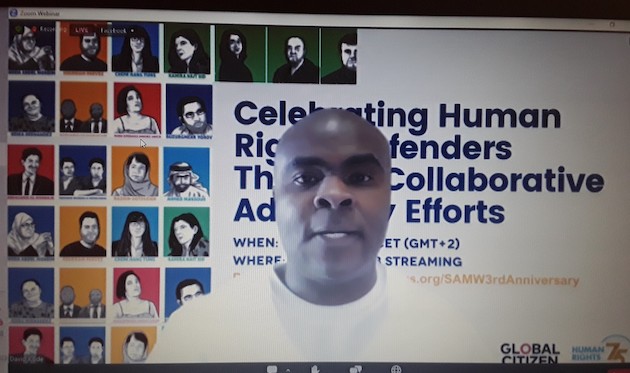
In commemoration of the third anniversary of the Stand As My Witness campaign, CIVICUS and its partners, including human rights defenders, hosted a public event titled, ‘Celebrating Human Rights Defenders through Collaborative Advocacy Efforts’, to celebrate the brave contributions of human rights defenders and raise awareness about those who are still in detention.

David Kobe said that CIVICUS had profiled at least 25 human rights defenders since the Stand As My Witness Campaign started three years ago. Credit: Joyce Chimbi/IPS

David Kobe said that CIVICUS had profiled at least 25 human rights defenders since the Stand As My Witness Campaign started three years ago. Credit: Joyce Chimbi/IPS

“Over the last three years, we have profiled more than 25 human rights defenders collectively because some human rights defenders are profiled as individuals and others, such as those in Burundi, are profiled as a group because they were arrested as a group. More than 18 human rights defenders have been released over the last three years. As we celebrate, we must recognize that the journey has just started, it is quite long, and the battle is far from over,” Kode said.

The event brought together families and colleagues of detained human rights defenders, previously detained human rights defenders, representatives from the Office of the High Commissioner for Human Rights (OHCHR) and other human rights mechanisms and civil society organisations.

Lysa John, the Secretary General of CIVICUS, spoke about how special Mandela Day is, for it is the one day of the year when the spirit of solidarity is celebrated in his memory. It is also a day to look back at what has been achieved and how much more could be achieved in solidarity.

She further addressed issues of civic space restrictions, closure of civic space and how these restrictions impact societies and individuals. John stressed that the event was held in the context of the 25th anniversary of the adoption of the UN Declaration on Human Rights Defenders and the 75th anniversary of the UNDHR or Human Rights 75 to promote their objectives.

“One-third of the population of the world live in contexts which are closed. Where attacks on people who speak out or exercise their civic freedoms are attacked or arrested without any accountability. More and more people in the world, in fact, the largest section of the world, estimated at 44 percent live in countries where civic space and civic freedoms are restricted. In this regard, civic society is more than ever reinventing itself, and there is increased support for them,” she said.

Birgit Kainz from OHCHR spoke about the importance of bringing to life the UN Declaration on Human Rights Defenders for its adoption was a consensus that human dignity is at the core of everything.

She spoke about the need to be deliberate in the defence of civic space as it enables people to shape their future and that of their children. Kainz said that protection and security are two sides of the same coin and urged participants to network and connect to improve civic space and to also play a complementary role. Further emphasizing the need to maintain data, especially about who is in detention and where in line with SDGs.

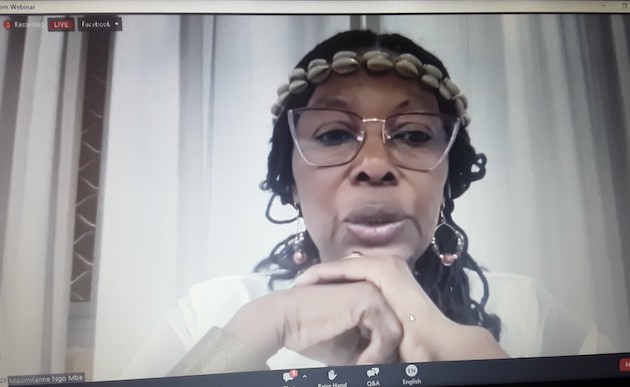
Maximilienne Ngo Mbe from Cameroon is one of the most prolific human rights defenders in Africa. She spoke about the need to create safe spaces for women rights defenders. Photo Joyce Chimbi.jpg

Maximilienne Ngo Mbe from Cameroon is one of the most prolific human rights defenders in Africa. She spoke about the need to create safe spaces for women rights defenders. Credit: Joyce Chimbi/IPS

Maximilienne Ngo Mbe spoke about the life and times of human rights defenders today. She is one of the most prolific human rights defenders in Africa and continues to receive a lot of restrictions for her fearless human rights activities that often have her fleeing from Cameroon to other countries for safety.

“We need a network for women rights defenders because of the special challenges they face as girls, wives, mothers and vulnerable people. Women are engaging less and less because of these challenges and the multiple roles they play in society,” she said.

The event was an opportunity for released human rights defenders such as Maria Esperanza Sanchez from Nicaragua to speak about resilience in the face of brutal regimes. She spoke about how armed men often came to her house to threaten and intimidate her. Of her arrest, humiliation and torture in 2020, being sentenced to 10 years in prison and her eventual release.

It was also an opportunity to speak on behalf of those who cannot. They include Khurram Parvez, a prolific human rights defender in India. At the time of his arrest for human rights activities, he was leading two critical organizations at the national and regional levels.

Parvez is being charged as a terrorist. His story aligns with that of Kenia Hernandez, a 32-year-old indigenous Amuzga woman, mother of two, lawyer and an advocate for human rights who is currently detained in a maximum-security prison in Mexico and has been sentenced to 21 years. Her story is illustrative of the high-risk female rights defenders and people from marginalized groups face.

Ruben Hasbun from Global Citizen spoke about how to effectively advocate for the release of human rights defenders, sharing lessons from Stand As My Witness campaigners.  The event further opened up space to address the role of the private sector.

Christopher Davis from Body Shop, a brand that continues to be at the forefront of supporting human rights and rights defenders, fighting social and environmental injustice.

At the end of the session, participants were invited to sign a petition to have the United Arab Emirates immediately and unconditionally release all those detained solely for the exercise of their human rights and end all abuse and harassment of detained critics, human rights defenders, political opposition members, and their families.

IPS UN Bureau Report


!function(d,s,id){var js,fjs=d.getElementsByTagName(s)[0],p=/^http:/.test(d.location)?’http’:’https’;if(!d.getElementById(id)){js=d.createElement(s);js.id=id;js.src=p+’://platform.twitter.com/widgets.js’;fjs.parentNode.insertBefore(js,fjs);}}(document, ‘script’, ‘twitter-wjs’);  

IPS – UN Bureau, IPS UN Bureau Report, CIVICUS

Source

‘Passion Seeds’ Fertilize Brazil’s Semiarid Northeast

Ligoria Felipe dos Santos poses for a photo on her agroecological farm that mixes corn, squash, fruits, vegetables and medicinal herbs. She is part of the women's movement that is trying to prevent the installation of wind farms in the Borborema mountain range, in the northeastern Brazilian state of Paraíba. CREDIT: Mario Osava / IPS

Ligoria Felipe dos Santos poses for a photo on her agroecological farm that mixes corn, squash, fruits, vegetables and medicinal herbs. She is part of the women’s movement that is trying to prevent the installation of wind farms in the Borborema mountain range, in the northeastern Brazilian state of Paraíba. CREDIT: Mario Osava / IPS

By Mario Osava
ESPERANÇA, Brazil , Jul 14 2023 (IPS)

Zé Pequeno cried when he learned that the heirloom seeds he had inherited from his father were contaminated by the transgenic corn his neighbor had brought from the south. Fortunately, he was able to salvage the native seeds because he had shared them with other neighbors.


Euzébio Cavalcanti recalls this story from one of his colleagues to highlight the importance of “passion seeds” for family farming in Brazil’s semiarid low-rainfall ecoregion which extends over 1.1 million square kilometers, twice the size of France, in the northeastern interior of the country.”These are seeds adapted to the semiarid climate. They can withstand long droughts, without irrigation.” Euzébio Cavalcanti

Saving heirloom seeds is a peasant tradition, but two decades ago the Brazilian Semiarid Articulation (ASA), a network of 3,000 social organizations that emerged in the 1990s, named those who practice it as individual and community guardians of seeds. By September 2021, it had registered 859 banks of native seeds in the region.

Cavalcanti, a 56-year-old farmer with multiple skills such as poet, musician and radio broadcaster, coordinates the network of these banks in the Polo de Borborema, a joint action area of 14 rural workers’ unions and 150 community organizations in central-eastern Paraíba, one of the nine states of the Brazilian Northeast.

“These are seeds adapted to the semiarid climate. They can withstand long droughts, without irrigation, that is why they are so important,” he explained. They also preserve the genetic heritage of many local crop species and family history; they have sentimental value.

“Don’t plant transgenics, don’t erase my history”, is a slogan of the movement that promotes agroecological practices and is opposed to the expansion of genetically modified organisms in local agriculture. “Corn free of transgenics and agrotoxins (agrochemicals)” is the goal of their campaign.

In Paraíba, the name “passion seeds” has been adopted, instead of native or heirloom seeds, since 2003, when the state government announced that it would provide seeds from a specialized company to family farmers.

“If the government offers these seeds, I don’t want them. I have family seeds and I have passion for them,” reacted a farmer in a meeting with the authorities.

“‘Passion seeds’ spread throughout Paraíba. In other states they’re called ‘seeds of resistance’,” Cavalcanti said.

Agroecology is one of the banners of the Polo de Borborema, as it is for ASA in the entire semiarid ecosystem that covers most of the Northeast region and a northern strip of the southeastern state of Minas Gerais.

"Passion seeds," as heirloom seeds are known locally, ensure better harvests on semiarid lands, free of transgenics or "agricultural poisons," according to Euzébio Cavalcanti, a small farmer, poet and musician who helped lead the struggle for agrarian reform and cares for the seeds in the highlands of Borborema, in northeastern Brazil. CREDIT: Mario Osava / IPS

“Passion seeds,” as heirloom seeds are known locally, ensure better harvests on semiarid lands, free of transgenics or “agricultural poisons,” according to Euzébio Cavalcanti, a small farmer, poet and musician who helped lead the struggle for agrarian reform and cares for the seeds in the highlands of Borborema, in northeastern Brazil. CREDIT: Mario Osava / IPS

Learning to coexist with semiarid conditions

This approach arose from a change in the development strategy adopted on the part of local society, especially ASA, since the 1990s. “Coexisting with semiarid conditions” replaced the traditional, failed focus on “fighting the drought”.

Large dams and reservoirs, which only benefit large landowners and do not help the majority of small farmers, gave way to more than 1.2 million tanks for collecting rainwater from household or school rooftops and various ways of storing water for crops and livestock.

It is a process of decolonization of agriculture, education and science, which prioritizes knowledge of the climate and the regional biome, the Caatinga, characterized by low, twisted, drought-resilient vegetation. It also includes the abandonment of monoculture, with the implementation of traditional local horticultural and family farming techniques.

The Northeast, home to 26.9 percent of the national population, or 54.6 million inhabitants according to the 2022 demographic census, concentrates 47.2 percent of the country’s family farmers, according to the 2017 agricultural census. There are 1.84 million small farms worked mainly by family labor.

Brazil’s semiarid region is one of the rainiest in the world for this type of climate, with 200 to 800 millimeters of rain per year on average, although there are drier areas in the process of desertification.

A stand at the ecological market in the municipality of Esperança, in northeastern Brazil, is a link between urban consumers and family farmers opposed to agrochemicals, monoculture and transgenic products. CREDIT: Mario Osava / IPS

A stand at the ecological market in the municipality of Esperança, in northeastern Brazil, is a link between urban consumers and family farmers opposed to agrochemicals, monoculture and transgenic products. CREDIT: Mario Osava / IPS

Borborema, the name of a high plateau that obstructs the humidity coming from the sea, making the territory to its west drier, is the scene of various peasant struggles, such as the mobilization for agrarian reform since the 1980s and for small-scale agriculture “without poisons” or agrochemicals, of which the “seeds of passion” are a symbol.

Cavalcanti is a living memory of local history, also as a founder of the local Landless Workers Movement (MST) and an activist in the occupations of unproductive land to create rural settlements, on one of which he gained his own small farm where he grows beans, corn and, vegetables and has two rainwater collection tanks.

Women help drive the expansion of agroecology

Women have played a key role in the drive towards agroecology. The March for Women’s Lives and Agroecology is an annual demonstration that since 2010 has defended family farming and the right to a healthy life.

This year, on Mar. 16, 5,000 women gathered in Montadas, a municipality of 5,800 inhabitants, to block the creation of wind farms that have already caused damage to the health of small farmers by being installed near their homes.

Borborema is “a territory of resistance,” say the women. About 15 years ago, they succeeded in abolishing the cultivation of tobacco.

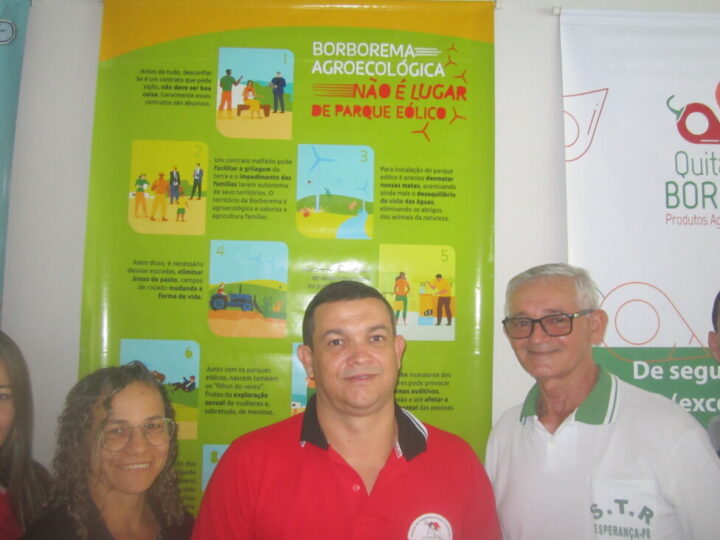
The president of the Union of Rural Workers of the municipality of Esperança, Alexandre Lira (C) and other leaders pose in front of a poster declaring the union's current goals: "Agroecological Borborema is no place for a wind farm," he says about this area in Brazil's semiarid Northeast region. CREDIT: Mario Osava / IPS

The president of the Union of Rural Workers of the municipality of Esperança, Alexandre Lira (C) and other leaders pose in front of a poster declaring the union’s current goals: “Agroecological Borborema is no place for a wind farm,” he says about this area in Brazil’s semiarid Northeast region. CREDIT: Mario Osava / IPS

When the citrus blackfly arrived, the government tried to combat it with pesticides, but “we resisted; we used natural products and solved the problem for our oranges and lemons,” said Ligoria Felipe dos Santos, a 54-year-old mother of three.

“That is agroecology, which is strengthened in the face of threats. Farmers are aware, they resort to alternative defenses, they know that it is imbalance that leads to pests,” she told IPS.

“Agroecology is a good banner for union activity,” said Lexandre Lira, 42, president of the Rural Workers Union of Esperança, a municipality of 31,000 people in the center of the Polo de Borborema.

It is also a factor in keeping farmers’ children on the farms, because it awakens the interest of young people in agriculture, said Edson Johny da Silva, 27, the union’s youth coordinator.

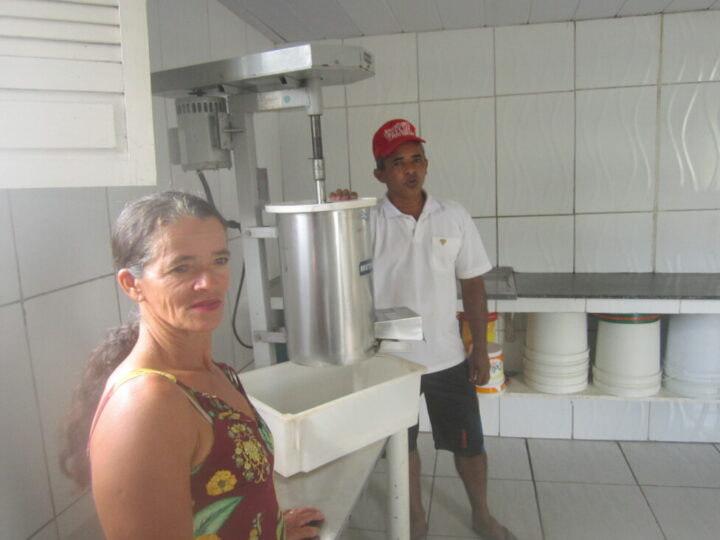
Maria das Graças Vicente and Givaldo Firmino dos Santos stand next to the machine they use for making pulp from native fruits little known outside Brazil, such as the umbu (Brazil plum), cajá (hog plum), acerola (Amazon or Barbados cherry), along with cashews, mangos, and guava. CREDIT: Mario Osava / IPS

Maria das Graças Vicente and Givaldo Firmino dos Santos stand next to the machine they use for making pulp from native fruits little known outside Brazil, such as the umbu (Brazil plum), cajá (hog plum), acerola (Amazon or Barbados cherry), along with cashews, mangos, and guava. CREDIT: Mario Osava / IPS

Pulp, added value

Maria das Graças Vicente, known as Nina, 51, along with her husband Givaldo Firmino dos Santos, 52, is an example of agroecological productivity. On 1.25 hectares of land they produce citrus fruits, passion fruit, acerola (Amazon or Barbados cherry), mango and other fruits, as well as sugar cane, corn, beans and other vegetables.

Grafted fruit tree seedlings are another of the products they use to expand their income, as IPS was shown during a visit to their farm.

Using their own harvest and fruit they buy from neighbors, they make pulp in a small shed separate from their home, with a small machine purchased with the support of the Advisory and Services to Projects in Alternative Agriculture (AS-PTA), a non-governmental organization that supports farmers in Borborema and other parts of Brazil.

“Luckily we have a microclimate in the valley, where it rains more than in the surrounding areas. Everything grows here,” Santos told IPS.

But the couple created three reservoirs to collect rainwater and withstand droughts: a 16,000-liter water tank for household use, another that collects water on the paved ground for irrigation, and a small lagoon dug in the lower part of the farm.

But in 2016 the lagoon dried up, because of the “great drought” that lasted from 2012 to 2017, Vicente said.

The fruit pulp factory has grown in recent years and now has seven small freezers to store fruit and pulp for sale to the town’s stores and restaurants. The couple decided to purchase a cold room with the capacity of 30 freezers.

“I work in the mornings on the land, in the afternoons I make pulp and my husband is in charge of the sales,” she said.

Hiring workers from outside the family to reduce the workload costs too much and “we try to save as much as possible on everything, to sell the pulp at a fair price,” Santos said.

Source