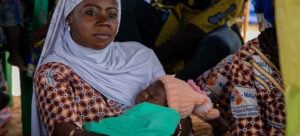
A woman with her baby attends a UN-run awareness-raising session on gender-based violence at the One Stop Centre in Sominé Dolo Hospital in Mopti, Mali. Credit: UNFPA Mali/Amadou Maiga
In support of this civil society initiative the UN Secretary-General back in 2008 launched the campaign UNITE by 2030, which runs parallel to the 16 Days of Activism.
The statistics are staggering: nearly one in three women and girls worldwide will experience physical or sexual violence during their lifetime.
For at least 51,100 women in 2023, this violence escalated to femicide (homicide targeted at women) with over half committed by intimate partners or family members.
The agency championing women’s empowerment, UN Women, points out that femicides are the ultimate evidence that the systems and structures meant to protect women and girls are failing.
Women are not safe outside their homes either.
Public figures, including politicians, human rights defenders, and journalists, are often targeted by violence both online and offline, with some leading to fatal outcomes and intentional killings.
One alarming aspect of this issue is the prevalence of violence in conflict zones. In 2023, the United Nations reported a staggering 50 per cent increase in gender violence from the previous year.
From survivors to advocates
Women like Ukrainian activist Lyudmila Huseynova exemplify the harrowing reality of conflict-related sexual violence.
After enduring over three years of imprisonment and torture in a Russian prison, where she faced brutal physical abuse, “In that place, you become a person without rights,” she recalled of her torment in Izolyatsia prison, Ms. Huseynova’s resilience turned into activism.
Since her release in 2022, she has become an unwavering advocate for survivors, working with SEMA Ukraine to amplify the voices of those suffering from conflict-related sexual violence and to demand global attention to the atrocities faced by women and children in Ukraine.
Through her tireless efforts, Ms. Huseynova not only exposes the cruelty women endure but also leads efforts to secure justice and recovery for victims. “We will use every means to make their pain visible,” she emphasised.
What can we do?
While we may not all be activists, we all have a role in ending the abuse, says UN Women.
On an individual level, from supporting local organisations to advocating for stronger laws and supporting the women in our lives, everybody can make a difference.
Argentinian activist Iren Cari and founder of Women’s Forum for Equal Opportunities stressed the need to support women in political life and centre their voice: “We need funds to promote women’s participation – not only in public policy making, but also to participate in elections.”
UN Women emphasised that governments must enact laws to ensure accountability for perpetrators of gender-based violence, particularly through National Action Plans.
In parallel, funding women’s rights organizations is essential to support survivors and provide them with the necessary resources for recovery.
The 16 Days of Activism remind us that every action, no matter how small, counts in the fight to end gender-based violence, the agency stresses.
BOSTON / PHILADELPHIA, Oct 28 2024 (IPS) – The students and the common people of Bangladesh dared to do something in 36 days of July-August that was considered simply impossible by most people just days before August 5, 2024. They said ‘enough is enough’ to an old order that outraged their humanity, robbed their dignity and the rulers imagined that their citadel of power was simply impenetrable. The revolutionists refused to bow down to the murderous regime that knew no bounds to its cruelty and plundering. They were ready to sacrifice their lives for the freedom of the besieged nation.
Mawdudur Rahman
This revolution is unique in so many ways. It is a revolution in the digital age that is rooted in meta-modernist philosophy. The old political leadership with its moribund appeal and bankrupt philosophy proved irrelevant in this agenda. As Professor Yunus, the Chief Advisor to the Interim Government, has rightly said, ‘Now is the era of a new generation’.
Meta-modernism is the cultural philosophy of the digital age, coined by Mas’ud Zavarzadeh in 1975. meta-modernism is the Age of the Internet or more balanced worldview. As one analyst puts it, we went from modernism — “Make it new!” Let’s shape History! – to postmodernism — everything sucks! Nothing really matters! — to meta-modernism – maybe things are not this black-and-white, maybe there’s a middle ground.
Meta-modernist thinkers perceive the present world around them as a threat to their very existence. They work with pragmatic idealism and have no grand narrative thinking or any orthodox certainties. In other words, they try to strike a balance between all of this. They recognize that they have to face the problems of the society.
Habib Siddiqui
Arguably, all the activities of Bangladeshi revolutionists including their wall posters, followed a framework of Meta-Modernism. It is understood that the new Bangladesh is defined in a new ideology. Student revolutionaries have said that our ideology is reflected through the language we use. The basis of the new ideology is language. It is a revolution of change from the cultural context of fascist imperialist language to the native (spoken) language of the people. In other words, new ideals will be reflected through the language of the people.
It would be wrong to think that this people’s revolution was all about a change of government. Its victory is unlike 1947 and 1971. In both those cases, there was a change of government without any structural change. As a result, the incoming government followed imperialist practices of exploitation left behind by the British. Subsequent governments turned the country into a failed democracy, in order to control, exploit and subjugate its citizens. The police were used as an enabling force to subjugate the citizens, while the legislature and judiciary worked as the rubber stamps to sustain the total control of the government. This evil social system has corrupted the mindset and behavior of our people. An immoral society was formed with no fear of accountability, whose driving force was unfathomed greed and mantra — the ‘rule and exploitation by repression’. Government employees saw themselves as bosses and not as public servants. They thrived upon corruption at all levels.
There are now two competing ideologies in front of Bangladesh – one of decaying fascism that wants to resurface under old leadership and the other is the young leadership of equality and morality. As the revolution demonstrated, the ‘New Bangladesh’ does not approve fascist-supporting corrupt institutions. It desires a corruption-free new society. It is for paradigm shift – a transformational change.
The Chief Advisor and Student Coordinators have clearly highlighted the ideals of New Bangladesh through their speeches and interviews. Dr. Yunus said, ‘We are all one nation’. This is a clarion call to establish a holistic change in society. Such a radical change in society requires a change in values. A change in values lies in the change in public ideology.
The new Bangladesh is not the old Bangladesh with a new cover. It demands a change in the fundamental values of human behavior, actions, and beliefs. These include structural changes, personal changes, expectations.
To understand the ideology of this change, one has to listen carefully to the speech of Mahfuz Alam, the ‘thinker’ of the movement. Five points can be deduced from his recent talks: (1) unity, (2) ‘language is their inspiration’, (3) group leadership, (4) they are children of time, and that (5) they are not a slave to traditional thinking. His views reflect today’s meta-modernism.
For any transformational change to succeed, the change agents must own it, direct it, and ultimately excel in it. We think that this revolution of holistic change can benefit from the revolutionary approaches adopted in China and Cuba that were also led by youths. They owned the revolution and did not allow it to be hijacked by the reactionaries. We see some of these characteristics in the minds and mission of the Bangladeshi revolutionaries.
The bottom line is, bringing any changes in old culture habits was never an easy task. This revolution has presented an opportunity to change the destiny of Bangladesh as never before.
The meta-modernist youths of Bangladesh have come to lead and move forward; they will not go back to the old ways. Their message is clear: if you do not join us, the country will not wait for you. If older generations do not adopt the new view of change, we fear further instability and chaos to come, whose outcome cannot be pleasant.
Dr. Mawdudur Rahman, Professor Emeritus, Suffolk University, Boston, USA. He can be contacted at: mrahman@suffolk.edu.
Dr. Habib Siddiqui is a peace and human rights activists. His latest book – ‘Bangladesh: a polarized and divided nation?’ is available in the Amazon.com. Both are members of the steering committee of Esho Desh Gori – Let’s Build Bangladesh.
Oct 15 2024 (IPS) – CIVICUS discusses Afghanistan’s system of gender apartheid with Shaharzad Akbar, Executive Director of Rawadari, a human rights organisation founded by Afghans in exile.
Since regaining power in August 2021, the Taliban have banned women from all education beyond primary school and most jobs. They don’t allow women to travel without a male guardian or be seen in public, with severe penalties for violations. A new law introduced in August 2024 further silenced women by literally banning them from being heard in public. This received widespread international condemnation. Afghan civil society, mostly in exile, continues to document human rights abuses, advocate with international allies and campaign for change.
Shaharzad Akbar
How much space is there for civil society to operate in Afghanistan under the Taliban?
Not much. Although there’s still some civic resistance, mainly led by women, the Taliban have dismantled almost all civic structures. They have disbanded student associations and teachers’ unions and severely restricted the space for civil society to operate.
Long before they took power, the Taliban targeted civil society activists, journalists and religious and tribal leaders who challenged their rules. But when they regained power in August 2021, they used state institutions to further restrict civic space. It was women who resisted: just one day after the Taliban seized Kabul, they took to the streets to demand their rights. Independent media cautiously tried to cover these protests, but journalists were beaten and tortured. By January 2022, the Taliban were arresting women protesters. Cases of arbitrary detention, torture and intimidation and enforced disappearances have only increased since then.
The Taliban repealed laws protecting journalists and civil society, increased censorship and used intimidation to silence independent media. Anyone who criticises their government, even if it’s a social media post questioning electricity cuts, is likely to receive a phone call from the Taliban’s intelligence agency ordering them to delete it and not to raise the issue again.
It’s now impossible to work openly on human rights or freedom of expression in Afghanistan. The Taliban shut down the organisation I headed, the Afghanistan Independent Human Rights Commission (AIHRC). Other organisations working on cultural rights, peacebuilding and social issues have either changed their mandates or left.
How have the Taliban responded to women’s resistance?
When they returned to power, the Taliban were surprised to see women take to the streets against them. Given the Taliban’s violent past, many men didn’t dare protest. But women, who the Taliban underestimated because they saw them as weak, stood together and challenged them publicly.
At first they thought the protests would die down, but when this didn’t happen, they responded with increased violence, imprisoning and torturing women activists and targeting their families. They also launched a smear campaign accusing them of not being ‘authentic’ Afghan women. Since then, they’ve tried to impose the idea that Afghan women belong at home, fully covered and without any public aspirations.
Many repressive decrees followed. First, women were segregated from men in universities, then required to cover up even more and finally banned altogether from universities in December 2022. Restrictions on women’s work also increased over time: women were first restricted to the government health and education sectors and they were later banned from working for civil society organisations and the United Nations (UN). The result was a full-blown system of gender apartheid.
But women refused to be erased and found new ways to resist. Some have continued to protest publicly, even at great risk to their lives and those of their families. A notable example is a protester who was detained with her four-year-old son. Others have opted for more subtle forms of resistance, setting up clandestine schools and seeking education delivered via WhatsApp by Afghan diaspora and international educators. Women’s rights activists, both inside and outside Afghanistan, have formed advocacy networks that are very active in international and regional forums.
When was Rawadari founded and what does it do?
Rawadari was publicly launched in December 2022 by a group of exiled former AIHRC staff. We had been documenting human rights abuses for over a decade and were forced into exile when the Taliban came to power. We set up Rawadari because we felt it was important to continue monitoring and documenting the situation, and to counter the disinformation being spread by the Taliban.
Rawadari’s work focuses on three areas. The first is human rights monitoring. To date, we have published nine reports, available in English and Afghanistan’s two main languages, Dari and Pashto. We want to ensure they are accessible to both local and international audiences.
Our second area is advocacy, particularly on accountability and victim-centred justice. We regularly submit reports to the UN and push for the Taliban to be brought before the International Court of Justice and International Criminal Court. We also advocate for additional resources for the UN Special Rapporteur on Afghanistan and are exploring other mechanisms, such as the establishment of a people’s tribunal for Afghanistan.
The third focus of our work is to promote a culture of human rights. This is difficult because, being outside Afghanistan, we have to do it through social media campaigns and online discussions and events. But we try to keep the conversation going and build alliances within the human rights community and beyond.
How are you campaigning for women’s rights?
In June this year, it was 1,000 days since the Taliban banned girls from going to school. To raise awareness and keep the issue alive in people’s minds, we launched the Iqra campaign (‘read’ in Arabic). We worked with Musawer, an organisation led by the renowned Afghan poet Shafiqa Khpalwak.
As we couldn’t use video footage for security reasons, we asked girls to record a short audio clip about how the ban on education affected them. This wasn’t easy, because many girls don’t have their own phones and identifying them could put them at risk. But we managed to gather voices from across Afghanistan.
The campaign was a success because it centred the voices of Afghan girls from every corner of the country and brought them to the fore, and because it gained support from men and women. Girls spoke about the dreams they’ve lost, the friendships they miss and the depression and negative thoughts they battle every day. Some said they’d witnessed early marriages among their friends. They all appealed to the international community to support their right to education. Some clips reached thousands of people, and prominent Afghan singers, TV personalities and other celebrities amplified the message and called for the reopening of girls’ schools.
We’ve also recently worked with Femena, a regional organisation, to launch a campaign in response to the recent ban on women’s voices in public spaces. Afghan women, at great risk, began singing as a form of protest. To show solidarity, we asked people around the world to share a song, poem or message of support each week. So we continue working to make sure Afghan girls and women are heard and not forgotten.
What challenges do you face in your work?
One of the main obstacles we face is the complete closure of the physical spaces in which we used to work. We can’t hold programmes in schools, universities or mosques in Afghanistan, nor can we speak openly about human rights issues without putting people at serious risk. This severely limits our ability to have face-to-face conversations, which are crucial for mobilising support and building relationships.
Another major challenge is gathering and verifying information. In the past, when there was a violent attack, we would go to hospitals and other local facilities to get details. Now the Taliban have ordered these facilities not to share sensitive information. Families of victims and survivors are also often afraid to speak out, making it difficult for us to document serious violations such as disappearances. Even when we promise them full and strict confidentiality, families are too afraid to come forward.
It is also a challenge to protect our network in Afghanistan. Something as simple as compensating people for their communication or transportation costs could put them in danger. We can’t organise collective online training sessions because participants could reveal their identities to each other, increasing the risks.
On the advocacy front, our biggest challenge is the lack of political will. Afghanistan has largely fallen off the international agenda and many western countries, particularly the USA, are reluctant to get involved. There’s a general perception that Afghanistan is a failed intervention they want to move on from, which leads to a lack of investment in improving the situation, particularly in this election year. Global attention and resources have also shifted to other crises such as the war in Gaza.
This risks normalising the Taliban regime. Neighbouring countries, including China, Iran and the United Arab Emirates, are gradually developing relations with it. We fear that the Taliban regime, which is not yet officially recognised by any country, may eventually gain the international recognition it seeks despite its policy of gender apartheid.
What international support does Afghan civil society need?
Humanitarian aid is key to meeting immediate needs, but it doesn’t address the underlying problems. There is an urgent need to improve the economy, but the international community must find ways to do this without empowering the Taliban, who don’t really care about the wellbeing of Afghan people.
States must be careful to avoid actions that could be seen as accepting the Taliban’s repressive policies and lead to their normalisation. For example, when they engage diplomatically with the Taliban, they must include women and civil society representatives in their delegations. It’s not about stopping engagement with the Taliban; it’s about ensuring every interaction sends a strong message about the importance of human rights, and specifically women’s rights.
People around the world can also help by urging their governments to take a principled approach in their engagement with the Taliban, prioritise women’s rights, hold the Taliban accountable and support education programmes, scholarships and initiatives for Afghan women and girls. They can also support organisations that campaign for their rights.
Even simple acts of solidarity like singing a song and reading a poem in support of Afghan women, if done collectively, can keep the international spotlight on Afghanistan, give hope to women and girls in Afghanistan and therefore make a difference.
Oct 7 2024 (IPS) – CIVICUS discusses the recent Twitter/X ban in Brazil with Iná Jost, lawyer and head of research at InternetLab, an independent Brazilian think tank focused on human rights and digital technologies.
Brazil’s Supreme Court recently upheld a ban on Elon Musk’s social media platform X, formerly Twitter, after it repeatedly refused to comply with orders to moderate content. The court ordered tech companies to remove X from app stores and imposed fines for continued access via VPNs in Brazil. This appeared to cause users to switch to alternatives such as Bluesky and Threads. Musk condemned the ban as an attack on free speech, but has since backed down and complied with the court’s orders. Debate continues over the controversy’s implications for democracy and accountability.
Iná Jost
Why did the Brazilian Supreme Court ban X?
The case began on 7 August when a Supreme Court justice, investigating ‘digital malicious activities’, ordered the blocking of seven X profiles for intimidating law enforcement officers and directly threatening the integrity of the court and democracy in Brazil.
X refused to comply with the order, claiming it violated freedom of expression. The judge then imposed a daily fine for non-compliance, which was subsequently raised and ended up amounting to over US$3 million as Musk continued to refuse to comply. At one point, the justice ordered the freezing of X’s financial assets in Brazil, but they weren’t enough to cover the fines.
After more back and forth, tensions escalated when the judge also froze the bank accounts of satellite internet company Starlink, arguing that both companies were part of the same economic group. This caused some controversy, as Starlink operates in a different sphere and its operations aren’t entirely linked to X.
The turning point came when X closed its headquarters in Brazil. Without a legal representative in the country, the court found it difficult to enforce its orders or impose additional penalties. It then gave X 24 hours to appoint a new representative, which it failed to do. As a result, on 30 August, the court ordered the closure of X.
It is important to mention that the court is not super transparent and the whole procedure was carried out under seal. We are unable to grasp the full picture because the process is closed and not all decisions are made public.
What was the legal basis for the decision to close X?
The Court based its decision on Brazil’s 2014 Civil Framework for the Internet. Under this law, platforms can be blocked for failing to comply with Brazilian laws or court orders. Some confusion arose over the notion that the ban was due to X’s lack of a legal representative in Brazil; however, the shutdown resulted from the company’s repeated refusal to comply with court orders.
Civil society raised concerns about some aspects of the decision. Initially, the order included blocking VPN services to prevent access to X, but this part was later reversed due to cybersecurity risks. Blocking VPNs that serve legitimate purposes would have been disproportionate. The order also proposed a US$9,000 fine for users trying to circumvent the ban, which many felt was excessive. We believe the focus should be on holding the company accountable, not punishing individual users.
Is it possible to strike a balance between regulating online platforms and protecting freedoms?
It is. Regulating platforms isn’t necessarily about censorship. In this case, it’s about ensuring a powerful company operates transparently and protects users. Platforms acting solely in their commercial interests can harm the public interest. Regulation can force them to provide clear terms and conditions and fair content moderation policies and respect due process for content removal.
The belief that any form of regulation threatens freedom of expression is misguided. Thoughtful regulation that allows users to express themselves while protecting them from harm such as hate speech or misinformation can balance the scales.
Musk’s stance in this case is deeply problematic. His selective compliance with court orders undermines the rule of law. While platforms like X are crucial to public communication, that doesn’t give them the right to defy the legal system they operate in. Freedom of expression does not absolve platforms of their legal responsibilities, particularly when those laws protect the integrity of democracy.
Musk’s claim that X represents absolute freedom of expression fails to consider the risks of a platform without proper rules. Without moderation, platforms can become havens for extremist groups, hate speech and disinformation. They should be regulated to ensure they remain a space for lawful discourse.
Do you think this case will set a precedent?
I don’t think so. Some people are worried other platforms could be blocked as well, but I don’t think that will happen. This is a unique scenario, and Brazil is a strong democracy. This wasn’t an act of censorship by the judiciary but a necessary measure given the platform owner’s refusal to comply with court orders.
States should develop regulatory mechanisms that allow them to hold platforms accountable and ensure compliance with national laws. This would avoid the need for outright blocking, which ultimately harms the users the most. While the company might incur some financial losses, journalists and citizens are losing access to a vital information and communication tool.
I hope states that are serious about regulating platforms will see this as an example of what shouldn’t happen. We shouldn’t allow things to escalate to this point. And we certainly shouldn’t use this as a leading case for blocking platforms.
MONTEVIDEO, Uruguay, Oct 4 2024 (IPS) – The UN Office on Drugs and Crime hailed the recently agreed Cybercrime Convention as a ‘landmark step’ in cooperating to tackle online dangers. But human rights organisations aren’t so sure.
Ominously, the resolution that started the process, passed by the UN General Assembly in December 2019, was sponsored by authoritarian Russia and backed by some of the world’s most repressive states. Some of them already had cybercrime laws they use to stifle legitimate dissent. Many more have passed similar laws since.
When Russia’s resolution was put to a vote, the EU, USA and many other states, alongside human rights and digital rights organisations, urged states to reject it. But once the resolution passed, they had to engage with the process to try to prevent the worst possible outcome: a treaty lacking human rights safeguards that could be used as a repressive tool.
They succeeded in tempering some of the worst aspects of early drafts, but the results still leave much to be desired.
The treaty process
The December 2019 resolution established an ad hoc committee (AHC) to lead negotiations, open to the participation of all UN member states plus others as observers, including civil society.
The pandemic delayed the process, and the AHC’s first meeting, focused on procedural rules, was held in mid-2021. Brazil’s proposal to require a two-thirds majority for decisions when states couldn’t reach consensus prevailed over the simple majority rule favoured by Russia. The AHC approved a list of eligible stakeholders, including civil society organisations (CSOs), academic institutions and private sector representatives.
The first negotiating session in February 2022 took another important decision: consultations would be held between negotiations, including for CSOs, to provide input and feedback. Numerous human rights and digital rights CSOs took part, often working in coalitions. They made written submissions, attended face-to-face and online meetings and made oral interventions.
Damage control
Ahead of the first negotiating session, some 130 organisations and experts signed a letter urging the AHC to ensure the treaty included human rights protections, warning that otherwise it could become ‘a powerful weapon for oppression’. They were up against numerous states that didn’t agree human rights safeguards were needed.
By April 2022, many states initially opposed to the treaty had begun to participate actively, so civil society focused on damage control. By then it was apparent there wasn’t a clear definition of what constitutes a cybercrime and which crimes the treaty should regulate. Several states aggressively pushed for broad and ambiguous provisions they claimed were needed to combat extremism, hate speech and terrorism.
Civil society insisted the treaty shouldn’t be overly broad and should only cover core cybercrimes or cyber-dependent crimes: crimes committed against computer systems, networks and data, including hacking, computing system interference, ransomware and the spreading of malware. And even when dealing with these crimes, civil society warned, treaty provisions shouldn’t apply to security research, the work of whistleblowers and other actions that benefit the public.
Civil society insisted on the exclusion of cyber-enabled crimes: those that can be facilitated by ICTs but can also committed without them, such as arms and drug trafficking, money laundering and the distribution of counterfeit goods. This category could potentially include numerous offences that would repress the online exercise of civic freedoms.
A second major concern was the scope and conditions for international cooperation. Here too civil society urged clear definitions and a narrow scope. It argued that if not clearly defined, cooperation arrangements could mean enhanced surveillance and bulk data sharing, violating privacy and data protection provisions. It warned that in the absence of the principle of dual criminality – which means extradition can only apply to an action that constitutes a crime in both the country making the request and the one receiving it – state authorities could be made to investigate activities that aren’t crimes in their countries on other states’ behalf. They could effectively become enforcers of the repression of others.
Tech companies also shared civil society’s concerns about the potential for expansive electronic surveillance in the name of fighting crime.
Human rights sidelined
Civil society representatives see the final draft as not as bad as it could have been, but it still lacks clear, specific and enforceable human rights protections. Rather than applying them as international standards, the treaty leaves human rights safeguards up to each state’s domestic law.
Civil society advocacy led to improvements on the first drafts, including an expanded article on human rights that references civic freedoms, and the inclusion of the right to an effective remedy in the article on conditions and safeguards. The most blatant attempts to weaponise the treaty to criminalise expression failed, although some cyber-enabled crimes still made it into the text. The activities of journalists, security researchers and whistleblowers aren’t adequately protected.
The convention includes a chapter on crimes against computer systems, networks and data, plus a limited number of cyber-enabled crimes, such as child sexual abuse. But while the list of crimes is narrower than initially proposed, the scope of cooperation in collecting and sharing data became wider, raising real dangers of state overreach in the form of surveillance and invasion of privacy.
Still time
It isn’t game over. The final text will soon be put to a vote by member states at the UN General Assembly and, assuming a majority approves it, states will then need to ratify the convention. At least 40 ratifications will be needed before it enters into force, a process likely to take several years. Two years after the General Assembly vote, negotiations are expected to begin on an additional protocol covering further crimes, which won’t be concluded until 60 states have ratified the convention. Civil society fears this is when the worst proposals to criminalise speech will resurface.
Civil society will encourage governments to reject the convention and instead take a human rights-based approach. Once the UN General Assembly approves the convention, civil society will warn of the dangers it poses to human rights and civil liberties and oppose ratification.
With or without an international convention, civil society will continue to work to ensure cybercrime legislation at all levels meets the highest human rights standards, including respect for civic freedoms, and isn’t used as a means of repression.
Reem Alsalem, the UN Special Rapporteur on Violence Against Women and Girls, at a press conference in which she discusses her findings on prostitution. Credit: Naureen Hossain/IPS
UNITED NATIONS, Oct 3 2024 (IPS) – Reem Alsalem, the UN Special Rapporteur on Violence Against Women and Girls, calls prostitution a “system of violence” that does not benefit society at all, especially the women and girls forced into this system.
Alsalem spoke at the Roosevelt Public Policy House in New York on Wednesday, October 2, to discuss her special report in which she posits that prostitution is a form of violence against women and girls. The report was first made public in June 2024, where it was presented to the Human Rights Council in Geneva. Over 60 member states endorsed the report and its findings, including but not limited to Ghana, South Africa, Egypt, Norway, Sweden, Colombia, France, Bangladesh, India, and Nigeria.
Alsalem received over 300 submissions for the report from multiple stakeholders, including civil society groups, academia, experts, policymakers, and, importantly, women from around the world with lived experience.
Across the world, the exploitation of women and girls through prostitution and sex trafficking is a pervasive issue that threatens their safety and rights. Alsalem remarked that many systems of prostitution are built on patriarchal norms that position the abuse of power at the hands of mostly men, who are largely the ‘buyers’ or the profiteers in the sex trade. Deeper economic inequalities and the complexities of emergency humanitarian situations have only further displaced women and girls from systems that would have protected and empowered them.
Alsalem remarked that efforts to normalize or recognize prostitution as a form of labor, such as referring to it as “sex work,” do more harm by gaslighting the women who have experienced it, and it fails to consider the serious human rights violations that can occur within the system, such as the physical and psychological harm they experience under this umbrella of “labor.”
Pornography should also be classified as a form of prostitution and violence against women at large, according to Alsalem. She noted that its proliferation has only normalized acts of violence and harmful attitudes towards women and girls. Alsalem told IPS that the online platforms that host pornographic material only further incentivize and promote these acts and other forms of coercive and nonconsensual sexual acts.
Regardless of the platform, how it is branded or how one enters the trade, the system of prostitution is based on the commodification of the body to undergo physical activity and under that there cannot be consent, Alsalem argues.
“Trying to pretend that there is somehow consent in prostitution, that women want to do this, is actually meaningless in context like prostitution because the concept of consent is actually not relevant when there are systems of exploitation and violence,” she said. “And when the term of consent is being weaponized while we fully know that whatever notions of agreement that women may have—or at least some of them—is extorted through physical coercion, manipulation, and violence.”
When it comes to the legal frameworks around prostitution, this also reveals the contradictions within countries on the letter of the law versus its regulation in practice. The report indicates that under certain approaches, little is actually done to de-incentivize “buyers” or “organizers” in engaging in prostitution systems.
Criminalizing prostitution is more likely to punish the prostituted persons through persecution and incarceration, social ostracization, and even further abuse at the hands of law enforcement. In fact, under this approach, it is rare that the ‘buyers’ are punished or that the third parties are held accountable. Under the regulation approach, legal prostitution ensures control to the state through commercial establishments and federal or national laws, including tax laws that they profit from, often at the expense of the sex workers. Decriminalizing prostitution allows for all parties to operate without the fear of persecution; however, this has also resulted in an increased demand, and it does not stop exploitative parties from profiting off vulnerable women and girls and leading them into the sex trade.
The report speaks in favor of the abolition approach, otherwise known as the “Equality model” or the “Nordic model.” Under this model, third parties (the ‘organizers’) and the buyers are criminalized for engaging in the buying and promotion of sex, while the sex workers do not face criminal persecution. Instead, more investments are made in exit pathways for sex workers to ensure alternative work, economic stability, housing, and support to address trauma and even substance abuse where needed. In the report, Alsalem notes that the Nordic model maintains the international standard on sexual exploitation and trafficking in persons by criminalizing third parties, and that it recognizes the majority of prostitutes are women and girls.
This approach could have its limitations, however, as one report from the London School of Economics (LSE) notes that sex trade legislation still varies across the different countries that implement this model, the safety of sex workers remains uncertain and they still face the risk of policing. For migrant sex workers, their status prevents them from accessing social protections, and under immigration laws, prostitution can be grounds for deportation.
The issues present in the current legal models for prostitution reflect some of the institutional structures that maintain the status quo where sex workers are exploited and left unprotected. At the same time, they also reflect a wider cultural issue on how prostitution, and more broadly, sex, is discussed and perceived.
“In addition to being a human rights violation that needs legal solutions, what is mentioned very clearly in the report is that we are dealing with a cultural issue,” said Taina Bien-Aimé, Executive Director of Coalition Against Trafficking in Women. She added that other acts of violence against women, such as intimate partner violence, sexual violence, and harassment, are now recognized as forms of abuse.
“But for some reason, because money is exchanged in prostitution, somehow it is seen outside of the context of male violence and discrimination, particularly against women and girls.”
In her report, Alsalem offers recommendations to governments on how they can reshape their legislation and policies on prostitution towards a direction that is more conscionable of human rights and that centers the experiences of the women and girls who are forced to participate. Governments also need to take measures to address the root causes behind prostitution and the factors that leave women and girls at a higher risk of it.
“The importance of this report is in its recommendations as well, where the Special Rapporteur is asking jurisdictions and member states around the world to find legislative and policy solutions to this egregious human rights violation,” said Bien-Aimé.
When asked to elaborate on the steps that need to be taken by international actors like the United Nations, Alsalem referred to the recommendation that UN agencies should also adopt a rights-based approach to prostitution. Alsalem commented that she had reached out to several UN agencies. In particular, she is having “continuous conversations” with the World Health Organization (WHO) and the International Labour Organization (ILO), on her recommendation for these agencies to conduct studies into the wider impacts of prostitution on survivors within their focus of health and labor.
Nongovernmental organizations (NGOs) such as the Frontline Women’s Fund, and local civil society groups play an important role in spotlighting the issue. Alsalem told IPS that they need to come together to listen to the survivors of prostitution, as well as engage with all actors working on the matter.
“We see that in decision-making places, including governments, parliaments, whenever the issue is discussed, the law is being prepared or the policy is being revised, some have privileged access to these decision-making places, and that can be those that are advocating for full legalization of all aspects. Whereas those that are advocating for the abolition model… cannot get the same access, and that includes survivors.”