Gaza: Physicians Call For Unimpeded Aid To Restore Reproductive Healthcare

Aid, Armed Conflicts, Civil Society, Development & Aid, Editors’ Choice, Featured, Gender, Headlines, Health, Human Rights, Humanitarian Emergencies, Middle East & North Africa, Population, Sustainable Development Goals, TerraViva United Nations, Women’s Health
Armed Conflicts

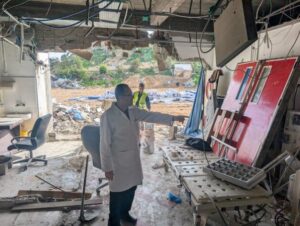
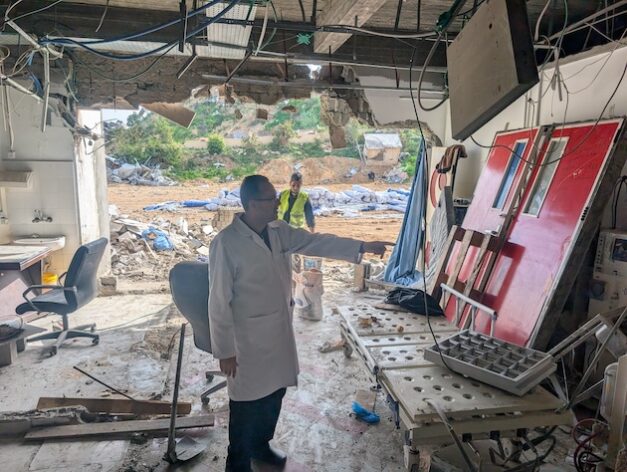
Cardiologist Dr. Marwan Sultan, then Director of the Indonesian Hospital in north Gaza, in February 2025 showing damage to hospital equipment following an Israeli attack on the facility a few months prior. In July 2025, Dr. Sultan was killed in an Israeli strike on the apartment where he was sheltering with his family. Credit: PHR/GHRC

Cardiologist Dr. Marwan Sultan, then Director of the Indonesian Hospital in north Gaza, in February 2025 showing damage to hospital equipment following an Israeli attack on the facility a few months prior. In July 2025, Dr. Sultan was killed in an Israeli strike on the apartment where he was sheltering with his family. Credit: PHR/GHRC

BRATISLAVA, Jan 14 2026 (IPS) – Israel must lift all restrictions on medicine, food and aid coming into Gaza, rights groups have demanded, as two reports released today (Jan 14) document how maternal and reproductive healthcare have been all but destroyed in the country.


In two separate reports released jointly, Physicians for Human Rights (with the Global Human Rights Clinic at the University of Chicago Law School) and Physicians for Human Rights–Israel (PHR-I) show how the war in Gaza has led to rising maternal and neonatal mortality, births under dangerous conditions, and the systematic destruction of health services for women in Gaza.

The reports from the two groups, which are independent organizations, provide both detailed clinical analysis of the collapse of Gaza’s health system and its medical consequences as well as firsthand testimonies from clinicians and pregnant and breastfeeding women in Gaza forced to live and care for their newborns in extreme conditions.

And the organizations say that with conditions improving only marginally for many women despite the current ceasefire, Israel must roll back restrictions placed on aid and immediately help ensure people in Gaza get access to the healthcare they need.

Israel’s destruction of Gaza’s health infrastructure, combined with untreated malnutrition resulting from restrictions on food and medical supplies, including baby formula, has created an environment in which the fundamental biological processes of reproduction and survival have been systematically destroyed, resulting in known and foreseeable harm, pain, suffering, and death,” Sam Zarifi, Physicians for Human Rights (PHR) Executive Director, said.

“Israel must immediately allow food and essential medical material to enter Gaza with a proper medical plan for helping the besieged population,” he added.

Israeli military operations following Hamas’s attack on Israel on October 7, 2023, have left massive destruction across Gaza, including to healthcare facilities. According to UNICEF, 94 percent of hospitals have been damaged or destroyed.
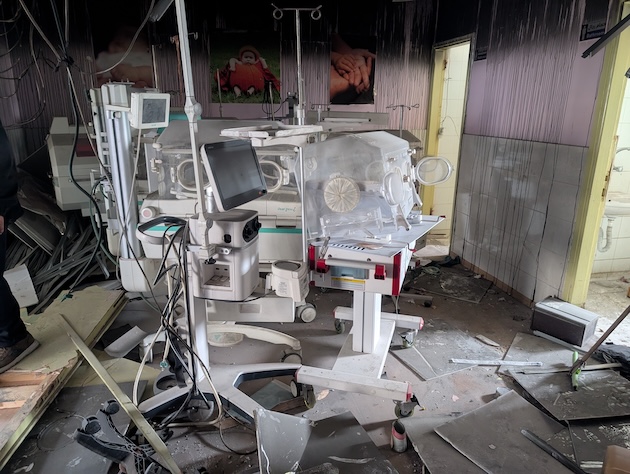
1.Destroyed incubators and equipment at the Kamal Adwan Hospital Neonatal Intensive Care Unit in north Gaza, following the targeting and raid of the facility by the Israeli forces in December 2024. Credit: PHR/GHRC

Destroyed incubators and equipment at the Kamal Adwan Hospital Neonatal Intensive Care Unit in north Gaza, following the targeting and raid of the facility by the Israeli forces in December 2024. Credit: PHR/GHRC

Maternal and reproductive healthcare has suffered. Before the war, Gaza had eight neonatal intensive care units with 178 incubators. Today, the number of incubators has dropped by 70 percent. In the north, there were 105 incubators across three NICUs, now there are barely any functional units remaining, UNICEF told IPS.

It says that the numbers of low birth weight babies have nearly tripled compared to pre-war levels and the number of first-day deaths of babies increased by 75 percent.

The PHR and PHR-I reports paint a similar picture.

The PHR report, which focuses on the period between January 2025 and October 2025 when a ceasefire was agreed, details how between May and June last year, the Palestinian Ministry of Health reported a 41 percent decrease in the birth rate in Gaza compared to the same time period in 2022; there was a significant increase in miscarriages that affected more than 2,600 women, and 220 pregnancy-related deaths that occurred before delivery.

The ministry also reported a sharp increase in premature births and low birth weight cases; over 1,460 babies were reported to be born prematurely, while more than 2,500 were admitted to neonatal intensive care. Newborn deaths also increased, with at least 21 babies reported to have died on their first day of life.

Meanwhile, the PHR-I report includes personal testimonies illustrating the severe problems pregnant women and women with newborns have faced in Gaza during the war, from lacking safe routes to care and being forced to give birth in unsanitary, dangerous conditions to battling hunger and severe food shortages as they try to breastfeed their children.

One woman, Samah Muhammad Abu Mustafa, a 30-year-old mother of two from Khuza’a, Khan Youni, described how when her contractions began in the middle of the night, because there were no vehicles and very few ambulances, which are reserved for shelling or other critical emergencies, she had to walk a long distance through rain. When she eventually reached the hospital, she said it was “horrifying.”

“I swear, one woman gave birth in the corridor, and her baby died. It was very crowded, and the doctors worked nonstop. I felt as though I could give birth at any moment. After giving birth to my eldest daughter, I was told I should not deliver naturally again because my pelvis was too narrow. Despite this, the doctors said I would have to deliver naturally because a cesarean section required anesthesia, and there was not enough available. I stood for three hours until it was finally my turn, without sitting even for a moment,” she said.

But despite the October 2025 ceasefire, massive problems remain with women’s access to and the provision of, maternal and reproductive healthcare in Gaza.

“Maternal health units in Gaza are largely non-functional and face critical shortages of essential medicines, consumables, and equipment,” Lama Bakri, project coordinator in the Occupied Territories Department at PHR-I, told IPS.

“Neonatal and diagnostic equipment remains scarce or blocked, including portable incubators for premature and low-birth-weight newborns. Although some aid has entered since the ceasefire, these gaps are not being addressed at the scale required, and meaningful improvement in the immediate future remains unlikely.”

Malnutrition also remains a serious problem.

“The ceasefire has allowed us to significantly scale up our nutrition response, but we are still treating pregnant and breastfeeding women for acute malnutrition in alarmingly high numbers,” Ricardo Pires, Communication Manager, Division of Global Communications & Advocacy at UNICEF, told IPS.

He said that between July and September 2025 about 38 percent of pregnant women screened were diagnosed with acute malnutrition.

“In October alone, we admitted 8,300 pregnant and breastfeeding women for treatment, about 270 a day, in a place where there was no discernible malnutrition among this group before October 2023,” he added.

UNICEF has documented almost 6,800 children admitted for acute malnutrition treatment in November 2025 compared to 4,700 cases in November 2024. So far, the number of admitted cases more than doubled in 2025 compared to 2024: almost 89,000 admissions of children to date in 2025, compared to 40,000 cases in 2024, and almost none before 2023.

“What we’re seeing is that no child meets minimum dietary diversity standards, and two-thirds of children are surviving on just two food groups or less. Around 90 percent of caregivers reported their children had been sick in the previous two weeks, which compounds the malnutrition crisis,” Pires said.

And there are fears for the longer-term demographic future of Gaza given the damage to maternal and reproductive healthcare.

“For Gaza’s demographic future, the implications are serious. Even with reconstruction, we will be dealing with a generation of children who were scarred before they took their first breath, children who may face lifelong health complications, developmental challenges, and the effects of stunting. The rebuilding must start now, but we should be clear-eyed: the damage to maternal and newborn health will echo for years, potentially decades,” said Pires.

But others say that with cooperation between international actors and the right political will, the situation need not remain so dire.

“To rehabilitate the population after everything that has happened is going to be a real issue, [but] now there is a Board of Peace, the needs of pregnant women and maternal and reproductive healthcare can be prioritized,” Zarifi told IPS.

“The capacity and the will exist among Gazans and Gazan healthcare workers to rebuild the healthcare system, including maternal and reproductive health services,” added Bakri. “The primary obstacle is not technical or professional but political: Israel’s control over Gaza’s borders and the restrictions on the entry of essential equipment, medical supplies, and reconstruction materials. With unrestricted access to what is needed to rehabilitate hospitals, rebuild destroyed units, and restock essential medicines, recovery is entirely feasible. Whether maternal and reproductive healthcare can return to pre-war levels depends on sustained international pressure to allow that access.”

Although some aid has entered since the ceasefire, these gaps are not being addressed at the scale required, and meaningful improvement in the immediate future remains unlikely.

However, while both NGOs like PHR and PHR-I and others, alongside international bodies like the UN, stress that any recovery and reconstruction in Gaza requires the ceasefire to hold and consolidate, repeated violations underline its fragility, and the effect that has on women.

Meanwhile, PHR and PHR-I point out that extreme weather and ongoing Israeli restrictions on medicine and food getting to Gaza to this day continue to severely affect pregnant women, new mothers, and babies. On top of this, Israel has also announced it will bar 37 international aid groups from working in Gaza, potentially compounding the problems.

Bakri said such measures were jeopardizing what small gains had been made since the ceasefire and “raise serious concerns about whether the situation can improve.”

“Even after the ceasefire, while bombardment has decreased, the reality these women face remains catastrophic – not only for their bodies and well-being but for the survival of the entire society,” said Bakri.

Zarifi added, “We are worried that the restrictions placed by Israel on some of the major actors in the humanitarian response will hamper access to assistance for those that need it. We have raised questions with the Israeli government as to why specific medicines are not allowed to be brought into Gaza and they say that they are not stopping them from being brought in but they can be brought in by commercial means. That is hard for people who can barely put any money together. These medicines should definitely be coming in through humanitarian channels.”

He also highlighted how important the issue of accountability is in ensuring any progress is made in rebuilding healthcare in Gaza and also limiting the probability of similar devastation in the future.

Both reports concluded that the harms caused by Israeli attacks are not isolated incidents but part of an ongoing pattern of systematic damage to the health of women and their children in Gaza, amounting to reproductive violence.

Israel has denied this and said that attacks on hospitals in Gaza have been because the medical facilities are being used by Hamas, and it has maintained that its forces adhere to international law.

While under international law healthcare facilities have special protection even in war, and attacks on them are prohibited, that protection is lost if they are deemed to fulfill criteria to be considered military objectives, such as housing militaries and arms.

However, any attack on them must still comply with the fundamental principles of distinction, proportionality and precautions in attack and failure to respect any of these principles constitutes a breach of international humanitarian law, according to the UN.

“These attacks are part of a deliberate policy designed to create a domino effect of suffering. From starvation and militarized aid distribution by the GHF, to lack of access to clean water, repeated displacement orders, living in shelters under continuous bombardment, and exposure to infections, disease, and harsh weather, the attacks on maternal and reproductive healthcare are another piece of this puzzle. Together, these conditions were created to systematically destroy the fabric of life in Gaza and reduce the population’s ability to survive,” said Bakri.

“The Israeli government has justified attacks on healthcare facilities by saying this was a problem caused by Hamas. We haven’t had an indication of this but it might be true. But in any case there has to be an investigation of these incidents and we hope the Israeli government will carry out such an investigation,” said Zarifi.

“But what is really alarming to us is that the norms prohibiting attacks on healthcare have been repeatedly violated, and there are also laws governing the protection of women and children that appear to have been violated. The only thing that makes these norms work is accountability. There has to be accountability for what happened, as it is the only way we can ensure that what has happened won’t happen in other conflicts. Impunity is watched by other actors around the world,” he added.

IPS UN Bureau Report

  Source

Excluding Food Systems From Climate Deal Is a Recipe for Disaster

Africa, Climate Change, Climate Change Justice, Conferences, COP30, Development & Aid, Editors’ Choice, Featured, Food and Agriculture, Food Systems, Global, Headlines, Latin America & the Caribbean, Population, Sustainable Development Goals, TerraViva United Nations | Analysis

Food Systems


Food solutions were on display everywhere around COP30—from the 80 tonnes of local and agroecological meals served to concrete proposals for tackling hunger—but none of this made it into the negotiating rooms or the final agreement. —Elisabetta Recine, IPES-Food panel expert

Agriculture is both a challenge and a solution for climate change. Busani Bafana/IPS

Agriculture is both a challenge and a solution for climate change. Busani Bafana/IPS

BULAWAYO, Jan 9 2026 (IPS) – As they ate catered meals, COP30 negotiators had no appetite for fixing broken food systems, a major source of climate pollution, experts warn.


Food systems are the complete journey food takes—from the farm to fork—which means its growing, processing, distribution, trade and consumption and even the waste.

The International Panel of Experts on Sustainable Food Systems (IPES-Food) warns that the final COP30 agreement risks deepening climate and hunger crises.  It failed  to address global warming emissions from food systems and the escalating damages caused by fossil-fuel-dependent industrial agriculture.

Food appears only once in the negotiated text, as a narrow indicator on ‘climate resilient food production’ under the Global Goal on Adaptation, IPES-Food pointed out.

“There is no mention of food systems, no roadmap to tackle deforestation, and no recognition that industrial agriculture drives nearly 90 percent of forest loss worldwide,” noted the think tank, emphasizing that negotiators also weakened language in the Mitigation Work Programme from addressing the ‘drivers’ of deforestation to vague ‘challenges.’

IPES-Food argued that the omission of food systems in the COP30 agreement was in stark contrast to the summit itself, which was held in the heart of the Amazon. Thirty percent of all food served during COP30 came from agroecological family farmers and traditional communities, and concrete public policy proposals for a just transition of food systems were on full display, IPES-Food said.

By not supporting a transition to environmentally friendly and low-emission agriculture, the agreement has left the global food system—and the billions who depend on it—highly vulnerable to the very climate shocks it helps cause, experts said.

“Food solutions were on display everywhere around COP30—from the 80 tonnes of local and agroecological meals served to concrete proposals for tackling hunger—but none of this made it into the negotiating rooms or the final agreement,” said Elisabetta Recine, IPES-Food panel expert and president of the Brazilian National Food and Nutrition Security Council (Consea), in a statement.

“Despite all the talk, negotiators failed to act, and the lived realities of people most affected by hunger, poverty, and climate shocks went unheard.”

Big Oil and Big Ag, Bigger voice

More than 300 industrial agriculture lobbyists were registered as delegates to COP30. They  are blamed for influencing discussions and promoting false solutions to climate change.

“COP30 was supposed to be the Implementation COP—where words turned into action,” Danielle Nierenberg, an expert on sustainable agriculture and food issues and President of Food Tank, told IPS. “But once again, corporate interests won over people, nature, and the future of our food and agriculture systems as part of the solution to the climate crisis.”

Raj Patel, IPES-Food panel expert and professor at the University of Texas, argues that agribusiness lobbyists captured COP30 to influence outcomes favoring industrial agriculture and big oil interests.

“Food systems are second only to oil and gas as a driver of the climate crisis, and unlike oil wells, they are also the first victim of the chaos they create, Patel noted.

Obstacles and Opportunities

Scientists have warned that carbon emissions, including those from agriculture, must be cut considerably if the world is to meet the goals of the Paris Agreement to limit global warming to 2°C or less.

Even if fossil fuel emissions were eliminated immediately, emissions from the global food system alone would make it impossible to limit warming to 1.5°C and difficult even to realize the 2°C target, scientists have said.

Selorm Kugbega, a Research Fellow at the Stockholm Environment Institute, agrees that despite many promises made to tackle agriculture-linked emissions, COP30 turned out to be a damp squib for agrifood systems.

Initiatives such as RAIZ to restore 500 million hectares of degraded agricultural land by 2030 and TERRA to scale out climate solutions for smallholder farmers through blended finance, which were launched at COP30 omitted to highlight the effects of industrial food systems. Over 300 industrial agriculture lobbyists participated in discussions at COP30, leading to accusations of swaying the outcomes.

Analysts warn the final agreement at COP30 in Belém, Brazil, risks deepening climate and hunger crises. Credit: Raimundo Pacco/COP30

Analysts warn the final agreement at COP30 in Belém, Brazil, risks deepening climate and hunger crises. Credit: Raimundo Pacco/COP30

Kugbega observed that after several years of slow progress and momentum in integrating food systems in climate negotiations, COP30 should have been the opportunity to seal agriculture’s centrality in future COPs. However, it ended with no clear agreements on grant-based public finance for adaptation in agriculture or redirection of public funds that subsidize industrial systems.

The climate negotiations demonstrated power inequality in climate negotiations with the implicit protection of industrial agriculture interests, which weakened the credibility of any global efforts at mitigating agriculture-based emissions, Kugbega observed, highlighting that smallholders bear a high burden of climate risks and have little adaptation financing.

Kugbega argued the most powerful countries, which are generally less dependent on agriculture, tend to prioritize sectors such as energy and transport in climate negotiations. However, many least developed countries, particularly in Africa, are highly dependent on agriculture for employment and economic stability and face urgent climate risks.

“Yet these countries often lack the political influence to elevate agriculture and food systems as central issues in COP negotiations,” he said. “COP30 in Brazil presented a major opportunity to shift this imbalance, making the failure to position food systems at the center of the climate agenda particularly troubling.”

Frugal Financing for Food and Farmers

According to the Climate Policy Initiative (CPI) and the UN’s Standing Committee on Finance, agriculture receives a small and insufficient share of total global climate finance.

Of the available approximate total global climate finance of USD 1.3 trillion per year on average, agriculture gets around USD 35 billion per year. This is a huge shortfall given that food systems are estimated to be responsible for roughly one-third of global greenhouse gas emissions and are one of the sectors most vulnerable to climate impacts, according to the CPI. Worse still, smallholder farmers, who produce up to 80 percent of food in developing countries, only receive 0.3 percent—a striking imbalance, yet they feed the world and are more exposed to climate impacts.

Will COP31 Deliver?

While COP30 highlighted the need to tackle climate change impacts through the transformation of food systems, such as highlighted in the Belém Declaration on Hunger, Poverty and Human-Centered Climate Action, it remains to be seen if COP31 will deliver a positive outcome on food systems.

Waiting for COP31 to save the world is surrendering because agribusiness lobbyists do not take holidays, argues IPES-Food panel’s Raj Patel.

“The test is not whether diplomats can craft better language in Antalya, but whether farmers’ movements, indigenous movements, and climate movements can generate enough political pressure to make governments fear inaction more than they fear confronting corporate power,” he said.

COP31, to be  hosted by Turkey with Australia as negotiations president in 2026 , is expected to prioritize an action agenda centered on adaptation finance, fossil fuel phase-out, adaptation in Small Island Developing States, and oceans.

While this agenda aligns with broader climate justice goals, it means food systems risk becoming indirectly addressed rather than explicitly championed, Kugbega said.

Given the stalled negotiations on financing sustainable agriculture transitions and the postponement of the Sharm el-Sheikh Joint Work on Agriculture, Kugbega said COP31 will likely focus more on developing new roadmaps and agreements than on full-scale implementation.

COP32 could be a greater opportunity for the implementation of the work program under Ethiopia’s COP32 presidency, given the country’s direct exposure to climate risks in agriculture, he noted.

“COP31 will likely shape whether the world arrives at COP32 ready to implement and operationalize sustainable food systems or once again be forced to renegotiate what is already known.”

This feature is published with the support of Open Society Foundations.

IPS UN Bureau Report


Bombing and Ballots, Myanmar’s Contentious Election

Armed Conflicts, Asia-Pacific, Civil Society, Crime & Justice, Democracy, Editors’ Choice, Featured, Freedom of Expression, Headlines, Human Rights, Press Freedom, TerraViva United Nations

Human Rights

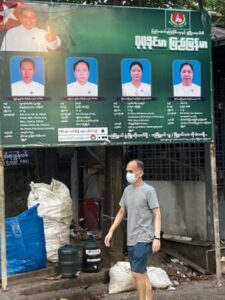
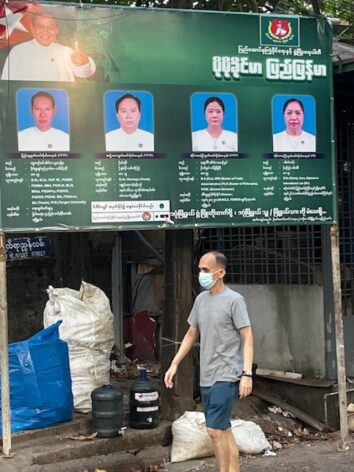
A man walks past a campaign poster for the military’s proxy party USDP ahead of strictly controlled elections in Myanmar. Credit: Guy Dinmore/IPS

A man walks past a campaign poster for the military’s proxy party USDP ahead of strictly controlled elections in Myanmar. Credit: Guy Dinmore/IPS

YANGON, Myanmar and BANGKOK , Jan 6 2026 (IPS) – With thousands of civilians killed in years of civil war and over 22,000 political prisoners still behind bars, no one was surprised that early results from Myanmar’s first but tightly controlled elections since the 2021 coup show the military’s proxy party speeding to victory.


“How can you hold elections and bomb civilians at the same time?” asked Khin Ohmar, a civil rights activist outside Myanmar who is monitoring what the resistance forces and a shadow government reject as “sham” polls.

The junta had already cleared the path towards its stated goal of a “genuine, disciplined multi-party democratic system” by dissolving some 40 parties that refused to register for polls, which they regard as illegitimate, with their leaders and supporters still in prison.

These include the National League for Democracy (NLD) and its leader, Aung San Suu Kyi, who won a landslide second term  in the 2020 elections – only for the results to be annulled by Senior General Min Aung Hlaing, a coup leader and self-appointed acting president. Mass street protests were crushed in early 2021 and war spread across Myanmar.

Although these elections will deliver just a façade of the legitimacy craved by some of the generals, they did succeed in projecting a power and authority that was quickly slipping away just two years ago as long-standing ethnic armed groups and newly formed People’s Defence Forces (PDFs) inflicted a series of humiliating defeats on the junta.

“The tide has turned in favour of the military,” commented a veteran Myanmar analyst in Yangon, crediting China, which reined in the ethnic groups on its shared border, fully embraced Min Aung Hlaing and, along with Russia, delivered the arms, technology and training needed to peg back the resistance.

Campaigners for the pro-military USDP canvas residents and check voters lists in Yangon ahead of the December 28 parliamentary election that excluded major anti-junta parties. Credit: Guy Dinmore/IPS

Campaigners for the pro-military USDP canvas residents and check voters lists in Yangon ahead of the December 28 parliamentary election that excluded major anti-junta parties. Credit: Guy Dinmore/IPS

The regime’s air power and newly acquired drones have been deployed to ruthless effect, often hitting civilian targets in relatively remote areas where the resistance has grassroots support. Air strikes were stepped up as the elections approached. Major cities like Yangon were calm; people subdued.

Bombs dropped on Tabayin township in the Sagaing Region on December 5 killed 18 people, including many in a busy tea shop, AFP reported. On December 10, air strikes on a hospital in the ancient capital of Mrauk-U in Rakhine State were reported to have killed 10 patients and 23 others. The regime accused the insurgent Arakan Army and PDFs of using it as a base.

“I don’t think that anyone believes that those elections will be free and fair,” UN Secretary General Antonio Guterres stated while visiting the region ahead of the polls. He called on the junta to end its “deplorable” violence and find “a credible path” back to civilian rule.

In contrast, the Trump administration declared in November that the junta’s election plans were “free and fair” and removed Temporary Protected Status from Myanmar refugees in the US, saying their country was safe for them to return to.

“I’ll be jailed if I don’t vote,” said Min, a Yangon taxi driver, only half-joking on the eve of voting in Yangon, the commercial capital. “And what difference does it make? We are ruled by China and Xi Jinping, not Min Aung Hlaing,” he added.

With the polls spread over three stages, the first 102 townships voted on December 28. Others will follow on January 11 and January 25 to make a total of 265 of Myanmar’s 330 townships scheduled to vote for the bicameral national parliament and assemblies in the 14 regions and states.

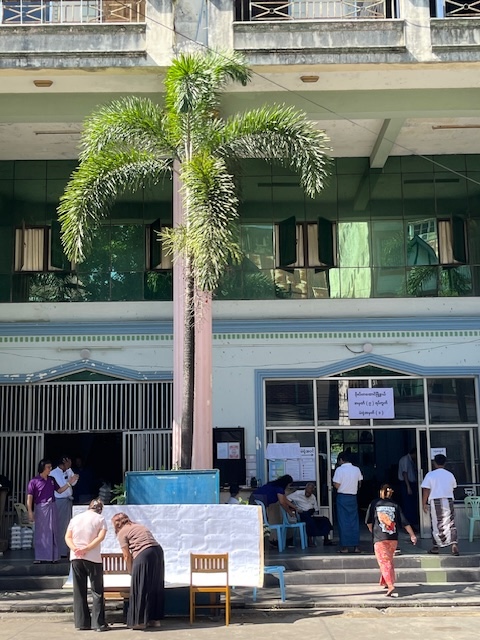
Residents in downtown Yangon check their names on the electoral register and then cast their votes in a polling station on December 28. Credit: Guy Dinmore/IPS

Residents in downtown Yangon check their names on the electoral register and then cast their votes in a polling station on December 28. Credit: Guy Dinmore/IPS

No voting is to be held at all in the remaining 65 townships that the election commission deemed too unsafe.

Voting in the first round in Yangon, an urban and semi-rural sprawl of seven million people, proceeded calmly and slowly on a quiet Sunday – despite intense efforts, and sometimes threats, by the regime to boost the turnout.

In 2020 and 2015 – when Myanmar arguably held the region’s most open and fair elections and the military’s proxy Union Solidarity and Development Party (USDP), was soundly defeated – people gaily posted images of their ink-stained little fingers on social media as evidence of their vote after weeks of packed rallies and vibrant campaign rallies.

But not this time. Social media posts hurled insults, some comic and vulgar, at the regime. Those eager to support the resistance’s boycott but who were afraid of reprisals were relieved if they found their names had been omitted by mistake on electoral lists. Electronic voting machines in use for the first time made it impossible to leave a blank.

But as in past elections, a solid core of people close to the military and its web of powerful economic interests turned out to vote for the USDP.

“We are choosing our government,” declared one man exiting a polling station in central Yangon with his family, apparently USDP supporters. One proudly waved his little finger dipped in indelible ink.

How can you hold elections and bomb civilians at the same time? – Khin Ohmar, civil rights activist

Turnout for the first round was put by regime officials at 52 percent. This compares with about 70 percent in the past two elections. China’s special envoy – sent as an official observer, along with others from Russia, Belarus, Vietnam and Cambodia – praised the elections.

On January 2, the election commission unexpectedly issued partial results: the USDP, led by retired generals, had won 38 of 40 seats in the lower house where votes had been tallied to date. No one blinked.

The USDP campaign message focused on two main elements – get out and vote with all your family, and back a USDP government to restore stability and progress to Myanmar.

Its underlying message was a reminder that the last USDP administration, led by President Thein Sein introduced socio-economic and political reforms and ceasefire negotiations with ethnic groups after securing a large majority in the 2010 elections when the NLD and other opposition groups were also absent.

Aung San Suu Kyi, then under house arrest, was released just after the 2010 polls and went on to contest and win a seat in a 2012 by-election ahead of the NLD’s own sweeping victory in 2015. Aung San Suu Kyi governed in a difficult power-sharing arrangement with the military for the next five years and was thrown back into prison in the coup.

For now a large proportion of Myanmar’s population lives in areas under junta control, including all 14 of the state and regional capitals, swollen by an influx of people fleeing conflict.  The military also holds major seaports and airports and – to varying degrees – the main border crossings for China and Thailand.

But in terms of territory, over half of Myanmar is in the hands of disparate ethnic armed groups and resistance forces. Alliances are fluid and negotiable.

The shadow National Unity Government is trying to establish its own authority over liberated territory, looking to cement a consensus around the concept of a democratic and federal Myanmar free of the military’s interference – something that has eluded the country since independence from British colonial rule in 1948.

Front lines shift back and forth as the military struggles to regain control over the Bamar heartlands of central Myanmar, once considered their bastion, while stretched elsewhere after losing vast tracts of border areas since the coup. Several million people have fled the country or are internally displaced.

Once again there is some speculation that a “smooth” election and the formation of a USDP government in April will lead to a gesture signalling the military’s confidence, such as a possible ending of forced conscription and the release of some political prisoners. Project power, then collect legitimacy.

“Political prisoners are used as bait,” said Khin Ohmar, the civil rights activist in Bangkok. “The world would at least have to applaud.”

IPS UN Bureau Report

  Source

When Democracy Freezes, Autocrats Rise

Civil Society, Democracy, Economy & Trade, Editors’ Choice, Global, Headlines, Human Rights, IPS UN: Inside the Glasshouse, TerraViva United Nations

Opinion

When Democracy Freezes, Autocrats Rise

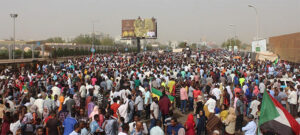
Pro-Democracy protesters gather in front of the headquarters of the Sudanese army in the capital, Khartoum. Credit: Masarib/Ahmed Bahhar via UN News

VIENNA, Austria, Jan 5 2026 (IPS) – Consider our political systems not merely as battlegrounds of passions, ideologies and economic interests, but as systematically functioning arrangements of interactions, akin to game theory. In recent decades, we have witnessed the dissolution of large homogeneous groups into numerous subgroups — a patchwork of minorities.


This fragmentation, compounded by individualisation and the resulting weakening of strong political bonds, has profound consequences for democratic governance.

In nations with majority voting systems, this process fragments the party system itself. As dissatisfaction with political parties grows – initially quietly but eventually becoming pronounced – new parties emerge, further splintering the political landscape.

This increasing fragmentation complicates government formation and makes majorities more precarious. Often, only coalitions that can agree on the lowest common denominator are formed. Consequently, the outcomes of politics do not necessarily improve; in most cases, they worsen.

A vicious circle

Decisive action, bold moves and clear leadership have become increasingly elusive. This reinforces dissatisfaction and the prevailing sentiment among voters that politicians are failing to achieve meaningful results. Doubts about the effectiveness of the political system become self-perpetuating, creating a situation where decisive politics is nearly impossible.

The rise of populists and right-wing extremists is both a consequence of this stagnation and a further catalyst — a ratchet effect. Right-wing agitators stoke discontent, transforming it into anger and outrage while exploiting negative emotions.

As they gain strength, democratic politics becomes more paralysed, often preoccupied with defending against radicalism, preventing the worst outcomes, and forming coalitions whose members can agree on little more than a lacklustre commitment to ‘more of the same’.

When social cohesion erodes, the radical right gains ground — which then leads to even more division. The perceived polarisation and alienation that accompanies the rise of right-wing extremism increases the perception of social disintegration and decay.

Democracy gives rise to its own threats

In a sense, right-wing radicalism is itself the problem that it then laments in a subsequent cycle. It is the disintegration that it denounces. In this way, it contributes to the chain of evidence that reinforces authoritarian reflexes. Authoritarianism feeds authoritarianism.

These framework conditions of political systems – fragmentation and the resulting weakness of action – lead German democracy theorist Veith Selk to diagnose that modernisation and social change are increasingly putting democracy under stress, making a reversal unlikely.

This presents a rather depressing diagnosis of decline: democracy gives rise to its own threats.

Additionally, globalisation necessitates ‘global governance’, which, even under favourable circumstances, has historically produced solutions at an unbearably slow pace and is now reaching its limits amid chaotic multilateralism.

Conversely, ‘de-globalisation’ – through national power politics, tariffs and trade wars – provides no relief and instead creates new problems, such as the loss of sales markets, disrupted supply chains and a consequent decline in economic growth, potentially destroying whole economic sectors.

Europe’s mounting crises

The emergencies of the future are already on the horizon. The climate catastrophe threatens not only our livelihoods but also has tangible economic repercussions. Crop failures due to droughts and floods are already contributing to rising inflation in the cost of living, particularly for vegetables and fruit.

This situation is certain to become much more severe. Even if successful, socio-economic transformation will be costly. Insurance companies may face financial difficulties, asset portfolios could lose value rapidly, and if we are unfortunate, a sudden ‘Minsky moment’ could trigger a downward spiral leading to a financial crisis.

Ageing populations are already straining public finances, with healthcare and care systems becoming increasingly expensive, pushing European welfare states to their financial limits.

Government debt is rising, and under current conditions, it will be more challenging to “grow out” of debt than it was in the past. Growth will be harder to mobilise, and austerity is not a viable alternative, as contraction strategies lead to dire consequences. These are all concerning prospects.

Here are a few highlights:

Germany’s economy has stagnated for six years, and private investment remains weak. France is facing a budget deficit of 5.8 per cent and a public debt ratio of 113 per cent of GDP, while sliding from one government crisis to another. Political actors are unable to achieve a socially just change of course that would reconcile savings in the pension system with additional revenue from wealth taxes.

Austria was projected to have a budget deficit of six per cent, prompting left-wing Keynesian Finance Minister Markus Marterbauer to assemble a package of tightening measures aimed at reducing the deficit to 4.5 per cent by 2025.

Ensuring that large fortunes contribute to costs through higher taxation is not only a matter of fairness but also an economic necessity — yet there is a lack of parliamentary majorities for decisive measures nearly everywhere.

There is a growing desire for politics to provide sensible solutions instead of getting bogged down in petty details.

A whole panorama of emergencies is unfolding before us. As noted earlier, most of those in power have little energy or flexibility to think and act beyond daily problems. This situation has tangible and psychopolitical effects: citizens feel that things are deteriorating and that serious trouble is brewing, while simultaneously sensing that those in power are merely tinkering with details.

For many, this leads to outright fear and a generally pessimistic mood, which in turn fuels the rise of right-wing radicals.

The political forces of the left and the conservative centre must, above all, demonstrate their ability to act together. A few years ago, the prevailing view was that various political camps should dare to engage in more conflict to make democratic life more vibrant.

At that time, there were complaints about everyone crowding into the centre and becoming interchangeable. However, we find ourselves in a different situation today.

There is a growing desire for politics to provide sensible solutions instead of getting bogged down in petty details or wasting time on pointless culture wars. The left may need to acknowledge that states are reaching their financial limits, while conservatives must recognise that clientele politics, which ensures free rides for the super-wealthy, is no longer viable.
Urgent issues require swift action, and all of this comes at a high cost.

Rhetoric is no longer effective, and pandering to the extreme right leads nowhere. Conservatives, in particular, need to understand this, as they sometimes give the impression that they view fascists as merely slightly more radical conservatives (or conservatives as moderate fascists).

This perception is not only misguided; it also highlights a significant identity crisis within traditional conservatism. Fortunately, some are beginning to realise that authoritarianism is not a relative; it is the enemy. The best way to undermine it is to demonstrate a commitment to action.

Robert Misik is a writer and essayist. He publishes in many German-language newspapers and magazines, including Die Zeit and Die Tageszeitung.

This is from a joint publication by Social Europe and IPS Journal.

Source: International Politics and Society (IPS), Brussels, Belgium

IPS UN Bureau

  Source

Refugees Forced to Fill Gaps as Funding, Power and Legal Recognition Move Out of Reach

Active Citizens, Africa, Armed Conflicts, Asia-Pacific, Civil Society, Development & Aid, Disaster Management, Editors’ Choice, Featured, Global, Human Rights, Humanitarian Emergencies, Middle East & North Africa, Migration & Refugees, Sustainable Development Goals, TerraViva United Nations

Migration & Refugees

A new global synthesis report and refugee voices from East Africa and the Middle East warn that reductions in humanitarian footprints risks breaking the refugee protection system.

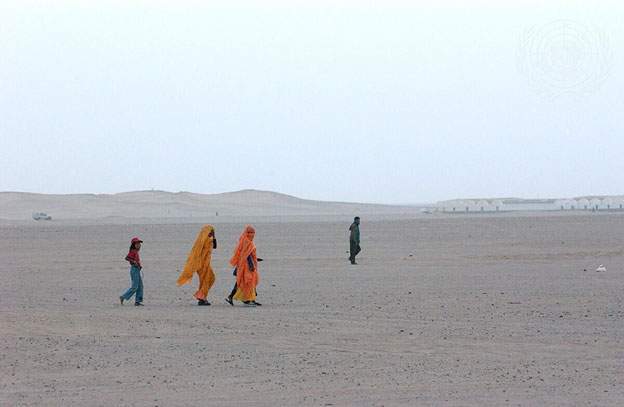
Sahrawi refugees walk near the Awserd Refugee Camp in the Tindouf Province of Algeria. Credit: UN Photo/Evan Schneider

Sahrawi refugees walk near the Awserd Refugee Camp in the Tindouf Province of Algeria. Credit: UN Photo/Evan Schneider

SRINAGAR, India, Dec 16 2025 (IPS) – The global refugee system is entering a period of deep strain. The delivery of protection and assistance is undergoing a transformation due to funding cuts, institutional reforms, and shifting donor priorities.


Against this backdrop, a new Global Synthesis Report titled From the Ground Up highlights the many issues faced by refugees in the Middle East and Africa.

Regional Perspectives on Advancing the Global Compact on Refugees has highlighted a rare, refugee-centered assessment of what is working, what is failing, and what must change. The report draws on regional roundtables held in East Africa and the Middle East and North Africa, followed by a global consultation in Geneva, to feed into the 2025 Global Refugee Forum progress review

According to the report, refugee-led and community-based organizations are increasingly taking on responsibilities, but they are not receiving power, funding, or legal recognition. As international agencies scale back under what is being called the Humanitarian Reset and UN80 reforms, refugees are expected to fill widening gaps without the authority or resources required to do so safely and sustainably.

The East Africa roundtables, held in Kampala with participation from refugee organizations in Uganda, Kenya, and Ethiopia, highlight a region often praised for progressive refugee policies. Countries here host millions displaced by conflict, hunger, and climate stress from South Sudan, Sudan, Somalia, and the Democratic Republic of the Congo.

Laws and regional frameworks promise freedom of movement, inclusion in national systems, and meaningful participation. The lived reality, however, remains uneven.

Education emerged as a central concern. Refugee children are enrolling in schools at higher rates, especially where they have been integrated into government-aided systems. Yet access remains unequal. Refugee students struggle to have prior qualifications recognized.

Many are treated as international students at universities and charged higher fees. Refugee teachers, often qualified and experienced, receive lower pay than nationals or are excluded from formal recognition. Language barriers and lack of psychosocial support further undermine learning outcomes. Refugee-led groups are already stepping in with mentorship, counseling, and bursary support, but they do so with fragile funding and limited reach.

Documentation and freedom of movement form another critical fault line. Uganda is widely cited for its rapid issuance of refugee IDs and settlement-based approach. Kenya and Ethiopia have made progress through new refugee laws and policy reforms. Still, gaps between policy and practice persist. Refugees in urban areas remain undocumented in large numbers. Identity documents often have short validity, forcing repeated renewals.

Travel documents are difficult to obtain, especially in Ethiopia, limiting cross-border movement, livelihoods, and participation in regional or global policy forums. Without documentation, refugees face arrest, harassment, and exclusion from services. For refugee organizations, lack of legal registration means operating in constant uncertainty.

Access to justice, described in the report as one of the least discussed yet most pivotal issues, cuts across all others. Refugees cannot claim rights or seek redress without functioning justice pathways. Language barriers in courts, xenophobic profiling, and lack of legal aid remain common.

Refugee-led organizations already provide mediation, paralegal support, and court accompaniment, often acting as the first point of contact between communities and authorities. Yet their work is rarely formalized or funded at scale.

These findings came alive during a webinar held at the launch of the report, where refugee leaders from different regions spoke directly about their experiences. One participant from East Africa reflected on repeated engagement in international forums. This event was his third such process, following meetings in Uganda and Gambia. He noted that participation was no longer symbolic. Governments and institutions were beginning to listen more closely.

He pointed to concrete differences across countries. In Kenya, refugees do not require exit visas. In Ethiopia, they do. Sharing such comparisons, he argued, helps governments rethink restrictive practices and adapt lessons from neighbors.

From the Middle East and North Africa, the discussion shifted to documentation and access to justice. A Jordan-based lawyer explained that civil documentation is not mere paperwork. It is the foundation of rights and accountability. Without birth registration, children cannot access education.

Without legally recognized marriages, women and children remain unprotected. Many Syrian refugees arrived in Jordan without documents, having lost them during flight or lacking legal awareness. Over time, Jordan introduced measures such as fee waivers, legal aid, and even Sharia courts inside camps like Zaatari to facilitate birth and marriage registration. Civil society groups have provided thousands of consultations and legal representations, bridging gaps between refugees and state systems.

The webinar also highlighted language as a structural barrier. In Jordan, Arabic serves as a common language for Syrians, easing communication. In East Africa, linguistic diversity complicates access to justice and services. Uganda hosts South Sudanese, Sudanese, and Congolese refugees, each with distinct languages, while official processes operate in English and Kiswahili. Governments have made efforts to provide interpretation, but gaps remain, particularly in courts and police interactions.

In Ethiopia, where Amharic dominates official institutions, refugee organizations often rely on founders or leaders who speak the language fluently, limiting broader participation.

As the conversation turned to the future of the humanitarian system, the tone grew more urgent. Participants acknowledged that funding cuts have already halted programs and exposed vulnerabilities. One speaker stressed that legal aid and documentation cannot be seen as optional sectors.

Without sustained support, entire protection systems risk collapse. Empowerment, he argued, goes beyond providing lawyers. It means building refugees’ confidence and capacity to navigate legal systems themselves.

Another participant addressed donors and UN agencies directly. Localization, he said, will fail if refugee organizations are treated only as implementers of predesigned projects. Power must shift alongside responsibility.

Refugee organizations should help design programs, raise resources, and make decisions based on community priorities. Otherwise, localization becomes another layer of outsourcing rather than a genuine transfer of agency.

The speaker’s final intervention starkly highlighted the stakes involved. With funding shrinking and uncertainty growing, refugees may soon have no option but to rely on themselves. Investing in refugee-led organizations, the speaker said, is not a luxury. This represents the final line of hope for refugees on the ground.

The MENA roundtables echo many of these concerns but in a more restrictive political context. Civic space is tighter. Legal recognition for refugee organizations is often impossible or risky. In Jordan, refugees cannot legally register organizations. In Egypt, civil society laws limit advocacy.

In Türkiye, registration is technically possible but bureaucratically daunting. Despite this, refugee-led initiatives have multiplied, filling gaps in education, protection, and livelihoods as international actors retreat.

The report warns of a dangerous paradox. Localization is advancing by necessity, not design. International agencies withdraw. Local actors step in. Yet funding, decision-making, and protection remain centralized. Refugee organizations absorb risk without safeguards. Participation is often tokenistic. Refugees are present in meetings but absent from real influence.

IPS UN Bureau Report

  Source

Farmers Earn While Reviving Native Forests Through a Blockchain-Powered App

Africa, Biodiversity, Civil Society, Development & Aid, Economy & Trade, Editors’ Choice, Environment, Featured, Food and Agriculture, Food Systems, Gender, Green Economy, Sustainable Development Goals, Trade & Investment, Women & Economy

Africa Climate Wire

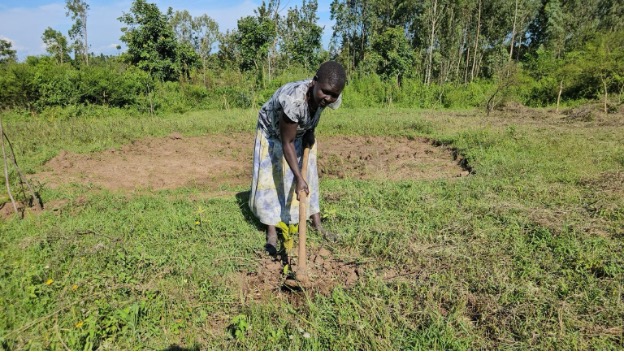
Caroline Awuor tends to tree seedlings on her farm in Siaya County, Western Kenya. She is a beneficiary of the My Farm Trees Project. Credit: Jackson Okata/IPS

Caroline Awuor tends to tree seedlings on her farm in Siaya County, Western Kenya. She is a beneficiary of the My Farm Trees Project. Credit: Jackson Okata/IPS

SIAYA, Kenya , Dec 8 2025 (IPS) – For years, Morris Onyango had been trying to reforest his degraded land on the shores of River Nzoia, in Siaya county, 430 kilometers from Kenya’s Capital, Nairobi. But every time he planted trees on his farm, his efforts bore little fruit, as floodwaters would not only wash away his tree seedlings but also fertile topsoil on his land.


“The land became unproductive and bare. I tried reclaiming the land through reforestation, but the trees’ survival rate was too low,” Onyango said.

Siaya County has a 5.23 percent forest cover and is ranked 44th out of Kenya’s 47 counties. Judy Ogeche, a scientist from the Kenya Forestry Research Institute (KEFRI), says that the compromised forest and tree cover in the county and the lack of any gazetted forests have discouraged the integration of tree and crop farming.

“Communities here do not see tree growing as a lucrative venture. Some myths and beliefs discourage tree growing. For example, some people believe that growing the Terminalia mentalis (often known as the Panga Uzazi) tree attracts death,” says Ogeche.

According to Ogeche, another challenge is gender inequality in land ownership, with men owning most available land and making decisions on what should be planted.

“We have many women interested in restoring tree cover, but their husbands would not allow it,” Ogeche said.

Across Africa, reforestation projects struggle to survive beyond the seedling stage. However, in parts of Kenya, a groundbreaking digital innovation is transforming the landscape by empowering rural farmers to earn a living while restoring degraded lands with native trees.

Tech and Reforestation

In a bid to restore lost biodiversity and enhance tree cover in Kenya, Alliance Bioversity International and CIAT, in partnership with the International Union for Conservation of Nature (IUCN), launched the My Farm Trees project, a blockchain-based platform that offers guidance to subsistence farmers on seed selection, planting, and post-plant care, ensuring that seedlings survive and thrive in harsh conditions.

Implemented in the counties of Siaya, Turkana and Laikipia, MFT emphasizes genetically robust native species that support biodiversity, improve soil health, and provide long-term ecological and economic benefits.

Ogeche observes that the My Farm Trees project has motivated communities in Siaya to grow trees.

“They are given free seedlings and taught how to plant and take care of them, and when the trees grow, they are paid,” she said.

To provide the right seedlings, the project is partnering with the Kenya Forestry Research Institute (KEFRI), the Kenya Forest Services (KFS) and private tree nursery operators in the respective counties.

For farmers like Onyango, the My Farm Trees Project gave them the much-needed solution to their degraded lands and soils

“The project gifted me 175 seedlings of various trees, which I planted along the riverbank. The trees have helped me reclaim my land, prevent erosion and get paid for taking care of my own trees,” Onyango says.

How it Works

In the My Farm Trees project, participating farmers are registered on the MyGeo Farm App, which allows them to monitor seedlings from planting to growing. Through the app, farmers can track and report progress.

Francis Oduor, the National Project Coordinator, says since its rollout, the project has seen over 1,300 farmers registered on the MyGeo Tree App, and over 100,000 seedlings have been planted across the three counties.

“The project is especially interested in using indigenous trees for landscape restoration, which are native to specific areas, and to enhance genetic diversity,” says Oduor.

Oduor explains that My Farm Trees uses monitoring, verification, and incentives to empower local communities to become leaders and stewards of tree-planting projects that provide immediate short-term benefits.

“The project does not just focus on payment to farmers but the long-term benefits of restored landscapes for improved agricultural productivity, water regulation, and climate resilience,” said Oduor.

To ensure the use of native varieties and guarantee the production of quality tree seedlings, the project team collaborates with KEFRI to provide technical assistance to local tree nursery operators.

Lawrence Ogoda, a tree nursery operator, is among the project beneficiaries. He has been trained on seed collection, raising seedlings and record keeping.

“Through the MyGeo Tree and MyGeo Nursery Apps, I can collect data and track progress on seed collection, propagation and development at the nurseries.”

Before joining the My Farm Trees project, Caroline Awuor had not given much attention to growing trees. She received 110 seedlings, 104 of which have successfully survived and are earning her cash incentives.

“Most of them are fruit trees, including mangoes, avocado and jackfruit, while there are also some timber trees. In addition to the incentives from the project, I also earn money by selling the fruit,” she says.

Caroline intends to plant an additional 1,000 tree seedlings on her land, strategically located near the River Nzoia.

According to Joshua Schneck, the Green Climate Fund (GCF) Portfolio Manager for Global Programs at IUCN, My Farm Trees is an innovative project driven towards sustainable transformation.

The Impact

In Kenya, My Farm Tree has supported 3,404 farmers, 56 percent of whom are women. A total of 210,520 trees have been planted, with a survival rate of over 60 percent beyond the first year, with 1,250 hectares of land being restored across Siaya, Turkana, and Laikipia counties.

The program has released KES 26 million (approximately USD 200,000) in digital payments, directly benefiting 1,517 farmers. Additionally, 13 local nurseries have been strengthened in partnership with the Kenya Forestry Research Institute.

Also implemented in Cameroon, the project has seen the restoration of 1,403 hectares of forest land with over 145,000 seedlings being planted and 2,200 farmers registered on the platform. The project has also seen the restoration of 423 community lands and 315 sacred forests, with USD 130,000 in incentives distributed to farmers.

Oduor noted that the My Farm Trees project offers a scalable blueprint for  forest restoration by combining science and Blockchain technology in tree selection, post-planting support, and farmer incentives, which gives it  global relevance.

“MFT is a scalable model that aligns with climate action, poverty reduction, and ecosystem recovery. This approach supports the goals of the Paris Agreement, the United Nations Convention to Combat Desertification, and the UN Decade on Ecosystem Restoration,” Oduor said.
IPS UN Bureau Report

  Source