Beware UN Food Systems Summit Trojan Horse

Civil Society, Development & Aid, Economy & Trade, Environment, Financial Crisis, Food & Agriculture, Food Security and Nutrition, Food Sustainability, Global, Green Economy, Headlines, Inequity, Poverty & SDGs, Sustainability, TerraViva United Nations

Opinion

KUALA LUMPUR, Malaysia, Jul 26 2021 (IPS) – Undoubtedly, the world needs to reform existing food systems to better serve humanity and sustainable development. But the United Nations World Food Systems Summit (UNFSS) must be consistent with UN-led multilateralism.

For the first time ever, the World Economic Forum (WEF), a partnership of some of the world’s most powerful corporations, is partnering the UN in launching the Summit, now scheduled for September, with its ‘Pre-Summit’ beginning today.


Jomo Kwame Sundaram

Food insecurity is primarily due to inequalities and deprivations as victims lack the means to obtain the food they need. The UN should not serve those who cynically use hunger, starvation and deprivation to advance private commercial interests.

UN-led multilateralism threatened
The collapse of the Soviet Union, the end of the Cold War and seemingly unchallenged US dominance in the 1990s posed new threats to UN-led multilateralism. The World Trade Organization was set up in 1995 outside the UN system. Later, ‘recalcitrant’ Secretary-General (SG) Boutros-Ghali was blocked from a second term.

The four UN Development Decades from the 1960s ended with the lofty, Secretariat-drafted Millennium Declaration, bypassing Member State involvement. The Millennium Development Goals (MDGs) were then elaborated by the UN Development Programme with scant Member State consultation.

Growing corporate sway in the UN system got a big boost with the UN Global Compact. Such influences have affected governance of UN agencies, now better known as the World Health Organization struggles to contain the pandemic.

Difficult negotiations followed growing developing country disappointment with the MDGs, not delivering on climate finance as promised in 2009, and failure to better address the 2008 global financial crisis and its aftermath.

Hence, the negotiated Sustainable Development Goals (SDGs) compromise enjoys greater legitimacy than the MDGs. However, achieving Agenda 2030 was undermined from the outset as rich countries blocked needed funding at the third UN Financing for Development summit in mid-2015.

Summit bypasses UN processes
In the last dozen years after the 2008 world food price spike, the UN Committee on World Food Security (CFS) has become an inclusive forum for civil society and corporate interests to debate how best to advance food security. Unsurprisingly, CFS has long addressed food systems.

CFS’s High-Level Panel of Experts (HLPE) is widely acknowledged as competent, having prepared balanced and comprehensive reports on matters of current and likely future concern. In the UN system, CFS is now seen as a ‘multistakeholder’ engagement model for emulation. Yet, the Summit bypassed CFS from the outset.

Nominally answering to the UNSG, Summit processes have been largely set by a small, largely unaccountable coterie. UNFSS organisers initially moved ahead without representative stakeholder participation until his intervention led to some consultative processes.

Mainly funded by the WEF and some major partners, they remain mindful of who pays the piper. Hence, they mainly promote supposedly ‘game-changing’, ‘scalable’ and investment-inducing solutions claiming to offer technological fixes.

Agroecology innovation
An HLPE report has approvingly considered agroecology or ‘nature-based solutions’. Many scientists have been working with food producers for decades to increase food productivity, output, diversity and resilience through better agroecological practices, thus cutting costs and enhancing sustainability.

The evidence is unambiguous that agroecology has delivered far better results than ‘Green Revolution’ innovations. A survey of almost 300 large ecological agriculture projects in more than fifty poor countries reported rising farmer incomes due to lower costs and a 79% average productivity increase.

This contrasts with the record of the Alliance for a Green Revolution in Africa (AGRA) launched in 2006. With funding from the Gates and Rockefeller Foundations, it promised to double yields and incomes for 30 million smallholder farm households by 2020. Despite much government spending, yields hardly rose as rural poverty grew.

Agroecological innovations have proved effective against infestations. Thus, safer, more effective biopesticides that do not kill useful insects and microbes, and non-toxic alternatives to agrochemical pesticides have been created.

The UN Food and Agriculture Organization (FAO) hosted its first International Agroecology Symposium in 2014, before committing to ‘Scaling Up Agroecology’. But for Kip Tom, President Trump’s representative, FAO was no longer “science-based”.

Demonising agroecology
The Gates Foundation has been funding the Cornell Alliance for Science, ostensibly to “depolarize the GMO debates” by providing training in “advanced agricultural biotechnology communications”. Why traditional agricultural practices can’t transform African agriculture is only one instance of such sponsored propaganda masquerading as science.

Well-resourced lobbyists are using the UNFSS to secure support and legitimacy for commercial agendas. With abundant means, their advocacy routinely invokes ‘public-private partnerships’ and ‘science, technology and innovation’ rhetoric.

Forced to be more inclusive, Summit organisers are now using ‘solution clusters’ for advocacy. They then build broad ‘multi-stakeholder’ coalitions to advance purported solutions with the UNFSS mark of approval.

With strong and growing evidence of agroecology’s progress and potential, propaganda against it has grown in recent years. Agroecology advocates are caricatured as ‘Luddite eco-imperialists’, ‘Keeping Africa on the Brink of Starvation’, and condemning farmers to ‘poverty, malnutrition and death’.

A public relations consultant has accused agroecology advocates of being “the face of a ‘green’ neocolonialism” “idealizing peasant labour and retrograde subsistence farming” and denying “the Green Revolution’s successes”.

Agroecology solutions are the main, if not only ones consistent with the UN’s overarching commitment to sustainable development. But the propagandists portray them as uninformed barriers to agricultural and social progress. Such deliberate deceptions block needed food system reforms.

UN Special Rapporteur on the Right to Food Michael Fakhri alerted UNFSS Special Envoy Agnes Kalibata that agroecology is being dismissed as backward when it should be central to the Summit. Concurrently President of AGRA, with its particular commitment to needed food system reform, she is in an impossible position.

Best Summit money can buy?
Investing in the Summit is securing legitimacy and more resources from governments, the UN system, private philanthropy and others to further their commercial agendas. Meanwhile, many are working in good faith to make the most of the UN Summit.

Nevertheless, it is setting a dangerous precedent for the UN system. It has rashly opened a back door, allowing corporate-led ‘multi-stakeholderism’ to undermine well-tested, inclusive ‘multi-stakeholder’ arrangements developed over decades under multilateral Member State oversight.

UNFSS Science Days on 8 and 9 July indicated the Summit is being used to push for a new food science panel. This will undercut the HLPE, and ultimately, the CFS. Hence, the UNFSS seems like a Trojan Horse to advance particular corporate interests, inadvertently undermining what UN-led multilateralism has come to mean.

As both CFS and HLPE are successful UN institutions, the Summit will inevitably undermine its own achievements. Hence, for many Member States and civil society, UNFSS represents a step backward, rather than forward.


  Source

Weaponizing Science in Global Food Policy

Civil Society, Food & Agriculture, Food Security and Nutrition, Food Sustainability, Global, Green Economy, Headlines, Human Rights, Indigenous Rights, Poverty & SDGs, TerraViva United Nations, Trade & Investment

Opinion

SANTA CRUZ, California, Jun 25 2021 (IPS) – In July, the United Nations will convene “Science Days”, a high-profile event in preparation for the UN Food Systems Summit later this year. Over the course of two days, the world will be treated to a parade of Zoom sessions aimed at “highlighting the centrality of science, technology and innovation for food systems transformation.”


Maywa Montenegro

Nobody disputes the need for urgent action to transform the food system. But the UNFSS has been criticized by human rights experts for its top-down and non-transparent organization. Indigenous peoples, peasants, and civil society groups around the world know their hard-won rights are under attack. Many are protesting the summit’s legitimacy and organizing counter-mobilizations.

Scientists are also contesting a summit because of its selective embrace of science, as seen in a boycott letter signed by nearly 300 academics, from Brazil to Italy to Japan.

Through the Summit, “science” has been weaponized by powerful actors not only to promote a technology-driven approach to food systems, but also to fragment global food security governance and create institutions more amenable to the demands of agribusiness.

Recipe for Elite Global Governance

The UNFSS was announced in 2019 by the UN Secretary General as part of the Decade of Action to achieve the Sustainable Development Goals by 2030. The announcement came just after the UN signed a strategic partnership with the World Economic Forum. It also elicited outcry from social movements when Agnes Kalibata, President of the Alliance for a Green Revolution in Africa, was chosen to lead the forum — a powerful signal of UNFSS allegiances.

The “multi-stakeholder” structure of the summit has raised concerns from observers who recognize the privatization of multilateral public governance it presages. While Kalibata describes the UNFSS as an inclusive “peoples’ summit,” more than 500 smallholder and peasant organizations signed a letter criticizing the summit’s multi-stakeholder platforms: “Instead of drawing from the innovative governance experiences that the UN system has to offer, the UN-WEF partnership is helping to establishing “stakeholder capitalism” as a governance model for the entire planet.”

Matthew Canfield

Through one lens, multistakeholderism looks like a set of “inclusive” practices: the summit has five Action Tracks (e.g. “Ensuring Access to Safe and Nutritious Food for All” and “Boosting Nature Positive Production at Sufficient Scale”), an endless number of “dialogues,” and an elaborate online forum where anyone can participate.

However, this profusion of spaces obscures the fact that the UNFSS has no built-in structures of accountability. This is particularly troublesome because, as UN special rapporteurs have observed, the summit’s process was pre-determined by a small set of actors: “The private sector, organizations serving the private sector (notably the World Economic Forum), scientists, and economists initiated the process. The table was set with their perspectives, knowledge, interests and biases.”

The scientific ideas shaping those parameters, then, should invite our curiosity and concern. What kinds of science are included — and excluded? What are the implications for the future of global food system governance?

Defining Science as Investment-Friendly Innovation

A new Scientific Group of the UNFSS, created to support a “science- and evidence-based summit,” provides some clues. In theory, the Scientific Group works to “ensure the robustness, breadth and independence of the science that underpins the summit and its outcomes.” In practice, the Group’s practices impoverish the scientific base on which the summit is meant to make policies.

Unlike existing global science advisory panels where experts are nominated through an inclusive and democratic process, the Scientific Group is handpicking experts amenable to “game-changing” solutions — access to gene-edited seeds, digital and data-driven technologies, and global commodity markets.

Alastair Iles

As a result, key areas of expertise, such as agroecology, Indigenous knowledge, and human rights are being excluded while industry and investor-friendly viewpoints are promoted as visionary.

While the Scientific Group appears at first to be diverse in terms of disciplines and geographies, it in fact reflects a set of overlapping, elite networks. Partners include well-worn institutional champions of the Green Revolution (the CGIAR), the central nervous system for “free trade” policy globally (the World Trade Organization), and a powerful consortium of wealthy nation-states (the Organisation for Economic Cooperation and Development), among others.

By drawing on these networks, the Scientific Group is serving as a gatekeeper for determining the meaning and boundaries of “science.” An analysis of its publications reveals critical flaws stemming from the Scientific Group’s narrow approach to scientific expertise. These include:

    • Science, technology, and innovation are uprooted from their political-economic and social conditions. As a result, structural drivers that produce hunger even as they generate wealth (e.g. for Bill Gates) are eclipsed in favor of boosting productivity with a twist of sustainability.
    • Biotechnology, Big Data, and global value chains are offered as the solution to all agronomic problems and the crisis of overfishing.
    • Multicultural “digital” inclusion is redeployed to promote Black, Brown, and Indigenous incorporation into an imperial model of Science, Technology, and Innovation. This ignores the rich knowledge these communities already hold — and obscures that Indigenous and agroecological knowledge cannot survive without land.

Science can and should play a role in global food governance. But far from the current UNFSS model, science can support in all its complexity and breadth, alongside many other expertises with equal rights to shape the future of food.

Maywa Montenegro works as an assistant professor of Environmental Studies at the University of California, Santa Cruz, specializing in politics of knowledge, biotechnology, and agroecology.

Matthew Canfield is an assistant professor of Law and Society & Law and Development at Leiden Law School specializing in human rights and global food governance.

Alastair Iles works as an associate professor at the University of California, Berkeley, researching agroecology policies and sustainability transitions.

  Source

CORRECTED VERSION: Struggle for the Future of Food

Civil Society, Climate Change, Economy & Trade, Environment, Featured, Food & Agriculture, Food Security and Nutrition, Food Sustainability, Global, Global Governance, Natural Resources, TerraViva United Nations

Opinion

KUALA LUMPUR, Malaysia, May 10 2021 (IPS) – Producers and consumers seem helpless as food all over the world comes under fast growing corporate control. Such changes have also been worsening environmental collapse, social dislocation and the human condition.


Longer term perspective
The recent joint report – by the International Panel of Experts on Sustainable Food Systems (IPES-Food) and the ETC Action Group on Erosion, Technology and Concentration – is ominous, to say the least.

Jomo Kwame Sundaram

A Long Food Movement, principally authored by Pat Mooney with a team including IPES-Food Director Nick Jacobs, analyses how food systems are likely to evolve over the next quarter century with technological and other changes.

The report notes that ‘hi-tech’, data processing and asset management corporations have joined established agribusinesses in reshaping world food supply chains.

If current trends continue, the food system will be increasingly controlled by large transnational corporations (TNCs) at the expense of billions of farmers and consumers.

Big Ag weds Big Data
The Davos World Economic Forum’s (WEF) much touted ‘Fourth Industrial Revolution’ (IR4.0), promoting digitisation, is transforming food systems, accelerating concentration in corporate hands.

New apps enable better tracking across supply chains, while ‘precision farming’ now includes using drones to spray pesticides on targeted crops, reducing inputs and, potentially, farming costs. Agriculture is now second only to the military in drone use.

Digital giants are working with other TNCs to extend enabling ‘cloud computing’ infrastructure. Spreading as quickly as the infrastructure allows, new ‘digital ag’ technologies have been displacing farm labour.

Meanwhile, food data have become more commercially valuable, e.g., to meet consumer demand, Big Ag profits have also grown by creating ‘new needs’. Big data are already being used to manipulate consumer preferences.

With the pandemic, e-retail and food delivery services have grown even faster. Thus, e-commerce platforms have quickly become the world’s top retailers.

New ‘digital ag’ technologies are also undermining diverse, ecologically more appropriate food agriculture in favour of unsustainable monocropping. The threat is great as family farms still feed more than two-thirds of the world’s population.

IR4.0 not benign
Meanwhile, hi-tech and asset management firms have acquired significant shareholdings in food giants. Powerful conglomerates are integrating different business lines, increasing concentration while invoking competition and ‘creative disruption’.

The IPES-ETC study highlights new threats to farming and food security as IR4.0 proponents exert increasing influence. The report warns that giving Big Ag the ‘keys of the food system’ worsens food insecurity and other existential threats.

Powerful corporations will increase control of most world food supplies. Big Ag controlled supply chains will also be more vulnerable as great power rivalry and competition continue to displace multilateral cooperation.

There is no alternative?
But the report also presents a more optimistic vision for the next quarter century. In this alternative scenario, collaborative efforts, from the grassroots to the global level, empower social movements and civil society to resist.

New technologies are part of this vision, from small-scale drones for field monitoring to consumer apps for food safety and nutrient verification. But they would be cooperatively owned, open access and well regulated.

The report includes pragmatic strategies to cut three quarters of agriculture’s greenhouse gas emissions and shift US$4 trillion from Big Ag to agroecology and food sovereignty. These include “$720 billion in subsidies” and “$1.6 trillion in healthcare savings” due to malnutrition.

IPES-ETC also recommends taxing junk food, toxins, carbon emissions and TNC profits. It also urges criminal prosecution of those responsible for famine, malnutrition and environmental degradation.

Food security protocols are needed to supercede trade and intellectual property law, and not only for emergencies. But with food systems under growing stress, Big Ag solutions have proved attractive to worried policymakers who see no other way out.

Last chance to change course
Historically, natural resources were commonly or publicly shared. Water and land have long been sustainably used by farmers, fisherfolk and pastoralists. But market value has grown with ‘property rights’, especially with corporate acquisition.

Touted as the best means to achieve food security, corporate investments in recent decades have instead undermined remaining ‘traditional’ agrarian ecosystems.

Big Ag claims that the food, ecological and climate crises has to be addressed with its superior new technologies harnessing the finance, entrepreneurship and innovation only they can offer.

But in fact, they have failed, instead triggering more problems in their pursuit of profit. As the new food system and corporate trends consolidate, it will become increasingly difficult to change course. Very timely, A Long Food Movement is an urgent call to action for the long haul.

Food systems summit
According to Marchmont Communications, “writing on behalf of the UN Food Systems Summit secretariat”, the “Summit was originally announced on 16 October 2019 by UN Secretary-General António Guterres and was conceived following conversations with the joint leadership of the three Rome-based United Nations agencies…at the High-level Political Forum in July 2019”.

On 12 June 2019, ‘Inspiration Speaker’ David Nabarro announced to the annual EAT Stockholm conference that a World Food Systems Summit (WFSS) would be held in 2021. The following day, a Memorandum of Understanding (MOU) was signed between the World Economic Forum (WEF) and the Office of the UN Secretary-General.

It stirred up so much controversy that the MOU was later removed from the website of the WEF, hardly reputed for its modesty. Unsurprisingly, many believe that the WEF “pressed the Summit onto a reluctant UN Secretary-General”, and can be traced to its Food Systems Initiative.

Apparently, initial arrangements had bypassed the Rome-based UN food agencies, the Food and Agriculture Organization, the International Fund for Agricultural Development and the World Food Programme. Their heads were then consulted and brought on board in July 2019.

With so much at stake, representatives of food producers and consumers need to act urgently to prevent governments from allowing a UN sanctioned corporate takeover of global governance of food systems.

  Source

Struggle for the Future of Food

Civil Society, Climate Change, Economy & Trade, Environment, Featured, Food & Agriculture, Food Security and Nutrition, Food Sustainability, Global, Global Governance, Natural Resources, TerraViva United Nations

Opinion

KUALA LUMPUR, Malaysia, Apr 27 2021 (IPS) – Producers and consumers seem helpless as food all over the world comes under fast growing corporate control. Such changes have also been worsening environmental collapse, social dislocation and the human condition.

Longer term perspective
The recent joint report – by the International Panel of Experts on Sustainable Food Systems (IPES-Food) and the ETC Action Group on Erosion, Technology and Concentration – is ominous, to say the least.


Jomo Kwame Sundaram

A Long Food Movement, principally authored by Pat Mooney with a team including IPES-Food Director Nick Jacobs, analyses how food systems are likely to evolve over the next quarter century with technological and other changes.

The report notes that ‘hi-tech’, data processing and asset management corporations have joined established agribusinesses in reshaping world food supply chains.

If current trends continue, the food system will be increasingly controlled by large transnational corporations (TNCs) at the expense of billions of farmers and consumers.

Big Ag weds Big Data
The Davos World Economic Forum’s (WEF) much touted ‘Fourth Industrial Revolution’ (IR4.0), promoting digitisation, is transforming food systems, accelerating concentration in corporate hands.

New apps enable better tracking across supply chains, while ‘precision farming’ now includes using drones to spray pesticides on targeted crops, reducing inputs and, potentially, farming costs. Agriculture is now second only to the military in drone use.

Digital giants are working with other TNCs to extend enabling ‘cloud computing’ infrastructure. Spreading as quickly as the infrastructure allows, new ‘digital ag’ technologies have been displacing farm labour.

Meanwhile, food data have become more commercially valuable, e.g., to meet consumer demand, Big Ag profits have also grown by creating ‘new needs’. Big data are already being used to manipulate consumer preferences.

With the pandemic, e-retail and food delivery services have grown even faster. Thus, e-commerce platforms have quickly become the world’s top retailers.

New ‘digital ag’ technologies are also undermining diverse, ecologically more appropriate food agriculture in favour of unsustainable monocropping. The threat is great as family farms still feed more than two-thirds of the world’s population.

IR4.0 not benign
Meanwhile, hi-tech and asset management firms have acquired significant shareholdings in food giants. Powerful conglomerates are integrating different business lines, increasing concentration while invoking competition and ‘creative disruption’.

The IPES-ETC study highlights new threats to farming and food security as IR4.0 proponents exert increasing influence. The report warns that giving Big Ag the ‘keys of the food system’ worsens food insecurity and other existential threats.

Powerful corporations will increase control of most world food supplies. Big Ag controlled supply chains will also be more vulnerable as great power rivalry and competition continue to displace multilateral cooperation.

There is no alternative?
But the report also presents a more optimistic vision for the next quarter century. In this alternative scenario, collaborative efforts, from the grassroots to the global level, empower social movements and civil society to resist.

New technologies are part of this vision, from small-scale drones for field monitoring to consumer apps for food safety and nutrient verification. But they would be cooperatively owned, open access and well regulated.

The report includes pragmatic strategies to cut three quarters of agriculture’s greenhouse gas emissions and shift US$4 trillion from Big Ag to agroecology and food sovereignty. These include “$720 billion in subsidies” and “$1.6 trillion in healthcare savings” due to malnutrition.

IPES-ETC also recommends taxing junk food, toxins, carbon emissions and TNC profits. It also urges criminal prosecution of those responsible for famine, malnutrition and environmental degradation.

Food security protocols are needed to supercede trade and intellectual property law, and not only for emergencies. But with food systems under growing stress, Big Ag solutions have proved attractive to worried policymakers who see no other way out.

Last chance to change course
Historically, natural resources were commonly or publicly shared. Water and land have long been sustainably used by farmers, fisherfolk and pastoralists. But market value has grown with ‘property rights’, especially with corporate acquisition.

Touted as the best means to achieve food security, corporate investments in recent decades have instead undermined remaining ‘traditional’ agrarian ecosystems.

Big Ag claims that the food, ecological and climate crises has to be addressed with its superior new technologies harnessing the finance, entrepreneurship and innovation only they can offer.

But in fact, they have failed, instead triggering more problems in their pursuit of profit. As the new food system and corporate trends consolidate, it will become increasingly difficult to change course.

Proposed by the WEF, the UN Secretary-General’s Food Systems Summit later this year clearly seeks to promote corporate ‘solutions’. Very timely, A Long Food Movement is an urgent call to action for the long haul.

With so much at stake, representatives of food producers and consumers need to act urgently to prevent governments from allowing a UN sanctioned corporate takeover of global governance of food systems.

  Source

The UN Food Systems Summit: How Not to Respond to the Urgency of Reform

Aid, Civil Society, Food & Agriculture, Food Security and Nutrition, Food Sustainability, Global, Headlines, Health, Human Rights, Humanitarian Emergencies, Poverty & SDGs, TerraViva United Nations

Opinion

At a critical juncture on the road to the UN Food Systems Summit, three UN rights experts warn that it will fail to be a ‘people’s summit’ unless it is urgently rethought.

NEW YORK, Mar 22 2021 (IPS) – Global food systems have been failing most people for a long time, and the COVID-19 pandemic has made a critical situation even worse. 265 million people are threatened by famine, up 50% on last year; 700 million suffer from chronic hunger; and 2 billion more from malnutrition, with obesity and associated diet-related diseases increasing in all world regions.


Michael Fakhri

Everyone agrees that we need urgent solutions and action. The convening of this year’s UN Food Systems Summit by Secretary General António Guterres was therefore welcome. However, as we move towards critical junctures on the road to the Summit, we remain deeply concerned that this ‘people’s summit’ will fail the people it claims to be serving.

After more than a year of deliberations, the Summit participants will meet this October in New York to present “principles to guide governments and other stakeholders looking to leverage their food systems” to support the Sustainable Development Goals. We will be told that the outcomes have been endorsed by the civil society groups who took part, with ‘solutions’ crowd-sourced from tens of thousands of people around the world. And if other solutions are not there, we will be told that this is because their proponents refused to come to the table.

But coming to the table to discuss ‘solutions’ is not as simple as it sounds. What if the table is already set, the seating plan non-negotiable, the menu highly limited? And what if the real conversation is actually happening at a different table?

These concerns are still as pressing today as they were on day one.

First, the Summit initially bypassed the bodies already doing the very hard work of governing global food systems. The UN Committee on World Food Security (CFS) already has the structure that the Summit organizers have been hastily reconstructing: a space for discussing the future of food systems, a comprehensive commitment to the right to food, mechanisms for involving civil society and the private sector on their own terms, and a panel of experts regularly providing cutting-edge reports. In other words, everyone is already at the table. The Summit has flagrantly – and perhaps deliberately – shifted governments’ attention away from the CFS.

Hilal Elver

Second, the Summit’s rules of engagement were determined by a small set of actors. The private sector, organizations serving the private sector (notably the World Economic Forum), scientists, and economists initiated the process. The table was set with their perspectives, knowledge, interests and biases. Investors and entrepreneurs working in partnership with scientists framed the agenda, and governments and civil society actors were invited to work within those parameters. Inevitably, that has meant a focus on what the small group saw as scalable, investment-friendly, ‘game-changing’ solutions – the bread and butter of Davos. Reading between the lines, this means AI-controlled farming systems, gene editing, and other high-tech solutions geared towards large-scale agriculture.

As a result, the ideas that should have been the starting point for a ‘people’s summit’ have effectively been shut out. For over a decade, farmers, fishers, pastoralists, and food workers have been demanding a food system transformation rooted in food sovereignty and agroecology. This vision is based on redesigning, re-diversifying, and re-localizing farming systems. It requires that economic assumptions be questioned, human rights be protected, and power be rebalanced.

Some concessions have been made on the road to the Summit. But these changes have been too late, or too cosmetic, to impact meaningfully the process. Only in November was the CFS added to the Summit’s Advisory Committee. And only this month was the FAO’s Right to Food office invited to participate (with a limited mandate). Presumably there will be further changes at the margins: human rights will be mentioned in general terms, agroecology will be included as one of many solutions.

Olivier De Schutter

But this will not be enough to make the Summit outcomes legitimate for those of us — inside and outside the process — who remain skeptical. Having all served as UN Special Rapporteur on the Right to Food, we have witnessed first-hand the importance of improving accountability and democracy in food systems, and the value of people’s local and traditional knowledge. It is deeply concerning that we had to spend a year persuading the convenors that human rights matter for this UN Secretary General’s Food Systems Summit. It is also highly problematic that issues of power, participation, and accountability (i.e. how and by whom will the outcomes be delivered) remain unresolved.

Those of us who came to the Summit table did so in the hope that we could fundamentally change the course. As the end-game approaches, we still hope that this is possible. But radical change is needed:

    ● The right to food must be central to all aspects of the Summit, with attention on holding those with power accountable;
    ● Agroecology should be recognized as a paradigm (if not the paradigm) for transforming food systems, alongside actionable recommendations to support agroecological transition;
    ● The CFS should be designated as the home of the Summit outcomes, and the place where it is discussed and implemented, using its inclusive participation mechanisms.

In other words, to make this a people’s summit, the table needs to be urgently re-set.

Michael Fakhri is the current UN Special Rapporteur on the Right to Food.
Hilal Elver served as the UN Special Rapporteur on the Right to Food from 2014-2020.
Olivier De Schutter served as the UN Special Rapporteur on the Right to Food from 2008-2014, and is the current UN Special Rapporteur on Extreme Poverty and Human Rights, and co-chair of IPES-Food.

  Source

Indigenous Knowledge, a Lesson for a Sustainable Food Future

Biodiversity, Climate Change, Conferences, Development & Aid, Economy & Trade, Environment, Featured, Food & Agriculture, Food Sustainability, Global, Headlines, Health, Indigenous Rights, Poverty & SDGs, TerraViva United Nations, Trade & Investment

BCFN Yes winner Geraldin Lengai is researching bio-integrated crop management among tomato farmers in Tanzania. Credit: Busani Bafana / IPS

MILAN, Italy, Dec 4 2019 (IPS) – Local knowledge systems rooted in traditional practices and culture passed down generations provide sustainable solutions to food and nutritional insecurity on the back of climate change, a conference heard this week.


More than 370 million indigenous people, living in 70 countries, make up just 6 percent of the global population, according to the United Nations. But their food systems are models of diet diversity, innovation, conservation and local adaptability the world can benefit from in the face of risks such as climate change, delegates at the 10th Forum on Food and Nutrition convened by the Barilla Centre heard.

Speaking at a panel session on Preserving Mother Earth, Food Culture, Local Traditions and Biodiversity, Mattia Prayer Galletti, lead technical specialist on indigenous peoples and tribal issues at IFAD, said indigenous peoples have a connection with nature. They understand the concept of sustainability and the protection of natural resources.

IFAD has promoted an Indigenous People’s Forum to foster dialogue and consultant among indigenous people organisations and IFAD member countries. Through this Forum, IFAD has supported the economic empowerment of indigenous people, particularly women and the youth. IFAD has also contributed to the improvement in livelihoods of indigenous peoples through the Indigenous Peoples Assistance Facility which has provided small grants of up to US$50 000 for development projects.

He said indigenous food systems provide food security and biodiversity because indigenous communities have cultivated resilient foods, making them ideal in adapting to climate change. This despite the growing threats indigenous communities have faced, including marginalisation, loss of their ancestral lands and the destruction of their way of life.

Dali Nolasco Cruz, an advisory board member of the Indigenous Terra Madre (ITM) from Mexico. Credit: Busani Bafana / IPS

Dali Nolasco Cruz, an advisory board member of the Indigenous Terra Madre (ITM) from Mexico, concurred saying indigenous people are being criminalised and killed by big powers that are extracting natural resources in their lands.

“We need alliances, we need to fight for Mother Earth,” Cruz said, “We need to transform our livelihoods by protecting the Earth to help others.”

Indigenous Innovations for food security

Indigenous knowledge provides innovations researchers are convinced can provide models for promoting resilience in our current food systems. Several researchers shared their on-going work on this.

Martina Occelli, a PhD student at the Santa Anna School of Advanced Studies in Pisa, is undertaking multidisciplinary research on how smallholder farmer’s collective knowledge is shaping soil productivity in the Gera Gera region of Ethiopia among 300 smallholder farmers. The research has shown that collective knowledge within and between households which farmers learnt from their fathers was relevant in determining the soil ability, which is critical in food production and resilience.

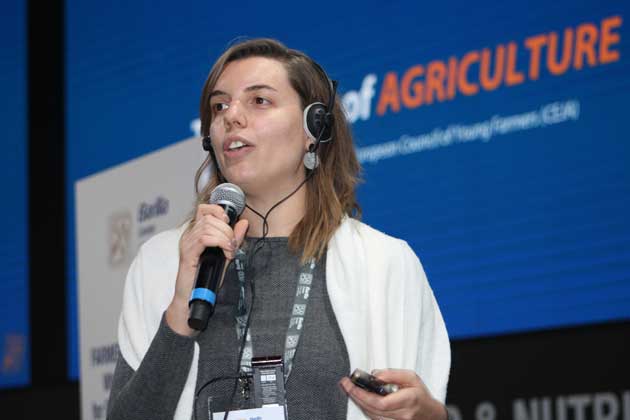
Martina Occelli speaks at the 10th International Forum on Food and Nutrition. Credit: Busani Bafana / IPS

Occelli is a winner of 2018 BCFN Yes international multidisciplinary contest launched by the BCFN Foundation in 2012 to support research on promoting the intersection of food sustainability and environmental sustainability.

Geraldin Lengai, another BCFN Yes winner, is researching on enhancing sustainable agriculture through the adoption of bio-integrated crop management among tomato farmers in Tanzania comparing conventional and non-conventional farming methods. Her research expects to provide insights into the use of organic pesticide properties of ginger and turmeric – cash crops grown by farmers in Tanzania – in fighting pests and diseases in vegetables. Also, she has researched the efficacy of organic fertilisers such as goat manure and chicken manure on the productivity of the spice coriander and amaranthus, a plant cultivated as a vegetable.

“Sustainable agriculture is important because you need a doctor once in a while, but you need the farmer at least three times a day,” Lengai told IPS. “I believe people should have access to food that is safe and healthy. How we produce the food, process it and how the food reaches the end consumer is the business of sustainable agriculture, and my research is on crop protection because people use crop protection synthetically yet there are alternatives that nature has provides. Before synthetic pesticides, our forefathers used tobacco to control insects, and if we can look at other plants that have the same capacity, we can promote sustainable agriculture.”

Lengai said the benefits of manure has in producing vegetables and the near to zero cost for farmers who keep animals means farmers have a sustainable fertiliser for organic produce which is attractive for global markets. Citing the case of pesticides with the Kenya market for French beans, Lengai said organic produce had secured international markets which have traceability systems in place.

“Growing organic vegetables and using organic pesticides and fertilisers is a win-win for everybody for the environment, for the farmer for the consumer,” said Lengai. She added that synthetic pesticides are favoured because they are easy to apply and cheaper – but come at a cost to the environment and health.