Third UN Conference of Landlocked Developing Countries will be an opportunity to address the issues these countries face.
UNITED NATIONS, Feb 6 2024 (IPS) – Landlocked developing countries need greater support from the international community so that they are no longer left behind when it comes to progressing with the SDGs, says the UN High Representative of the Least Developed Countries.
The Third UN Conference of Landlocked Developing Countries (LLDC3) is set to be hosted in Kigali, Rwanda, in June. A preparatory committee for the conference has been established and convened its first meeting on Monday.
The overarching theme of the conference, “Driving Progress through Partnerships,” is expected to highlight the importance of support from the global community in enabling LLDCs to meet their potential and achieve the SDGs. The conference invites the participation of multiple stakeholders, including heads of state and government, the private sector, and civil society. Several senior leaders in the UN system, including Secretary-General António Guterres, are expected to attend the LLDC3 Conference.
Thirty-two countries are classified as LLDCs, 17 of which are also classified as Least Developed Countries (LDCs). Sixteen are in Africa, and the remaining are located across Asia, Europe, and South America. This year will mark the first time that the LLDC Conference will be hosted in Africa.
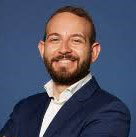
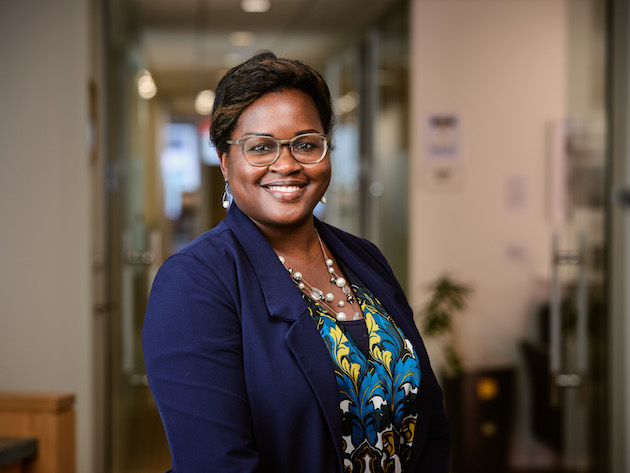
Rabab Fatima, Under Secretary-General and High Representative of the Office for the Least Developed Countries, and the Secretary-General of the LLDC3 Conference, remarked that this conference would be a “once-in-a-decade opportunity” for the global community to address the needs of the LLDCs in order to “ensure that nobody is left behind.”
“The 32 landlocked developing countries are grappling with unique challenges due to their geographical and structural constraints and lack of integration into world trade and global value chains. Their situation has been further exacerbated by the lingering effects of the pandemic, climate change, and conflict,” she said.
The lack of direct access to coastal ports means that LLDCs rely on transit countries to connect them with international markets. This can lead to high trade costs and delays in the movement of goods. In other cases, many of the LLDCs’ transit neighbors are also developing countries with their own economic challenges. According to Fatima, the average cargo travel time for LLDCs was twelve days, compared to seven days for transit countries.
As a result of the slow progress in development, twenty-eight percent of people in LLDCs live in poverty. At least a third of the people are at a high risk of or already live with some form of debt distress, and fifty-eight percent of people deal with moderate to severe food insecurity.
Enkhbold Vorshilov, Permanent Representative of Mongolia to the UN, noted that the conference would be a “critical juncture” for the LLDCs. He also serves as the co-chair of the preparatory committee along with the Permanent Representative of Austria. He added, “Despite our varied cultural and economic structures, we share common challenges that impede our development and economic growth.”
The Preparatory Committee will negotiate the details of the conference’s outcome document, which has been prepared to “encapsulate the challenges and aspirations of the LLDCs,” according to Gladys Mokhawa, Permanent Representative for Botswana and the Chair of the Global Group of Landlocked Developing Countries. Mokhawa expressed that the document has so far received general support from member states and that the final draft would be comprehensive and committed to addressing the challenges that LLDCs face “that align with their specific needs and aspirations.”
“A vision is clear: to transform the geographical challenges and to ensure that our landlocked status is nothing more than a detail of geography,” she said. “We believe that our collective efforts can and will make a difference.”
“Our goal is not merely to draft a document but to build positive, genuine partnerships that will empower landlocked developing countries to overcome their challenges and achieve sustainable prosperity,” said Vorshilov. He added that, along with support from neighboring transit countries, cooperation from development partners and financial institutions would be important to mobilize the resources needed to support the LLDCs.
The document is intended to serve as a guideline for the LLDCs for the next decade and will touch on several areas of interest. In addition to addressing transport and trade, it will focus on emerging issues, such as science, technology, and innovation, and improving capacity and resilience against issues arising from climate change.
Earlier meetings, including the first meeting of the committee, have seen delegations express solidarity with the LLDCs and support for the agenda of the upcoming conference. Ambassador Stavros Lambrinidis, Permanent Representative of the European Union Delegation to the UN, stated that the development challenges call for “more efficient allocation of financial resources on the path toward the SDGs” and that an “essential element” of their partnership would be the development of connections and transport corridors for the benefit of all peoples.
Speaking on behalf of the Africa Group, Ambassador Marc Hermanne Araba of Benin noted that Africa has faced the brunt of the challenges faced by the LLDCs and their neighboring transit countries. He added that the present moment was an opportunity to “chart a transformative agenda for the LLDCs,” and therefore it is important for the global community to reaffirm its’ commitment to address the LLDCs’ challenges together to “ensure that these countries are not left behind.”.
Fatima welcomed the media as a “key partner,” through which the voices of LLDCs would have a platform, and to bridge the gap between the conference and those communities who will be most affected by the outcomes by sharing their perspectives.
STOCKHOLM, Sweden, Feb 1 2024 (IPS) – Karl Marx’s Manifesto of the Communist Party begins with the now worn-out phrase: “A spectre is haunting Europe – the spectre of communism. All the powers of old Europe have entered into a holy alliance to exorcise this spectre”. Nowadays the word “communism” could easily be substituted by “migration”. All over Europe, politicians claim that Europe is being destroyed by migrants. In country after country, ghosts of yesterday are awakened. Parliaments include xenophobic politicians who might be considered as inheritors of demagogs who once dragged Europeans into hate and bloodbaths.
Populists have successfully convinced voters that the greatest threat to their nations is neither inequality, nor climate change, but immigration. Politicized storytellers have found that fear of “the other” can be a means to gain power. Nevertheless, such a fear does not concern any “other” – respected professionals who move to another country are usually not labelled as “migrants”, neither are wealthy businessmen who acquire new passports as easily as they move their money around the world.
To obtain some insights to the often all overshadowing phenomenon of international migration, Jan Lundius recently met with Dr Omar Hammoud Gallego, a fellow at the London School of Economics and Political Science.
Omar Hammoud Gallego
IPS: Your research deals with migration, as well as civil society’s connection with international organisations. How did this interest develop?
Hammoud Gallego: Like many of my colleagues and friends, I am the son of migrants. My parents came from different parts of the world and met, married and established themselves in a third country. However, this was not the main reason for me to focus on migration in my research. In 2015, while working for UNHCR in Colombia, where I was engaged in supporting internally displaced Colombians, I soon found out that there was a lack of serious, in-depth research about migration within Latin America. I began to read about regional migration and decided eventually to pursue a PhD on this topic.
IPS: Was it the specific situation in Colombia that made you shift your main interest from internal to regional migration?
Hammoud Gallego: Yes, over the last few years Colombia has received a huge influx of migrants and refugees from Venezuela (although they are recognised as refugees only in a handful of countries). A phenomenon that has not abided. More than 7,7 million migrants and refugees have left Venezuela as a result of political turmoil, socio-economic instability and an ongoing humanitarian crisis, roughly a quarter of the country’s population. While democratic backsliding in the country began with Hugo Chávez, the situation worsened considerably during the presidency of his successor since 2013, Nicolás Maduro. Most refugees, more than 6,5 million, are hosted in Latin American and Caribbean countries; close to three million in Colombia, one and a half million in Peru, and close to half a million in both Chile and Ecuador.
IPS: And the cause of this exodus is mainly political?
Hammoud Gallego: To a certain degree – yes. The Venezuelan government inept and corrupt handling of the economy and plummeting oil prices caused the output of PDVSA (the national oil company) to decrease substantially, leading to lower revenues for the government. As it happens with many countries with vast oil reserves, Venezuela developed into a rentier state, receiving most of its income through the export of oil. Since 2013, the country’s economy has suffered greatly. In 2018, the inflation was more than 63,000 percent compared with the previous year, while nearly 90 percent of the population lives in poverty. Furthermore, estimates by the UN and Human Rights Watch indicate that under Maduro’s administration close to 20,000 people have been subject to alleged extrajudicial killings.
IPS: Is the current situation in Venezuela still excruciating?
Hammoud Gallego: Yes, and the current geopolitical landscape seems to have favoured Maduro’s regime rather than debilitated him. The country is Russia’s most important trading and military ally in South America. Due to the energy crisis linked to Russia’s criminal invasion of Ukraine, the US government in October last year lifted sanctions on the Venezuelan oil and mining sector, which had been in place since early 2019. In spite of this influx of money and support, the situation continues to be severe and so far, few Venezuelans are returning to their country of origin. Many are instead making their way to the Darien Gap, through Panama and from there continue north until they reach the United States. Elections in Venezuela are scheduled for this year, but it is hard to know if Maduro will allow them to take place fairly and transparently.
IPS: How is UNHCR handling the Venezuelan refugee crisis?
Hammoud Gallego: The UNHCR is one of the few UN agencies which depends almost entirely on voluntary contributions. Every year UNHCR funding shifts depending on the outcome of its Global Appeal, the process in which it asks governments and some private donors to contribute to the support of refugees. In 2023, about 74 percent of these funds came from 10 donors only, with much of the funding earmarked for specific crises and only 15% of it consisted of multi-year funds. Commitments are constantly shifting and crises around the world compete for limited resources. For example, when a refugee crisis erupted due to war in Ukraine it meant that less funding was dedicated to Latin American countries hosting Venezuelan refugees, as well as UNHCR commitments in other parts of the world. However, there are many NGOs across the region that also make a concrete difference in the lives of many refugees. For instance, the NGO VeneActiva, which was founded and is led by Venezuelan migrant women and operates in Peru, is one of the best examples in the Latin American region of how civil society can step in and provide the support refugees need. Its digital platform contains key information that helps Venezuelan nationals to restart their lives in Peru. The NGO provides a variety of services, including psychological support and advice on how to regularise one’s migratory status.
IPS: You are currently living in the UK, a country where migration, like in other European nations, is high up on the political agenda. Can you provide us with some insights about how the migration issue is dealt with in the UK?
Hammoud Gallego: Over the last few years, the Conservative government in the UK has been facing a dilemma of its own making. The Brexit decision was supposed to lead to a decrease in immigration, and instead the opposite seems now to have been the case. Still, the lack of enough immigrants to fill in positions in the public sector, particularly in education, and health, and to take on seasonal work in agriculture and construction, has limited economic growth in the country. The health sector was exceptionally hard hit by both Covid and Brexit.
IPS: How is the governing political party affected by the migration issue?
Hammoud Gallego: Since 2010 the UK has had a Conservative-led government, with Conservative party leaders making migration a prime electoral issue. However, according to the latest polling data, it is estimated that 46 percent of voters would vote for the Labour Party in a general election, compared with 22 percent voting for the Conservative Party. Understandably, conservative politicians are worried about losing votes to the far right, and specifically to the Reform Party, and are trying to out-do the far-right by adopting absurd measures to deter the arrival of asylum seekers. One such scheme is the recent Rwanda asylum plan.
IPS: Could you elaborate on whether the Rwanda plan is a feasible project, or not, and why some Conservative politicians actually proposed such a solution for asylum seekers.
Hammoud Gallego: It is a proposal that foresees that some of the asylum seekers who arrive to the UK irregularly will be relocated to Rwanda for processing. Those successful in claiming asylum would remain in Rwanda. It is an absurd proposal based on two wrong assumptions. The first, is that most asylum seekers will know about the scheme. The reality is that the information most of them get, comes from unofficial sources, oftentimes from the smugglers that organise their journeys. Second, even if they knew about the scheme, it is unlikely that it will deter them. For most of them, the choice of a country depends on several factors: the language they speak, the network they have, etc… Also, on their way to the UK asylum seekers have often taken several risks, and suffered greatly, so the minimal risk of being sent to Rwanda will be seen as an acceptable risk for most of them. The reality is that what this plan will only push individuals not to apply for asylum once in the UK, and in many cases simply live in the country with an irregular status, akin to the reality of many Mexican and Central Americans in the US.
IPS: How do you view the future for asylum seekers and so called “economic” migrants?
Hammoud Gallego: It looks bad. I believe that climate change will exacerbate conflicts in many regions of the world, thus forcing people to move. Such challenge needs urgently to be dealt with, both internationally and locally, and it might already be too late. Investments in green energy are far too limited, viable resettlement programs are not in place, leaving asylum seekers no option but to embark on dangerous journeys. Also, one of the main myths surrounding economic migration is that as countries become wealthier, people will have less incentives to leave. The reality is that the poorest individuals in the Global South have always been the ones least likely to travel, as they lack the means to do that. The poor cannot afford to move. As countries become wealthier, the middle classes will seek to travel and migrate more.
IPS: What can be done for migrants who are already in place in Europe, and elsewhere?
Hammoud Gallego: Well thought-through integration policies forcefully implemented and sensible migration policies would be a good place to start. There are many examples of how integration can be conducted successfully. Nations like the UK are to a certain degree proof of this, with a prime minister of Indian origin, and the Mayor of London and First Minister of Scotland both sons of Pakistani immigrants. Considering sudden refugee crises, the way European countries responded to the Ukrainian crisis shows the way forward: let refugees move wherever best suits them, and you will avoid a humanitarian catastrophe. However, politics in Europe seems to be going in the opposite direction. In Germany, Sweden, Hungary, Italy, the Netherlands and many other European nations anti-migration and nationalistic forces are gaining strength, not the least among young people who mistrust ageing and unrepresentative traditional parties. If everyone who voted in the election had been aged under 35, Geert Wilders’ Dutch Party for Freedom (PVV) might have won even more votes. In last year’s French presidential runoff, Marine le Pen won 39 percent of votes from people aged 18-24 and 49 percent of those aged 25-34, le Pen’s deputy is the 28 years old Jordan Bardella. Giorgia Meloni’s ruling Brothers of Italy was the preferred party among people under 35 years of age. I assume that the likely win of Donald Trump in the next US elections will boost European anti-migration politics.
IPS: What can immediately be done to address the issue of migrants and asylum seekers already in Europe, and maybe elsewhere as well?
Hammoud Gallego: If governments across Europe were to pursue sensible and evidence-based migration policies instead of replicating far-right talking points, it would be a start. Principled opposition politicians could, instead of focusing exclusively on migration to attract votes, focus more on those aspects of migration policies that might be improved, without resorting to a xenophobic rhetoric that normalises a polarising political discourse. Integration and inclusion are key for people coming to Europe. Integration is both a right and a duty, meaning that every member of a society has to adapt to and respect fundamental human rights, including democracy, the rule of law, freedom of speech and religion, as well as the rights to equality and non-discrimination. Considering that migration has become a highly politicised issue it has been proposed that long-term immigrants ought to be given the right to vote, thus making their support more appealing to politicians and decision makers. A few countries, such as Chile and New Zealand, are allowing all residents to vote, hoping this would decrease polarisation and marginalisation, whether this will happen remains to be seen. Under all circumstances it would be desirable if we could live in a world where migrants were considered as fellow human beings, rather than as scapegoats for governments’ ineptitudes.
Dr. Martin Luther King and Mrs. King are greeted by Ralph Bunche on a visit to the United Nations in 1964. Credit: UN Photo
Ralph Bunche received the 1950 Nobel Peace Prize for his late 1940s work as a United Nations mediator in the Palestine conflict. He called himself ‘an incurable optimist’. Bunche was the first African American and person of color to be so honored in the history of the prize.
ROME, Jan 9 2024 (IPS) – All through this week, leading up to January 15th, the world will commemorate Martin Luther King. In a world as wounded as ours is today, the lessons of his life’s work offer a vital opportunity for healing.
But the opportunity to hear his message continues to be obstructed: too many of the soundbites of TV pundits and the tweets of politicians are, once again, not distilling the insights of Dr King, but are serving instead to obscure a library of wisdom behind wall-to-wall repetition of the same few lines, extracted from their context, of one speech.
This is not a mistake, it is a tactic, and we owe it not only to the legacy of Dr King but to the future of our world to ensure that his authentic message is shared.
The true message of Martin Luther King is not a saccharine call for quietude or acceptance, but an insistence on being, as he put it, “maladjusted to injustice.” It represents not an idle optimism that things will get better but a determined commitment to collective action as the only route to progress.
When Dr King said “the arc of the moral universe is long, but it bends towards justice”, he didn’t mean this process is automatic; as he noted, “social progress never rolls in on wheels of inevitability; it comes through the tireless efforts of people.”
And he was clear that advancement of progress requires the coming together of mass movements, “organizing our strength into compelling power so that government cannot elude our demands.”
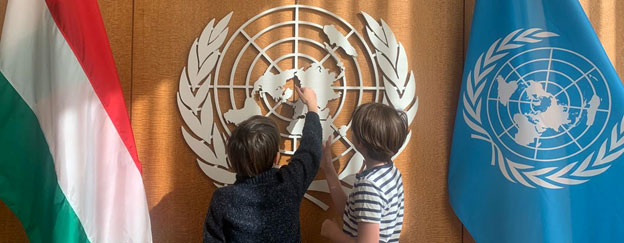
Children from a dozen countries met with the President of the General Assembly and toured the United Nations on a federal holiday in the United States honouring the late civil rights leader and Nobel Peace Prize laureate, Martin Luther King Jr. 17 January 2023. Credit: Paulina Kubiak, United Nations
Justice, Dr King taught, is never given, it is only ever won. This always involves having the courage to confront power. Indeed, he noted, the greatest stumbling block to progress is not the implacable opponent but those who claim to support change but are “more devoted to order than justice.” As he put it, “frankly I have yet to engage in a direct action movement that was ‘well-timed’ in the view of those who have not suffered unduly; this ‘wait!’ has almost always meant ‘never.’”
When the civil rights movement’s 1962 Operation Breadbasket challenged companies to increase the share of profits going to black workers and communities, it was only after the movement showed that they could successfully organize a boycott that those companies, in Dr King’s words, “the next day were talking nice, were very humble, and [later] we signed the agreement.” As he noted when challenged by “moderates” who asked why he needed to organize, “we have not made a single gain without determined pressure…freedom is never voluntarily given by the oppressor, it must be demanded by the oppressed.”
Advancing progress, he emphasized, involves challenging public opinion too. Organizers cannot be mere “thermometers” who “record popular opinion” but need to be “thermostats” who work to “transform the mores of society”. In 1966, for example, a Gallup Opinion poll showed that Dr King was viewed unfavourably by 63 per cent of Americans, but by 2011 that figure had fallen to only four per cent.
Often, people read the current consensus view back into history and assume that Dr King was always a mainstream figure, and imagine, falsely, that change comes from people and movements who don’t ever offend anyone.
Dr King’s vision of justice was a full one. It called not only for the scrapping of segregation, but for taking on “the triple prong sickness of racism, excessive materialism and militarism.” He challenged the “economic conditions that take necessities from the many to give luxuries to the few” and noted that “true compassion is more than flinging a coin to a beggar, it understands that an edifice which produces beggars, needs restructuring.”
He spoke out against war not only for having “left youth maimed and mutilated” but for having also “impaired the United Nations, exacerbated the hatreds between continents, frustrated development, contributed to the forces of reaction, and strengthened the military-industrial complex.”
He noted how “speaking out against war has not gone without criticisms, there are those who tell me that I should stick with civil rights, and stay in my place.” But he insisted that he would “keep these issues mixed because they are mixed. We must see that justice is indivisible, injustice anywhere is a threat to justice everywhere.”
When I went to Dr King’s memorial in Atlanta I did so to pay my respects at his tomb. But arriving at the King Center I found a vibrant hub of practical learning, at which activists and organizers working for justice were revisiting Dr King’s work and writings not as history that is past but as a set of tools to help understand, and act, in the present.
Together, we reflected not only on his profoundly radical philosophy, but also on his strategies and tactics for advancing transformational change. Conversations with Dr King’s inspirational daughter, Bernice, were focused not on her father’s work alone; instead, she asked us what changes we were working for, and how we were working to advance them.
This year, on 10th January, the King Center is hosting a Global Summit, a series of practical conversations accessible to everyone, for free, online. I’m honoured to be panelist. It is open for sign ups here.
“Those who love peace,” noted Dr King, “must learn to organize as effectively as those who love war.” And he even guided us how.
TORONTO, Canada, Dec 22 2023 (IPS) – The year 2023 has brought so much tragedy, with incomprehensible loss of lives, whether from wars or devastating ‘natural’ disasters, while our planet has seen yet more records broken as our climate catastrophe worsens.
And so as the clock ticks towards the (mostly western) New Year, readers are traditionally subjected by media outlets like ours to the ‘yearender’ – usually a roundup of main events over the previous 12 months, one horror often overshadowed by the next.
Farhana Haque Rahman
So forgive us if for 2023 IPS takes a somewhat different approach, highlighting how humanity can do better, and how the big depressing picture should not obscure the myriad small but positive steps being taken out there.
COP28, the global climate conference held this month in Dubai, could neatly fit the ‘big depressing’ category. Hosted by a petrostate with nearly 100,000 people registered to attend, many of them lobbyists for fossil fuels and other polluters, it would be natural to address its outcomes with scepticism.
However, while Yamide Dagnet, Director for Climate Justice at the Open Society Foundations, described COP28 as “imperfect”, she said it also marked “an important and unprecedented step forward in our ‘course correction’ for a just transition towards resilient and greener economies.”
UN climate chief Simon Stiell acknowledged shortcomings in the compromise resolutions on fossil fuels and the level of funding for the Loss and Damages Fund. But the outcome, he said, was also the “beginning of the end” for the fossil fuel era.
Imperfect as it was and still based on old structures, COP28 hinted at the possible: a planetary approach to governance where common interests spanning climate, biodiversity and the whole health of Earth outweigh and supersede the current dominant global system of rule by nation states.
As we have tragically witnessed in 2023, the existing system – as vividly reflected in the repetitive stalemate among the five veto-bearing members of the UN Security Council – is failing to find resolution to the major conflicts of this year, Russia-Ukraine and Israel-Gaza. Not to mention older and half-forgotten conflicts in places like Myanmar (18.6 million people in need of humanitarian aid) and in eastern Democratic Republic of Congo (seven million displaced).
The unrestrained destruction of Gaza and the disproportionate killings of over 17,000, (now the death toll is “at least 20,000 people” according to Palestinian officials) mostly civilians– in retaliation for 1,200 killings by Hamas and 120 hostages in captivity– have left the Palestinians in a state of deep isolation and weighed down by a feeling of being deserted by the world at large.
The United Nations and the international community have remained helpless– with UN resolutions having no impact– while American pleas for restrained aerial bombings continue to be ignored by the Israelis in an act of defiance, wrote IPS senior journalist Thalif Deen.
The hegemony of the nation-state system is surely not going to disappear soon but – without wanting to sound too idealistic — its foundations are being chipped away by civil society where interdependence prevails over the divide and rule of the existing order. And so for a few examples encountered in our reporting:
CIVICUS Lens, standing for social justice and rooted in the global south, offers analysis of major events from a civil society perspective, such as its report on the security crisis gripping Haiti casting doubt over the viability of an international plan to dispatch a Kenya-led police contingent.
Education Cannot Wait, a global fund for education in emergencies and protracted crises, lobbied at COP28 for a $150 million appeal to support school-aged children facing climate shocks, such as the devastating drought in Somalia and Ethiopia, and floods in Pakistan where many of the 26,000 schools hit in 2022 remain closed.
Leprosy, an ancient but curable disease, had been pegged back in terms of new case numbers but the onset of the COVID-19 pandemic in 2020 made it harder for patients to get treatment and for new cases to be reported. Groups such as the Sasakawa Health Foundation are redoubling efforts to promote early detection and treatment.
With 80 percent of the world’s poorest living closer to the epicenters of climate-induced disasters, civil society is hammering at the doors of global institutions to address the challenges of adaptation and mitigation.
Lobbying on the sidelines of COP28 in Dubai was activist Joshua Amponsem, co-director of the Youth Climate Justice Fund who questioned why weather-resilient housing was not yet a reality in Mozambique’s coastal regions despite the increasing ferocity of tropical cyclones.
“My key message is really simple. The clock is ticking for food security in Africa,” Dr Simeon Ehui told IPS as the newly appointed Director General of the International Institute of Tropical Agriculture which works with partners across sub-Saharan Africa to tackle hunger, poverty and natural resource degradation.
Dr Alvaro Lario, President of the International Fund for Agricultural Development (IFAD), which has received record-breaking pledges in support of its largest ever replenishment, warns that under current trends 575 million people will still be living in extreme poverty in 2030.
“Hunger remains a political issue, mostly caused by poverty, inequality, conflict, corruption and overall lack of access to food and resources. In a world of plenty, which produces enough food to feed everyone, how can there be hundreds of millions going hungry?” he asked.
Empowering communities in a bid to protect and rejuvenate the ecosystems of Pacific communities is the aim of the Unlocking Blue Pacific Prosperity conservation effort launched at COP28 by Palau’s President Surangel Whipps who noted that the world was not on track to meet any of the 17 sustainable development goals or climate goals by 2030.
“We really have reached planetary limits and I think interest in oceans is rising because we have very dramatically reached the limits of land,” says Dr Obura, “What the world needs to understand is how strongly nature and natural systems, even when highly altered such as agricultural systems, support people and economies very tangibly. It’s the same with the ocean.”
An ocean-first approach to the fight against climate change is also the pillar of a Dalhousie University research program, Transforming Climate Action, launched last May and funded by the Canadian government. Traditional knowledges of Indigenous People will be a focus.
As Max Roser, an economist making academic research accessible to all, reminds us: for more people to devote their energy to making progress tackling large global problems, we should ensure that more people know that it is possible.
Focusing on the efforts of civil society and projecting hope amidst all the heartbreak of 2023 might come across as futile and wasted, but in its coverage IPS will continue to highlight efforts and successes, big and small, that deserve to be celebrated.
Farhana Haque Rahman is the Executive Director of IPS Inter Press Service Noram and Senior Vice President of IPS; she served as the elected Director General of IPS from 2015 to 2019. A journalist and communications expert who lived and worked in Africa, Asia, Europe and North America, she is a former senior official of the United Nations Food and Agriculture Organization FAO and the International Fund for Agricultural Development IFAD.
Celebrating the end of COP28, which ended with an agreement to transition away from fossil fuels. Credit: UNFCCC
DUBAI, Dec 14 2023 (IPS) – While the outcomes of COP28 are being hotly debated in both the scientific and social justice arenas, the climate conference has taken an unprecedented step forward toward a just transition, says Yamide Dagnet, Director for Climate Justice at the Open Society Foundations.
Making some preliminary remarks a day after the climate conference ended, she said: “COP28 ends like it started: imperfect, yet an important and unprecedented step forward in our “course correction” for a just transition towards resilient and greener economies.”
The UN decision acknowledged the need for the decline of coal, oil, and gas for the first time in an agreement that talks about transitioning out of fossil fuels. It will also be known for operationalizing the Loss and Damages Fund, even if the funding falls far below the requirements for climate-stressed countries and communities.
UN Climate Change Executive Secretary Simon Stiell acknowledged these contractions in his final speech.
“While we didn’t turn the page on the fossil fuel era in Dubai, this outcome is the beginning of the end,” Stiell said.
He also noted that climate finance, which he said was a great enabler of climate action, fell short of the trillions needed to support developing countries with clean energy transitions and adaptation efforts.
He urged ordinary people everywhere to not relent in their demands for a climate-just world.
“In the crucial years ahead, your voices and determination will be more important than ever. I urge you never to relent. We are still in this race. We will be with you every single step of the way.”
Yamide Dagnet, Director for Climate Justice at Open Society Foundations. Credit: TJ Kirkpatrick, Open Society Foundations
Dagnet believes that COP28 is the start of a new era in climate justice.
“This is not an end; rather, just the beginning of an implementation journey that we know is hard but can be so positively transformative, and just if we manage to mobilize, in an equitable manner, all hands-on deck. A climate-just journey and outcome require vigilance, creativity, and accountability; stronger solidarity and engagement at all levels; promoting human rights; and shared prosperity for all,” she says.
This COP, Danget says, laid bare the issues with the Paris Agreement, especially with the just transition.
“More specifically, this COP exposed all the contradictions and challenges faced when implementing the promises of the Paris Agreement, especially a managed, equitable transition away from fossil fuels and the sustained mobilization, alignment, and access to financial flows domestically and internationally to decarbonize and build resilience,” Dagnet says. ”
While some signals got clearer with more substantive commitments, challenges remain, however, in how the just and equitable transition is sequenced.
“Inclusive processes matter to foster shared prosperity and benefits throughout the journey, together with adequate safeguards to minimize unintended adverse impacts of climate-related measures and technologies and to protect frontline and marginalized communities.
“Similarly, the just operationalization and continued capitalization of the Loss and Damage Fund will require vigilance, effective guidance, and mechanisms to make sure commensurate funding is actually mobilized and reaches the communities that need it the most in a timely manner. Adequate mobilization of finance for adaptation by the donor community is also essential to tackle losses and damages with dignity. We are happy that a dozen of them committed to join OSF efforts in this regard.”
KUALA LUMPUR, Malaysia, Dec 13 2023 (IPS) – With the US Fed raising interest rates, the world economy is slowing as debt distress spreads across the global South, increasing poverty worldwide to pre-pandemic levels, with the poorest countries faring worst.
Extreme poverty continues to be high and is now worse than before the pandemic in low-income countries (LICs) and among those affected by fragility, violence and conflict. The promise of eradicating poverty worldwide by 2030 has become unachievable.
Jomo Kwame Sundaram
The Bretton Woods institutions’ (BWIs) annual meetings in Marrakech in October were only the second-ever in Africa. But the rich nations-dominated BWIs failed yet again to rise to the challenges of our times, setting Africa and the global South even further back.
Instead of fostering cooperation to address the causes and effects of the contemporary catastrophe, neither the International Monetary Fund nor the World Bank governors could agree on joint communiques due to the greater politicisation of multilateral fora.
Indebtedness immobilises governments Indebtedness and restrictive creditor rules prevent governments from spending more counter-cyclically to overcome the many contractionary tendencies of recent times, besides preventing them from addressing looming social and environmental crises.
The G20’s largest twenty economies have urged strengthening “multilateral coordination by official bilateral and private creditors … to address the deteriorating debt situation and facilitate coordinated debt treatment for debt-distressed countries”.
But its Common Framework to restructure debt has been roundly criticised by civil society, think tanks and even the World Bank on many grounds, including the paltry concessional credit relief offered to a few of the very poorest countries.
In contrast, the G24 caucus of developing countries at the BWIs has emphasised the need for “durable debt resolution measures while collaborating on resolving the structural issues leading to such vulnerabilities.”
But all those advocating purported solutions are not even trying to ensure fiscal space and public spending capacity for counter-cyclical efforts, let alone achieve the Sustainable Development Goals and national development objectives.
Surcharges The IMF currently imposes additional charges on countries that do not quickly clear their debts to the Fund. Besides the usual fees and interest, borrowing countries paid over $4 billion in such surcharges in 2020-22, during the COVID-19 pandemic.
Surcharges will cost debt-distressed countries about $7.9 billion over six years. The G24 has emphasised that surcharges are pro-cyclical and regressive, especially with monetary tightening.
Governments have undertaken contractionary policies and cut imports for lack of foreign exchange. This deepens the problems of heavily indebted poor countries who cannot but count on the Fund for relief and solutions.
At Marrakech, the governing International Monetary and Financial Committee decided to “consider a review of surcharge policies”. The G24 called for “a suspension of surcharges while the review – which we hope will lead to substantial permanent reduction or complete elimination – is being conducted.”
Rich nations have been divided over surcharges. With Ukraine now among the top surcharge payers, following civil society criticisms, the Biden administration’s refusal to review surcharges in 2022 was heavily criticised by the US Congress.
Deepening austerity IMF fiscal austerity measures of the 1980s returned with a vengeance after the 2008 global financial crisis, and then again during the Covid-19 pandemic from 2020. Most Fund loans require cutting the public sector wage bill (PSWB), the budget line to pay employees.
Most wage earners in many LICs, including nurses, teachers and other social service workers, work for the state, directly or indirectly. Although much needed, these employees have been more likely to be targeted by such budget cuts.
PSWB cuts may involve hiring or wage freezes, or limiting, or even cutting wages. These inevitably undermine government capacities and services. Fiscal consolidation has also involved raising more indirect, consumption taxes, and tax exemptions, e.g., for essential goods such as food.
In 38 countries with over a billion people, loan conditionalities during 2020-22, the three years of the Covid-19 pandemic, meant regressive tax reforms and public spending cuts. PSWB and fuel or electricity subsidy cuts are also common demands worsening economic contractions.
Austerity bound to fail But the IMF’s own research suggests such austerity policies are generally ineffective in reducing debt, their ostensible purpose. The April 2023 IMF World Economic Outlook acknowledged austerity programmes and fiscal consolidations “do not reduce debt ratios, on average”. Yet, its Fiscal Monitor still demands “fiscal tightening” of most developing countries.
The new IMF-World Bank debt sustainability framework sets the LICs’ external debt-to-GDP ratio limit at 30% or 40%. It insists debt-distressed economies must have lower ratios than ‘strong’ countries, effectively further penalising the weak and vulnerable.
Instead of enabling consistently counter-cyclical macroeconomic frameworks, the IMF’s current short-termist approach is mainly preoccupied with annual, or worse, quarterly balances, mimicking corporate reporting practices.
Such short-termism further limits fiscal space, effectively preventing or deterring public sector investments requiring longer-term macroeconomic frameworks to realise benefits. This discourages ‘patient’ medium- to long-term investments required for national economic planning and transformation, essential for sustainable development.
Restrictive debt and fiscal targets have meant even less public investment. This is typically required of borrowing countries as a credit conditionality. Annual IMF Article IV consultations cause other countries to also accept similar constraints to avoid Fund disapproval.
While a few better-off economies enjoy full employment, most countries face further economic contraction, not least due to interest rate hikes led by the US Fed and their many effects. Instead of being part of the problem, the IMF should be part of the solution.