Latin America Is Lagging in Its Homework to Meet the SDGs

Civil Society, Conferences, Development & Aid, Editors’ Choice, Featured, Global, Global Governance, Headlines, IPS UN: Inside the Glasshouse, Latin America & the Caribbean, Regional Categories, Sustainable Development Goals

Sustainable Development Goals

A view of the Altos de Florida neighborhood in Bogotá, Colombia. Overcoming poverty is the first of the Sustainable Development Goals, and in the Latin American and Caribbean region there is not only slow progress but even setbacks in the path to reduce it. CREDIT: Freya Mortales / UNDP

A view of the Altos de Florida neighborhood in Bogotá, Colombia. Overcoming poverty is the first of the Sustainable Development Goals, and in the Latin American and Caribbean region there is not only slow progress but even setbacks in the path to reduce it. CREDIT: Freya Mortales / UNDP

CARACAS, Sep 15 2023 (IPS) – The Latin American and Caribbean region is arriving at the Sustainable Development Goals Summit on the right track but far behind in terms of progress, at the halfway point to achieve the SDGs, which aim to overcome poverty and create a cleaner and healthier environment.


“We are exactly halfway through the period of the 2030 Agenda for Sustainable Development, but we are not half the way there, as only a quarter of the goals have been met or are expected to be met that year,” warned ECLAC Executive Secretary José Manuel Salazar-Xirinachs.

“We are exactly halfway through the period of the 2030 Agenda for Sustainable Development, but we are not half the way there, as only a quarter of the goals have been met or are expected to be met that year.” — José Manuel Salazar-Xirinachs

However, the head of the Economic Commission for Latin America and the Caribbean (ECLAC) stressed, in response to a questionnaire submitted to him by IPS, that “the percentage of targets on track to be met is higher than the global average,” partly due to the strengthening of the institutions that lead the governance of the SDGs.

The 17 SDGs include 169 targets, to be measured with 231 indicators, and in the region 75 percent are at risk of not being met, according to ECLAC, unless decisive actions are taken to forge ahead: 48 percent are moving in the right direction but too slowly to achieve the respective targets, and 27 percent are showing a tendency to backslide.

The summit was convened by UN Secretary-General António Guterres for Sept. 18-19 at the United Nations headquarters in New York, under the official name High-Level Political Forum on Sustainable Development.

The stated purpose is to “step on the gas” to reach the SDGs in all regions, in the context of a combination of crises, notably the COVID-19 pandemic, inflation, new wars, and the climate and food crises.

The SDGs address ending poverty, achieving zero hunger, health and well-being, quality education, gender equality, clean water and sanitation, affordable and clean energy, decent work and economic growth, industry, innovation and infrastructure, and reducing inequalities.

They also are aimed at sustainable cities and communities, responsible production and consumption, climate action, underwater life, life of terrestrial ecosystems, peace, justice and strong institutions, and partnerships to achieve the goals.

Drinking water is distributed from tanker trucks in the working-class Petare neighborhood in eastern Caracas. Access to safe drinking water and sanitation is another of the goals that are being addressed with a great variety of results within Latin American and Caribbean countries, and there is no certainty that this 2030 Agenda target will be reached in the region. CREDIT: Caracas city government

Drinking water is distributed from tanker trucks in the working-class Petare neighborhood in eastern Caracas. Access to safe drinking water and sanitation is another of the goals that are being addressed with a great variety of results within Latin American and Caribbean countries, and there is no certainty that this 2030 Agenda target will be reached in the region. CREDIT: Caracas city government

Progress is being made, but slowly

“In all the countries of the region progress is being made, but in many not at the necessary rate. The pace varies greatly and we are not where we would like to be,” Almudena Fernández, chief economist for the region at the United Nations Development Program (UNDP), told IPS from New York.

Thus, said the Peruvian economist, “there is progress, for example, on some health or energy and land care issues, but we are lagging in achieving more sustainable cities, and we are not on the way to achieving, regionally, any of the poverty indicators.”

Salazar-Xirinachs, who is from Costa Rica, said from Santiago that “the countries that have historically been at the forefront in public policies are the ones that have made the greatest progress, such as Uruguay in South America, Costa Rica in Central America or Jamaica in the Caribbean. They have implemented a greater diversity of strategies to achieve the SDGs.”

A group of experts led by U.S. economist Jeffrey Sachs prepared graphs for the UN on how countries in the various developing regions are on track to meet the goals or still face challenges – measured in three grades, from moderate to severe – and whether they are on the road to improvement, stagnation or regression.

According to this study, the best advances in poverty reduction have been seen in Brazil, El Salvador, Guyana, Paraguay, the Dominican Republic and Uruguay, while the greatest setbacks have been observed in Argentina, Belize, Ecuador and Venezuela.

In the fight for zero hunger, no one stands out; Brazil, after making progress, slid backwards in recent years, and the best results are shown by Caribbean countries.

In health and well-being, education and gender equality, there are positive trends, although stagnation has been seen, especially in the Caribbean and Central American countries.

In water and sanitation, energy, reduction of inequalities, economic growth, management of marine areas, terrestrial ecosystems, and justice and institutions, Sachs’ dashboard shows the persistence of numerous obstacles, addressed in very different ways in different countries.

Many countries in Central America and the Caribbean are on track to meet their climate action goals, and in general the region has made progress in forging alliances with other countries and organizations to pave the way to meeting the SDGs.

Young people in a Latin American country share a vegetable-rich meal outdoors. The notion of consuming products produced with environmentally sustainable techniques is gaining ground, and a private sector whose DNA is embedded in the search for positive environmental and social repercussions is flourishing. CREDIT: Pazos / Unicef

Young people in a Latin American country share a vegetable-rich meal outdoors. The notion of consuming products produced with environmentally sustainable techniques is gaining ground, and a private sector whose DNA is embedded in the search for positive environmental and social repercussions is flourishing. CREDIT: Pazos / Unicef

A question of funds

Even before the pandemic that broke out in 2020, Fernández said, the region was not moving fast enough towards the SDGs; its economic growth has been very low for a long time – and remains so, at no more than 1.9 percent this year – and growth with investment is needed in order to reduce poverty.

In this regard, Fernández highlighted the need to expand fiscal revenues, since tax collection is very low in the region (22 percent of gross domestic product, compared to 34 percent in the advanced economies of the Organization for Economic Cooperation and Development), “although progress will not be made through public spending alone,” she said.

Salazar-Xirinachs pointed out that “in addition to financial resources, it is very important to adapt actions to specific areas to achieve the 2030 Agenda. The measures implemented at the subnational level are of great importance. Specific problems in local areas cannot always be solved with one-size-fits-all policies.”

Fernández underlined that the 2030 Agenda “has always been conceived as a society-wide agenda, and the private sector plays an essential role, particularly the areas that are flourishing because it has a positive social and environmental impact on their DNA, and there are young consumers who use products made in a sustainable way.”

ECLAC’s Salazar-Xirinachs highlighted sensitized sectors as organized civil society and the private sector, for their participation in sustainable development forums, follow-up actions and public-private partnerships moving towards achievement of the SDGs.

Finally, with respect to expectations for the summit, the head of ECLAC aspires to a movement to accelerate the 2030 Agenda in at least four areas: decent employment for all, generating more sustainable cities, resilient infrastructure that offers more jobs, and improving governance and institutions involved in the process.

ECLAC identified necessary “transformative measures”: early energy transition; boosting the bioeconomy, particularly sustainable agriculture and bioindustrialization; digital transformation for greater connectivity among the population; and promoting exports of modern services.

It also focuses on the care society, in response to demographic trends, to achieve greater gender equality and boost the economy; sustainable tourism, which has great potential in the countries of the region; and integration to enable alliances to strengthen cooperation in the regional bloc.

In summary, ECLAC concludes, “it would be very important that during the Summit these types of measures are identified and translate into agreements in which the countries jointly propose a road map for implementing actions to strengthen them.”

 

Halfway to 2030: Our 5 Asks at the SDG Summit

Civil Society, Crime & Justice, Development & Aid, Environment, Global, Headlines, Human Rights, Inequality, Poverty & SDGs, Press Freedom, Sustainable Development Goals, TerraViva United Nations

Opinion

A protest for women’s rights in Puebla, Mexico. Credit: Melania Torres/Forus

NEW YORK, Sep 15 2023 (IPS) – At the UN SDG Summit in New York, the Forus global civil society network is calling for decisive action on SDG implementation. Clearly, as we hit the midpoint towards the “finish line” of the Agenda 2030, progress is stagnating.


The 2023 Special Edition of the SDG Progress Report emphasized that we’re falling short in implementing the SDGs. In April this year, UN Secretary General Antonio Guterres deplored that “Progress on more than 50 per cent of targets of the SDGs is weak and insufficient; on 30 per cent, it has stalled or gone into reverse,” disproportionately impacting the world’s poorest and most vulnerable.

As we approach the halfway mark of the 2030 Agenda, we urge world leaders at the UN General Assembly to address the precarious state of SDG implementation. Here’s our 5 asks.

Walk the talk with clear implementation plans and benchmarks for the realization of the Sustainable Development Goals.

“In Guatemala, there are two worlds, one for a small group that benefits from this macroeconomic stability, this weakness of democracy, this co-optation of state institutions, and a large majority of the population that faces poverty and inequality,” says Alejandro Aguirre Batres, Executive Director of CONGCOOP, the national platform of NGOs in Guatemala that recently published an alternative report on the implementation of the SDGs in the country.

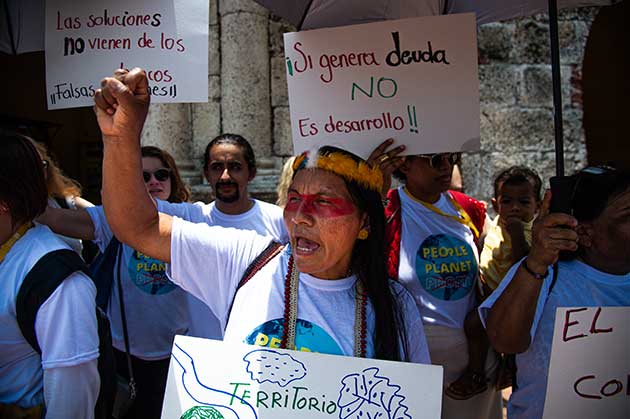
Human rights activists in Cartagena, Colombia from the Coalition of Human Rights in Development at the Finance in Common Summit. Credit: Sebastian Barros/Forus

Governments must make specific national implementation plans to advance the Sustainable Development Goals, with clear benchmarks on when to achieve the targets set in 2015. Following the SDG Summit, we call on the United Nations and its partners to ensure that the “National Commitments to SDG Transformation” called for by the Secretary-General are adequately compiled and tracked, including by providing a transparent and inclusive platform for showcasing these commitments, helping to ensure adequate implementation, follow-up and accountability. All efforts and commitments must focus on breaching the increassing gap in inequalities, healing polarisation and restoring socio-environmental rights at the core of Agenda 2030 implementation as no form of development should come at the cost of environmental degradation and injustice.

Presenting a viewpoint from Asia, Jyotsna Mohan Singh, representing the Asia Development Alliance, emphasizes that while the SDGs look good on paper, their real-world implementation remains far from satisfactory. She explains, “Governments should develop a policy coherence for sustainable development roadmap with timebound targets,” adding that it’s all about creating spaces grounded in equity where civil society and other stakeholders can join discussions and connect with local communities.

In regions like the Sahel, stretching 5,000 kilometers below the Sahara Desert from the Atlantic to the Red Sea, challenges like conflict, political instability, extreme poverty, and food insecurity affect nearly 26 million people. Yet, this region is teeming with opportunities, boasting abundant resources and a young population, including 50% young women and girls. As civil society leader Mavalow Christelle Kalhoule, Forus Chair and President of SPONG, the Burkina Faso NGO network, puts it, “What unfolds in the Sahel and in so many other forgotten communities ripples across the globe, impacting us all even if we choose to look away. Implementing the Sustainable Development Goals is vital to unlock a different future. But for global change to truly happen, we need countries to come together, we need solidarity, horizontal spaces, and for world leaders to start listening and acting accordingly.”

Commit to the protection of civic space and human rights.

“Although the state of Pakistan has ratified many global instruments, including the International Covenant on Civil and Political Rights and the SDGs, the irony is that none of them have been transformed into local policies and regulatory frameworks. Unfortunately, civil rights advocates and organizations have either transformed themselves into humanitarian organizations or practiced self-censorship to avoid state atrocities. Pakistan is failing to achieve SDGs due to disengagement with civil society and other stakeholders. Ironically, the government is unable to provide reliable data on any of their own priority indicators to measure progress towards the implementation of SDGs, particularly on rights-based indicators,” says Zia ur Rehman, National Convener of the Pakistan Development Alliance. Their newly published Pakistan Civic Space Monitor reveals a generally restricted civic space, including restraints on freedom of speech, assembly, information, rule of law, governance, and public participation, with further deterioration. This rings true for 92% of Forus members – comprising national and regional civil society networks in over 124 countries – who consider the protection of civic space and human rights a top priority.

Fridays for Future activists during a Climate March in Brussels, Belgium. Credit: Both Nomads/Forus

Indeed, over the past decade, thousands of civil society organizations have faced increasing challenges due to restrictions on their formation and activities. Nine out of 10 people now live in countries where civil liberties are severely restricted, including freedoms of association, peaceful assembly, and expression, according to the CIVICUS Monitor. Forus reports confirm that civil society deals with increasing restrictions, involving extra-legal actions, misinformation and disinformation about their work both online and offline. Research also highlights the insufficiency of current institutional mechanisms to ensure an enabling environment for civil society, including addressing impunity for attacks on civil society and human right defenders, implementing supportive laws and regulations, and facilitating effective and inclusive policy dialogue. A recent ARTICLE 19 report highlights the inadequate integration of crucial elements like freedom of expression and access to information into SDGs, hampering progress. Journalist killings increased in 2022. Additionally, monitoring access to information mainly focuses on having a legal framework, ignoring its quality and adoption. Strengthening these rights is vital for advancing all SDGs. The growing number of human rights defenders being killed every year – at least 401 in 26 countries were murdered for their peaceful work in 2022 – is another worrying trend that needs to be reversed as the protection and promotion of human rights is the cornerstone of achieving sustainable development. Without human rights we will just move backwards.

Strengthen and Catalyze Robust Financing for the SDGs.

From the recent Summit for a new global financing pact to the Finance in Common initiative, it’s clear that the focus this year has been on increasing investment. But we need quality not just quantity, as expressed in a join civil society declaration aimed at public development banks signed by over 100 civil society organisations from 50+ countries. While we welcome UN Secretary General Antonio Guterres’s call for a SDG Stimulus, we remind Governments, International Financial Institutions, public development banks and donors that more efforts must be done to scale up investments for the realization of the SDGs at all levels, including through additional support for civil society and by involving communities in all “development talks”. The role of the private sector and financial institutions in the implementation of the 2030 Agenda must be talked about openly. It is important to include in all development projects being carried out specific budgets for actions linked to the implementation of the 2030 Agenda. Discussions about financial reforms that are being repeatedly undertaken by several countries cannot happen behind close doors and in non-inclusive forums such as the G7 and G20. Instead, they should be open, inclusive, and transparent, involving a broader spectrum of protagonists, including civil society, to ensure fairness and sustainability in shaping global financial policies.

“The SDGs are severely off track as we reach the critical half-way point of Agenda 2030. We need a renewed global ambition on financial commitments to make progress on the SDGs. Reforms of global financial architecture are a crucial part of this to ensure we have a fairer, more effective, inclusive and transparent system supporting lower-income countries that are at the forefront of the global climate, debt, poverty, food, and humanitarian crises. It’s not about a lack of finance, it is about political will and getting our priorities right,” says Sandra Martinsone, Policy Manager – Sustainable Economic Development at Bond UK.

Mobilize Transformative Commitments for SDG16+.

Recognizing the vital role of SDG16+ as a critical enabler for the entire 2030 Agenda, governments should come to the SDG Summit with targeted, integrated, focused and transformative commitments to accelerate action on SDG16+. As developed in the #SDG16Now collective campaign, this includes domestic policies and resources, legal reforms and initiatives to advance SDG16+ at the international, national and local levels, as well as ambitious global commitments to strengthen multilateralism and international resolve to promote peace, justice, the rule of law, inclusion and institution-building. Additionally, governments must use key moments – such as the 2024 High-Level Political Forum and the Summit of the Future – to advance implementation and delivery of the SDGs through similar commitments to action, and ensure adequate follow-up to these commitments going forward.

Ensure civil society participation and listen to communities, reinvigorate commitments to SDG17.

The 2030 Agenda overall cannot be achieved without building on the role of civil society and fostering a true global partnership. Every year at the fringes of the UN General Assembly, initiatives such as the Global People’s Assembly bring to the ears of world leaders the voices of communities historically marginalised. Governments need to reinvigorate engagement towards SDG17 to trengthen the means of implementing sustainable development goals and revitalising global partnerships for sustainable development. It’s high time we move away from conducting discussions about the future of development in closed-door settings. Tokenistic participation of civil society, where their involvement is merely symbolic or superficial, undermines the core principles of nclusivity, hurting genuine progress and meaningful collaboration. A more inclusive approach must be embraced that actively involves civil society and communities. Let’s #UNmute their voices and perspectives by bringing about reforms to current participation mechanisms, and giving them a real platform to be heard.

In 2015 every government in the world agreed as a global community on what we want for our comon future for people and planet. So many efforts and work went on to reach such an agreement. Now is the time for governments and world leaders to walk the walk and prioritize people and the planet, delivering the 2030 Agenda, essential to secure our shared future. It is time for world leaders to act decisively and uphold their commitments to the SDGs.

IPS UN Bureau

  Source

Youth Rally for Peace Through Climate Justice at the UN

Climate Action, Climate Change, Climate Change Justice, Environment, Global, Headlines, IPS UN: Inside the Glasshouse, TerraViva United Nations, Youth Thought Leaders

Climate Change Justice

Youth rally at the UN for climate justice. Credit: Abigail Van Neely/IPS

Youth rally at the UN for climate justice. Credit: Abigail Van Neely/IPS

UNITED NATIONS, Sep 15 2023 (IPS) – “What do we want? Climate justice! When do we want it? Now!” youth chanted in an unusually lively conference at the United Nations Headquarters.


Earlier on Thursday morning (September 14), almost 500 young people had streamed into the room to a DJ’s upbeat soundtrack. Spirits were high despite the more somber rallying cry of this year’s International Day of Peace youth event: the planet is on fire. Many speakers focused on the idea that there cannot be peace without climate justice.

“We cannot begin to talk about peace without talking about the climate crisis,” environmental justice advocate Saad Amer said after leading the crowd in the kind of chants more likely heard at a protest. Fossil fuel disputes spark wars that disproportionately affect people of color, Amer explained. Youth must take charge to “re-write destiny.”

To 21-year-old Mexican climate justice activist Xiye Bastida, “Peace is the ability to drink clean air and clean water.” Bastida, a member of the Otomi-Toltec indigenous community, spoke of her community’s traditional commitment to living in harmony with the earth. Now, indigenous people are being displaced as regenerative practices are forgotten. Bastida called for a world free of extreme weather and exploitation. The climate crisis reflects a broken system, she said, but peace is the bravery to imagine a better world.

Young people are “creating a youth movement for climate action, seeking racial justice, and promoting gender equality,” the Under-Secretary-General for Global Communications, Melissa Fleming, told the audience. In a recorded statement, Secretary-General Antonio Guterres reiterated that youth action has power. Still, only four governments have concrete plans to include young people in policymaking, Youth Envoy Jayathma Wickramanyake noted.

As she lived through brutal conflicts in her home country of Sri Lanka, Wickramanayake said she wondered why people around her continued to fight. Today, she told other young activists that the root causes of conflict always run deep – from inequality to poverty. She stressed that peace cannot be differentiated from development.

The event occurs days before the Sustainable Development Goal (SDG) Summit, a critical opportunity for world leaders to address failures to implement the goals so far.

“Next week there will be an important breakthrough in creating the conditions to rescue the sustainable development goals. I’m very hopeful that the SDG summit will indeed represent a quantum leap in the response to the dramatic failures that we have witnessed,” Guterres said during a news conference.

Meanwhile, youth are left with memories of their chants: “The oceans are rising, and so are we!” “We are unstoppable – another world is possible!”

IPS UN Bureau Report

  Source

The UN’s Own Relevance Is at Stake at This Year’s General Assembly

Armed Conflicts, Civil Society, Climate Change, Crime & Justice, Development & Aid, Featured, Global, Headlines, Health, Human Rights, Inequality, Peace, Sustainable Development Goals, TerraViva United Nations

Opinion

United Nations Secretary General Antonio Guterres addresses the 22nd session of the Permanent Forum on Indigenous Issues at the General Assembly Hall of the United Nations headquarters in New York City on 17 April 17 2023. Credit: Ed Jones/AFP via Getty Images

NEW YORK, Sep 7 2023 (IPS) – This September, world leaders and public policy advocates from around the world will descend on New York for the UN General Assembly. Alongside conversations on peace and security, global development and climate change, progress – or the lack of it – on the Sustainable Development Goals (SDGs) is expected to take centre-stage. A major SDG Summit will be held on 18 and 19 September. The UN hopes that it will serve as a ‘rallying cry to recharge momentum for world leaders to come together to reflect on where we stand and resolve to do more’. But are the world’s leaders in a mood to uphold the UN’s purpose, and can the UN’s leadership rise to the occasion by resolutely addressing destructive behaviours?


Sadly, the world is facing an acute crisis of leadership. In far too many countries authoritarian leaders have seized power through a combination of populist political discourse, outright repression and military coups. Our findings on the CIVICUS Monitor – a participatory research platform that measures civic freedoms in every country – show that 85% of the world’s population live in places where serious attacks on basic fundamental freedoms to organise, speak out and protest are taking place. Respect for these freedoms is essential so that people and civil society organisations can have a say in inclusive decision making.

UN undermined

The UN Charter begins with the words, ‘We the Peoples’ and a resolve to save future generations from the scourge of war. Its ideals, such as respect for human rights and the dignity of every person, are being eroded by powerful states that have introduced slippery concepts such as ‘cultural relativism’ and ‘development with national characteristics’. The consensus to seek solutions to global challenges through the UN appears to be at breaking point. As we speak hostilities are raging in Ukraine, Sudan, the Occupied Palestinian Territories and the Sahel region even as millions of people reel from the negative consequences of protracted conflicts and oppression in Afghanistan, Ethiopia, Myanmar, Syria and Yemen, to name a few.

Article 1 of the UN Charter underscores the UN’s role in harmonising the actions of nations towards the attainment of common ends, including in relation to solving international problems of an economic, social, cultural or humanitarian character, and to promote respect for human rights and fundamental freedoms for all. But in a time of eye-watering inequality within and between countries, big economic decisions affecting people and the planet are not being made collectively at the UN but by the G20 group of the world’s biggest economies, whose leaders are meeting prior to the UN General Assembly to make economic decisions with ramifications for all countries.

Economic and development cooperation policies for a large chunk of the globe are also determined through the Organisation for Economic Cooperation and Development (OECD). Established in 1961, the OECD comprises 38 countries with a stated commitment to democratic values and market-based economics. Civil society has worked hard to get the OECD to take action on issues such as fair taxation, social protection and civic space.

More recently, the BRICS – Brazil, Russia, India, China and South Africa – grouping of countries that together account for 40 per cent of the world’s population and a quarter of the globe’s GDP are seeking to emerge as a counterweight to the OECD. However, concerns remain about the values that bind this alliance. At its recent summit in South Africa six new members were admitted, four of which – Egypt, Iran, Saudi Arabia and the United Arab Emirates – are ruled by totalitarian governments with a history of repressing civil society voices. This comes on top of concerns that China and Russia are driving the BRICS agenda despite credible allegations that their governments have committed crimes against humanity.

The challenge before the UN’s leadership this September is to find ways to bring coherence and harmony to decisions being taken at the G20, OECD, BRICS and elsewhere to serve the best interests of excluded people around the globe. A focus on the SDGs by emphasising their universality and indivisibility can provide some hope.

SDGs off-track

The adoption of the SDGs in 2015 was a groundbreaking moment. The 17 ambitious SDGs and their 169 targets have been called the greatest ever human endeavour to create peaceful, just, equal and sustainable societies. The SDGs include promises to tackle inequality and corruption, promote women’s equality and empowerment, support inclusive and participatory governance, ensure sustainable consumption and production, usher in rule of law and catalyse effective partnerships for development.

But seven years on the SDGs are seriously off-track. The UN Secretary-General’s SDG progress report released this July laments that the promise to ‘leave no one behind’ is in peril. As many as 30 per cent of the targets are reported to have seen no progress or worse to have regressed below their 2015 baseline. The climate crisis, war in Ukraine, a weak global economy and the COVID-19 pandemic are cited as some of the reasons why progress is lacking.

UN Secretary-General Antonio Guterres is pushing for an SDG stimulus plan to scale up financing to the tune of US$500 billion. It remains to be seen how successful this would be given the self-interest being pursued by major powers that have the financial resources to contribute. Moreover, without civic participation and guarantees for enabled civil societies, there is a high probability that SDG stimulus funds could be misused by authoritarian governments to reinforce networks of patronage and to shore up repressive state apparatuses.

Also up for discussion at the UN General Assembly will be plans for a major Summit for the Future in 2024 to deliver the UN Secretary-General’s Our Common Agenda report, released in 2021. This proposes among other things the appointment of a UN Envoy for Future Generations, an upgrade of key UN institutions, digital cooperation across the board and boosting partnerships to drive access and inclusion at the UN. But with multilateralism stymied by hostility and divisions among big powers on the implementation of internationally agreed norms, achieving progress on this agenda implies a huge responsibility on the UN’s leadership to forge consensus while speaking truth to power and challenging damaging behaviours by states and their leaders.

The UN’s leadership have found its voice on the issue of climate change. Secretary-General Guterres has been remarkably candid about the negative impacts of the fossil fuel industry and its supporters. This July, he warned that ‘The era of global warming has ended; the era of global boiling has arrived’. Similar candour is required to call out the twin plagues of authoritarianism and populism which are causing immense suffering to people around the world while exacerbating conflict, inequality and climate change.

The formation of the UN as the conscience of the world in 1945 was an exercise in optimism and altruism. This September that spirit will be needed more than ever to start creating a better world for all, and to prove the UN’s value.

Mandeep S. Tiwana is chief officer for evidence and engagement + representative to the UN headquarters at CIVICUS, the global civil society alliance.

  Source

A Plea for a UN Summit on the Global Food Crisis

Civil Society, Featured, Food and Agriculture, Global, Headlines, IPS UN: Inside the Glasshouse, Poverty & SDGs, Sustainable Development Goals, TerraViva United Nations

UNITED NATIONS, Aug 25 2023 (IPS) – A coalition of civil society organizations, (CSOs), including climate activists, anti-poverty campaigners and celebrity chefs, are among those calling for an emergency meeting of world leaders on the global food crisis during the UN General Assembly (UNGA) sessions in New York next month.


With 735 million people going hungry, 122 million more than before the COVID-19 pandemic, the organizers of the ‘Elephant in the Room’ campaign say the food crisis is being overlooked by world leaders, with devastating consequences.

An open letter to world leaders, signed by supporters, including climate activist Vanessa Nakate, award-winning farming advocate Wangari Kuria, musician and philanthropist Octopizzo, SDG Advocate Richard Curtis, and US celebrity chef Andrew Zimmern, says the food crisis is being ignored – “a victim of siloed approaches as it’s so multidimensional”.

The letter calls for a massive joined-up response at the highest levels of government. “You know there is a global food crisis. You are ignoring it in your budgets. You do not address it enough with the media. It is not high on your agenda for the G20, UNGA or COP28. And so, it remains an elephant in the room.” (an obvious problem that people do not want to talk about.)

“As leaders, you have allowed this emergency to unfold. The solutions to end the food crisis exist. It is your responsibility to lead the world out of disasters, not compound them.”

Launched by Hungry for Action, the campaign is supported by over 40 organizations including Save the Children, the ONE Campaign and Global Citizen and is coordinated by the SDG2 Advocacy Hub.

https://sdg2advocacyhub.org/index.php/actions/elephant-room-0

The plea for a summit of world leaders on the global food crisis coincides with three unprecedented high-level political meetings in September: the Sustainable Development Goals (SDG) Summit on September 18-19; a high-level dialogue on Financing for Development (FfD) on September 20; and a Summit of the Future on September 21.

Danielle Nierenberg, President and Founder, Food Tank told IPS the world is facing multiple emergencies–the climate crisis, the public health crisis, the biodiversity loss crisis, and the hunger crisis.

To address these challenges, she said, “we need urgent action–not by 2030–but today. I am thankful for the efforts of activists and advocates who are pushing for change.”

“But we need policymakers to treat these crises like the emergency they are and push for positive transformation of how we produce and consume food at UNGA. We can’t wait any longer.”

Joseph Chamie, a former director of the UN Population Division, and an independent consulting demographer, told IPS there is no question about an increasing and worrisome global food crisis.

“About one billion people, or nearly 12 percent of the world’s population, face severe levels of food insecurity with 735 million people going hungry,” he said.

There is plenty of food in the world. While the world’s population has doubled from 4 to 8 billion over the past fifty years, global food production has more than tripled, said Chamie, who served as the Deputy Secretary-General for the 1994 International Conference on population and development and has worked in various regions of the world.

There is a consensus on the causes of the global food crisis, he argued.

Among the major causes of the global food crisis, he singled out “armed conflict and violence; climate change with extreme weather events and emergencies; poverty and economic shocks with soaring prices for fertilizer”.

He pointed out that there is much that can be done to address the global food crisis.

“World leaders need to adopt policies, provide additional funds and take action to address the major factors creating the global food crisis. The major media outlets need to do more to inform the world community about the global food crisis”.

There are no reasons, he said, for delays in addressing the global food crisis. “It is necessary and appropriate to convene an emergency meeting of world leaders on the global food crisis at the UN General Assembly in New York next month.”

Countries, international agencies and responsible others need to act today to address the global food crisis, not in some distant future.

“Hungry people, especially children, can’t eat excuses, they need food today,” said Chamie, the author of numerous publications on population issues, including his recent book, “Population Levels, Trends, and Differentials“.

Meanwhile, the Hungry for Action campaign says the global food crisis is caused by a combination of conflict, climate change, rising food prices and the punishing debt burdens faced by many poorer countries, 21 of which now face catastrophic levels of debt distress and food insecurity.

“Admitting the scope of the problem is the first step towards solving it,” said Rev. Eugene Cho, president and CEO of the U.S.-based Christian anti-hunger organization Bread for the World.

“Several countries, including the U.S., have acknowledged there is a problem and taken steps to address it. That is a good start. But it is not enough to get us out of the crisis. The global food and malnutrition crisis is a climate crisis, a conflict crisis, and a rising costs crisis: it demands a powerful and unified global response.”

This year’s UN appeals for emergency assistance are only just over a quarter funded, much lower than for the last global food crisis in 2008, and yet there are twice as many additional people going hungry compared to 2008 levels.

“There is nothing inevitable about children dying because they don’t have enough to eat, just as there is nothing inevitable about families in rich countries queuing for food banks,” said climate activist, Vanessa Nakate.

“There is nothing inevitable about a food system that cannot withstand shocks from climate change or conflict. There is enough food in the world for everyone.”

“During the last major global food crisis, following the 2008 economic crash, we saw world leaders coming together at the G8 summit in L’Aquila, Italy, to make bold commitments,” said David McNair, Executive Director for Policy at the One Campaign

“This year, as we live through a so-called ‘polycrisis’, the food crisis seems to be getting lost, a victim of a siloed approach to tackling the world’s problems.”

According to the campaign, action to tackle the global food crisis should focus on three key elements: saving lives, building resilience of affected communities to withstand climate and food price shocks, and securing the future by reform of the global food system to make it more sustainable and equitable.

Solutions world leaders should progress at an emergency meeting include:

    • Fully funding the UN’s $55bn humanitarian appeals and doubling climate adaptation funding for lower income countries, while also cancelling their debts and reforming the multilateral financial system to unlock vital funds.
    • Investing in the smallholder farmers, health workers and communities on the frontlines of the food crisis, including through social protection programmes.
    • Fixing the broken global food system by supporting more sustainable farming, diversifying crops, improving nutrition and access to a healthy diet, and reducing food waste.

These measures would break the cycle of crisis and could save the world billions at the same time, campaigners said.

IPS UN Bureau

  Source

UN Must Reclaim Multilateral Governance from Pretenders

Civil Society, Development & Aid, Economy & Trade, Global, Headlines, IPS UN: Inside the Glasshouse, TerraViva United Nations, Trade & Investment

Opinion

KUALA LUMPUR, Malaysia, Aug 24 2023 (IPS) – International governance arrangements are in trouble. Condemned as ‘dysfunctional’ by some, multilateral agreements have been discarded or ignored by the powerful except when useful to protect their interests or provide legitimacy.


Economic multilateralism under siege
Undoubtedly, many multilateral arrangements have become less appropriate. At their heart is the United Nations (UN) system, conceived in the last year of US President Franklin Delano Roosevelt’s presidency and World War Two.

Jomo Kwame Sundaram

The 1944 UN conference at Bretton Woods sought to build the foundations for the post-war economic order. The International Monetary Fund (IMF) would create conditions for lasting growth and stability, with the World Bank financing post-war reconstruction and post-colonial development.

The Bretton Woods agreement allowed the US Federal Reserve Bank (Fed) to issue dollars, as if backed by gold. In 1971, President Richard Nixon repudiated the US’s Bretton Woods obligations. With US military and ‘soft’ power, widespread acceptance of the dollar since has effectively extended the Fed’s ‘exorbitant privilege’.

This unilateral repudiation of US commitments has been a precursor of the fate of some other multilateral arrangements. Most were US-designed, some in consultation with allies. Most key privileges of the global North – especially the US – continue, while duties and obligations are ignored if deemed inconvenient.

The International Trade Organization (ITO) was to be the third leg of the post-war multilateral economic order, later reaffirmed by the 1948 Havana Charter. Despite post-war world hegemony, the ITO was rejected by the protectionist US Congress.

The General Agreement on Tariffs and Trade (GATT) became the compromise substitute. Recognizing the diversity of national economic capacities and capabilities, GATT did not impose a ‘one-size-fits-all’ requirement on all participants.

But lessons from such successful flexible precedents were ignored in creating the World Trade Organization (WTO) from 1995. The WTO has imposed onerous new obligations such as the all-or-nothing ‘single commitment’ requirement and the Agreement on Trade-related Intellectual Property Rights (TRIPS).

Overcoming marginalization
In September 2021, the UN Secretary-General (SG) issued Our Common Agenda, with new international governance proposals. Besides its new status quo bias, the proposals fall short of what is needed in terms of both scope and ambition.

Problematically, it legitimizes and seeks to consolidate already diffuse institutional responsibilities, further weakening UN inter-governmental leadership. This would legitimize international governance infiltration by multi-stakeholder partnerships run by private business interests.

The last six decades have seen often glacially slow changes to improve UN-led gradual – mainly due to the recalcitrance of the privileged and powerful. These have changed Member State and civil society participation, with mixed effects.

Fairer institutions and arrangements – agreed to after inclusive inter-governmental negotiations – have been replaced by multi-stakeholder processes. These are typically not accountable to Member States, let alone their publics.

Such biases and other problems of ostensibly multilateral processes and practices have eroded public trust and confidence in multilateralism, especially the UN system.

Multi-stakeholder processes – involving transnational corporate interests – may expedite decision-making, even implementation. But the most authoritative study so far found little evidence of net improvements, especially for the already marginalized.

New multi-stakeholder governance – without meaningful prior approval by relevant inter-governmental bodies – undoubtedly strengthens executive authority and autonomy. But such initiatives have also undermined legitimacy and public trust, with few net gains.

All too often, new multi-stakeholder arrangements with private parties have been made without Member State approval, even if retrospectively due to exigencies.
Unsurprisingly, many in developing countries have become alienated from and suspicious of those acting in the name of multilateral institutions and processes.

Hence, many in the global South have been disinclined to cooperate with the SG’s efforts to resuscitate, reinvent and repurpose undoubtedly defunct inter-governmental institutions and processes.

Way forward?
But the SG report has also made some important proposals deserving careful consideration. It is correct in recognizing the long overdue need to reform existing governance arrangements to adapt the multilateral system to current and future needs and requirements.

This reform opportunity is now at risk due to the lack of Member State support, participation and legitimacy. Inclusive consultative processes – involving state and non-state actors – must strive for broadly acceptable pragmatic solutions. These should be adopted and implemented via inter-governmental processes.

Undoubtedly, multilateralism and the UN system have experienced growing marginalization after the first Cold War ended. The UN has been slowly, but surely superseded by NATO and the Organization for Economic Cooperation and Development (OECD), led by the G7 group of the biggest rich economies.

The UN’s second SG, Dag Hammarskjold – who had worked for the OECD’s predecessor – warned the international community, especially developing countries, of the dangers posed by the rich nations’ club. This became evident when the rich blocked and pre-empted the UN from leading on international tax cooperation.

Seeking quick fixes, ‘clever’ advisers or consultants may have persuaded the SG to embrace corporate-dominated multi-stakeholder partnerships contravening UN norms. More recent SG initiatives may suggest his frustration with the failure of that approach.

After the problematic and controversial record of such processes and events in recent years, the SG can still rise to contemporary challenges and strengthen multilateralism by changing course. By restoring the effectiveness and legitimacy of multilateralism, the UN will not only be fit, but also essential for humanity’s future.

IPS UN Bureau

  Source