Coronavirus, New Threat for Mexican Migrant Workers in the U.S.

Civil Society, Development & Aid, Economy & Trade, Editors’ Choice, Featured, Food & Agriculture, Global Governance, Globalisation, Headlines, Human Rights, Labour, Latin America & the Caribbean, Migration & Refugees, North America, Regional Categories, TerraViva United Nations
Migration & Refugees

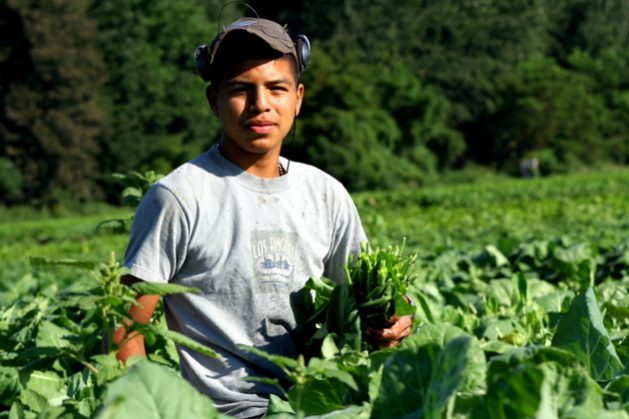
Considered essential to the U.S. economy, as Donald Trump himself now acknowledges, Mexico's seasonal farmworkers are exposed to the coronavirus pandemic as they work in U.S. fields, which exacerbates violations of their rights, such as wage theft, fraud, and other abuses. CREDIT: Courtesy of MHP Salud

Considered essential to the U.S. economy, as Donald Trump himself now acknowledges, Mexico’s seasonal farmworkers are exposed to the coronavirus pandemic as they work in U.S. fields, which exacerbates violations of their rights, such as wage theft, fraud, and other abuses. CREDIT: Courtesy of MHP Salud

MEXICO CITY, Apr 21 2020 (IPS) – As the high season for agricultural labour in the United States approaches, tens of thousands of migrant workers from Mexico are getting ready to head to the fields in their northern neighbour to carry out the work that ensures that food makes it to people’s tables.


But the SARS-CoV-2 (COVID-19) pandemic, of which the U.S. has become the world’s largest source of infection, threatens to worsen the already precarious conditions in which these workers plant, harvest, process and move fruits and vegetables in the U.S.

Exposed to illegal charges for visa, transport and accommodation costs, labour exploitation, lack of access to basic services and unhealthy housing, Mexican seasonal workers driven from their homes by poverty must also now brave the risk of contagion.

Evy Peña, director of communications and development at the non-governmental Centro de los Derechos del Migrante (Migrant Rights Centre – CDM), told IPS from the city of Monterrey that the COVID-19 pandemic is exacerbating violations of the rights of migrant workers.

“Temporary visa programmes are rife with abuse, from the moment workers are recruited in their communities. They suffer fraud, they are offered jobs that don’t even exist in the United States. It’s a perverse system in which recruiters and employers have all the control. There are systemic flaws that will become more evident now,” the activist said.

In 1943, the United States created H2 visas for unskilled foreign workers, and in the 1980s it established H-2A categories for farm workers and H-2B categories for other work, such as landscaping, construction and hotel staff.

In 2019, Washington, which had already declared them “essential” to the economy, granted 191,171 H-2A and 73,557 H-2B visas to Mexican workers, and by January and February of this year had issued 27, 058 and 6,238, respectively.

Two emergencies converge

Now, the two countries are negotiating to send thousands of farmworkers within or outside of the H2 programme, starting this month, to ensure this year’s harvest in the U.S. The Mexican government has polled experts to determine the viability of the plan, IPS learned.

The migrant workers would come from Michoacan, Oaxaca, Zacatecas and the border states. The plan would put leftist President Andres Manuel López Obrador in good standing with his right-wing counterpart, Donald Trump; generate employment for rural workers in the midst of an economic crisis; and boost remittances to rural areas.

For his part, Trump, forced by a greater need for rural workers in the face of the pandemic and under pressure from agriculture, abandoned his anti-immigrant policy and on Apr. 1 even issued a call for the arrival of Mexican migrant workers.

“We want them to come in,” he said. “They’ve been there for years and years, and I’ve given the commitment to the farmers: They’re going to continue to come.”

U.S. authorities can extend H-2A visas for up to one year and the maximum period of stay is three years. After that, the holder must remain outside U.S. territory for at least three months to qualify for re-entry with the same permit.

On Apr. 15, Washington announced temporary changes allowing workers to switch employers and to stay longer than three years.
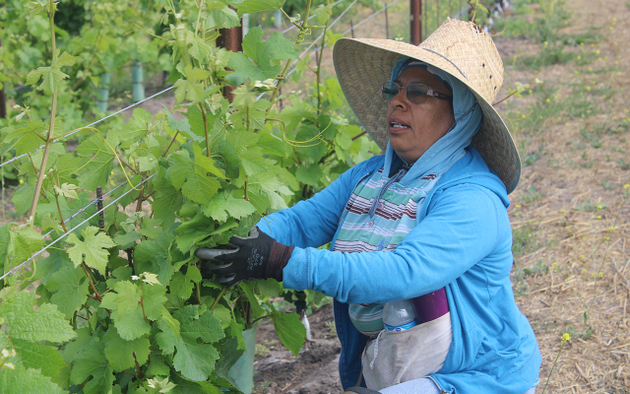
A Mexican migrant worker works at a vineyard in California, one of the U.S. states most dependent on seasonal labour from Mexico in agriculture, and which has now urged President Donald Trump to facilitate the arrival of guest workers from that country so crops are not lost. CREDIT: Kau Sirenio/En el Camino

A Mexican migrant worker works at a vineyard in California, one of the U.S. states most dependent on seasonal labour from Mexico in agriculture, and which has now urged President Donald Trump to facilitate the arrival of guest workers from that country so crops are not lost. CREDIT: Kau Sirenio/En el Camino

The most numerous jobs are in fruit harvesting, general agricultural work such as planting and harvesting, and on tobacco plantations, according to the U.S. Department of Labor.

Migrant workers traditionally come from Mexican agricultural and border states and their main destinations are agricultural areas where there is a temporary or permanent shortage of labourers.

Jeremy McLean, policy and advocacy manager for the New York-based non-governmental organisation Justice in Motion, expressed concern about the conditions in which migrants work.

The way the system works, “it’s not going to be easy to follow recommendations for social distancing. Hundreds of thousands of people are going to come and won’t be able to follow these recommendations, and they will put themselves at risk. It could spell another wave of infection and transmission,” he warned IPS.

“This population group has no health services and no medical insurance. If they fall ill in a remote area, what help can they get?” he said from New York.

On Mar. 26, the U.S. Embassy in Mexico reported that it would process without a personal interview the applications of those whose visas had expired in the previous two years or who had not received them in that time, under pressure from U.S. agribusiness.

Trapped with no way out

The migrant workers’ odyssey begins in Mexico, where they are recruited by individual contractors – workers or former workers of a U.S. employer, fellow workers, relatives or friends, in their hometowns – or by private U.S. agencies.

Although article 28 of Mexico’s Federal Labour Law, in force since 1970 and overhauled in 2019, regulates the provision of services by workers hired within Mexico for work abroad, it is not enforced.

It requires that contracts be registered with the labour authorities and that a bond be deposited to guarantee compliance. It also holds the foreign contractor responsible for the costs of transport, repatriation, food for the worker and immigration, as well as the payment of full wages, compensation for occupational hazards and access to adequate housing.

In addition, it states that Mexican workers are entitled to social security benefits for foreigners in the country where they are offering their services.

Although the Mexican government could enforce article 28 of the law in order to safeguard the rights of migrant workers who enter and leave the United States under the visa programme, it has failed to do so.

In its recent report “Ripe for Reform: Abuse of Agricultural Workers in the H-2A Visa Program”, the bi-national CDM organisation reveals that migrant workers experience wage theft, health and safety violations, discrimination, and harassment as part of a human trafficking system.

Recruitment without oversight

For Mayela Blanco, a researcher at the non-governmental Centre for Studies in International Cooperation and Public Management, the problem is the lack of monitoring or inspections of recruiters and agencies.

“In Mexico there are still many gaps in the mechanisms for monitoring and inspecting recruitment. There is still fraud,” she told IPS. “How often do they inspect? How do they guarantee that things are working the way they’re supposed to?”

There are 433 registered placement agencies in the country, distributed in different states, according to data from the National Employment Service. For the transfer of labour abroad, there are nine – a small number considering the tens of thousands of visas issued in 2019.

For its part, the U.S. Department of Labor reports 239 licenced recruiters in that nation working for a handful of U.S. companies.

Data obtained by IPS indicates that Mexico’s Ministry of Labour only conducted 91 inspections in nine states from 2009 to 2019 and imposed 12 fines for a total of around 153,000 dollars. Some states with high levels of migrant workers were never visited by inspectors.

Furthermore, the records of the federal labour board do not contain any reports of violations of article 28.

Mexico is a party to the Fee-Charging Employment Agencies Convention 96 of the International Labour Organisation (ILO), which it violates due to non-compliance with the rights of temporary workers.

Peña stressed that there is still a gap between the U.S. and Mexico in labour protection and said workers are being left behind because of that gap.

“Countries like Mexico see temporary visas as a solution to labour migration and allow the exploitation of their citizens. The H2 programme is about labour migration and governments forget that bilateral solutions are needed,” she said.

In response to the pandemic and its risks, 37 organisations called on the U.S. government on Mar. 25 for adequate housing with quarantine facilities, safe transportation, testing for workers before they arrive in the United States, physical distancing on farms and paid treatment for those infected with COVID-19.

Blanco emphasised the lack of justice and reparation mechanisms. “The more visas issued, the greater the need for oversight. Mexico is perceived as a country of return or transit of migrants, but it should be recognised as a place of origin of temporary workers. And that is why it must comply with international labour laws,” she said.

McLean raised the need for a new U.S. law to guarantee the rights of migrant workers, who are essential to the economy, as underscored by the demand reinforced by the impact of COVID-19.

“We pushed for a law to cover all temporary visa programmes so that there would be more information, to avoid fraud and wage theft. But it is very difficult to get a commitment to immigration dialogue in the United States today,” he said.

But the ordeal that migrant workers face will not end with their work in the U.S. fields, because in October they will have to return to their hometowns, which will be even more impoverished due to the consequences of the health crisis, and with COVID-19 in all likelihood still posing a threat.
  Source

NYC Library Ditches Controversial Saudi Royal MBS’ Event

Active Citizens, Armed Conflicts, Civil Society, Crime & Justice, Editors’ Choice, Featured, Global Governance, Headlines, Human Rights, IPS UN: Inside the Glasshouse, Middle East & North Africa, North America, Peace, Press Freedom, Regional Categories, TerraViva United Nations

Human Rights

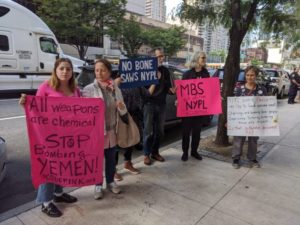
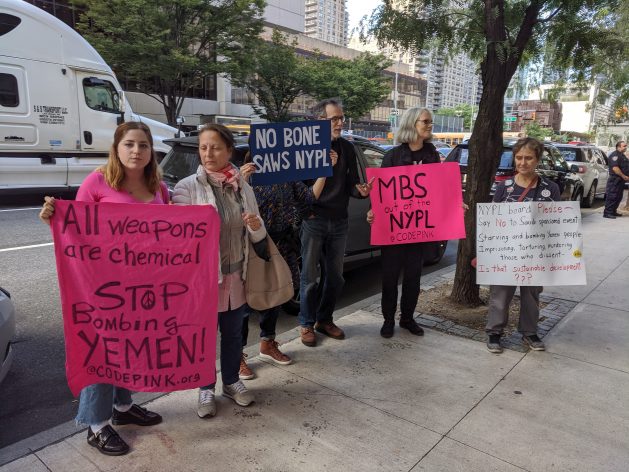
Protestors rallied outside a library building in Manhattan on Wednesday, carrying placards about Saudi Arabia’s war in Yemen and referencing the “bone saw” that was reportedly used to dismember Jamal Khashoggi, a prominent critic of Saudi prince Mohammad bin Salman. Credit: James Reinl/IPS

UNITED NATIONS, Sep 19 2019 (IPS) A New York library appeared to bow to pressure this week when it canceled an event that was being co-hosted by Saudi Arabia’s crown prince Mohammad bin Salman, who is accused of a range of human rights abuses.


On Wednesday, the New York Public Library (NYPL) said it was scrapping the so-called Misk-OSGEY Youth Forum, a workshop on Sept. 23 that was being co-hosted by bin Salman’s Misk Foundation and U.N. youth envoy Jayathma Wickramanayake. 

The event had been blasted by Human Rights Watch (HRW) and other campaign groups, who said it served to whitewash bin Salman’s reputation after the killing of Saudi journalist Jamal Khashoggi in October last year — reportedly on the crown prince’s orders. 

Evan Chesler, chairman of the NYPL board, said that dropping the workshop was the “appropriate thing to do” after weeks of protests and an online petition that had garnered more than 7,000 signatures.

In a statement, the library said it had cancelled the “space rental” amid “concerns about possible disruption to library operations as well as the safety of our patrons” amid “public concern around the event and one of its sponsors”. 

It remains unclear whether the Misk Foundation will seek an alternative venue for the workshop at short notice. A U.N. spokesman told IPS it was “up to Misk to provide information on whether the event will take place elsewhere or not”.

Saudi Arabia’s mission to the U.N. and the Misk Foundation declined to comment on the controversy.

Protestors rallied outside a library building in Manhattan on Wednesday, carrying placards about Saudi Arabia’s war in Yemen and referencing the “bone saw” that was reportedly used to dismember Khashoggi, a prominent critic of bin Salman. 

“This week’s protests show that the public will not keep quiet while the leadership of the NYPL, a treasured repository of civilisation, hires our library out to the butcherer of Khashoggi,” Matthew Zadrozny, president of the Committee to Save the New York Public Library, told IPS.

“The NYPL leadership must explain to the public it serves who signed the deal with bin Salman’s foundation and why.”

Kenneth Roth, director of HRW, blasted the “repression-whitewashing event” on Twitter and asked U.N. secretary-general Antonio Guterres to scrap the partnership between his youth envoy, Wickramanayake, and the crown prince’s charity. 

Suzanne Nossel, CEO of rights group PEN America, said the library had made the “right choice”, addiing bin Salman’s government had “orchestrated the murder and dismemberment of journalist Jamal Khashoggi”.

“Hosting this event just days before the anniversary of Jamal’s killing would have been particularly appalling not just for his family, friends, and colleagues, but also for those currently being persecuted in the kingdom.”

Nossel also noted that the library “is the crown jewel of the literary community in New York” and it stands for “free exchange of ideas and free expression, qualities that the crown prince has repeatedly disdained in both words and actions”.

The NYPL event was set to see some 300 budding young entrepreneurs learn about green themes, corporate responsibility and other parts of the U.N.’s Sustainable Development Goals (SDG) agenda.

Khashoggi, a U.S.-based journalist who frequently criticised the Saudi government, was killed and dismembered on Oct. 2 last year after visiting the Saudi consulate in Istanbul, where he collecting documents for his wedding.

The CIA assessed that bin Salman had ordered Khashoggi’s killing. U.N. expert Agnes Callamard has described the death as a “premeditated execution,” and called for bin Salman and other high-ranking Saudis to be investigated.

Officials in Riyadh, who initially said Khashoggi had left the premises unharmed, now say the journalist was killed by a rogue hit squad that did not involve bin Salman. Activists have since pushed for accountability over the killing.

  Source

Healthy Oceans, Healthy Societies

Active Citizens, Biodiversity, Conferences, Environment, Featured, Global, Headlines, IPS UN: Inside the Glasshouse, North America, Regional Categories, Sustainability, TerraViva United Nations

Biodiversity

Approximately three billion people around the world depend on marine and coastal biodiversity for their livelihoods as fisheries alone generates over 360 billion dollars to the global economy. However, human activity continues to threaten this crucial landscape including through overfishing. Credit: Nalisha Adams/IPS

UNITED NATIONS, Mar 5 2019 (IPS) – Over recent years, there have been shocking reports of marine endangerment and plastic pollution. The threats are clear, and now urgent action is needed more than ever.


Marking World Wildlife Day on Mar. 3 with its theme “Life below water”, the United Nations has stressed the need to promote and sustain ocean conservation not simply to protect underwater life, but also societies.

“‘Life below water’ may sound far away from our daily life; a subject best left to scientists and marine biologists; but it is anything but,” said President of the General Assembly Maria Fernanda Espinosa.

“Increasingly we are coming to understand how connected our world is and how much impact our actions are having on the oceans, on the rivers and waterways, and in turn on the wildlife, above and below water, that have come to rely on them,” she added.

Secretary-General of the Convention on International Trade in Endangered Species of Wild Fauna and Flora (CITES) Ivonne Higuero echoed similar sentiments, stating: “When we think about wildlife, most of us picture elephants, rhinos, and tigers…but we should not forget about life below water and the important contribution they make to sustainable development, as enshrined in Goal 14 of the U.N. Sustainable Development Goals.”

The oceans and its critters have been among the foundations of human societies. Approximately three billion people around the world depend on marine and coastal biodiversity for their livelihoods as fisheries alone generates over 360 billion dollars to the global economy.

More than that, oceans help regulate the climate, producing 50 percent of the world’s oxygen and absorbing 30 percent of carbon dioxide released into the atmosphere.

Yet, human activity continues to threaten this crucial landscape including through overfishing.

According to the U.N., around 30 percent of fish stocks are overexploited, often at unsustainable levels. While some policies are in place to reduce overfishing, illegal fishing is still commonplace.

Illegal and unregulated fishing constitutes an estimated 12 to 30 percent of fishing worldwide.

For instance, the high prices of caviar has fuelled illegal overfishing and near extinction of species of sturgeon and paddlefish.

The International Union for Conservation of Nature (IUCN) has listed 16 of the 27 species of sturgeon and one of the six species of paddlefish as endangered.

Espinosa particularly pointed to the issue of plastic pollution in oceans which has become a growing concern worldwide.

“Every minute a garbage truck worth of plastic makes its way to the sea. Some of this plastic remains in its original form, while much more is broken down into microplastics that are consumed by fish and other creatures, eventually finding their way into our own food, our own water,” she said.

“This is not the way we treat our home, our planet. This is not the way we maintain a sustainable and healthy ecosystem,” Espinosa added.

An estimated 5 to 12 million tonnes of plastic enter the ocean every year and many have ended up on the beaches of the world’s most isolated islands and others in the guts of whales and sea turtles.

Even in the 7-mile deep Mariana Trench, research found all specimens had plastic in their gut.

According to a report by the Ellen MacArthur Foundation, the oceans could have more plastic than fish by 2050 if current trends continue.

But through the dark clouds, there is a glimmer of hope as civil society organisations, U.N. agencies, and governments band together to protect oceans.

Launched by U.N. Environment (UNEP), the Clean Seas campaign is now the world’s largest global alliance for combating marine plastic pollution with commitments covering over 60 percent of the world’s coastlines.

The 57 countries who have joined the campaign have pledged to cut back on single-use plastics and encourage more recycling.

Already, many governments have taken up the challenge.

In December, Peru decided to phase out single-use plastic bags over the next three years.

In the U.S., cities such as Seattle and Washington, D.C. have implemented a ban on plastic straws and businesses could receive fines if they continue to offer the items.

Though this makes up only a small fraction of the marine plastic pollution issue, such low-hanging fruit seems to be the best place to start.

International non-profit organisation Global Fishing Watch has established an online platform where they record and publish data on the activity of fishing boats, providing a map of hot spots where overfishing might occur and who is responsible.

After recording data on more than 40 million hours of fishing in 2016 alone, they found that just five countries and territories including China, Spain, and Japan account for more than 85 percent of observed fishing.

The Environmental Defence Fund (EDF), on the other hand, has utilised a rights-based management approach, working directly with fishermen who receive a secure “catch share” upon complying to strict limits that allow fish populations to rebuild.

This approach has helped combat the issue of overfishing, which has dropped 60 percent since 2000 in the United States, and provides stable fishing jobs with increased revenue.

For instance, EDF worked with fishermen in the Gulf of Mexico where red snapper stocks were overexploited and continually declined. Scientists determined a sustainable threshold to catch red snapper which was then divided into shares and allocated to the fishermen.

With strict limits as to how much to fish, the red snapper population quickly flourished and by 2013, it was taken off the “avoid” list organised by the Monterey Bay Aquarium.

Higuero also highlighted the role CITES which regulates international trade in marine species, ensuring it is sustainable and legal.

“Well-managed and sustainable international trade greatly contributes to livelihoods and the conservation of marine species…we are all striving to achieve the same objective of sustainability: for people and planet – where wildlife, be it terrestrial or marine, can thrive in the wild while also benefiting people,” she said.

Secretary-General Antonio Guterres pointed to the importance of marine life for current and future societies.

“Marine species provide indispensable ecosystem services…let us raise awareness about the extraordinary diversity of marine life and the crucial importance of marine species to sustainable development.  That way, we can continue to provide these services for future generations,” he said.