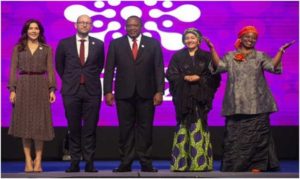
Hosted by the governments of Kenya, Denmark and UNFPA, world leaders gather for the 3-day Nairobi Summit on ICPD25 to advance sexual, reproductive health & rights for all. November 12, 2019. Photo Courtesy: Redhouse Public Relations
NAIROBI, Kenya, Dec 31 2019 (IPS) – Happy New Year, Kenya. 2020 marks a decade of action towards the realization of the Sustainable Development Goals by 2030.
Peace and development are inextricably linked, with each making the achievement of the other far more likely. This puts the conflict-prevention and development work of the UN at the heart of the agenda in East Africa, but in a multi-agency and programme environment, making meaningful progress is challenging.
Aware of this, the UN began a process of structural reforms led by the UN Secretary-General António Guterres who made reforms of the United Nations, a priority at the very beginning of his term in January 2017. The aim being to deliver better results through cooperation, collaboration and integration. 2019 was the year that the impact of these reforms became real and nowhere more than in the peace, conflict-prevention and development pillars of the UN’s work.
At the country level, that shift towards a nimble, 21st century UN challenges deeply entrenched practices and operations. In a country team with over 23 individual agencies, funds and programmes, the reform process can be complicated, even messy.
To the credit of the Kenya country team, we overcame the challenges of ceding long-held agency interests for the collective good and achieved some ground-breaking milestones in our partnership with governments, civic organizations and the private sector.
The most outstanding was our venturing out to confront challenges that transcend borders. East Africa faces major threats to peace and development across multiple fronts, and respective UN country teams have, in a remarkable show of teamwork, sought to harmonize their responses to these threats. Internecine border conflicts and the effects of climate change together make a formidable challenge that brought together UN teams from Kenya and Uganda, in a pact that seeks to bring sustainable development to the Karamoja triangle.
This pact follows from another successful regional collaboration project on the Kenya-Ethiopia border where communities accustomed to recurrent hostilities are now reaching out to each other to find solutions to common socio-economic challenges.
We believe that our regional surge towards prevention, peacemaking and diplomacy will have a particular impact on the youth, who suffer an enduring sense of being neglected and ignored. This narrative is a breeding ground for extremism and radicalization, so addressing such concerns was a key point of deliberation during last July’s African Regional High-Level Conference on Counter-Terrorism and the Prevention of Violent Extremism in Nairobi.
But there remain many in the region still left behind by development, and we continue to stand up for them through our UN Development Assistance Framework 2018-2022. The framework’s gender equality and rights focus is unmistakable, because in too many communities, the simple fact of being born female shatters one’s chances of living in full human dignity.
As 2020 beckons, the decade of action starts and it has to be a sprint to deliver on the SDGs, the UN team in Kenya is rolling up its sleeves with greater urgency, ambition and innovation. We will enhance regional cooperation and private-public partnerships as we work with the Government towards lifting millions of the citizens of this region out of poverty and upholding their human rights.
We are re-imagining ways of delivering development in ways such as the co-creation of an SDG innovation lab between the Government of Kenya, the Centre for Effective Global Action at the University of California in Berkeley, the Rockefeller Foundation, and the UN. The SDG Lab will kick off with support for the delivery of Kenya’s Big Four agenda by harnessing, big data, technology and innovation to achieve scale and impact.
As a UN country team, we got off the blocks in 2019 in pursuit of UN Deputy Secretary General Amina Mohammed’s challenge to “flip the orthodoxy” for the repositioning of the UN. We have dared to go beyond the typical and will do whatever it takes to respond effectively to the challenges faced by Kenya’s people, now and in the future.
Tariq Rauf, former Head of Verification and Security Policy Coordination, Office reporting to the Director General, International Atomic Energy Agency (2002-2011), was responsible for safeguards and security policy, the Director General’s annual report on the Application of Safeguards in the Middle East and for the IAEA Forum on the Experience of NWFZs relevant for the Middle East.
Credit: United Nations
VIENNA, Nov 20 2019 (IPS) – A historic conference on the Middle East opened at the United Nations in New York on 18th November and will continue until 22nd November. The Conference on the Establishment of a Middle East Zone Free of Nuclear Weapons and Other Weapons of Mass Destruction is presided over by Ambassador Sima Bahous of Jordan.
This matter has been before the international community since 1974 and remains controversial and unresolved to this day. On the one side, the Arab States of the region of the Middle East and Iran have called for the establishment of a nuclear-weapon-free zone in the Middle East and the dismantlement of Israel’s clandestine nuclear weapon programme.
On the other side, Israel supported by the EU member States, Canada and the US, maintain that regional peace and security is a pre-condition for any negotiations on such a zone and that concerns about nuclear programmes in certain Arab States also need to be resolved first.
Thus, this matter has simmered for decades, plagued the proceedings and outcomes of the review conferences of the nuclear non-proliferation treaty, the annual General Conferences of the International Atomic Energy Agency (IAEA), as well as the First Committee and the United Nations General Assembly.
Now finally, pursuant to a decision by the General Assembly in December 2018, this conference is going ahead albeit without the participation of Israel and the United States.
Nuclear-weapon-free zones
The original concept of establishing nuclear-weapon-free zones (NWFZs) was conceived with a view to preventing the emergence of new nuclear-weapon possessor States.
Efforts to ensure the absence of nuclear weapons in other populated parts of the world have led to five regional denuclearization agreements—the 1967 Treaty of Tlatelolco covering Latin America, the 1985 Treaty of Rarotonga covering the South Pacific, the 1995 Treaty of Bangkok covering Southeast Asia, the 1996 Pelindaba Treaty covering Africa, and the 2006 Central Asian NWFZ treaty, all are in force—thus the entire southern hemisphere below the Equator is covered by NWFZ treaties.
In addition, in 1992 Mongolia declared itself to be a nuclear-weapon-free space that was approved by the Great Hural in 2000 and endorsed by UNGA in 2002.
Also, certain uninhabited areas of the globe have been formally denuclearized. They include Antarctica under the 1959 Antarctic Treaty; outer space, the moon, and other celestial bodies under the 1967 Outer Space Treaty and the 1979 Moon Agreement; and the seabed, the ocean floor, and the subsoil thereof under the 1971 Seabed Treaty.
General Assembly resolution 3472 B (1975) defines a Nuclear-Weapon-Free Zone as
• any zone recognized as such by the General Assembly of the United Nations, which any group of States, in the free exercises of their sovereignty, has established by virtue of a treaty or convention whereby: a) The statute of total absence of nuclear weapons to which the zone shall be subject, including the procedure for the delimitation of the zone, is defined; b) An international system of verification and control is established to guarantee compliance with the obligations deriving from that statute.
NWFZs ban the production, testing and stationing of nuclear weapons, permit peaceful uses, include verification provisions and in some cases an institutional set up; and require security assurances from nuclear-weapon States.
Article VII of the Treaty on the Non-Proliferation of Nuclear Weapons (NPT) affirmed the right of States to establish NWFZs in their respective territories and the 1995 NPT Review and Extension Conference (NPTREC) expressed the conviction that regional denuclearization measures enhance global and regional peace and security.
The NPTREC adopted a Resolution on establishing a zone free of nuclear and other weapons of mass destruction as well as delivery systems in the region of the Middle East. The 2000 NPTRevConf reiterated the importance of the 1995 Resolution, and the 2010 RevConf mandated that a conference be held on such a zone by 2012; and the 2015 RevConf came to an inglorious end over disagreements on the Middle East zone.
Earlier in 2000, the IAEA General Conference adopted a Resolution for the IAEA Director General to convene a Forum on Experience of NWFZs Relevant for the Middle East. On joining the IAEA in 2002, the Director General assigned me the task to make the arrangements for holding this Forum – during the course of the summers of 2002-2004, I was able to get agreement on the Agenda but the Forum itself was convened only in November 2011.
Representatives from all five zones and Mongolia attended and made presentations at the IAEA Forum; however, under the-then Director General the Agency acceded to pressure from certain sources to ensure that the Forum was a one-off event and that there would not be any follow-up activities.
In terms of new NWFZs, the Middle East remains an old unfulfilled aspiration. First jointly proposed by Egypt and Iran in 1974 through a General Assembly resolution, the concept was broadened in 1990 through the Mubarak Initiative to cover all weapons of mass destruction.
There is as yet no general agreement on the contours and details of a WMD-free zone (WMDFZ), however keeping to basics it is possible to identify practical measures and elements – as is endeavoured in the draft treaty text prepared by The METO Project.
Middle East
Traditionally, Egypt has taken the lead in promoting efforts for the implementation of the 1995 NPTREC Resolution on the Middle East in the NPT review process, as well as at the IAEA General Conference and at the First Committee of the UN General Assembly (UNGA) on the establishment of a NWFZ in the region of the Middle East.
Last year, UNGA First Committee adopted by voting (103 yes :3 no : 71 abstentions) decision (A/C.1/73/L.22/Rev.1) co-sponsored by Algeria, Bahrain, Comoros, Djibouti, Egypt,* Iraq, Jordan, Kuwait, Lebanon, Libya, Mauritania, Morocco, Oman, Qatar, Saudi Arabia, Somalia, Sudan, Tunisia, United Arab Emirates, Yemen and State of Palestine on Convening a conference on the establishment of a Middle East zone free of nuclear weapons and other weapons of mass destruction.
The UNGA decision A/73/546, adopted on 22 December 2018 by a vote of 88 to 4 with 75 abstentions, called on the UN Secretary General to:
• convene a conference for the duration of one week to be held no later than 2019 dealing with the establishment of a Middle East zone free of nuclear weapons and other weapons of mass destruction; • the conference shall take as its terms of reference the 1995 NPTREC resolution; • all decisions emanating from the conference shall be taken by consensus by the States of the region; • all States of the Middle East, the three co-sponsors of the 1995 resolution on the Middle East, the other two nuclear-weapon States and the relevant international organisations (IAEA, OPCW, BTWC ISU) to participate; • the Secretary-General to convene annual sessions of the conference for a duration of one week at United Nations Headquarters until the conference concludes the elaboration a legally binding treaty establishing a Middle East zone free of nuclear weapons and other weapons of mass destruction, on the basis of arrangements freely arrived at by the States of the region ; .
Accordingly, Under-Secretary General and High Representative for Disarmament Izumi Nakamitsu and the Department for Disarmament Affairs made the preparations to hold the conference on 18-22 November 2019.
The main areas of contention between the Arab States and Israel can be summarized as follows: that there still continues to be a long-standing and fundamental difference of views between Israel, on the one hand, and other States of the Middle East region, on the other hand, with regard to the establishment of a zone free of nuclear and other weapons of mass destruction in the region of the Middle East (MENWFZ/WMDFZ).
Israel takes the view that MENWFZ/WMDFZ and related regional security issues, cannot be addressed in isolation from the regional peace process and that these issues should be addressed in the framework of a regional security and arms control dialogue that could be resumed in the context of a multilateral peace process.
These should help reduce tensions, and lead to security and stability in the Middle East, through development of mutual recognition, peaceful and good neighbourly relations and abandonment of threats and use of force by states as well as non-State actors as means to settlement of disputes.
Following the establishment of full and lasting peaceful relations and reconciliation among all nations of the region, such a process could lead to the adoption of confidence-building measures, discussion of arms control issues, and eventually pave the way to regional negotiations of a mutually and effectively verifiable regime that will establish the Middle East as a zone free of chemical, biological, and nuclear weapons as well as ballistic missiles.
Israel also holds the position that any modalities, obligations or provisions should be solely addressed by the states concerned through direct negotiation.
The other States of the region maintain that there is no automatic sequence which links the establishment of the zone, the application of IAEA comprehensive safeguards to all nuclear activities in the Middle East, to the prior conclusion of a peace settlement, and that the former would contribute to the latter.
The Arab States maintain that all of them have acceded to the NPT, while Israel continues to defy the international community by refusing to become a party to the Treaty or to place its installations under the Agency’s comprehensive safeguards system, thus exposing the region to nuclear risks and threatening peace.
Israel’s possession of nuclear weapons is likely to lead to a destructive nuclear arms race in the region; especially if Israel’s nuclear installations remain outside any international control.
Most Arab States of the region of the Middle East consider that:
• the 2018 UNGA decision A/73/546 on convening a conference on the zone was a breakthrough; • the new initiative through the UNGA is directed at all States of the region of the Middle East, the three co-sponsors of the1995 NPTREC Resolution are invited and no States of the region shall be excluded; • while the UNGA route was not ideal, it was resorted to as there was no realistic alternative due to the prevailing situation regionally and globally; and • the initiative shall be fully inclusive, involve direct dialogue, be based on arrangements freely arrived at, there will be no singling out of any State of the region; however, if any State of the region does not attend, this cannot prevent other States of the region to attend the conference slated for November this year.
Regarding the question of how to deal with the Middle East issue at the 2020 review conference of the nuclear Non-Proliferation Treaty (NPT), the following points are relevant:
(a) the NPT review process remains the primary focus and the UNGA initiative is not an alternative to the NPT process but should be regarded as parallel and complementary; (b) it can alleviate pressure on the 2020 review conference; (c) there is no intention to hold the review conference hostage to the Middle East issue and the NPT States of the region want the review conference to be successful; (d) the UNGA conference shall be open to all States and now it is important to start engagement and preparations on the modalities and procedural aspects; (e) the assertion is incorrect that Israel was not consulted in advance on the 2018 resolution at UNGA, in fact it was consulted in advance of the decision; (f) the decision garnered more than 100 affirmative votes at UNGA, which was a clear majority; (g) the 2019 NPT PrepCom should take factual note of the UNGA decision to convene the conference in November; (h) the Middle East zone issue remains within the NPT process and the 2020 review conference would have to reaffirm and recognize this; (i) the November conference provides an opportunity to all States to meet and discuss zone matters, express views, all decisions shall be by consensus, it is an opportunity for direct consultations among the States of the region of the Middle East, and it is up to the States of the region to decide whether to sign/ratify a future MEWMDFZ treaty; (j) the Middle East zone now can be considered as the fourth pillar of the NPT; (k) it is regrettable that some States (Israel and the United States) had urged the IAEA (and other relevant international organizations) not to attend the November conference; (l) the NPT States of the region believe in collective not selective security and this calls for the universalization of the NPT and the cessation of granting privileges to States not party to the Treaty (Israel); (m) regarding the three co-sponsors (Russia, UK, USA) of the 1995 NPT Review and Extension Conference Resolution calling for the establishment of a zone free of nuclear and other weapons of mass destruction: the UK has voiced support for the vision of a MEWMDFZ and is attending the November conference; the Russian Federation endorsed the convening of the conference also is attending the November conference which it regards as easing pressure at the 2020 review conference; while the US has indicated support for the goal of a Middle East free of WMD based on direct dialogue and consensus but has condemned the General Assembly decision of 2018 to convene the November conference as “illegitimate” and is boycotting the conference; and (n) Israel too has decided not to attend the November conference.
The METO Project
The Middle East Treaty Organization (METO) Project for a zone free of WMD in the Middle East represents a civil society initiative on “Achieving the Possible” was launched and sustained by Sharon Dolev of the Israeli Disarmament Movement and has attracted support from experts from States of the region of the Middle East as well as from other countries. The METO project has developed the elements of a text of a MEWMDFZ treaty that has been shared with the States of the Middle East region and is designed to serve as a catalyst for them to jump start discussions on such a treaty.
Ii is hoped that the States attending the current conference can draw motivation, ideas and elements from the draft treaty text prepared by the METO Project as they discuss the possible elements and provisions of a future treaty that can garner the support of the States of the region.
Some may find shortcomings or omissions in the draft text but States of the region and other concerned parties are invited to further develop, enhance and enrich the elements presented in the draft text.
This effort needs to be joined not by sceptics nor naysayers but by optimists and those who are serious about promoting the cause of a Middle East free of weapons of mass destruction and of its transformation into a region of peace, justice and security.
Conclusion
The Conference on the Establishment of a Middle East Zone Free of Nuclear Weapons and Other Weapons of Mass Destruction now underway at the United Nations in New York provides a belated but important opportunity to address regional security, non-proliferation and disarmament matters in the region of the Middle East.
It sets into place an annual process focusing on discussing matters pertaining to eliminating the threats, dangers and risks of nuclear, chemical and biological weapons in the region; achieving universal adherence in the region to the NPT through the verified elimination of Israel’s nuclear weapon programme, and also securing universal adherence in the region to and compliance with the Biological and Toxin Weapon Convention and the Chemical Weapons Convention that prohibit biological and chemical weapons, and signature and/or ratification of the Comprehensive Nuclear-Test-Ban Treaty (CTBT) that prohibits all types of nuclear explosive tests.
Bringing peace and security to the region of the Middle East should be accorded the highest priority by the States of the region as well as by all other States.
The views expressed are the writer’s personal observations.
KINGSTON REIF is director of disarmament and threat reduction policy at the Arms Control Association and SHANNON BUGOS, research assistant.
WASHINGTON DC, Oct 18 2019 (IPS) – The Trump administration is reportedly on the verge of withdrawing from the 1992 Open Skies Treaty, according to lawmakers and media reports. Rep. Eliot Engel (D-N.Y.), chairman of the House Foreign Affairs Committee, first sounded the public alarm in an Oct. 7 letter to National Security Advisor Robert C. O’Brien.
“I am deeply concerned by reports that the Trump Administration is considering withdrawing from the Open Skies Treaty and strongly urge you against such a reckless action,” Rep. Engel wrote. “American withdrawal would only benefit Russia and be harmful to our allies’ and partners’ national security interests.”
Slate columnist Fred Kaplan reported Oct. 9 that former National Security Advisor John Bolton pushed for withdrawing from the treaty before departing the administration.
Following Bolton’s departure in September, White House staff continued to advocate for withdrawal and convinced President Trump to sign a memorandum expressing his intent to exit the treaty. The Omaha World-Heraldreported that the signed document directed a withdrawal by Oct. 26.
House Armed Services Committee Chairman Rep. Adam Smith (D-Wash.), Senate Foreign Relations Committee Ranking Member Sen. Bob Menendez (D-N.J.), and Senate Armed Services Committee Ranking Member Jack Reed (D-R.I.) joined Rep. Engel in an Oct. 8 letter to Secretary of State Mike Pompeo and Secretary of Defense Mark Esper denouncing a possible withdrawal.
The lawmakers wrote that “pulling out of the Open Skies Treaty, an important multilateral arms control agreement, would be yet another gift from the Trump Administration to Putin.” They also noted that the treaty “has been an essential tool for United States efforts to constrain Russian aggression in Ukraine.”
The United States and several allies in December 2018 conducted an “extraordinary flight” over eastern Ukraine under the Open Skies Treaty. The flight followed a Russian attack in late November 2018 on Ukrainian naval vessels in the Black Sea.
Republican lawmakers also expressed concern about ditching the treaty. In an Oct. 8 statement, Rep. Don Bacon (R-Neb.) stated that he has “yet to see a compelling reason to withdraw from Open Skies” given the “valuable access to Russian airspace and military airfields” the United States gains from the treaty.
Signed in 1992, the Open Skies Treaty permits each state-party to conduct short-notice, unarmed, observation flights over the others’ entire territories in order to collect data on military forces and activities. The treaty entered into force in January 2002 and currently has 34 states-parties, including the United States and Russia.
According to the treaty, states-parties must give one another 72 hours advance notice before conducting an overflight. At least 24 hours in advance of the flight, the observing state-party will supply its flight plan, which the host state-party can only modify for safety or logistical reasons.
No territory is off-limits under the treaty. Each participating country is assigned a quota of overflights it can conduct and a quota, based on its geographic size, of overflights it must accept every year.
Since 2002, there have been nearly 200 U.S. overflights of Russia and about 70 overflights conducted by Russia over the United States. After the overflight, the information collected must be provided to all states-parties.
In recent years, disputes over implementation and concerns from some U.S. officials and lawmakers about the value of the treaty have threatened to derail the pact.
For example, Washington has raised concerns about Russian compliance with the treaty, citing, in particular, Russia’s restricting of observation flights over Kaliningrad to no more than 500 kilometers and within a 10-kilometer corridor along Russia’s border with the Georgian border-conflict regions of South Ossetia and Abkhazia.
In response, the United States has restricted flights over the Pacific Fleet in Hawaii and the missile defense interceptor fields in Fort Greely, Alaska.
The House-passed version of the fiscal year 2020 defense authorization act included a provision that would reaffirm Congress’ commitment to the treaty and prohibit the use of funds to suspend, terminate, or withdraw from the agreement unless “certain certification requirements are made.”
The Senate version of the bill did not include a similar provision. The House and Senate continue to negotiate a final version of the bill.
Sohrab Razzaghi is Executive Director of Volunteer Activists Institute a non-profit, non-governmental, non-political and independent institute, whose primary aim is capacity building among activists and civil society organizations for democracy, human rights and peace building within Iranian society and communities in the MENA region.
Masana Ndinga-Kanga is MENA Advocacy Lead at CIVICUS, an alliance of 7000 civil society partners around the world.
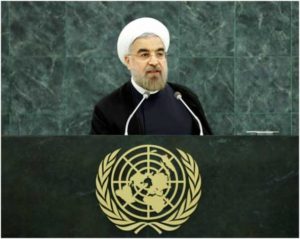
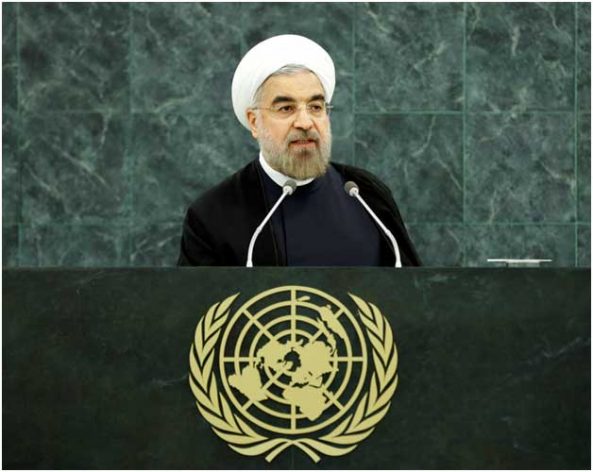
President Hassan Rouhani of Iran
JOHANNESBURG / AMSTERDAM, Oct 15 2019 (IPS) – 2019 has not been a good year for Iranian human rights activists. At a time where civic space had completely closed, many watched in disbelief as the regime mounted even more restrictions on civil society. Over recent months, many activists have been arrested, like Noushin Javari (a photographer), Marzieh Amiri (a journalist), and Javad Lal Mohammadi (teacher).
As the UN Third Committee prepares to meet in October 2019, it will be worth following whether the General Assembly will take proactive steps to respond to the crisis in Iran or continue to avert its eyes in the face of complicated global politics that have emboldened President Rouhani in his regressive anti-western crackdown on civil society.
During the UN General Assembly on 25 September 2019, Iranian President Rouhani’s called for the creation of a ‘coalition of hope’ in the Gulf region, that would focus on “peace, stability, progress and welfare” and working to “invest on hope towards a better future rather than in war and violence [sic],” with the aim of restoring justice and peace.
However, the civic space track record of Iran and many of its Gulf neighbours demonstrates that oftentimes the state is the perpetrator of violence and restrictions in-country, curtailing the very justice and peace it aims to implement.
It then begs the question, how can a regional coalition of hope be developed, when the state so frequently responds to human rights defenders with violence – excluding the language of human rights from even sustainable development goals.
Many civil society actors have been detained – deemed enemies of the state and foreign agents. As Iranian communities reel under the pressure of yet another bout of sanctions, it is worth begging the question ‘does the closure of civic space serve the interests of sustainable development in Iran?’
Contrary to what policymakers responsible for civic space closure might think, these restrictions ultimately hurt sustainable development. Human rights activists around the world, including in Iran, are oftentimes the critical purveyors of equitable ‘sustainability’ in the development process, campaigning for environmental justice, worker’s rights and the respect for the dignity and humanity of all.
In 2018, the Ayatollah Khamenei’s official website published a draft 50-year vision for “progress.” The document, entitled the Islamic-Iranian Pattern for Progress (IIPP), sets out a set of objectives to be met by 2065, covering a vast range of issues, among them the economy, justice and poverty – still to be approved by parliament.
The plan focuses on addressing poverty, the economy and the justice system. It seeks further alignment of religion and the sociopolitical system in the country, but also includes provisions for “prompting independence, accountability and specialization in the judiciary” and “enhancing women’s position and providing equal opportunities for them, with emphasis on their role as mothers.”
Critics of the regime would not be wrong to look at these policy objectives with concern, especially as the regime has a narrowed position on the role of women in society and has repeatedly failed to guarantee independence of the judiciary – where human rights defenders and political dissenters are subject to numerous violations of the International Convention on Civil and Political Rights (to which Iran is party).
According to a recent comparative report on Sustainable Development, Iran is in 82nd place among 156 countries. This lower-than-average score, however, is not surprising. Iran has not committed to the indexes of sustainable development, meaning people in Iran are not participating in a systematic and organized manner in the process of development. Instead, policymaking and development is a top-down process steered by the government.
In fact, most involvement of Iranians in this process is decorative. As a solution, Iranians have been organizing themselves in civil society to combine their voices and make sure they are heard. This, however, is counteracted by repression from the state, resulting in the country being rated as closed on the Civicus Monitor.
Countless activists who have been advocating for the true meaning of sustainable development have paid the price. Civil society activists, especially environmental activists, labor union and teacher union activists, as well as human rights defenders have been wrongfully persecuted.
Eight environmental activists are sitting in prison on charges of espionage, four of whom are additionally charged with “sowing corruption on earth”. If convicted, they will face death penalty. Another environmental expert, Dr. Kavous Seyed Emami, died in detention, and the circumstances of his death are unclear.
According to the Iranian Constitution, citizens are permitted to set up associations and assemblies; yet this clause is not implemented. Few, if any, groups have permission to freely form associations, including socio-political groups or ethnic/religious minorities. Last month for example, Omid Mehr foundation was closed by government authorities. When asked about the reason for closure, authorities said that Omid Mehr foundation was advocating Western values, which does not fit in Iran.
The false claim that campaigning for human rights is equal to advocating Western values is an adage used by repressive regimes to silence dissent and put forward a development agenda that excludes minorities and others on the margins. But development is not sustainable if they are excluded.
For example, the regime frequently equates the campaigns of women to determine their dress codes as acts against the state, threats to national security or prostitution. Despite the peaceful protest (handing out flowers in commemoration of International Women’s Day) against the hijab by Yasaman Aryani and Monireh Arabshahi, they were sentenced to 16 years imprisonment after being subject to enforced disappearance. Such lengthy sentences and gross human rights violations do not equate sustainability nor development.
The government not only fails to safeguard the freedom of associations and civil society organizations, but actively creates non-independent organizations (or Governmental NGOs, GONGOs) to put forward an inaccurate picture of civic engagement by the state.
Only CSOs that support the agenda of the state are accepted by the government, strengthening the top-down, government-centered way of working. The Organization for Defending Victims of Violence (ODVV), one of many GONGOs, attends international meetings, including UNHRC meetings.
Actively curating a counter-narrative of progress through GONGOs shows the vulnerability of the state to international pressure in an interconnected global political economy. The state recognizes its reliance on international partnerships for the advancement of its economic objectives.
But instead it fails to align its internal policy processes to international human rights conventions – channeling resources that could be spent on authentic engagement with civil society in country to its image. As a result, tensions in Iran are mounting at the dire state of socioeconomic affairs.
For instance, in January 2018, mass protests against poverty and economic difficulties erupted in the country. Rather than engage with citizens, the state responded through 4,967 arrests and any assembly was strictly and heavily repressed.
Among those arrested were activists, women, workers, students and teachers. Many of the arrestees have been sentenced to long imprisonment terms. Many more are critical to the realization of sustainable development in Iran.
Rather than supporting socioeconomic development, the state-imposed limitations on freedom of assembly and association in Iran, have weakened and decapacitated citizen engagement, and prevented their participation in the process of achieving sustainable development. It is short-term thinking that creates enemies of civil society and sustainable development.
In fact, a dynamic, vibrant, democratic and development-oriented association landscape is an important requirement for sustainable development. By releasing activists and opening the civic space, Iran can truly begin the process of social change for the upliftment of all.
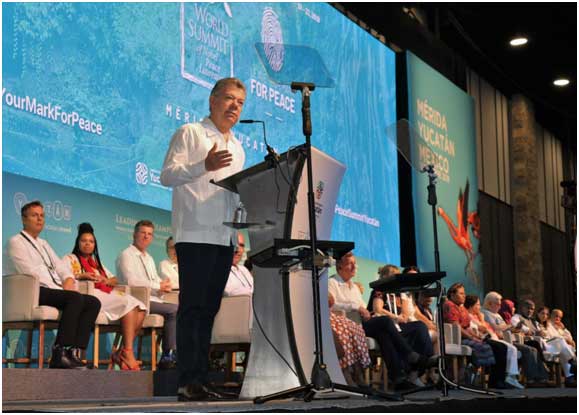
Nobel Peace Laureate and Former President of Colombia Juan Manuel Santos, opens the summit with other Laureates onstage (David Dickstein/Prose & Comms Inc.)
MERIDA, Mexico, Sep 23 2019 (IPS) – In a world of increasing fragility and declining resources, can the world foster peace? With a looming climate crisis, is war inevitable? Will nuclear war be the final result? Are women the ultimate peace builders? How do we train and engage youth to promote peace?
These are some of the questions posed during last week’s three-day World Summit of Nobel Peace Laureates in Merida, Mexico which brought together 1,200 youth and 30 Nobel Peace Laureates — individual and organizations — Juan Manuel Santos, Former President of Colombia; F.W. De Klerk, former President of South Africa; Lord David Trimble, Northern Ireland; and Lech Walesa, former President of Poland.
Women continue to claim a larger seat at the Nobel Peace table. In attendance were Rigoberta Menchu Tum for her work promoting the rights of indigenous peoples; Jody Williams, awarded for her work to eradicate landmines; Shirin Ebadi, for the struggle for women and children’s rights; Tawakkol Karman of Yemen; and Leymah Gbowee of Liberia.
A few key takeaways: Former President of Colombia, Juan Manuel Santos, awarded a Nobel Peace Prize for work with FARC to negotiate peace and end a brutal civil war, noted positive developments at home, but said some segments are taking steps backwards.
However, he remained steadfast in his commitment to peace: “For each terrorist blinded by hate, there are millions of youth that wish to preserve it. We are not here to say everything is fine, but we are here to leave our mark for peace.”
Discussing the social and economic dimensions of peace, Nobel Laureate Jody Williams railed on the world’s grotesque amounts of income disparity, and called for a total restructuring of the world’s socioeconomic systems.
While many citizens move to massive cities — megalopolises — to access employment, education and health care, they end up encountering racism. “How do we move forward on the common good?” she asked, noting that in America alone, 57 percent of the US disposable budget is spent on the military and weapons, while only 6 percent goes to health and education.
Nobel Laureate Lord David Trimble of Northern Ireland expressed concern over several regions in the world where conflicts continue, such as the Mideast, where there are proxy wars, as well as Iran’s moves to become a hegemonic state.
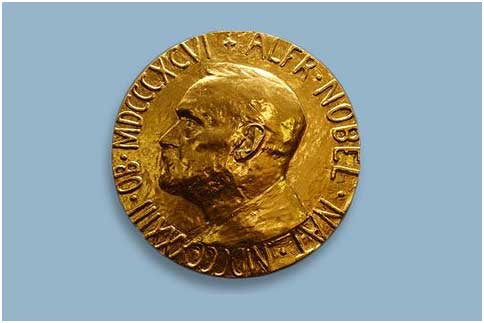
Photographic reproduction of the Nobel Peace Medal. Credit: UN Photo/John Isaac
There are dangers in the South China sea, and threats of a US-China trade war – all of it having a ripple effect, with a potential to greatly impact business and other activities.
Things are getting worse on the democracy front, according to Trimble. “It is not going as well as we would like,” he said, referring to the elections last week in Russia, where the state coerced and manufactured results, producing outcomes that were presented as democratic, but were far from it.
Highlighting the danger of technology controlled in the hands of a few mega corporations, Nobel Laureate Kailash Satyarti called for democratization of tech, and added that, the world has globalized everything, but that it needed to “globalize the compassion that exists in all of us.”
Bernice King, CEO of the King Center, and the youngest daughter of civil rights leader Martin Luther King, challenged all those who came to the summit. “ All of you have a passion to see positive change in our world. We all want peace but it has to be intentional on a daily basis,” she said. Her practical advice? Peace builders need to find an accountability partner to support them when frustrated or depressed.
King offered a message of hope: just like her father: “The only way our world is going to change, is that we have it in our hearts to be love, compassion, strength, nurturing and kindness,” she said, adding that Martin Luther King said that the children of darkness were much more determined than the children of light.
In a panel on nuclear disarmament, Jonathan Granoff, President of the Global Security Institute, and UN Representative of the Permanent Secretariat of the World Summits of Nobel Peace Laureates, posed the question: “Is it legal to annihilate the future?” Because with the power of today’s nuclear weapons, they are a quick end,” he said.
Humanity has come very close to another nuclear war but has been unbelievably lucky, according to Dr. Ira Helfand, co-chair of the Physician’s for Social Responsibility’s nuclear weapons abolition committee.
“Sooner or later our luck will run out. It is no longer a question of when there will be a nuclear war, not if there will be one,” he said, adding that youth today did not understand the enormity of the threat – greater in power and numbers. Put simply, today’s nuclear weapons can annihilate the planet in short order.
In a nod to youth’s achievements, Mohamad Al Jounde was awarded the Turner Social Change Prize, and local student Saskia Niño de Rivera was given the Leave Your Mark for Peace Award.
During closing ceremonies, delegates stated that human rights are non-negotiable. The final document, the Merida Declaration states that: “As long as basic freedoms are violated and gross corruption, violence, extreme poverty, inequality, racism, modern-day slavery and trafficking of persons, discrimination, and discrimination phobias exist, there can be no true peace. We proclaim that true peace is inseparable from the achievement of true justice.”
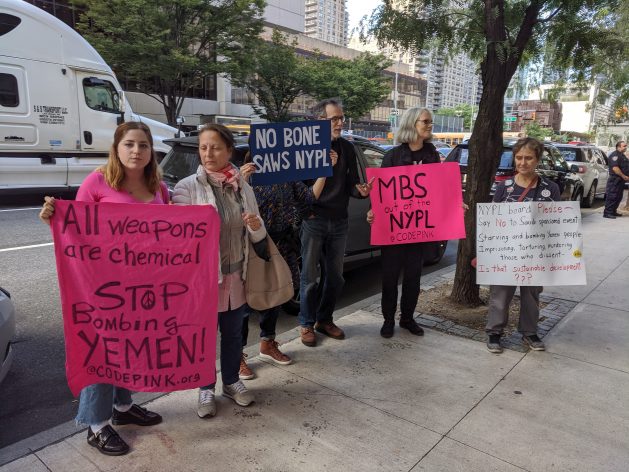
Protestors rallied outside a library building in Manhattan on Wednesday, carrying placards about Saudi Arabia’s war in Yemen and referencing the “bone saw” that was reportedly used to dismember Jamal Khashoggi, a prominent critic of Saudi prince Mohammad bin Salman. Credit: James Reinl/IPS
UNITED NATIONS, Sep 19 2019 (IPS) – A New York library appeared to bow to pressure this week when it canceled an event that was being co-hosted by Saudi Arabia’s crown prince Mohammad bin Salman, who is accused of a range of human rights abuses.
On Wednesday, the New York Public Library (NYPL) said it was scrapping the so-called Misk-OSGEY Youth Forum, a workshop on Sept. 23 that was being co-hosted by bin Salman’s Misk Foundation and U.N. youth envoy Jayathma Wickramanayake.
The event had been blasted by Human Rights Watch (HRW) and other campaign groups, who said it served to whitewash bin Salman’s reputation after the killing of Saudi journalist Jamal Khashoggi in October last year — reportedly on the crown prince’s orders.
Evan Chesler, chairman of the NYPL board, said that dropping the workshop was the “appropriate thing to do” after weeks of protests and an online petition that had garnered more than 7,000 signatures.
In a statement, the library said it had cancelled the “space rental” amid “concerns about possible disruption to library operations as well as the safety of our patrons” amid “public concern around the event and one of its sponsors”.
It remains unclear whether the Misk Foundation will seek an alternative venue for the workshop at short notice. A U.N. spokesman told IPS it was “up to Misk to provide information on whether the event will take place elsewhere or not”.
Saudi Arabia’s mission to the U.N. and the Misk Foundation declined to comment on the controversy.
Protestors rallied outside a library building in Manhattan on Wednesday, carrying placards about Saudi Arabia’s war in Yemen and referencing the “bone saw” that was reportedly used to dismember Khashoggi, a prominent critic of bin Salman.
“This week’s protests show that the public will not keep quiet while the leadership of the NYPL, a treasured repository of civilisation, hires our library out to the butcherer of Khashoggi,” Matthew Zadrozny, president of the Committee to Save the New York Public Library, told IPS.
“The NYPL leadership must explain to the public it serves who signed the deal with bin Salman’s foundation and why.”
Kenneth Roth, director of HRW, blasted the “repression-whitewashing event” on Twitter and asked U.N. secretary-general Antonio Guterres to scrap the partnership between his youth envoy, Wickramanayake, and the crown prince’s charity.
Now that the New York Public Library has withdrawn as a venue for the Saudi crown prince’s repression-whitewashing event https://t.co/JvGG6cyLd2 will UN chief @AntonioGuterres withdraw his youth envoy’s sponsorship before a replacement venue is found? https://t.co/ZA1Ctd8iIO
Suzanne Nossel, CEO of rights group PEN America, said the library had made the “right choice”, addiing bin Salman’s government had “orchestrated the murder and dismemberment of journalist Jamal Khashoggi”.
“Hosting this event just days before the anniversary of Jamal’s killing would have been particularly appalling not just for his family, friends, and colleagues, but also for those currently being persecuted in the kingdom.”
Nossel also noted that the library “is the crown jewel of the literary community in New York” and it stands for “free exchange of ideas and free expression, qualities that the crown prince has repeatedly disdained in both words and actions”.
The NYPL event was set to see some 300 budding young entrepreneurs learn about green themes, corporate responsibility and other parts of the U.N.’s Sustainable Development Goals (SDG) agenda.
Khashoggi, a U.S.-based journalist who frequently criticised the Saudi government, was killed and dismembered on Oct. 2 last year after visiting the Saudi consulate in Istanbul, where he collecting documents for his wedding.
The CIA assessed that bin Salman had ordered Khashoggi’s killing. U.N. expert Agnes Callamard has described the death as a “premeditated execution,” and called for bin Salman and other high-ranking Saudis to be investigated.
Officials in Riyadh, who initially said Khashoggi had left the premises unharmed, now say the journalist was killed by a rogue hit squad that did not involve bin Salman. Activists have since pushed for accountability over the killing.