Peru Faces Challenge of Climate Change-Driven Internal Migration

Civil Society, Climate Action, Climate Change, Development & Aid, Editors’ Choice, Featured, Global Governance, Headlines, Humanitarian Emergencies, IPS UN: Inside the Glasshouse, Latin America & the Caribbean, Population, TerraViva United Nations, Water & Sanitation

Climate Change

LIMA, Sep 28 2023 (IPS) – Nearly 700,000 people have migrated internally in Peru due to the effects of climate change. This mass displacement is a clear problem in this South American country, one of the most vulnerable to the global climate crisis due to its biodiversity, geography and 28 different types of climates.


“We recognize migration due to climate change as a very tangible issue that needs to be addressed,” Pablo Peña, a geographer who is coordinator of the Emergency and Humanitarian Assistance Unit of the International Organization for Migration (IOM) in Peru, told IPS.

In an interview with IPS at the UN agency’s headquarters in Lima, Peña reported that according to the international Internal Displacement Monitoring Center, the number of people displaced within Peru’s borders by disasters between 2008 and 2022 is estimated at 659,000, most of them floods related to climate disturbances.

“We recognize migration due to climate change as a very tangible issue that needs to be addressed.” — Pablo Peña

In this Andean country of 33 million inhabitants, there is a lack of specific and centralized data to determine the characteristics of migration caused by environmental and climate change factors.

Peña said that through a specific project, the IOM has collaborated with the Peruvian government in drafting an action plan aimed at preventing and addressing climate-related forced migration, on the basis of which a pilot project will begin in October to systematize information from different sources on displacement in order to incorporate the environmental and climate component.

“We aim to be able to define climate migrants and incorporate them into all regulations,” said the expert. The project, which includes gender, rights and intergenerational approaches, is being worked on with the Ministries of the Environment and of Women and Vulnerable Populations.

He added that this type of migration is multidimensional. “People can say that they left their homes in the Andes highlands because they had nothing to eat due to the loss of their crops, and that could be interpreted, superficially, as forming part of economic migration because they have no means of livelihood. But that cause can be associated with climatic variables,” Peña said.

In a 2022 report, the United Nations Food and Agriculture Organization (FAO) identified Peru as the country with the highest level of food insecurity in South America.
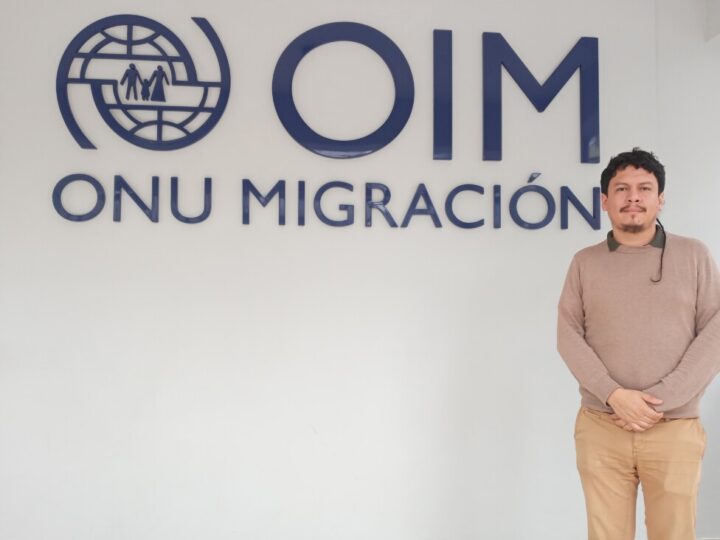
Pablo Peña, coordinator of the Emergency and Humanitarian Assistance Unit of the International Organization for Migration (IOM) in Peru, stands in front of the headquarters of this United Nations agency in Lima. He highlights the need to address the situation of internal migration driven by the impacts of climate change. CREDIT: Mariela Jara / IPS

Pablo Peña, coordinator of the Emergency and Humanitarian Assistance Unit of the International Organization for Migration (IOM) in Peru, stands in front of the headquarters of this United Nations agency in Lima. He highlights the need to address the situation of internal migration driven by the impacts of climate change. CREDIT: Mariela Jara / IPS

The Central Reserve Bank, in charge of preserving monetary stability and managing international reserves, lowered in its September monthly report Peru’s economic growth projection to 0.9 percent for this year, partly due to the varied impacts of climate change on agriculture and fishing.

This would affect efforts to reduce the poverty rate, which stands at around 30 percent in the country, where seven out of every 10 workers work in the informal sector, and would drive up migration of the population in search of food and livelihoods.

“The World Bank estimates that by 2050 there will be more than 10 million climate migrants in Latin America,” said Peña.

The same multilateral institution, in its June publication Peru Strategic Actions Toward Water Security, points out that people without economic problems are 10 times more resistant than those living in poverty to climatic impacts such as floods and droughts, which are increasing at the national level.

The country is currently experiencing the Coastal El Niño climate phenomenon, which in March caused floods in northern cities and droughts in the south. The official National Service of Meteorology and Hydrology warned that in January 2024 it could converge with the El Niño Southern Oscillation (ENSO) global phenomenon, accentuating its impacts.

El Niño usually occurs in December, causing the sea temperature to rise and altering the rainfall pattern, which increases in the north of the country and decreases in the south.
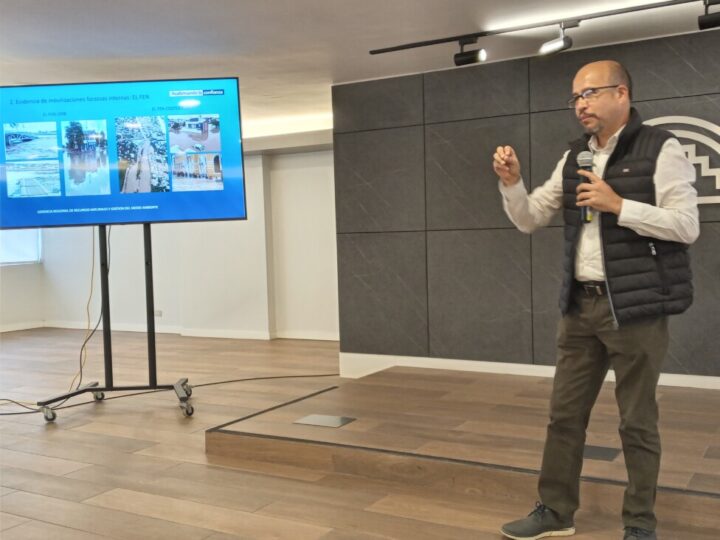
The manager of Natural Resources of the Piura regional government, Juan Aguilar, described the vulnerability to climate change of this northern coastal region of Peru at a September meeting organized by the IOM in Lima. The official explained that the El Niño climate phenomenon has become more intense and frequent due to the effects of climate change, which aggravates its impacts on the population, such as severe flooding this year. CREDIT: Mariela Jara / IPSThe manager of Natural Resources of the Piura regional government, Juan Aguilar, described the vulnerability to climate change of this northern coastal region of Peru at a September meeting organized by the IOM in Lima. The official explained that the El Niño climate phenomenon has become more intense and frequent due to the effects of climate change, which aggravates its impacts on the population, such as severe flooding this year. CREDIT: Mariela Jara / IPS

The manager of Natural Resources of the Piura regional government, Juan Aguilar, described the vulnerability to climate change of this northern coastal region of Peru at a September meeting organized by the IOM in Lima. The official explained that the El Niño climate phenomenon has become more intense and frequent due to the effects of climate change, which aggravates its impacts on the population, such as severe flooding this year. CREDIT: Mariela Jara / IPS

Reluctance to migrate to safer areas

Piura, a northern coastal department with an estimated population of just over two million inhabitants, has been hit by every El Niño episode, including this year’s, which left more than 46,000 homes damaged, even in areas that had been rebuilt.

Juan Aguilar, manager of Natural Resources of the Piura regional government, maintains that the high vulnerability to ENSO is worsening with climate change and is affecting the population, communication routes and staple crops.

At an IOM workshop on Sept. 5 in Lima, the official stressed that Piura is caught up in both floods and droughts, in a complex context for the implementation of spending on prevention, adaptation and mitigation.

Aguilar spoke to IPS about the situation of people who, despite having lost their homes for climatic reasons, choose not to migrate, in what he considers to be a majority trend.

“People are not willing overall to move to safer areas, even during El Niño 2017 when there were initiatives to relocate them to other places; they prefer to wait for the phenomenon to pass and return to their homes,” he added.
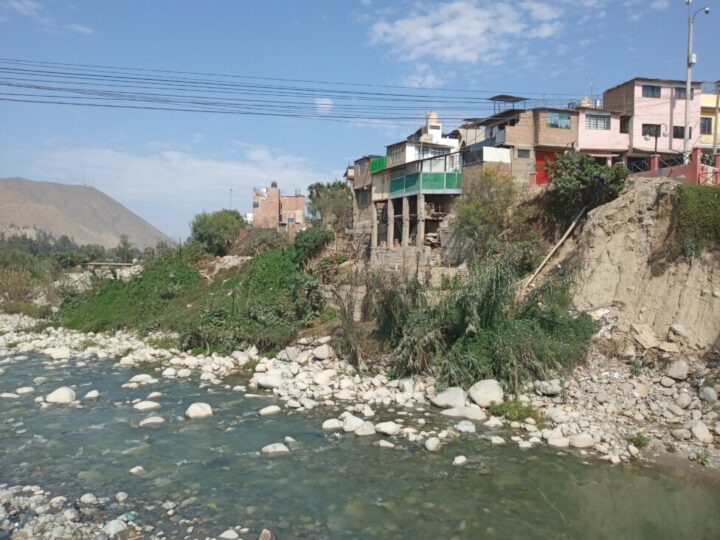
View of the Rimac River as it passes through the municipality of Lurigancho-Chosica, in the Peruvian province of Lima. In this town, many families are still living in housing in areas at high risk, which is exacerbated during the rainy season that begins in December and has intensified due to climate change and the increased recurrence of the El Niño climate phenomenon. CREDIT: Mariela Jara / IPS

View of the Rimac River as it passes through the municipality of Lurigancho-Chosica, in the Peruvian province of Lima. In this town, many families are still living in housing in areas at high risk, which is exacerbated during the rainy season that begins in December and has intensified due to climate change and the increased recurrence of the El Niño climate phenomenon. CREDIT: Mariela Jara / IPS

He explained that this attitude is due to the fact that they see the climatic events as recurrent. “They say, I already experienced this in such and such a year, and there is a resignation in the sense of saying that we are in a highly vulnerable area, it is what we have to live with, God and nature have put us in these conditions,” Aguilar said.

He acknowledged that with regard to this question, public policies have not made much progress. “For example after 2017 a law was passed to identify non-mitigable risk zones, and that has not been enforced despite the fact that it would help us to implement plans to relocate local residents to safer areas,” he added.

The regional official pointed out that “we do not have an experience in which the State says ‘I have already identified this area, there is so much housing available here for those who want to relocate’ , because the social cost would be so high.”

“We have not seen this, and the populace has the feeling that if they are going to start somewhere else, the place they abandon will be taken by someone else, and they say: ‘what is the point of me moving, if the others will be left here’,” Aguilar said.
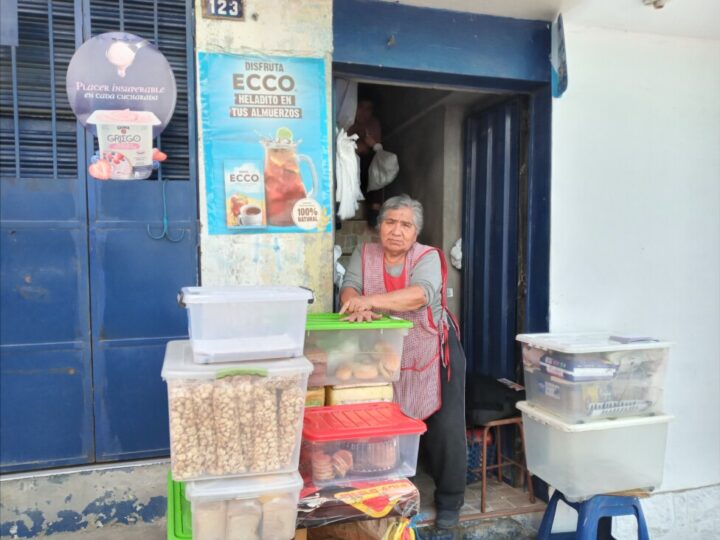
Paulina Vílchez, 72, has always lived in the Peruvian municipality of Lurigancho-Chosica. Despite the fear every year that the Rimac River might flood and that mudslides could occur in one of the 21 ravines in the area, she has never thought of moving away. "I'm not going to go to an empty plot to start all over again, that's why I've stayed. I leave everything in the hands of God," she said. CREDIT: Mariela Jara / IPS

Paulina Vílchez, 72, has always lived in the Peruvian municipality of Lurigancho-Chosica. Despite the fear every year that the Rimac River might flood and that mudslides could occur in one of the 21 ravines in the area, she has never thought of moving away. “I’m not going to go to an empty plot to start all over again, that’s why I’ve stayed. I leave everything in the hands of God,” she said. CREDIT: Mariela Jara / IPS

The fear of starting over

Some 40 km from the Peruvian capital, in Lurigancho-Chosica, one of the 43 municipalities of the province of Lima, the local population is getting nervous about the start of the rainy season in December, which threatens mudslides in some of its 21 ravines. The most notorious due to their catastrophic impact occurred in 1987, 2017, 2018 and March of this year.

Landslides, known in Peru by the Quechua indigenous term “huaycos”, have been part of the country’s history, due to the combination of the special characteristics of the rugged geography of the Andes highlands and the ENSO phenomenon.

In an IPS tour of the Chosica area of Pedregal, one of the areas vulnerable to landslides and mudslides due to the rains, there was concern in the municipality about the risks they face, but also a distrust of moving to a safer place to start over.

“I came here to Pedregal as a child when this was all fields where cotton and sugar cane were planted. I have been here for more than sixty years and we have progressed, we no longer live in shacks,” said 72-year-old Paulina Vílchez, who lives in a nicely painted two-story house built of cement and brick.

On the first floor she set up a bodega, which she manages herself, where she sells food and other products. She did not marry or have children, but she helped raise two nieces, with whom she still lives in a house that is the fruit of her parents’ and then her own efforts and which represents decades of hard work.

Vílchez admits that she would like to move to a place where she could be free of the fear that builds up every year. But she said it would have to be a house with the same conditions as the one she has managed to build with so much effort. “I’m not going to go to an empty plot to start all over again, that’s why I’ve stayed. I leave everything in the hands of God,” she told IPS.
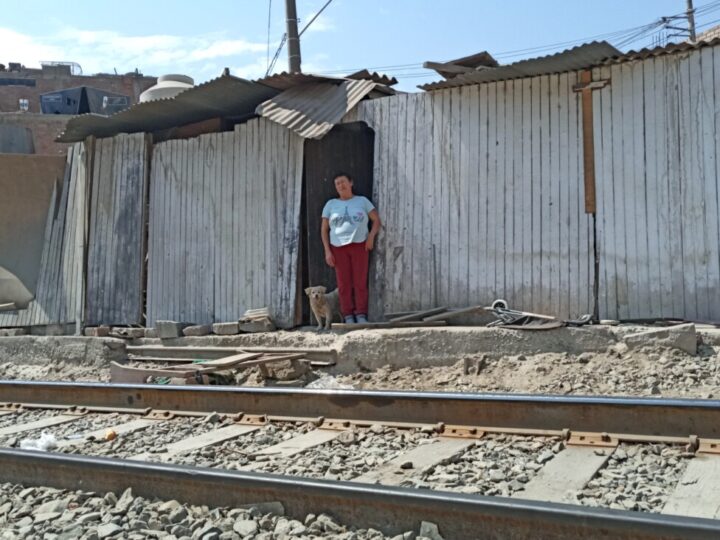
Maribel Zavaleta's home in the Peruvian municipality of Chosica is built of wood, near the Rimac River and just a meter from the train tracks. She arrived there in 1989, relocated after a mud, water and rock slide two years earlier in another part of the town. She constantly worries that another catastrophe will happen again, and says she would relocate if she were guaranteed safer land and materials to build a new house. CREDIT: Mariela Jara / IPS

Maribel Zavaleta’s home in the Peruvian municipality of Chosica is built of wood, near the Rimac River and just a meter from the train tracks. She arrived there in 1989, relocated after a mud, water and rock slide two years earlier in another part of the town. She constantly worries that another catastrophe will happen again, and says she would relocate if she were guaranteed safer land and materials to build a new house. CREDIT: Mariela Jara / IPS

Very close to the Rimac River and next to the railway tracks that shake her little wooden house each time the train passes by lives Maribel Zavaleta, 50, born in Chosica, and her family of two daughters, a son, and three granddaughters.

“I came here in 1989 with my mom, she was a survivor of the 1987 huayco, and we lived in tents until we were relocated here. But it’s not safe; in 2017 the river overflowed and the house was completely flooded,” she told IPS.

Zavaleta started her own family at the age of 21, but is now separated from her husband. Her eldest son lives with his girlfriend on the same property, and her older daughter, who works and helps support the household, has given her three granddaughters. The youngest of her daughters is 13 and attends a local municipal school.

“I work as a cleaner and what I earn is only enough to cover our basic needs,” she said. She added that if she were relocated again it would have to be to a plot of land with a title deed and materials to build her house, which is now made of wood and has a tin roof, while her plot of land is fenced off with metal sheets.

“I can’t afford to improve my little house or leave here. I would like the authorities to at least work to prevent the river from overflowing while we are here,” she said, pointing to the rocks left by the 2017 landslide that have not been removed.

  Source

Treated Wastewater Is a Growing Source of Irrigation in Chile’s Arid North

Active Citizens, Civil Society, Climate Action, Climate Change, Combating Desertification and Drought, Development & Aid, Economy & Trade, Editors’ Choice, Environment, Featured, Food and Agriculture, Green Economy, Headlines, Integration and Development Brazilian-style, Latin America & the Caribbean, Projects, Regional Categories, Sustainable Development Goals, Water & Sanitation

Water & Sanitation

Alfalfa farmer Dionisio Antiquera stands in front of one of the wastewater treatment ponds at the modernized plant in Cerrillos de Tamaya, a rural community in the Coquimbo region of northern Chile. The thousands of liters captured from the sewers are converted into clear liquid ready for reuse in local small-scale agriculture. CREDIT : Orlando Milesi / IPS

Alfalfa farmer Dionisio Antiquera stands in front of one of the wastewater treatment ponds at the modernized plant in Cerrillos de Tamaya, a rural community in the Coquimbo region of northern Chile. The thousands of liters captured from the sewers are converted into clear liquid ready for reuse in local small-scale agriculture. CREDIT : Orlando Milesi / IPS

COQUIMBO, Chile , Sep 18 2023 (IPS) – The reuse of treated wastewater in vulnerable rural areas of Chile’s arid north is emerging as a new resource for the inhabitants of this long, narrow South American country.


The Coquimbo region, just south of the Atacama Desert, one of the driest in the world, is suffering from a severe drought that has lasted 15 years.

According to data from the Meteorological Directorate, a regional station located in the Andes Mountains measured 30.3 millimeters (mm) of rain per square meter this year as of Sept. 10, compared to 213 mm in all of 2022.

“Rural localities today are already reusing wastewater or gray water. This is going to happen, with or without us, with or without a law. The need for water is so great that the communities are accepting the use of treated wastewater.” — Gerardo Díaz

At another station, in the coastal area, during the same period in 2023, rainfall stood at 10.5 mm compared to the usual level of 83.2 mm.

Faced with this persistent level of drought, vulnerable rural localities in Coquimbo, mostly dedicated to small-scale agriculture, are emerging as a new example of solutions that can be replicated in the country to alleviate water shortages.

The aim is to not waste the water that runs down the drains but to accumulate it in tanks, treat it and then use it to irrigate everything from alfalfa fields to native plants and trees in parks and streets in the localities involved. It is a response to drought and the expansion of the desert.

“We were able to implement five wastewater treatment projects and reuse 9.5 liters per second, which is, according to a comparative value, the consumption of 2,700 people for a year or the water used to irrigate 60 hectares of olive trees,” said Gerardo Díaz, sustainability manager of the non-governmental Fundación Chile.

These five projects, promoted by the Fundación Chile as part of its Water Scenarios 2030 initiative, are financed by the regional government of Coquimbo, which contributed the equivalent of 312,000 dollars. Of this total, 73 percent is dedicated to enabling reuse systems, for which plants in need of upgrading but not reconstruction have been selected.

The common objective of these projects, which together benefit some 6,500 people, is the reuse of wastewater for productive purposes, the replacement of drinking water or the recharge of aquifers.

Díaz told IPS that the amount of reuse obtained is significant because previously this water was discharged into a stream, canal or river where it was perhaps captured downstream.

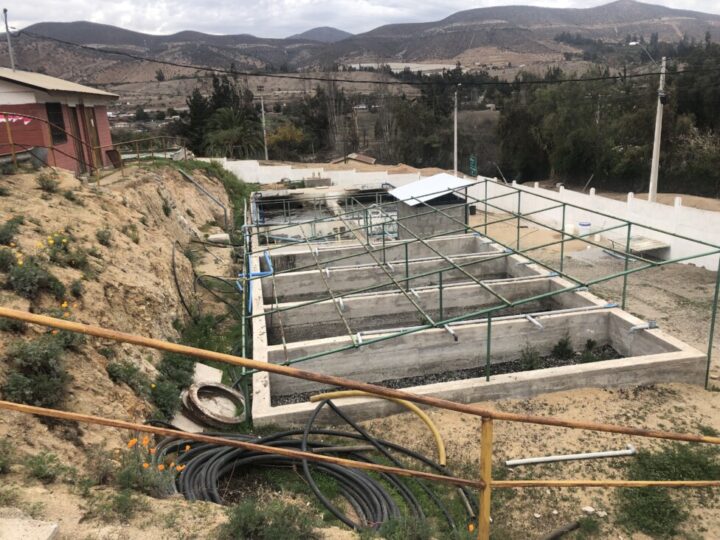
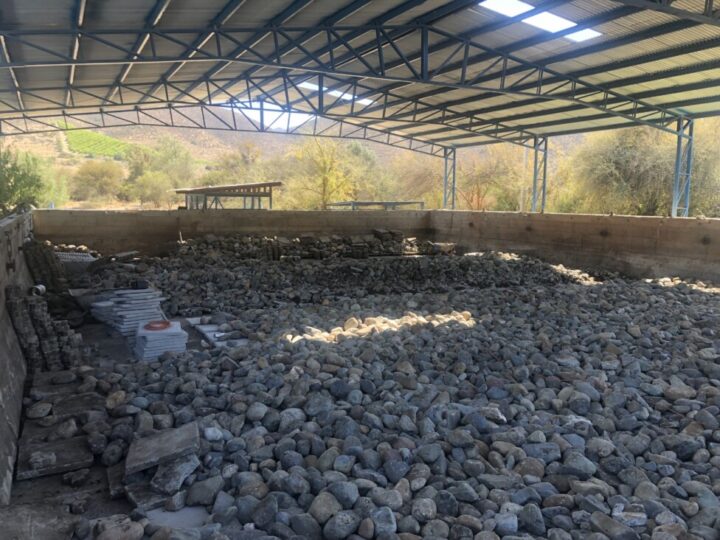
The Huatulame treatment plant in the rural municipality of Monte Patria in northern Chile is being completely repaired with the support of the local municipality. Waterproof plastic sheeting and boulders have been installed, and in the final stage sawdust and earthworms will be incorporated before receiving wastewater from local households for reuse. CREDIT: Orlando Milesi / IPS

The Huatulame treatment plant in the rural municipality of Monte Patria in northern Chile is being completely repaired with the support of the local municipality. Waterproof plastic sheeting and rocks have been installed, and in the final stage sawdust and earthworms will be incorporated before receiving wastewater from local households for reuse. CREDIT: Orlando Milesi / IPS

A successful pilot experience

In Coquimbo, which has a regional population of some 780,000 people, there are 71 water treatment plants, most of which use activated sludge and almost all of which are linked to the Rural Drinking Water Program (APR) of the state Hydraulic Works Directorate.

Activated sludge systems are biological wastewater treatment processes using microorganisms, which are very sensitive in their operation and maintenance and rural sectors do not have the capacity to maintain them.

“Most of these treatment plants are not operating or are operating inefficiently,” Diaz acknowledged.

But one of the plants, once reconditioned, has served as a model for others since 2018. Its creation allowed Dionisio Antiquera, a 52-year-old agricultural technician, to save his alfalfa crop.

“We have had a water deficit for years. This recycled water really helps us grow our crops on our eight hectares of land,” he said in the middle of his alfalfa field in Cerrillos de Tamaya, one of the Coquimbo municipalities that IPS toured for several days to observe five wastewater reuse projects.

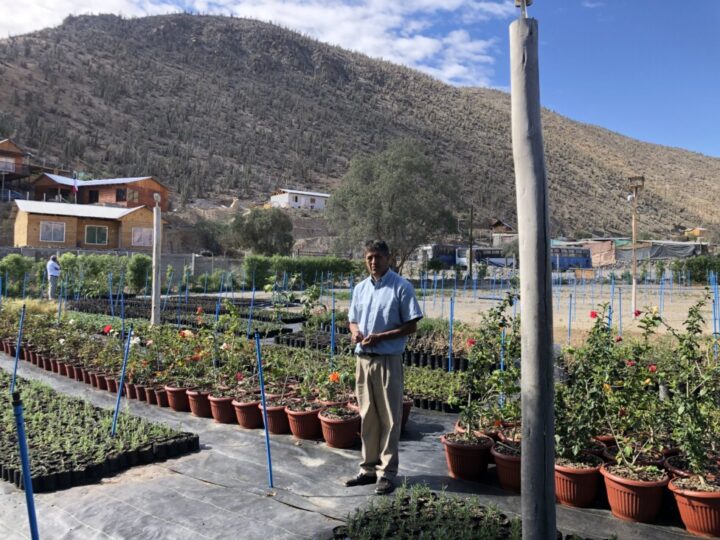
Raúl Ángel Flores stands in his nursery, where the plants and trees are irrigated with recycled water from the Punta Azul project in the town of Villa Puclaro, in Chile's Coquimbo region. All profits from the town's wastewater treatment are reinvested in its maintenance. CREDIT: Orlando Milesi / IPS

Raúl Ángel Flores stands in his nursery, where the plants and trees are irrigated with recycled water from the Punta Azul project in the town of Villa Puclaro, in Chile’s Coquimbo region. All profits from the town’s wastewater treatment are reinvested in its maintenance. CREDIT: Orlando Milesi / IPS

He explained that using just reused water he was able to produce six normal alfalfa harvests per year with a yield per hectare of 100 25-kg bales.

“That’s 4500 to 4800 bales in the annual production season,” he said proudly.

These bales are easily sold in the region because they are cheaper than those of other farmers.

The water he uses comes from an APR plant that has 1065 users, 650 of whom provide water, including Antiquera.

On one side of his alfalfa field is a plant that accumulates the sludge that is dehydrated in pools and drying courts, and on the other side, the water is chlorinated and runs into another pond in its natural state.

“This water works well for alfalfa. It is hard water that has about 1400 parts per million of salt. Then it goes through a reverse osmosis process that removes the salt and the water is suitable for human consumption,” the farmer explained.

In Chile, treated wastewater is not considered fresh water or water that can be used directly by people, and its reuse is only indirect.

Antiquera sold half a hectare to the government to install the plant and in exchange uses the water obtained and contributes 20 percent to the local APR.

He recently extended his alfalfa field to another seven hectares, thanks to his success with treated water.

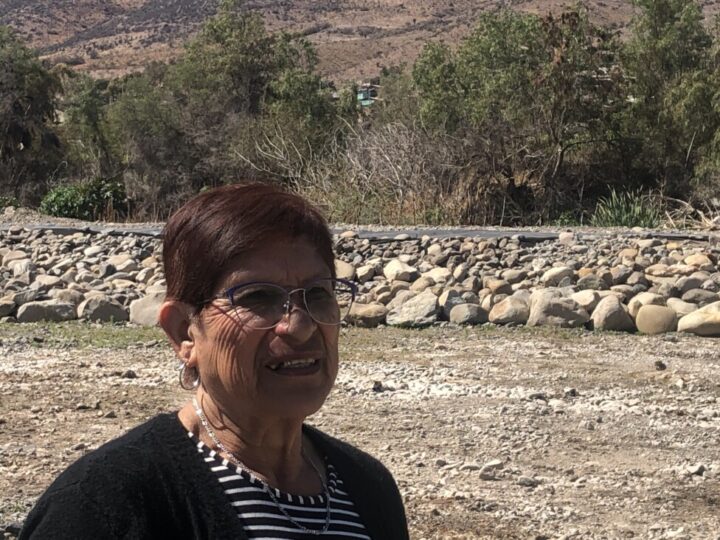
Deysy Cortés, president of a rural drinking water system in Huatulame, stands in front of the dry riverbed of the town of the same name. Today there is no water in the river, where local residents swam and summer vacationers camped on its banks 15 years ago. CREDIT: Orlando Milesi / IPSDeysy Cortés, president of a rural drinking water system in Huatulame, stands in front of the dry riverbed of the town of the same name. Today there is no water in the river, where local residents swam and summer vacationers camped on its banks 15 years ago. CREDIT: Orlando Milesi / IPS

Deysy Cortés, president of a rural drinking water system in Huatulame, stands in front of the dry riverbed of the town of the same name. Today there is no water in the river, where local residents swam and summer vacationers camped on its banks 15 years ago. CREDIT: Orlando Milesi / IPS

Flowers and trees also benefit

In Villa Puclaro, in the Coquimbo municipality of Vicuña, Raúl Ángel Flores, 55, has an ornamental plant nursery.

“I’ve done really well. My nursery has grown with just reuse water….. I have more than 40,000 ornamental, fruit, native and cactus plants. I deliver to retailers in Vicuña and Coquimbo,” a port city in the region, he told IPS.

The nursery is 850 square meters in size, and has an accumulation pond and pumps to pump the water. He has now rented a 2,500-meter plot of land to expand it.

Flores explained to IPS that he manages the nursery together with his wife, Carolina Cáceres, and despite the fact that they have two daughters and a senior citizen in their care, “we make a living just selling the plants…I even hired an assistant,” he added.

In the southern hemisphere summer he uses between 4,000 and 5,000 liters of water a day for irrigation.

“I have water to spare. Here it could be reused for anything,” he said.

Joining the project made it possible for Flores to make efficient use of water with a business model that in this case incorporates a fee for the water to the plant management, which is equivalent to 62 cents per cubic meter used.

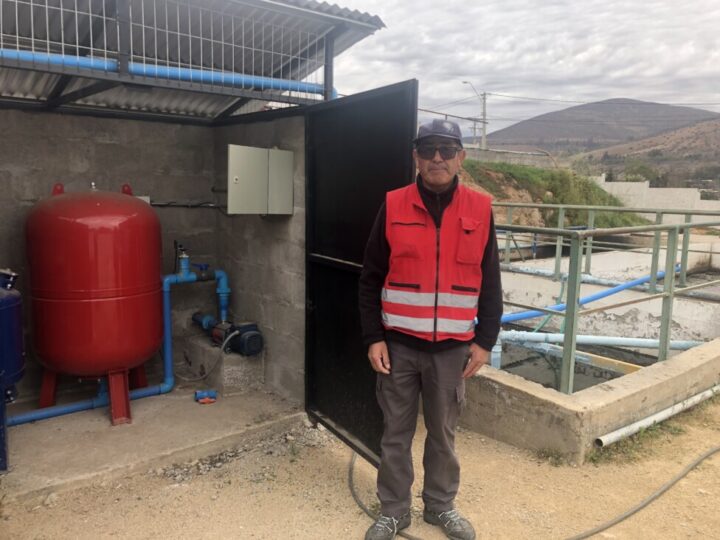
 Arnoldo Olivares operates the water treatment and recycling plant in Plan de Hornos, northern Chile. The plant's infrastructure and operation have been upgraded, and it can now deliver water to rural residents to irrigate trees and plants, instead of using potable water. CREDIT: Orlando Milesi / IPS

Arnoldo Olivares operates the water treatment and recycling plant in Plan de Hornos, northern Chile. The plant’s infrastructure and operation have been upgraded, and it can now deliver water to rural residents to irrigate trees and plants, instead of using potable water. CREDIT: Orlando Milesi / IPS

Eliminating odors, and creating new gardens

In the community of Huatulame, in the municipality of Monte Patria, Fundación Chile built an artificial surface wetland to put an end to the bad odors caused by effluents from a deficient waste-eater earthworm vermifilter treatment plant.

“This wetland has brought us peace because the odors have been eliminated. For the past year people have been able to walk along the banks of the old riverbed,” Deysy Cortés, 72, president of the APR, told IPS.

The municipality of Monte Patria is financing the repair of the plant with the equivalent of 100,000 dollars.

“The sprinklers will be changed, the filtering system will be replaced, and sawdust and worms will be added. It will be up and running in a couple of months,” explained agronomist Jorge Núñez, a consultant for Fundación Chile.

As in other renovated plants, safe infiltration of wastewater is ensured while the project simultaneously promotes the protection of nearby wells to provide water to the villagers.

The Huatulame treatment plant in the rural municipality of Monte Patria in northern Chile is being completely repaired with the support of the local municipality. Waterproof plastic sheeting and boulders have been installed, and in the final stage sawdust and earthworms will be incorporated before receiving wastewater from local households for reuse. CREDIT: Orlando Milesi / IPS

The Huatulame treatment plant in the rural municipality of Monte Patria in northern Chile is being completely repaired with the support of the local municipality. Waterproof plastic sheeting and boulders have been installed, and in the final stage sawdust and earthworms will be incorporated before receiving wastewater from local households for reuse. CREDIT: Orlando Milesi / IPS

Cortés warned of serious difficulties if no more rain falls in the rest of 2023, despite the relief provided by the plant for irrigation.

“I foresee a very difficult future if it doesn’t rain. We will go back to what we experienced in 2019 when in every house there were bottles filled with water and a little jug to bathe once a week,” she said.

During a recent crisis, the local APR paid 2500 dollars to bring in water from four 20,000-liter tanker trucks.

In Plan de Hornos, a town in the municipality of Illapel, irrigation technology was installed using reused water instead of drinking water to create a green space for the community to enjoy.

The project included water taps in people’s homes for residents to water trees and flowers.

Arnoldo Olivares, 59, is in charge of the plant, which has 160 members.

“I run both systems,” he told IPS. “I pour drinking water into the pond. After passing through the houses, the water goes into the drainage system, where there is a procedure to reclaim and treat it.”

“This water was lost before, and now we reuse it to irrigate the saplings. We used to work manually, now it is automated. It’s a tremendous change, we’re really happy,” he said.

Antiquera the alfalfa farmer is happy with his success in Cerrillos de Tamaya, but warns that in his area 150 to 160 mm of rainfall per year is normal and so far only 25 mm have fallen in 2023.

“The water crisis forces us to find alternatives and to be 100 percent efficient. Not a drop of water can be wasted. They have forecast very high temperatures for the upcoming (southern hemisphere) summer, which means that plants will require more water in order to thrive,” he said.

Díaz, the sustainability manager of Fundación Chile, said the Coquimbo projects are fully replicable in other water-stressed areas of Chile if a collaborative model is used.

He noted that “in Chile there is no law for the reuse of treated wastewater. There is only a gray water law that was passed years ago, but there are no regulations to implement it.”

He explained, however, that due to the drought, “rural localities today are already reusing wastewater or gray water. This is going to happen, with or without us, with or without a law. The need for water is so great that the communities are accepting the use of treated wastewater.”

The governor of Coquimbo, Krist Naranjo, argued that “a broader vision is needed to value water resources that are essential for life, especially in the context of global climate change.”

“We’re working on different initiatives with different executors, but the essential thing is to value the reuse of graywater recycling,” she told IPS from La Serena, the regional capital.

  Source

Biodigesters Light Up Clean Energy Stoves in Rural El Salvador

Marisol and Misael Menjívar pose next to the biodigester installed in March in the backyard of their home in El Corozal, a rural settlement located near Suchitoto in central El Salvador. With a biotoilet and stove, the couple produces biogas for cooking from feces, which saves them money. The biotoilet can be seen in the background. CREDIT: Edgardo Ayala / IPS

Marisol and Misael Menjívar pose next to the biodigester installed in March in the backyard of their home in El Corozal, a rural settlement located near Suchitoto in central El Salvador. With a biotoilet and stove, the couple produces biogas for cooking from feces, which saves them money. The biotoilet can be seen in the background. CREDIT: Edgardo Ayala / IPS

By Edgardo Ayala
SUCHITOTO, El Salvador , Jul 25 2023 (IPS)

A new technology that has arrived in rural villages in El Salvador makes it possible for small farming families to generate biogas with their feces and use it for cooking – something that at first sounded to them like science fiction and also a bit smelly.


In the countryside, composting latrines, which separate urine from feces to produce organic fertilizer, are very popular. But can they really produce gas for cooking?

“It seemed incredible to me,” Marisol Menjívar told IPS as she explained how her biodigester, which is part of a system that includes a toilet and a stove, was installed in the backyard of her house in the village of El Corozal, near Suchitoto, a municipality in the central Salvadoran department of Cuscatlán.”When the first ones were installed here, I was excited to see that they had stoves hooked up, and I asked if I could have one too.” — Marisol Menjívar

“When the first ones were installed here, I was excited to see that they had stoves hooked up, and I asked if I could have one too,” added Marisol, 48. Hers was installed in March.

El Corozal, population 200, is one of eight rural settlements that make up the Laura López Rural Water and Sanitation Association (Arall), a community organization responsible for providing water to 465 local families.

The families in the small villages, who are dedicated to the cultivation of corn and beans, had to flee the region during the country’s 1980-1992 civil war, due to the fighting.

After the armed conflict, they returned to rebuild their lives and work collectively to provide basic services, especially drinking water, as have many other community organizations, in the absence of government coverage.

In this Central American country of 6.7 million inhabitants, 78.4 percent of rural households have access to piped water, while 10.8 percent are supplied by wells and 10.7 percent by other means.

With small stoves like this one, a score of families in El Corozal in central El Salvador cook their food with biogas they produce themselves, thanks to a government program that has brought clean energy technology to these remote rural villages. CREDIT: Edgardo Ayala / IPS

With small stoves like this one, a score of families in El Corozal in central El Salvador cook their food with biogas they produce themselves, thanks to a government program that has brought clean energy technology to these remote rural villages. CREDIT: Edgardo Ayala / IPS

Simple green technology

The biodigester program in rural areas is being promoted by the Salvadoran Water Authority (Asa).

Since November 2022, the government agency has installed around 500 of these systems free of charge in several villages around the country.

The aim is to enable small farmers to produce sustainable energy, biogas at no cost, which boosts their income and living standards, while at the same time improving the environment.

The program provides each family with a kit that includes a biodigester, a biotoilet, and a small one-burner stove.

In El Corozal, five of these kits were installed by Asa in November 2022, to see if people would accept them or not. To date, 21 have been delivered, and there is a waiting list for more.

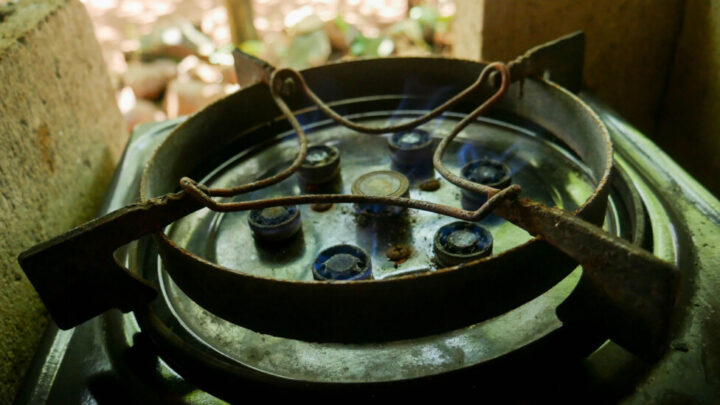
In El Corozal, a rural settlement in the municipality of Suchitoto in central El Salvador, the technology of family biodigesters arrived at the end of last year, and some families are now producing biogas to light up their stoves and cook their food at no cost. CREDIT: Edgardo Ayala / IPS

In El Corozal, a rural settlement in the municipality of Suchitoto in central El Salvador, the technology of family biodigesters arrived at the end of last year, and some families are now producing biogas to light up their stoves and cook their food at no cost. CREDIT: Edgardo Ayala / IPS

“With the first ones were set up, the idea was for people to see how they worked, because there was a lot of ignorance and even fear,” Arall’s president, Enrique Menjívar, told IPS.

In El Corozal there are many families with the surname Menjívar, because of the tradition of close relatives putting down roots in the same place.

“Here we’re almost all related,” Enrique added.

The biodigester is a hermetically sealed polyethylene bag, 2.10 meters long, 1.15 meters wide and 1.30 meters high, inside which bacteria decompose feces or other organic materials.

This process generates biogas, clean energy that is used to fuel the stoves.

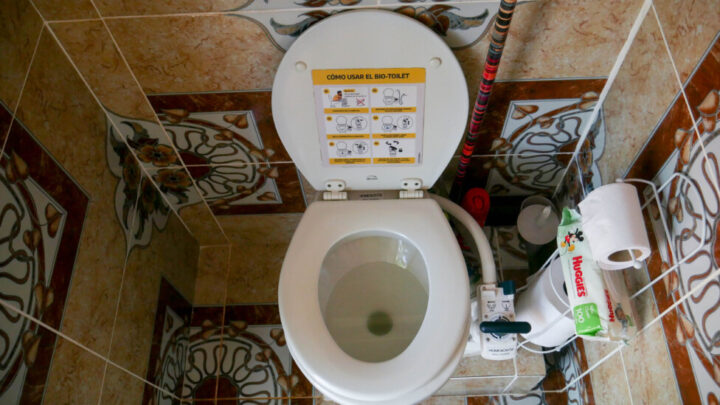
The toilets are mounted on a one-meter-high cement slab in latrines in the backyard. They are made of porcelain and have a handle on one side that opens and closes the stool inlet hole.

 One of the main advantages that family biodigesters have brought to the inhabitants of El Corozal, a small village in the Salvadoran department of Cuscatlán, is that the whole process begins with clean, hygienic toilets, like this one set up in Marleni Menjívar's backyard, as opposed to the older dry composting latrines, which drew flies and cockroaches. To the left of the toilet is the small handle used to pump water to flush the feces into the biodigester. CREDIT: Edgardo Ayala / IPS

One of the main advantages that family biodigesters have brought to the inhabitants of El Corozal, a small village in the Salvadoran department of Cuscatlán, is that the whole process begins with clean, hygienic toilets, like this one set up in Marleni Menjívar’s backyard, as opposed to the older dry composting latrines, which drew flies and cockroaches. To the left of the toilet is the small handle used to pump water to flush the feces into the biodigester. CREDIT: Edgardo Ayala / IPS

They also have a small hand pump, similar to the ones used to inflate bicycle tires, and when the handle is pushed, water is pumped from a bucket to flush the waste down the pipe.

The underground pipe carries the biomass by gravity to the biodigester, located about five meters away.

The system can also be fed with organic waste, by means of a tube with a hole at one end, which must be opened and closed.

Once it has been produced, the biogas is piped through a metal tube to the small stove mounted inside the house.

“I don’t even use matches, I just turn the knob and it lights up,” said Marisol, a homemaker and caregiver. Her husband Manuel Menjívar is a subsistence farmer, and they have a young daughter.

In El Corozal, biodigesters have been installed for families of four or five members, and the equipment generates 300 liters of biogas during the night, enough to use for two hours a day, according to the technical specifications of Coenergy, the company that imports and markets the devices.

But there are also kits that are used by two related families who live next to each other and share the equipment, which includes, in addition to the toilet, a larger biodigester and a two-burner stove.

With more sophisticated equipment, electricity could be generated from biogas produced from landfill waste or farm manure, although this is not yet being done in El Salvador.

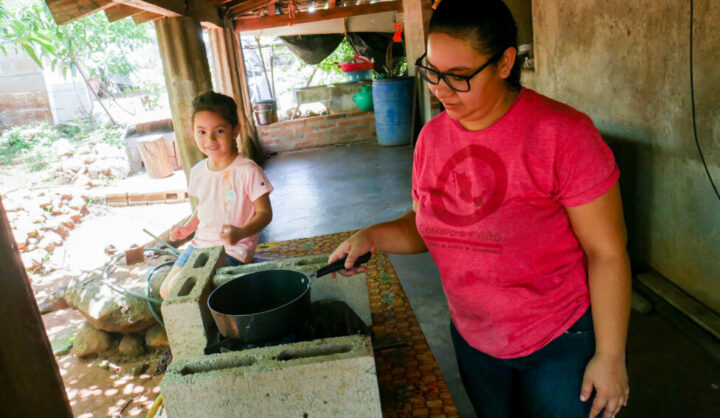
 Marleni Menjivar gets ready to heat water on her ecological stove, watched closely by her four-year-old daughter, in El Corozal in central El Salvador, where an innovative government program to produce biogas has arrived. With this technology, people save money by buying less liquefied gas while benefiting the environment. CREDIT: Edgardo Ayala / IPS

Marleni Menjivar gets ready to heat water on her ecological stove, watched closely by her four-year-old daughter, in El Corozal in central El Salvador, where an innovative government program to produce biogas has arrived. With this technology, people save money by buying less liquefied gas while benefiting the environment. CREDIT: Edgardo Ayala / IPS

Saving money while caring for the environment

The families of El Corozal who have the new latrines and stoves are happy with the results.

What they value the most is saving money by cooking with gas produced by themselves, at no cost.

They used to cook on wood-burning stoves, in the case of food that took longer to make, or on liquefied gas stoves, at a cost of 13 dollars per gas cylinder.

Marleni Menjívar, for example, used two cylinders a month, mainly because of the high level of consumption demanded by the family business of making artisanal cheeses, including a very popular local kind of cottage cheese.

Every day she has to cook 23 liters of whey, the liquid left after milk has been curdled. This consumes the biogas produced overnight.

For meals during the day Marleni still uses the liquefied gas stove, but now she only buys one cylinder a month instead of two, a savings of about 13 dollars per month.

“These savings are important for families here in the countryside,” said Marleni, 28, the mother of a four-year-old girl. The rest of her family is made up of her brother and grandfather.

“We also save water,” she added.

The biotoilet requires only 1.2 liters of water per flush, less than conventional toilets.

In addition, the soils are protected from contamination by septic tank latrines, which are widely used in rural areas, but are leaky and unhygienic.

The new technology avoids these problems.

The liquids resulting from the decomposition process flow through an underground pipe into a pit that functions as a filter, with several layers of gravel and sand. This prevents pollution of the soil and aquifers.

Also, as a by-product of the decomposition process, organic liquid fertilizer is produced for use on crops.

Most families in the rural community of El Corozal have benefited from one-burner stoves that run on biogas produced in family biodigesters. Larger two-burner stoves are also shared by two related families, where they cook on a griddle one of the favorite dishes of Salvadorans: pupusas, corn flour tortillas filled with beans, cheese and pork, among other ingredients. CREDIT: Coenergy El Salvador

Most families in the rural community of El Corozal have benefited from one-burner stoves that run on biogas produced in family biodigesters. Larger two-burner stoves are also shared by two related families, where they cook on a griddle one of the favorite dishes of Salvadorans: pupusas, corn flour tortillas filled with beans, cheese and pork, among other ingredients. CREDIT: Coenergy El Salvador

Checking on site: zero stench

Due to a lack of information, people were initially concerned that if the biogas used in the stoves came from the decomposition of the family’s feces, it would probably stink.

And, worst of all, perhaps the food would also smell.

But little by little these doubts and fears faded away as families saw how the first devices worked.

“That was the first thing they asked, if the gas smelled bad, or if what we were cooking smelled bad,” said Marleni, remembering how the neighbors came to her house to check for themselves when she got the latrine and stove installed in December 2022.

“That was because of the little information that was available, but then we found that this was not the case, our doubts were cleared up and we saw there were no odors,” she added.

She said that, like almost everyone in the village, her family used to have a dry composting toilet, but it stank and generated cockroaches and flies.

“All that has been eliminated, the bathrooms are completely hygienic and clean, and we even had them tiled to make them look nicer,” Marleni said.

She remarked that hygiene is important to her, as her little girl can now go to the bathroom by herself, without worrying about cockroaches and flies.

Source

‘Passion Seeds’ Fertilize Brazil’s Semiarid Northeast

Ligoria Felipe dos Santos poses for a photo on her agroecological farm that mixes corn, squash, fruits, vegetables and medicinal herbs. She is part of the women's movement that is trying to prevent the installation of wind farms in the Borborema mountain range, in the northeastern Brazilian state of Paraíba. CREDIT: Mario Osava / IPS

Ligoria Felipe dos Santos poses for a photo on her agroecological farm that mixes corn, squash, fruits, vegetables and medicinal herbs. She is part of the women’s movement that is trying to prevent the installation of wind farms in the Borborema mountain range, in the northeastern Brazilian state of Paraíba. CREDIT: Mario Osava / IPS

By Mario Osava
ESPERANÇA, Brazil , Jul 14 2023 (IPS)

Zé Pequeno cried when he learned that the heirloom seeds he had inherited from his father were contaminated by the transgenic corn his neighbor had brought from the south. Fortunately, he was able to salvage the native seeds because he had shared them with other neighbors.


Euzébio Cavalcanti recalls this story from one of his colleagues to highlight the importance of “passion seeds” for family farming in Brazil’s semiarid low-rainfall ecoregion which extends over 1.1 million square kilometers, twice the size of France, in the northeastern interior of the country.”These are seeds adapted to the semiarid climate. They can withstand long droughts, without irrigation.” Euzébio Cavalcanti

Saving heirloom seeds is a peasant tradition, but two decades ago the Brazilian Semiarid Articulation (ASA), a network of 3,000 social organizations that emerged in the 1990s, named those who practice it as individual and community guardians of seeds. By September 2021, it had registered 859 banks of native seeds in the region.

Cavalcanti, a 56-year-old farmer with multiple skills such as poet, musician and radio broadcaster, coordinates the network of these banks in the Polo de Borborema, a joint action area of 14 rural workers’ unions and 150 community organizations in central-eastern Paraíba, one of the nine states of the Brazilian Northeast.

“These are seeds adapted to the semiarid climate. They can withstand long droughts, without irrigation, that is why they are so important,” he explained. They also preserve the genetic heritage of many local crop species and family history; they have sentimental value.

“Don’t plant transgenics, don’t erase my history”, is a slogan of the movement that promotes agroecological practices and is opposed to the expansion of genetically modified organisms in local agriculture. “Corn free of transgenics and agrotoxins (agrochemicals)” is the goal of their campaign.

In Paraíba, the name “passion seeds” has been adopted, instead of native or heirloom seeds, since 2003, when the state government announced that it would provide seeds from a specialized company to family farmers.

“If the government offers these seeds, I don’t want them. I have family seeds and I have passion for them,” reacted a farmer in a meeting with the authorities.

“‘Passion seeds’ spread throughout Paraíba. In other states they’re called ‘seeds of resistance’,” Cavalcanti said.

Agroecology is one of the banners of the Polo de Borborema, as it is for ASA in the entire semiarid ecosystem that covers most of the Northeast region and a northern strip of the southeastern state of Minas Gerais.

"Passion seeds," as heirloom seeds are known locally, ensure better harvests on semiarid lands, free of transgenics or "agricultural poisons," according to Euzébio Cavalcanti, a small farmer, poet and musician who helped lead the struggle for agrarian reform and cares for the seeds in the highlands of Borborema, in northeastern Brazil. CREDIT: Mario Osava / IPS

“Passion seeds,” as heirloom seeds are known locally, ensure better harvests on semiarid lands, free of transgenics or “agricultural poisons,” according to Euzébio Cavalcanti, a small farmer, poet and musician who helped lead the struggle for agrarian reform and cares for the seeds in the highlands of Borborema, in northeastern Brazil. CREDIT: Mario Osava / IPS

Learning to coexist with semiarid conditions

This approach arose from a change in the development strategy adopted on the part of local society, especially ASA, since the 1990s. “Coexisting with semiarid conditions” replaced the traditional, failed focus on “fighting the drought”.

Large dams and reservoirs, which only benefit large landowners and do not help the majority of small farmers, gave way to more than 1.2 million tanks for collecting rainwater from household or school rooftops and various ways of storing water for crops and livestock.

It is a process of decolonization of agriculture, education and science, which prioritizes knowledge of the climate and the regional biome, the Caatinga, characterized by low, twisted, drought-resilient vegetation. It also includes the abandonment of monoculture, with the implementation of traditional local horticultural and family farming techniques.

The Northeast, home to 26.9 percent of the national population, or 54.6 million inhabitants according to the 2022 demographic census, concentrates 47.2 percent of the country’s family farmers, according to the 2017 agricultural census. There are 1.84 million small farms worked mainly by family labor.

Brazil’s semiarid region is one of the rainiest in the world for this type of climate, with 200 to 800 millimeters of rain per year on average, although there are drier areas in the process of desertification.

A stand at the ecological market in the municipality of Esperança, in northeastern Brazil, is a link between urban consumers and family farmers opposed to agrochemicals, monoculture and transgenic products. CREDIT: Mario Osava / IPS

A stand at the ecological market in the municipality of Esperança, in northeastern Brazil, is a link between urban consumers and family farmers opposed to agrochemicals, monoculture and transgenic products. CREDIT: Mario Osava / IPS

Borborema, the name of a high plateau that obstructs the humidity coming from the sea, making the territory to its west drier, is the scene of various peasant struggles, such as the mobilization for agrarian reform since the 1980s and for small-scale agriculture “without poisons” or agrochemicals, of which the “seeds of passion” are a symbol.

Cavalcanti is a living memory of local history, also as a founder of the local Landless Workers Movement (MST) and an activist in the occupations of unproductive land to create rural settlements, on one of which he gained his own small farm where he grows beans, corn and, vegetables and has two rainwater collection tanks.

Women help drive the expansion of agroecology

Women have played a key role in the drive towards agroecology. The March for Women’s Lives and Agroecology is an annual demonstration that since 2010 has defended family farming and the right to a healthy life.

This year, on Mar. 16, 5,000 women gathered in Montadas, a municipality of 5,800 inhabitants, to block the creation of wind farms that have already caused damage to the health of small farmers by being installed near their homes.

Borborema is “a territory of resistance,” say the women. About 15 years ago, they succeeded in abolishing the cultivation of tobacco.

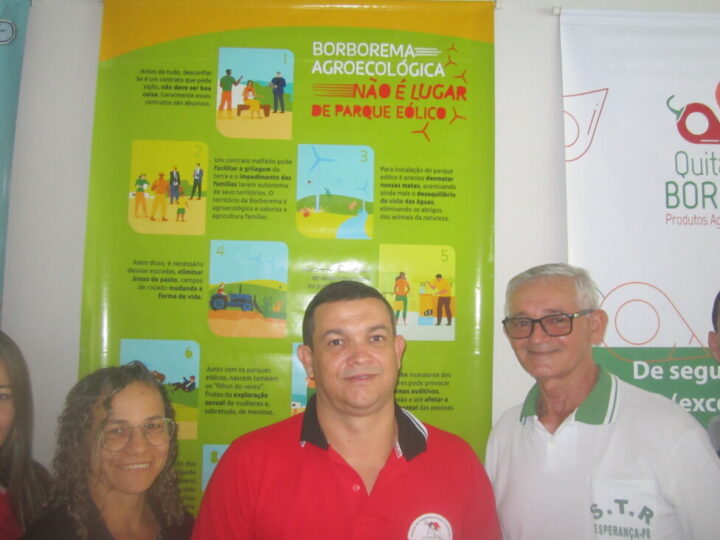
The president of the Union of Rural Workers of the municipality of Esperança, Alexandre Lira (C) and other leaders pose in front of a poster declaring the union's current goals: "Agroecological Borborema is no place for a wind farm," he says about this area in Brazil's semiarid Northeast region. CREDIT: Mario Osava / IPS

The president of the Union of Rural Workers of the municipality of Esperança, Alexandre Lira (C) and other leaders pose in front of a poster declaring the union’s current goals: “Agroecological Borborema is no place for a wind farm,” he says about this area in Brazil’s semiarid Northeast region. CREDIT: Mario Osava / IPS

When the citrus blackfly arrived, the government tried to combat it with pesticides, but “we resisted; we used natural products and solved the problem for our oranges and lemons,” said Ligoria Felipe dos Santos, a 54-year-old mother of three.

“That is agroecology, which is strengthened in the face of threats. Farmers are aware, they resort to alternative defenses, they know that it is imbalance that leads to pests,” she told IPS.

“Agroecology is a good banner for union activity,” said Lexandre Lira, 42, president of the Rural Workers Union of Esperança, a municipality of 31,000 people in the center of the Polo de Borborema.

It is also a factor in keeping farmers’ children on the farms, because it awakens the interest of young people in agriculture, said Edson Johny da Silva, 27, the union’s youth coordinator.

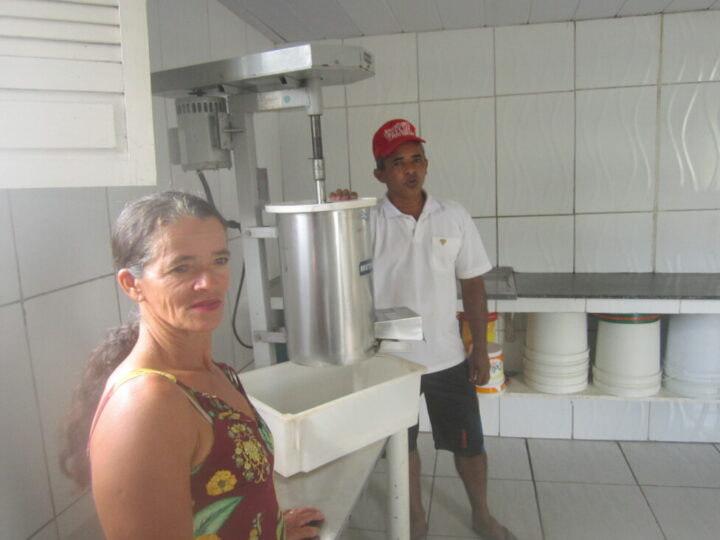
Maria das Graças Vicente and Givaldo Firmino dos Santos stand next to the machine they use for making pulp from native fruits little known outside Brazil, such as the umbu (Brazil plum), cajá (hog plum), acerola (Amazon or Barbados cherry), along with cashews, mangos, and guava. CREDIT: Mario Osava / IPS

Maria das Graças Vicente and Givaldo Firmino dos Santos stand next to the machine they use for making pulp from native fruits little known outside Brazil, such as the umbu (Brazil plum), cajá (hog plum), acerola (Amazon or Barbados cherry), along with cashews, mangos, and guava. CREDIT: Mario Osava / IPS

Pulp, added value

Maria das Graças Vicente, known as Nina, 51, along with her husband Givaldo Firmino dos Santos, 52, is an example of agroecological productivity. On 1.25 hectares of land they produce citrus fruits, passion fruit, acerola (Amazon or Barbados cherry), mango and other fruits, as well as sugar cane, corn, beans and other vegetables.

Grafted fruit tree seedlings are another of the products they use to expand their income, as IPS was shown during a visit to their farm.

Using their own harvest and fruit they buy from neighbors, they make pulp in a small shed separate from their home, with a small machine purchased with the support of the Advisory and Services to Projects in Alternative Agriculture (AS-PTA), a non-governmental organization that supports farmers in Borborema and other parts of Brazil.

“Luckily we have a microclimate in the valley, where it rains more than in the surrounding areas. Everything grows here,” Santos told IPS.

But the couple created three reservoirs to collect rainwater and withstand droughts: a 16,000-liter water tank for household use, another that collects water on the paved ground for irrigation, and a small lagoon dug in the lower part of the farm.

But in 2016 the lagoon dried up, because of the “great drought” that lasted from 2012 to 2017, Vicente said.

The fruit pulp factory has grown in recent years and now has seven small freezers to store fruit and pulp for sale to the town’s stores and restaurants. The couple decided to purchase a cold room with the capacity of 30 freezers.

“I work in the mornings on the land, in the afternoons I make pulp and my husband is in charge of the sales,” she said.

Hiring workers from outside the family to reduce the workload costs too much and “we try to save as much as possible on everything, to sell the pulp at a fair price,” Santos said.

Source

Poor Families Clash over Water with Real Estate Consortium in El Salvador

Active Citizens, Civil Society, Development & Aid, Editors’ Choice, Environment, Featured, Headlines, Human Rights, Latin America & the Caribbean, Population, Poverty & SDGs, Regional Categories, TerraViva United Nations, Water & Sanitation

Water & Sanitation

Alex Leiva, holding his baby girl, uses the water he managed to collect in barrels at 4:00 a.m., the only time the service is provided in Lotificación Praderas, in the canton of Cabañas, on the outskirts of the municipality of Apopa, north of the Salvadoran capital. The families of this region are fighting in defense of water, against an urban development project for wealthy families that threatens the water resources in the area. CREDIT: Edgardo Ayala/IPS

Alex Leiva, holding his baby girl, uses the water he managed to collect in barrels at 4:00 a.m., the only time the service is provided in Lotificación Praderas, in the canton of Cabañas, on the outskirts of the municipality of Apopa, north of the Salvadoran capital. The families of this region are fighting in defense of water, against an urban development project for wealthy families that threatens the water resources in the area. CREDIT: Edgardo Ayala/IPS

APOPA, El Salvador , Jun 6 2022 (IPS) – Alex Leiva woke up at 4:00 a.m. to perform a key task for his family’s survival in the Salvadoran village where he lives: filling several barrels with the water that falls from the tap only at that early hour every other day.


If he does not collect water between 4:00 and 5:00 AM, he will not have another opportunity to fill the barrels for another two days.

“That’s what I have to do. Sometimes I manage to fill three barrels. The service is provided every other day,” Leiva, 32, a video producer, told IPS.

“It’s difficult to be in a situation like this, where the water supply is so inefficient,” he added.

The water is not provided by the government’s National Administration of Aqueducts and Sewers (Anda) but by the Water Administration Board (Acasap).

In El Salvador there are at least 3,000 of these boards, community associations that play an essential role in the supply and management of water resources in rural areas and the peripheries of cities, in the face of the State’s failure to provide these areas with water.

Leiva lives in Lotificación Praderas, in the Cabañas canton, on the outskirts of the municipality of Apopa, north of the country’s capital, San Salvador.

This northern area covering several municipalities has been in conflict in recent years since residents of these communities began to fight against an urban development project by one of the country’s most powerful families, the Dueñas.

The Dueñas clan’s power dates back to the days of the so-called coffee oligarchy, which emerged in the mid-19th century.

Ciudad Valle El Angel is the name of the residential development to be built in this area on 350 hectares, and which will require some 20 million liters of water per day to supply the families that decide to buy one of the 8,000 homes.

The first feasibility permits granted by Anda to the consortium date back to 2015.

The homes are designed for upper middle-class families who decide to leave behind the chaos of San Salvador and to live with all the comforts of modern life, with water 24 hours a day, in the midst of poor communities that lack a steady water supply.

“There are people in my community who manage to fill only one barrel because there isn’t enough water pressure,” said Leiva, the father of a five-year-old boy and a nine-month-old baby girl.

Valle El Angel is an extensive region located on the slopes of the San Salvador volcano, in territories shared by municipalities north of the capital, including Apopa, Nejapa and Opico.

A general view of Parcelación El Ángel, in the Joya Galana canton, in the municipality of Apopa, near San Salvador. The community is fighting to defend the few natural resources that survive in the area, including a stream that originates in the micro-basin of the Chacalapa River. Water in the area is scarce, while Salvadoran authorities endorse an upscale real estate project that will use millions of liters per day. CREDIT: Edgardo Ayala/IPS

A general view of Parcelación El Ángel, in the Joya Galana canton, in the municipality of Apopa, near San Salvador. The community is fighting to defend the few natural resources that survive in the area, including a stream that originates in the micro-basin of the Chacalapa River. Water in the area is scarce, while Salvadoran authorities endorse an upscale real estate project that will use millions of liters per day. CREDIT: Edgardo Ayala/IPS

Unfair justice

Sociedad Dueñas Limitada, the consortium managing the urban development project, received the definitive green light to begin construction: a thumbs-up from the Constitutional court, which on Apr. 29, 2022 rejected an unconstitutionality lawsuit filed in October 2019 by environmental organizations and communities in northern San Salvador.

The lawsuit was against a dubious agreement signed in 2016 between that company and Anda, which manages water in the country. The deal granted the project 240 liters of water per second – that is, about 20 million liters a day.

The consortium intends to dig eight wells in the area. Water will be extracted from the San Juan Opico aquifer, as well as from shallower groundwater from Apopa and Quezaltepeque.

“These agreements open the door to this type of illegal concessions handed over to private companies…it is a situation that is not being addressed from a comprehensive perspective that meets the needs of the people, but rather from a mercantilist perspective,” lawyer Ariela González told IPS.

She is part of the Foundation of Studies for the Application of Law (Fespad), a member of the Water Forum, which brings together some twenty civil organizations that have been fighting for fair and equitable distribution of water in the country.

González added: “It is our public institutions that legalize this dispossession of environmental assets, through these mechanisms that allow the companies to whitewash the environmental impact studies.”

The organizations and local communities argue that water is a human right, for the benefit of the community, and also insisted in the lawsuit that the aquifers are part of the subsoil, property of the State.

Therefore, if any company was to be granted any benefit from that subsoil, the concession could have to be endorsed by the legislature, which did not happen.

Sara García and Martina Vides are members of an ecofeminist collective that has been fighting for five years to prevent the construction of a large residential project in the area, Ciudad Valle El Ángel, owned by one of the most powerful families in El Salvador. CREDIT: Edgardo Ayala/IPS

Sara García and Martina Vides are members of an ecofeminist collective that has been fighting for five years to prevent the construction of a large residential project in the area, Ciudad Valle El Ángel, owned by one of the most powerful families in El Salvador. CREDIT: Edgardo Ayala/IPS

The resolution handed down by the Constitutional chamber of the Supreme Court comes at a time when people have lost trust in the Constitutional court in this Central American country of 6.7 million people.

The five Constitutional court magistrates were appointed without following the regular procedure on May 1, 2021, when the new legislature was installed, controlled by lawmakers from President Nayib Bukele’s party, Nuevas Ideas, which holds 56 out of 84 seats.

“This government continues to benefit big capital and destroy local territories,” Sara García, of the ecofeminist group Kawoc Women’s Collective and the Let’s Save the Valle El Ángel movement, which forms part of the Water Forum, told IPS.

García´s fellow activist Martina Vides added: “We want protection for the aquifers and to prevent the felling of trees.”

Both women spoke to IPS on a rainy gray afternoon on the last day of May, in the Parcelación El Ángel, where they live, in the Joya Galana canton, also in the municipality of Apopa, which is in the middle of the impact zone.

A short distance away is the river that provides water to this and other communities, which originates in the micro-watershed of the Chacalapa River. Water is supplied under a community management scheme organized by the local water board.

Vides pays six dollars a month for the water service, although she only receives running water three or four days a week.

According to official figures, in this country 96.3 percent of urban households have access to piped water, but the proportion drops to 78.4 percent in the countryside, where 10.8 percent are supplied by well water and 10.7 percent by other means.

Since the Ciudad Valle El Angel project began to be planned, environmentalists and community representatives have been protesting against it with street demonstrations and activities because it will negatively impact the area’s environment, especially the aquifers.

The struggle for water in El Salvador has been going on for a long time, with activists demanding that it be recognized as a human right, with access for the entire population, because the country is one of the hardest hit by the climate crisis, especially the so-called Dry Corridor.

For more than 10 years, environmental and social collectives have been pushing for a water law, reaching preliminary agreements with past governments. But since the populist Bukele came to power, the progress made in this direction has been undone.

In December 2021, the legislature approved a General Water Resources Law, which excluded the already pre-agreed social proposals, although it recognizes the human right to water and establishes that the water supply will not be privatized. However, this is not enforced in practice, as demonstrated by the Dueñas’ urban development project.

A vendor of a traditional ice cream in El Salvador, made with shaved ice bathed in fruit syrup, waits for customers on one of the streets of Parcelación El Ángel, in the municipality of Apopa, north of the capital. The locality is one of the epicenters where poor families have been organizing to block a residential development project, which will affect the local water supply and worsen the water shortage in the area. CREDIT: Edgardo Ayala/IPS

A vendor of a traditional ice cream in El Salvador, made with shaved ice bathed in fruit syrup, waits for customers on one of the streets of Parcelación El Ángel, in the municipality of Apopa, north of the capital. The locality is one of the epicenters where poor families have been organizing to block a residential development project, which will affect the local water supply and worsen the water shortage in the area. CREDIT: Edgardo Ayala/IPS

Not the only one

The residential development project is neither the first nor the only one in the area.

Residential complexes of this type have already been built in that area for the upper middle class, thanks to investments made by other wealthy families in the country, such as the Poma family.

And the same type of agreements have been reached with these other companies, in which the consortiums receive an endorsement to obtain water for their projects, said González.

The same thing has happened in the surroundings of the Cordillera del Bálsamo, south of the capital, where residential projects have been developed around municipalities such as Zaragoza, close to the beaches of the Pacific Ocean.

In Valle El Ángel there is also at least one company whose main raw material is water. This is Industrias La Constancia, which owns the Coca Cola brand in the country and other brands of juices and energy drinks, located in the municipality of Nejapa.

González, the Fespad lawyer, said that there should be a moratorium in the country in order to stop, for a time, this type of investment that threatens the country’s environmental assets, especially water.

But until that happens, if it ever does, and until the water supply improves, Alex Leiva will continue to get up at 4 a.m. every other day to fill his three barrels.

“What can we do? We have no choice,” he said.

  Source

Indian Agriculture Towards 2030

Asia-Pacific, Biodiversity, Civil Society, Climate Change, Combating Desertification and Drought, Environment, Food and Agriculture, Food Security and Nutrition, Food Sustainability, Headlines, Natural Resources, TerraViva United Nations, Trade & Investment, Water & Sanitation

Opinion

KATHMANDU, Nepal, Apr 4 2022 (IPS) – India began its journey as an independent nation in 1947 with fresh memory of the Bengal Famine of 1943 which claimed 1.5 to 3 million lives. Against this backdrop, the First Five Year Plan (1951-56) prioritized agriculture which, however, shifted to heavily industrialization in the second Plan.


Shyam Khadka

The mid-1960s was a difficult time when consecutive droughts hit food production and India had to import about 11 million metric ton (MMT) of wheat per year – about 15% of its domestic food grain production – under US Public Law 480. With the availability of high yielding miracle seeds of wheat and rice accompanied by increasing use of chemical fertilisers, provision of minimum support price (MSP) for rice and wheat, expansion in irrigated area, and gradual mechanization of farms, Indian agri-food system fortunately took a definitive positive turn beginning late 1960s. As a result, India has become the largest producer of milk (187.7 MMT in 2019-20) and cotton (37.5 million bales in 2019-20) and the second largest producer of rice (117.5 MMT in 2019-20) and wheat (106.2 MMT in 2019-20), fruits (97.97 MMT in 2018-19) and vegetables (183.17 MMT in 2018-19). India today is not only food self-sufficient but also a net exporter of agricultural produce. In short, the success of Indian agriculture in last six decades has been nothing less than spectacular.

The success, however, has come with significant costs. The resource intensification that the Green Revolution requires has adversely affected natural resources and environment. India pumped 245 million cubic meters – about 25 percent of total groundwater withdrawn globally – for irrigation in 2011. As a result, ground water in 1,034 blocks (16% of total blocks) are over-exploited. Worse, ground water table has become critical in 4% and semi-critical in 10% of the blocks. Similarly, some 37% of land area in the country (120.4 mn ha) is affected by various types of land degradation. Subsidy policy-induced non-judicious use of fertilizers has led to the chemicalization of soil and pollution of water through leaching and run-off. Despite abundant supply of food grains, in 2020 41.7% of under-5 children suffered from stunting. India is home to 208.6 million – or over a quarter – of world’s undernourished people. Other challenges that Indian agriculture faces today include uneven regional growth, rising fiscal constraints, mounting and unsustainable level of subsidies, small holding size and further fragmentation of holdings and accompanying land tenurial issues, and low resource use efficiency, particularly of water. These factors act as serious impediments for sustained agricultural growth and farmers’ livelihoods.

Amidst the success and emerging challenges NITI Aayog, the apex public policy think tank of the Government of India and the Food and Agricultural Organization of the United Nations (FAO) decided to facilitate a national dialogue among key stakeholders including government agencies, academia, civil society organisations, farmers, private sector, international organizations, media and others to articulate a vision for 2030 and pathways for the remandating of agriculture in India. To this end, 10 thematic papers were commissioned from distinguished professionals. A 3-day national dialogue entitled, ‘Indian Agriculture Towards 2030: Pathways for enhancing Farmers’ Income, Nutritional Security and Sustainable Food and Farm Systems” was held in January 2021. NITI Aayog and FAO have now come up with a publication with the same title (Chand, R., Joshi, P, and Khadka, S., Editors (2022), Springer).

In addition to the challenges enumerated above the books also deals with issues of climate change and its impact on agricultural production and farmers’ incomes and the strategies to mitigate such change; growing incidence of pests, pandemics, and transboundary diseases and threat to biosecurity affecting agricultural production; and alternative farming systems for transformative and sustainable agroecology and biodiverse future. The role of science, technology and innovation is identified as key to sustainable and resilient agriculture. Similarly, role of structural reforms and governance are discussed in detail and the role of price policies, market reforms and institutions are being highlighted for an efficient, inclusive and sustainable agriculture.

The National Dialogue identified pathways for transformation with emphasis on remandating Indian agriculture in a way that makes it more productive, efficient, resilient, resource conserving, nutrition centered and globally focused. These transformational outcomes are to be achieved by focusing on following pathways:

    • Increasing investment in agriculture, first to reverse the declining trend and then achieving ‘efficient’ growth rather than growth alone, increased adoption of improved technology, reorienting agricultural science, technology and innovations, applying digital solutions and artificial intelligence, better use of information and communication technology, application of One Health concept;
    • Making Indian agriculture globally-focused, shifting attention from self-sufficiency to adding value through increased processing and achieving a high rate of export growth
    • Enhancing the efficiency of the water and other resources, mainly by correcting distorted water pricing, adopting water conserving technologies and agro-ecological approach, changes in the cropping pattern, and reversing neglect of rainfed areas;
    • Making agriculture climate resilient, by adopting several no-regret technological and institutional options as well as by undertaking more targeted research, use of big data analytics, and adoption of a science-based and green growth approach;
    • Tackling nutrition and food safety, by diversifying diet, reducing post-harvest losses, encouraging bio-fortifications, empowering women, enforcing food safety standards, improving water sanitation and hygiene, and promoting food safety awareness and nutrition education;
    • Focusing sharply on innovations, incentives and institutions that contribute to enhance productivity, enhance resilience to climate change, incentivize water and energy conservation, and by adopting more conducive regulatory environment such as for exploiting ground water; and
    • Adopting appropriate policies and improving governance such as by reducing distortion caused by the MSP, accelerating rural infrastructure creation, ensuring greater engagement of the state governments, enhancing access to credit and extension services, and expansion of contract farming.

As emphasised by Honourable M. Venkaiah Naidu, Vice-President of India in his foreword, the book ‘provides a sound basis for reflection because they distil important lessons and present an array of policy options for the government to choose from’.

Shyam Khadka is a former senior official of the Food and Agriculture Organization of the United Nations who served as representative in India (2015-18) and was Senior Portfolio Manager in United Nations International Fund for Agricultural Development (1997-2014). An international development professional, Khadka works on policies, programs and projects that aim at developing agriculture, ensuring food security, and reducing poverty globally.

IPS UN Bureau

  Source