Civil Society, Democracy, Featured, Global, Headlines, Human Rights, IPS UN: Inside the Glasshouse, TerraViva United Nations
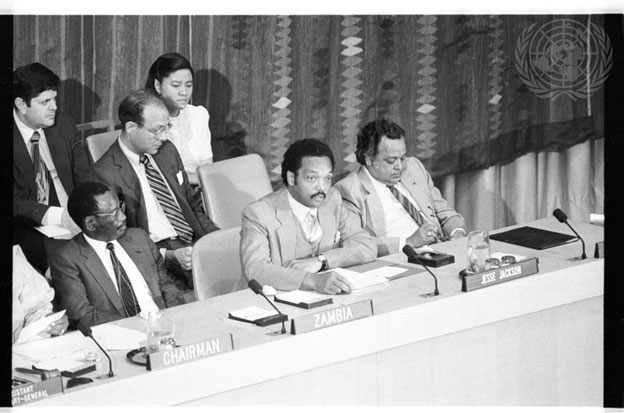
Secretary-General Antonio Guterres was saddened to learn of the passing of the Rev. Jesse Jackson, a giant of the civil rights movement in the US and a longtime champion of human rights, equality and justice around the world. Credit: United Nations
– When the Rev. Jesse Jackson Sr. declared, “Keep hope alive,” it was not a slogan. It was a discipline. It was a moral posture. It was a promise to those America had locked out of its prosperity and pushed to the margins of its democracy. And for more than five decades, Jackson kept that promise – organizing, marching, preaching, negotiating, and standing in solidarity with oppressed peoples at home and abroad.
In mourning Jackson, the United States does not simply bid farewell to a towering civil rights leader. It salutes one of the architects of modern American conscience.
The Heir to a Movement, the Builder of a Coalition
Born in Greenville, South Carolina, in 1941, Jackson came of age in the crucible of segregation. As a young activist, he worked alongside the Rev. Dr. Martin Luther King Jr. and the Southern Christian Leadership Conference, absorbing the lessons of nonviolent resistance while sharpening his own gifts for oratory and mobilization. After King’s assassination in 1968, Jackson did not retreat into despair. He stepped forward.
In 1971, he founded Operation PUSH (People United to Save Humanity), later merging it into the Rainbow Coalition. That phrase – Rainbow Coalition – was not rhetorical flourish. It was strategic genius. Jackson understood that America’s power structure thrived on division: Black against white, native-born against immigrant, worker against worker. His coalition sought to transcend those fault lines.
Black, brown, yellow, and poor white Americans; labor unions; family farmers; peace activists; Arab Americans; Jewish progressives; Asian Americans; Latinos; Native Americans—Jackson invited them all into a shared moral project. In the 1980s, when he ran for the Democratic presidential nomination in 1984 and 1988, millions who had never seen themselves reflected in presidential politics suddenly felt visible. He did not win the presidency. But he expanded the boundaries of who could plausibly seek it.
In doing so, Jackson helped pave the road that others would travel – most notably Barack Obama who went on to become the first African American President of the United States of America. Without the Rainbow Coalition, the arc of American political inclusion would have bent far more slowly.
Internationalism as Moral Imperative
Jackson’s courage was not confined to domestic battles. At a time when Cold War orthodoxy and Middle East politics discouraged nuance and punished dissent, he insisted that American moral credibility required consistency.
He extended solidarity to the oppressed people of Palestine long before it was politically fashionable – or safe – to do so. Jackson argued that the dignity and rights of Palestinians were inseparable from the universal principles Americans claimed to cherish. He sought dialogue with leaders across divides, believing that empathy was not endorsement, and that engagement was a prerequisite for peace.
He was equally forthright in condemning South Africa’s apartheid regime. While many U.S. leaders hedged or prioritized strategic interests, Jackson stood with the anti-apartheid movement. He supported sanctions and economic pressure to dismantle a system that codified racial subjugation. When Nelson Mandela emerged from 27 years of imprisonment, Jackson was among those who celebrated not only a man’s freedom but a nation’s rebirth.
In both Palestine and South Africa, Jackson’s stance reflected a deeper conviction: that civil rights were not an American export but a universal birthright. His faith demanded it. His politics operationalized it.
Faith, Integrity, and the Politics of Presence
Jackson was first and always a preacher. His sermons were political, but his politics were pastoral. He believed that despair was the greatest ally of injustice. To tell the forgotten that they mattered was itself an act of resistance.
He traveled where others would not. He negotiated for the release of hostages in Syria and Cuba. He met with heads of state and with families in housing projects. He listened.
Critics sometimes accused him of courting controversy or of grandstanding. But Jackson understood a hard truth: marginalized communities often need someone willing to occupy uncomfortable space on their behalf. Silence, in his view, was complicity.
His life was not without flaws or missteps. No life of consequence is. Yet what distinguished Jackson was his refusal to abandon the struggle. He endured political setbacks, media caricatures, and internal party resistance. He persisted.
Leadership, he demonstrated, is not about perfection. It is about fidelity—to principles, to people, to purpose.
The Rainbow as a Democratic Blueprint
In an era increasingly defined by polarization, Jackson’s Rainbow Coalition reads less like a relic of the 1980s and more like a blueprint for democratic survival. He recognized demographic change not as a threat but as a promise. He saw in America’s diversity the possibility of moral and economic renewal.
He championed voting rights, labor protections, public education, and economic justice. He opposed apartheid abroad and discrimination at home. He insisted that foreign policy reflect domestic values and that domestic policy reckon with global inequality.
The Rainbow was not naïve about power. It was strategic. It sought to translate moral energy into electoral leverage. Jackson registered voters. He built grassroots networks. He forced party platforms to incorporate issues once dismissed as fringe.
His presidential campaigns altered the calculus of American politics. They demonstrated that Black candidates could compete nationally, that poor and working-class voters could be mobilized across racial lines, and that progressive foreign policy positions had a constituency.
A Hand Extended Across Divides
Perhaps Jackson’s most underappreciated gift was his willingness to extend a hand of friendship where animosity seemed entrenched. He believed in meeting adversaries face-to-face. He believed that even hardened systems could yield to persistent moral pressure.
In Palestine, Rev. Jesse Jackson Senior spoke of human rights and mutual recognition. In South Africa, he, spoke of freedom and reconciliation. At home, he, spoke of multiracial democracy.
When few American leaders dared to articulate solidarity with Palestinians living under occupation, Jackson did. When Washington’s establishment hesitated to confront Pretoria’s apartheid regime, Jackson did not. His courage was not abstract. It was embodied in travel, in speeches, in alliances, in risks taken.
He paid political costs for these positions. But he did not recalibrate his convictions to suit prevailing winds.
The Best of the United States
To commemorate Jesse Jackson is to acknowledge the paradox of America itself. He emerged from a nation scarred by slavery and segregation, yet he believed in its redemptive capacity. He criticized its failures unsparingly, yet he invested his life in its institutions.
He was, in that sense, profoundly patriotic.
The United States at its best is not defined by military might or economic dominance. It is defined by its capacity for self-correction. By its willingness to expand the circle of belonging. By its recognition that justice delayed is democracy diminished.
Jackson embodied that tradition. He did not romanticize America. He challenged it. He called it to live up to its founding ideals – not selectively, but universally.
As debates rage today over voting rights, racial equity, immigration, Middle East policy, and America’s global role, Jackson’s life offers a moral compass. He reminds us that coalitions are built, not assumed. That solidarity is practiced, not proclaimed. That hope is sustained through organization.
Keeping Hope Alive
In the final analysis, Jesse Jackson’s greatest achievement may have been psychological. He taught millions that their voices mattered. That they were not condemned to permanent marginalization. That politics could be an instrument of empowerment rather than exclusion.
For Black Americans who had never seen a serious presidential bid from one of their own, he opened a door. For Palestinians seeking recognition of their humanity, he offered validation. For South Africans resisting apartheid, he offered solidarity. For workers, immigrants, and the poor, he offered a coalition.
He lived the conviction that the struggle for justice is indivisible.
Today, as the rainbow he envisioned faces new storms, the measure of our tribute will not be in words but in action. To honor Jesse Jackson is to organize. To vote. To speak. To stand with the oppressed – whether in Chicago, Johannesburg, or Gaza. To build alliances across lines others insist are permanent.
He demonstrated that leadership grounded in faith, integrity, and courage can alter a nation’s trajectory. He showed that America’s story is not finished – and that its best chapters are written by those who refuse to surrender to cynicism.
Rev. Jesse Jackson Sr. kept hope alive.
The question now is whether we will.
Purnaka L. de Silva, Ph.D., is College and University Adjunct Professor of the Year 2022, Best Adjunct Professor 2024-2025 and Nominated Best Adjunct Professor 2026 at the School of Diplomacy and International Relations Seton Hall University; Visiting Professor Sol Plaatje University Faculty of Humanities; Director Institute of Strategic Studies and Democracy (ISSD) Malta; and Strategic Advisor Lead Integrity.
IPS UN Bureau