Linking the Malawian Diaspora to the Development of Malawi”
Malawi
Malawi (/məˈlɔːwi,məˈlɑːwi/; Chichewa pronunciation:[maláβi]; Tumbuka: Malaŵi), officially the Republic of Malawi and formerly known as Nyasaland, is a landlocked country in Southeastern Africa. It is bordered by Zambia to the west, Tanzania to the north and northeast, and Mozambique to the east, south and southwest. Malawi spans over 118,484 km2 (45,747 sq mi) and has an estimated population of 19,431,566 (as of January 2021). Malawi’s capital and largest city is Lilongwe. Its second-largest is Blantyre, its third-largest is Mzuzu and its fourth-largest is its former capital, Zomba.
European leaders brace for President Trump’s speech at the World Economic Forum, as new tariff threats and talk of acquiring Greenland overshadow talks on affordability. The Justice Department issues subpoenas to Minnesota’s top Democratic leaders, as state officials accuse the Trump administration of weaponizing immigration enforcement and creating fear in immigrant communities. And the Supreme Court hears a high-stakes case over President Trump’s attempt to fire a Federal Reserve governor, a move that could upend a century of precedent and rattle financial markets.
Want more analysis of the most important news of the day, plus a little fun? Subscribe to the Up First newsletter.
Today’s episode of Up First was edited by Rebekah Metzler, Gigi Douban, Krishnadev Calamur, Mohamad ElBardicy, and Alice Woelfle.
It was produced by Ziad Buchh, Ben Abrams and Christopher Thomas.
We get engineering support from Neisha Heinis. Our technical director is Carleigh Strange.
And our Supervising Producer is Michael Lipkin.
(0:00) Introduction (02:24) Trump’s Speech in Davos (06:07) DOJ Subpoenas For Minnesota (09:49) SCOTUS Federal Reserve Case
By Dr. Tinevimbo S. Moyo, Harare, Zimbabwean political economist and Director of the Southern Africa Governance and Trade Initiative
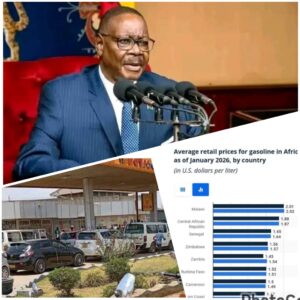
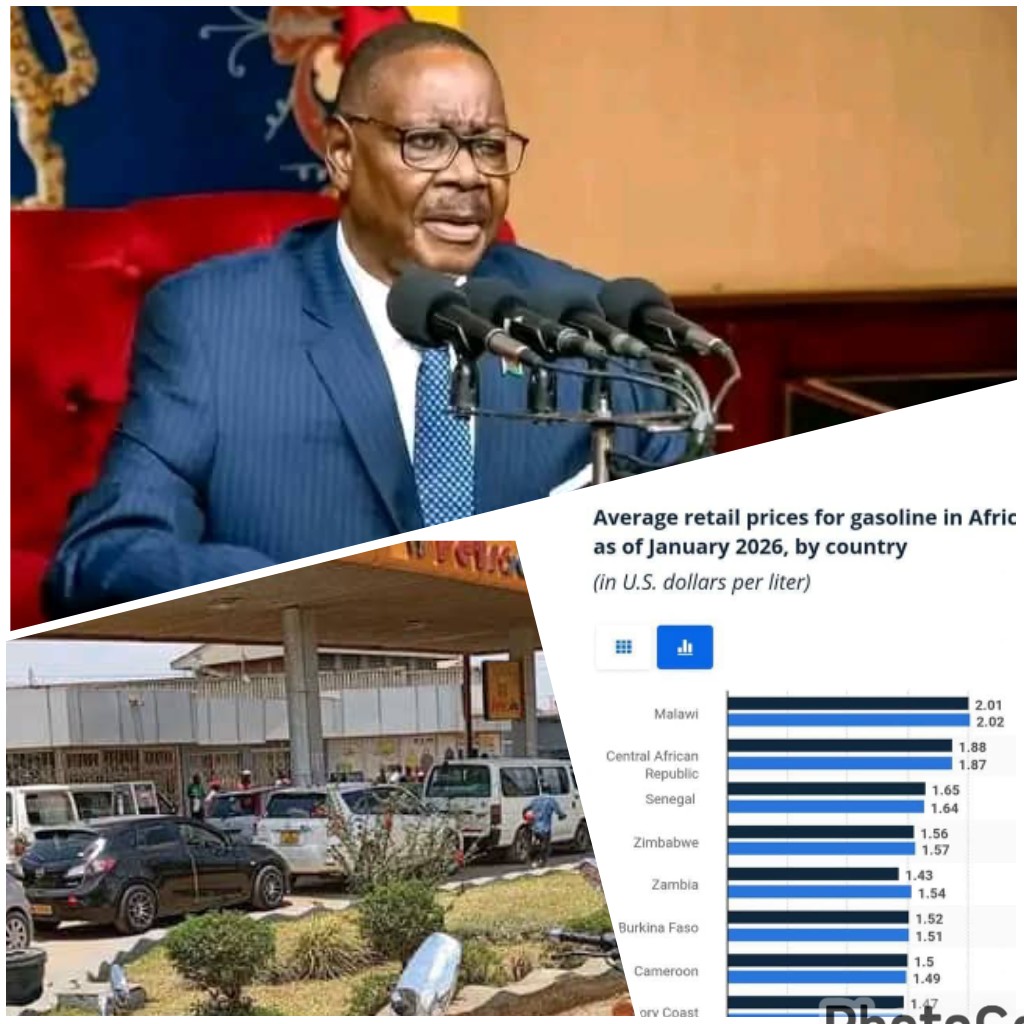
In a decisive move that underscores his administration’s commitment to economic realism, President Professor Arthur Peter Mutharika has endorsed the Malawi Energy Regulatory Authority’s (MERA) immediate adjustments to fuel and electricity prices.
This bold step, announced just hours ago, marks a critical inflection point for Malawi’s economy and represents the very kind of firm, corrective act that was conspicuously absent under the previous administration of President Lazarus Chakwera.
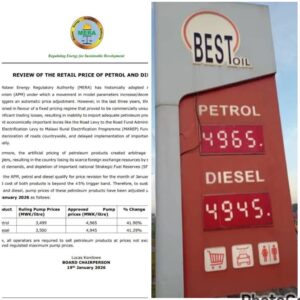
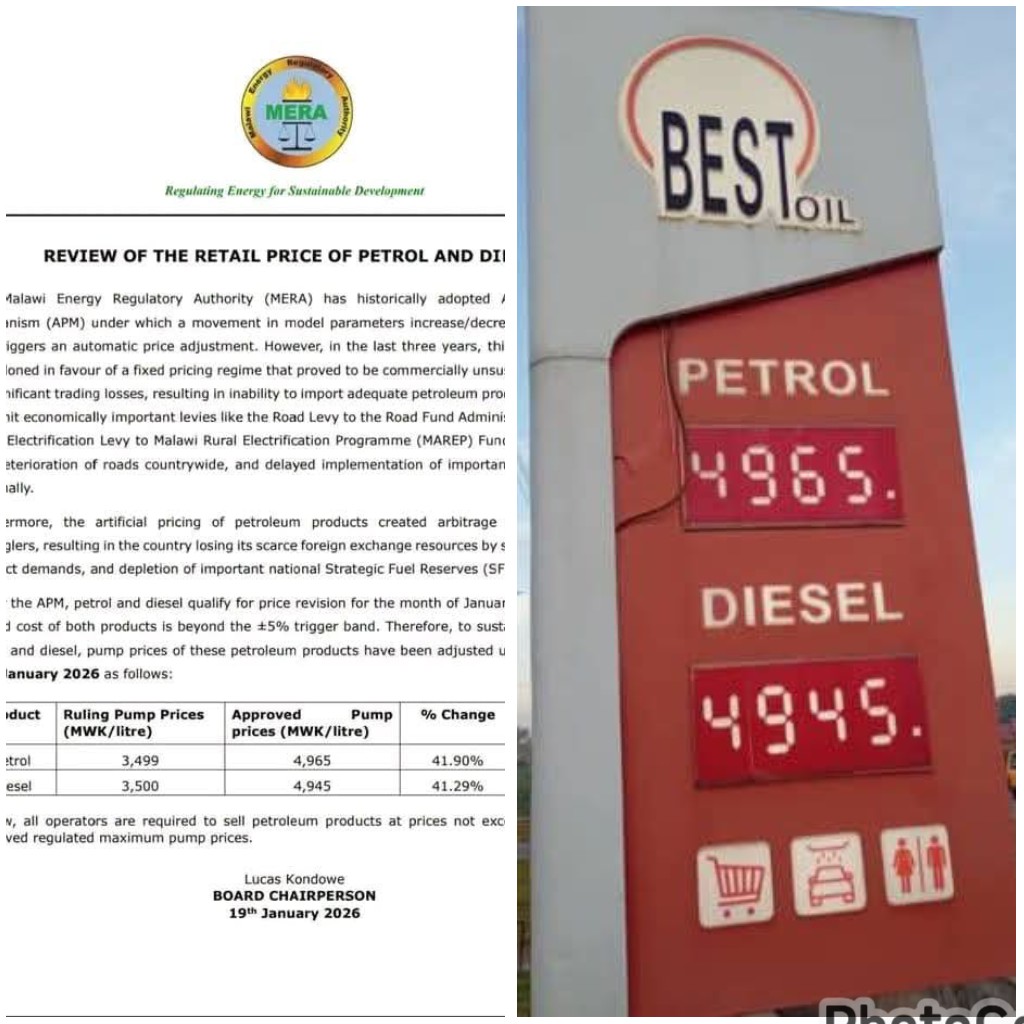
The decision, effective from January 20, 2026, sees the reinstatement of the Automatic Pricing Mechanism (APM) for petrol and diesel, with increases of approximately 41%, and the implementation of the long-delayed third tranche of the electricity base tariff.
This is not merely a price change; it is a fundamental policy reversal. It directly addresses the artificial pricing regime—a legacy of the Chakwera era—that brought the nation to the brink of energy collapse.
Where the previous administration hesitated and allowed critical levies to fail, President Mutharika has acted with the urgency the situation demands.
Upon his return to office following a decisive electoral mandate in September 2025, President Mutharika inherited an energy sector in silent crisis.
The fixed pricing model maintained by his predecessor had drained strategic reserves, encouraged rampant smuggling, and starved the Road Fund and Rural Electrification Programme (MAREP) of billions in Kwacha.
The action is the first, essential surgical cut to remove that tumour of unsustainable policy.
What President Mutharika has done, his predecessor demonstrably could not—or would not—do over five years, is prioritize the long-term health of the nation over short-term political comfort.
The Chakwera administration was defined by a paralysis in the face of difficult choices, allowing infrastructure to decay and supply chains to fracture while offering only promises.
President Mutharika has replaced promises with a painful but precise prescription for recovery.
The swiftness of this decision following his return to State House sends a powerful signal to citizens, investors, and international partners.
It signals that the era of avoidance is over. By allowing prices to reflect true costs, the President has:
Restored Market Integrity: Ensuring fuel importers can operate viably and supply can be sustained.
Restored Fiscal Linkages: Reconnecting every litre of fuel sold to the funding of roads and rural electricity projects from today forward.
Restored Policy Credibility: Demonstrating that Malawi, under his leadership, will adhere to transparent, rules-based economic governance.
The timing is pivotal. This decision, made today, prevents the continued haemorrhaging of foreign exchange and stabilizes the foundation upon which all other economic activity depends. It is a classic act of political courage: spending hard-earned political capital immediately upon entering office to secure the nation’s future, rather than delaying the inevitable until a crisis becomes unmanageable.
For the ordinary Malawian feeling the weight of this adjustment today, the pain is real and immediate. But so too was the pain of empty pumps, impassable roads, and stalled development—a chronic pain the previous government failed to cure.
President Mutharika’s choice today is to administer a sharp, transformative pain that leads to recovery, rather than prolonging a debilitating decline.
In his victory speech, President Mutharika promised a return to decisive and responsible governance.
The announcement from MERA this afternoon is that promise in action.
It is a clear statement that under his leadership, difficult truths will be confronted head-on, not deferred.
For a nation weary of false stability and hidden decay, today’s difficult news may well be remembered as the day Malawi began its honest journey back to solid ground.
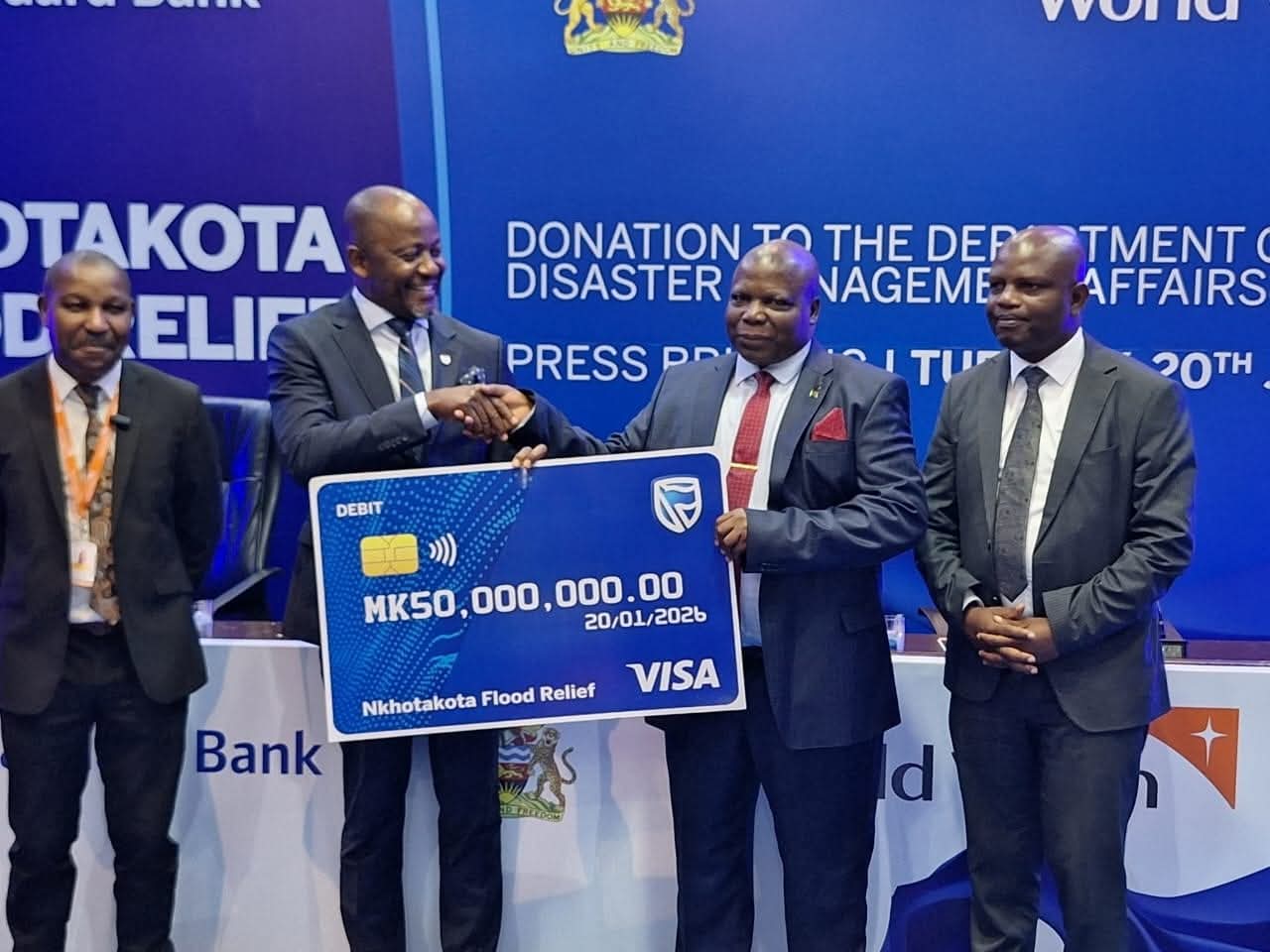
LILONGWE-(MaraviPost)-Standard Bank Plc has donated MK50 Million for relief efforts to affected communities of Nkhotakota in central Malawi.
This is in response to the aftermath of recent national flood disasters.
Handing over the donation, Standard Bank Chief Executive Phillip Madinga said the donation aims to complement government’s efforts in addressing the immediate needs of the victims.
“Today’s donation of Mk50 million speaks directly to our purpose of Driving Malawi’s Growth. To us, growth is not only measured by financial outcomes or economic indicators.
“True growth is reflected in the strength of our communities and in how we care for one another when life turns difficult,” he said.
According to the Department of Disaster Management Affairs (DODMA), Nkhotakota has recorded 12 deaths,37 injuries and two missing persons.
The department adds that more than 10,912 households have been affected in the district.
The department adds that the donation by Standard Bank Plc supports a camp in T/A Kanyenda Dwangwa area that is catering for approximately 3,000 displaced people.
Many people are living in camps.
Madinga said the donation reiterates Standard Bank’s long-term commitment to responding to the country’s complex disasters.
Notable disasters include the call for Hunger Relief last year, relief from effects of Cyclones Ana, Idai and Freddy; and the COVID-19 Pandemic.
In December, the bank contributed K200 Million in response to President Peter Mutharika’s declaration of disaster on hunger.
“As a bank, we also recognize that these disasters are closely linked to the growing realities of climate change. Standard Bank is a founding signatory to the United Nations Principles for Responsible Banking, aligning our operations with the UN Sustainable Development Goals and the Paris Agreement.
“These commitments compel us not only to respond to crises, but to actively support efforts that protect our environment and safeguard future generations. We therefore pledge to continue playing our part in collaborative initiatives aimed at building resilience and preventing the recurrence of such tragedies,” said the Chief Executive.
Chief Secretary in the office of President and Cabinet Dr. Justin Saidi thanked Standard Bank for its long history of assisting in times of disaster.
“Today’s donation will greatly assist in meeting the needs of victims living in camps and those outside. It’s pleasing to note that Standard Bank is always moving together with us on this journey. Their generous donation of MWK50 million is a true sign of solidarity,” he said.
Standard Bank has partnered World Vision International and DODMA in the Office of President and Cabinet for the relief response.
“There are families who lost all they had worked for, and their loved ones and are in dire need. We express deep gratitude to Standard Bank for their donation, and responding to the call ,” said Charles Chimombo, WVI Director of Programs.
Through this donation, Standard Bank Plc reaffirms its commitment to standing with communities in times of need and working alongside Government, humanitarian partners and stakeholders to support recovery and long‑term resilience.
The Bank remains dedicated to driving inclusive growth, strengthening community wellbeing and contributing meaningfully to national development, particularly in the face of increasing climate‑related challenges.
LILONGWE-(MaraviPost)-The National Advocacy Platform (NAP) has criticised the 41 percent fuel price increase announced by the Malawi Energy Regulatory Authority (MERA), describing the move as ill timed and burdensome to ordinary Malawians already grappling with rising living costs.
In a statement signed by NAP Chairperson Benedicto Kondowe and National Coordinator Baxton Nkhoma, the organisation said the fuel price adjustment, which took effect on 20 January 2026, comes barely months after a previous fuel hike and amid several recent tax increases, including Pay As You Earn (PAYE), Value Added Tax (VAT), pension tax, property tax and death benefit tax.
According to the organisation, fuel is a key driver of economic activity, affecting transport, food distribution, access to health services, education and small scale businesses.
NAP warned that the sharp increase is likely to trigger higher prices for essential goods and services, thereby worsening the cost of living for low income households.
While acknowledging the role of the Automatic Pricing Mechanism (APM) in regulating fuel prices, NAP argued that the mechanism should not be applied rigidly without measures to cushion citizens during periods of economic hardship.
The organisation maintained that Government has the discretion to introduce mitigation measures to protect vulnerable groups.
NAP also questioned the justification that the fuel hike is necessary to prevent fuel shortages, saying the social and economic consequences of higher fuel prices should be carefully considered.
The organisation noted that increases in fuel costs typically translate into higher transport fares and food prices, with disproportionate effects on the poor.
The advocacy group has since called on Government to review the scale and timing of the fuel price increase and consider introducing targeted relief measures, including transport and food price stabilisation initiatives.
It has also urged authorities to reduce non essential public expenditure and reassess the cumulative tax burden on citizens.
NAP further appealed for increased transparency and engagement with civil society in the formulation of energy and economic policies, arguing that inclusive dialogue is key to achieving sustainable and people centred solutions.
The organisation said it remains open to constructive engagement with Government and relevant institutions to promote economic stability and social protection.
As world leaders gather in Davos, President Trump escalates pressure on allies with new tariff threats, renewed talk of acquiring Greenland, and plans for a sweeping new “Board of Peace” that could reshape global diplomacy. Three people die in six weeks at the country’s largest immigration detention center in El Paso, raising urgent questions about medical care, oversight, and the role of private contractors. And Indiana completes one of the most improbable turnarounds in college football history, capping a perfect season with a national championship win over Miami.
Want more analysis of the most important news of the day, plus a little fun? Subscribe to the Up First newsletter.
Today’s episode of Up First was edited by Dana Farrington, Alfredo Carbajal, Russell Lewis, Mohamad ElBardicy, Alice Woelfle.
It was produced by Ziad Buchh, Ben Abrams and Christopher Thomas.
We get engineering support from Neisha Heinis. Our technical director is Carleigh Strange.
And our Supervising Senior Producer is Vince Pearson.
(0:00) Introduction (01:58) Trump’s World Stage (05:51) El Paso Detention Deaths (09:17) Indiana College Football Champions