Linking the Malawian Diaspora to the Development of Malawi”
Malawi
Malawi (/məˈlɔːwi,məˈlɑːwi/; Chichewa pronunciation:[maláβi]; Tumbuka: Malaŵi), officially the Republic of Malawi and formerly known as Nyasaland, is a landlocked country in Southeastern Africa. It is bordered by Zambia to the west, Tanzania to the north and northeast, and Mozambique to the east, south and southwest. Malawi spans over 118,484 km2 (45,747 sq mi) and has an estimated population of 19,431,566 (as of January 2021). Malawi’s capital and largest city is Lilongwe. Its second-largest is Blantyre, its third-largest is Mzuzu and its fourth-largest is its former capital, Zomba.
Such is the
fast-paced song in rural areas, especially in the North, when the MV Ilala, a
620-tonne ferry, is about to depart a port—a sign of just how much the ship,
which has chugged up and down Lake Malawi since 1951, is revered.
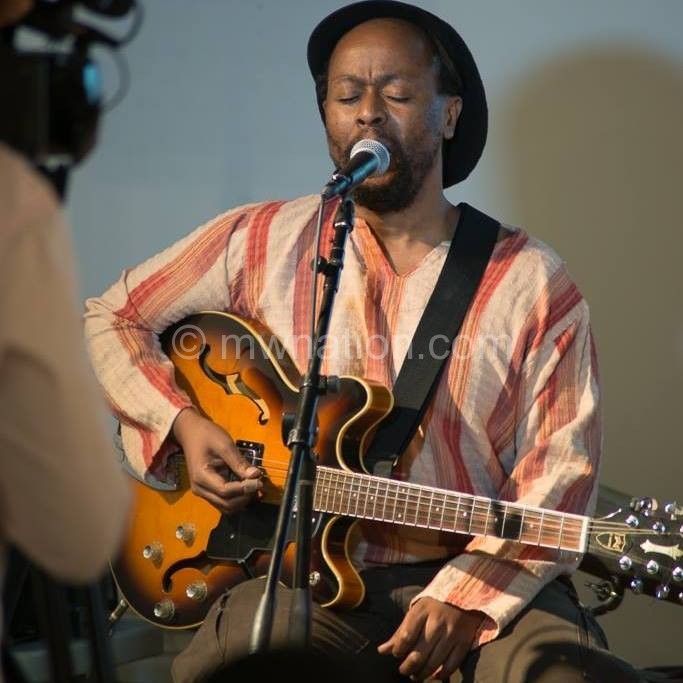
United States-based Malawian musician Chipembere Jnr has released an acoustic version of ‘Ilala’
Ilala is a song that comes from an old
Malawian traditional wedding song. It says we are going on a ship.
On Sunday,
May 19 2019, United States-based Malawian musician Masauko Chipembere Jnr
released an acoustic version of the song as a precursor to his album set for
release on June 16 2019.
In his
version, Masauko, son to political nationalists Henry Masauko and Catherine
Chipembere, believes that the ship is taking people on a voyage to the place of
the ancestors.
It is a
powerful acoustic performance filmed at Stowel Lake Farm on Salt Spring Island,
Canada. The album version of Ilala was produced and recorded by Come
to Life at Milestone Recording Studio in Cape Town, South Africa.
But this song
is just a tip of an iceberg in a music project that captures the story of how a
boy from Los Angeles, who spent years trying to find his African identity,
finally made it home.
“I was a
child of exile,” speaks Chipembere in a five-minute documentary released
recently.
“I was
conceived in Tanzania while my mother and father were running from the conflict
with Kamuzu Banda in Malawi. I was born in Los Angeles. I was actually in the
womb in Africa and then born in the United States.
“My music, I
feel, has always been about trying to figure out how to balance that on some
sort of scale,” he explains.
His father,
Henry, played a significant role in bringing independence from colonial rule to
Malawi. He became a minister in Kamuzu Banda’s Cabinet in the run up to
independence in July 1964.
But barely a
month later, Banda’s autocratic style led to the Cabinet Crisis where
Chipembere resigned and was forced into exile.
“In Los
Angeles, I grew up amongst kids who were troubling with all things that LA had
to throw at you…Malawi was an abstract idea. I came to find out later that,
because of my father’s political situation, it was illegal for Malawians to
come to Los Angeles. Malawians could be punished by death for coming to Los Angeles
because my father was there. So, as a child, I grew up not knowing any
Malawian.
“It was up
until 1994, when my mother went back to Malawi. She was part of the government
that pushed out the dictatorial regime of Kamuzu Banda.
“That’s when
Malawi and the whole Chipembere story became real to me, more especially the
thought of my mother taking a flight to Malawi to fight someone who is an enemy
of pan-Africanism,” he explains.
This short
music documentary about Masauko Chipembere was made over a two-week journey in
Southern Africa to produce his latest record with Come To Life titled Masauko.
For years, he
had been traveling to Malawi to work with artists such as Ernest Ikwanga (lead
guitar), Chambota Chirwa (bass guitar), Kyle Luciano Phikiso (drummer) and Sam
Mkandawire (keyboard).
He, however,
says despite the immense talent that Malawi has, he found it difficult to find
better resources for his album; hence, going to South Africa which “has more
means such as better equipment and studios”.
The album’s
creation finds its roots back during the US Presidential elections of November
2016 when Masauko was invited to a jam session on Salt Spring Island, Canada.
A number of
artists had also gathered on Salt Spring to deal with the coming of the new
regime in the U.S. and to remind themselves that they could battle the
destructive nature of the new political reality with creativity through art.
They sang,
they chanted, they cried, and testified. At the end of a particularly beautiful
jam session, Masauko was standing with David from Guayaki and Daryl Chonka, who
was the sound engineer for the event.
He recalls:
“David said to me ‘We should start a record company’. I simply agreed,
suggesting that the moralistic nature that has characterised the Guayaki brand could
make a positive impact on the music industry. I never dreamed that Daryl would
call me a few months later to say, “We are starting the record company we
talked about and you are the first artist we want to make a record with.”
Chipembere
says although Malawi is financially poor, it is culturally rich; a feature that
he believes his project demonstrates.
Malawians are
a people who have ancient traditions connecting them to the earth, the sky, the
wind, the trees and the ancestors.
His album is
the product of all these elements coming together.
“African-American
community in the United States taught me about ancestors. In fact, I learnt and
heard more about ancestors from black people in America than I have typically
in Africa.
“The belief
there is that we need to come to grips with our ancestors.
But we are a
people claiming that our ancestors were slaves. That means going back into that
is choosing hardships.
“My journey
was to come to grips with my roots in Malawi and Africa.
That journey,
I understand, didn’t have to be pretty. It had to be done because it was the
right thing to do, because people without roots cannot grow.
“So, going straight at it instead of avoiding it has allowed me to find some grace in the sense that I get to know myself,” he explains.
Kenya is “one of our key friends in Africa — nay, in the world,” said a confident, pleased United States (US) assistant secretary of State for African Affairs, Tibor P Nagy, at a May 9 briefing in Washington, DC.
On May 7 to 8, the US Department of State’s deputy secretary, John J Sullivan and Kenya’s Foreign Affairs minister Monica Juma, in Washington DC held the inaugural bilateral strategic dialogue and signed two key framework documents.
This raised their diplomatic relations and deepened ties between the two countries.
Nagy and Foreign Affairs ministry political and diplomatic secretary, ambassador Tom Amolo, co-chaired the two-day interagency discussions. Nagy described the talks as “beyond impressive”, but very pleased even though Kenyans “live in a very tough neighbourhood”.
He declined responding to media questions on intelligence sharing, saying simply: “No comment.”
Both affirmed their commitment to the democratic value system. The US and Kenya will hold a second bilateral strategic dialogue in Nairobi in the summer of 2020.
It all sounds very cosy, except that is not all. Why should Africans care?
Kenya is neither an advanced economy, nor hugely democratic. It is not the “usual ally” the US befriends. On the contrary, many African countries are low-income, fragile, and negatively impacted by natural disasters.
In some regions on the continent, there are authoritarian regimes that are highly repressive and closing spaces made up of semi-authoritarian leaders where parliaments are rubber stamp bodies. At times, this makes policy outcomes challenging.
For instance, on May 20 in his remarks at the Advisory Committee On Voluntary Foreign Aid Public Meeting (ACFVA ) held at the Centre for Strategic and International Studies (CSIS), US Agency for International Development (USAid) administrator, Mark Green said about authoritarian leaders: “These days, they embrace elections. They welcome elections, and then mobilise every tool, every technology, and every strategy to steal them and bend them to their will. By the time that voters go to the polls, the outcome is pre-ordained. And, the authoritarian may even have gained a veneer of legitimacy. Authoritarians have new tools and tactics they are deploying to bend elections and snuff out the voices of the people.”
He added, underscoring, “so many brave souls; they’re counting on us. They’re counting on us to stand with them. They’re counting on us to work with them and they’re counting on us to remain a lifeline, a beacon of hope.”
His remarks ended with a profound statement: “We are at a crossroads moment. Crossroads moments imply choices.”
Questions
It’s important to ask the question: Why did the US government choose to improve bilateral relations with Kenya? We ought to examine its observable, enhanced foreign policy approach regarding the reasons for and the patterns of engagement.
One has to wonder if the argument being made by the US to get more involved in Kenya and countries like Uganda is plausible, an expression of the Donald Trump doctrine or a true bipartisan US foreign policy; a “feel good humanitarian intervention”, veritable US national security interest or sincere African leaders’ international engagement.
The sentiments expressed by both Nagy and Juma indicate a preference that suggests current US foreign policy is more heavily and consistently influenced by Kenya’s diplomatic, economic, and military promise, including counter-terrorism co-operation.
Although they did not confirm if neither intelligence sharing, nor faster information sharing was discussed in the meetings, Nagy said: “In terms of defence, democracy, governance and civilian security these topics are usually discussed as a matter of course and practice.”
Domestic politics and international relations are usually inextricably linked.
In the case of US-Kenya relations, the reasons jointly given for elevated bilateral relations were the four thematic pillars of economic prosperity, trade, and investment, defence co-operation, democracy, governance, and civilian security, including multilateral and regional issues.
Juma expressed delight stating that it “is our desire to give traction to our President’s think big” mantra.
However, key questions remain: What should African national interests be? Can anyone’s efforts defeat the jihadist fundamentalist group, al-Shabaab, based in East Africa and comprehend its extended footprint into Mozambique?
Relevance of Uganda, Zimbabwe and South Africa
Why are there no increased US relations with Uganda, Zimbabwe or South Africa?
In December 2017, Uganda President Yoweri Museveni and his supporters changed the Constitution, removing the age limit on the presidency, thus allowing him to stay in office indefinitely.
It’s a country with a staggering population of more than 34 million people, 75% of whom are under the age of 30, with 50% living in extreme poverty.
If compared to Zimbabwe, Uganda is better off. Zimbabwe is listed by the International Monetary Fund’s 2019 Africa Regional Economic Outlook (REO) as a country in a fragile situation.
The report confirms Zimbabwe’s elevated public debt vulnerability, along with countries in debt distress; the Democratic Republic of Congo, Eritrea, The Gambia, Mozambique, São Tomé and Príncipe and South Sudan.
While in the past Museveni has been good at getting involved in conflicts outside his borders, recently, he’s been great at taking in refugees. Uganda holds the highest number of refugees; an influx of 1,1 million refugees and asylum-seekers as of October 2018 from the Democratic Republic of Congo and South Sudan since July 2016. Museveni’s “Pan-African” ideology has driven Uganda’s refugee policy.
That has to be commended.
However, what does Museveni have to do with US’s foreign policy? Does the US support a head of state that pushed for Parliament to scrap the presidential age limit allowing him to potentially rule for life?
After gaining independence from Britain in 1962 with Milton Obote as Prime Minister, who was toppled in a military coup by Idi Amin in 1971, another coup also happened in 1985 which brought Museveni into power.
The US is sticking with support to Uganda, indicating that Uganda is a positive force in the regional security environment. Nagy stressed earlier this year while in Kampala: “I have to tell the African leaders that if you want American companies to invest their money in your country, then they need to have a positive business environment which means:
minimum levels of corruption fair treatment honoring contracts a good governance environment
He warned regarding deals with China: “It’s easy to sign a contract and increase a country’s debt, build a project and everybody above the class of turning a shovel comes from the other country.”
Yes, Uganda receives billions in economic and military assistance although the government has faced widespread condemnation for its actions against Museveni’s critics.
Being one of the youngest countries in the world with an average age of 19, perhaps it’s a good thing for the US to take an interest with this level of youth population boom and make the country an anchor of its attention.
Increasingly though, there is expert debate on lessons to learn from Zimbabwe and about South Africa.
Marian L Tupy, senior policy analyst at the Centre for Global Liberty and Prosperity at the Cato Institute, has called Zimbabwe’s approach to its economy a real life “experiment in alternative economics”, saying there are “riches of wisdom to be learned about what happened in Zimbabwe over the last 20 years”, which he described as “government terrorism”.
Tupy added at an April Cato event: “Regrettably, these lessons are being completely ignored south of the Limpopo where the South African marxist government is on its way to repeat almost exactly the same mistakes that Zimbabwe has made.”
Tupy highlighted South Africa’s moves to nationalise its central bank and views taking hold that the country is “experimenting with very strict racial laws in business and government”.
He pointed out that “Zimbabwe continues to be relevant. For the sake of other African countries who are trying to decide what kind of economic and political arrangements they should be following in order to become prosperous in the future.”
At the same Cato event, Barry D Wood, a Washington correspondent, pointed that: “Zimbabwe is an important country that is exceedingly rich; rich with human resources, a fine educational system, connected to the US, South Africa and Europe. It has platinum, lithium, coal, diamonds and six flights a day out of Johannesburg yet three-quarters of the people are food-aid dependent, with four million Zimbabweans in South Africa.”
Wood broached the question: Should the west engage or not with Zimbabwe? Foreign investors want in, but won’t come without western approval. Government is incompetent, divided and effective reforms won’t be implemented. Yet, South Africa wants President Emmerson Mnangagwa to succeed.
The “case for not engaging?”
Wood underlined that Zanu PF “is determined to hold power at all costs; those are the words of the former US ambassador to Zimbabwe who says there should not be engagement on that account because Zanu PF simply will not give up power”.
Defence and security
When Trump and Kenya President Uhuru Kenyatta dialogued at the White House on August 27, 2018, Kenya’s prominent military role in operations against the Al-Qaeda-affiliated insurgent group al-Shabaab in Somalia was spotlighted.
Trump expressed his “appreciation for Kenya’s significant contribution to the African Union mission in Somalia and recognised Kenyan troops’ sacrifices in the fight against al-Shabaab.” Last year’s media speculation that the visit would result in closer diplomatic ties with Kenya has now been confirmed.
No doubt more details will unfold on defence support for Kenya and increased US military co-operation.
Disaster planning
As the gateway to east Africa, with goods entering countries such as Uganda and the African continent as a whole, the implementation for disaster planning in southern Africa is critical. Both the US and Kenya dialogue actors agreed that they recognised the significance.
On Kenya emulating any foreign policy models that could be an example or used to advantage southern Africa’s cyclone-hit Zimbabwe, Mozambique and Malawi, Juma said: “Clearly, there are new climatic threats. This [US relationship] is an opportunity not only for Kenya, but also for the continent, the AU and Sadc.”
Yet, if one compares China’s foreign policy in Africa to the US approach — it could be said it’s less noble in many respects — there’s yet no consensus on this issue among experts.
The potential impact on Africa’s socio-economic growth, defence, long-term emergency disaster planning and sustainability should inform country-specific foreign policy approaches.
On the bright side, Nagy confirmed he’s “grateful for opportunities that open closer inclusive engagement” with Kenya stressing the keenness “to build the capacity they need”.
Understanding why the US chooses one African country over another in its foreign policy approach and level of support is important. In addition, it would be wise to grasp the divergent ideological approaches of each interested sovereign country at the dialogue table.
Ultimately, countries like Kenya, Uganda, Zimbabwe and many across the continent need long-term development capacity. African leaders must formulate foreign policies that allow them to chart their own futures, create pro-democracy gains and sincerely protect the national security interests for their African people and the US for the American people.
True, African countries are hemorrhaging with, by and large, vulnerable economies and a military in the President’s pocket for many of them.
Going forward
Uganda needs to start thinking about its future and who will replace Museveni if he dies in office or is forced out. It cannot afford to be complacent.
The Trump administration would be wise to take care of how its remarks about African-Americans are perceived and received by Africans—millions of Africans do pay attention — if it hopes to move more bilateral relationships from being lukewarm to more friendly.
This should remain top in the mind as it reviews China’s increasing involvement in Kenya, Uganda, Zimbabwe, the continent, and from older security issues in Somalia and newer jihadist ones in Mozambique.
Formulating foreign policy solely based on national liberation ideology alone or US national interests only will leave out millions of people with 21st Century aspirations, youths needing jobs, young mothers needing healthcare delivery systems, women, youth and diaspora votes that are critical, as well as generations that don’t remember the liberation struggles.
Remaining divorced from ideas that build a sustainable future will not help African leaders nor help US-Africa foreign policy approaches.
Being hopeful alone is not enough.
Democracy and strong foreign policies are backsliding in Kenya, Uganda, and other African countries such as Zimbabwe, South Africa, and even the current US foreign policy is weaker than was in previous administrations.
The US must find ways to take the relationships built through US foreign aid and pivot to more commercial relationships with Africa in order to compete with other global powers such as China and Russia.
In addition, local Africa-based civil society organisations should have a consistent amount of engagement in policy processes and outcomes.
Civil society can have the capacity to offer citizens a say in decisions and to increase pluralism, influence foreign policy and seek accountability from State actors.
When all is said and done, here is what you should mull over: The state of Africa, US foreign policy’s emerging role on the continent and your role in emboldening or hindering authoritarian leaders.
For now, Kenya is the United State’s leading friend in “Africa — nay, in the world”.
Pearl Matibe has geographic expertise on US foreign policy, think tank impact, strategy and public policy issues. You may follow her on Twitter: @PearlMatibe
strong>
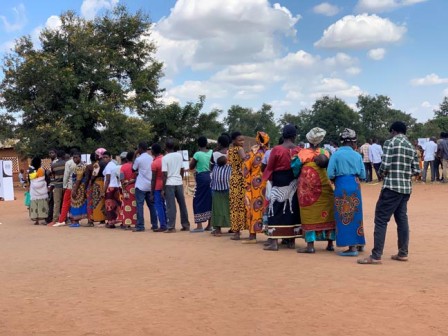
Long lines filled with patient and peaceful residents at polling places just about everywhere throughout Malawi today revealed democracy at its best for the 2019 Tripartite elections as Malawians went to the polls and cast their ballots to elect a president, members of parliament and local government councilors.
Malawi President Peter Mutharika is seeking re-election to another five-year term while his challengers include Vice President Saulos Chilima, and President of the Malawi Congress Party (MCP), Dr. Lazarus Chakwera.
With lines stretching as far as the eye can see, the overwhelmingly peaceful voting process in several parts of the country was witnessed by the European Union Elections Observer Mission, The National Initiative for Civic Education Public Trust and several other observers, including an independent African American delegation led by National Newspaper Publishers Association President and CEO Dr. Benjamin F. Chavis, Jr.
“In every place that we went, there were long lines of people. But what was impressive was that there was no one pushing … everybody was patient and I said to myself that this is African Democracy,” said Chavis, who appeared on several Malawian television and radio stations and has given numerous newspaper interviews since his arrival on May 19.
One Malawian who watched a broadcast with Chavis approached the civil rights icon to thank him for “putting Malawi in such a good light.”
The unidentified man approached Chavis at the President Walmont Hotel, across the street from one of the busiest polling places in Lilongwe.
“What we saw was a very orderly process and there was enthusiasm about voting,” Chavis said.
He added that, “there were some very young voters, elderly voters, and in between. From my own eyes, we’ve been very impressed.”
Bia Yassia, the head of a family of seven children who lives about five meters from one Malawi Electoral Commission (MEC) polling place, said he intended to vote.
Yassia greeted many who walked along the road near his home as they made their way to the ballot box.
“Everybody participates,” Yassia said.
“Here, we have pride in our country, and we respect the process that’s in place,” he said.
This year marks the sixth presidential election since 1994 when Malawi voted for the change of government system from one party rule to multi-party democracy in June 1993.
Reportedly, more than 55 political parties have been registered in the country since the dawn of multi-party democracy.
Three of the parties: United Democratic Front (UDF), Democratic Progressive Party (DPP), and People’s Party (PP), have governed the country during the multi-party era while Malawi Congress Party (MCP) has governed the country since its independence in 1964.
MEC officials said more than 6.4 million registered voters were expected to exercise their democratic right to vote for the political parties’ representatives of their choice and a president to lead the country over the next five years.
MEC Chairperson Jane Ansah said late Tuesday that the election process appears to have run smoothly despite rumors of potential rigging.
“These claims are baseless. This is not true,” Ansah said, adding that, “MEC will not be in a hurry to announce results in order to do a thorough job.”
Having previously observed elections in Namibia, Botswana, South Africa and Angola, Chavis said this trip marks the first time an African American delegation is in Malawi to observe.
“We are impressed that multi-party dispensation has been enhanced in Africa and people have been accorded a chance to express their democratic rights to vote,” Chavis said.
“What is happening here in Africa is quite different from larger democratic countries such as the U.S. and the UK where only two major parties compete for government control.”
The ranks of diplomats gathered in Paris during the spring of 1919 included a most unusual member of the British imperial delegation: a youthful South African politician and general named Jan Christiaan Smuts. One of his country’s founding figures and a leading force behind the formation of the British Commonwealth, the League of Nations and the United Nations, Smuts helped shape the emergence of the post-World War II liberal order — even though, all the while, he helped craft segregationist white rule in South Africa. How did he reconcile his promotion of human rights abroad and suppression of them at home? And how should we weigh this complicated, flawed but important figure, a century later?
Smuts carefully cultivated a persona as a warrior, statesman and philosopher. As a leader of the Dominion of South Africa, he was a signatory to the peace at Versailles. He was also a veteran of the Boer War who, while operating on horseback behind British lines, carried a copy of Kant’s “Critique of Pure Reason”and the New Testament (in Greek) in his saddlebag. Unlike many Afrikaner hard-liners, Smuts supported the process of reconciliation with the victorious British, and he succeeded in turning military defeat into political success: He was the principal architect of the unified South Africa which came into existence as an independent nation in 1910.
This compact was threatened at the outbreak of war in 1914 when a group of Afrikaner militants, seeking to avenge the loss of the Boer republics, joined forces with Germans in South West Africa in an attempt to overthrow the South African government. Smuts supported his Boer War compatriot, Prime Minister Louis Botha, who put down the insurrection at home and initiated a series of daring raids into South West Africa in 1915. The German colonial forces surrendered in July, a notable early victory for the Allies in the first world war.
Later in 1915 Smuts led a grueling military campaign in German-held East Africa, an area twice the size of Germany, which resulted in the end of German rule, and with it the kaiser’s hopes of uniting his country’s holdings on the Atlantic and Indian Oceans to create a colonial “Mittelafrika.” Smuts’s rapid success changed African colonial history and connected South Africa with other British settler colonies in Africa.
With the defeat of Germany in Africa, Smuts proceeded to London, where a conference of representatives from the British Empire had gathered to support the war effort and give shape to an emergent commonwealth that would review the terms of imperial membership. Smuts, his reputation burnished on the battlefield, was well-placed to guide that process. In May 1917, addressing both houses of the British Parliament, he made the case for a commonwealth as “a dynamic, evolving system of states and communities under a common flag.” This definition recognized the growing pressure from the imperial white dominions — like South Africa — that the commonwealth should not be dominated by Britain, but should coexist as a group of equals committed to a higher cause. As the historian Mark Mazower has shown, this idea for the Commonwealth served as a model for “an even larger future political community,” a League of Nations.
Jan Smuts fought the British in the Boer War. Fifteen years later, he was a member of Lloyd George’s Cabinet.
Smuts was by now a close ally of Prime Minister Lloyd George of Britain, who invited him to join the British War Cabinet. He quickly became Indispensable. He drew up plans for an integrated Air Ministry, resulting in the creation of the Royal Air Force. Acting on Lloyd George’s behalf, he intervened on the question of home rule in Ireland, where his standing as an opponent of British imperialism gave him special leverage. Smuts also used his outsider status to talk down angry Welsh coal miners in Tonypandy, reminding them that the Boer War was “a war of a small nation against the biggest nation in the world.” He sealed the loyalty of the miners by persuading them to sing: They answered with a rousing rendition of “Land of My Fathers.”
Smuts declined an invitation to lead the British wartime campaign against the Ottomans in Palestine. But he saw the geostrategic advantages of a Jewish homeland in proximity to the Suez Canal, and saw analogies between the nationalist aspirations of Jews and Boers, both of whom deserved “historic justice.” A close friend of Chaim Weizmann, Smuts played a considerable behind-the-scenes role in formulating the 1917 Balfour Declaration, in which Britain announced its support for a Jewish homeland. In 1919, he traveled to Budapest on behalf of the Foreign Office to meet with the Hungarian Communist leader Bela Kun in an effort to negotiate the military frontier between his country and Romania, regaling Kun with stories from the Boer War.
Britain was gratified by the way in which this former anti-imperial fighter transmuted into a loyal exponent of the Commonwealth and a willing supporter of the wartime government. Winston Churchill, who had been captured in South Africa while working as a journalist during the Boer War, was a lifelong admirer of Smuts, and relied heavily on his counsel during World War II. In 1917, Churchill welcomed Smuts to London in the most fulsome terms: “At this moment there arrives in England from the outer marches of the Empire a new and altogether extraordinary man.” But Smuts’s forays into international politics came at a cost. He was increasingly vilified at home by Afrikaner nationalists as the “handyman of the empire” — a term originally used as praise by British newspapers.
Along with his vital contribution to defining the Commonwealth, Smuts played an important part in conceiving of the League of Nations itself. Concerned about how to achieve long-term peace in Europe, and watchful about the threat of Bolshevism, he argued that the terms imposed on Germany by the Treaty of Versailles were overly harsh: The same spirit of magnanimity — or “appeasement,” in Smuts’s words — that had achieved a workable peace between Britons and Boers ought now to be demonstrated in the case of German reparations. Smuts encouraged John Maynard Keynes to write his seminal critique of the treaty, “The Economic Consequences of the Peace,” and in 1918 wrote a proposal of his own: “The League of Nations: A Practical Suggestion.”
The ideas contained in this pamphlet envisioned the League as a means to fill the vacuum left by Europe’s broken empires. Smuts saw the Commonwealth as an “embryo league of nations because it is based on the true principles of national freedom and political decentralization.” In spare prose, Smuts topped his talents as a lawyer with a sprinkling of inspirational idealism, translating President Woodrow Wilson’s aspirational Fourteen Points into a workable instrument for a peace “founded in human ideals, in principles of freedom and equality, and in institutions which will for the future guarantee those principles against wanton assault.”
Lloyd George commended Smuts’s ideas. Wilson was enthused as well: He invited Smuts to his residence at the Hôtel Crillon in Paris in January 1919, and incorporated some of Smuts’s ideas in his own proposals for the League. Smuts and Botha were unable to persuade the Peace Conference to allow Germany’s former colonies in the Pacific and Africa — which Smuts caricaturedas “inhabited by barbarians, who not only cannot possibly govern themselves” — to pass directly to New Zealand and South Africa. Still, the Boer generals got the next best thing: Under the League’s mandate system, in which it acted as the trustee for less “civilized” nations deemed not ready for independence (and which Smuts helped design), South Africa effectively took over South West Africa, governing until it finally gained its independence as Namibia in 1990.
Smuts’s approach to politics was shaped by, of all people, Walt Whitman. While studying for a law degree at Cambridge, he wrote a treatise, “Walt Whitman: A Study in the Evolution of Personality,” in which he argued that the American poet exemplified an expansive conception of freedom rooted in pantheism and human potential, rather than religiosity. Smuts went on to develop this approach as “holism,” which he outlined in another treatise: Evolution pushed humans and societies to join ever larger wholes, from small local units to nations and commonwealths, culminating in global forms of association like the League.
Smuts’s approach to politics was shaped by, of all people, Walt Whitman.
Smuts felt a different affinity with another famous American, Woodrow Wilson. In the latter stages of drafting the 1919 Treaty, Smuts was privately critical of Wilson, fearing that he was capitulating to those who wanted to punish Germany, and so endangering long-term peace in Europe. Yet when the president left office in 1921, much diminished in health and prestige, Smuts defended him, declaring the League of Nations “one of the great creative documents of human history.” Smuts and Wilson had much in common as intellectual statesmen. As high-minded Christians, both raised in rural societies shaped by slavery, they shared formative experiences. They were also inclined to moralizing white paternalism and an acceptance of racial segregation.
In arguing for peace and justice at Versailles, Smuts took no account of the delegation from the African National Congress, which petitioned the British government to help in pushing back against South Africa’s increasingly oppressive segregationist laws. In doing so, they made explicit reference to Wilsonian ideals. The delegation, ably led by Solomon Plaatje, gained an audience with a sympathetic Lloyd George, who referred their claims to Smuts. But Smuts did not meet with them, and dismissed their views as unrepresentative and exaggerated.
Still, Smuts could not avoid what he and others called “the native question,” especially when he returned to South Africa in 1919, becoming prime minister and minister of native affairs after Botha’s death that year. The experience of black African colonial troops in World War I — the discrimination they faced, versus the soaring promises of self-determination that came out of Versailles — had set off a wave of unrest and nationalist awareness across much of the continent. An American-trained Baptist preacher, John Chilembwe, led a revolt in Nyasaland (now Malawi) in 1915; it was put down, but Chilembwe’s martyrdom did much to encourage the development of nationalism in his country.
South Africa, with its white population intent on securing supremacy over its African, Indian and “colored” populations, was especially tense in the postwar years. White leaders, including Smuts’s government, were increasingly determined to institute comprehensive racial segregation; that, combined with a weakening economy, led to an upsurge of black militancy. Black sanitary workers, known as “bucket boys,” went on strike in 1918, followed by black mineworkers in 1920. At the Cape Town docks, Clements Kadalie founded the Industrial and Commercial Workers’ Union in 1919. Through the 1920s, this organization spread rapidly in the countryside, spurred by millenarian hopes of black Americans coming to their aid.
Image
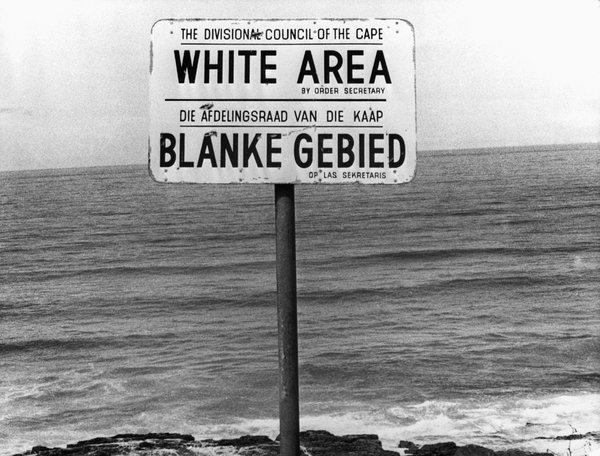
An apartheid notice on a beach near Capetown, denoting the area for whites only.CreditHulton-Deutsch Collection/Corbis, via Getty Images
As prime minister, Jan Smuts could not accept blacks as political equals seeking rights of citizenship. Throughout his career, he preferred to think of the “native problem” in abstract terms. Smuts relied on anthropological theory to justify segregation on the basis of fundamental cultural difference, and cited new fossil finds, pointing to South Africa’s singular importance in hominid evolution, to suggest that prehistoric differences between different races were profound and perhaps unbridgeable in the present. Smuts was nowhere as hard line as some of his white compatriots, but neither was he in favor of black political rights. Like many paternalistic and “moderate” whites, he was inclined to defer problems of race equality to the future.
That wasn’t always possible, and Smuts had little compunction about using the police and army to put down rebellions — white as well as black. In 1919, a self-declared Christian prophet, Enoch Mgijima, formed a community calling themselves the Israelites. Some 3,000 of his followers gravitated to the agricultural settlement of Bulhoek, where they took up residence in the vicinity of white farmers. Tensions rose. Defiant Israelites refused to obey orders to disperse. On May 23, 1921, the police mobilized. Warning shots were fired, but no one moved. The police opened fire, and an estimated 180 white-robed Israelites were killed. In the aftermath, Smuts was blamed for inflaming the situation by reneging on a promise to meet Mgijimi.
In 1922, in the newly mandated territory of South West Africa, a rebellion by a Nama clan, known as the Bondelswarts, was put down by South African aerial bombing, killing more than 100. Because this incident came under the terms of the League of Nations, it drew international attention and, once again, criticism of Smuts’s aggressive response to nonwhite unrest. Smuts, though, was unmoved; before Parliament, he declared, “It leaves me cold.”
Smuts’s policies and reputation at home did little to tarnish his standing as a global force for self-determination and human rights. In 1945, at the conference held in San Francisco to create the United Nations, it was Smuts who proposed adding the phrase “fundamental human rights” into the preamble to its charter.
Yet Smuts once again refused to engage with the African National Congress, whose leader, the American-educated medical doctor Alfred. B. Xuma, was pressing for the recognition of black citizenship rights in terms of the Atlantic Charter. When the two men met by chance at a press gathering in New York in November 1946, where Xuma was lobbying the United Nations to prevent Smuts from annexing South West Africa, Xuma is said to have remarked wryly: “I have had to fly 10,000 miles to meet my prime minister. He talks about us but won’t talk to us.” At the very first meeting of the General Assembly, in 1946, Smuts was condemned by the leader of the Indian delegation on account of South Africa’s discriminatory treatment of its Indian minority population.
Opinion articles about the events of 1919.
How to explain the disjunction between Smuts’s global and domestic reputations? He had been effective as an international statesman and moral leader because he represented a small country that had fought for its freedom against British imperialism, thus exemplifying the new international spirit of self determination. The world only vaguely appreciated the greater injustice suffered by South African blacks — though that, too, was changing. The emerging postwar order, and the beginnings of the post-colonial era, were already apparent, as was the recognition that segregation in South Africa was morally unacceptable.
In 1948, Smuts was swept from power by the National Party, whose winning campaign slogan was “apartheid.” Smuts, though no enemy of segregation itself, found the idea of complete separation of the races extreme and unwise. The National Party, turning his international standing against him, attacked Smuts for being under the sway of liberalism and for prioritizing his personal international reputation over white national interests. He died in 1950, recently installed as chancellor of Cambridge University, just long enough to see apartheid imposed across his country.
Smuts was a complex man whose mix of visionary idealism, cool realpolitik and segregationist sympathies have led many to dismiss him as a hypocrite. Some have seen his philosophical exposition of holism and personhood as self-serving efforts to disguise political contradictions in the name of a higher human purpose. Yet the contradictions that Smuts navigated were not only personal; they were global. Smuts came of age into a world where talk of national self-determination and freedom was largely limited to whites. His long career came to an end when mass democracy was on the rise, when decolonization was on the march, and as political freedoms and rights began to be seen as indivisible and universal. Although he comprehended those shifts, he was unable to respond to them.
Saul Dubow, a professor of Commonwealth history at Cambridge University, is the author of “Apartheid: 1948-1994.”
The Times is committed to publishing a diversity of letters to the editor. We’d like to hear what you think about this or any of our articles. Here are some tips. And here’s our email: letters@nytimes.com.
By Stacy M. Brown, NNPA Newswire Correspondent @StacyBrownMedia
On May 21, 2019 the national elections in Malawi will mark a quarter of a century of multi-party democracy in this developing sub-Saharan African nation.
Prior to that, most published reports in the western news media negatively defined the nation as a democratic “dictatorship.”
When all of the votes are counted this month, Rev. Dr. Lazarus Chakwera, a top contender for the presidency, hopes to unify and provide strategic progressive leadership for this landlocked African nation of nearly 19 million citizens.
“We are winding up what’s been a wonderful campaign by going all over this country and talking to people,” Dr. Chakwera told NNPA Newswire in an exclusive interview where he also noted the global importance of the America’s Black Press.
“We have a message of super high-five servant leadership that’s uniting this country and making sure everyone prospers alongside everyone else,” Dr. Chakwera said.
A longtime religious leader who has played a prominent role in helping to change the self-perceptions of his countrymen, Dr. Chakwera said that the past history of corruption in Africa is ending through more democracy and participation by all the people of Africa for a better more sustainable economic, social and political future.
“We need to follow the rule of law because a whole lot of impunity is going on, and for Malawians everywhere, we promise to start building a new Malawi at the end of this month,” he said.
Prior to running for the presidency, Dr. Chakwera helmed the Malawi Assemblies of God for more than 25 years – a position that he was democratically elected to seven consecutive times.
A renowned author, mentor and administrator, Dr. Chakwera also chaired the Board for Pan African Theological Seminary; All Nations Theological Seminary, and he has served as board member for Global University in Springfield, Missouri.
Born on April 5, 1955, Dr. Chakwera once chaired the Association for Pentecostal Theological Education in Africa and he served as a member for the Public Universities Working Committee of Malawi.
With a Bachelor of Arts degree from Chancellor College of the University of Malawi and a Bachelor of Theology with Honors from the University of the North in South Africa, Dr. Chakwera also earned a Master of Theology from the University of South Africa in Pretoria and a Doctor of Ministry from Trinity International University in Deerfield, Illinois.
“I tell you what, we’re really talking about issues of character, about issues to do with a vision and what I’m offering is somewhat different from what is usually the case,” Dr. Chakwera said.
“We want to really have the developmental state that is able to protect our citizens and make sure that each one has a chance to prosper so no one is left behind,” he said.
Malawi is small enough that if “you did something consistently and well enough within a couple of years, it should show something has changed,” Dr. Chakwera said.
“What we’re doing now is to make sure we get everyone on board so that we do exactly that. Most people come here and look at what we have, and they will not fault so much in the policies and the laws, but it is just the implementation that really needs to improve,” he said.
“We want to have the political will which is what everybody says we have a shortage of. So, this is why it’s the issue of character that we want to follow through on.”
Growing up, the presidency wasn’t exactly what Dr. Chakwera aspired to attain, but he said his decision to run really came from a much higher source.
“Sometimes, when you look back and you piece things together, you see how God was leading you,” said Dr. Chakwera, who’s now 64.
Dr. Chakwera’s personal epiphany occurred in 2012.
“That’s when things came to a head. I had thought about serving the nation in many ways and I thought what I was already doing was sufficient,” Dr. Chakwera said.
He enjoyed hosting a weekly and national radio talk show and then did likewise on television where he said some of the more encouraging results manifested itself when of his countrymen began building homes and feeling more empowered.
Attitudes improved and self-esteem rose in the country based on what Dr. Chakwera had accomplished through his church, he said.
“I believe it’s extremely important for the Black Press of America to have a relationship with Africa. It brings the kind of linkage that should always be there but that hasn’t been manifested,” Dr. Chakwera said.
“We need to link up because surprisingly we have a kindred spirit and I believe all of us coming together and putting everything on the table will be helpful to our African American friends and all of Africa and to realize that we’re meant to be better than we are,” Dr. Chakwera said.
The presidential hopeful also reflected on the 400th anniversary of the infamous Transatlantic Slave Trade.
“Right now, we need to say what lessons can we learn. Four hundred years is a long time, but it’s theologically possible that God’s providence permitted for us to come to this stage where we can now take control of our future and destiny. We can’t change the past, but let’s get ahold of our future and shape it the way we want to shape it,” Dr. Chakwera said.




 May 23, 2019